Two-a-Day Lifting Sessions: Do Morning and Evening Splits Build More Muscle?
Two a day lifting sessions split your workout into morning and evening. See what the research says on volume, recovery, sleep and who should actually try it.
TL;DR. The short answer
- No trial we found directly tests two a day lifting sessions against one session for hypertrophy. The case rests on indirect evidence about weekly volume, rest and recovery.
- When weekly sets per muscle are equal, how you divide them across sessions or days does not meaningfully change muscle growth. Splitting helps only if it lets you do more quality sets.
- Morning and evening training produce similar muscle growth overall (11 studies, meta-analysis), so choose the slot you can repeat.
- Leave 6-10 hours between sessions, eat carbs and protein in between, and protect 7-9 hours of sleep. Poor sleep can reduce compound lift performance.
- Most lifters are better off fixing weekly volume, rest times and sleep first. Two-a-days suit advanced trainees with flexible schedules and a nearby gym.
Part of our complete guide: Best Workout Split for Muscle Growth: PPL vs Upper/Lower vs Full Body, What the Research Says
Table of contents
Two a day lifting sessions mean splitting one workout into a morning block and an evening block, for example chest and shoulders at 7 am and back and arms at 6 pm. They are not proven to build more muscle than one well-run session. They can help if the split lets you do more hard sets at good quality, or if it simply fits your day better.
This is one tool inside the bigger picture of workout splits and session architecture, and it suits a narrow group of lifters. Here is what the research does and does not say, how to set it up, and who should skip it.
Do two a day lifting sessions build more muscle?
Honest answer: nobody has directly tested it well. In our PubMed searches we did not find a trial that compares the same weekly program done as one daily session against two shorter ones, in trained natural lifters. Anyone telling you two-a-days are “proven” is extrapolating.
What we do have is indirect evidence, and it points in a clear direction.
Frequency does not matter much when volume is equal. A 2019 meta-analysis of 25 studies found no significant difference between higher and lower training frequencies when weekly volume was matched, including in resistance-trained people (Schoenfeld et al., 2019). The authors concluded that, for a given volume, you can choose frequency by preference. Splitting a day into two sessions is a form of frequency, so by itself it is not a growth trick.
Volume does matter. A meta-analysis of 15 studies found a graded dose-response: each additional weekly set was associated with about a 0.37% bigger gain in muscle size (Schoenfeld et al., 2017). Gains per set shrink as volume climbs, and the data come mostly from fairly short studies, so this is a trend, not a promise.
Put those together. A two-a-day is useful only if it lets you do the sets you would otherwise skip, or do them better. If you are already hitting your weekly sets in one session, splitting changes little.
What is the real argument for splitting a workout?
The argument is about fatigue and set quality. In a long session, late sets are often done tired, with shorter rests and lower loads. A fresh second session in the evening resets that.
Here is how that plays out in the gym. By set 18 of a 90-minute workout, many lifters are cutting rest short and grinding out reps they would have done cleanly an hour earlier. Those sets still count as effort, but they may be lower-quality work.
There is a piece of evidence that rest affects results. In a trial of 21 resistance-trained men over 8 weeks, a group resting 3 minutes between sets gained more quadriceps thickness and more strength than a group resting 1 minute, with everything else equal (Schoenfeld et al., 2016). That is a small trial in young men, but it supports the idea that being recovered between sets matters. It does not show that a separate session is needed to get that benefit. You can also just rest longer, or drop the lowest-value exercises.
Treat “eliminates fatigue drop-off” as a plausible mechanism, not a demonstrated result. If your workouts are already under an hour and you rest properly, there may be nothing to fix. We cover that side in managing workout duration and physiological drop-off.
Morning or evening: does the time of day change growth?
Not meaningfully. A 2019 meta-analysis of 11 studies of moderate to good quality found that increases in muscle size were similar whether people trained in the morning or the evening, and strength gains were similar too (Grgic et al., 2019). The same review noted that people are typically stronger in the evening at baseline, and that training in the morning can bring morning strength up toward evening levels.
There is one conflicting result. A 24-week trial in 42 young men doing combined strength and endurance training found all groups gained muscle, but between weeks 13 and 24 the evening groups gained more muscle mass (Küüsmaa et al., 2016). That study was in young men, used same-session strength and endurance work, and the difference showed up only after 12 weeks. So it is a hint, not a rule.
The practical takeaway: do not rearrange your life for the “best” hour. If you split your day, nothing says the heavier or more important session must be in the evening. Put the muscle group you most want to bring up in the session where you feel best. For the full time-of-day evidence, see morning vs evening training.
How far apart should the two sessions be?
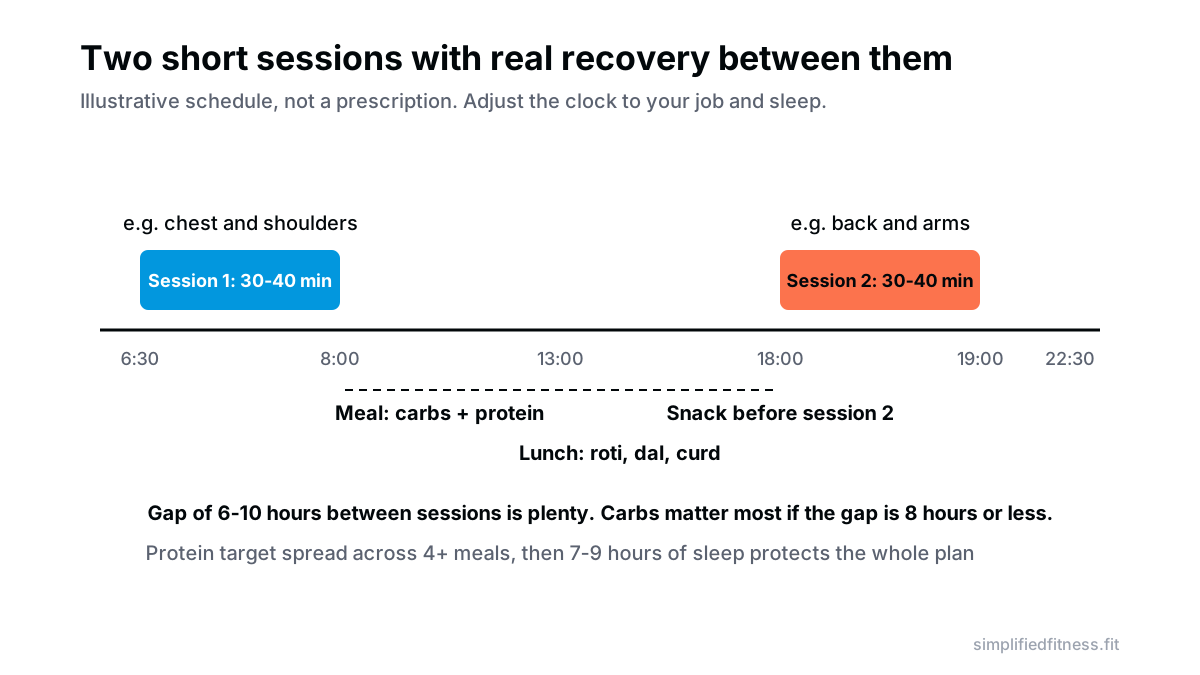
There is no tested optimal gap for lifting. A reasonable working range is 6-10 hours. That is long enough to eat, move around, and lower the fatigue from session one. It is short enough that you can still get both done before work and dinner.
Closer than about 4-5 hours, and you are likely just running one long workout with a lunch break. At that point you lose most of the point of splitting.
What should you eat between sessions?
Food matters most if the gap is short. A 2021 systematic review and meta-analysis of 29 trials looked at recovery of 8 hours or less and found that eating carbohydrate (about 1 g per kg body mass per hour) restored muscle glycogen faster than water (Craven et al., 2021). Adding protein to carbohydrate did not change the glycogen recovery rate. The water versus carbohydrate comparison rests on 10 of those trials, measured with muscle biopsies after a single standardised exercise bout, not a lifting program, so treat it as a rough guide for lifters, not a precise rule.
For lifting, glycogen is rarely the main limit in a 30-40 minute session, but a decent carb meal still helps the second session feel better. Two-a-days also give you an easy way to hit protein. A 2018 review suggests about 0.4 g/kg per meal across at least four meals to reach roughly 1.6 g/kg per day (Schoenfeld & Aragon, 2018). For a 70 kg lifter that is about 28 g per meal.
An Indian-kitchen version of the between-session meal:
- Roti or rice, a bowl of dal, and curd for a vegetarian base.
- Paneer bhurji or soya chunks if you need more protein.
- Eggs or chicken with rice if you eat non-vegetarian.
- A banana and a glass of milk or a scoop of whey if the second session is within a couple of hours.
Work out your daily target with our protein calculator.
How much sleep and recovery do you need?
Sleep is where many two-a-day plans fail. A morning session means an earlier alarm, and an evening session can push bedtime late.
A systematic review of 17 studies (rated moderate or weak quality) found that sleep deprivation had little effect on strength in resistance exercise, but several nights of sleep restriction could reduce force in multi-joint lifts, not single-joint ones (Knowles et al., 2018). The hormonal results were conflicting. So the evidence is not tidy, but the practical risk is clear: short sleep can hurt the compound lifts you care about.
If you cannot protect around 7-9 hours, the second session is the first thing to cut.
Which muscles go in which session?
Keep each session focused and short, about 30-45 minutes. Some patterns that work:
| Split | Morning | Evening | Why it works |
|---|---|---|---|
| Upper body split | Chest, shoulders | Back, arms | Pressing and pulling fatigue stay separate |
| Lower and upper | Quads, hamstrings | Upper body push or pull | Big lower-body fatigue does not leak into upper work |
| Priority split | Lagging muscle group | Everything else | Your weak point gets your freshest effort |
| Compound and accessory | Main heavy lifts | Isolation and machine work | Heavy work stays fresh, volume work comes later |
Keep every major muscle at around twice a week, as the parent guide on splits explains. Do not hit the same muscle hard in both sessions on the same day. And if you are short on time rather than energy, antagonist pairing within one session is a simpler option, see antagonist paired sets and supersets.
Not sure how many sets that adds up to? Check the weekly total in the training volume calculator.
Who should actually do two-a-days?
Good candidates:
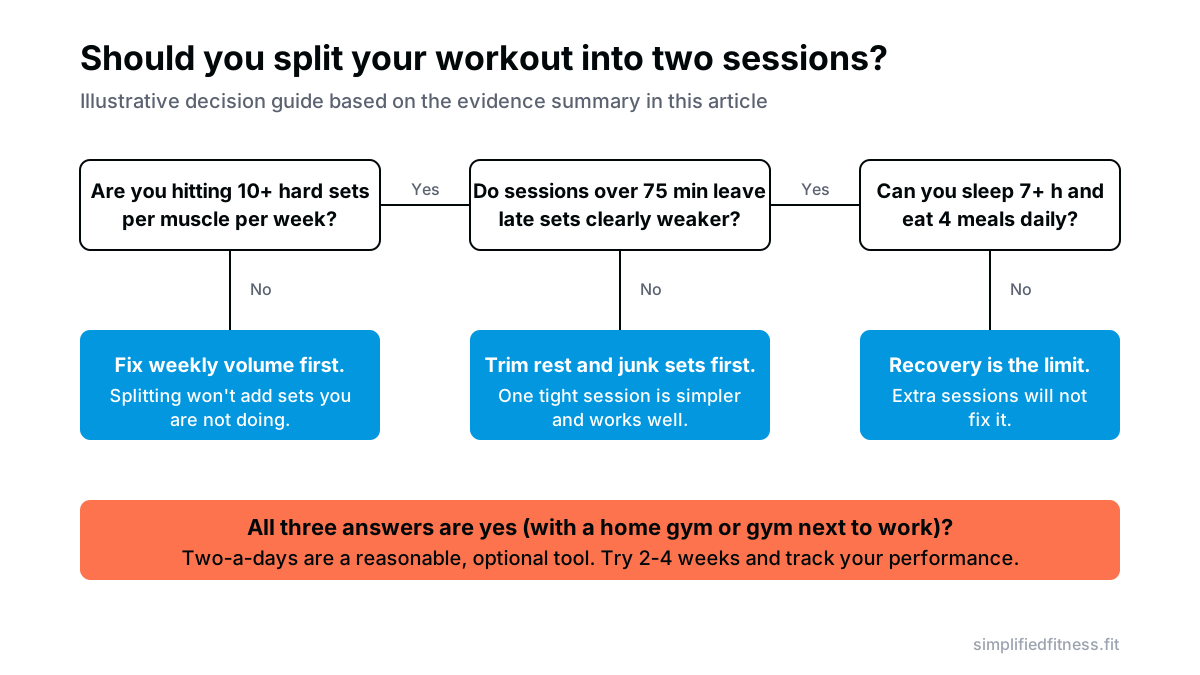
- Advanced lifters who already train 4-6 days a week and have run out of room to add volume in one session.
- People with a home gym or a gym at work, so a second session costs 40 minutes, not 2 hours.
- Lifters with a split day: for example, a 30-minute session before work and another after.
- Anyone whose single sessions drag past 75-90 minutes with clearly weaker late sets.
Poor candidates:
- Beginners, who grow well on simple 2-3 day programs.
- Anyone sleeping under 6-7 hours or under heavy life stress.
- Lifters who commute 30+ minutes each way to a commercial gym.
- People already struggling to recover from the current program.
If you are short on time because of work, you may also like our guide to workout splits for high-stress careers and shift work, and if you train at home, the home gym hypertrophy blueprint. Running as well? See hybrid training scheduling.
How to try it without wrecking your recovery
- Run one normal week first. Log your sets and loads so you have a baseline.
- Keep weekly sets the same at first. Just split them. Seeing whether quality improves is the real test.
- Cap each session at 30-45 minutes. Use the rest times you would use normally, around 2-3 minutes on big compounds.
- Eat a real meal in between and keep protein spread across the day.
- Track for 2-4 weeks. Compare top-set loads and reps to your baseline. If they improve or hold while you feel fine, keep it. If not, go back.
- Add volume slowly. Only add sets if recovery is clearly fine.
When to see a doctor
Two-a-days are an optional optimization, not something your health depends on. Stop and see a doctor or a qualified professional if you get chest pain, dizziness, fainting, unusual shortness of breath, persistent joint or tendon pain, or you stop having periods or feel run down for weeks. Persistent exhaustion and mood changes can be signs of overtraining or under-eating, and it is worth getting checked out rather than pushing through.
The bottom line
Two a day lifting sessions are a scheduling tool, not a muscle-building shortcut. The research says weekly volume and effort matter most, frequency matters little when volume is equal, and morning versus evening makes no consistent difference. Splitting your workout earns its place when it helps you do more good sets, or when it simply fits your day.
Start by getting the basics right with a simple plan like our push, pull, legs plan. Then, if you are advanced, have the logistics and sleep covered, and your sessions drag, try a two-week split and let your logbook decide.
Frequently Asked Questions
Do two a day lifting sessions build more muscle?
Not on their own. We found no trial that directly compares splitting a workout into two sessions with doing it in one, and meta-analysis evidence suggests that with equal weekly sets, frequency does not meaningfully change hypertrophy. Two-a-days can help only if they let you perform more hard sets at good quality, so judge them by your logbook.
Is training twice a day bad for natural lifters?
It is not inherently harmful, but it adds total weekly stress that has to be recovered from. Natural lifters have a finite recovery budget set by sleep, food, work and life stress. If your performance drops or you feel run down, the extra session is costing more than it gives, so drop back to one.
How long should I wait between two workouts in one day?
Around 6-10 hours is a sensible target, though the research here is indirect and no exact window has been tested for lifting. Carbohydrate intake matters most when the gap is 8 hours or less, because muscle glycogen replenishes with regular carbs. Pick a gap that lets you feel fresh for the second session.
Is it better to lift in the morning or evening?
Neither is clearly better. A 2019 meta-analysis of 11 studies found similar strength and muscle size gains whether people trained in the morning or the evening. Strength is typically higher in the evening, so choose the time you will stick to consistently.
Should I train different muscles in each session?
Usually yes, because it keeps each session short and avoids overlapping fatigue. A pairing like chest and shoulders in the morning with back and arms in the evening works for many people. Keep each muscle hit about twice per week, and avoid training the same muscle hard in both sessions on the same day.
How many sets should I do in each session?
A typical split-session plan uses roughly 8-14 hard sets per session, so the day totals what you would normally do in one longer workout. The evidence on volume shows a dose-response: more weekly sets tend to give more growth, up to a point. Use our training volume calculator to check your weekly sets per muscle.
Does eating between sessions matter?
Yes, especially carbohydrate if the gap is 8 hours or less. A 2021 meta-analysis found that carbohydrate speeds muscle glycogen resynthesis versus water, while adding protein did not change the rate. Include a normal meal with roti or rice, dal and curd, then protein across at least four meals.
How much sleep do I need if I train twice a day?
Aim for 7-9 hours, since one systematic review found that several nights of restricted sleep reduced force in compound lifts. That review rated many included studies as moderate or weak quality, so treat it as a caution rather than a precise rule. If sleep slips, cut a session before you cut sleep.
Can beginners do two a day workouts?
Beginners rarely need to. They grow well on 2-3 full-body sessions a week, and extra sessions mostly add complexity and fatigue. Master consistent single sessions first.
Is two-a-day training worth it if I commute to a commercial gym?
Usually not. Two trips can burn 1-2 hours of travel for a result that one focused session often matches. It makes more sense with a home gym, a gym in your office building or one close to home.
Can I split a workout into two sessions just to save time?
Yes, this is a legitimate use. Two 30-minute blocks may fit a busy day better than one 70-minute block. Total weekly hard sets and effort still decide the outcome, not the split.
When should I stop doing two a day sessions?
Stop or scale back if lifts stall or drop for two weeks, sleep gets worse, joints ache, or motivation sinks. Those are signs that recovery is the limit, not session design. Return to one session per day for a few weeks, then reassess.
Sources & References
Every claim above is checked against peer-reviewed research (PubMed, U.S. National Library of Medicine) or guidance from established health bodies. How we fact-check.
- Schoenfeld BJ, et al. How many times per week should a muscle be trained to maximize muscle hypertrophy? A systematic review and meta-analysis of studies examining the effects of resistance training frequency. J Sports Sci. 2019. PMID: 30558493
- Schoenfeld BJ, et al. Dose-response relationship between weekly resistance training volume and increases in muscle mass: A systematic review and meta-analysis. J Sports Sci. 2017. PMID: 27433992
- Schoenfeld BJ, et al. Longer interset rest periods enhance muscle strength and hypertrophy in resistance-trained men. J Strength Cond Res. 2016. PMID: 26605807
- Grgic J, et al. The effects of time of day-specific resistance training on adaptations in skeletal muscle hypertrophy and muscle strength: A systematic review and meta-analysis. Chronobiol Int. 2019. PMID: 30704301
- Küüsmaa M, et al. Effects of morning versus evening combined strength and endurance training on physical performance, muscle hypertrophy, and serum hormone concentrations. Appl Physiol Nutr Metab. 2016. PMID: 27863207
- Craven J, et al. The effect of consuming carbohydrate with and without protein on the rate of muscle glycogen re-synthesis during short-term post-exercise recovery: a systematic review and meta-analysis. Sports Med Open. 2021. PMID: 33507402
- Schoenfeld BJ, et al. How much protein can the body use in a single meal for muscle-building? Implications for daily protein distribution. J Int Soc Sports Nutr. 2018. PMID: 29497353
- Knowles OE, et al. Inadequate sleep and muscle strength: Implications for resistance training. J Sci Med Sport. 2018. PMID: 29422383

Umair Hazrami · Founder & Head Coach, Simplified Fitness
Umair Hazrami founded Simplified Fitness and the Simplified Lifter channel to cut through fitness noise. With 4+ years of consistent training and 10+ coaching clients, he writes every guide from the peer-reviewed research and links the sources so you can check them. Our editorial standards.
Educational content only, not medical advice. If you have a medical condition, are pregnant, or take medication, talk to a qualified doctor before changing your diet, supplements or training. Full disclaimer.
Keep reading

Programming
2-Day per Week Lifting Programs: Minimum Effective Dose for Busy Professionals
Can a 2 day a week workout routine hypertrophy goals support? Yes. Get a ready two-day full-body plan, the research behind it and how to run it in 60 minutes.
9 min read
Programming
30-Minute High-Density Hypertrophy Sessions: Micro-Workouts for Time-Constrained Lifters
Can a 30 minute workout for muscle growth work? See how paired sets, Myo-reps and machine setups fit 16 hard sets into half an hour, plus a 4-day plan.
10 min read

Programming
The 7-Minute Dynamic Warm-Up: A Fast Routine to Prep Joints Before Lifting
A dynamic warm up for lifting takes about 7 minutes, not 25. See the 2-3-2 routine, what the research says about stretching and foam rolling, and what to skip.
9 min read
Programming
Antagonist Paired Sets: Cut Workout Time by About 40% Without Losing Reps
Antagonist paired sets supersets time saving explained: pairing push and pull cuts a session by roughly 40% keeping reps. Pairings and rest times included.
8 min read