Push/Pull 4-Day Split With Legs: Where Quads and Hamstrings Go
A push pull split 4 day with legs puts quads on push day, hamstrings and glutes on pull day. See the sequencing, set counts and a sample week to copy.
TL;DR. The short answer
- A push pull split 4 day with legs works by putting quads and calves on push days, and hamstrings and glutes on pull days. Each muscle is trained twice a week without a dedicated leg day.
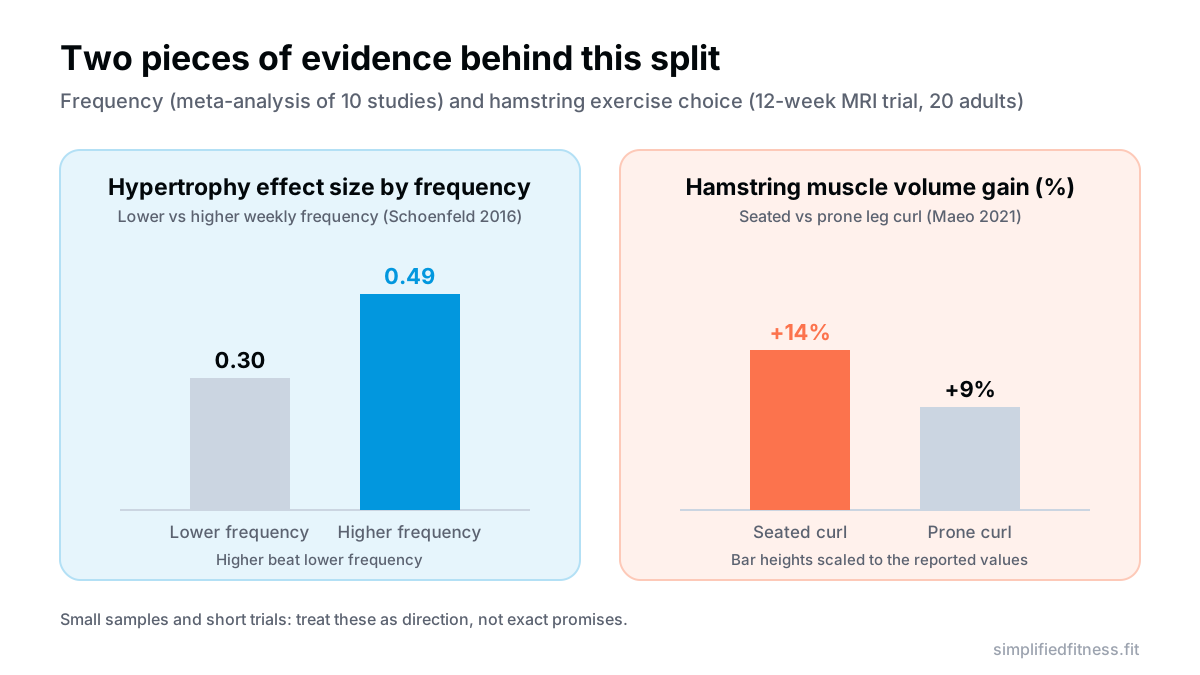
- In a 2016 meta-analysis, higher training frequency gave a larger hypertrophy effect size than lower frequency (0.49 vs 0.30), and the authors recommended twice a week. Newer data suggest weekly volume matters more, so treat twice a week as a convenient default.
- Put your heaviest squat or hinge first in the session. Strength gains tend to be largest in the exercises done first, while muscle growth looks similar across exercise orders.
- For hamstrings, a seated leg curl grew more muscle than a prone curl in one 12-week MRI trial (+14% vs +9%), so it deserves a slot on pull day.
- If you have knee or lower back pain that persists, or a sharp hamstring pull, see a doctor or physiotherapist before pushing heavy leg work.
Part of our complete guide: Best Workout Split for Muscle Growth: PPL vs Upper/Lower vs Full Body, What the Research Says
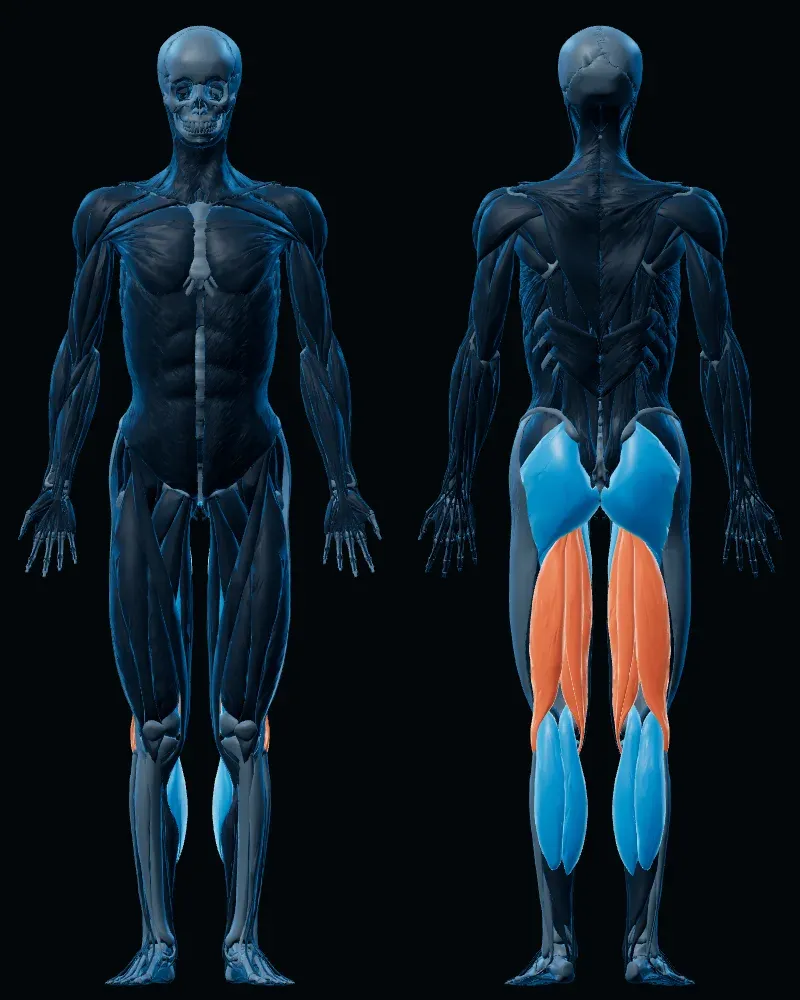
Muscles worked: hamstrings
Main movers: biceps femoris, semitendinosus and semimembranosus
Assisting: glutes, calves and adductor magnus
Table of contents
Yes, you can run a push pull split 4 day with legs and never schedule a “leg day”. Quads and calves go on push days. Hamstrings and glutes go on pull days. Every muscle gets trained twice a week, which makes it easy to spread enough weekly sets for growth.
This guide is a practical branch of our workout splits and session architecture guide. We will cover how to assign leg muscles to each day, what order to lift in, how many sets to aim for, and a sample week you can copy.
Does a push pull split 4 day with legs actually work?
It works if the numbers add up. Two numbers matter: how often you hit each muscle, and how many hard sets you do per week.
A 2016 systematic review and meta-analysis of 10 studies found higher training frequency was associated with a greater hypertrophy effect size than lower frequency (0.49 vs 0.30). Its conclusion was that major muscle groups should probably be trained at least twice a week, while it remained unclear whether three times beats twice (Schoenfeld et al., 2016).
A 4-day push/pull week gives you exactly two exposures per muscle. Chest, quads, hamstrings, all of it.
Here is the honest caveat. Newer analysis suggests frequency may matter less than total volume. A 2026 meta-regression of 67 studies found muscle growth increased with weekly set volume, with diminishing returns, while frequency’s effect on hypertrophy was compatible with negligible effects (Pelland et al., 2026). For strength, frequency showed a more consistent effect.
So the cautious reading is this. Twice a week is a sensible default, mostly because it lets you spread your sets across more sessions. The split itself is not magic.
Quads on push day, hamstrings on pull day: why this assignment
Think about movement patterns, not body parts.
Push day already trains muscles that press and extend. Squats, leg presses and leg extensions all work the quads by extending the knee, so they sit naturally with chest, shoulders and triceps. Calf raises are a small add-on that fits anywhere.
Pull day trains muscles that pull and hinge. Deadlift variations, leg curls and hip thrusts load the hamstrings and glutes, so they sit with back, rear delts and biceps.
| Day | Upper body | Lower body |
|---|---|---|
| Push | Chest, front and side delts, triceps | Quads, calves |
| Pull | Lats, upper back, rear delts, biceps | Hamstrings, glutes |
Squats still hit your glutes and hamstrings a bit, and hinges still load your quads a little. That is fine. Nothing here needs to be perfect.
How should you order exercises on each day?
Lead with the lift you most want to improve. That is the simple rule.
A 2021 meta-analysis of 11 studies found strength gains were largest in the exercises performed at the beginning of a session. For muscle growth, exercise order did not make a significant difference, so multi-joint first or single-joint first produced similar results (Nunes et al., 2021).
What this means for your week:
- Push day: squat first, then presses. Your shoulders and triceps are fresh for the bar on your back, and your legs are not wrecked before the bench.
- Pull day: hinge first (stiff-leg deadlift or similar), then rows and pulldowns, then leg curls and hip thrusts.
- Lower back caution: if you row heavily before a hinge, your spinal erectors may be tired. A chest-supported row keeps your back out of the equation.
The most common mistake here is stacking a heavy bench session before a heavy squat and then wondering why the squat stalls. You do not need to pre-exhaust anything. Put the big leg lift first and let the rest follow. For more on this principle, see our deep dive on exercise order and compounds before isolations.
A sample 4-day push/pull week with legs
Four days, two push and two pull. Call them A and B.
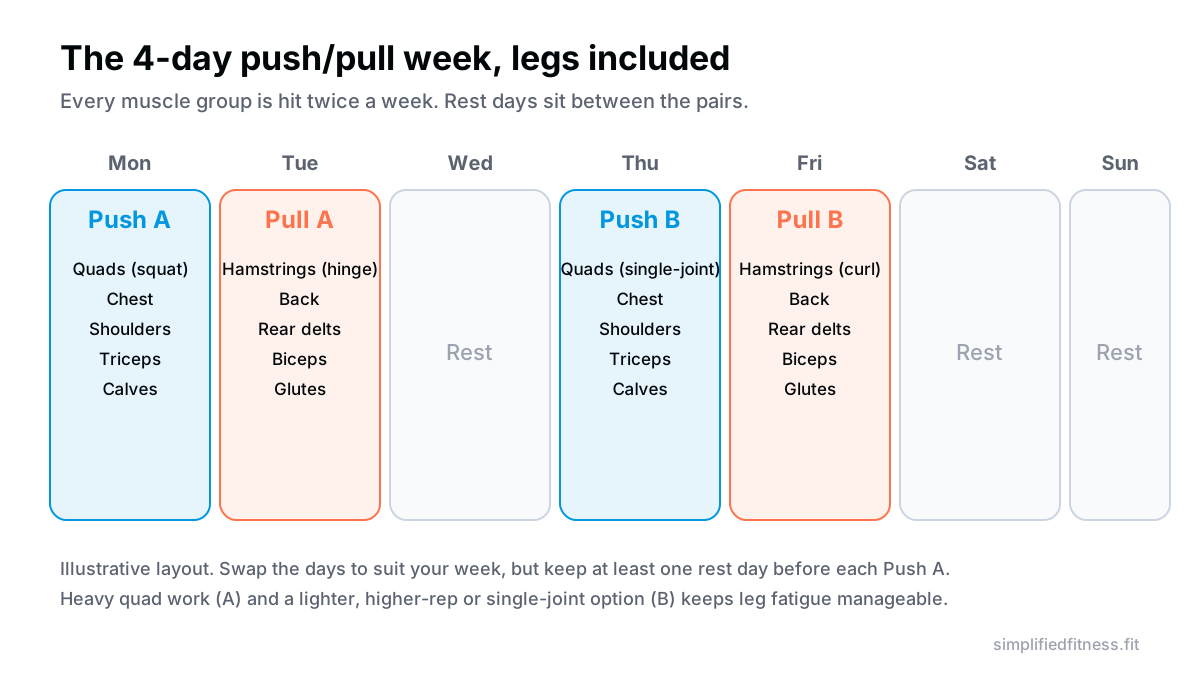
The A days are heavier, with lower reps. The B days use more single-joint or machine work with higher reps, which tends to be easier on your joints and recovery.
Push A (heavy quads, chest focus)
- Barbell back squat: 3 sets of 5-8
- Incline dumbbell press: 3 sets of 6-10
- Dumbbell shoulder press: 2 sets of 8-12
- Dumbbell lateral raise: 3 sets of 12-20
- Overhead tricep extension: 2-3 sets of 10-15
- Standing calf raise: 3 sets of 8-15
Pull A (hinge focus)
- Stiff-leg deadlift: 3 sets of 6-10
- Wide-grip lat pulldown: 3 sets of 8-12
- Chest-supported T-bar row: 3 sets of 8-12
- Reverse pec dec fly: 2-3 sets of 12-20
- Hammer curl: 2-3 sets of 8-12
- Hip thrust: 2-3 sets of 8-12
Push B (volume, machines and single-joint)
- Leg press or hack squat: 3 sets of 8-12
- Single-leg extension: 3 sets of 10-15
- Pec dec fly or cable fly: 3 sets of 10-15
- Dumbbell shoulder press or machine press: 2-3 sets of 8-12
- Tricep pushdown: 3 sets of 10-15
- Standing calf raise: 3 sets of 10-20
Pull B (curl focus)
- Seated leg curl: 3-4 sets of 8-12
- Close-grip seated row: 3 sets of 8-12
- Wide-grip pulldown or pull-up: 2-3 sets of 8-12
- Kelso shrug: 2 sets of 10-15
- Preacher curl: 2-3 sets of 8-12
- Hip thrust or glute bridge: 2-3 sets of 10-15
Count the weekly total. Quads get about 9 hard sets between squats, leg press and extensions. Hamstrings get about 6-7 between the stiff-leg deadlift and leg curl, plus some work from hip thrusts and squats. Adjust depending on how you recover.
Why include a seated leg curl for hamstrings?
Not every hamstring exercise is equal. In a 12-week trial, 20 healthy adults trained one leg with seated leg curls and the other with prone curls, 5 sets of 10 reps at 70% of 1RM, twice a week. MRI showed whole-hamstring volume rose more in the seated leg (+14%) than in the prone leg (+9%). The authors suggest training at long muscle lengths promotes more growth (Maeo et al., 2021).
Treat that as a nudge, not gospel. It was a small trial of healthy adults, using a within-person design, and it only tests one comparison. But it supports putting a seated curl and a hip hinge on pull day, rather than relying on hinges alone.
How many sets of quads and hamstrings per week?
A 2017 meta-analysis of 15 studies found a graded dose-response relationship: more weekly sets were associated with more muscle growth. Each additional set was linked to a 0.37% greater gain, though when sets were grouped into categories (fewer than 5, 5-9, 10+ per muscle) the trend was weaker (P = 0.074) (Schoenfeld et al., 2017).
And again, the 2026 meta-regression found diminishing returns (Pelland et al., 2026). More is not always better, and the sweet spot depends on how well you recover.
A reasonable plan:
- Weeks 1-4: run the sample week as written (about 9 quad sets and 6-7 hamstring sets). If that is a big jump from what you do now, start with 2 sets per leg exercise.
- Weeks 5-8: add a set to one exercise per day if your reps and sleep are holding up.
- After that: hold a volume that keeps progress moving. Use the training volume calculator to tally your weekly sets.
Evidence is limited for exact numbers, and most studies use young adults over weeks, not years. Your own logbook is the tiebreaker.
What about strength on this split?
If you also care about squat or deadlift numbers, a meta-analysis of 22 studies found strength gains were higher with higher frequency, but when volume was equated, frequency made no significant difference (Grgic et al., 2018). The authors noted most data came from untrained participants.
In resistance-trained men, a 6-week trial compared 3 versus 6 sessions a week with volume equated and found similar strength and thickness changes in rectus femoris and vastus intermedius (Saric et al., 2019). That was 27 men over 6 weeks, so it is short and small.
Takeaway: two squat or hinge exposures a week is plenty for most lifters. If your priority is a maximal squat, put your hardest squat on Push A and keep Push B lighter.
Mistakes that wreck a push/pull split with legs
- Skipping the lower-body half. When time is short, people drop leg sets first. Cut upper-body accessories instead.
- Doing all legs hard, every session. Make A heavy and B easier. Two killer leg sessions in one week stack fatigue.
- No warm-up before the first squat. Do 2-3 ramp-up sets rather than loading straight to working weight.
- Training legs twice in a row. Keep a rest day between Push A and Push B sessions, which the layout above does.
- Ignoring calves. They respond to direct work on push day, and take about ten minutes.
Practical notes for Indian lifters
Leg days feel harder in summer heat, and two leg-loaded days a week will raise your appetite. Add an extra roti or a bowl of rice, and keep protein steady with dal, paneer, curd, eggs or soya. Drink water through the session. If you train in a crowded gym with one squat rack, start with leg press or goblet squats on B day.
Session length matters too. With 6 exercises and around 15-19 sets, most sessions land in the 50-70 minute range. If you run longer, read our piece on managing workout duration and trim accessories first.
Push/pull vs other 4-day options
| Option | Leg handling | Best for |
|---|---|---|
| Push/pull 4-day | Legs split across push and pull | Lifters who dislike leg days |
| Upper/lower 4-day | Legs share lower days | Strength and simple structure (guide) |
| PPL variations | Dedicated leg day | More weekly volume (guide) |
If you are still choosing, our overview of full-body vs upper-lower vs PPL splits walks through the trade-offs. You can also see a ready-made leg day session for ideas on leg exercise selection.
When to see a doctor
Muscle soreness is normal. Sharp knee pain, pain that travels down the leg, numbness, or a sudden pop in the back of the thigh is not. See a doctor or physiotherapist if pain persists beyond a few days, worsens with loading, or limits walking. This article is general education and does not diagnose or replace medical advice.
The bottom line
A push pull split 4 day with legs is a workable way to train every muscle twice a week without a dedicated leg day. Put quads on push days, hamstrings and glutes on pull days, lead each session with the lift that matters most, and keep one rest day between the pairs.
Do not obsess over the label. Hard sets, steady progression, enough protein and sleep decide most of the outcome. Start with the sample week, keep notes for 6-8 weeks, and adjust sets up or down from your own results.
Frequently Asked Questions
Can you train legs on a push pull split?
Yes. You assign the knee-dominant work (squats, leg press, leg extensions, calves) to push days and the hip-dominant work (deadlift variations, leg curls, hip thrusts) to pull days. Each muscle then gets trained twice a week, a sensible default for spreading your weekly sets. Start by adding 3-4 leg sets to each day and build up.
Should quads go on push day or pull day?
Quads fit push day because squats and leg presses are pushing movements, and the quadriceps extend the knee. This also keeps your hamstrings and glutes on pull day, where hinging and curling are pulling-type patterns. If you prefer, you can flip it, but the squat-first, press-second order on push day is easier for most people to recover from.
Is a 4-day push pull split enough to build muscle?
For most lifters, yes. A 2016 meta-analysis favoured training each muscle twice a week over once, although a larger 2019 analysis found frequency matters little when weekly sets are equal. A 4-day push/pull week hits every muscle twice. What matters more is hard sets per muscle per week, so use the training volume calculator to check your totals.
How many sets of quads and hamstrings per week do I need?
A reasonable starting point is about 8-12 hard sets per week for each of quads and hamstrings, split across two sessions. A 2017 meta-analysis found more weekly sets were generally associated with more growth, a 2026 meta-regression found diminishing returns, and the evidence for specific cut-offs is uncertain. Add sets slowly, and only if you are recovering well.
Should I squat before or after pressing on push day?
Squat first if the squat is your priority lift. A 2021 meta-analysis found strength gains were largest in exercises performed at the start of a session, while hypertrophy was similar either way. Do your presses afterwards with a slightly lower load if your legs feel heavy.
Will pressing before squatting hurt my squat?
It can if your shoulders, triceps and upper back are tired, since the bar sits on your back and you brace hard. The research on exercise order suggests lifts done later in a session tend to gain less strength. Squat first, or keep pressing volume modest before squats.
Where do glutes go on a push pull split?
Glutes fit on pull day with hamstrings, through hip thrusts and hip hinges like stiff-leg deadlifts. Squats on push day also train the glutes to a degree. Two hip thrust or hinge slots per week is a practical amount for most people.
Should hamstring work be a leg curl or a deadlift?
Use both. Hinges like stiff-leg deadlifts train the hamstrings at the hip, and leg curls train them at the knee. In a 12-week MRI trial of 20 adults, seated leg curls grew whole-hamstring volume more than prone curls (+14% vs +9%), so a seated curl is a good default.
Do I need a dedicated leg day for big legs?
No. What drives growth is enough hard sets, spread across the week, taken close to failure and progressed over time. A dedicated day is just one way to organise that. A push/pull split can deliver the same weekly leg volume spread across two days.
How should I set up the week with rest days?
The simplest layout is Push, Pull, rest, Push, Pull, with two rest days at the weekend or around your work schedule. This gives each muscle roughly 72-96 hours before it is trained again. If a hot week or poor sleep leaves you flat, take an extra rest day rather than grinding.
Is this split good for beginners?
It can be, but a full-body routine is often simpler for the first few months. Beginners can start with fewer leg sets (around 3-4 per session) and add a set only when reps and technique are clean. A 4-day split makes sense once you want more weekly volume than 3 full-body days can give comfortably.
How is this different from upper-lower or PPL?
Upper-lower splits put all legs on lower days, while PPL gives legs their own day. Here, legs are spread across push and pull days, so each session stays balanced. Compare the options in our guide to workout splits before choosing.
What if my legs are too sore to train again?
Soreness is not a good measure of a useful session, and it fades as you adapt. Keep leg sets 1-3 reps from failure at first, use controlled lowering, and lower the load if your next session is affected. If pain is sharp, joint-based, or lasts more than a few days, see a doctor or physiotherapist.
Sources & References
Every claim above is checked against peer-reviewed research (PubMed, U.S. National Library of Medicine) or guidance from established health bodies. How we fact-check.
- Schoenfeld BJ, et al. Effects of Resistance Training Frequency on Measures of Muscle Hypertrophy: A Systematic Review and Meta-Analysis. Sports Med. 2016. PMID: 27102172
- Schoenfeld BJ, et al. Dose-response relationship between weekly resistance training volume and increases in muscle mass: A systematic review and meta-analysis. J Sports Sci. 2017. PMID: 27433992
- Pelland JC, et al. The Resistance Training Dose Response: Meta-Regressions Exploring the Effects of Weekly Volume and Frequency on Muscle Hypertrophy and Strength Gains. Sports Med. 2026. PMID: 41343037
- Grgic J, et al. Effect of Resistance Training Frequency on Gains in Muscular Strength: A Systematic Review and Meta-Analysis. Sports Med. 2018. PMID: 29470825
- Saric J, et al. Resistance Training Frequencies of 3 and 6 Times Per Week Produce Similar Muscular Adaptations in Resistance-Trained Men. J Strength Cond Res. 2019. PMID: 30363041
- Nunes JP, et al. What influence does resistance exercise order have on muscular strength gains and muscle hypertrophy? A systematic review and meta-analysis. Eur J Sport Sci. 2021. PMID: 32077380
- Maeo S, et al. Greater Hamstrings Muscle Hypertrophy but Similar Damage Protection after Training at Long versus Short Muscle Lengths. Med Sci Sports Exerc. 2021. PMID: 33009197

Umair Hazrami · Founder & Head Coach, Simplified Fitness
Umair Hazrami founded Simplified Fitness and the Simplified Lifter channel to cut through fitness noise. With 4+ years of consistent training and 10+ coaching clients, he writes every guide from the peer-reviewed research and links the sources so you can check them. Our editorial standards.
Educational content only, not medical advice. If you have a medical condition, are pregnant, or take medication, talk to a qualified doctor before changing your diet, supplements or training. Full disclaimer.
Keep reading

Programming
2-Day per Week Lifting Programs: Minimum Effective Dose for Busy Professionals
Can a 2 day a week workout routine hypertrophy goals support? Yes. Get a ready two-day full-body plan, the research behind it and how to run it in 60 minutes.
9 min read
Programming
30-Minute High-Density Hypertrophy Sessions: Micro-Workouts for Time-Constrained Lifters
Can a 30 minute workout for muscle growth work? See how paired sets, Myo-reps and machine setups fit 16 hard sets into half an hour, plus a 4-day plan.
10 min read
Programming
The 7-Minute Dynamic Warm-Up: A Fast Routine to Prep Joints Before Lifting
A dynamic warm up for lifting takes about 7 minutes, not 25. See the 2-3-2 routine, what the research says about stretching and foam rolling, and what to skip.
9 min read
Programming
Antagonist Paired Sets: Cut Workout Time by About 40% Without Losing Reps
Antagonist paired sets supersets time saving explained: pairing push and pull cuts a session by roughly 40% keeping reps. Pairings and rest times included.
8 min read