Exercise Order: Why Heavy Compounds Should Come Before Isolation Work
Compound before isolation exercise order, tested: what pre-exhaustion trials and a meta-analysis show, plus the few cases where isolation first makes sense.

TL;DR. The short answer
- Compound before isolation is the safer default. The first exercise in a session gets the biggest strength gains and the most quality reps, and a 2021 meta-analysis found exercise order made no real difference to muscle size.
- Pre-exhaustion (isolation first, then the compound) has not beaten traditional order in trials. In one 8-week trial of 48 trained lifters, traditional order was slightly ahead for muscle size, with statistical uncertainty.
- Fatiguing a muscle first lowers your reps on the big lift. In one study, men pre-exhausted with knee extensions did fewer leg press reps and showed lower thigh EMG.
- Order is a priority list, not a law. Whatever you want to progress most goes first, and a short, light isolation warm-up can be reasonable for a sore joint.
- The effect on hypertrophy is small and short-term data dominate, so do not agonise over it. Pick an order, keep it for a few months, and track your lifts.
Part of our complete guide: Best Workout Split for Muscle Growth: PPL vs Upper/Lower vs Full Body, What the Research Says
Table of contents
For most lifters, compound before isolation exercise order is the better default. Heavy multi-joint lifts need your freshest muscles and your best coordination, and fatiguing a small muscle first mostly lowers the weight and reps you can use on the big lift. It does not reliably add growth.
Here is what the research actually says, including the parts that do not fit the tidy “always compounds first” rule. This article is part of our complete guide to workout splits and session design. If you are more interested in how nervous system demand shapes the whole session, see intra-session exercise sequencing.
Does pre-exhaustion work better than compound first?
Pre-exhaustion means doing an isolation exercise to near failure, then moving straight to a compound lift for the same muscle. Think pec-deck flies, then bench press. Or leg extensions, then leg press.
The logic sounds neat. If the chest is already tired, the bench should hit it harder, and the “weak link” triceps will no longer be the limit. Bodybuilding magazines pushed this for decades.
The trials do not back it up.
In a 12-week study of 39 trained participants, one group did pre-exhaustion, another did the same order with rest between exercises, and a third did compounds first. There were no significant between-group differences in strength or body composition. The authors concluded pre-exhaustion offers no greater benefit than the same exercises done with rest between them, or in an order that prioritises compounds (Fisher et al., 2014).
A newer trial gives a slightly firmer answer for muscle size. In 2026, researchers randomised 48 young, resistance-trained people to pre-exhaust or traditional lower-body training for 8 weeks. Muscle size and body composition showed slightly greater improvements with traditional training, though with statistical uncertainty about a real difference. Strength, local muscular endurance and jump height were similar (Hermann et al., 2026).
What happens to your compound lift when the muscle is already tired?
This is the part most people feel but rarely measure.
In a leg press study, 17 healthy men did one set of leg press with and without a set of knee extensions first, both at 10RM. After pre-exhaustion, they completed significantly fewer leg press reps, and EMG activity of the rectus femoris and vastus lateralis was lower. The authors said the results do not support the belief that pre-exhaustion enhances muscle activity, and that it may reduce performance in the multi-joint lift (Augustsson et al., 2003).
The bench press tells a more nuanced story. In eight experienced lifters, bench pressing at 95% of 1RM after fatiguing the triceps led to higher triceps activity. Pre-fatiguing the chest or front delts did not change chest or delt activity. The authors said coaches should not expect pre-exhaustion to raise pectoralis or anterior deltoid activity (Golas et al., 2017). So you may recruit your triceps more, which is rarely the goal when you bench for your chest. With only eight lifters and one session per condition, treat this as a hint, not a rule.
A broader review of exercise order explains why. Total repetitions, and therefore volume, are greater when an exercise is placed at the start of a session, regardless of how much muscle mass it uses (Simao et al., 2012).
→ Tired muscle first → fewer reps and less load on the big lift → less quality volume where you wanted it.
What does the exercise order meta-analysis say about strength and size?
The best summary we have is a 2021 systematic review and meta-analysis of 11 studies of good-to-excellent methodological quality (Nunes et al., 2021).
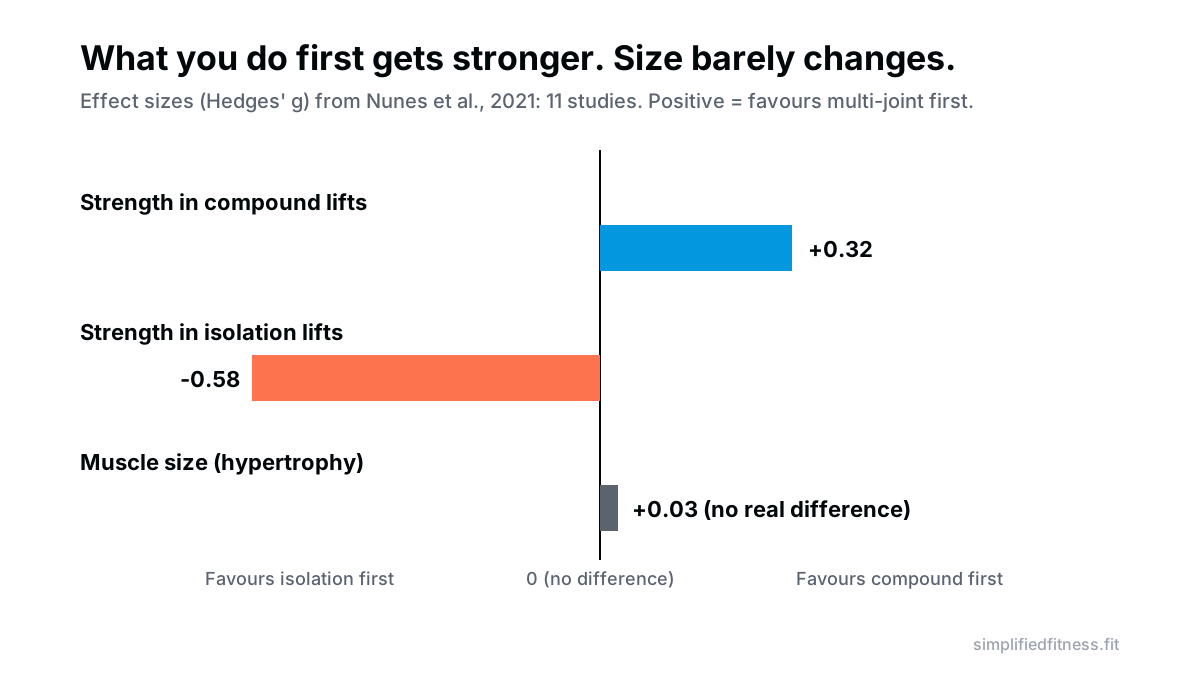
- All strength tests combined: no difference between orders (ES = -0.11).
- Strength in multi-joint lifts: better when multi-joint exercises came first (ES = 0.32).
- Strength in single-joint lifts: better when single-joint exercises came first (ES = -0.58).
- Hypertrophy: no significant effect of order (ES = 0.03).
Read that twice. Order does not magically make you stronger overall. It shifts strength toward whatever you do first.
So “compounds first” is not a muscle growth hack. It is a way of making sure your heaviest, most technical lifts get your best effort. If your goal is a stronger squat, bench or row, that matters. If your goal is only muscle size, the margin is slim.
A 6-week trial in 36 young men found both orders grew biceps similarly (about 14%), but only the compound-first group showed a significant increase in mid-thigh muscle thickness (+7.2% vs +3.9% with isolation first) (Avelar et al., 2019). The authors called it a potentially beneficial effect for the thigh, not a firm result.
Why do you do bench press before triceps?
A bench, press or push-up is a chain: chest, front delts, triceps. The chain breaks at its weakest link under fatigue, and for most people that is the triceps.
Do pushdowns first and your triceps tire. On the next heavy bench set, you stop because your arms quit, not because your chest worked to its limit. You walk out having trained the triceps twice and the chest less.
The same logic holds for biceps before back. Rows and pulldowns depend on your arms to hold on. Tired biceps lower your row numbers well before your lats are done. A practical order is a heavy press or row, then pushdowns or curls.
Is isolation work even needed after compounds?
A 2017 review of 23 studies looked at whether single-joint exercises add anything. For upper limbs, long-term studies found no difference between single-joint and multi-joint exercise, and no extra effect from adding single-joint work to a multi-joint program. The authors suggested single-joint work may be mainly needed for the lumbar extensors and for correcting muscular imbalances (Gentil et al., 2017).
That does not mean curls are pointless. Studies in this area are often short, many used untrained participants, and trained lifters chasing a lagging muscle may behave differently. A sensible read is: compounds do most of the work, and isolations are useful tools, not requirements.
They also come with low systemic cost, which is why they sit nicely at the end of a session. Fatigue there matters less, because you are not trying to lift a heavy, technical load afterward. For more on picking exercises by payoff versus fatigue, see compound vs isolation exercises and the stimulus-to-fatigue ratio.
When does isolation first make sense?
Order is a priority list. A few exceptions are reasonable.
- A lagging muscle. If your side delts or hamstrings are your weak point, do their work first so they get your best effort. You will probably lift less on the compound that follows. Accept that trade on purpose.
- A cranky joint. One or two light sets of leg extensions or band pull-aparts can prepare a knee or shoulder. Keep it light and far from failure, then continue to your first working lift. Our guide to warm-up protocols covers ramping sets.
- Time-saving supersets. Pairing opposing muscles keeps both fresh, which is a different idea from pre-exhaustion. See antagonist paired sets.
- Specific sport or physique goals. If strength on a compound is not your priority, order matters even less.
If you do put isolation first, expect the compound to drop. The evidence suggests this is a trade, not a free upgrade.
What about untrained or time-short lifters?
Some evidence in pre-exhaustion points the other way, and it deserves fair mention. A 9-week trial in untrained men (12 per training group, plus a non-training control group) compared leg press alone with a set of leg extensions to failure before leg press. Pre-exhaustion maintained strength and quadriceps thickness despite lower training load and volume, and the authors suggested it can reduce total volume while maintaining results. Fat mass loss was greater in the traditional group (Trindade et al., 2019).
So why do these studies differ from the 2026 trial? They tested different people (untrained vs resistance-trained) and compared different setups (one lift vs a full four-exercise lower-body routine). The cautious takeaway: pre-exhaustion is not a disaster, and beginners may get similar results with lighter loads on the compound, but it has not been shown to beat traditional order for size in trained lifters.
How should you order a workout in practice?
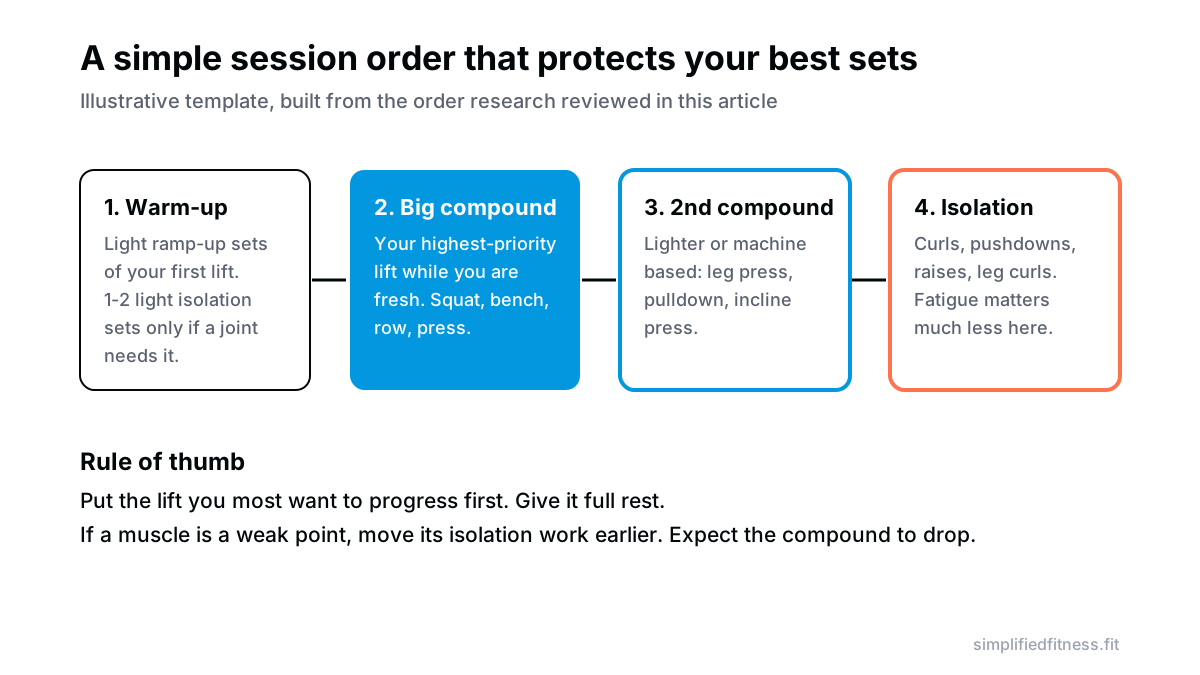
- Warm up with the first lift. Ramp up with lighter sets of the exercise you will do first.
- Heavy compound first. Squat, deadlift variation, bench, overhead press, row or pull-up.
- Second compound or machine. Leg press, incline press or pulldown.
- Isolation work last. Curls, pushdowns, lateral raises, leg curls, calves.
- Rest between lifts. A few minutes after heavy compounds is not wasted time. Read why 2-3 minute rests help hypertrophy.
An example push day: incline dumbbell press, seated dumbbell shoulder press, then lateral raises and triceps pushdowns. You can see this order in our free push day plan, and use the training volume calculator to check you are not stacking too many sets.
When to talk to a professional
Order questions are mostly about efficiency, not safety. If a joint hurts during an exercise, or you have a known injury, ask a physiotherapist or doctor for advice rather than trying to train around pain by changing order alone.
The bottom line
Compounds first is a sensible default because the exercise that opens your session gets the most reps, the most load and the largest strength gains. Pre-exhaustion has not been shown to improve growth, and one 2026 trial slightly favoured traditional order. The effect on muscle size is small and the evidence is mostly short-term, so treat order as a priority list, keep it consistent for a block of training, and judge it by your logbook.
Frequently Asked Questions
Should you do compound or isolation exercises first?
Compound exercises first is the better default for most lifters. Research reviews show reps and strength gains are largest for whichever exercise opens the session, and heavy multi-joint lifts need the most freshness and coordination. Start with your highest-priority compound lift, then move to isolation work.
Does pre-exhaustion work for building muscle?
Not better than normal order, based on current trials. In an 8-week trial in resistance-trained people, pre-exhaust training produced slightly smaller gains in muscle size than traditional training, though the difference was statistically uncertain. Use it only if you enjoy it and accept that your compound lift will usually get weaker sets.
Why do you do bench press before triceps?
Because the triceps are a smaller link in the chain, so tired triceps cap your bench before your chest is truly challenged. A small study in experienced lifters found that pre-fatiguing the triceps raised triceps activity in a heavy bench, while pre-fatiguing the chest or front delts did not raise their activity. Bench first, then pushdowns or extensions once the heavy work is done.
Is it bad to do biceps before back?
It is not harmful, but it usually makes your back work worse. Tired biceps become the weak link on pulldowns and rows, so you may stop a set because your arms quit before your lats do. Do rows or pulldowns first, then curls.
Does exercise order matter for muscle growth?
Less than most people think. A 2021 meta-analysis of 11 studies found no significant effect of order on hypertrophy, though strength favoured the exercise done first. Choose the order that lets you hit your target reps and effort on the lifts that matter most.
What is post-exhaustion training?
Post-exhaustion means doing the compound lift first, then immediately an isolation exercise for the same muscle. It is effectively the standard order with little rest between the two. Rest properly after the compound, then do the isolation set when your breathing has settled.
Are there times when isolation should come first?
Yes, in a few specific cases. If a muscle is a lagging weak point, you can train it earlier so it gets your best effort, accepting a lighter compound afterward. A light, short isolation set to wake up a cranky elbow or knee is also reasonable, as long as it does not leave you tired.
Should I do leg extensions before squats?
It is not a good idea if your goal is heavy squats. In a leg press study, doing knee extensions first reduced leg press reps and lowered thigh muscle activation. Squat first, then do extensions at the end, or use one or two very light sets as a knee warm-up.
Do I need isolation exercises at all?
Not strictly. A 2017 review concluded that adding single-joint exercises did not give extra benefit for upper-limb size or strength in the studies it covered, though lumbar extensors and muscular imbalances may be exceptions. They are still handy for targeting a lagging muscle or for finishing a session with low fatigue.
How many exercises should I do per workout?
There is no fixed number, but most effective sessions have a few compound lifts and a handful of isolation sets. Quality drops as you accumulate fatigue, so every extra exercise should earn its place. Our training volume calculator can help you sanity check your weekly sets.
Does exercise order matter for strength training?
Yes, more than for muscle size. The meta-analysis found strength gains were largest in the exercises placed first in a session, for both compound and isolation lifts. Put the lift you want to get strongest at first, when you are freshest.
Is order different for a full-body workout?
The same logic applies, but with more muscles competing for energy. Rank your lifts by priority and start with the biggest one, then rotate so no single muscle is repeatedly pre-fatigued.
Sources & References
Every claim above is checked against peer-reviewed research (PubMed, U.S. National Library of Medicine) or guidance from established health bodies. How we fact-check.
- Nunes JP, et al. What influence does resistance exercise order have on muscular strength gains and muscle hypertrophy? A systematic review and meta-analysis. Eur J Sport Sci. 2021. PMID: 32077380
- Fisher JP, et al. The effects of pre-exhaustion, exercise order, and rest intervals in a full-body resistance training intervention. Appl Physiol Nutr Metab. 2014. PMID: 25092528
- Hermann T, et al. Front-Loading Fatigue: Does the Pre-exhaustion Method influence Resistance Training-induced Muscular Adaptations? Int J Exerc Sci. 2026. PMID: 42516618
- Trindade TB, et al. Effects of Pre-exhaustion Versus Traditional Resistance Training on Training Volume, Maximal Strength, and Quadriceps Hypertrophy. Front Physiol. 2019. PMID: 31824336
- Augustsson J, et al. Effect of pre-exhaustion exercise on lower-extremity muscle activation during a leg press exercise. J Strength Cond Res. 2003. PMID: 12741886
- Gołaś A, et al. Effects of Pre-exhaustion on the Patterns of Muscular Activity in the Flat Bench Press. J Strength Cond Res. 2017. PMID: 27984499
- Simao R, et al. Exercise order in resistance training. Sports Med. 2012. PMID: 22292516
- Avelar A, et al. Effects of order of resistance training exercises on muscle hypertrophy in young adult men. Appl Physiol Nutr Metab. 2019. PMID: 30248269
- Gentil P, et al. A Review of the Acute Effects and Long-Term Adaptations of Single- and Multi-Joint Exercises during Resistance Training. Sports Med. 2017. PMID: 27677913

Umair Hazrami · Founder & Head Coach, Simplified Fitness
Umair Hazrami founded Simplified Fitness and the Simplified Lifter channel to cut through fitness noise. With 4+ years of consistent training and 10+ coaching clients, he writes every guide from the peer-reviewed research and links the sources so you can check them. Our editorial standards.
Educational content only, not medical advice. If you have a medical condition, are pregnant, or take medication, talk to a qualified doctor before changing your diet, supplements or training. Full disclaimer.
Keep reading

Programming
2-Day per Week Lifting Programs: Minimum Effective Dose for Busy Professionals
Can a 2 day a week workout routine hypertrophy goals support? Yes. Get a ready two-day full-body plan, the research behind it and how to run it in 60 minutes.
9 min read
Programming
30-Minute High-Density Hypertrophy Sessions: Micro-Workouts for Time-Constrained Lifters
Can a 30 minute workout for muscle growth work? See how paired sets, Myo-reps and machine setups fit 16 hard sets into half an hour, plus a 4-day plan.
10 min read

Programming
The 7-Minute Dynamic Warm-Up: A Fast Routine to Prep Joints Before Lifting
A dynamic warm up for lifting takes about 7 minutes, not 25. See the 2-3-2 routine, what the research says about stretching and foam rolling, and what to skip.
9 min read
Programming
Antagonist Paired Sets: Cut Workout Time by About 40% Without Losing Reps
Antagonist paired sets supersets time saving explained: pairing push and pull cuts a session by roughly 40% keeping reps. Pairings and rest times included.
8 min read