Circuit Training vs True Hypertrophy Lifting: Do Circuits Compromise Muscle Tension?
Circuit training vs hypertrophy lifting: what trials show on muscle gain, why non-stop bootcamps can cap tension, and how to fit cardio in without losing size.

TL;DR. The short answer
- Circuit training builds conditioning well, but non-stop bootcamp-style circuits are a poor default for maximising muscle size because heart rate and breathing, not the target muscle, often end each round.
- Direct trials are more forgiving than the gym myth: heavy, structured circuits (about 6RM, short rest) produced similar strength and lean mass to rested sets in small 8-week studies.
- Rest matters, but less than people think. A 2024 Bayesian meta-analysis found a small hypertrophy edge for rests longer than 60 seconds and no clear difference beyond about 90 seconds.
- Adding cardio to lifting does not appear to hurt whole-muscle size in meta-analyses, so the practical fix is to separate cardio from lifting rather than blend them.
- If you want size, keep lifting sets hard and rested, then put intervals in their own block or on another day.
Part of our complete guide: Best Workout Split for Muscle Growth: PPL vs Upper/Lower vs Full Body, What the Research Says
Table of contents
Circuit training vs hypertrophy lifting is not a fair fight, but it is not a knockout either. Circuits build conditioning and save time. For maximum muscle size, rested sets are the safer choice, because they let the target muscle, not your breathing, decide when each set ends.
That is the core idea inside our guide to workout splits and session architecture. Here we look at how far the “circuits kill gains” claim actually holds up, because the research is a bit more forgiving than gym folklore.
What is the difference between a circuit and a hypertrophy session?
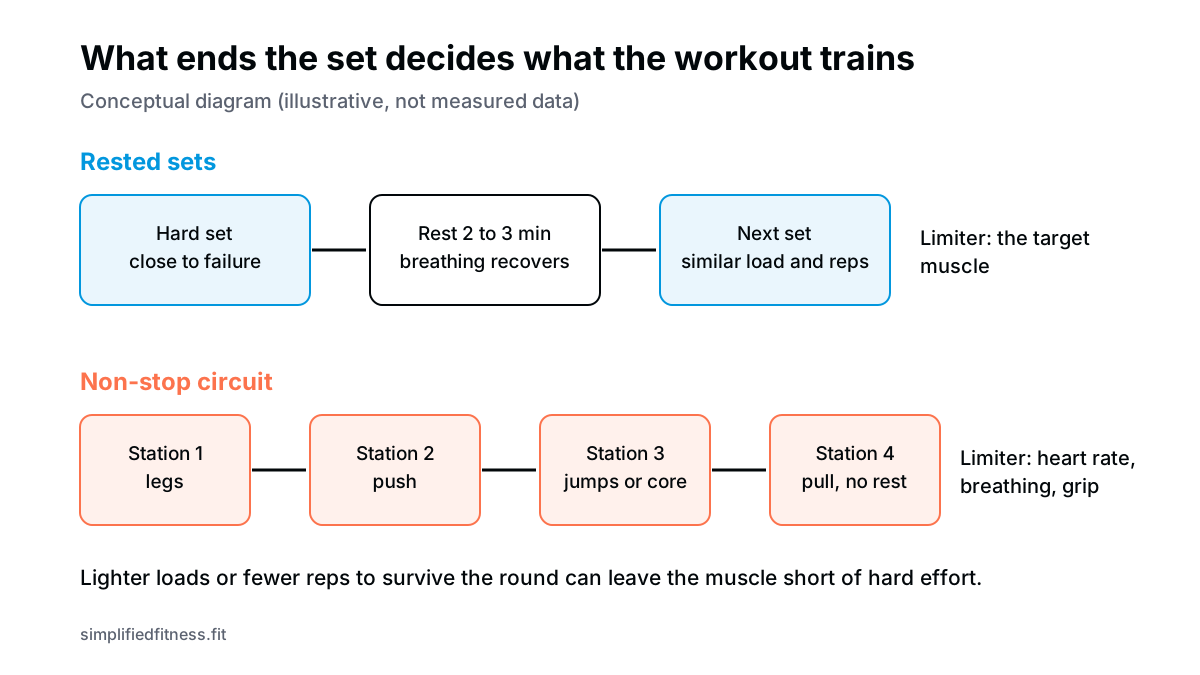
A hypertrophy session is built around hard sets of one exercise at a time, with rest in between. You press, you rest, you press again. The muscle you are training gets repeated chances to work close to failure.
A circuit chains several stations (squat, push-up, row, jump, core) with little or no rest and loops through them for a fixed time or number of rounds. Bootcamps, CrossFit-style classes and many “HIIT” group sessions work this way.
The two formats pursue different goals. One chases muscular effort. The other chases a raised heart rate.
Why can circuits limit muscle tension?
Muscle grows when a muscle works hard, ideally within a few reps of failure, with enough total hard sets across the week. You need good-quality reps on the target muscle.
In a non-stop circuit, something else usually ends the round. Your heart rate is high, your breathing is ragged, your grip is cooked. So you drop the load, cut the reps or move on before the muscle has really been taxed.
Cardiovascular load is easy to measure. In a small crossover study of 10 healthy adults with strength training experience, a heavy circuit (35 seconds rest, 6RM loads) gave the same bench press reps and bar speed as traditional sets with 3 minutes of rest. But average heart rate was higher: about 129 beats per minute (roughly 71% of max) versus 113 (roughly 62%) (Alcaraz et al., 2008).
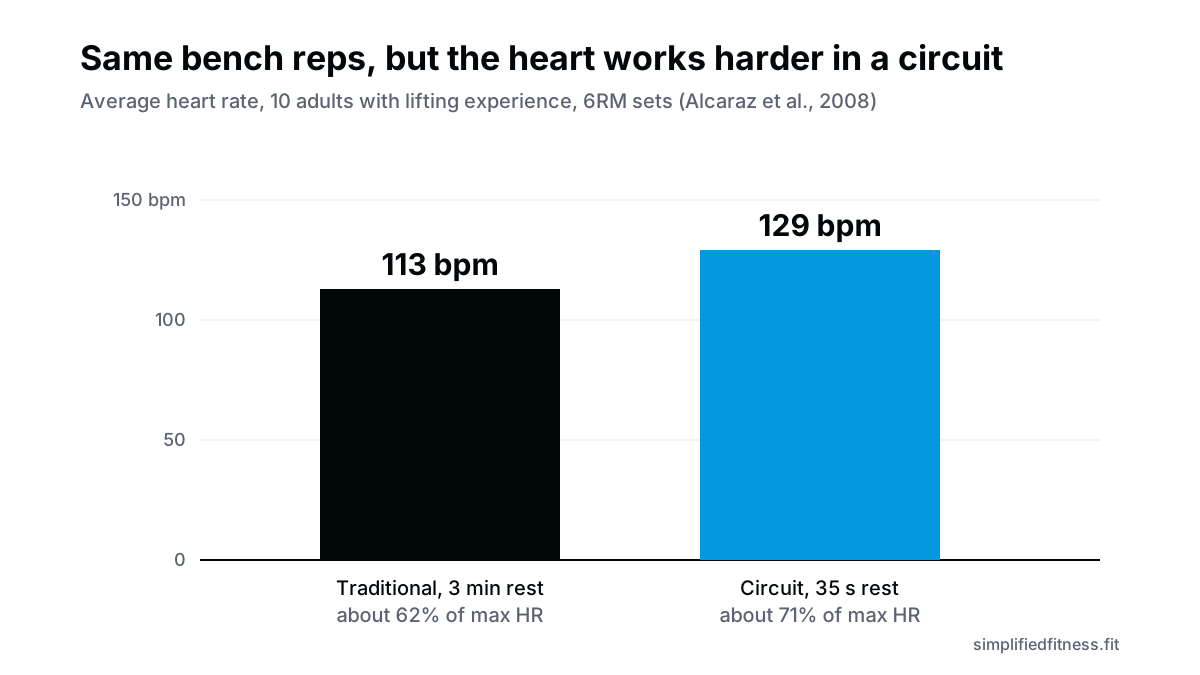
Notice what that study actually shows. In a short single session with heavy loads, the circuit did not cost bench reps. So the problem is not circuits as a concept. The problem arises when the circuit design (light loads, many stations, no rest) makes cardio the bottleneck.
Do circuits build less muscle than rested lifting?
This is where gym wisdom often overreaches, so let us be careful. The direct evidence does not show circuits are dramatically worse. It shows they can be similar when they are heavy and well designed.
Trial A. In 33 healthy men (including a non-training control group), 8 weeks of heavy circuit training (about 6RM, roughly 35 seconds between sets) was compared with traditional training (6RM, 3 minutes rest). Lean mass rose in both groups, and 1RM bench and half squat improved equally. Body fat percentage fell in the circuit group only. Peak cycling power rose only in the traditional group (Alcaraz et al., 2011).
Trial B. In 14 trained women, 8 weeks of high intensity circuits (two short circuits with 5 minutes rest between rounds) matched traditional training with 3 minutes rest. Both groups improved 3RM strength and lean mass similarly, with no significant group differences (Carpenter et al., 2025).
Both studies are small, short and used structured heavy loads, not a 45-minute bootcamp class. The authors of the women’s trial noted that circuits finished much faster, so time efficiency is the real selling point.
How much does rest between sets matter for muscle growth?
Rest is the lever that circuits remove. Here the evidence has shifted over the years, and it is a good example of conflicting findings.
One trial in 21 young resistance-trained men compared 1-minute and 3-minute rests over 8 weeks with all other variables held constant. The 3-minute group had greater quadriceps thickness and 1RM gains, and a trend for the triceps (Schoenfeld et al., 2016).
A later Bayesian meta-analysis pooled 9 studies and concluded there is probably a small hypertrophy benefit to rests longer than 60 seconds, possibly mediated by volume load. It did not detect appreciable differences when resting longer than 90 seconds, and the heterogeneity was substantial (Singer et al., 2024).
Why do the findings differ? Study length, exercises, how close to failure people trained and whether the shorter rest actually reduced volume all vary. The sensible takeaway: rest long enough to keep your load and reps from collapsing. For big compound lifts, that is often 2 to 3 minutes. We cover this in detail in rest intervals for hypertrophy and when short rests still make sense in short rest intervals, penalties and uses.
Does low-load circuit work grow muscle at all?
Possibly, yes. A 2021 review argues that muscular adaptations can be obtained across a wide spectrum of loads, not only in a “8 to 12 rep zone” (Schoenfeld et al., 2021). That is useful for context. It is not a licence to do easy sets for 40 seconds and call it hypertrophy.
The key variable underneath is effort. Light loads can work when sets are taken near failure for the target muscle. In a circuit you often stop at a time limit, long before that. See training to failure vs RIR for how close is close enough.
Does cardio-style training blunt muscle growth?
Adding cardio to lifting is a separate question from circuits, and the answer is gentler than many expect.
A 2022 meta-analysis of 43 studies found concurrent aerobic and strength training did not compromise muscle hypertrophy (standardised mean difference about 0), or maximal strength. Explosive strength gains were attenuated, more so when both were done in the same session than when separated by at least 3 hours (Schumann et al., 2022).
There is a nuance. Another meta-analysis of 25 studies found no difference in whole-muscle hypertrophy, but lifting alone produced greater muscle fiber hypertrophy than lifting combined with HIIT (fiber-level measures) (Monserdà-Vilaró et al., 2023). Treat that fiber-level finding cautiously, since whole-muscle size did not differ.
Summed up: doing some cardio will not erase your gains. But if you want the cleanest signal for size, keep intervals out of the lifting block. More on this in our cardio and concurrent training interference article.
Circuit training vs hypertrophy lifting: side by side
| Rested hypertrophy lifting | Non-stop circuit | |
|---|---|---|
| Rest between efforts | 1 to 3+ minutes | 0 to 45 seconds |
| Usual limiter | Target muscle | Heart rate, breathing, grip |
| Load progression | Easy to track | Harder to track |
| Time per session | Longer | Shorter |
| Conditioning effect | Modest | Higher |
| Best for | Muscle size and strength | Fitness, time-poor days, fat loss support |
How do I separate cardio from lifting?
Here is a practical way to do it without giving up conditioning.
- Lift first, conditioning last. If you must do both in one session, put your hard lifting sets first and a short finisher after.
- Separate days when possible. Cardio on its own day or at least a few hours apart, per the same-session finding above.
- Use zone 2 or low-impact cardio on days before heavy leg sessions so legs stay fresh. Use our heart rate zone calculator to set easy intensities.
- Use supersets, not circuits, to save time. Pair opposing muscles and rest after each pair. See antagonist paired sets and supersets.
- Short on time? Use a dense but rested approach from our 30-minute express hypertrophy workouts.
If you run as well as lift, our hybrid training scheduling guide helps with the week.
What is the most common mistake with circuits?
Choosing circuits as the main plan for muscle gain, then wondering why the weights never go up. Progressive overload needs a number you can beat each week. In a clock-driven circuit the number is murky.
When circuits make sense
Circuits are not the enemy. They are a good fit when:
- you are new to training and building a base;
- you have 25 to 30 minutes and want a full-body session;
- your goal is conditioning or general fitness first.
If you love them, build them heavy, rest a few minutes between rounds (the women’s trial used 5), and keep two or three rested lifting sessions a week. Our free workout plans show how to structure a rested week.
Who should check with a doctor first?
High-intensity circuits push your heart rate. If you have heart disease risk factors, chest pain, dizziness on exertion, high blood pressure or are returning after a long break, get medical clearance before starting.
The bottom line
Heavy, structured circuits can build muscle in the short term, according to small trials. Bootcamp-style non-stop circuits are a weaker default for size because cardio fatigue, not muscle tension, often sets the limit. The reliable approach is to lift with rest for hypertrophy and train conditioning separately. Keep the best energy for the lifting block.
Frequently Asked Questions
Does circuit training build muscle?
Yes, it can, especially in beginners and when loads are heavy and sets are taken close to failure. In trained people, two small 8-week trials found heavy circuits gave similar lean mass gains to rested sets. The catch is that most bootcamp circuits use light loads and no rest, so check that your muscles, not your lungs, are ending each set.
Is circuit training or weight training better for muscle growth?
Traditional rested weight training is the safer bet for size because it lets you repeat hard, high-quality sets. Trials of structured heavy circuits show comparable results, but those are short and small. If hypertrophy is the main goal, lift with rest and do conditioning separately.
Why are circuits bad for muscle growth?
They are not automatically bad, but non-stop circuits shift the limiting factor from the muscle to heart rate, breathing and grip. That can lower the load you use or the effort your muscle reaches. Rest long enough that the target muscle, not your cardio, decides when the set ends.
Is bootcamp or weight training better for building size?
For size, weight training with progressive loading is better. Bootcamps tend to use bodyweight or light loads, rotate muscles fast and are paced by fatigue. I found no trials that directly compared bootcamp classes with lifting for muscle size, so this rests on mechanism and related studies.
How much rest do I need between sets for hypertrophy?
Around 2 to 3 minutes for heavy compound lifts is a solid default. A 2024 meta-analysis found a small advantage for rests over 60 seconds and no appreciable difference beyond 90 seconds. Rest less on small isolation lifts if you like, but keep the reps and load from collapsing.
Does cardio fatigue limit lifting performance?
It can. When breathing and heart rate stay high, you may do fewer reps or use less load on the next set. In one trial, 35-second circuit rests raised average heart rate to about 71% of max versus about 62% with 3-minute rests. Give yourself enough rest that the next set matches the last.
Can I do HIIT and lift weights in the same week?
Yes. A 2022 meta-analysis of 43 studies found that combining aerobic and strength training did not compromise muscle hypertrophy. Explosive strength gains may be blunted when both are done in one session. Keep intervals on separate days or at least several hours after lifting if you can.
Should I do cardio before or after weights?
For muscle size, lift first and do cardio after, or on a separate day. Pre-fatiguing with cardio can lower the quality of your sets. Aim for the lifting block to get your best energy and keep conditioning to the end.
Are supersets the same as circuits?
No. Supersets pair two exercises back to back, often for opposing muscles, and then you rest before repeating. Circuits chain more stations with little or no rest. Supersets can save time without turning the workout into cardio, so they are a better compromise.
Is a circuit good for fat loss?
It can help, because it is time efficient and burns energy. In one 8-week trial, the heavy-circuit group lowered body fat percentage while the rested group did not, though other studies show body fat falling in both groups. Total weekly calories and consistency matter more than the format.
Are circuits good for beginners?
They can be a fine start because beginners grow muscle from almost any reasonable stimulus. Just keep loads challenging and form clean. Move to rested sets as you get stronger so progression stays measurable.
How can I make a circuit better for muscle gain?
Use challenging loads (the trials used 6RM sets, or 8 to 15 reps close to failure), pick stations that train different muscles, and take a proper rest between rounds. A trial in trained women used two short circuits with 5 minutes between each round and matched rested sets on lean mass. Treat it as a time saver, not a hypertrophy hack.
Sources & References
Every claim above is checked against peer-reviewed research (PubMed, U.S. National Library of Medicine) or guidance from established health bodies. How we fact-check.
- Alcaraz PE, et al. Similarity in adaptations to high-resistance circuit vs. traditional strength training in resistance-trained men. J Strength Cond Res. 2011. PMID: 21659889
- Alcaraz PE, et al. Physical performance and cardiovascular responses to an acute bout of heavy resistance circuit training versus traditional strength training. J Strength Cond Res. 2008. PMID: 18438256
- Carpenter SL, et al. Effects of high intensity circuit versus traditional strength training on physiological responses in trained women. Eur J Sport Sci. 2025. PMID: 40323711
- Schoenfeld BJ, et al. Longer interset rest periods enhance muscle strength and hypertrophy in resistance-trained men. J Strength Cond Res. 2016. PMID: 26605807
- Singer A, et al. Give it a rest: a systematic review with Bayesian meta-analysis on the effect of inter-set rest interval duration on muscle hypertrophy. Front Sports Act Living. 2024. PMID: 39205815
- Schumann M, et al. Compatibility of concurrent aerobic and strength training for skeletal muscle size and function: an updated systematic review and meta-analysis. Sports Med. 2022. PMID: 34757594
- Monserdà-Vilaró A, et al. Effects of concurrent resistance and endurance training using continuous or intermittent protocols on muscle hypertrophy: systematic review with meta-analysis. J Strength Cond Res. 2023. PMID: 36508686
- Schoenfeld BJ, et al. Loading recommendations for muscle strength, hypertrophy, and local endurance: a re-examination of the repetition continuum. Sports (Basel). 2021. PMID: 33671664

Umair Hazrami · Founder & Head Coach, Simplified Fitness
Umair Hazrami founded Simplified Fitness and the Simplified Lifter channel to cut through fitness noise. With 4+ years of consistent training and 10+ coaching clients, he writes every guide from the peer-reviewed research and links the sources so you can check them. Our editorial standards.
Educational content only, not medical advice. If you have a medical condition, are pregnant, or take medication, talk to a qualified doctor before changing your diet, supplements or training. Full disclaimer.
Keep reading

Programming
2-Day per Week Lifting Programs: Minimum Effective Dose for Busy Professionals
Can a 2 day a week workout routine hypertrophy goals support? Yes. Get a ready two-day full-body plan, the research behind it and how to run it in 60 minutes.
9 min read
Programming
30-Minute High-Density Hypertrophy Sessions: Micro-Workouts for Time-Constrained Lifters
Can a 30 minute workout for muscle growth work? See how paired sets, Myo-reps and machine setups fit 16 hard sets into half an hour, plus a 4-day plan.
10 min read

Programming
The 7-Minute Dynamic Warm-Up: A Fast Routine to Prep Joints Before Lifting
A dynamic warm up for lifting takes about 7 minutes, not 25. See the 2-3-2 routine, what the research says about stretching and foam rolling, and what to skip.
9 min read

Programming
Antagonist Paired Sets: Cut Workout Time by About 40% Without Losing Reps
Antagonist paired sets supersets time saving explained: pairing push and pull cuts a session by roughly 40% keeping reps. Pairings and rest times included.
8 min read