How Blood Flow Restriction Builds Muscle: Venous Occlusion, Metabolites and Cell Swelling
BFR training hypertrophy mechanisms explained: how a cuff and 20% 1RM can match heavy lifting for size. Metabolites, swelling, mTOR, myostatin and cuff safety.

TL;DR. The short answer
- BFR training pairs a light load (about 20-30% of 1RM) with a cuff that slows venous outflow. In a 2018 meta-analysis it produced muscle growth similar to heavy lifting, though strength gains were smaller.
- The mechanisms are not fully settled. Leading candidates are metabolite build-up, low oxygen, extra fast-twitch fibre recruitment, cell swelling and mTORC1 signalling, which probably work together.
- One acute human study found muscle protein synthesis rose 46% after BFR leg extensions at 20% 1RM, while the same exercise without a cuff changed nothing.
- Cuff pressure is set relative to your own arterial occlusion pressure, not a random number. A 7 out of 10 tightness rating averaged 120 mmHg in the legs against 171 mmHg for full occlusion.
- Serious adverse events look rare in supervised use, but with a history of clots, high blood pressure or vascular disease, see a doctor before trying it.
Part of our complete guide: How Muscle Actually Grows: The Natural Lifter's Guide to Hypertrophy Science
Table of contents
Blood flow restriction (BFR) builds muscle by wrapping a cuff around the top of a limb so blood pools in the working muscle while you lift something light, around 20-30% of your 1RM. The BFR training hypertrophy mechanisms are not fully pinned down, but metabolite build-up, low oxygen, extra fast-twitch fibre use, cell swelling and mTOR signalling all look involved. Muscle growth ends up similar to heavy lifting in the data we have, with smaller strength gains.
That makes it interesting if your knees, elbows or shoulders complain under heavy load. This article covers the physiology: what the cuff changes inside the muscle and how much of it is proven. It sits inside our wider muscle hypertrophy guide for natural lifters. For setup, cuffs and sample sessions, see the practical BFR gym guide.
Why would a 20% 1RM set grow muscle at all?
The traditional rule says you need roughly 65% of 1RM or more to grow. BFR challenged that. A 2015 review notes that low-intensity BFR has consistently produced hypertrophy at loads under 50% 1RM (Pearson and Hussain, 2015).
The authors say the mechanisms are “not well defined”. Metabolic stress is the leading suggestion. Mechanical tension is low with light loads, yet some growth pathways seem to respond to tension anyway. Their view: the two stimuli may be additive.
So no single switch. Think of it as several smaller levers pulled at once.
What does the cuff actually do?
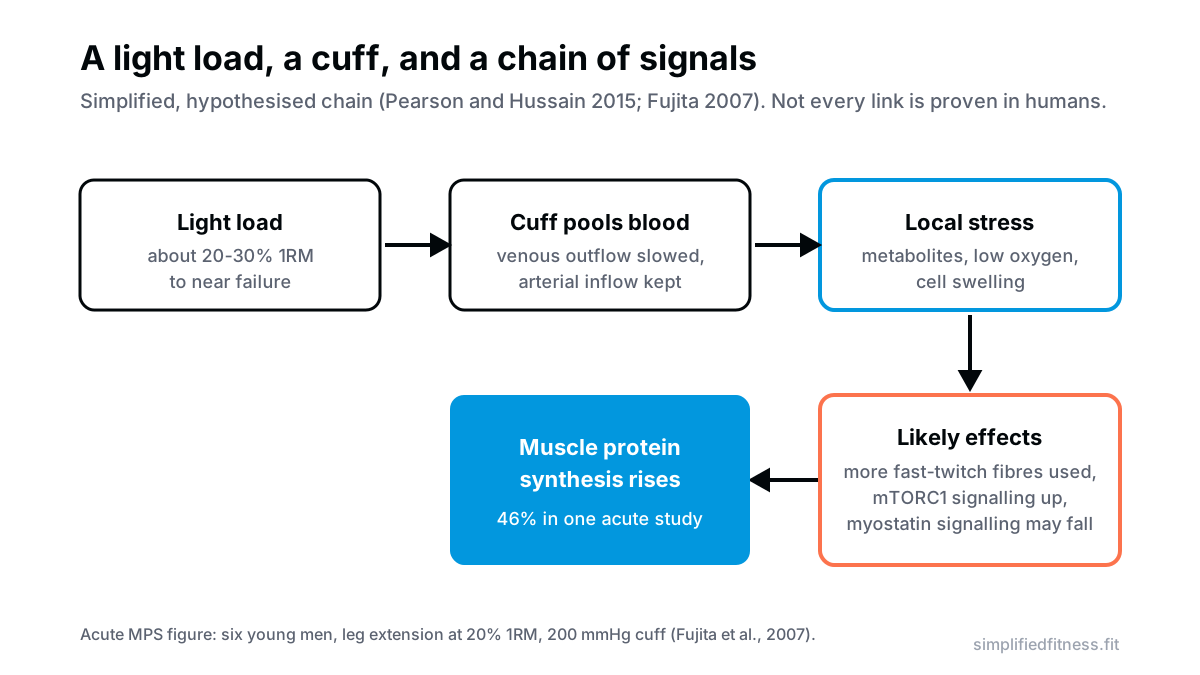
A properly set cuff is tight enough to slow venous outflow (blood leaving the limb) but not so tight that it blocks arterial inflow. Blood keeps arriving and has a harder time leaving. Venous occlusion is the working idea behind the technique (Pearson and Hussain, 2015).
In the gym, that feels like a fast, heavy pump and burning on set one, even though the bar is light.
Mechanism 1: Metabolite accumulation and a hypoxic environment
With restricted outflow, waste products of hard muscle work (lactate and related metabolites) are not cleared as quickly, and oxygen delivery is relatively poorer. Reviews describe this metabolic stress as a primary candidate for BFR’s effect. Blood lactate was higher after BFR than after the same light exercise without a cuff in a small study of six young men (Fujita et al., 2007).
Be careful with the word “causes”. Metabolites rising alongside growth does not prove they are driving it. Some of the downstream effects appear to be triggered more by mechanical tension than by metabolic stress, which is why researchers talk about additive effects instead of one winner (Pearson and Hussain, 2015). For the broader tension-versus-metabolite debate, see our piece on mechanical tension versus muscle damage.
Mechanism 2: Early recruitment of high-threshold motor units
Early in a light set, your biggest, fast-twitch motor units are mostly idle, which is why the first reps at 20% 1RM feel pointless. The standard idea is that as slower fibres fatigue under restriction, the nervous system calls in fast-twitch fibres sooner. Pearson and Hussain list increased fast-twitch fibre recruitment among the proposed mechanisms (Pearson and Hussain, 2015).
It fits the logic behind Henneman’s size principle: fatigue pushes recruitment up the ladder. It is still a hypothesis in the BFR setting, not a measured certainty in every study.
Mechanism 3: Cell swelling
Cell swelling is the physiology most people have never heard of. Blood pooling, metabolite accumulation and the rush of blood after the cuff comes off all push fluid into and around muscle cells. Reviews list cell swelling among the candidate signals for growth (Pearson and Hussain, 2015).
The honest status: plausible, not proven as a main driver. It is also unlikely to be the only story, since a post-workout pump happens with plenty of normal training too. We separate the pump from real growth in gym pump versus true muscle hypertrophy.
One related idea that has been tested directly: does the rush of blood after the cuff comes off (reactive hyperemia) drive growth? In a crossover study of six young men, infusing a vasodilator into the thigh artery to mimic that rush did not raise muscle protein synthesis, while BFR exercise raised it by 49% (Gundermann et al., 2012). So reactive hyperemia alone is not the main mechanism.
Mechanism 4: mTORC1 signalling and muscle protein synthesis
This is the most directly measured link. In six young men doing leg extensions at 20% of 1RM with a 200 mmHg thigh cuff, muscle protein synthesis rose 46% and S6K1 phosphorylation (a downstream marker of mTOR) rose too. Without the cuff, neither changed (Fujita et al., 2007).
That is a very small, acute study in young men, so treat the exact number cautiously. It does show the cuff changes the muscle’s growth signalling, not just how it feels.
Mechanism 5: Myostatin and other growth regulators
Myostatin is a protein that restrains muscle growth. In a 2012 trial, 29 physically active men trained for 8 weeks with either low-intensity work, low-intensity work with BFR, or heavy lifting at 80% of 1RM. Quadriceps size increased by about 6% in both the BFR and heavy groups, and myostatin gene expression fell in both (Laurentino et al., 2012).
Note what this does not show. It measured mRNA, a gene-expression marker, not the amount of active myostatin protein, and the trial was small and limited to physically active men. An acute study of five inactive men walking with BFR did not find a myostatin drop (Khoubi et al., 2020). Together, the answer is mixed: possible contributor, not a settled mechanism.
Does it actually match heavy lifting?
Mechanisms are interesting, but results matter more. A 2018 systematic review and meta-analysis compared heavy training (above 65% 1RM) with low-load BFR training. Hypertrophy was similar between them regardless of cuff width or pressure prescription, while strength gains were higher with heavy loads (Lixandrao et al., 2018). The authors suggest BFR is of particular interest for people with physical limitations to heavy training.
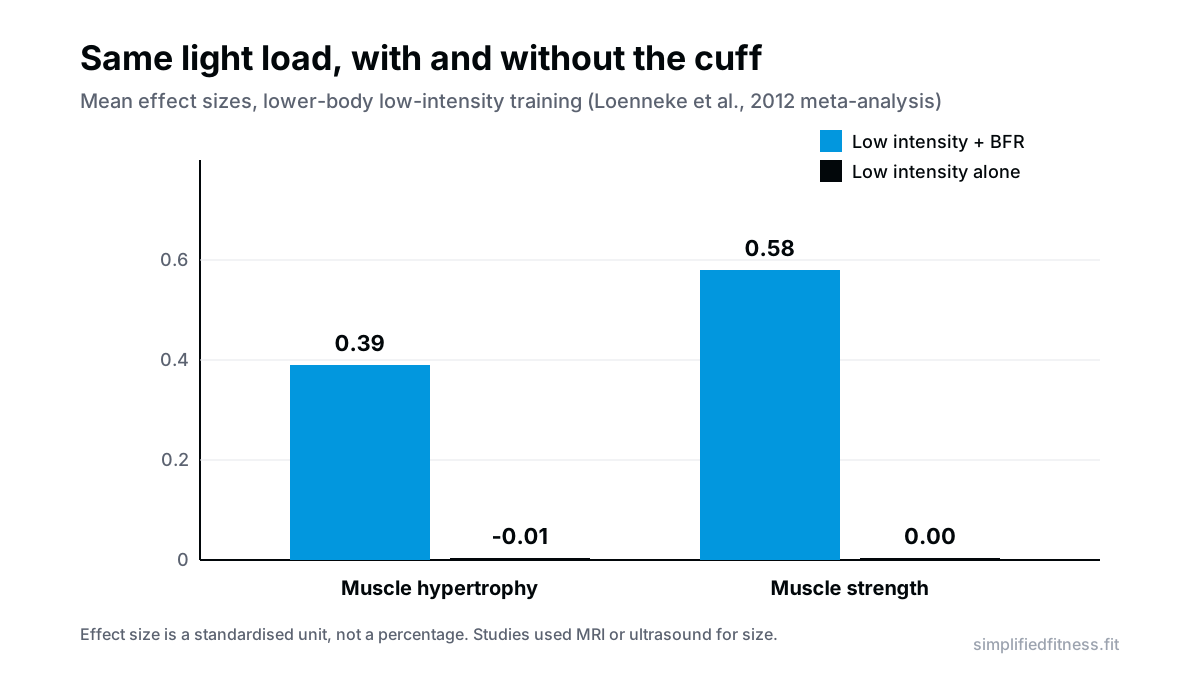
And the cuff itself matters. A 2012 meta-analysis of lower-body studies reported a mean hypertrophy effect size of 0.39 for low-intensity BFR versus about -0.01 for the same low-intensity exercise alone (Loenneke et al., 2012).
| Question | What studies suggest | Confidence |
|---|---|---|
| Hypertrophy vs heavy lifting | Similar | Moderate to good (meta-analysis) |
| Strength vs heavy lifting | Heavy training higher | Moderate to good |
| Light load without cuff | Little effect in the pooled data | Moderate |
| Exact mechanism | Several likely contributors | Low to moderate |
Safe cuff pressure: what the research supports
Pressure is usually described relative to arterial occlusion pressure (AOP), the pressure at which arterial flow stops. You want to be under it, not at it. In a study of 120 participants, a “7 out of 10” perceived tightness averaged 120 mmHg in the lower body, compared with an average arterial occlusion pressure of 171 mmHg (Bell et al., 2018). The authors conclude that perceived tightness might help set sub-occlusive pressure practically.
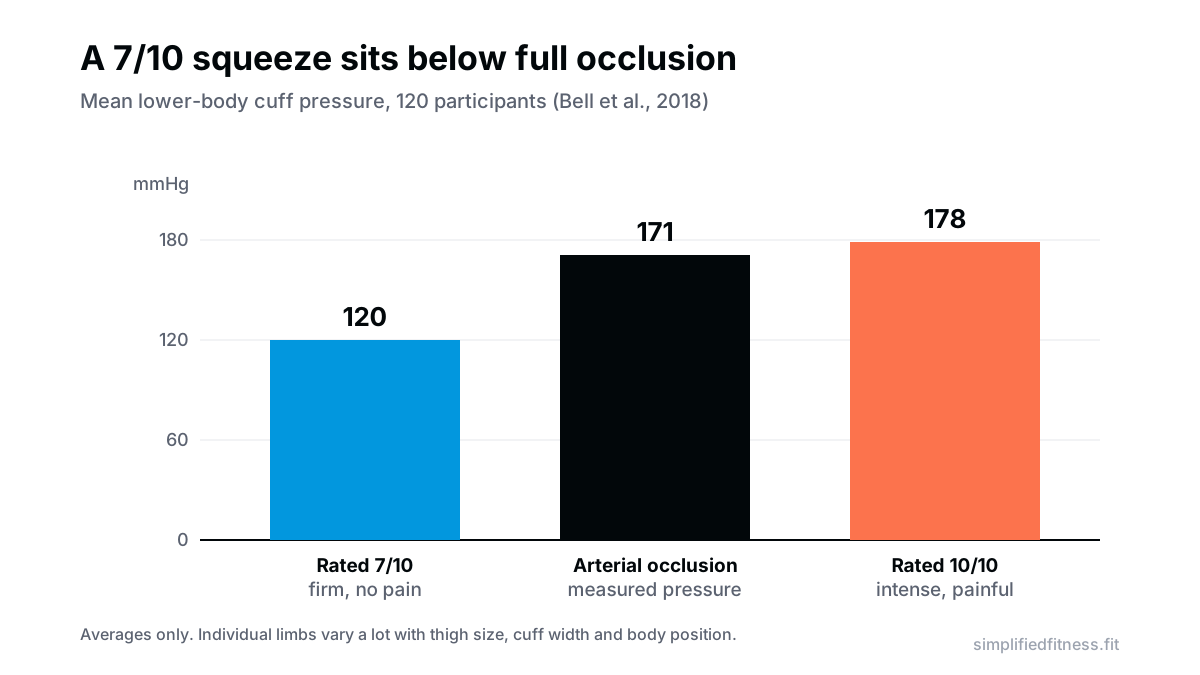
Those are group averages. Thigh size, cuff width and position all shift the numbers, so one person’s 7/10 is not another’s. A device that measures AOP is more precise than feel. The details of cuffs and protocols live in the practical BFR guide.
Is BFR safe?
A systematic review of 19 studies in patients with musculoskeletal disorders (322 participants pooled) found that in randomized trials, people doing BFR were not more likely to have an adverse event than those exercising without it. Rare events, including an upper-limb deep vein thrombosis and rhabdomyolysis, were reported in a few studies (Minniti et al., 2020). The authors conclude BFR appears safe for knee-related conditions, but note research is limited elsewhere.
The common, milder effects reported in that review were acute muscle pain and fatigue. Rare but serious ones are why screening matters.
See a doctor before trying BFR if you have:
- a history of blood clots or deep vein thrombosis
- high blood pressure or heart or vascular disease
- a recent surgery or fracture in the limb
- unexplained limb swelling, pain or numbness
Stop and seek care for severe pain, a limb that turns pale or blue, or persistent numbness. This article is education, not medical advice.
Who benefits most, and who can skip it?
Injured or joint-sensitive lifters are the obvious audience, because BFR lets you load a muscle while the joint sees little force. Many healthy lifters with no joint complaints will get more out of well-planned heavy and moderate training, plus a sensible high-load versus low-load mix. BFR is an add-on, not a replacement.
If knee pain is the issue, our guide to leg extensions, rectus femoris and knee safety covers exercise choices. And if you are building a leg session around it, our free leg day plan is a solid base.
The bottom line
BFR works by changing what a light set does inside the muscle: more metabolic stress, likely earlier use of fast-twitch fibres, more signalling through mTORC1, and probably some cell swelling. Growth is similar to heavy lifting, strength is not. Which of those mechanisms matters most is still being argued, and much of the molecular work comes from small, short-term studies in young men.
Use it to train around a cranky joint, not as a magic trick. Keep pressure sub-occlusive, push sets close to failure, and check with a doctor first if you have any clotting or vascular history. Dial in your protein for recovery with the protein calculator.
Frequently Asked Questions
How does blood flow restriction training build muscle?
A cuff slows blood leaving the working muscle while arterial blood still flows in, so metabolites and fluid build up during light sets. That stress probably brings in more fast-twitch fibres, and a 2007 human study showed it switches on mTORC1 growth signalling and muscle protein synthesis. Treat it as a joint-friendly tool, not magic, and keep sets close to failure.
Can lifting 20% of your 1RM really build muscle?
With a cuff, the evidence says yes. A 2012 meta-analysis found low-intensity training alone produced a hypertrophy effect size of about zero (-0.01), versus 0.39 when the same light work was done with BFR. So the light weight is not the secret, the cuff and the effort are.
Is BFR as good as heavy lifting for muscle size?
For muscle size, studies suggest it is similar, according to a 2018 systematic review and meta-analysis of high-load versus BFR training. Strength gains, however, were higher with heavy loads. If maximal strength matters to you, BFR works best as an add-on rather than a full replacement.
What is venous occlusion and why does it matter?
Venous occlusion means the cuff is tight enough to slow blood returning toward the heart while arterial blood still reaches the muscle. The limb pools blood, which is thought to raise local metabolite levels and cell swelling. Full arterial occlusion is not the goal, and a lower, sub-occlusive pressure is the common target.
Does BFR work because of cell swelling?
Cell swelling is a plausible contributor, but it is a hypothesis rather than a proven main driver. Reviews list swelling alongside fibre recruitment, mTOR signalling and metabolic stress. In practice you cannot isolate it, so judge BFR by the growth results seen in trials.
Does BFR lower myostatin?
Possibly. In one 2012 trial of 29 men, myostatin mRNA fell after 8 weeks of both low-load BFR and heavy training. However, a small acute walking study with five inactive men did not show a myostatin drop, so the data are mixed and mostly short-term.
What cuff pressure should I use for BFR?
Researchers usually set pressure as a percentage of the pressure that fully stops arterial flow, which differs from person to person and limb to limb. Without a device, a perceived tightness of about 7 out of 10 gave sub-occlusive pressure in a 120-person study. Start lighter than you think and get a qualified professional to check it.
Is blood flow restriction training safe?
In knee-related rehab trials, people doing BFR were not more likely to have an adverse event than people exercising without it. Rare events like clots and rhabdomyolysis have still been reported. Avoid it, or ask a doctor first, if you have clotting, vascular or blood pressure problems.
Should I use BFR if I have sore knees or joint pain?
It can be a useful way to train a muscle without heavy joint loading, and trials in knee-related conditions report it as generally safe. Pain that is sharp, swelling or an undiagnosed injury still needs proper assessment first. Get cleared by a physio or doctor, then use light loads and stop if anything feels wrong.
Is BFR worth it for healthy lifters with no injuries?
For most healthy lifters, regular heavy and moderate training with enough sets is simpler and builds strength better. BFR makes more sense when joints are irritated, during a deload, or as a finisher on a stubborn muscle. It is an option, not a requirement.
How often should you do BFR training?
The 2012 meta-analysis found 2-3 sessions per week gave a larger effect than 4-5 sessions per week. That points to recovery mattering, even with light loads. Start with 1-2 sessions per muscle group a week and see how your joints and muscles respond.
Is Kaatsu the same as BFR?
Kaatsu is the original Japanese brand and method, and BFR is the broader term for the family of techniques. Both involve applying a cuff to a limb during exercise. The mechanisms described in research apply to the general approach, though cuff type and pressure vary between systems.
Sources & References
Every claim above is checked against peer-reviewed research (PubMed, U.S. National Library of Medicine) or guidance from established health bodies. How we fact-check.
- Pearson SJ, et al. A review on the mechanisms of blood-flow restriction resistance training-induced muscle hypertrophy. Sports Med. 2015. PMID: 25249278
- Fujita S, et al. Blood flow restriction during low-intensity resistance exercise increases S6K1 phosphorylation and muscle protein synthesis. J Appl Physiol. 2007. PMID: 17569770
- Gundermann DM, et al. Reactive hyperemia is not responsible for stimulating muscle protein synthesis following blood flow restriction exercise. J Appl Physiol. 2012. PMID: 22362401
- Lixandrao ME, et al. Magnitude of muscle strength and mass adaptations between high-load resistance training versus low-load resistance training associated with blood-flow restriction: a systematic review and meta-analysis. Sports Med. 2018. PMID: 29043659
- Loenneke JP, et al. Low intensity blood flow restriction training: a meta-analysis. Eur J Appl Physiol. 2012. PMID: 21922259
- Laurentino GC, et al. Strength training with blood flow restriction diminishes myostatin gene expression. Med Sci Sports Exerc. 2012. PMID: 21900845
- Bell ZW, et al. An investigation into setting the blood flow restriction pressure based on perception of tightness. Physiol Meas. 2018. PMID: 30211696
- Minniti MC, et al. The safety of blood flow restriction training as a therapeutic intervention for patients with musculoskeletal disorders: a systematic review. Am J Sports Med. 2020. PMID: 31710505
- Khoubi M, et al. Acute interval walking with blood flow restriction could not increase ERK, p38 and decrease myostatin. J Sports Med Phys Fitness. 2020. PMID: 32008310

Umair Hazrami · Founder & Head Coach, Simplified Fitness
Umair Hazrami founded Simplified Fitness and the Simplified Lifter channel to cut through fitness noise. With 4+ years of consistent training and 10+ coaching clients, he writes every guide from the peer-reviewed research and links the sources so you can check them. Our editorial standards.
Educational content only, not medical advice. If you have a medical condition, are pregnant, or take medication, talk to a qualified doctor before changing your diet, supplements or training. Full disclaimer.
Keep reading
Hypertrophy
Anabolic Resistance in Older Adults: Why Muscle Responds Less and How to Beat It
Anabolic resistance in older adults explained: why muscle responds less to protein and lifting after 50, plus the protein dose, leucine and sets that help.
8 min read
Hypertrophy
CNS Fatigue vs Muscle Fatigue: Is Your Nervous System Really Fried?
CNS fatigue vs muscle fatigue: what central and peripheral fatigue really are, how long each lasts, and how to tell which one is holding your lifts back.
9 min read

Hypertrophy
Exercise-Induced Muscle Damage (EIMD): Why Chasing Soreness Is Counterproductive
Muscle damage and hypertrophy are not the same thing. See what Z-disc streaming studies show, why soreness is a poor gauge of growth, and what to track.
8 min read
Hypertrophy
Genetics and Muscle Growth: Are You a Non-Responder to Lifting?
Muscle building genetics explained: why the same program gives wildly different growth, what 'non-responder' really means, and how more volume can help.
9 min read