Mechanical Tension vs Muscle Damage vs Metabolic Stress: What Truly Drives Hypertrophy?
Mechanical tension vs muscle damage: which one actually grows muscle? See what the research says about tension, soreness and the pump, and how to train for it.

TL;DR. The short answer
- Mechanical tension, meaning force through the muscle fibres in hard sets taken close to failure, is the best-supported trigger for muscle growth. Reviews call mechanical signals the prime candidate stimulus.
- Muscle damage (soreness, swelling) is probably not essential for hypertrophy. In one trial, a group that avoided detectable damage gained the same muscle size and strength as a group that was damaged.
- Metabolic stress (the burn and the pump) may contribute, but the evidence is mostly indirect, for example from low-load training with blood flow restriction.
- Early size gains in a new lifter are partly swelling, not new muscle. Damas and colleagues propose true hypertrophy shows up after roughly 18 sessions.
- Practical rule: chase progressive, well-executed hard sets, not soreness. If you are very sore for days, your next session probably suffers.
Part of our complete guide: How Muscle Actually Grows: The Natural Lifter's Guide to Hypertrophy Science
Table of contents
Mechanical tension is the best-supported driver of muscle growth. Muscle damage is probably a side effect rather than a requirement, and metabolic stress (the burn and the pump) may play a supporting role, but the evidence for it is weaker and mostly indirect.
That matters because a lot of people judge a workout by how wrecked they feel. If you have ever left the gym thinking “I could barely walk, so it must have worked,” the mechanical tension vs muscle damage question is directly about you. This article is a detailed look at one part of our complete guide to muscle hypertrophy for natural lifters: which signal actually tells muscle to grow, and which ones just make you sore.
What are the three proposed mechanisms of muscle growth?
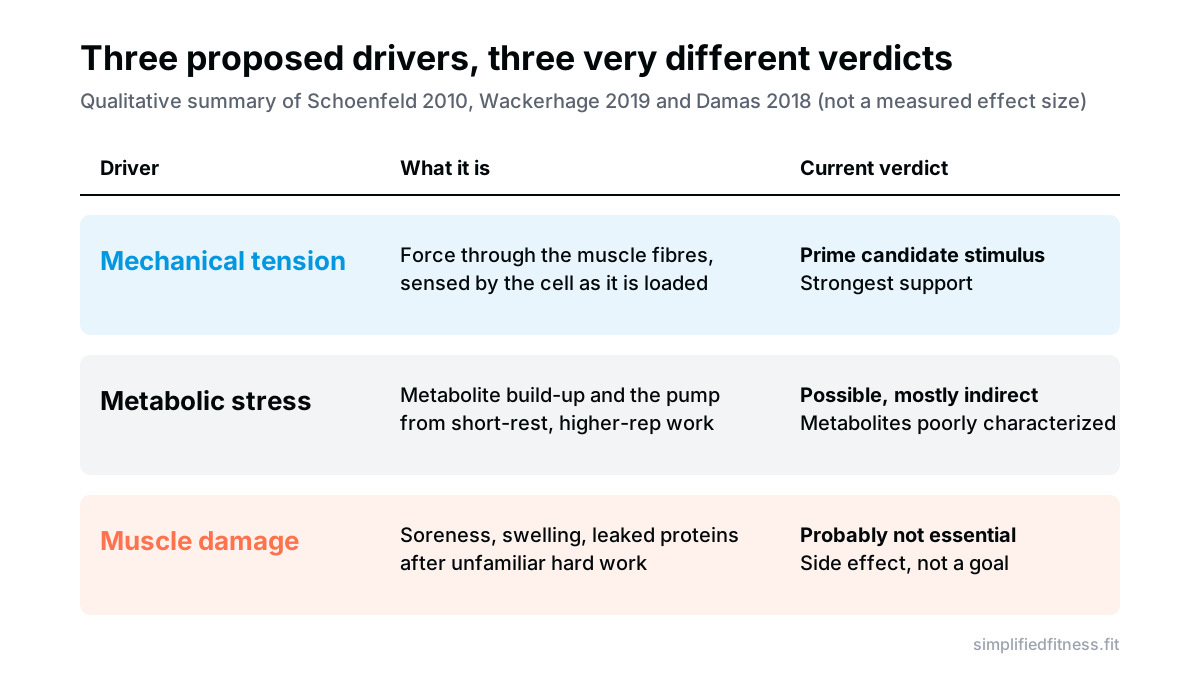
In 2010, Brad Schoenfeld reviewed the literature and concluded that mechanical tension, muscle damage and metabolic stress can all play a role in exercise-induced muscle growth (Schoenfeld, 2010). That paper became the famous “three mechanisms” model, and it is still how most gym content is organised.
Here is the plain-language version:
- Mechanical tension: force going through the muscle fibres as they contract against load, especially when the muscle is working hard and is stretched.
- Muscle damage: the micro-level disruption, swelling and soreness you get after unfamiliar or very hard work.
- Metabolic stress: the build-up of by-products inside the muscle during sets, which you feel as the burn and the pump.
The 2010 paper laid out the candidates. It did not say all three carry equal weight. Since then, researchers have tried to test each one separately, and the picture has become clearer.
Is mechanical tension the main driver of hypertrophy?
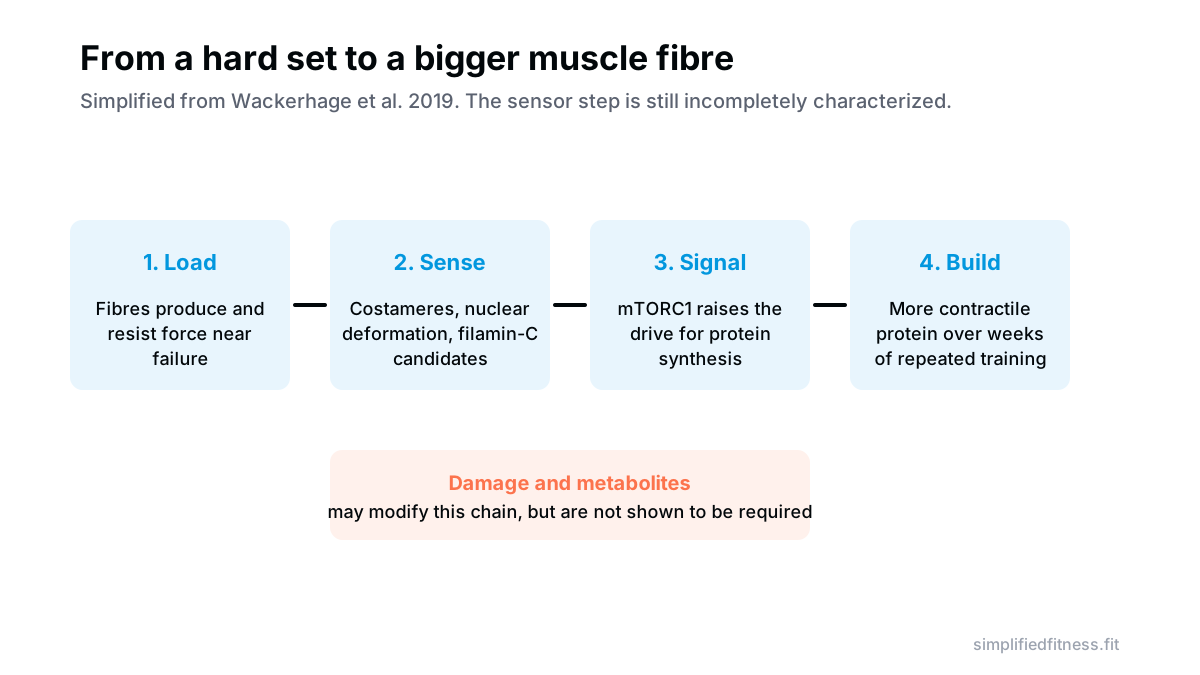
A 2019 review in the Journal of Applied Physiology looked at what actually initiates growth after resistance exercise. Its conclusion on the stimulus was direct: mechanical signals are the prime hypertrophy stimuli candidates (Wackerhage et al., 2019). The same review notes that mTORC1-mediated increases in muscle protein synthesis are the key, but not the only, mechanism by which resistance exercise causes hypertrophy.
Think of it like a switch. Something has to tell the muscle cell “this load is more than you are built for.” The leading ideas are that structures called costameres (the muscle’s anchoring points to its surrounding tissue) sense force, that nuclear deformation sends a signal, and that a protein complex involving filamin-C and BAG3 helps regulate mTORC1, Hippo and autophagy signalling. The review calls that last one plausible but still incompletely characterized.
So the honest summary is: we are confident mechanical loading is central, and we are still working out exactly which sensor does the job.
Is muscle damage necessary for muscle growth?
Probably not. Three lines of evidence point the same way.
1. A direct test of the hypothesis. Flann and colleagues split people into two groups. One group did a three-week gradual ramp-up that avoided demonstrable damage. The other group was thrown into an initial damaging bout. Both then did eight weeks of high-force eccentric cycling designed to equate total work. The unaccustomed group showed more than five times higher plasma creatine kinase and reported soreness, yet muscle size gains and strength gains were not different between groups (about 25% vs 26% strength improvement). The authors concluded that muscle rebuilding can be initiated without discernible damage (Flann et al., 2011).
2. Protein synthesis early on goes to repair. In ten young men followed over ten weeks, muscle protein synthesis after the first session was the highest, and so was damage, but neither was related to eventual hypertrophy. Later in the programme, as damage faded, the protein synthesis response became strongly related to hypertrophy (Damas et al., 2016).
3. The review that connects it. Damas and colleagues argue that the early rise in protein synthesis is likely directed at repair and remodelling, and that damage is not the process that mediates or potentiates hypertrophy (Damas et al., 2018).
Now the other side, because it is not quite settled. The 2019 review above says muscle damage is probably not essential, but also that it is still unclear whether and how damage could augment a growth response (Wackerhage et al., 2019). So “useless” would be too strong. “Not required, and not something to aim for” is the fair statement.
A caution on the evidence: the Flann trial and the ten-man protein synthesis study are small and used mostly untrained participants, so we should not stretch them to every advanced lifter. The 2018 review is also a review with a stated thesis, not a neutral meta-analysis.
Why do the first weeks of training make you look bigger?
If damage is not the driver, why do new lifters swell up fast? Because part of the early size gain is not muscle tissue.
In ten untrained young men, thigh muscle area measured by ultrasound rose about 2.7% by week 3 and about 10.4% by week 10 of training. Over the same period, the echo intensity of the image rose too, and the authors concluded that early increases are not purely hypertrophy because edema-induced swelling, probably due to damage, may account for a large proportion of the early change (Damas et al., 2016, Eur J Appl Physiol).
The 2018 review turns that into a proposed timeline. In the early phase (up to about 4 sessions), increases in muscle area are mostly attributable to damage-induced swelling. Around 10 sessions, a modest amount of hypertrophy appears. True hypertrophy is observed after roughly 18 sessions (Damas et al., 2018).
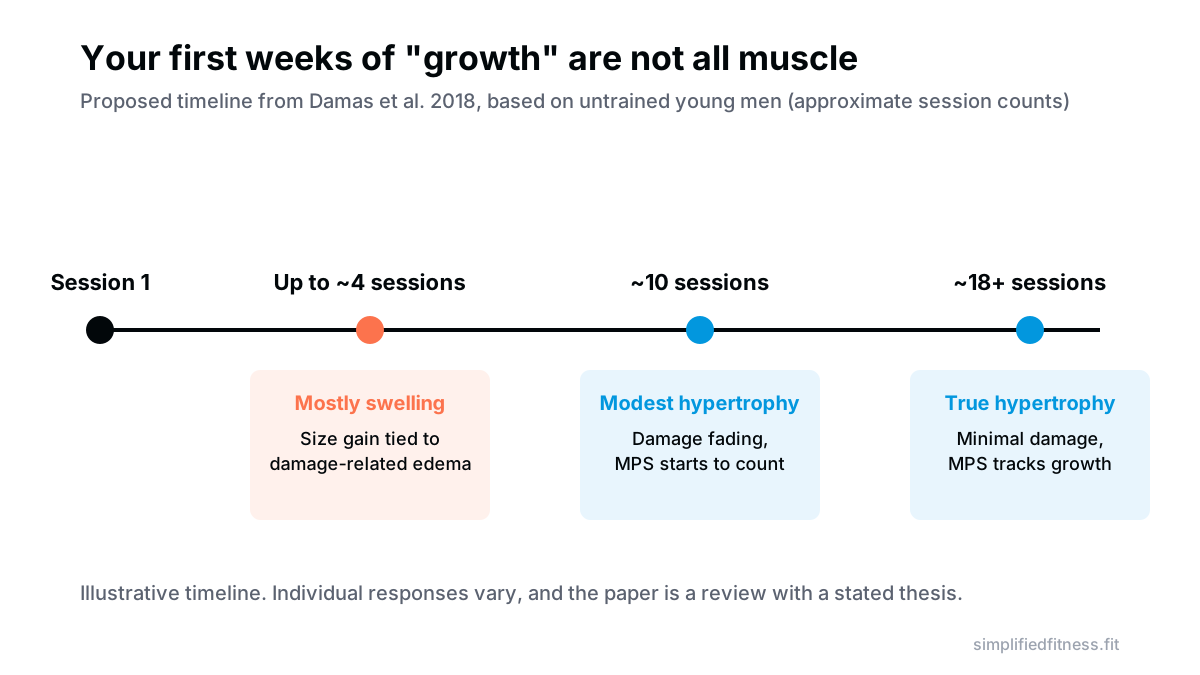
This is a proposal from research in untrained young men, not a law. The practical point still holds: a big jump in size or soreness in your first fortnight is not proof the plan is working, and a flat tape measure in week two is not proof it is failing.
What does metabolic stress add to hypertrophy?
Metabolic stress is the hardest of the three to judge. Here is what we can say.
Wackerhage’s review notes that interventions combining blood flow restriction (BFR) with low-load exercise suggest resistance exercise-regulated metabolites could be hypertrophy stimuli, but that this is based on indirect evidence and the metabolite candidates are poorly characterized (Wackerhage et al., 2019). In other words, the burn might matter, but nobody has pinned down which molecule does what.
BFR itself looks effective. A meta-analysis comparing high-load training with low-load training plus BFR found higher strength gains with high-load work, but similar hypertrophy between the two (Lixandrao et al., 2018). That tells us growth is possible without heavy loads. It does not tell us that metabolites are the reason, because BFR may also change how hard fibres have to work and which ones get recruited. We cover the details in our guide to how blood flow restriction works for hypertrophy.
Do you need heavy weights, or can light weights work too?
This is where the tension idea gets practical. If tension means “force through the fibres near failure,” then load is only one way to get there.
A meta-analysis of 21 studies compared low-load training (60% of 1RM or less) with high-load training, with all sets taken to momentary failure. Gains in 1RM strength favoured high loads, isometric strength did not differ, and measures of hypertrophy were similar between conditions. The authors concluded that muscle hypertrophy can be achieved across a spectrum of loading ranges (Schoenfeld et al., 2017).
The key phrase is “taken to failure.” Light sets stopped far short of failure are a different thing. Our deeper comparison is in high-load vs low-load hypertrophy, and the reason heavy and light sets can both recruit the big fibres is explained in Henneman’s size principle.
| Approach | What you feel | What the evidence suggests |
|---|---|---|
| Heavy sets (about 5-10 reps) close to failure | Hard, low burn, strong effort | Good hypertrophy and the best 1RM strength gains |
| Lighter sets (20+ reps) taken to failure | Brutal burn, discomfort | Similar hypertrophy in meta-analysis, smaller 1RM gains |
| Lighter sets stopped far from failure | Easy, mild pump | Not what these trials tested, likely a weaker stimulus |
| Extreme damaging session | Heavy soreness for days | Not shown to add growth, may hurt next session |
The last two rows are coaching logic rather than cited results. Light sets far from failure were not part of the meta-analysis, and for the damaging session the reasoning is simple: if you cannot train a muscle properly for several days, you lose quality work, and quality work is where the tension comes from.
What does this mean for how you train?
Put it together and the rules are simple.
- Choose exercises you can load progressively and control. Machines, cables and dumbbells are as good as barbells for this. If you want a ready structure, our push, pull and legs plan is built this way.
- Train close to failure. Most working sets should end within a few reps of failure. Use the RIR/RPE calculator to practise judging that, and read training to failure vs RIR for the evidence.
- Progress the numbers slowly. More reps, more weight or better control, week by week. This is the part people skip.
- Introduce new exercises gently. Start with fewer sets so you do not turn a new movement into a week of limping. Your muscles adapt quickly, which is covered in the repeated bout effect.
- Treat the pump and the burn as a bonus. They tell you which muscle you hit. They do not prove the session worked.
For the soreness side of this story, including what DOMS really tells you, see DOMS and muscle growth and the full breakdown in our article on the exercise-induced muscle damage myth. For how long the growth signal lasts after a session, read the muscle protein synthesis timeline.
When should you see a doctor about muscle soreness?
Normal soreness peaks within a day or two and settles over several days. See a doctor promptly if you have severe pain with marked swelling, very dark or cola-coloured urine, weakness out of proportion to the session, or soreness that does not settle. Those can be signs of a serious muscle injury, and this article cannot diagnose them.
The bottom line
The three-mechanism model is a useful map, but the territory is lopsided. Mechanical tension has the strongest case as the main growth stimulus. Metabolic stress might help, and the evidence is indirect. Muscle damage is probably a by-product, not a goal, and early size gains in beginners are partly swelling.
So stop chasing useless fatigue. Pick sound exercises, take sets close to failure, and add a little more over time. Track your volume with the training volume calculator and let the numbers, not the soreness, tell you if you are on the right path.
Frequently Asked Questions
What is the main driver of muscle growth?
Mechanical tension is the best-supported driver. Reviews describe mechanical signals as the prime candidate for the stimulus that starts hypertrophy, with sensors in the muscle cell feeding into mTORC1 and muscle protein synthesis. In practice, that means hard sets close to failure with a load and rep range you can progress.
Do you need to damage the muscle to grow it?
Probably not. In a trial comparing a gradual ramp-up group (no detectable damage) with an unaccustomed group (clear damage markers), muscle size and strength gains were the same. Treat soreness as an optional side effect and focus on progressive overload instead.
Does muscle soreness mean a good workout?
No, soreness is a poor yardstick for growth. It depends heavily on how new the exercise is to you, and it fades with repetition even while you keep growing. Judge sessions by performance (load, reps, proximity to failure), not by how sore you feel the next day.
What is metabolic stress in hypertrophy?
Metabolic stress is the build-up of metabolites in the muscle during sets, which you feel as the burn and the pump. It might act as a growth signal, but a 2019 review says this rests on indirect evidence and the candidate metabolites are poorly characterized. Do not chase the burn at the cost of load or form.
Is the pump important for muscle growth?
The pump is not proven to cause growth. It reflects fluid and blood moving into the working muscle, and it may be linked to metabolic stress, but direct evidence is thin. Enjoy it as a useful sign that you are training the right muscle, not as a target.
What is mechanotransduction?
Mechanotransduction is how a cell converts physical force into chemical signals. In muscle, candidate sensors include structures called costameres and signals that arise from nuclear deformation, which feed into pathways such as mTORC1. You do not need to manage this directly, because lifting with enough effort supplies the signal.
Is muscle damage completely useless for hypertrophy?
It is not proven to be useless, but it is probably not required. A 2019 review says it is unclear whether and how damage could augment growth, while a 2018 review concludes it does not mediate or potentiate hypertrophy. Do not deliberately train to wreck yourself.
Does lifting light weights to failure build muscle?
Yes, it can. A meta-analysis of 21 studies found similar hypertrophy for low-load (60% of 1RM or less) and high-load training when sets were taken to failure, though heavy loads gave bigger 1RM strength gains. Pick loads you can control, and push close to failure.
Does blood flow restriction training prove metabolic stress matters?
It supports the idea, but does not prove it. A meta-analysis found similar hypertrophy between high-load training and low-load training with blood flow restriction, which suggests something other than heavy load can drive growth. The mechanism is still debated, so use BFR only if you understand it or have guidance, particularly if you have any health conditions.
Why do beginners gain size so fast in the first month?
Part of the early increase is swelling, not new contractile tissue. In ten untrained men, ultrasound showed muscle area rising about 2.7% by week 3 alongside signs of edema, and about 10.4% by week 10. If you are new, expect real strength progress early and treat the tape measure with some caution.
How many sessions until I see real hypertrophy?
One review proposes true hypertrophy appears after around 18 sessions, with a modest amount at around 10. That is a proposal built from a small body of research in untrained people, so individual timelines vary. Stay consistent for at least two to three months before judging a program.
Should I avoid being sore after workouts?
You do not need to avoid it, but you do not need to chase it either. Heavy soreness can make your next session worse, so start new exercises with a moderate number of sets and build up. If soreness is severe, comes with dark urine or marked swelling, or does not settle, see a doctor.
What should I do in the gym to maximise tension?
Use a full, controlled range of motion, pick loads in a range where you can add reps or weight over time, and finish most sets within a few reps of failure. Track your numbers and aim to beat them gradually. Our RIR/RPE calculator helps you set how close to failure to go.
Sources & References
Every claim above is checked against peer-reviewed research (PubMed, U.S. National Library of Medicine) or guidance from established health bodies. How we fact-check.
- Schoenfeld BJ. The mechanisms of muscle hypertrophy and their application to resistance training. J Strength Cond Res. 2010. PMID: 20847704
- Wackerhage H, et al. Stimuli and sensors that initiate skeletal muscle hypertrophy following resistance exercise. J Appl Physiol. 2019. PMID: 30335577
- Damas F, et al. The development of skeletal muscle hypertrophy through resistance training: the role of muscle damage and muscle protein synthesis. Eur J Appl Physiol. 2018. PMID: 29282529
- Damas F, et al. Resistance training-induced changes in integrated myofibrillar protein synthesis are related to hypertrophy only after attenuation of muscle damage. J Physiol. 2016. PMID: 27219125
- Flann KL, et al. Muscle damage and muscle remodeling: no pain, no gain? J Exp Biol. 2011. PMID: 21270317
- Schoenfeld BJ, et al. Strength and hypertrophy adaptations between low- vs. high-load resistance training: a systematic review and meta-analysis. J Strength Cond Res. 2017. PMID: 28834797
- Lixandrao ME, et al. Magnitude of muscle strength and mass adaptations between high-load resistance training versus low-load resistance training associated with blood-flow restriction: a systematic review and meta-analysis. Sports Med. 2018. PMID: 29043659
- Damas F, et al. Early resistance training-induced increases in muscle cross-sectional area are concomitant with edema-induced muscle swelling. Eur J Appl Physiol. 2016. PMID: 26280652

Umair Hazrami · Founder & Head Coach, Simplified Fitness
Umair Hazrami founded Simplified Fitness and the Simplified Lifter channel to cut through fitness noise. With 4+ years of consistent training and 10+ coaching clients, he writes every guide from the peer-reviewed research and links the sources so you can check them. Our editorial standards.
Educational content only, not medical advice. If you have a medical condition, are pregnant, or take medication, talk to a qualified doctor before changing your diet, supplements or training. Full disclaimer.
Keep reading

Hypertrophy
Anabolic Resistance in Older Adults: Why Muscle Responds Less and How to Beat It
Anabolic resistance in older adults explained: why muscle responds less to protein and lifting after 50, plus the protein dose, leucine and sets that help.
8 min read

Hypertrophy
How Blood Flow Restriction Builds Muscle: Venous Occlusion, Metabolites and Cell Swelling
BFR training hypertrophy mechanisms explained: how a cuff and 20% 1RM can match heavy lifting for size. Metabolites, swelling, mTOR, myostatin and cuff safety.
8 min read
Hypertrophy
CNS Fatigue vs Muscle Fatigue: Is Your Nervous System Really Fried?
CNS fatigue vs muscle fatigue: what central and peripheral fatigue really are, how long each lasts, and how to tell which one is holding your lifts back.
9 min read

Hypertrophy
Exercise-Induced Muscle Damage (EIMD): Why Chasing Soreness Is Counterproductive
Muscle damage and hypertrophy are not the same thing. See what Z-disc streaming studies show, why soreness is a poor gauge of growth, and what to track.
8 min read