Satellite Cells and Myonuclei: How Muscle Fibers Add Nuclei to Grow
Do satellite cells matter for muscle hypertrophy? See how muscle stem cells add nuclei to growing fibers, what research shows, and what it means for training.

TL;DR. The short answer
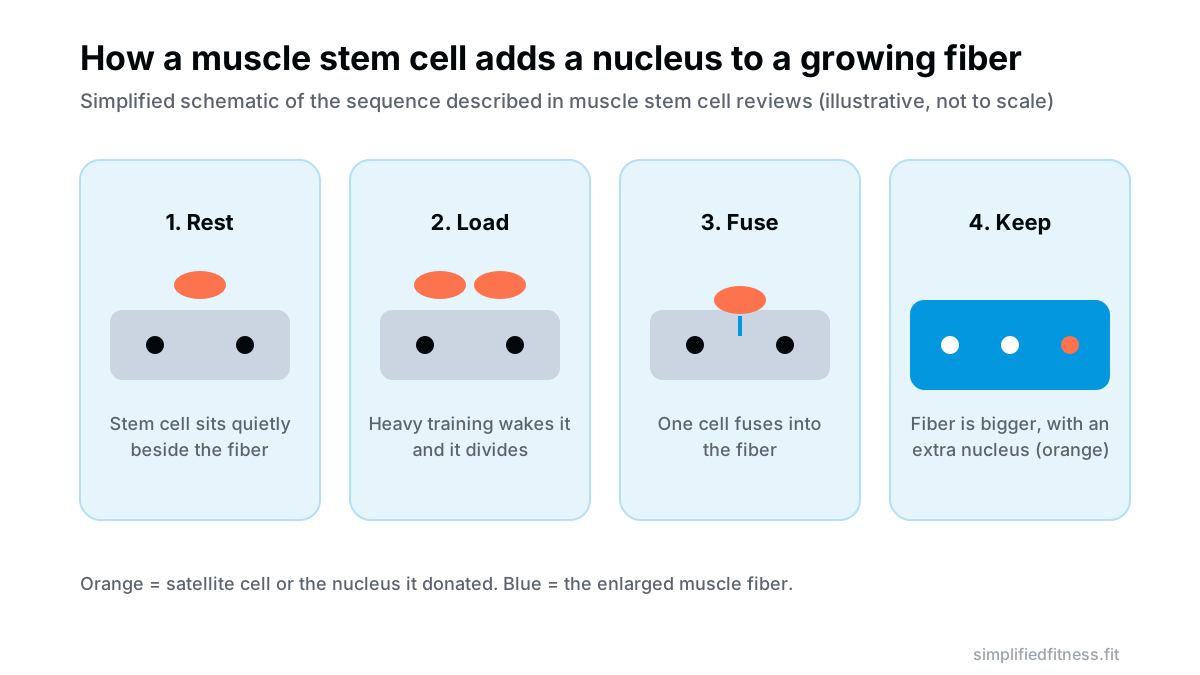
- Satellite cells are muscle stem cells that sit beside each fiber. When you train hard, some of them fuse into the fiber and donate a nucleus, which gives the fiber more genetic machinery to support a bigger size.
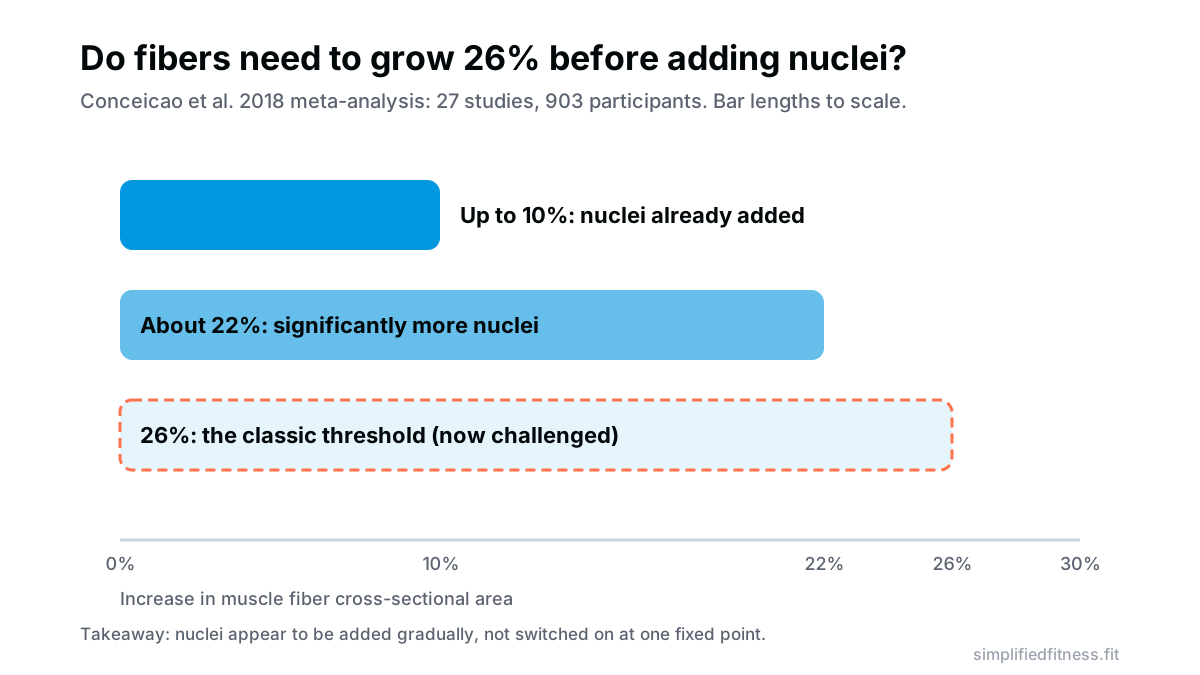
- The old rule that fibers must grow about 26% before adding nuclei has been challenged. A 2018 meta-analysis of 27 studies found nuclei were added even when fibers grew 10% or less, with more consistent addition around 22% growth.
- Whether new nuclei are strictly required for hypertrophy is still debated. Two mouse studies using the same method reached opposite conclusions, so the honest answer is that a role is likely but the exact limit is unsettled.
- In one human study, extra nuclei were still present after 16 weeks of detraining, although the muscle did not clearly regrow faster afterwards. Myonuclei look durable, but the practical payoff is unproven.
- In older men, one 6-week study found nuclei were added just as well as in younger men, so reduced nuclei addition does not seem to explain why growth slows with age.
Part of our complete guide: How Muscle Actually Grows: The Natural Lifter's Guide to Hypertrophy Science
Table of contents
Satellite cells are muscle stem cells that sit next to each fiber and, when you train hard, fuse into it and donate an extra nucleus. That extra nucleus lets a growing fiber keep up with its own size. The role of satellite cells in muscle hypertrophy is real, but how strictly a fiber depends on them is still being argued over.
This article is the cell-level view of the process described in our complete guide to muscle hypertrophy for natural lifters. If you want what to actually do in the gym, that guide has it. Here we look at what is happening inside the fiber, what is solid, what is contested, and why none of it should change your training much.
What are satellite cells and why do lifters care?
A muscle fiber is not a normal cell. It is a very long cell with many nuclei spread along its length, each holding the DNA blueprint the nearby section uses to make protein. Satellite cells are the stem cells parked on the outside of the fiber, mostly dormant.
Reviews describe them as quiet until high mechanical loading pushes them out of that resting state, after which they proliferate, and they are the cells responsible for the increased number of myonuclei (Fukada et al., 2021). The same review notes that this activation can happen without the fiber being damaged. That fits an earlier review of hypertrophy mechanisms, which concluded that mechanical tension, muscle damage and metabolic stress can all play a role in growth, so damage is only one candidate signal among several (Schoenfeld, 2010). For the tension story, see mechanical tension vs muscle damage.
What is the myonuclear domain theory?
The myonuclear domain theory says each nucleus looks after a roughly fixed volume of fiber. Grow past that volume and you need more nuclei. In the version most lifters have heard, fibers must enlarge by about 26% before new nuclei get added (Conceição et al., 2018).
Is the domain really fixed? A review of the evidence says no. Domain size appears to increase during overload-induced growth and shrink during disuse and ageing, so the idea of a constant size should be treated cautiously. Only once the domain passes a certain threshold would new nuclei be needed for further growth (Van der Meer et al., 2011). In other words, the domain stretches, and there is a limit somewhere. Nobody has pinned down exactly where.
Do fibers need to grow 26% before adding nuclei?
Probably not. The best test of the threshold idea is a 2018 systematic review and meta-analysis of 27 studies, 62 treatment groups and 903 people. It found that fiber growth of 10% or less was already accompanied by more myonuclei. A significantly higher number of nuclei showed up when fibers grew around 22%. Age, sex and fiber type did not change the pattern (Conceição et al., 2018).
The authors conclude that nuclei addition is more consistent above 22% growth but that the idea of a hard threshold is challenged.
A shorter, smaller study points the same way. Ten men trained one leg with resistance exercise only and the other with aerobic plus resistance exercise for 5 weeks. Change in nuclei per fiber correlated strongly with change in fiber size (r above 0.8), so nuclei were being added during a very short training block (Lundberg et al., 2020). That is correlation, in ten young men, but it fits the meta-analysis.
Do you need satellite cells to build muscle? The mouse evidence disagrees
This is the genuinely contested part. Both studies below are in mice, so be careful about carrying them over to people.
In 2011, McCarthy and colleagues removed more than 90% of satellite cells in adult mice and then overloaded the plantaris muscle by removing a synergist muscle. After two weeks, the satellite-cell-depleted muscle grew by about the same amount as normal muscle, and the usual rise in myonuclei was missing, so each nucleus covered more fiber. They concluded that fibers can mount a strong overload response that does not depend on satellite cells (McCarthy et al., 2011).
In 2016, Egner and colleagues essentially repeated the experiment, but analysed fibers with immunohistochemistry and imaging. They found overload hypertrophy was prevented in satellite-cell-deficient mice, in two different muscles. They argued the earlier result came from using whole-muscle mass as a stand-in for fiber growth and from including regenerating fibers in the analysis. They also noted that regrowth after a layoff is different, since it can use myonuclei that are already present (Egner et al., 2016).
So which is right? Different measurement choices produced opposite answers from the same basic model. A large 2023 review of overload mechanisms lists satellite cell abundance and myonuclear accretion among the processes involved in hypertrophy, but also describes areas of disagreement about them (Roberts et al., 2023).
A cautious reading: satellite cells probably support sustained fiber growth. Egner and colleagues argue that no animal model has yet shown functional, lasting hypertrophy without them, though McCarthy’s group would dispute that. Either way, it is not a proven human requirement.
Do the nuclei stay when you stop training?
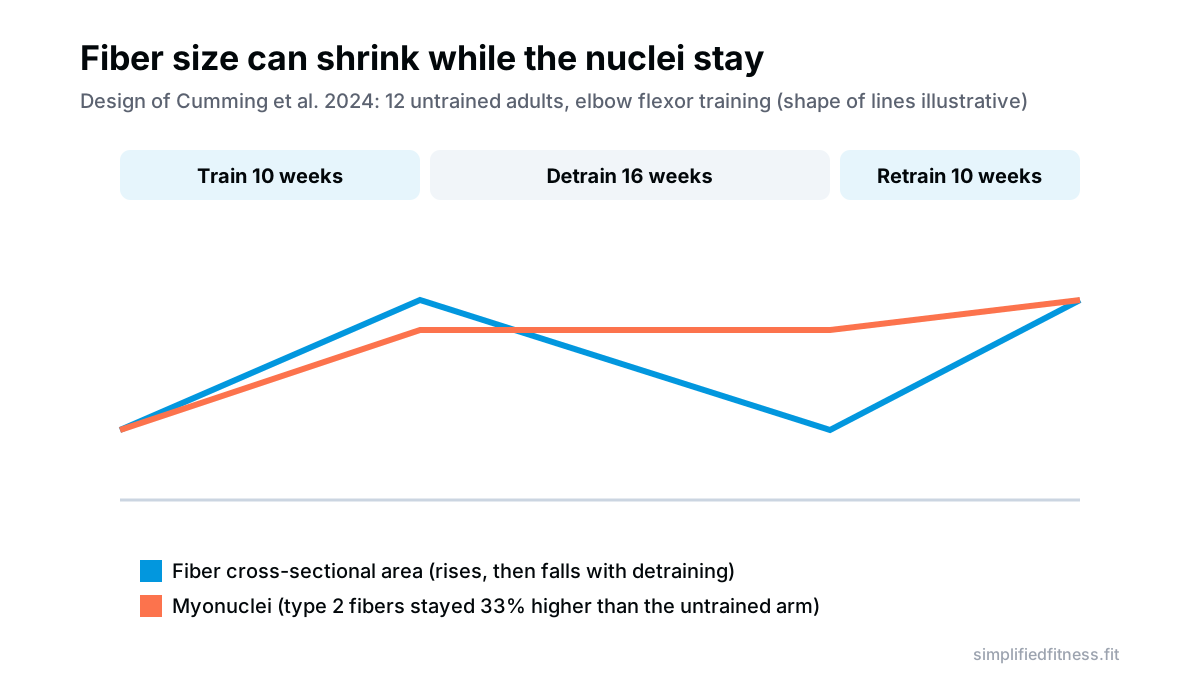
Here the human data are more interesting. Cumming and colleagues took 12 untrained men and women through 10 weeks of unilateral elbow flexor training, 16 weeks of detraining, and then 10 weeks of retraining with both arms, using biopsies along the way.
Myonuclei rose by 13% in type 1 fibers and 33% in type 2 fibers during training. After detraining, fiber size fell but nuclei were maintained, leaving type 2 fibers with 33% more nuclei in the previously trained arm than the untrained one (Cumming et al., 2024).
The caveat matters. After retraining, the previously trained arm ended up with larger type 2 fibers than the control arm, but the change in fiber size was not different between arms. The authors say the physiological benefit remains to be determined. Extra nuclei persisted. Whether they made regrowth faster is not shown.
This is the cellular basis of muscle memory. For the longer story, including gene-level changes, read muscle memory biology. For how fast size is lost in practice, see detraining timelines. We keep this article on the acute cell biology and leave regain to those two.
Does ageing run out of nuclei? What older lifters should know
A common assumption is that older muscle grows poorly because satellite cells fail to add nuclei. One study tested it directly. Younger men (about 23 years) and older men (about 69 years) did 6 weeks of unilateral resistance training with biopsies at baseline, 3 and 6 weeks.
Type 2 fiber area increased in the younger group but not significantly in the older group. Yet myonuclei counts increased similarly in both groups, in both fiber types, and DNA synthesis rates did not differ by age. The authors concluded that declines in myonuclei addition do not underlie impaired growth in older humans, pointing to ribosomal and protein-handling problems instead (Brook et al., 2023).
Retraining matters here too. In six older men with biopsies, type 2 fiber growth after 12 weeks of retraining came with a 72% increase in satellite cells and a 13% rise in myonuclei. Fiber size changes tracked myonuclear changes, leaving the domain stable. During the 12-week break before that, type 2 myonuclei also trended down by about 12%, which is a reminder that “permanent” nuclei are not guaranteed in older muscle (Blocquiaux et al., 2020). That is a small sample, and the paper’s own p-values hover near 0.05, so treat the numbers as indicative.
Note the apparent tension: the younger-versus-older study suggests nuclei addition is intact in age, while the retraining study found fiber size and nuclei moving together. These are not necessarily in conflict. Nuclei can be added in step with growth in both ages while the growth signal itself is weaker in older muscle. The practical read for older lifters is in our guide to anabolic resistance in older adults: train progressively, cover protein, and be patient.
What does this mean for your training?
Short answer: not much changes. You cannot directly train a satellite cell. What you can do is supply the stimulus that wakes them up.
- Load the muscle hard. Sets taken close to failure, in a rep range you can control, are the practical form of mechanical tension.
- Progress over time. Fibers that keep getting bigger are the ones that call for more nuclei.
- Eat enough protein. Satellite cells need raw material too. Our protein intake calculator gives a starting target.
- Do not chase soreness. Reviews report stem cell activation without fiber damage, so wrecking yourself is not required.
- Keep volume sane. Use the training volume calculator and see the weekly set volume dose-response curve.
Early gains in a new lifter also come partly from the nervous system, not only from added nuclei. We cover that split in neural adaptations vs muscle growth.
Limits of what we know
Most of the clean cell biology comes from mice, small human biopsy studies, or untrained volunteers. Biopsies are painful, so groups are small: 6, 10, 12 people. Fiber measurements also vary between labs. That is why the field still argues about thresholds.
If you have unexplained muscle loss or weakness, especially if it comes with pain or dark urine, see a doctor. Do not try to fix it with training articles.
Satellite cells are a strong part of the hypertrophy picture, and probably a long-term one. Keep lifting hard, add load when you can, and let the cells sort themselves out.
Frequently Asked Questions
What are satellite cells in muscle?
Satellite cells are resident muscle stem cells that sit on the surface of each muscle fiber, usually dormant. Under heavy mechanical loading some of them wake up, divide and fuse into the fiber. Think of them as a reserve pool of new nuclei that the fiber can draw on when it needs to grow.
What is a myonucleus?
A myonucleus is one of the many nuclei inside a single muscle fiber. Muscle fibers are giant multinucleated cells, and each nucleus holds the DNA instructions that the nearby part of the fiber uses to make proteins. More nuclei means more local capacity to build and maintain muscle protein.
What is the myonuclear domain theory?
It proposes that each nucleus supports a roughly fixed volume of fiber, so a fiber has to add nuclei once it grows beyond that limit. A review of the evidence suggests the domain size is not truly fixed and likely stretches during growth, so new nuclei may only be needed past some threshold. That threshold has not been pinned down.
Do you need satellite cells to build muscle?
We do not know for certain, because mouse studies disagree. McCarthy and colleagues found normal overload growth after removing over 90% of satellite cells, while Egner and colleagues repeated the work with different imaging and found growth was prevented. Both are animal studies, so they do not settle the question for lifters; keep training hard and progress anyway.
Do you have to grow 26% before new myonuclei are added?
Probably not. A 2018 meta-analysis of 27 studies found myonuclei were added with fiber growth of 10% or less, though addition was more consistent at around 22%. Treat the 26% figure as an old estimate, not a switch your biceps flip.
Do myonuclei stay after you stop training?
In one human study of 12 untrained adults, extra nuclei in type 2 fibers were still there after 16 weeks of detraining, giving 33% more than the untrained arm. The fibers shrank but the nuclei stayed. This is the cellular idea behind muscle memory, so see the muscle memory article for the full story.
Why does muscle growth slow down as we age?
Ageing blunts growth in several ways, and one 6-week study in older men found myonuclei were added as well as in younger men. The authors pointed instead to impaired ribosome and protein-handling processes. The practical response is to keep training with progressive loading and cover protein needs.
Do satellite cells decline with age?
The picture in humans is not simple, and I would not assume satellite cells simply run out. In a 6-week study, older men added myonuclei about as well as younger men. Resistance training remains the best-supported way to keep muscle in later life.
Can you increase satellite cells with training?
Probably, in the context of growth. In six older men with biopsies, 12 weeks of retraining after a break came with a 72% rise in satellite cell number in type 2 fibers. That is a tiny sample, so treat it as a hint, not a rule.
Do I need supplements or special training to activate satellite cells?
No supplement has been shown to reliably do this in lifters. The best-supported trigger is mechanical load: lifting hard sets close to failure with progressive overload. Spend your money on food and consistency instead.
Do satellite cells mean muscle damage is needed to grow?
No. A review of muscle stem cells notes that satellite cells can proliferate in response to mechanical loading without fiber damage. Heavy tension seems to be enough, so you do not need to chase extreme soreness.
Is the number of muscle fibers fixed?
The studies in this article measure growth as fibers getting bigger, which is the main thing lifters should care about. In the McCarthy mouse study, fiber hyperplasia (more fibers) was only a small part of the response and was blunted without satellite cells. For practical training, assume you are growing the fibers you already have.
Sources & References
Every claim above is checked against peer-reviewed research (PubMed, U.S. National Library of Medicine) or guidance from established health bodies. How we fact-check.
- Conceição MS, et al. Muscle Fiber Hypertrophy and Myonuclei Addition: A Systematic Review and Meta-analysis. Med Sci Sports Exerc. 2018. PMID: 29509639
- McCarthy JJ, et al. Effective fiber hypertrophy in satellite cell-depleted skeletal muscle. Development. 2011. PMID: 21828094
- Egner IM, et al. Satellite cell depletion prevents fiber hypertrophy in skeletal muscle. Development. 2016. PMID: 27531949
- Cumming KT, et al. Muscle memory in humans: evidence for myonuclear permanence and long-term transcriptional regulation after strength training. J Physiol. 2024. PMID: 39159314
- Brook MS, et al. Neither myonuclear accretion nor a myonuclear domain size ceiling is a feature of the attenuated hypertrophic potential of aged human skeletal muscle. Geroscience. 2023. PMID: 36083436
- Lundberg TR, et al. Early accentuated muscle hypertrophy is strongly associated with myonuclear accretion. Am J Physiol Regul Integr Comp Physiol. 2020. PMID: 32432913
- Blocquiaux S, et al. The effect of resistance training, detraining and retraining on muscle strength and power, myofibre size, satellite cells and myonuclei in older men. Exp Gerontol. 2020. PMID: 32017951
- Van der Meer SF, et al. Is the myonuclear domain size fixed? J Musculoskelet Neuronal Interact. 2011. PMID: 22130137
- Fukada SI, et al. Exercise/Resistance Training and Muscle Stem Cells. Endocrinol Metab (Seoul). 2021. PMID: 34372625
- Roberts MD, et al. Mechanisms of mechanical overload-induced skeletal muscle hypertrophy: current understanding and future directions. Physiol Rev. 2023. PMID: 37382939
- Schoenfeld BJ. The mechanisms of muscle hypertrophy and their application to resistance training. J Strength Cond Res. 2010. PMID: 20847704

Umair Hazrami · Founder & Head Coach, Simplified Fitness
Umair Hazrami founded Simplified Fitness and the Simplified Lifter channel to cut through fitness noise. With 4+ years of consistent training and 10+ coaching clients, he writes every guide from the peer-reviewed research and links the sources so you can check them. Our editorial standards.
Educational content only, not medical advice. If you have a medical condition, are pregnant, or take medication, talk to a qualified doctor before changing your diet, supplements or training. Full disclaimer.
Keep reading

Hypertrophy
Anabolic Resistance in Older Adults: Why Muscle Responds Less and How to Beat It
Anabolic resistance in older adults explained: why muscle responds less to protein and lifting after 50, plus the protein dose, leucine and sets that help.
8 min read

Hypertrophy
How Blood Flow Restriction Builds Muscle: Venous Occlusion, Metabolites and Cell Swelling
BFR training hypertrophy mechanisms explained: how a cuff and 20% 1RM can match heavy lifting for size. Metabolites, swelling, mTOR, myostatin and cuff safety.
8 min read

Hypertrophy
CNS Fatigue vs Muscle Fatigue: Is Your Nervous System Really Fried?
CNS fatigue vs muscle fatigue: what central and peripheral fatigue really are, how long each lasts, and how to tell which one is holding your lifts back.
9 min read

Hypertrophy
Exercise-Induced Muscle Damage (EIMD): Why Chasing Soreness Is Counterproductive
Muscle damage and hypertrophy are not the same thing. See what Z-disc streaming studies show, why soreness is a poor gauge of growth, and what to track.
8 min read