Sarcoplasmic vs Myofibrillar Hypertrophy: Bodybuilding Myth vs Cellular Reality
Sarcoplasmic vs myofibrillar hypertrophy: is bodybuilder muscle just fluid? We read the biopsy and electron microscopy studies so you do not have to guess.

TL;DR. The short answer
- The idea that bodybuilders grow 'fluffy' sarcoplasm while powerlifters grow 'dense' myofibrils has no direct trial support. No study shows that a rep range builds one compartment and skips the other.
- A small biopsy study found muscle fibers grew 23% over 6 weeks of high-volume training while measured actin and myosin concentration fell by about 30%, but the result was borderline significant and came from 15 trained men.
- A different trial using heavy, low-volume training for 10 weeks saw almost no change in sarcoplasmic protein or muscle fluid. Findings differ by program, so treat sarcoplasmic expansion as plausible but unsettled.
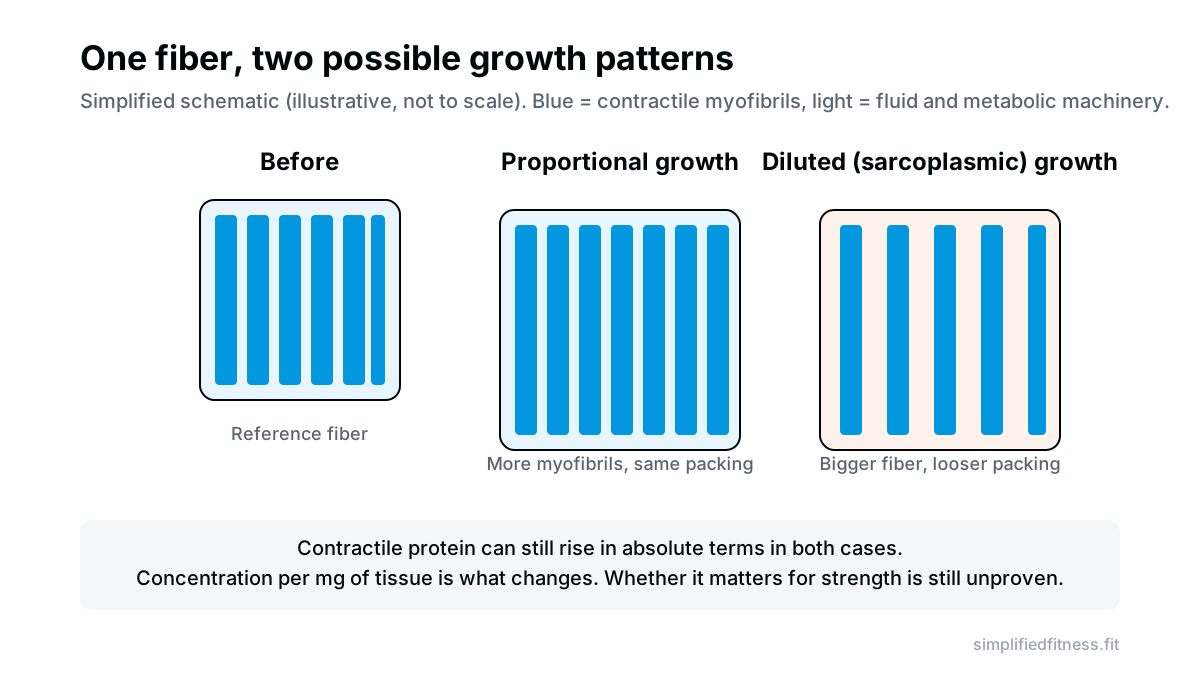
- Even in the 'diluted' scenario, total contractile protein can still go up. What changes is how tightly it is packed, and nobody has shown that packing density decides your strength.
- Practical answer: train hard sets near failure across a mix of loads, progress over time, and ignore labels like 'sarcoplasmic workout'.
Part of our complete guide: How Muscle Actually Grows: The Natural Lifter's Guide to Hypertrophy Science
Table of contents
Is bodybuilder muscle just water and sarcoplasm, while powerlifter muscle is “dense”? Not in any way the research can prove. Sarcoplasmic vs myofibrillar hypertrophy is a real topic in muscle biology, but the gym version of it (high reps for fluff, heavy singles for density) has never been demonstrated in a trial.
Here is what the biopsies and electron microscopy studies actually show, where they disagree, and what to do with your training. This is a deep-dive inside our complete guide to muscle hypertrophy for natural lifters, so start there if you want the full picture.
What do sarcoplasmic and myofibrillar mean?
A muscle fiber is a long cell. Inside it you have two broad compartments.
- Myofibrillar: the contractile machinery. Actin, myosin and the other proteins arranged in sarcomeres, bundled into myofibrils. This is the part that shortens and produces force.
- Sarcoplasmic: everything else inside the cell. Fluid, glycogen, enzymes for energy production, mitochondria, the sarcoplasmic reticulum. Often called “non-contractile,” though that is slightly misleading because these parts keep the contractile machinery running.
The popular claim is that you can grow one without the other. Train in the 8-15 rep range and you get “sarcoplasmic” size. Lift heavy for fives and you get “myofibrillar” size. Neat story. The problem is that no one has run a trial showing a rep range does that.
Is sarcoplasmic hypertrophy real?
This is where it gets interesting, because there is real data behind the debate. It is just thinner than forum posts make it sound.
The 6-week biopsy study
In 2019, a research group at Auburn University had 30 previously trained men (average 5 years of training) do 6 weeks of high-volume resistance training with biopsies of the vastus lateralis before, at week 3 and at week 6. They then looked closer at 15 men whose fibers clearly grew (Haun et al., 2019).
In those 15 responders:
- Mean fiber cross-sectional area rose 23%.
- Muscle glycogen concentration did not change.
- Citrate synthase activity, a marker of mitochondrial volume, fell 24%.
- Actin and myosin concentrations fell roughly 30%, though the statistical tests only approached significance (p = 0.052 and 0.055).
- Proteins tied to glycolysis and other energy pathways went up in the sarcoplasmic fraction.
Eight days after the last session, seven of the participants were biopsied again. Sarcoplasmic protein concentration was still higher than baseline and actin and myosin were still lower.
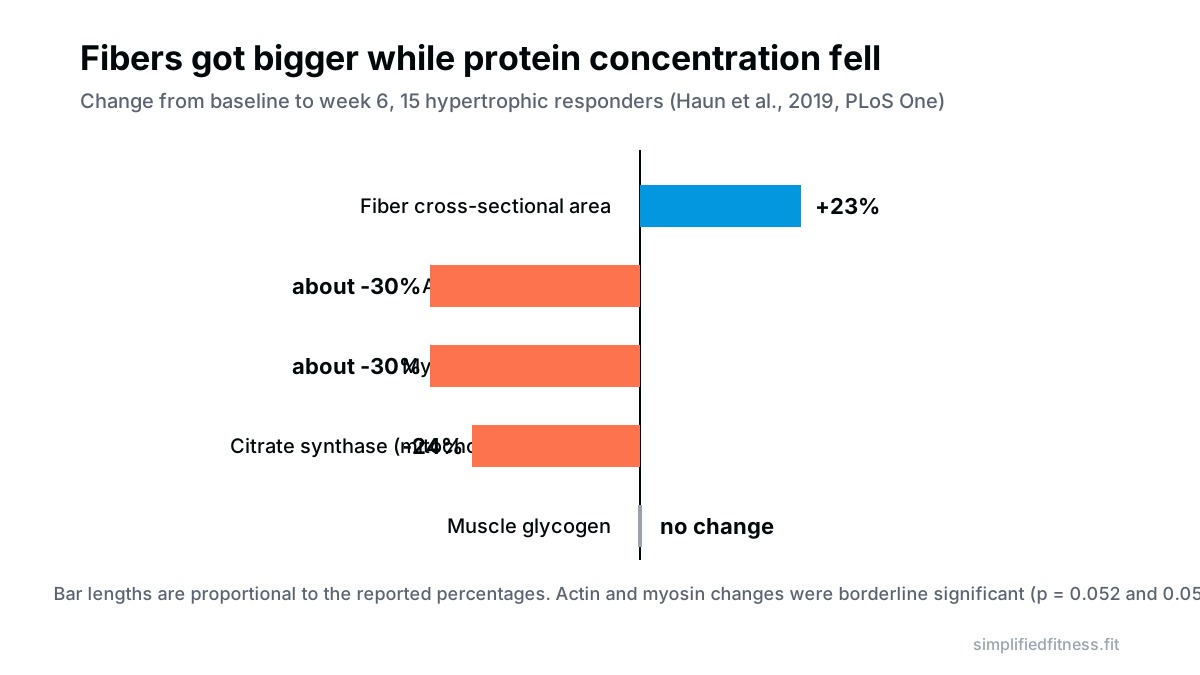
The authors read this as sarcoplasmic expansion: the fiber got bigger, and the contractile proteins became more diluted. Reasonable reading. It also comes with caveats: only 15 men, borderline p-values in the main analysis, one program, and commercial funding among the supporters (Impedimed, plus a gift in kind through a coaching company, both disclosed in the paper).
The review that reframes the whole question
The same lab, with Brad Schoenfeld and others, wrote a critical review the same year. It points out that the textbook model assumes fiber growth comes with proportional growth in myofibrillar protein, but that there is “ample evidence” that myofibrillar concentration may be diluted by sarcoplasmic expansion as fibers grow. It also notes that changes at the whole-muscle, fiber and molecular levels are often poorly correlated with one another (Haun et al., 2019).
Read that twice. The honest conclusion is not “sarcoplasmic hypertrophy is the main thing.” It is “our measurements of what happens inside the fiber are noisy, and the neat model is shakier than the textbooks suggest.”
Does the evidence agree? No.
Conflicting results deserve a fair hearing, so here they are.
Study A, high volume (2019). Trained men, 6 weeks, high volume. Fiber area up, actin and myosin concentration down, sarcoplasmic proteins up (Haun et al., 2019).
Study B, high load, low volume (2020). Fifteen recreationally trained men did full-body, low-volume training at 68-90% of 1RM for 10 weeks. Type II fiber area and squat strength rose. But sarcoplasmic protein concentration and muscle tissue percent fluid did not change, myosin heavy chain trended slightly down (-2.9%, p = 0.069) and actin dropped about 3.2%. Only 13 sarcoplasmic proteins changed, and metabolism-related proteins were not affected (Vann et al., 2020). Odd detail: whole-body fat-free mass decreased in that study, which tells you how messy these outcomes can be.
Study C, 12 weeks in untrained men (2018). Researchers split young men by how much muscle they gained. Myofibrillar and sarcoplasmic protein concentrations did not differ between high and low responders, before or after training. Citrate synthase fell over time across both groups, and high responders had higher citrate synthase activity overall (Roberts et al., 2018).
Why might they differ? Different training volumes, different populations (trained versus untrained), different measurement methods, small samples, and the simple fact that biopsy results from one spot in one muscle are noisy. A cautious reading: sarcoplasmic expansion can probably happen, particularly with high-volume work in trained people, but the size and consistency of the effect is not established, and heavy lower-volume training looks less likely to produce it.
Do bodybuilders and powerlifters have different muscle density?
This is the part that fuels most of the arguments, so let’s be exact about what the old data say.
In 1982, MacDougall and colleagues took triceps biopsies from two international-level powerlifters and five elite bodybuilders, plus five volunteers measured before and after 6 months of arm training. Fiber areas in the elite group were not significantly different from the trained controls, despite far bigger arms and strength, which suggests the elite group simply had more fibers. Myofibrillar volume density was significantly lower and cytoplasmic volume density higher in the elite group than in the trained controls. The authors also noted more structural abnormalities in the elite group and said these might be associated with anabolic steroid use (MacDougall et al., 1982).
Three things matter here:
- The powerlifters and bodybuilders were analyzed as one elite group. Seven people. You cannot read off “bodybuilders are less dense than powerlifters” from that paper.
- Possible steroid use is flagged by the authors, so this may not describe natural lifters.
- It is a snapshot of people with extreme muscle, not a trial of what a rep range does.
In another small data point, a 2020 pilot of 18 men (6 per group) found total myofibrillar protein per mg of muscle was higher in trained men than in older untrained men, but not significantly different from younger untrained men. Actin and myosin abundance per mg was higher in the trained men than in both untrained groups. The authors described the packing difference as modest (about 9%) and called the results preliminary, given the small groups (Vann et al., 2020). So if there is a “density” difference between trained and untrained muscle, the best available data say it is modest.
None of this proves bodybuilders and powerlifters build different tissue. What it tells you: elite people differ in many ways, and the cleanest explanation for very large muscles may be fiber number and total volume of tissue, not a fancy fiber recipe.
What about glycogen and mitochondria?
These are the usual suspects for “non-contractile growth.”
Glycogen. It binds water, so more glycogen can mean a fuller-looking muscle, which is why a high-carb day can change how you look in the mirror. In the 6-week high-volume study, though, muscle glycogen concentration did not change (Haun et al., 2019). So glycogen did not explain the fiber growth in that trial. The short-term swelling you feel mid-workout is a different thing; we cover it in gym pump vs true muscle hypertrophy.
Mitochondria. Older work found that 6 months of heavy training in six men reduced mitochondrial volume density by 26% and the effect correlated with fast-twitch fiber growth (r = 0.845). The authors concluded this was dilution from larger myofibrils, not a loss of mitochondria (MacDougall et al., 1979). Newer trials found falling citrate synthase activity too, in the 6-week study (24% drop) and in the 12-week study. Mitochondrial markers per unit of muscle fall as fibers grow. That does not mean you lose conditioning. It means a bigger fiber has to build more machinery just to keep the same density.
Does this change how you should train?
Short answer: not much.
If sarcoplasmic expansion is real, it is not something you can aim at. If myofibrillar growth is the main driver, it is not something you can isolate. Either way, the practical levers are the same ones that drive growth in general.
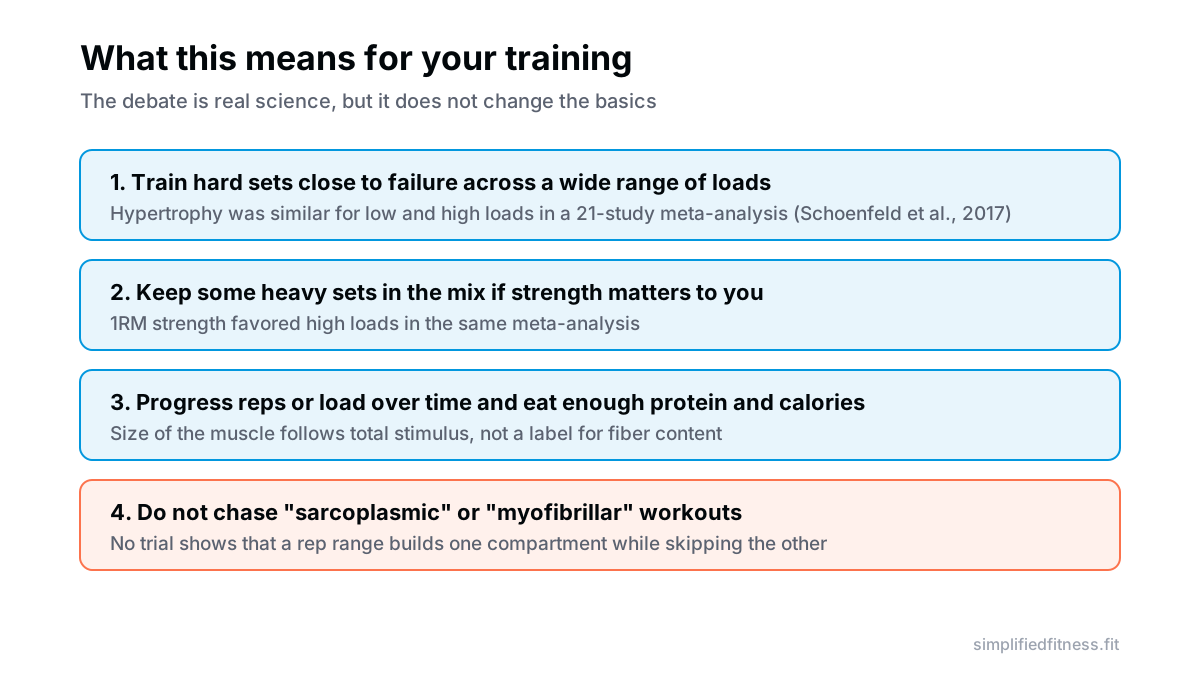
Heavy and light loads grow muscle similarly. A meta-analysis of 21 trials with sets taken to failure found hypertrophy was similar between low-load (60% 1RM or less) and high-load training, while 1RM strength favored heavy loads (Schoenfeld et al., 2017). A later review argued that muscular adaptations can be obtained across a wide range of loading zones, challenging the idea of a strict “hypertrophy rep range” (Schoenfeld et al., 2021). If you want the deeper breakdown, see high-load vs low-load hypertrophy.
Here is how to apply it:
- Use a mix. Heavy compounds around 5-10 reps for strength and some lighter, higher-rep isolation work for muscle and joint comfort.
- Take sets close to failure. Reps far from failure with light loads are where “pump work” stops being productive.
- Progress something. More reps, a little more weight, better control. Our training volume calculator helps you check how many hard sets per muscle you are actually doing each week.
- Do not turn this into a program design question. A balanced split like the ones on our free plans page already covers a sensible spread of ranges.
Why does the myth stick around?
Three reasons, all understandable.
First, elite bodybuilders and elite powerlifters really do look and perform differently. That is easy to read as different tissue, when selection, genetics, body composition, drug use and training goals all differ too.
Second, strength-to-size ratio varies between people. Neural factors, tendon insertions and limb length, and technique shape strength, so “strong for his size” is not evidence for dense fibers. That connects to how fast and slow fibers respond to training and to what actually drives growth, which we cover in mechanical tension vs muscle damage.
Third, the biology is not fully settled, so each side can quote a paper. That is exactly why a cautious reading helps. Newer biopsy work suggests concentration of contractile protein can fall as fibers grow in some situations. What has not been shown is that this matters for strength, long-term health or how you should program.
If you are curious how growth gets laid down at the nuclear level, satellite cells and myonuclear addition is the natural next read.
Limits of the evidence
Be honest about what we do not know.
- Small samples. The key biopsy studies had 15 to 30 participants, and the electron microscopy study had seven elite lifters.
- Narrow populations. Mostly young, college-aged men. Very little in women, older adults or advanced natural bodybuilders.
- Short durations. 6 to 12 weeks is not years of training.
- Measurement noise. A biopsy is a tiny sample from one muscle, and concentration measures can shift with how the tissue is processed.
- No direct test. No trial has randomized people to “sarcoplasmic” and “myofibrillar” programs and tracked strength and size outcomes.
If you are on medication, have a muscle or kidney condition, or notice unusual swelling, pain or dark urine after training, check with a doctor. None of this article is medical advice.
The bottom line
Muscle growth is not a choice between fluid and protein. Fibers grow, and they probably change in more than one way when they do. In some trained men doing high-volume work, contractile protein concentration appeared to dilute. In others, with heavier work, it barely moved. And no study shows that you can steer which one happens with a rep range.
So lift hard, close to failure, across a mix of loads. Add reps or weight over time. Eat enough protein, around the amounts in our protein calculator, and sleep. The cell biology debate is fascinating. Your next set is more important.
Frequently Asked Questions
What is the difference between sarcoplasmic and myofibrillar hypertrophy?
Myofibrillar hypertrophy means more contractile protein (actin and myosin in myofibrils), while sarcoplasmic hypertrophy means more of the fluid, enzymes, glycogen and other material around those myofibrils. Both are parts of the same muscle fiber, and a fiber that grows will usually add some of each. The useful action is to train for muscle size and strength rather than for one compartment.
Is sarcoplasmic hypertrophy real?
It is a plausible but not settled idea. A 2019 biopsy study in trained men reported that fiber area rose 23% while actin and myosin concentrations dropped about 30% after 6 weeks of high-volume training, which fits a sarcoplasmic expansion model. Other work, including a 10-week high-load study, saw much smaller changes, so the size of the effect depends on the program and the measurement.
Is sarcoplasmic hypertrophy bad or useless?
There is no evidence that it is harmful, and no good evidence that it is useless. A bigger fiber is still a bigger fiber, and many of the proteins involved in sarcoplasmic changes support energy production. Keep training for progressive overload and let the structure sort itself out.
Do bodybuilders have less dense muscle than powerlifters?
The best-known electron microscopy study (1982) looked at seven elite lifters, two powerlifters and five bodybuilders, and reported them as one group with lower myofibrillar volume density than trained controls. It did not separate the two sports, and some of the group may have used anabolic steroids. So it cannot tell you that bodybuilders specifically have less dense muscle.
Does high-rep training cause sarcoplasmic hypertrophy and low-rep training cause myofibrillar hypertrophy?
No trial has shown that clean split. A meta-analysis of 21 studies found similar hypertrophy with low and high loads when sets went to failure, with only 1RM strength favoring heavy loads. Use a mix of rep ranges because it is practical, not because you are targeting a compartment.
Can you train specifically for myofibrillar hypertrophy?
There is no evidence-based way to isolate it. Heavy training builds strength well and still grows muscle, but it has not been shown to add contractile protein while avoiding sarcoplasmic change. Simply lift hard, progress, and judge results by strength and muscle size.
Does sarcoplasmic hypertrophy mean the muscle is just water?
No. The sarcoplasmic fraction includes metabolic enzymes and other proteins, not just water. In the 2019 biopsy study, proteins in glycolysis-related pathways were upregulated, while muscle glycogen was unchanged. Water-only muscle growth is not what the data describe.
Does glycogen make muscles bigger?
Glycogen is stored with water and can make a muscle look fuller for a short time, especially after a high-carb day. The 2019 high-volume trial found no change in muscle glycogen concentration across 6 weeks, so glycogen did not explain the fiber growth there. For the acute swelling you see after a workout, read our guide on the muscle pump.
Do mitochondria increase when muscles grow?
Not necessarily. In a classic 1979 study, six men training for 6 months had a 26% drop in mitochondrial volume density, which the authors read as dilution from larger fibers. A 2019 trial also saw citrate synthase activity fall 24%. This is a concentration effect, not proof that you lost aerobic capacity, so keep some conditioning in your week.
Is muscle density a real thing?
People use 'dense' loosely to mean hard-looking or strong for its size. In research, the closest measures are myofibrillar protein per mg of tissue and muscle quality such as strength per unit of muscle. A small 2020 pilot (6 men per group) found total myofibrillar protein per mg was higher in trained men than in older untrained men but not significantly different from younger untrained men, and the authors described the packing difference as modest (about 9%).
Should I stop doing high-rep sets?
No. High-rep sets taken near failure grow muscle about as well as heavy sets in the meta-analytic data, and they are often easier on the joints. Use them for isolation work and keep heavy compound lifts for strength.
Does sarcoplasmic expansion go away if I stop training?
The data are too limited to say. In the 2019 study, seven participants were re-biopsied 8 days after the last session and sarcoplasmic protein was still higher than at baseline. Long-term time course is unknown, so do not assume any change is permanent or temporary.
Do I need to see a doctor about muscle size changes?
Normal training-related growth is not a medical concern. See a doctor if you get sudden swelling in one limb, severe pain, dark urine after hard exercise, or weakness that does not match your training. Those are not signs of a hypertrophy type.
Sources & References
Every claim above is checked against peer-reviewed research (PubMed, U.S. National Library of Medicine) or guidance from established health bodies. How we fact-check.
- Haun CT, et al. Muscle fiber hypertrophy in response to 6 weeks of high-volume resistance training in trained young men is largely attributed to sarcoplasmic hypertrophy. PLoS One. 2019. PMID: 31166954
- Haun CT, et al. A critical evaluation of the biological construct skeletal muscle hypertrophy: size matters but so does the measurement. Front Physiol. 2019. PMID: 30930796
- Vann CG, et al. Skeletal muscle protein composition adaptations to 10 weeks of high-load resistance training in previously-trained males. Front Physiol. 2020. PMID: 32292355
- Vann CG, et al. Skeletal muscle myofibrillar protein abundance is higher in resistance-trained men, and aging in the absence of training may have an opposite effect. Sports (Basel). 2020. PMID: 31936810
- MacDougall JD, et al. Muscle ultrastructural characteristics of elite powerlifters and bodybuilders. Eur J Appl Physiol Occup Physiol. 1982. PMID: 7199447
- MacDougall JD, et al. Mitochondrial volume density in human skeletal muscle following heavy resistance training. Med Sci Sports. 1979. PMID: 158694
- Roberts MD, et al. Skeletal muscle mitochondrial volume and myozenin-1 protein differences exist between high versus low anabolic responders to resistance training. PeerJ. 2018. PMID: 30065891
- Schoenfeld BJ, et al. Strength and hypertrophy adaptations between low- vs. high-load resistance training: a systematic review and meta-analysis. J Strength Cond Res. 2017. PMID: 28834797
- Schoenfeld BJ, et al. Loading recommendations for muscle strength, hypertrophy, and local endurance: a re-examination of the repetition continuum. Sports (Basel). 2021. PMID: 33671664

Umair Hazrami · Founder & Head Coach, Simplified Fitness
Umair Hazrami founded Simplified Fitness and the Simplified Lifter channel to cut through fitness noise. With 4+ years of consistent training and 10+ coaching clients, he writes every guide from the peer-reviewed research and links the sources so you can check them. Our editorial standards.
Educational content only, not medical advice. If you have a medical condition, are pregnant, or take medication, talk to a qualified doctor before changing your diet, supplements or training. Full disclaimer.
Keep reading

Hypertrophy
Anabolic Resistance in Older Adults: Why Muscle Responds Less and How to Beat It
Anabolic resistance in older adults explained: why muscle responds less to protein and lifting after 50, plus the protein dose, leucine and sets that help.
8 min read

Hypertrophy
How Blood Flow Restriction Builds Muscle: Venous Occlusion, Metabolites and Cell Swelling
BFR training hypertrophy mechanisms explained: how a cuff and 20% 1RM can match heavy lifting for size. Metabolites, swelling, mTOR, myostatin and cuff safety.
8 min read
Hypertrophy
CNS Fatigue vs Muscle Fatigue: Is Your Nervous System Really Fried?
CNS fatigue vs muscle fatigue: what central and peripheral fatigue really are, how long each lasts, and how to tell which one is holding your lifts back.
9 min read

Hypertrophy
Exercise-Induced Muscle Damage (EIMD): Why Chasing Soreness Is Counterproductive
Muscle damage and hypertrophy are not the same thing. See what Z-disc streaming studies show, why soreness is a poor gauge of growth, and what to track.
8 min read