Muscle Protein Synthesis (MPS) vs Breakdown (MPB): The Net Anabolic Balance Timeline
The muscle protein synthesis timeline after lifting: how long MPS lasts, why breakdown matters, and how trained lifters differ. Every study linked.
TL;DR. The short answer
- After a hard session, muscle protein synthesis (MPS) stays raised for roughly 24-48 hours in untrained people (+112% at 3 h, +65% at 24 h, +34% at 48 h in one tracer study). In trained lifters it likely fades sooner.
- Muscle growth depends on net balance: synthesis minus breakdown. Lifting raises both, and without protein afterwards the balance stays negative, just less negative than at rest.
- A single protein meal switches MPS on for only about 2-3 hours, even while amino acids stay high in the blood. This is the 'muscle-full' effect.
- Acute MPS numbers do not predict growth perfectly. In one study, the biggest early MPS response was not related to later hypertrophy.
- Practical takeaway: train each muscle regularly, eat enough total protein (about 1.6 g/kg/day is a sensible target), and spread it over a few meals.
Part of our complete guide: How Muscle Actually Grows: The Natural Lifter's Guide to Hypertrophy Science
Table of contents
The muscle protein synthesis timeline after a hard session runs roughly 24-48 hours in untrained people, with the biggest rise in the first few hours. In trained lifters it probably fades sooner. Muscle only grows if synthesis beats breakdown across those days, which is why food, sleep and repeat sessions matter more than any single post-workout moment.
This article zooms in on the exercise-induced physiology: what tracer studies actually measured, how the curve changes with training, and what it can and cannot tell you. For the full picture of how muscle grows, start with our complete muscle hypertrophy guide for natural lifters.
What are MPS, MPB and net protein balance?
Your muscle is never static. Old protein is constantly being broken down (muscle protein breakdown, MPB) and new protein is constantly being built (muscle protein synthesis, MPS). Think of it like a bank account with deposits and withdrawals running all day.
Net protein balance = synthesis minus breakdown. Positive means you are adding protein to muscle. Negative means you are losing it. Muscle size over weeks and months is the running total of that balance.
Two points that people miss:
- You are in a slightly negative balance when fasted, even at rest.
- Lifting does not “turn off” breakdown. It raises it too.
How do researchers measure MPS? (Tracers and FSR)
Researchers cannot see muscle being built, so they track a labelled amino acid. A volunteer gets an infusion of an amino acid carrying a harmless heavy isotope, and small muscle biopsies show how much of that label ended up inside muscle protein. The share of the protein pool newly built per hour is the fractional synthetic rate (FSR), often written in %/h.
Breakdown is measured with a second tracer, giving the fractional breakdown rate (FBR). Newer studies use deuterium oxide (heavy water) to track synthesis over days or weeks rather than a few hours.
Every method has limits. Biopsies are invasive, so most studies use 8-24 people, often young men. Results in women, older adults and long-term veterans are thinner. Keep that in mind for every number below.
How long does MPS last after lifting?
The classic answer comes from a study of eight untrained adults. They did eight sets of eight reps at 80% of their one-rep max and were measured fasted at rest, then 3, 24 and 48 hours later. Synthesis was up 112% at 3 hours, 65% at 24 hours and 34% at 48 hours. Breakdown was up 31% at 3 hours and 18% at 24 hours, and back to resting levels by 48 hours (Phillips et al., 1997).
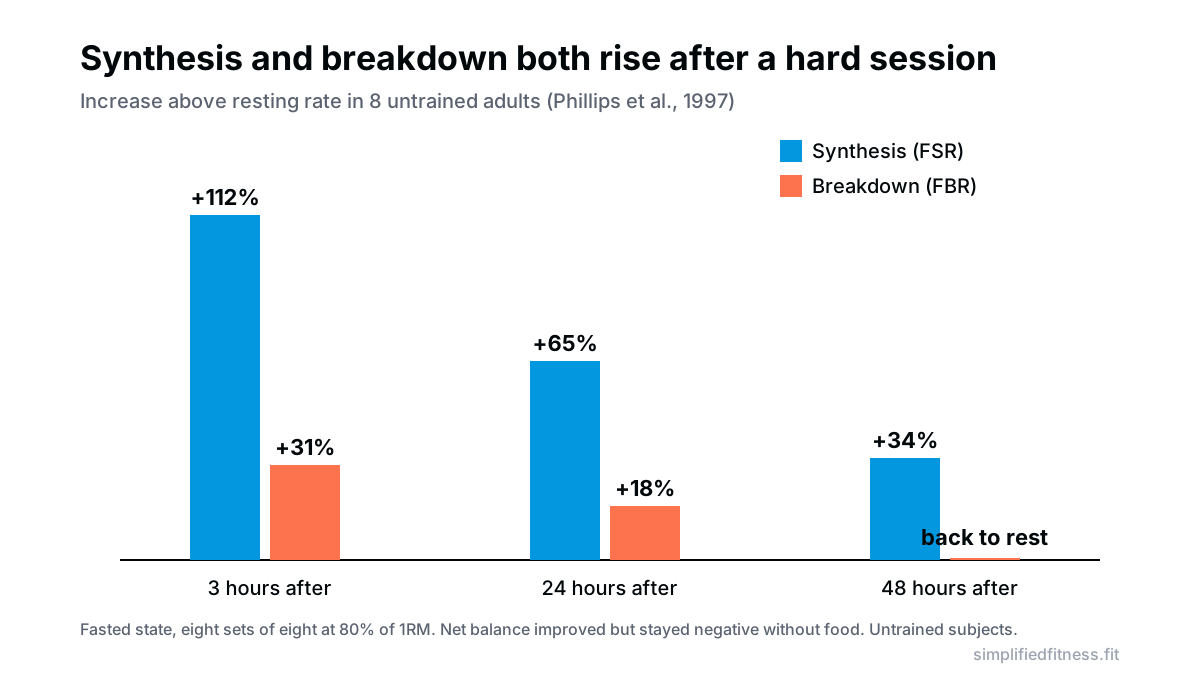
Look at the net balance in that paper. It improved at every time point after exercise, but it was still below zero because the volunteers were fasted. The authors also found synthesis and breakdown were strongly linked (r = 0.88). Lifting speeds up the whole turnover machine. Food is what tips it positive.
Two caveats. These were untrained volunteers, and they were fasted. A trained lifter eating normally will not look the same.
Why MPS returns to baseline faster in trained lifters
If you have trained for a while, your muscle adapts to the stimulus. A study had 10 young men train one leg for 8 weeks while the other leg stayed untrained. After training, both legs did a bout of exercise and were fed. At 4 hours, synthesis rose 162% in the trained leg versus 108% in the untrained leg. By 28 hours, the trained leg was back at resting levels while the untrained leg was still 70% above rest (Tang et al., 2008).
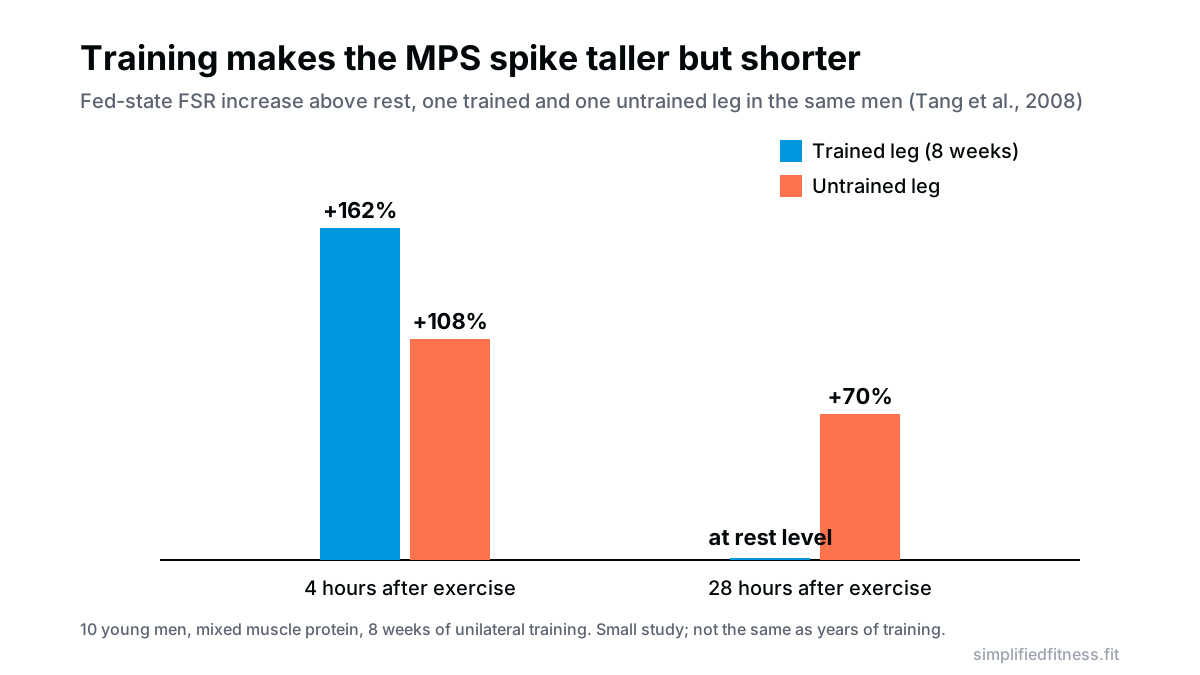
The authors describe this as training shortening the time synthesis stays elevated. That is a sensible direction, but it is 10 men, 8 weeks and one leg exercise. It is not proof that a 10-year lifter gets exactly 24 hours.
The practical read: the longer you have trained, the less you can count on one session carrying you for two days. That is one reason many programmes hit each muscle about twice a week. For the actual growth data on frequency, see our article on training frequency with equated volume.
The muscle-full effect: why one big meal does not keep MPS high
You might assume more protein means a longer MPS rise. Not quite. In eight young men given 48 g of whey, myofibrillar synthesis went from 0.03 to 0.10 %/h about 45-90 minutes after the meal, then fell back to baseline, even though blood essential amino acids were still elevated (+130% at 120 minutes, +80% at 180 minutes) (Atherton et al., 2010). Researchers call this the “muscle-full” effect.
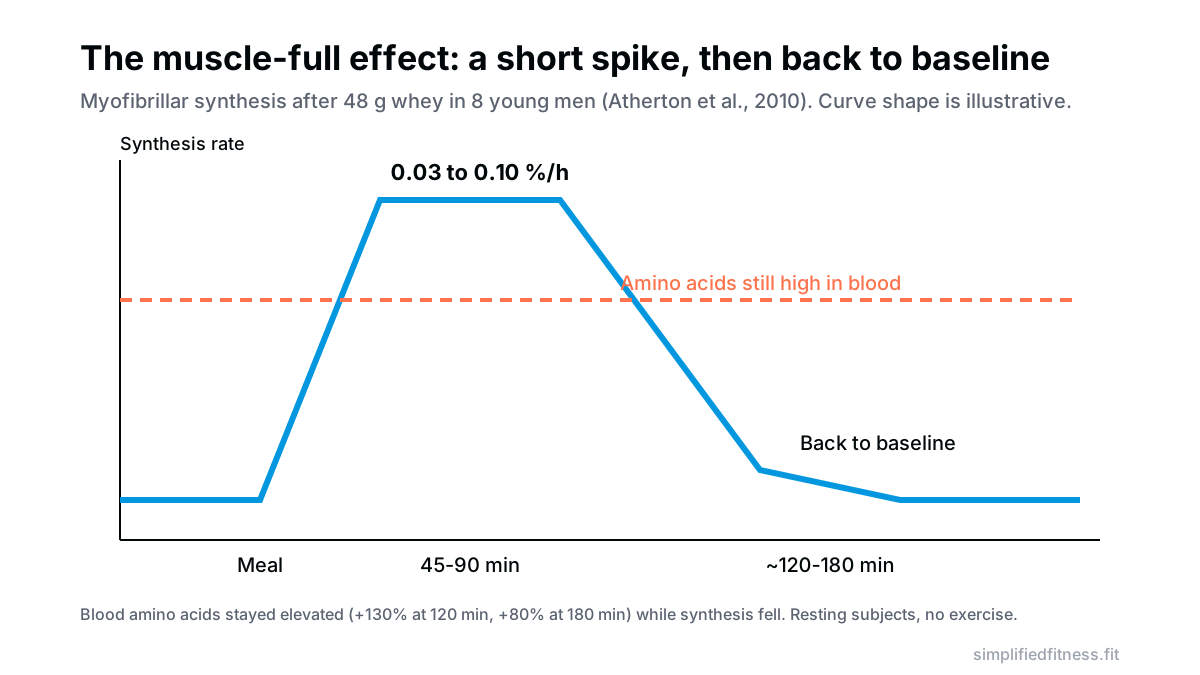
That was at rest, in young men, with a single dose. It does not mean protein past a certain amount is wasted for every purpose. It does suggest that stretching your day’s protein across several meals gives more “on” windows. In a trial of 24 trained men eating 80 g of whey after training, 20 g every 3 hours produced greater MPS across 12 hours than 8 small doses or 2 large ones (Areta et al., 2013). We cover meal planning in detail in protein distribution across 3 vs 5 meals, and the signalling side in the leucine threshold and mTOR article.
Does exercise change how well you use protein afterwards?
Yes, at least for a day. Fifteen young men had their leg muscle tested at rest and 24 hours after exercise, each time with 15 g of whey. Myofibrillar synthesis in response to the same feeding was higher 24 hours after exercise, but only when sets were taken to failure (4 sets at 90% of 1RM to failure, or 30% of 1RM to failure). Light sets matched for work but stopped short of failure did not show the effect (Burd et al., 2011).
So training seems to leave muscle more responsive to protein for at least 24 hours. That fits with the reality that you do not need to rush a shake out of the gym bag. For the research on timing, read the anabolic window myth.
Does a bigger MPS spike mean more muscle?
Not necessarily, and this is where lab numbers get oversold.
In a study of 10 young men, researchers tracked synthesis over 24-48 hours after a workout at the start, week 3 and week 10 of training. The first week produced the largest MPS response, but also the most muscle damage, and that response was not related to later growth. At weeks 3 and 10, synthesis was lower but strongly correlated with hypertrophy (r around 0.9) (Damas et al., 2016). The authors suggest early MPS goes partly into repairing damage and only later into building size.
A second study using heavy water found something similar over 6 weeks. In one leg trained 3 times a week, synthesis was raised in weeks 0-3 but not weeks 3-6, and muscle thickness gains peaked at 3 weeks (Brook et al., 2015). Both studies are small, in young men, and short.
What conflicts, and what to make of it
| Finding | What it suggests | Limit |
|---|---|---|
| MPS up 24-48 h after lifting (Phillips 1997) | Window of 1-2 days | Untrained, fasted, n=8 |
| Trained leg returns to baseline by 28 h (Tang 2008) | Window shortens with training | One leg, 8 weeks, n=10 |
| Early MPS not linked to growth (Damas 2016) | Acute spikes mislead | n=10, young men |
| Protein meal gives 2-3 h MPS rise (Atherton 2010) | Spread protein out | Rest, single 48 g dose |
These do not truly contradict each other. They measure different things: how long, how high, and whether it predicts size. The sensible conclusion is cautious. MPS tells you how muscle responds on a given day. It is not a scoreboard for 12-week results.
How to use the MPS timeline in real life
Here is what holds up without overreaching.
1. Train each muscle regularly. If the window is about a day or two, once-a-week bro splits leave long gaps. Twice weekly is a simple fix, with weekly hard sets as the real driver.
2. Hit a daily protein number. A meta-analysis of 49 trials (1863 people) found protein supplementation added to resistance-training gains, and fat-free mass gains did not improve beyond about 1.6 g/kg/day (Morton et al., 2018). It also found the benefit was smaller with older age. For a 70 kg lifter, that is about 112 g a day. Check yours in the protein calculator. Older lifters can read about anabolic resistance in older adults.
3. Spread it across 3-4 meals. An Indian vegetarian day might be curd and besan chilla, dal with roti and paneer at lunch, soya chunks or sprouts in the evening, and tofu or more paneer at dinner. If you eat eggs, they fit anywhere. Do not obsess over exact grams per meal.
4. Do not fast after training for hours. Without food, net balance stays negative even after lifting. A normal meal within a few hours is plenty.
Limits of the research
- Most tracer studies use young men. Data in women and older adults are smaller.
- Biopsy studies measure hours or days, while growth takes months.
- Several studies were fasted, rested, or used single protein doses, which is not how you eat.
- Heavy dieting, poor sleep and illness can shift balance in ways these studies did not test.
If you have kidney disease, a medical condition affecting muscle, or unexplained muscle loss or weakness, see your doctor before changing protein intake or training.
Frequently Asked Questions
How long does muscle protein synthesis last after a workout?
In untrained people, MPS stays elevated for about 24-48 hours after a hard session, with the biggest rise in the first hours. One tracer study measured +112% at 3 hours, +65% at 24 hours and +34% at 48 hours above rest. Trained lifters likely have a shorter window, so train each muscle roughly 2 times a week and keep protein steady every day.
What is the difference between MPS and MPB?
MPS is muscle protein synthesis, the building of new muscle protein, while MPB is muscle protein breakdown, the clearing of old protein. Muscle size only changes when one outweighs the other over time, which is why researchers talk about net protein balance. Eat enough protein and train hard so synthesis wins more days than breakdown.
What is net protein balance?
Net protein balance is muscle protein synthesis minus muscle protein breakdown. A positive number means you are gaining protein in muscle, a negative number means you are losing it. After lifting without eating, the balance improves but usually stays negative, so a protein-containing meal is what pushes it above zero.
What is fractional synthetic rate (FSR)?
FSR is the percentage of the muscle protein pool that is newly built per hour or per day, measured by tracking a labelled amino acid into muscle biopsies. It is the standard lab measure of MPS. It is a snapshot of a short window, so it is useful for mechanisms but does not perfectly predict how much muscle you gain over months.
What is the muscle-full effect?
The muscle-full effect means MPS responds to a dose of protein for only a short time, then returns to baseline even though blood amino acids are still high. In young men given 48 g of whey, synthesis rose within 45-90 minutes and had fallen back by about 2-3 hours. In practice, this is why splitting protein across meals tends to work better than one huge dose.
Does MPS return to baseline faster in trained lifters?
Evidence suggests yes. In a study of young men trained on one leg for 8 weeks, the trained leg had a larger spike at 4 hours (+162% vs +108%) but was back at rest by 28 hours, while the untrained leg was still up 70%. This was a small study over 8 weeks, so treat it as a direction, not an exact number for veterans.
Is a bigger MPS spike always better for muscle growth?
No. In a 10-week study, the largest MPS response came in the first week of training, when muscle damage was highest, and it was not related to later growth. MPS measured after 3 and 10 weeks did correlate with hypertrophy. Do not chase soreness or a 'big spike'; chase consistent, progressive training.
How often should I train a muscle based on the MPS timeline?
The 24-48 hour window supports hitting each muscle roughly twice a week, but frequency itself matters less than total weekly hard sets. The MPS data come from short lab measurements, while training-frequency trials look at actual growth. Pick a split you can follow for months.
Do I need to drink protein within 30 minutes of training?
No strict deadline is supported. In the study that looked, sets taken to failure left muscle more sensitive to protein for at least 24 hours, so a meal before or after training both work. Aim to eat protein within a few hours of your session and hit your daily total.
How much protein maximises muscle protein synthesis?
For a single meal, studies in young men often use about 20-40 g, but the right amount varies with body size and age. For daily intake, a meta-analysis of 49 trials found gains in fat-free mass stopped improving beyond about 1.6 g/kg/day. Use our protein calculator to set your own number.
Does muscle protein breakdown matter, or only synthesis?
Both matter, because growth is the difference between them. Lifting raises breakdown too (about +31% at 3 hours and +18% at 24 hours in one study), and the two rates were strongly correlated. Feeding mainly helps by pushing synthesis above breakdown, so avoid long stretches with no protein.
Does eating more protein make MPS stay elevated all day?
No. Because of the muscle-full effect, extra protein beyond a moderate dose does not keep synthesis high for longer. Total daily protein and meal spacing matter more than one giant serving. In India, dal, curd, paneer, eggs and soya can be spread over breakfast, lunch, snack and dinner.
Can this timeline help me build muscle faster?
Only indirectly, because the timeline shows why consistent training and regular protein intake add up. There is no trick that makes MPS last longer than your biology allows. See your doctor or a dietitian before raising protein if you have kidney disease.
Sources & References
Every claim above is checked against peer-reviewed research (PubMed, U.S. National Library of Medicine) or guidance from established health bodies. How we fact-check.
- Phillips SM, et al. Mixed muscle protein synthesis and breakdown after resistance exercise in humans. Am J Physiol. 1997. PMID: 9252485
- Burd NA, et al. Enhanced amino acid sensitivity of myofibrillar protein synthesis persists for up to 24 h after resistance exercise in young men. J Nutr. 2011. PMID: 21289204
- Atherton PJ, et al. Muscle full effect after oral protein: time-dependent concordance and discordance between human muscle protein synthesis and mTORC1 signaling. Am J Clin Nutr. 2010. PMID: 20844073
- Tang JE, et al. Resistance training alters the response of fed state mixed muscle protein synthesis in young men. Am J Physiol Regul Integr Comp Physiol. 2008. PMID: 18032468
- Damas F, et al. Resistance training-induced changes in integrated myofibrillar protein synthesis are related to hypertrophy only after attenuation of muscle damage. J Physiol. 2016. PMID: 27219125
- Brook MS, et al. Skeletal muscle hypertrophy adaptations predominate in the early stages of resistance exercise training, matching deuterium oxide-derived measures of muscle protein synthesis and mechanistic target of rapamycin complex 1 signaling. FASEB J. 2015. PMID: 26169934
- Morton RW, et al. A systematic review, meta-analysis and meta-regression of the effect of protein supplementation on resistance training-induced gains in muscle mass and strength in healthy adults. Br J Sports Med. 2018. PMID: 28698222
- Areta JL, et al. Timing and distribution of protein ingestion during prolonged recovery from resistance exercise alters myofibrillar protein synthesis. J Physiol. 2013. PMID: 23459753

Umair Hazrami · Founder & Head Coach, Simplified Fitness
Umair Hazrami founded Simplified Fitness and the Simplified Lifter channel to cut through fitness noise. With 4+ years of consistent training and 10+ coaching clients, he writes every guide from the peer-reviewed research and links the sources so you can check them. Our editorial standards.
Educational content only, not medical advice. If you have a medical condition, are pregnant, or take medication, talk to a qualified doctor before changing your diet, supplements or training. Full disclaimer.
Keep reading

Hypertrophy
Anabolic Resistance in Older Adults: Why Muscle Responds Less and How to Beat It
Anabolic resistance in older adults explained: why muscle responds less to protein and lifting after 50, plus the protein dose, leucine and sets that help.
8 min read

Hypertrophy
How Blood Flow Restriction Builds Muscle: Venous Occlusion, Metabolites and Cell Swelling
BFR training hypertrophy mechanisms explained: how a cuff and 20% 1RM can match heavy lifting for size. Metabolites, swelling, mTOR, myostatin and cuff safety.
8 min read

Hypertrophy
CNS Fatigue vs Muscle Fatigue: Is Your Nervous System Really Fried?
CNS fatigue vs muscle fatigue: what central and peripheral fatigue really are, how long each lasts, and how to tell which one is holding your lifts back.
9 min read

Hypertrophy
Exercise-Induced Muscle Damage (EIMD): Why Chasing Soreness Is Counterproductive
Muscle damage and hypertrophy are not the same thing. See what Z-disc streaming studies show, why soreness is a poor gauge of growth, and what to track.
8 min read