Sex Differences in Muscle Hypertrophy: Do Men and Women Grow Muscle Differently?
Sex differences in muscle hypertrophy are smaller than you think. See what meta-analyses say about relative growth, fibre types, estrogen and fatigue in women.
TL;DR. The short answer
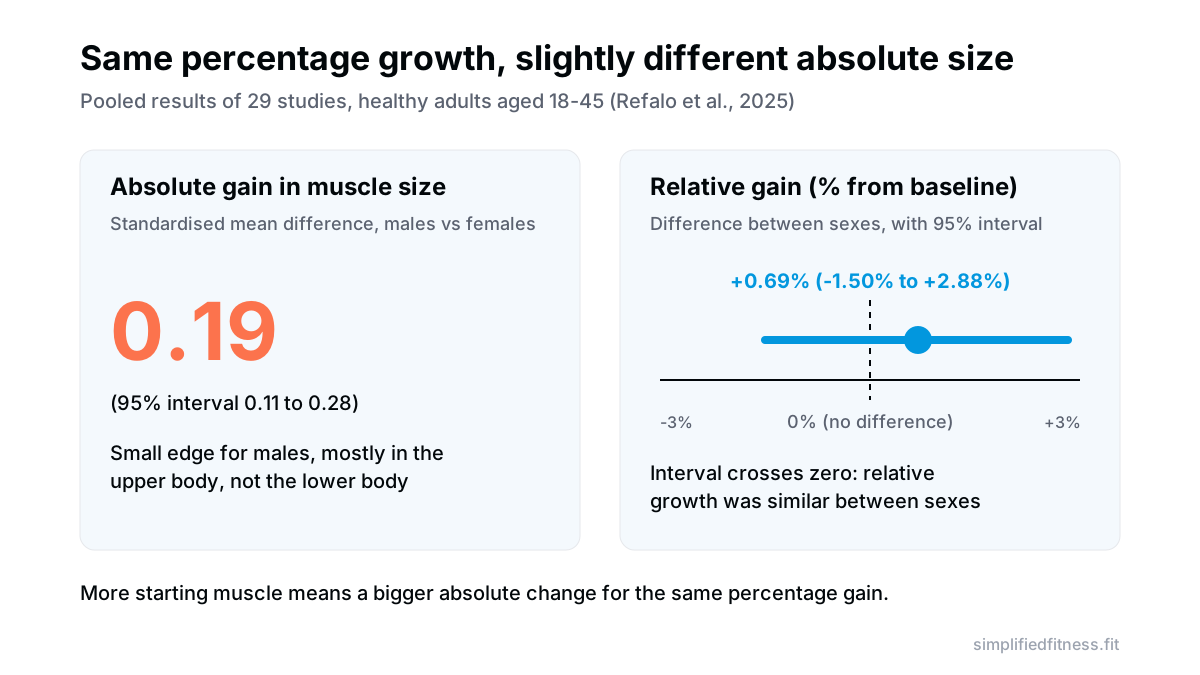
- Relative muscle growth (% increase from baseline) is similar in men and women. A 2025 Bayesian meta-analysis of 29 studies found a difference of 0.69%, with an interval (-1.50% to 2.88%) that includes zero.
- Men gain slightly more in absolute terms, mainly in the upper body, because they start with more muscle. Lower-body growth and Type II fibre growth looked similar between sexes.
- Women tend to have a higher share of slow-twitch Type I fibres and often complete more reps at the same relative load, so they may tolerate somewhat more upper-body volume. That is a tendency, not a rule.
- Estrogen may protect muscle membranes and help repair in animal studies, but human evidence is mixed, so it is not a proven reason for different programming.
- Train women with the same principles as men: progressive overload, hard sets near failure, enough protein. Adjust rep ranges and volume to the individual, not the sex.
Part of our complete guide: How Muscle Actually Grows: The Natural Lifter's Guide to Hypertrophy Science
Table of contents
Do men and women grow muscle differently? Not in any way that should split your program in two. Measured as a percentage of starting size, the evidence says the two sexes respond to lifting about equally, and the real sex differences in muscle hypertrophy are small tweaks around that core.
This article is a deep dive inside our complete guide to muscle hypertrophy for natural lifters. We will look at what the meta-analyses actually found, what estrogen may or may not do, and why women often seem to get through sets with less fatigue. If you are a woman who has been handed a “light weights, high reps, don’t get bulky” plan, this is for you.
Do women build muscle differently from men?
The cleanest answer comes from a 2025 systematic review with Bayesian meta-analysis. It pooled 29 studies of healthy adults aged 18-45 who followed the same resistance training program, and compared the change in muscle size (Refalo et al., 2025).
Two results matter:
- Absolute gains slightly favoured males (SMD = 0.19, 95% interval 0.11 to 0.28).
- Relative gains were similar between sexes (a difference of 0.69%, interval -1.50% to 2.88%, which includes zero).
Experience level did not change the result, and the type of size measurement had only a minimal influence.
An earlier meta-analysis of 10 studies reached a compatible conclusion for hypertrophy: no significant difference between males and females (effect size 0.07, P = 0.31) when both did the same program (Roberts et al., 2020). The same paper found a larger relative upper-body strength gain in females. The authors raised several possible explanations, such as neural factors, motor learning, or simply the short duration of the included studies, and said more research was needed.
Why do men look bigger if the growth is similar?
Because percentage and kilograms are not the same thing. If one person starts with 20 kg of muscle in an area and another starts with 30 kg, the same 5% gain adds 1 kg to one and 1.5 kg to the other. That gap compounds over years.
The 2025 meta-analysis also found the absolute advantage for males showed up in the upper body but not the lower body (Refalo et al., 2025). That is a group average across mostly young adults over a short time. It does not say a given woman’s arms or shoulders cannot grow. It says her starting point and the typical absolute change look different from the typical man’s.
The practical point: compare yourself with your own photos, measurements and lifts from three months ago. Not with someone else’s body.
Will lifting heavy make women bulky?
Short version: the data above already answer it. Women gain muscle at a similar relative rate from a smaller base, so visible change is gradual. Load is not the switch either. A 2021 review argued that muscle growth can be obtained across a wide spectrum of loads, not just one “hypertrophy zone” (Schoenfeld et al., 2021), so lifting heavier on your main exercises is a choice you make for strength, not one that forces a particular look. We cover the myth in full in will lifting heavy make women bulky, and loads in high-load vs low-load hypertrophy.
Muscle fibre types: do women have more slow-twitch fibres?
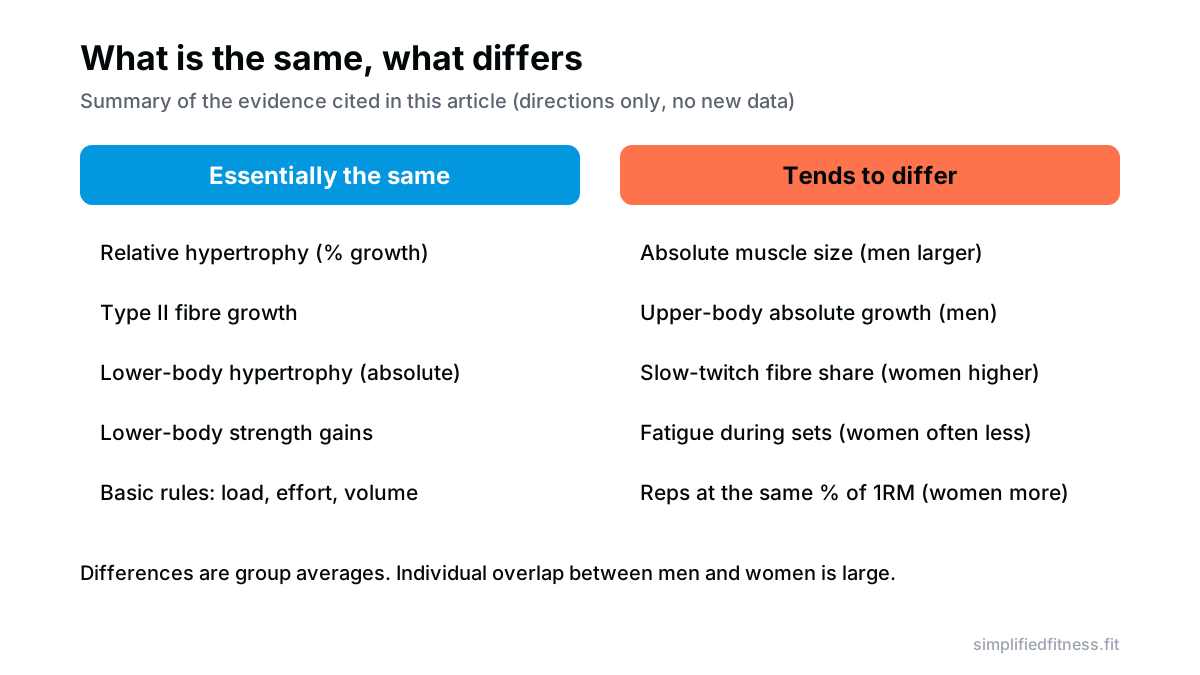
On average, yes. A 2024 meta-analysis pooled 110 biopsy studies (2,875 men and 2,452 women, mostly vastus lateralis in healthy adults) and found women had a greater percentage of Type I (slow-twitch) fibres, while men had a greater percentage of Type II fibres and larger cross-sectional area across all fibre types (Nuzzo, 2024).
Does that change how muscle grows? Somewhat. In the hypertrophy meta-analysis, Type I fibre growth slightly favoured males, while Type II fibre growth was similar between sexes (Refalo et al., 2025). The authors noted that fibre-type-specific growth in highly trained people needs more research.
Slow-twitch-rich muscle tends to be more fatigue resistant, which is one proposed reason women often handle sets and reps differently. Fibre typing is still only part of the story, and individuals vary a lot. For the wider topic, see fast-twitch vs slow-twitch fibres and training.
Does estrogen help build muscle?
This is where the claims outrun the data, so let’s separate what is known from what is plausible.
Animal studies. Reviews of mostly rodent work describe estrogen reducing markers of exercise-induced muscle damage, limiting inflammatory cell infiltration, and supporting repair, including activation of satellite cells. Proposed mechanisms include acting as an antioxidant, stabilising cell membranes and signalling through estrogen receptors (Enns and Tiidus, 2010).
Human studies. The same review says human findings are less clear, partly due to differences in age, fitness level and exercise protocols, and because sex comparisons also include other hormones. A 2023 systematic review of 32 studies found postmenopausal women had less muscle mass and strength than premenopausal women, but effects on damage markers were unclear, and evidence for benefits of estrogen therapy was largely conflicting and inconclusive (Critchlow et al., 2023).
So estrogen is a plausible protective factor, mainly in animals, but we cannot say it makes training fundamentally different for a premenopausal woman. If you are going through menopause and worried about muscle loss, lifting and enough protein still help, and any question about hormone therapy belongs with your doctor.
Do women fatigue less and recover faster?
Here the picture has two halves.
Less fatigue during exercise, task-dependent. A review by Hunter notes women are usually less fatigable than men in single-limb isometric contractions, mainly due to contractile differences. For dynamic contractions the difference depends on the task: women were less fatigable for elbow flexors at slow but not high velocities, and for knee extensors when fatigue was measured as the drop in maximal voluntary isometric force. There was no evidence of a sex difference in central fatigue (Hunter, 2016).
In trained lifters. In a study of 20 resistance-trained people doing four sets of unilateral biceps curls at 50% of 1RM to failure, females completed significantly more repetitions than males and lost less strength across the protocol. The authors concluded females might tolerate more upper-body volume (Voskuil et al., 2024).
Faster recovery? Not shown here. In that same study there were no sex differences in strength or muscle activation responses during the recovery phase. So “women recover faster between sets” is not established. “Women may fatigue less within a set at a given relative load” is better supported, though for specific tasks.
Caveats: a small sample, one exercise, one load, and findings from mostly young adults. Do not generalise to every lift.
How should women train for hypertrophy?
The same way as men, with a bit of individualisation.
- Progressive overload. Add reps or weight over time. Use our free training plans or push day, pull day and leg day as a base.
- Hard sets. Stop 1-3 reps before failure on most sets. Many lifters who “feel” a set is hard at rep 10 still have more reps left. Use the RIR / RPE calculator to calibrate.
- Loads. Mix heavier work (5-8 reps) on compounds with moderate and higher reps (10-20) on isolations. Both can build muscle if the sets are close to failure.
- Volume. Start in a moderate range and add sets only if progress stalls. The next layer of detail is in the weekly set volume dose-response article. If upper-body volume tolerance seems higher for you, you may add it gradually.
- Protein. Get your number from our protein calculator. In Indian diets, dal, curd, paneer, eggs, soya chunks and whey fill the gap.
- Sleep and food. If you are not eating enough, growth slows whatever your sex.
If you track one thing, track strength at a fixed rep range on your main lifts. It is the most honest feedback for any lifter.
What the evidence cannot tell us
Be honest about limits:
- Most included studies are in untrained or young adults and last weeks, not years. Findings for advanced women are less certain. The authors of the 2025 meta-analysis themselves point to highly trained participants as a gap.
- Group averages hide huge overlap. Some women out-fatigue most men; some do not.
- The estrogen story is largely mechanistic and animal-based.
- Menstrual cycle, contraceptives, pregnancy and menopause add variables that are still being studied, and our current evidence does not justify strict cycle-based programming.
If you have missed periods, unusual fatigue, pain with exercise, or any sudden change in strength or body composition, speak to a doctor rather than adjusting training yourself.
The bottom line
The data on sex differences in muscle hypertrophy say the sexes are alike where it matters most: percentage growth from the same program. Men tend to end up with more absolute muscle, particularly in the upper body. Women tend to have more slow-twitch fibres and may fatigue less in some tasks. None of that calls for a separate method.
Lift progressively, push sets close to failure, eat enough protein and be patient. For more detail on how fast progress should look, go back to the muscle hypertrophy guide and the genetics and responders article.
Frequently Asked Questions
Do men and women build muscle differently?
Not in any way that changes the basic plan. A 2025 meta-analysis found relative muscle growth was similar between sexes, even though men gained slightly more in absolute size. Train with progressive overload, hard sets and enough protein, whatever your sex.
Can women build muscle as fast as men?
In percentage terms, yes, the evidence points to similar rates. Men usually start with more muscle, so the same percentage gain is a bigger absolute change in kilograms. Judge your progress against your own starting point, not against a man's body.
Will lifting heavy make women bulky?
Unlikely. Women gain muscle at a similar relative rate, but starting from less muscle, so the visible change is smaller and slower than most people fear. If you want a more toned look, keep lifting and manage body fat through food, since fat loss changes how muscle shows.
Does estrogen help women build muscle?
It may help protect and repair muscle, but the evidence is not settled. Animal studies suggest estrogen acts as a membrane stabiliser and antioxidant and supports satellite cell activity, while human studies are less clear. Do not time or change your training around estrogen on current evidence.
Do women have more slow-twitch muscle fibres?
On average, yes. A 2024 meta-analysis of 110 biopsy studies found women had a greater share of Type I fibres, while men had larger fibres of every type. Many people overlap, so use it as a loose guide to rep ranges rather than a rule.
Can women do more reps than men at the same weight?
Often, relative to their maximum. In a study of trained people doing biceps curls at 50% of 1RM to failure, women completed significantly more reps than men. It was a small sample of 20 and one exercise, so test it on yourself with a rep in reserve.
Do women need different rep ranges for hypertrophy?
There is no good evidence that women need a different range. Muscle growth occurs across a wide spectrum of loads when sets are taken close to failure. Pick a range you can progress in and use heavier sets for your big lifts.
Do women recover faster between sets?
Women may fatigue less during a set, but evidence for faster recovery afterwards is weak. In the biceps curl study, strength and muscle activation recovery after exercise did not differ by sex. Use rest times that let you hit your target reps, usually 2-3 minutes on heavy compounds.
Do women need less training volume than men?
We found no good evidence that they need less. If anything, some data suggest women may tolerate a bit more upper-body volume. Start in a moderate range and add sets only when progress stalls and recovery is good.
Do women build lower body muscle faster than upper body?
Not necessarily in relative terms, but the absolute gap with men is smaller in the lower body. The 2025 meta-analysis found men's absolute advantage in the upper body but not the lower body.
Does the menstrual cycle change how I should train?
For most women, the evidence does not justify rigid cycle-based programming. Symptoms, sleep and energy vary a lot between individuals. If you feel poor during part of your cycle, lower the load or volume that day and see a doctor if cycles are irregular or very painful.
Do women need more protein than men to build muscle?
There is no strong evidence that women need a different protein target per kilogram of body weight. Muscle building depends on total daily protein and hard training. Use our protein calculator, and spread intake across dal, paneer, curd, eggs or soya through the day.
Is the research on female hypertrophy good enough?
It is improving but still thinner than the research in men. Most studies involve untrained or young adults and last only weeks, so conclusions for highly trained women are less certain. Treat the findings as a strong general pattern with room for individual variation.
Sources & References
Every claim above is checked against peer-reviewed research (PubMed, U.S. National Library of Medicine) or guidance from established health bodies. How we fact-check.
- Refalo MC, et al. Sex differences in absolute and relative changes in muscle size following resistance training in healthy adults: a systematic review with Bayesian meta-analysis. PeerJ. 2025. PMID: 40028215
- Roberts BM, et al. Sex Differences in Resistance Training: A Systematic Review and Meta-Analysis. J Strength Cond Res. 2020. PMID: 32218059
- Nuzzo JL. Sex differences in skeletal muscle fiber types: A meta-analysis. Clin Anat. 2024. PMID: 37424380
- Enns DL, et al. The influence of estrogen on skeletal muscle: sex matters. Sports Med. 2010. PMID: 20020786
- Critchlow AJ, et al. The role of estrogen in female skeletal muscle aging: A systematic review. Maturitas. 2023. PMID: 37716136
- Hunter SK. Sex differences in fatigability of dynamic contractions. Exp Physiol. 2016. PMID: 26440505
- Voskuil CC, et al. Sex differences in fatiguability during single-joint resistance exercise in a resistance-trained population. Eur J Appl Physiol. 2024. PMID: 38441692
- Schoenfeld BJ, et al. Loading Recommendations for Muscle Strength, Hypertrophy, and Local Endurance: A Re-Examination of the Repetition Continuum. Sports (Basel). 2021. PMID: 33671664

Umair Hazrami · Founder & Head Coach, Simplified Fitness
Umair Hazrami founded Simplified Fitness and the Simplified Lifter channel to cut through fitness noise. With 4+ years of consistent training and 10+ coaching clients, he writes every guide from the peer-reviewed research and links the sources so you can check them. Our editorial standards.
Educational content only, not medical advice. If you have a medical condition, are pregnant, or take medication, talk to a qualified doctor before changing your diet, supplements or training. Full disclaimer.
Keep reading

Hypertrophy
Anabolic Resistance in Older Adults: Why Muscle Responds Less and How to Beat It
Anabolic resistance in older adults explained: why muscle responds less to protein and lifting after 50, plus the protein dose, leucine and sets that help.
8 min read

Hypertrophy
How Blood Flow Restriction Builds Muscle: Venous Occlusion, Metabolites and Cell Swelling
BFR training hypertrophy mechanisms explained: how a cuff and 20% 1RM can match heavy lifting for size. Metabolites, swelling, mTOR, myostatin and cuff safety.
8 min read
Hypertrophy
CNS Fatigue vs Muscle Fatigue: Is Your Nervous System Really Fried?
CNS fatigue vs muscle fatigue: what central and peripheral fatigue really are, how long each lasts, and how to tell which one is holding your lifts back.
9 min read

Hypertrophy
Exercise-Induced Muscle Damage (EIMD): Why Chasing Soreness Is Counterproductive
Muscle damage and hypertrophy are not the same thing. See what Z-disc streaming studies show, why soreness is a poor gauge of growth, and what to track.
8 min read