The Repeated Bout Effect: Why Soreness Fades and What Protects Your Muscles
Repeated bout effect lifting explained: why week 1 soreness vanishes by week 3, which adaptations protect muscle (neural, collagen) and what is unproven.

TL;DR. The short answer
- The repeated bout effect is the protective adaptation where one damaging session, especially one heavy on lengthening (eccentric) work, makes the next similar session cause less soreness, strength loss and damage.
- No single mechanism explains it. The evidence points to a mix of neural changes (steadier motor unit firing), connective tissue remodeling and possibly altered stiffness, while the popular sarcomere-addition idea looks doubtful for the first repeated bout.
- Less soreness in week 3 usually means your muscles have adapted to that specific workout, not that the training stopped working. Soreness is a poor yardstick for growth in either direction.
- How long the protection lasts depends on the muscle. In one knee extensor study of young men it was clear at 3 and 6 weeks, partly present at 9, and gone by 12 weeks, while an older elbow flexor study found protection lasting at least 6 months.
- Sharp pain, a joint that hurts, dark urine or marked swelling is not normal soreness. See a doctor rather than training through it.
Part of our complete guide: How Muscle Actually Grows: The Natural Lifter's Guide to Hypertrophy Science
Table of contents
You start a new split on Monday and by Wednesday you cannot sit down without a plan. Three weeks later the same workout barely registers. That is the repeated bout effect in lifting: one damaging session protects you against the next similar one, so soreness, strength loss and muscle damage markers are smaller the second time around.
It is one of the most useful ideas in the muscle hypertrophy guide for natural lifters because it explains why soreness is such a bad scoreboard. Below we look at what the research says protects the muscle, which popular explanations (including the “sarcomere pop” idea) are shakier than gym lore suggests, and how to use this when you change your training.
If you want the plain-language, soreness-focused version first, see our companion piece on why you stop getting sore. This article goes deeper into the structural and neural mechanisms.
What is the repeated bout effect?
The repeated bout effect (RBE) is the adaptation whereby a single bout of eccentric exercise protects against muscle damage from later eccentric bouts (McHugh, 2003). Eccentric means the muscle lengthens while producing force, like lowering the bar on a bench press or the stretch phase of a Romanian deadlift.
Two details matter. First, most of the research uses eccentric-heavy protocols, because they cause the biggest, most measurable damage. Second, the protection shows up across several markers: less strength loss, less soreness and quicker recovery. It does not mean the muscle stops responding. It means the same stimulus is less disruptive.
Why does muscle soreness decrease after a few weeks?
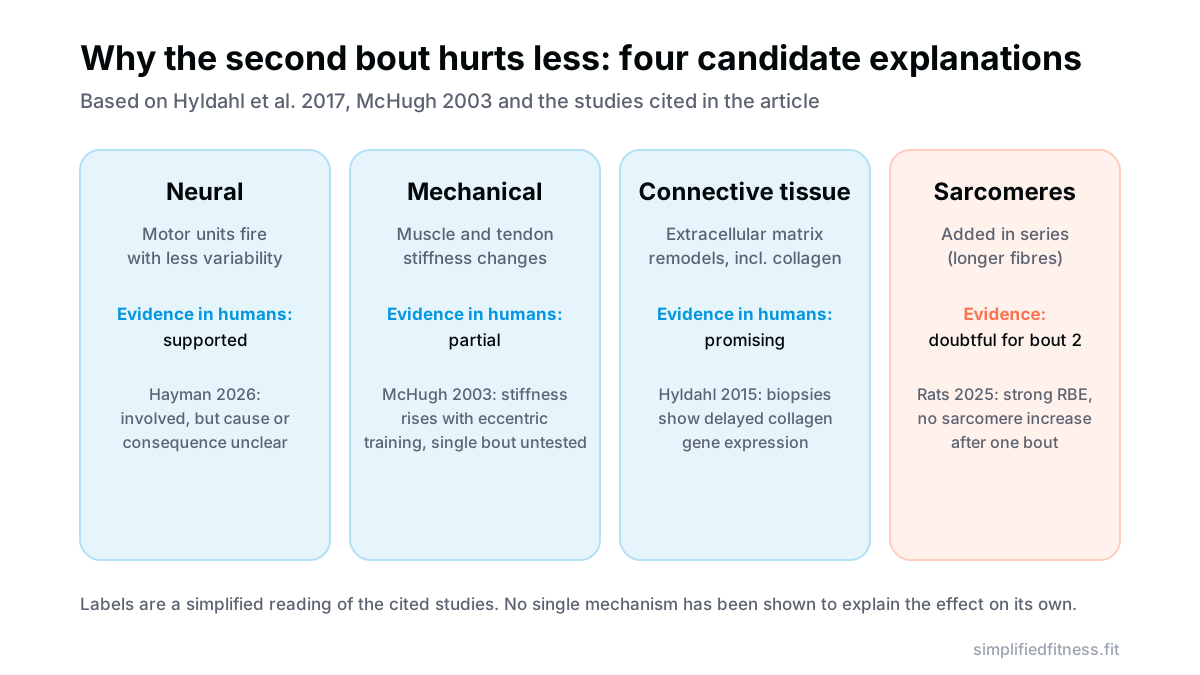
Nobody has pinned down a single cause. A 2017 review proposed that neural adaptations, changes in the mechanical properties of the muscle, remodeling of the extracellular matrix and biochemical signaling work together to produce the protection, and it described the mechanisms as still poorly understood (Hyldahl et al., 2017). An earlier review grouped the candidates as neural, mechanical and cellular, and concluded that a unified theory “remains elusive” (McHugh, 2003).
That honesty matters, because many articles present one tidy mechanism as fact. The sections below take each candidate in turn and say how strong the human evidence is.
Neural adaptation: steadier motor unit firing
This has the most direct recent human data, with caveats. In a 2026 study, 23 participants (6 of them female, average age 26) did two bouts of 10 sets of 10 eccentric repetitions with the dorsiflexors (the muscles that lift your foot), three weeks apart (Hayman et al., 2026). Work performed was similar, yet strength and soreness recovered faster after bout 2. The second bout also showed lower variability in motor unit discharge rate, and a smaller rise in firing rate.
The authors conclude that motor unit adjustments are involved. They also state plainly that the study cannot tell whether these changes actively protect the muscle or simply reflect that there was less damage and pain to begin with. So “neural adaptation” is real, but whether it is cause or consequence is still open. A small, non-lifting muscle group and a young sample also limit how far the result stretches to your quads or chest.
Earlier work pulls in both directions. McHugh’s review noted some evidence of a shift toward greater recruitment of slow twitch motor units, but also that the effect appears with electrically stimulated contractions, which bypass the brain’s control of recruitment. That suggests a peripheral, non-neural adaptation predominates (McHugh, 2003). For the broader picture of how your nervous system drives early strength gains, see neural adaptations vs muscle growth in weeks 1-8.
Connective tissue: the extracellular matrix
Muscle fibres sit inside a scaffold of connective tissue. A 2015 biopsy study took muscle samples from people after an initial bout of lengthening contractions and again after a repeated bout (Hyldahl et al., 2015).
Three findings stand out. Tenascin-C, an extracellular matrix protein, rose 10.8-fold after the first bout, was lower after the second bout, and tracked with strength loss. Collagen I, III and IV gene transcripts were unchanged early but rose 27 days after bout 1. And satellite cell content rose 80% two days after the first bout. The authors interpret this as sequential matrix remodeling, early loosening followed by delayed rebuilding, that appears to contribute to the effect.
Plain-language version: the first hard session damages the scaffold, the muscle rebuilds it over the following weeks, and the rebuilt version seems better at handling the same load. This is a small human biopsy study, so treat the numbers as supportive rather than final.
Mechanical changes: stiffness
McHugh’s review also covered stiffness. There is evidence that both dynamic and passive muscle stiffness increase with eccentric training, but the review noted no studies on stiffness changes after a single eccentric bout (McHugh, 2003). A stiffer muscle-tendon unit could in theory share load more evenly, but that link is still a hypothesis. We cannot say from the available abstracts how much this contributes.
What about the sarcomere pop theory?
“Sarcomere pop” is the gym nickname for the idea that damage makes fibres add sarcomeres in series (end to end), making the fibre longer so each sarcomere is strained less during lengthening. McHugh’s review described this as a proposed cellular adaptation (McHugh, 2003).
The evidence is split, and the split is instructive.
For: in a 2025 study, 12 participants did 9 weeks of Nordic hamstring training. Biceps femoris long head fascicle length rose 19% in the central region and 33% in the distal region, and serial sarcomere number rose 25% and 49% respectively. After 3 weeks of detraining, fascicle length fell by 12% and 16% (Andrews et al., 2025). So prolonged eccentric training can add sarcomeres in series in humans.
Against, for the first repeated bout: a 2025 rat study had animals do maximal eccentric contractions, then measured serial sarcomere number 13 days later in one group and gave a second bout to another. Torque recovered by 2 days after the repeated bout, a clear repeated bout effect, but sarcomere number did not differ from control legs. The authors concluded that serial sarcomerogenesis is not one of the primary initial mechanisms (Vlemmix et al., 2025).
Why do these differ? One is a 9-week training programme in people, the other a single bout in rats. A plausible reading is that sarcomere addition is a slower, longer-term training adaptation that protects over months, not the thing that explains why bout 2 hurts less than bout 1. That is an interpretation, not a proven conclusion, and rat results do not automatically transfer to humans.
Does the repeated bout effect work in trained lifters?
This is where studies disagree. In 11 resistance-trained men, 100 eccentric bench press actions were repeated 14 days later, and the researchers found no repeated bout effect for force or soreness, nor change in EMG frequency content (Falvo et al., 2009). Most other RBE studies use untrained or recreationally active people and a different muscle or exercise.
Possible reasons: trained men may already have adapted so that the first bout did less damage (leaving less to protect against), the sample was tiny, and the bench press is a different stimulus from isolated lab protocols. The cautious takeaway is that experienced lifters probably experience a smaller, harder-to-see effect, but a new exercise or a new emphasis on the lengthening phase can still make them sore.
How long does the protection last?
A 2026 study had 48 young men do two identical maximal eccentric knee extension sessions (5 sets of 15), with the second bout 3, 6, 9 or 12 weeks later in four separate groups (Theodorou et al., 2026). The effect was evident at 3 and 6 weeks for most outcomes, detectable at 9 weeks for selected markers, and at 12 weeks no significant difference between bouts remained.
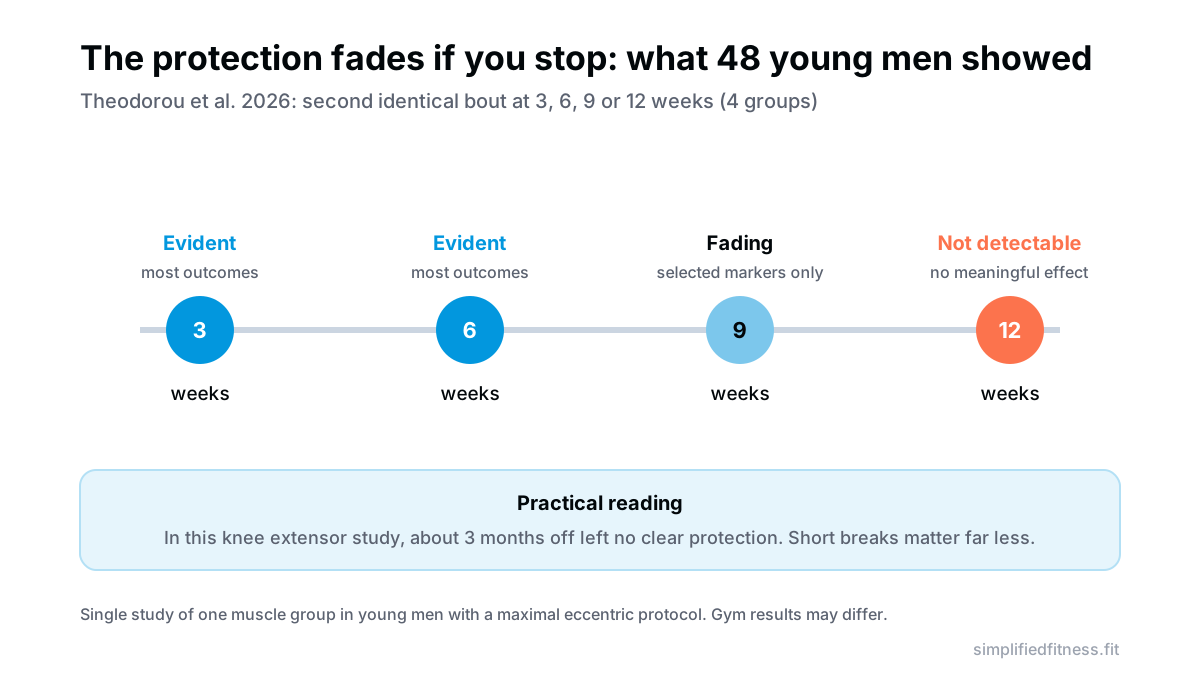
This was a single study of one muscle group in young men using a maximal protocol, and other muscles can hold the protection much longer. In a 2001 study of 35 male students, an elbow flexor eccentric bout still protected against a second bout at 6 months, partly at 9 months, and not at 12 months (Nosaka et al., 2001). The exact timeline in your gym will vary. A useful rule of thumb: a week or two off should not reset you, but several months away might.
Repeated bout effect lifting: how to use it in your training
You do not need to engineer this. You can use it with sensible ramping.
- Start new splits at moderate volume. Use fewer hard sets in week 1 and stay a couple of reps from failure. A gentler first bout can still protect the next one, and you avoid a week of walking like a robot.
- Add new exercises gradually. Protection looks specific to the type of stimulus. Swapping flat bench for deep stretch flyes, or adding Romanian deadlifts for the first time, is a fresh eccentric challenge for that muscle.
- Change one big variable at a time. If you are also lengthening your tempo or range of motion, expect more soreness.
- After a long layoff, treat it as a restart. Per the studies above, a break of a few months may leave little protection in some muscles, so the first session back should be lighter.
- Keep progressing. Less soreness is not a signal to stop adding load, reps or sets. Our progressive overload and deload guide covers how.
If you want to see eccentric work done deliberately, our piece on Nordic hamstring curls and fascicle lengthening shows how coaches introduce it. And for the opposite worry, that too much damage is counterproductive, see exercise-induced muscle damage.
What a lack of soreness does and does not mean
| Observation | What it probably means | What it does not mean |
|---|---|---|
| Very sore in week 1, barely sore in week 3 | Muscles adapted to that workout (RBE) | The program stopped working |
| Not sore after a hard session | Familiar stimulus, protected muscle | You did not train hard enough |
| Sore again after adding new exercises | New lengthening stimulus | You were overtraining |
| Sore after a 3-month break | Protection may have faded | You lost all your gains |
Be careful with the comfort of this table. Lack of soreness is not proof that you are growing, and soreness is not proof that you are not. Weekly sets near failure, progressive load and recovery are the better signals.
When to see a doctor
Normal soreness is a dull, diffuse ache that eases over a few days. See a doctor if you have severe pain or swelling out of proportion to the session, dark or cola-coloured urine, pain in a joint rather than a muscle, numbness, or soreness that is getting worse after several days. We cannot diagnose from an article, and these signs deserve proper medical assessment.
The bottom line
The repeated bout effect is real, well described, and incompletely explained. The evidence points to neural, connective tissue and possibly mechanical adaptations working together. The sarcomere theory is plausible for long-term eccentric training but shaky as the explanation for week 3 versus week 1. Use it practically: ramp up new training, expect fresh soreness when the stimulus changes, and judge your program by progression, not by how much you ache.
Frequently Asked Questions
What is the repeated bout effect in lifting?
It is the adaptation where one bout of unfamiliar, damaging exercise protects you against a similar bout later. Reviews describe it mostly after eccentric (lengthening) exercise, where strength loss, soreness and other damage markers are smaller the second time. In practice, ease into a new routine so the first session is not a shock.
Why does muscle soreness decrease after a few weeks of training?
Your muscles adapt to the specific movements you repeat. Researchers propose that neural, mechanical, connective tissue and cellular changes work together, though no single cause has been proven. The practical takeaway is that fading soreness is expected and does not mean your workouts stopped being productive.
Does less soreness mean I am not building muscle?
No. Soreness reflects how unfamiliar a session was, not how much growth it triggered. The repeated bout effect means the same workout produces less damage and soreness the second time, so keep progressing load, reps or sets instead of chasing the ache.
Is the sarcomere pop theory true?
It is a hypothesis, not a settled fact. Adding sarcomeres in series (longer fibres) has been proposed to reduce strain on each sarcomere during lengthening, and a 9-week Nordic hamstring study in 12 people did find added sarcomeres. But a 2025 rat study found a strong repeated bout effect with no increase in sarcomere number, so it likely does not explain the first repeated bout.
How long does the repeated bout effect last?
It depends on the muscle, the exercise and the marker measured. In a 2026 study of 48 young men doing maximal eccentric knee extensions, it was evident at 3 and 6 weeks and no longer detectable at 12, while a 2001 study of the elbow flexors found it lasted at least 6 months. If you return to a muscle after a long break, treat the first session as new and start lighter.
Does the repeated bout effect apply to experienced lifters?
Probably, but the evidence is mixed. One small study of 11 resistance-trained men found no repeated bout effect after 100 eccentric bench press actions, possibly because trained muscle is already well protected. Experienced lifters should still expect fresh soreness when they change exercises, tempo or range of motion in a big way.
Can I get sore again after changing my program?
Yes, if the new exercises, loading or lengthening demands are unfamiliar to those muscles. The protection is largely specific to the type of damaging stimulus. Phase new movements in gradually, for example with fewer sets for the first week.
Should I train sore muscles?
Mild soreness is generally fine to train through if movement feels normal and you can control the load. Heavy soreness that changes your range of motion or form is a reason to lower the volume or pick another muscle group. Sharp, joint or localised pain is different, so get it checked.
Does the repeated bout effect only apply to lifting?
No. The research is about eccentric (lengthening) exercise in general, and most studies use lab machines rather than barbells. So any unfamiliar activity with a lot of lengthening work, such as downhill walking or a new sport, can plausibly cause fresh soreness. If you add a new activity, ease into it for the first week or two.
How do I avoid being crippled by soreness when starting a new split?
Start with fewer hard sets than you think you need, stay a few reps from failure, and avoid heavy lengthening emphasis in week 1. Because one bout can protect the next, a moderate first week sets you up for a bigger second week. Build volume over 2-4 weeks.
What is a normal amount of soreness after training?
Soreness that peaks within a day or two, feels like a dull ache or tenderness, and eases over several days is typical after unfamiliar training. It should not come with severe swelling, dark urine or sharp pain. If it does, see a doctor.
Can I speed up the repeated bout effect with a light first session?
Reviews describe protection from a single prior bout of eccentric exercise, and the studies we cite did not test light priming sessions directly, so this is an inference. A moderate first session still leaves you able to train properly the next week. Keep it a few reps from failure and add volume over 2-4 weeks.
Is the repeated bout effect the same as getting stronger?
No. It is a protective adaptation against damage, while strength gains involve separate neural and muscular changes. They overlap in time, which is why early training can feel like both getting stronger and getting less sore. For the strength side, see our article on early neural adaptations.
Sources & References
Every claim above is checked against peer-reviewed research (PubMed, U.S. National Library of Medicine) or guidance from established health bodies. How we fact-check.
- Hyldahl RD, et al. Mechanisms and Mediators of the Skeletal Muscle Repeated Bout Effect. Exerc Sport Sci Rev. 2017. PMID: 27782911
- McHugh MP. Recent advances in the understanding of the repeated bout effect: the protective effect against muscle damage from a single bout of eccentric exercise. Scand J Med Sci Sports. 2003. PMID: 12641640
- Vlemmix E, et al. Serial sarcomerogenesis does not contribute to the initial repeated bout effect in skeletal muscle. J Biomech. 2025. PMID: 40403600
- Hayman O, et al. Motor unit adaptations contribute to the repeated bout effect following damaging resistance exercise. J Appl Physiol. 2026. PMID: 41553735
- Falvo MJ, et al. Repeated bout effect is absent in resistance trained men: an electromyographic analysis. J Electromyogr Kinesiol. 2009. PMID: 19059793
- Theodorou AA, et al. The Duration of the Repeated-Bout Effect After Eccentric Exercise. Scand J Med Sci Sports. 2026. PMID: 42886157
- Hyldahl RD, et al. Extracellular matrix remodeling and its contribution to protective adaptation following lengthening contractions in human muscle. FASEB J. 2015. PMID: 25808538
- Andrews MH, et al. Multiscale hamstring muscle adaptations following 9 weeks of eccentric training. J Sport Health Sci. 2025. PMID: 39461588
- Nosaka K, et al. How long does the protective effect on eccentric exercise-induced muscle damage last? Med Sci Sports Exerc. 2001. PMID: 11528337

Umair Hazrami · Founder & Head Coach, Simplified Fitness
Umair Hazrami founded Simplified Fitness and the Simplified Lifter channel to cut through fitness noise. With 4+ years of consistent training and 10+ coaching clients, he writes every guide from the peer-reviewed research and links the sources so you can check them. Our editorial standards.
Educational content only, not medical advice. If you have a medical condition, are pregnant, or take medication, talk to a qualified doctor before changing your diet, supplements or training. Full disclaimer.
Keep reading
Hypertrophy
Anabolic Resistance in Older Adults: Why Muscle Responds Less and How to Beat It
Anabolic resistance in older adults explained: why muscle responds less to protein and lifting after 50, plus the protein dose, leucine and sets that help.
8 min read
Hypertrophy
How Blood Flow Restriction Builds Muscle: Venous Occlusion, Metabolites and Cell Swelling
BFR training hypertrophy mechanisms explained: how a cuff and 20% 1RM can match heavy lifting for size. Metabolites, swelling, mTOR, myostatin and cuff safety.
8 min read
Hypertrophy
CNS Fatigue vs Muscle Fatigue: Is Your Nervous System Really Fried?
CNS fatigue vs muscle fatigue: what central and peripheral fatigue really are, how long each lasts, and how to tell which one is holding your lifts back.
9 min read

Hypertrophy
Exercise-Induced Muscle Damage (EIMD): Why Chasing Soreness Is Counterproductive
Muscle damage and hypertrophy are not the same thing. See what Z-disc streaming studies show, why soreness is a poor gauge of growth, and what to track.
8 min read