Motor Unit Recruitment and Henneman's Size Principle: How Heavy Do You Really Need to Lift?
Henneman's size principle in lifting explained: how motor units are recruited, why fatigue pulls in big units, and whether light sets can really build muscle.

TL;DR. The short answer
- Henneman's size principle says your nervous system recruits small, low-threshold motor units first and large, high-threshold units only as the demand on the muscle rises.
- Demand can rise two ways: a heavy load from rep one, or a lighter load that becomes harder as fatigue builds. That is why light sets taken close to failure can still reach the big units.
- When sets go to failure, lighter and heavier loads have produced similar muscle growth in meta-analyses and in trained men, while heavier loads win for maximal strength.
- Surface EMG cannot count motor units directly, so the recruitment explanation is a well-supported mechanism, not proof that every light set works equally well.
- Practical rule: heavy sets can stop a rep or two short of failure, light sets need to finish within a few reps of failure to count.
Part of our complete guide: How Muscle Actually Grows: The Natural Lifter's Guide to Hypertrophy Science
Table of contents
Henneman’s size principle lifting rule in one line: your nervous system recruits small motor units first and large, growth-relevant ones only when the demand is high enough. Demand gets high in two ways, a heavy weight or a lighter weight taken close to failure, which is why you probably do not need to lift 90% of your max to grow. This article is the nerve-and-muscle physiology behind that idea, part of our complete muscle hypertrophy guide for natural lifters.
What is Henneman’s size principle?
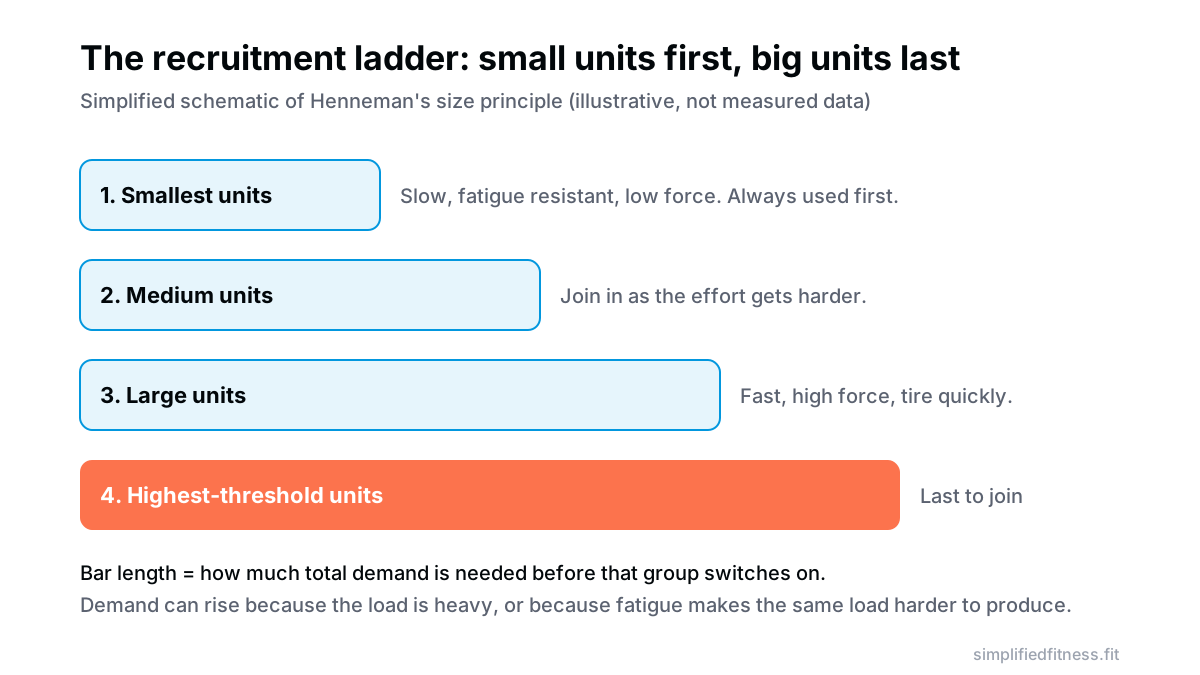
A motor unit is one motor neuron plus every muscle fibre it controls. Small units drive a handful of slow, fatigue-resistant fibres. Large units drive many fast fibres that produce more force and tire quickly.
Henneman’s size principle says units are recruited in order of size. Picking up a pen uses the small ones. A near-maximal squat needs the large ones as well. The brain does not choose individual fibres; it turns up the drive and the units switch on in that fixed-ish order.
Here is the physiology in plain terms:
- Recruitment: more units join as demand rises.
- Rate coding: units already active can fire faster to add force.
- Threshold: the point of demand at which a given unit switches on. Large units have high thresholds.
One human lab study on the soleus (calf) muscle recorded 42 motor units in five people and found units were recruited progressively from rest up to contractions close to 95% of maximum, with low-threshold units firing slower and peaking lower than late-recruited high-threshold units (Oya et al., 2009). Small sample, isometric contractions, but a clean picture of the principle in humans.
Why do high-threshold motor units matter for muscle growth?
The high-threshold units control the fast-twitch fibres, which are generally thought to have the most growth potential. If a set never asks for those units, those fibres get little stimulus. That is the logic behind the old advice that you must lift heavy to build size. For how fibre types differ in training response, see our guide on slow vs fast-twitch fibres.
Notice the wording, though. The principle explains which units are active. It does not by itself prove that every active unit grows equally, or that recruitment is the only driver of hypertrophy. Mechanical tension, effort and volume all matter too, covered in mechanical tension vs muscle damage.
Do I need to lift 90% of my 1RM to recruit them?
No. This is the part most lifters miss. Heavy loads recruit large units straight away because the force requirement is high from rep one. But that is one route, not the only route.
The second route is fatigue. As the small units tire, they cannot hold the force on their own, so the nervous system recruits more units to keep the bar moving. In a lab study of 20 people holding a light (15% of maximum) sustained contraction until failure, motor unit recruitment thresholds dropped as the task went on, by 48% and 30% in two groups of units during the more demanding position task (Baudry et al., 2009). In other words, units that needed more drive early on were being activated at lower drive later. This was a sustained isometric elbow task at very low intensity, not a gym set, so it supports the mechanism rather than proving it for lifting.
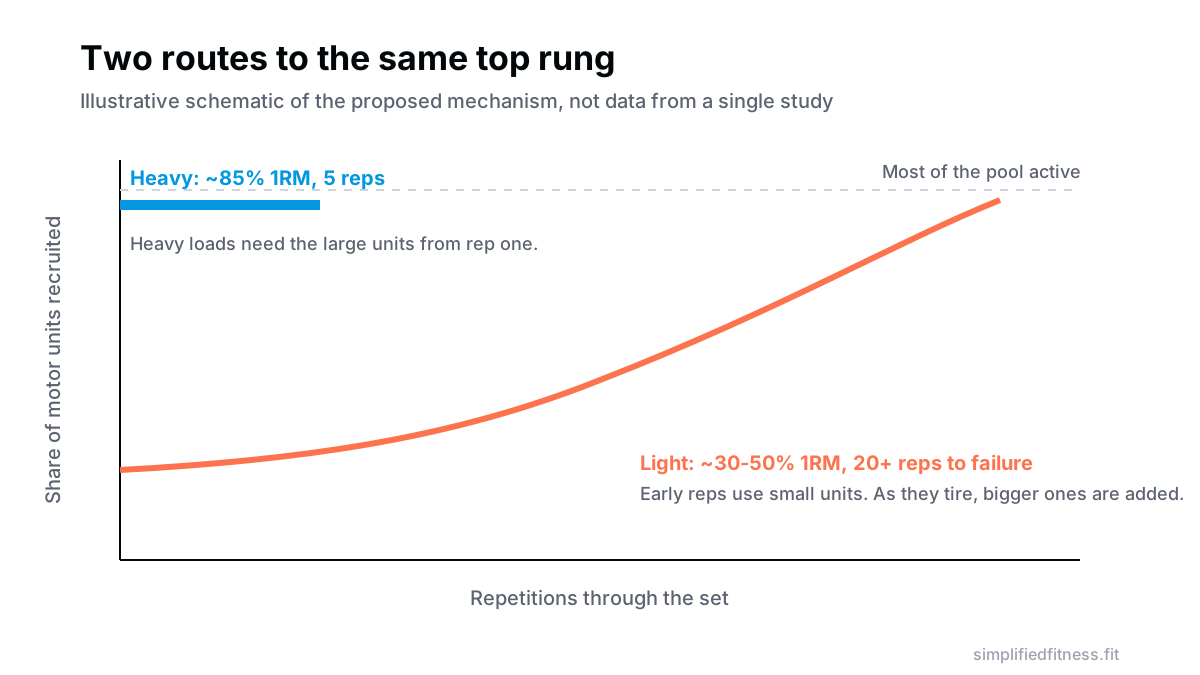
This is why a light set can feel like nothing for 15 reps and then suddenly brutal. The first reps are handled by small units. The last ones are where the pool opens up. Our deeper comparison of the programming side is in low vs high load recruitment and acidosis, and the fatigue source itself is explained in central vs peripheral fatigue.
What does the muscle growth evidence say?
If recruitment is the key, then the load should not matter much as long as sets are hard. That is what the outcome studies largely show.
A 2017 systematic review and meta-analysis of 21 studies compared low-load (60% 1RM or less) with high-load training, all sets to momentary failure, over at least 6 weeks. Muscle hypertrophy was similar between conditions, while 1RM strength was greater with high loads (Schoenfeld et al., 2017). The authors conclude maximal strength benefits from heavy loads while hypertrophy can be achieved across a spectrum of loads. A 2021 review argues the old repetition continuum, where heavy builds strength, moderate builds size and light builds endurance, is not well supported and proposes adaptations can be obtained across a wide spectrum of loads (Schoenfeld et al., 2021).
What about people who already train? In a 12-week trial of 49 resistance-trained men, a group using about 30-50% 1RM for 20-25 reps and a group using about 75-90% 1RM for 8-12 reps, all to failure, had similar gains in lean mass and in type I and type II fibre size, though bench press 1RM rose more with heavier loads (14 vs 9 kg) (Morton et al., 2016). An 8-week study of 18 well-trained men found similar quadriceps thickness gains (9.3% with heavy loads vs 9.5% with light loads of 25-35 reps) but a larger squat strength gain with heavy training (19.6 vs 8.8%) (Schoenfeld et al., 2015).
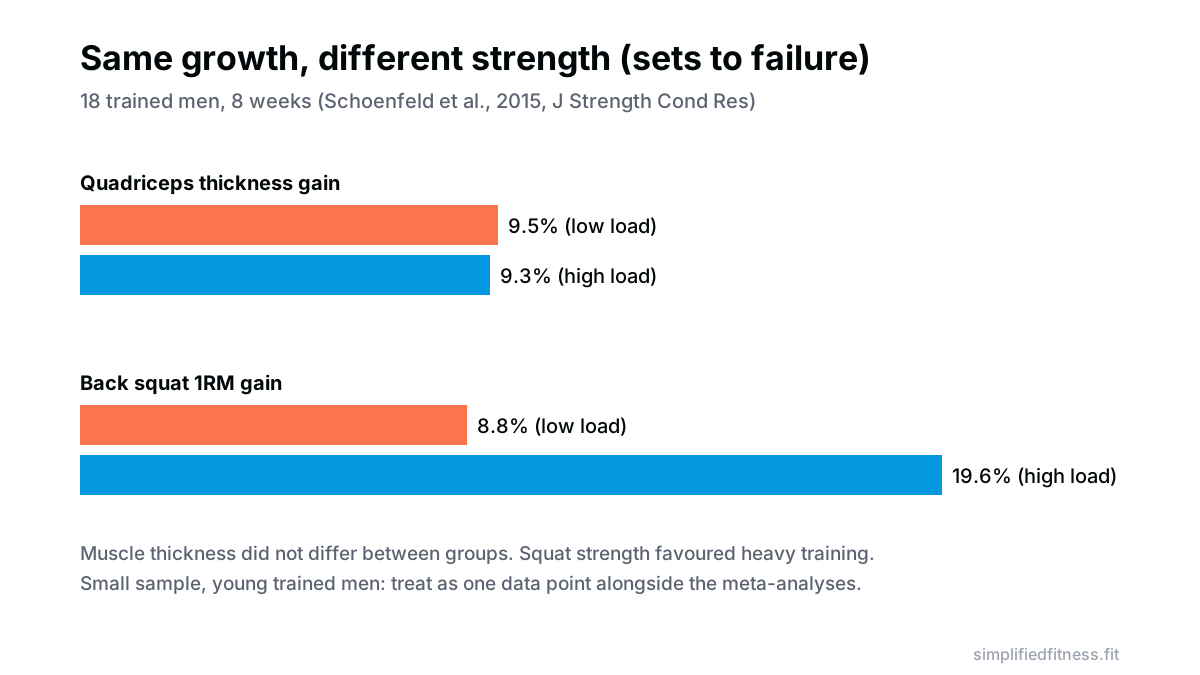
Notice both of those trials share a condition: sets were taken to failure. That is the catch, and it is the practical bit.
How close to failure do light sets need to be?
This is where the evidence is less tidy, so I will give both sides.
A 2023 meta-analysis of 15 studies found a trivial advantage for training to set failure over non-failure for hypertrophy (effect size 0.19, 95% CI 0.00 to 0.37), with no moderating effect of relative load. But when the analysis compared momentary muscular failure with non-failure specifically, there was no advantage either way (effect size 0.12, 95% CI -0.13 to 0.37) (Refalo et al., 2023). The authors suggest a potentially non-linear relationship between proximity to failure and hypertrophy.
Why do the findings look mixed? Studies define “failure” differently, include different loads, and many are short. My cautious reading: you do not need to grind out every rep to absolute failure, but you should not be miles away from it either, especially on light sets where the nervous system needs fatigue to reach the big units. Heavier sets can end 1-3 reps short and still have high recruitment from the start. You can estimate how close you are with our RIR/RPE calculator.
| Training style | Where recruitment of big units comes from | Practical stopping point |
|---|---|---|
| Heavy (about 75-90% 1RM, 5-12 reps) | The load itself, from rep one | Roughly 1-3 reps short of failure |
| Moderate (about 60-75% 1RM, 10-15 reps) | A mix of load and rising fatigue | Roughly 1-3 reps short |
| Light (about 30-50% 1RM, 20+ reps) | Mostly fatigue late in the set | Close to failure, 0-2 reps short |
The ranges in the table are practical rules of thumb, not figures taken from a single study.
Is the size principle a rigid law?
Mostly, but not always. In a 2022 study of one rhesus macaque, researchers found motor unit activity changed depending on the behaviour, and described the pattern as flexible rather than rigid, which challenges the idea that cortex only supplies a single common drive (Marshall et al., 2022). That is animal work in one monkey, so be careful about extending it to your bench press.
For lifters, the size principle remains a solid working model for slow, grinding sets. Just do not treat it as a switch you can flip with a particular rep range.
What are the limits of the evidence?
- EMG is imperfect. One classic study found the size principle could not be reliably detected at individual sites for the lowest-threshold units using conventional needle EMG, because the electrodes sample too small an area (Ertas et al., 1995). Surface EMG, used in most lifting studies, has its own limit: it records a blended signal and cannot count individual motor units.
- Mechanism vs outcome. The recruitment story explains why light training could work. The training trials above show that it does work in the groups tested, mostly young men.
- Short trials. Most last 6-12 weeks. Longer-term differences are less clear.
- Joints and fatigue. Heavy sets stress joints more, light sets accumulate fatigue and discomfort. These practical issues matter more than the physiology for many people.
How to use this: a practical split
You do not need to pick a side. A mixed approach covers both routes.
- Heavy compounds (squat, press, row) in roughly the 5-10 rep range, stopping 1-3 reps short. This builds strength and gets high recruitment immediately.
- Moderate isolation work in the 10-15 range for most accessories.
- Light finishers (15-30 reps) on joint-friendly movements, taken close to failure, especially useful if you train at home with dumbbells or a limited stack.
On a budget or in a crowded gym where the heavy dumbbells are always taken, this is useful: a lighter weight pushed hard still counts. If you want a structured version, our push, pull and legs plans already mix rep ranges this way.
If you have joint pain, a recent injury or a medical condition, talk to a doctor or physiotherapist before choosing heavy or near-failure training, rather than guessing from an article.
The bottom line
Henneman’s size principle explains why big units need a high demand to switch on. Heavy loads give you that demand immediately, and light loads can give it to you through fatigue, if you take them close enough to failure. Trials in trained people so far show similar muscle growth either way, and heavy lifting wins for maximal strength. Use both, finish sets honestly hard, and keep progressing.
Frequently Asked Questions
What is Henneman's size principle in simple terms?
It is the rule that motor units switch on in order of size, from small to large, as the effort demanded of a muscle increases. Small units supply low force and tire slowly, while large units supply high force and tire quickly. In the gym this means the big, growth-relevant units only join in when a set is heavy or when fatigue makes it effectively hard.
What is a motor unit?
A motor unit is one motor neuron from your spinal cord plus all the muscle fibres it controls. Small units control few fibres and large units control many, which is why large units produce more force. When you lift, your brain decides how many units to activate and how fast they fire.
Do I need to lift 85-90% of my 1RM to grow?
No, heavy loads are one route to high recruitment, not the only one. Meta-analyses of training to failure find similar muscle growth across a wide range of loads, though heavier loads build more maximal strength. If you enjoy heavy work and your joints tolerate it, use it, and if not, lighter sets taken close to failure are a reasonable alternative.
Can light weights recruit high-threshold motor units?
Probably yes, if the set gets hard enough. In one lab study of a sustained light contraction, motor unit recruitment thresholds fell as fatigue developed in one of the two tasks tested, meaning more units were drawn in for the same job. In practice, take light sets to within a few reps of failure rather than stopping while they still feel easy.
Is training to failure necessary for hypertrophy?
Not strictly, but proximity to failure matters most with light loads. A 2023 meta-analysis found no clear advantage of momentary failure over non-failure training for hypertrophy, with only a trivial advantage when set failure was defined more loosely. Stopping about 1-3 reps short is a sensible default for most lifters, and lighter loads should sit at the closer end of that range.
What is rate coding?
Rate coding is how fast a motor neuron fires action potentials. Once a unit is recruited, the nervous system can raise force further by increasing its firing rate. Recruitment and rate coding work together, and both contribute to how much force you can produce.
What are high-threshold motor units?
They are the large motor units that only activate when a high level of force is needed. They control many fast-twitch fibres and fatigue quickly. You reach them with heavy loads, explosive effort, or by pushing a lighter set until it is genuinely hard.
Does the size principle always hold?
It is a very robust general rule, but not a rigid law in every situation. A 2022 monkey study found motor unit activity was flexibly controlled depending on the task, suggesting recruitment order can bend. For lifters, the standard size-principle explanation remains a good working model for slow, grinding sets.
Do fast explosive reps recruit more motor units?
Fast intended speed generally demands higher motor unit activation, but the research I reviewed here did not test this directly for hypertrophy. Treat it as a plausible mechanism, not a guarantee. A practical option is to lift the weight with intent to move it quickly while still controlling the lowering phase.
Why do my light sets feel useless until the last few reps?
Early reps in a light set are largely handled by smaller, easier units, so the sense of effort stays low. The reps that feel hard are likely the ones where fatigue forces more units to join. That is why the final few reps of a light set are the ones that count.
Is surface EMG a reliable measure of recruitment?
Not completely. Conventional EMG picks up signals from a small area, and one study found the size principle could not be reliably detected at individual recording sites in low-threshold units. Use EMG studies as supporting evidence, then lean on training outcome studies, which measure the thing you care about, muscle growth.
How should I use this for training in a crowded gym or at home?
You do not need heavy equipment to reach high recruitment, you need enough effort. Choose a load you can lift for roughly 15-30 reps and stop within a few reps of failure, using a slow controlled tempo. Our RIR calculator can help you judge how close to failure you are.
Do beginners need to worry about motor unit recruitment?
Not really. Beginners grow from almost any hard-enough resistance training, and early strength gains are partly neural. Focus on showing up, progressing the load or reps, and finishing sets close to failure.
Sources & References
Every claim above is checked against peer-reviewed research (PubMed, U.S. National Library of Medicine) or guidance from established health bodies. How we fact-check.
- Schoenfeld BJ, et al. Loading Recommendations for Muscle Strength, Hypertrophy, and Local Endurance: A Re-Examination of the Repetition Continuum. Sports (Basel). 2021. PMID: 33671664
- Refalo MC, et al. Influence of Resistance Training Proximity-to-Failure on Skeletal Muscle Hypertrophy: A Systematic Review with Meta-analysis. Sports Med. 2023. PMID: 36334240
- Morton RW, et al. Neither load nor systemic hormones determine resistance training-mediated hypertrophy or strength gains in resistance-trained young men. J Appl Physiol. 2016. PMID: 27174923
- Schoenfeld BJ, et al. Strength and Hypertrophy Adaptations Between Low- vs. High-Load Resistance Training: A Systematic Review and Meta-analysis. J Strength Cond Res. 2017. PMID: 28834797
- Schoenfeld BJ, et al. Effects of Low- vs. High-Load Resistance Training on Muscle Strength and Hypertrophy in Well-Trained Men. J Strength Cond Res. 2015. PMID: 25853914
- Baudry S, et al. Load type influences motor unit recruitment in biceps brachii during a sustained contraction. J Neurophysiol. 2009. PMID: 19625539
- Oya T, et al. Recruitment and rate coding organisation for soleus motor units across entire range of voluntary isometric plantar flexions. J Physiol. 2009. PMID: 19703968
- Marshall NJ, et al. Flexible neural control of motor units. Nat Neurosci. 2022. PMID: 36216998
- Ertas M, et al. Can the size principle be detected in conventional EMG recordings? Muscle Nerve. 1995. PMID: 7715629

Umair Hazrami · Founder & Head Coach, Simplified Fitness
Umair Hazrami founded Simplified Fitness and the Simplified Lifter channel to cut through fitness noise. With 4+ years of consistent training and 10+ coaching clients, he writes every guide from the peer-reviewed research and links the sources so you can check them. Our editorial standards.
Educational content only, not medical advice. If you have a medical condition, are pregnant, or take medication, talk to a qualified doctor before changing your diet, supplements or training. Full disclaimer.
Keep reading

Hypertrophy
Anabolic Resistance in Older Adults: Why Muscle Responds Less and How to Beat It
Anabolic resistance in older adults explained: why muscle responds less to protein and lifting after 50, plus the protein dose, leucine and sets that help.
8 min read

Hypertrophy
How Blood Flow Restriction Builds Muscle: Venous Occlusion, Metabolites and Cell Swelling
BFR training hypertrophy mechanisms explained: how a cuff and 20% 1RM can match heavy lifting for size. Metabolites, swelling, mTOR, myostatin and cuff safety.
8 min read
Hypertrophy
CNS Fatigue vs Muscle Fatigue: Is Your Nervous System Really Fried?
CNS fatigue vs muscle fatigue: what central and peripheral fatigue really are, how long each lasts, and how to tell which one is holding your lifts back.
9 min read

Hypertrophy
Exercise-Induced Muscle Damage (EIMD): Why Chasing Soreness Is Counterproductive
Muscle damage and hypertrophy are not the same thing. See what Z-disc streaming studies show, why soreness is a poor gauge of growth, and what to track.
8 min read