Neural Adaptations vs Muscle Growth: Why You Get Stronger Before You Look Bigger
Neural adaptations vs muscle growth: why beginners gain strength in weeks 1-8 before the mirror changes, what the studies show, and what to expect.
TL;DR. The short answer
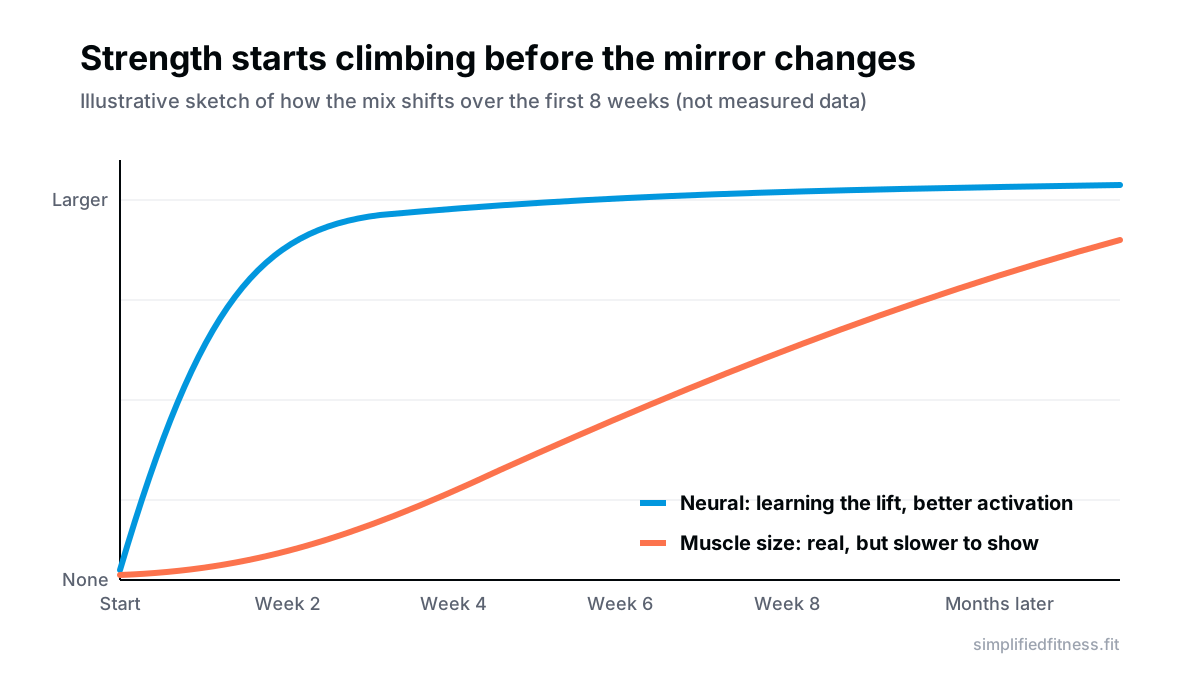
- Early strength gains in beginners come mostly from the nervous system learning the lift (better muscle activation, coordination and timing between muscles), with muscle size catching up more slowly.
- It is not purely neural. In sedentary men, thigh muscle size rose measurably within weeks 3-4 of training, and about 9.6% by week 8 (DeFreitas et al., 2011), so the old 'neural only' story is too simple.
- Training one limb can raise strength in the untrained limb by about 12% on average (31 trials), which is hard to explain without a neural component.
- Strength can rise faster than the mirror changes because small size gains are hard to see, while technique and coordination improve the number on the bar quickly.
- A fair expectation: fast early strength, small but real size gains, and visible change usually needing months of consistent progressive overload, food and sleep.
Part of our complete guide: How Muscle Actually Grows: The Natural Lifter's Guide to Hypertrophy Science
Table of contents
You start lifting, and within a month your squat or lat pulldown has jumped a lot. You check the mirror and, honestly, you look about the same. That gap is the story of neural adaptations vs muscle growth: early strength gains come largely from your nervous system getting better at using the muscle you already have, while muscle size changes more slowly and is harder to see.
It is not a pure either/or, though, and that is where many explanations go wrong. This article sits under our complete guide to muscle hypertrophy for natural lifters and zooms in on the first 8 weeks, so you know what is happening and what to expect.
Why does strength increase before muscle size?
Strength is not only about how much muscle you have. It also depends on how well your nervous system switches that muscle on. In a classic review, Sale described how strength training can let a person “more fully activate prime movers” and better coordinate all the muscles involved, producing more force in the intended direction (Sale, 1988).
A useful gym comparison: think of a new lifter as someone with a big engine but a clumsy driver. The first few weeks are the driver learning the car. The engine barely changed, yet the car goes faster.
Gabriel and colleagues make the same point in a later review: an increase in strength without noticeable hypertrophy is “the first line of evidence” for neural involvement (Gabriel et al., 2006).
What actually changes in the nervous system?
Reviews of the evidence point to several candidates. The strength of the evidence differs for each, so it helps to separate them.
- More muscle activation. Surface EMG (electrodes on the skin that read muscle electrical activity) shows higher amplitude in the early phase of training, usually interpreted as increased neural drive (Gabriel et al., 2006).
- Better motor unit behaviour. A motor unit is one nerve cell plus the muscle fibres it controls. Reviews describe lower recruitment thresholds, higher discharge rates and more double discharges (two very close nerve impulses) early in training (Griffin and Cafarelli, 2005).
- Cortical and spinal changes. The same review notes evidence for increased excitation at the cortical level after short-term training. It focuses on isometric training, so read these as “likely contributors” rather than a precise recipe.
- Coordination. Better teamwork between the main muscle and its helpers, and changes in how much opposing muscles co-contract (Griffin and Cafarelli, 2005).
- Motor unit synchronisation. Gabriel et al. call this a possible mechanism that “has yet to be definitely demonstrated”. It is a good example of why I hedge.
How does cross-education show the neural effect?
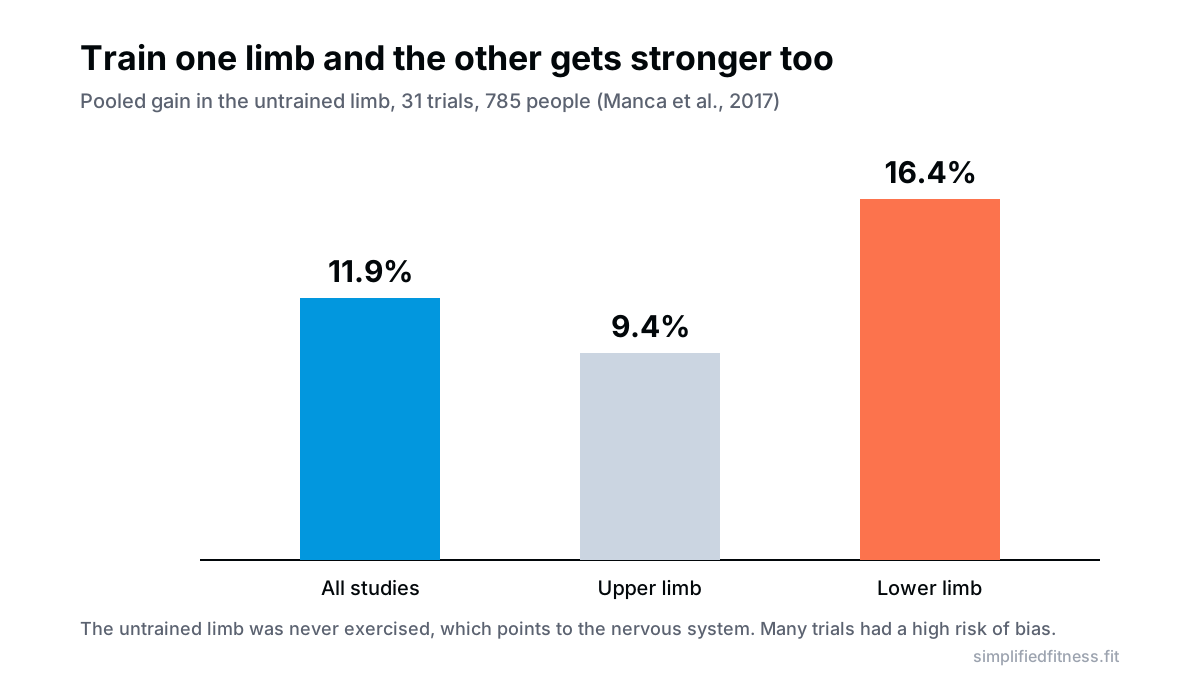
One of the neatest pieces of evidence is cross-education: train one limb and the other, untrained limb gets stronger. A 2017 meta-analysis pooled 31 randomised trials and 785 people and found an average 11.9% strength gain in the untrained limb, with +9.4% for upper limbs and +16.4% for lower limbs (Manca et al., 2017). The authors flagged a high risk of bias across studies, so the exact number should be held loosely.
A smaller 8-week study then looked inside the muscle with high-density EMG. Nine people trained one arm and were compared with nine controls. Strength in the untrained biceps rose 7% by week 4 and 10% by week 8, alongside lower motor unit recruitment thresholds and a higher net discharge rate (Lecce et al., 2024). That is a small sample, so it fits the neural picture rather than proving it on its own.
The key idea: if a muscle you never trained gets stronger, the most likely explanation is better signalling from the nervous system, not that muscle building bulk.
Is it really “only neural” for the first 8 weeks?
This is where the popular story needs a correction. You will often read that early gains are almost exclusively neurological. The direct measurements say it is more mixed.
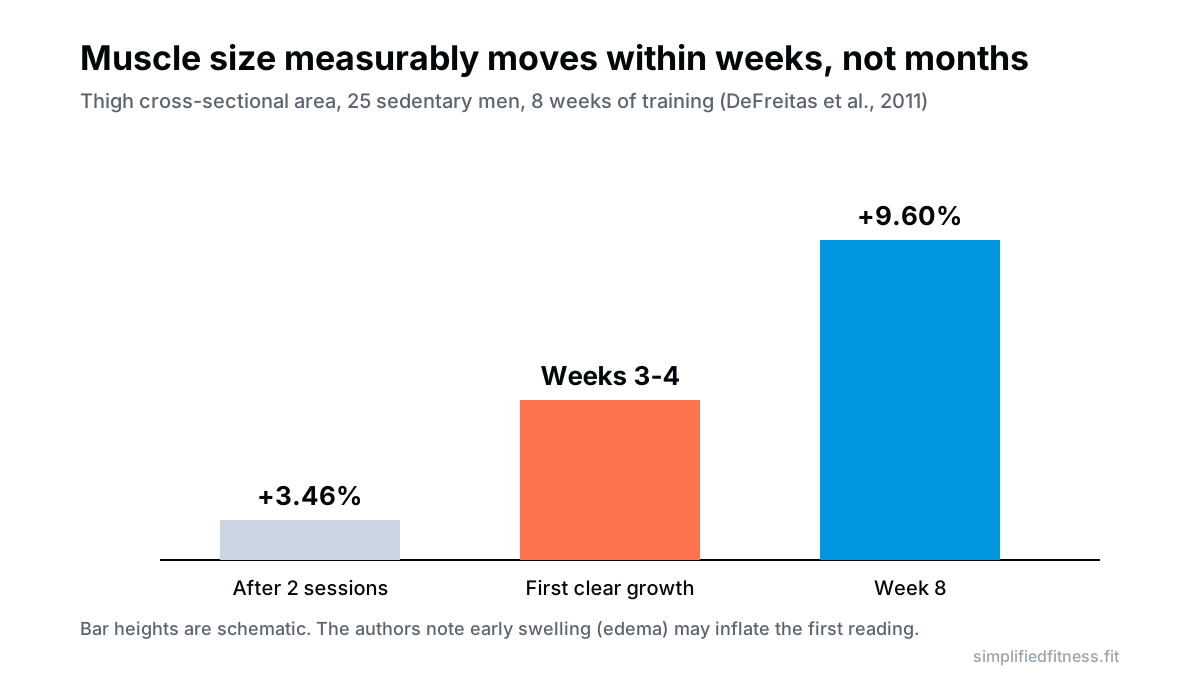
What study A found. In a trial of 25 sedentary men doing 8 weeks of high-intensity resistance training, thigh cross-sectional area was measured every week. After just two sessions it was already up 3.46%. The authors cautioned that muscle swelling (edema) may have inflated that early number, so they looked at the next significant step, which came around week 3. The first significant strength increase appeared at week 4, and by week 8 thigh size was up 9.60% (DeFreitas et al., 2011). Their conclusion was that meaningful growth “likely occurred around weeks 3-4”.
What study B found. Another group tested whether early size changes were just damage and swelling. Thirteen untrained men did concentric-only curls and shoulder presses (the lifting part only, no muscle-damaging lowering phase) twice a week for 4 weeks. Soreness and swelling markers did not change, yet lean mass and muscle thickness rose within seven training sessions. Muscle thickness was up by about 0.23-0.31 cm across the last three tests, although measured strength (peak torque) did not change significantly over those 4 weeks (Stock et al., 2017). So some early size gain looks real rather than just a pump.
Why the studies can disagree with “neural only”. Part of the older view probably reflects a time when strength could be tracked closely but small size changes were hard to measure. Newer imaging and weekly testing detect small changes sooner. Also, swelling can blur early measurements, and different muscles, training styles and participants respond differently.
Practical takeaway. Both things are happening. Neural learning likely leads the strength gains in the first weeks, while a small but real muscle size increase runs in the background. The size change is simply too small to see in the mirror.
A trial in women adds a useful note: in young and older women training three times per week for 8 weeks, thigh muscle thickness increased within 1-3 weeks and strength rose by week 2 in most measurements. Muscle size explained only 9-35% of the within-person strength variance, so a large share of strength change was left unexplained (Loenneke et al., 2017). That is consistent with a mixed picture, though it does not tell us how much of the remainder is neural.
Why does it not look like anything in the mirror?
Several ordinary reasons stack up.
- Small change, big camera. A few millimetres of muscle thickness is real, but hard to see through body fat, loose clothes and bad lighting.
- Strength is learned quickly. You can lift more by bracing better and moving smoother, with no visible change.
- Early numbers can mislead. Swelling inflates early scans, and a pump after training can fool the mirror.
- Daily checking. You see yourself every day, so slow change disappears.
What should I expect in weeks 1-8?
This is a realistic, hedged outline. Individual results vary a lot, and the studies above used mostly untrained men with some data in women.
| Phase | What is usually happening | What you might notice |
|---|---|---|
| Weeks 1-2 | Learning the movement, higher activation, swelling after sessions | Lifts feel smoother, loads climb fast, some soreness |
| Weeks 3-4 | Strength still rising; measurable size change in some studies | Slightly fuller muscles after training, mirror mostly the same |
| Weeks 5-8 | Gains in strength continue, usually slower; size changes accumulate | Clothes may fit differently, progress photos start to differ |
| After 8 weeks | Size increasingly contributes to strength | Visible change becomes easier with consistent overload and food |
Notice that I am not giving a fixed percentage for how neural or muscular the gains are at each point. The studies do not support a precise split, and I would rather say that than invent one.
How do I use this to train smarter in the first 8 weeks?
Because the early phase is partly motor learning, practice quality matters.
- Pick a small set of exercises and keep them. Repeating the same lifts gives your brain something to learn. Our exercise selection and biomechanics guide helps you choose them. Constantly rotating exercises resets the learning, a point we cover in the muscle confusion myth.
- Add load or reps gradually. Progress in small steps and write it down. See how to keep a training logbook.
- Stop a couple of reps short of failure at first. Your form is still improving, and clean reps are better practice. The RIR / RPE calculator can help you gauge effort.
- Eat enough protein. Size gains need raw material. Dal, paneer, curd, eggs, soya chunks and chicken all work. The protein calculator gives a daily target for your weight.
- Do not chase soreness. In the concentric-only study, size rose without soreness changes, so soreness is a weak progress signal. For the broader picture, see DOMS vs muscle growth.
- Start with a plan. If you need structure, our free push pull legs plan gives a simple weekly split.
Does the neural effect fade, and what comes next?
Neural adaptation does not switch off at week 8. It continues, but as you train longer, muscle size is generally thought to take on a bigger share of your strength gains, a shift Sale discussed back in 1988 (Sale, 1988). The quick jumps slow down. That is normal and not a plateau.
If you are past the beginner stage and stuck at “stronger but not bigger”, our guide to strength gains vs muscle growth picks up from here. If you want to go deeper on the nervous system side for experienced lifters, our article on neuromuscular foundations of maximal strength covers it. This piece stays with the beginner window.
Who should see a doctor?
Normal early progress feels like lifts getting easier and muscles feeling a bit fuller. See a doctor or physiotherapist if you notice sudden unexplained weakness, numbness or tingling, severe or lingering pain, or unusual swelling. Those are not typical adaptations, and this article cannot diagnose them.
The bottom line
Early strength gains are largely your nervous system learning, which is why the bar moves before the mirror does. The research also shows real muscle growth starting within weeks in beginners, so “neural only” is too simple.
Be patient for 8-12 weeks, keep the lifts consistent, add load slowly, eat enough protein and sleep well. Judge yourself by the log and monthly photos, not the daily mirror.
Frequently Asked Questions
Why do I get stronger before I see muscle growth?
Early strength gains reflect the nervous system getting better at using the muscle you already have, plus small real size changes that are hard to see. Reviews of the research describe higher muscle activation, better coordination and changes in opposing-muscle activity in the first weeks of training. Keep logging your lifts, because the bar number is the most honest early signal.
How long does it take for neural adaptations to happen?
Strength often rises measurably within the first 2-4 weeks, and the neural share of that gain is largest early on. Trials of 4-8 weeks have measured changes in motor unit behaviour, for example a 7% strength gain in an untrained arm by week 4. There is no exact cutoff, so treat 'weeks 1-8' as a guide rather than a switch.
Is early strength gain only neural?
No. Older textbooks often say so, but studies that measured muscle directly found size increases within weeks. One study of sedentary men found significant growth around weeks 3-4, and another found small increases within seven sessions even without muscle-damaging eccentric work. Plan on both mechanisms working together.
How long until I see muscle growth from lifting?
Scanners can pick up small size changes in a few weeks, but visible change in the mirror usually takes longer. In one 8-week study, thigh size rose about 9.6% in sedentary men, yet a few millimetres of thickness is easy to miss by eye. Photos taken every 4 weeks in the same light show change far better than daily mirror checks.
Is it normal to be stronger but not bigger after a month?
Yes, this is the typical pattern for a beginner. Strength can improve through coordination and activation while muscle size changes are modest and partly hidden by body fat and clothing. Keep adding reps or weight, eat enough protein, and judge progress over 8-12 weeks.
What is motor learning in strength training?
Motor learning is your brain getting better at a movement pattern, such as the squat bar path or how hard you brace. It happens because practice refines which muscles fire, when, and how hard. It is why technique cues and consistent exercise selection help early progress.
What is cross-education of strength?
Cross-education means training one limb and gaining strength in the other, untrained limb. A meta-analysis of 31 trials and 785 people found an average gain of about 11.9% in the untrained limb. Because the untrained muscle was not worked, this supports a neural explanation, though many trials had a high risk of bias.
What does antagonist co-activation mean?
It is the opposing muscle tensing while the main muscle works, for example the hamstrings tightening during a leg extension. Reviews report that co-activation can decrease or increase with training, so the picture is not simple. The practical takeaway is that smoother, more coordinated movement often shows up as extra strength.
Do neural adaptations stop after 8 weeks?
No. Neural adaptation continues, but muscle size usually contributes a larger share of strength gains as training goes on. Trained lifters still refine skill and motor unit behaviour, just with smaller steps than a beginner. Keep progressing loads slowly and expect gains to slow down over time.
Does muscle soreness mean I am growing?
Not necessarily. A 4-week study in untrained men using concentric-only training found small increases in muscle size without meaningful soreness or swelling markers. Soreness is a poor guide to progress, so track performance and consistency instead.
Can women or older adults expect the same early pattern?
The early pattern appears in both, though study details differ. One trial in young and older women found muscle thickness rose within 1-3 weeks and strength improved by week 2 in most measurements. Treat the findings as supportive rather than identical for everyone, and start with manageable loads.
Should beginners train to failure to build muscle fast?
Not required in the first weeks. Beginners gain strength quickly with moderate effort because skill and activation are improving. Stopping a couple of reps short of failure on most sets lets you practise good technique and recover between sessions.
When should I see a doctor about strength changes?
See a doctor if you have sudden unexplained weakness, numbness, sharp or persistent pain, or swelling after starting training. Normal early gains feel like slightly easier lifts, not new neurological symptoms. This article is education, not a diagnosis.
Sources & References
Every claim above is checked against peer-reviewed research (PubMed, U.S. National Library of Medicine) or guidance from established health bodies. How we fact-check.
- DeFreitas JM, et al. An examination of the time course of training-induced skeletal muscle hypertrophy. Eur J Appl Physiol. 2011. PMID: 21409401
- Stock MS, et al. The time course of short-term hypertrophy in the absence of eccentric muscle damage. Eur J Appl Physiol. 2017. PMID: 28321637
- Manca A, et al. Cross-education of muscular strength following unilateral resistance training: a meta-analysis. Eur J Appl Physiol. 2017. PMID: 28936703
- Lecce E, et al. Cross-education: motor unit adaptations mediate the strength increase in non-trained muscles following 8 weeks of unilateral resistance training. Front Physiol. 2024. PMID: 39839528
- Sale DG. Neural adaptation to resistance training. Med Sci Sports Exerc. 1988. PMID: 3057313
- Gabriel DA, et al. Neural adaptations to resistive exercise: mechanisms and recommendations for training practices. Sports Med. 2006. PMID: 16464122
- Griffin L, et al. Resistance training: cortical, spinal, and motor unit adaptations. Can J Appl Physiol. 2005. PMID: 16129897
- Loenneke JP, et al. Time-course of muscle growth, and its relationship with muscle strength in both young and older women. Geriatr Gerontol Int. 2017. PMID: 28276188

Umair Hazrami · Founder & Head Coach, Simplified Fitness
Umair Hazrami founded Simplified Fitness and the Simplified Lifter channel to cut through fitness noise. With 4+ years of consistent training and 10+ coaching clients, he writes every guide from the peer-reviewed research and links the sources so you can check them. Our editorial standards.
Educational content only, not medical advice. If you have a medical condition, are pregnant, or take medication, talk to a qualified doctor before changing your diet, supplements or training. Full disclaimer.
Keep reading

Hypertrophy
Anabolic Resistance in Older Adults: Why Muscle Responds Less and How to Beat It
Anabolic resistance in older adults explained: why muscle responds less to protein and lifting after 50, plus the protein dose, leucine and sets that help.
8 min read

Hypertrophy
How Blood Flow Restriction Builds Muscle: Venous Occlusion, Metabolites and Cell Swelling
BFR training hypertrophy mechanisms explained: how a cuff and 20% 1RM can match heavy lifting for size. Metabolites, swelling, mTOR, myostatin and cuff safety.
8 min read
Hypertrophy
CNS Fatigue vs Muscle Fatigue: Is Your Nervous System Really Fried?
CNS fatigue vs muscle fatigue: what central and peripheral fatigue really are, how long each lasts, and how to tell which one is holding your lifts back.
9 min read

Hypertrophy
Exercise-Induced Muscle Damage (EIMD): Why Chasing Soreness Is Counterproductive
Muscle damage and hypertrophy are not the same thing. See what Z-disc streaming studies show, why soreness is a poor gauge of growth, and what to track.
8 min read