Exercise-Induced Muscle Damage (EIMD): Why Chasing Soreness Is Counterproductive
Muscle damage and hypertrophy are not the same thing. See what Z-disc streaming studies show, why soreness is a poor gauge of growth, and what to track.
TL;DR. The short answer
- Muscle damage is not required for hypertrophy. In a trial where one group avoided damage by ramping up gradually, strength gains were 25% versus 26% and muscle size rose equally in both groups.
- Damage is greatest in the first sessions of a new program, when protein synthesis appears to go toward repair. In a small study of 10 untrained men, post-workout synthesis only tracked growth once damage had faded.
- Early scan gains in a new lifter are partly swelling (edema), not pure new muscle tissue.
- Soreness is a rough signal of unfamiliar stress, not a score for your session. Progressive overload, close-to-failure sets and recoverable volume are better targets.
- Pain that is sharp, one-sided, joint-based, or comes with dark urine or marked swelling is not normal soreness. See a doctor.
Part of our complete guide: How Muscle Actually Grows: The Natural Lifter's Guide to Hypertrophy Science
Table of contents
If you are not limping the day after training, was the workout wasted? Probably not. The research on muscle damage and hypertrophy suggests damage is a side effect of unfamiliar training, not the thing that builds muscle, and chasing it can cost you quality sessions later in the week.
This article looks inside the muscle fibre to see what damage is, what it does to force and protein synthesis, and why progressive overload beats soreness as a guide. It sits inside our complete muscle hypertrophy guide for natural lifters. If you only want the pain side, our piece on DOMS versus muscle growth covers it.
What is exercise-induced muscle damage?
Exercise-induced muscle damage (EIMD) happens mostly after unaccustomed exercise, and the greatest damage comes from eccentric work, where the muscle is forcibly lengthened (Schoenfeld, 2012). Think slow lowering phases, a first session of Romanian deadlifts, or a big jump in volume after a break.
The damage ranges from small disturbances in a few proteins to larger tears in the fibre membrane and supporting connective tissue (Schoenfeld, 2012). Direct signs include cellular and subcellular disturbance, particularly Z-line streaming, while indirect signs include swelling on MRI, prolonged loss of force, inflammatory markers, proteins leaking into the blood, and soreness (Clarkson & Hubal, 2002).
So “damage” is a cluster of things, and soreness is only the one you can feel.
What does Z-disc streaming look like, and is it really damage?
Each muscle fibre is a stack of tiny repeating units called sarcomeres, and Z-discs are the boundaries that anchor them. After a hard unfamiliar session, electron micrographs of muscle biopsies show Z-discs that look smeared, widened or misaligned. That is Z-disc streaming.
Here is where it gets interesting. Researchers who examined biopsies from people with delayed onset soreness found Z-disc streaming, smearing and disruption were more frequent 2-3 days and 7-8 days after exercise. Their interpretation was that these changes reflect adaptive remodelling of the myofibrils rather than pure injury (Yu et al., 2004).
Other reviews still treat Z-line streaming as a hallmark of damage (Clarkson & Hubal, 2002). Both can be partly right: the same structural change may be the muscle both breaking down and rebuilding. For practical purposes, it is a sign of unfamiliar stress that your body then has to clean up.
Does muscle damage cause hypertrophy?
The popular belief is that damage and the inflammation that follows are necessary for growth. Schoenfeld’s review lays out both sides: a theory in which structural changes alter gene expression and strengthen the tissue, and critics who note that hypertrophy can occur in the relative absence of damage (Schoenfeld, 2012).
Three lines of research push the debate toward “damage is not the driver.”
The ramp-up trial
One study split people into a pre-trained group, who avoided demonstrable damage through a three-week gradual ramp-up, and a naive group, who started with a damaging bout. Both then did eight weeks of high-force eccentric cycling with matched work. The naive group showed more than five times higher plasma creatine kinase and reported initial soreness, yet muscle size and strength gains did not differ. Strength rose 25% in the ramp-up group and 26% in the naive group, and IGF-1Ea mRNA rose similarly in both (Flann et al., 2011).
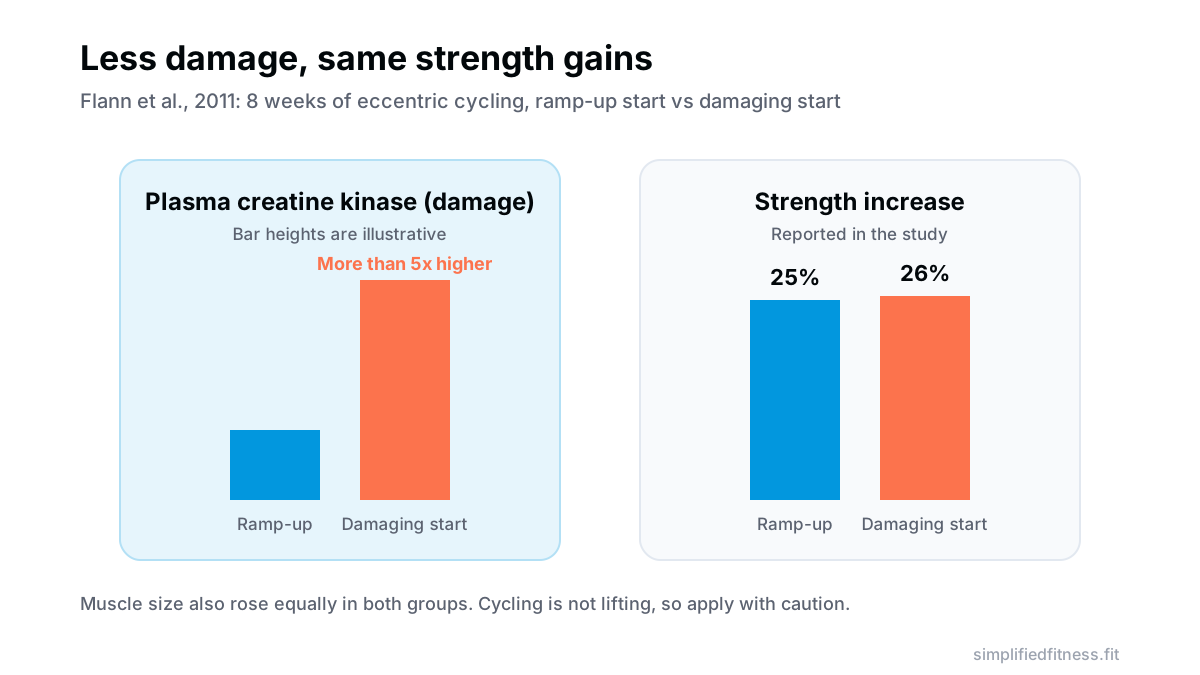
Caveats matter here. This was eccentric cycling, not barbell training, so it does not map perfectly onto your bench or squat.
Protein synthesis goes toward repair first
In a small study, ten untrained young men had muscle biopsies at the start of training, at week 3 and at week 10. Muscle damage (Z-band streaming) was highest after the first session and minimal by week 10. Myofibrillar protein synthesis was also highest at the start, but it was not related to later hypertrophy; synthesis at weeks 3 and 10 was strongly correlated with growth (r about 0.9). The authors concluded that the initial response is not directed at hypertrophy, and that growth reflects accumulated synthesis mainly after damage is attenuated (Damas et al., 2016).
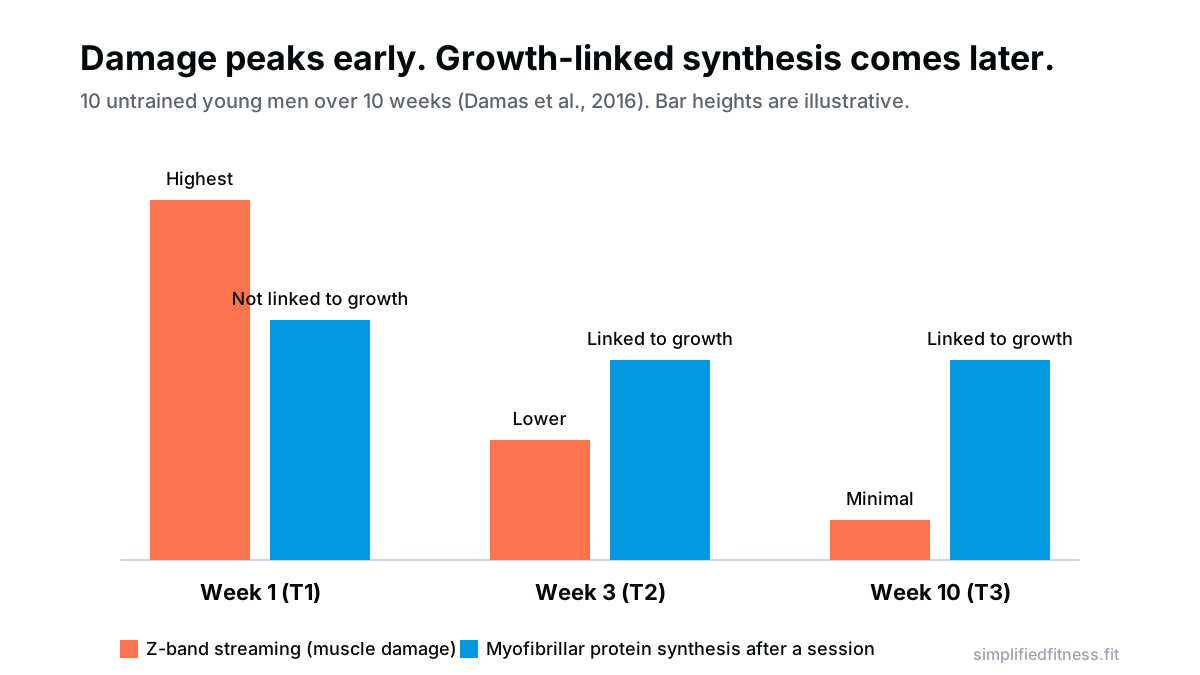
The same group’s review argues that early synthesis likely goes to repair and remodelling, that RT protocols without significant damage still produce similar hypertrophy and strength, and concludes muscle damage is not the process that mediates or potentiates hypertrophy (Damas et al., 2018). That is a review with a clear stance, and ten men is a very small sample, so I would call it a strong hint rather than the last word.
Early “growth” is partly swelling
In ten untrained young men, muscle area measured by ultrasound rose about 2.7% by week 3 and about 10.4% by week 10. But echo intensity rose alongside, and the authors proposed that the early increases are not purely hypertrophy because edema-related swelling, probably from damage, may account for a large share (Damas et al., 2016). They also noted myoglobin and interleukin-6 were elevated at week 3.
So the pump you feel and the size you see in your first month of lifting is not all new muscle tissue.
Why does too much damage backfire?
Heavy damage has costs. Prolonged decreases in force production are among the indirect markers of damage, along with swelling and soreness (Clarkson & Hubal, 2002). If the next session is weaker, you lift less load or fewer quality reps, and that is the thing that drives progress.
Schoenfeld notes that although damage can have detrimental short-term effects on markers of performance and pain, some have hypothesised that the associated inflammation and protein turnover are necessary for long-term adaptation, a view others question (Schoenfeld, 2012). There is a plausible story that repair work competes with building work, including for the cells and energy involved, but human evidence for the details is limited, so I will not pretend it is settled.
What should you track instead of soreness?
Soreness is a noisy measure. It depends on novelty, the type of contraction, and the person. Better signals:
- Performance: are your load or reps trending up over 4-8 weeks on the same exercises?
- Proximity to failure: are your working sets hard, ending about 0-3 reps from failure? Our RIR and RPE calculator helps you rate it.
- Weekly sets per muscle: enough to stimulate growth, not so many that you cannot recover. See volume landmarks (MV, MEV, MAV, MRV) and check yours with the training volume calculator.
- Mechanical tension: loading the muscle through a good range. We compare it with damage in mechanical tension versus muscle damage.
Why do you get less sore over time?
After one bout of eccentric exercise, the muscle becomes less vulnerable to the next bout. This is the repeated bout effect, and the mechanism is still debated, with theories including altered motor unit recruitment, more sarcomeres in series, and a blunted inflammatory response (Clarkson & Hubal, 2002).
A 2023 meta-analysis of 20 studies in healthy adults found DOMS and creatine kinase were significantly greater after the first bout than the second at 24 and 48 hours (SMD 0.51-1.23), and strength and jump performance were lower after the first (SMD -0.27 to -0.40) (Doma et al., 2023). Every study in that analysis used multi-joint exercises, so the protection is not just a lab quirk of single-muscle eccentric tests.
This is why feeling less sore is not a sign you stopped growing. It is a sign your body adapted. The full story is in our repeated bout effect guide.
How to train without chasing soreness
- Start new exercises conservatively. Use 2-3 sets with 3-4 reps in reserve for the first week, especially for lengthening-heavy moves like RDLs, deep lunges and slow negatives.
- Add volume in steps. Raise sets by 1-2 per muscle per week rather than doubling. Returning after a break? Start well below your old volume (around half is a sensible rule of thumb) and build back.
- Keep your best exercises stable. Repeating a movement lets you progress and lets damage fade. Our guide to progressive overload beyond adding iron shows other ways to progress.
- Eat enough protein and sleep. Recovery supports everything above. In India, dal, paneer, curd, eggs and soya chunks can cover protein on a budget.
- Do not train through red flags. The warning signs are listed below.
When is soreness not normal?
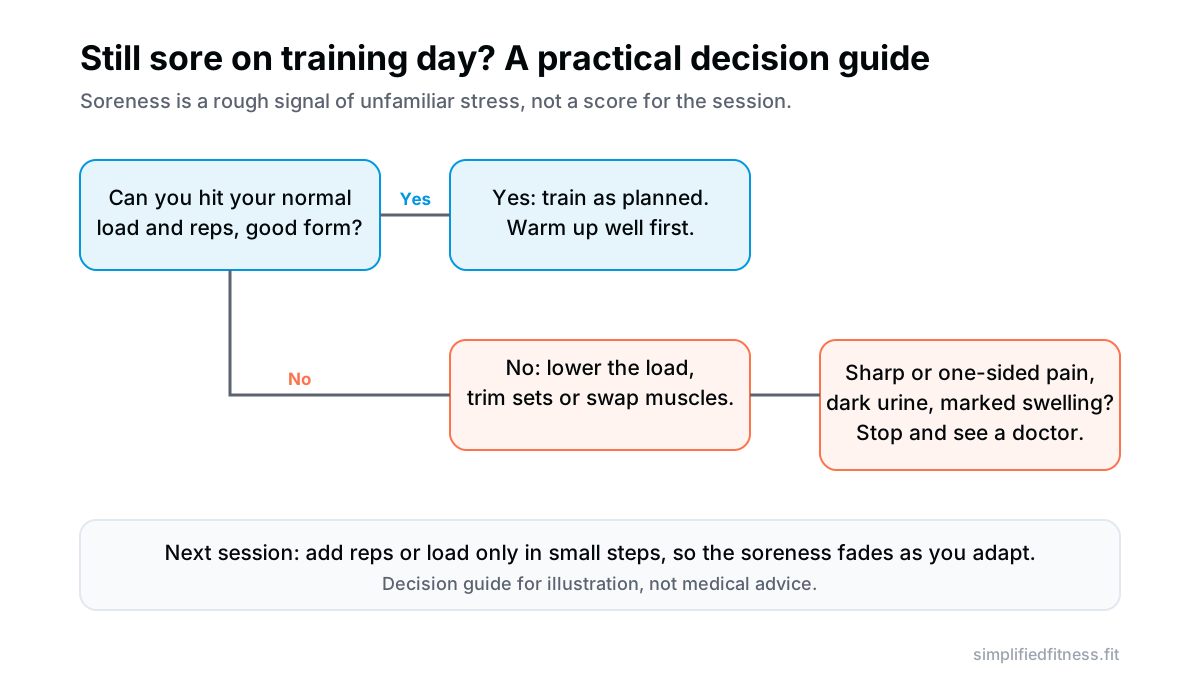
Normal soreness is dull, affects both sides, and gets better within a few days. See a doctor if you have severe or one-sided pain, a swollen and tense limb, weakness out of proportion to the workout, or very dark or tea-coloured urine. These can point to a serious problem such as rhabdomyolysis. This is general information, not a diagnosis.
Can any damage be useful?
Possibly. Schoenfeld’s review sets out the theoretical case that damage-related signalling could add to the growth stimulus, alongside the counter-evidence (Schoenfeld, 2012), and the question is not fully closed. The reasonable stance is that some mild damage is an unavoidable by-product of hard training and nothing to worry about, but deliberately maximising it is not supported.
The bottom line
Muscle damage and hypertrophy overlap, but the evidence does not support the idea that more damage means more growth. Trials show similar gains with and without it, early size changes include swelling, and early protein synthesis seems aimed at repair. Most studies here are small, in untrained people, over weeks rather than years, so hold the conclusion with some humility.
Train hard, get close to failure, add load or reps gradually and recover well. If you want a structure that does this, try our free training plans.
Frequently Asked Questions
Does muscle damage cause muscle growth?
Not necessarily. Reviews conclude that hypertrophy can happen with little or no detectable damage, and one trial found equal growth with and without an initial damaging bout. Damage may still be part of the stimulus in some cases, but it does not look like the driver. Aim for hard, progressive sets rather than for pain.
Do I need to be sore to build muscle?
No. Soreness mostly reflects unfamiliar exercise, especially lengthening (eccentric) work, and it fades as your body adapts even while you keep growing. Many experienced lifters get little soreness and still progress. Judge your training by load, reps and quality of sets over weeks.
What is Z-disc streaming?
Z-discs are the boundaries that anchor each sarcomere, the repeating unit of muscle. Z-disc streaming is the smeared or misaligned appearance seen under an electron microscope after unaccustomed exercise, and it is a classic marker of damage. Some researchers argue it may partly reflect remodelling rather than only injury, so treat it as a sign of unfamiliar stress.
Is muscle damage the same as DOMS?
No. Damage describes what happens inside the fibre, while delayed onset muscle soreness (DOMS) is the pain you feel, and the two do not line up perfectly. You can have measurable damage with little soreness or the reverse. Our soreness article covers the pain side in more detail.
Is a lot of soreness a sign of a good workout?
Not reliably. Soreness tells you the session was unfamiliar, not that it was effective. A routine that you recover from well and can progress each week usually beats one that leaves you limping. Use soreness as one input, alongside performance.
Why does muscle damage reduce strength?
Strength can fall for days after a damaging session because force transmission and excitation-contraction coupling are disrupted, and a review notes these force losses can be prolonged. That means your next session may be weaker even if you feel motivated. If you cannot hit your usual loads, trim volume rather than grinding through.
Do I grow muscle in the first weeks of lifting?
Yes, but part of the early size gain is swelling. In a study of untrained men, early scan increases in muscle area coincided with edema, and true hypertrophy appeared later. Strength rises early mostly from learning and neural changes, so keep going for at least 8 to 12 weeks before judging.
Does eccentric training cause more damage?
Yes. Reviews describe eccentric (lengthening) contractions as producing the greatest damage, especially when unaccustomed. That is why a first session of Romanian deadlifts or slow negatives can wreck you. Introduce them gradually and keep reps in reserve at first.
Why am I less sore than I used to be?
Your muscles adapt after a first damaging bout, so the same workout causes less damage and soreness next time (the repeated bout effect). Less soreness does not mean less growth. Keep adding load or reps gradually, and see our repeated bout article for the details.
How long should I wait before training a sore muscle?
There is no fixed rule, but if you can train with normal load, full range and good form, mild soreness is usually not a reason to skip. If soreness limits your range or strength, lower the load or train another muscle group that day. Seek medical advice if pain is sharp, one-sided or unusual.
Can too much soreness delay my progress?
It can, indirectly. Damage can reduce force production and make the next sessions weaker or skipped, which lowers your weekly training quality. Building volume in steps lets you collect the benefit without being flattened. Add 1-2 sets at a time rather than doubling your volume overnight.
When should I worry about muscle soreness?
See a doctor if you have severe pain, marked swelling, very dark or tea-coloured urine, or weakness that is out of proportion to the workout. These can be signs of a more serious problem such as rhabdomyolysis. Normal soreness is dull, symmetrical and improves within a few days.
Sources & References
Every claim above is checked against peer-reviewed research (PubMed, U.S. National Library of Medicine) or guidance from established health bodies. How we fact-check.
- Schoenfeld BJ. Does exercise-induced muscle damage play a role in skeletal muscle hypertrophy? J Strength Cond Res. 2012. PMID: 22344059
- Damas F, et al. The development of skeletal muscle hypertrophy through resistance training: the role of muscle damage and muscle protein synthesis. Eur J Appl Physiol. 2018. PMID: 29282529
- Damas F, et al. Resistance training-induced changes in integrated myofibrillar protein synthesis are related to hypertrophy only after attenuation of muscle damage. J Physiol. 2016. PMID: 27219125
- Damas F, et al. Early resistance training-induced increases in muscle cross-sectional area are concomitant with edema-induced muscle swelling. Eur J Appl Physiol. 2016. PMID: 26280652
- Flann KL, et al. Muscle damage and muscle remodeling: no pain, no gain? J Exp Biol. 2011. PMID: 21270317
- Yu JG, et al. Evidence for myofibril remodeling as opposed to myofibril damage in human muscles with DOMS: an ultrastructural and immunoelectron microscopic study. Histochem Cell Biol. 2004. PMID: 14991331
- Clarkson PM, et al. Exercise-induced muscle damage in humans. Am J Phys Med Rehabil. 2002. PMID: 12409811
- Doma K, et al. The repeated bout effect of multiarticular exercises on muscle damage markers and physical performances: a systematic review and meta-analyses. J Strength Cond Res. 2023. PMID: 38015738

Umair Hazrami · Founder & Head Coach, Simplified Fitness
Umair Hazrami founded Simplified Fitness and the Simplified Lifter channel to cut through fitness noise. With 4+ years of consistent training and 10+ coaching clients, he writes every guide from the peer-reviewed research and links the sources so you can check them. Our editorial standards.
Educational content only, not medical advice. If you have a medical condition, are pregnant, or take medication, talk to a qualified doctor before changing your diet, supplements or training. Full disclaimer.
Keep reading
Hypertrophy
Anabolic Resistance in Older Adults: Why Muscle Responds Less and How to Beat It
Anabolic resistance in older adults explained: why muscle responds less to protein and lifting after 50, plus the protein dose, leucine and sets that help.
8 min read

Hypertrophy
How Blood Flow Restriction Builds Muscle: Venous Occlusion, Metabolites and Cell Swelling
BFR training hypertrophy mechanisms explained: how a cuff and 20% 1RM can match heavy lifting for size. Metabolites, swelling, mTOR, myostatin and cuff safety.
8 min read
Hypertrophy
CNS Fatigue vs Muscle Fatigue: Is Your Nervous System Really Fried?
CNS fatigue vs muscle fatigue: what central and peripheral fatigue really are, how long each lasts, and how to tell which one is holding your lifts back.
9 min read
Hypertrophy
Genetics and Muscle Growth: Are You a Non-Responder to Lifting?
Muscle building genetics explained: why the same program gives wildly different growth, what 'non-responder' really means, and how more volume can help.
9 min read