Squat Mobility With Long Femurs: Adapting Range of Motion to Your Hips
Squat mobility with long femurs is mostly a lever and hip-socket issue, not a flaw. Learn how to adjust depth, stance and heels without risking your hips.
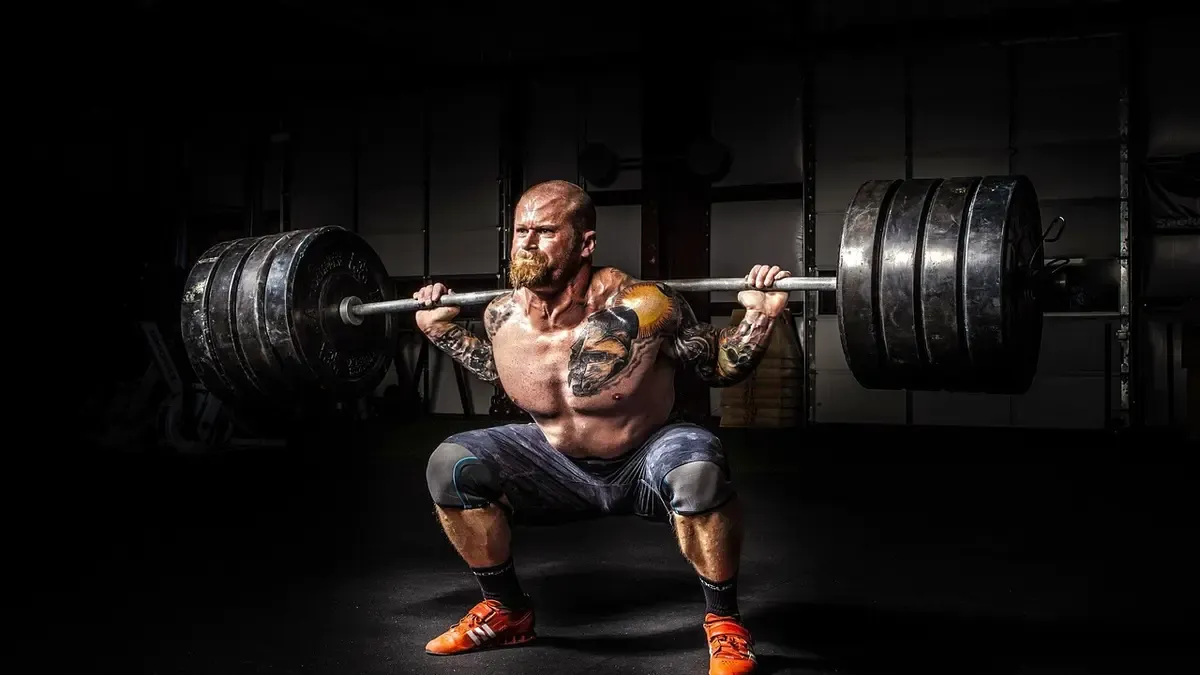
TL;DR. The short answer
- Squat mobility with long femurs is often a lever and hip-socket shape issue, not a mobility failure. Two people with identical flexibility can hit different natural depths.
- Pinching at the front of the hip that does not improve with warming up can be bone-on-bone contact. Pushing deeper through it is a bad trade; capping depth where it feels clean is a reasonable choice.
- A 2026 meta-analysis of 14 studies found raising the heels added about 4-5 degrees at the ankle and knee but did not change hip or trunk range of motion.
- Stance width and toe angle change how the hip meets the pelvis. Small experiments over a few sessions beat copying someone else's setup.
- Sharp pain, catching, locking or pain that lingers for days is a reason to see a doctor or physiotherapist, not to try harder.
Part of our complete guide: Muscle Length, Range of Motion and Stretch-Mediated Hypertrophy: What the Research Actually Shows
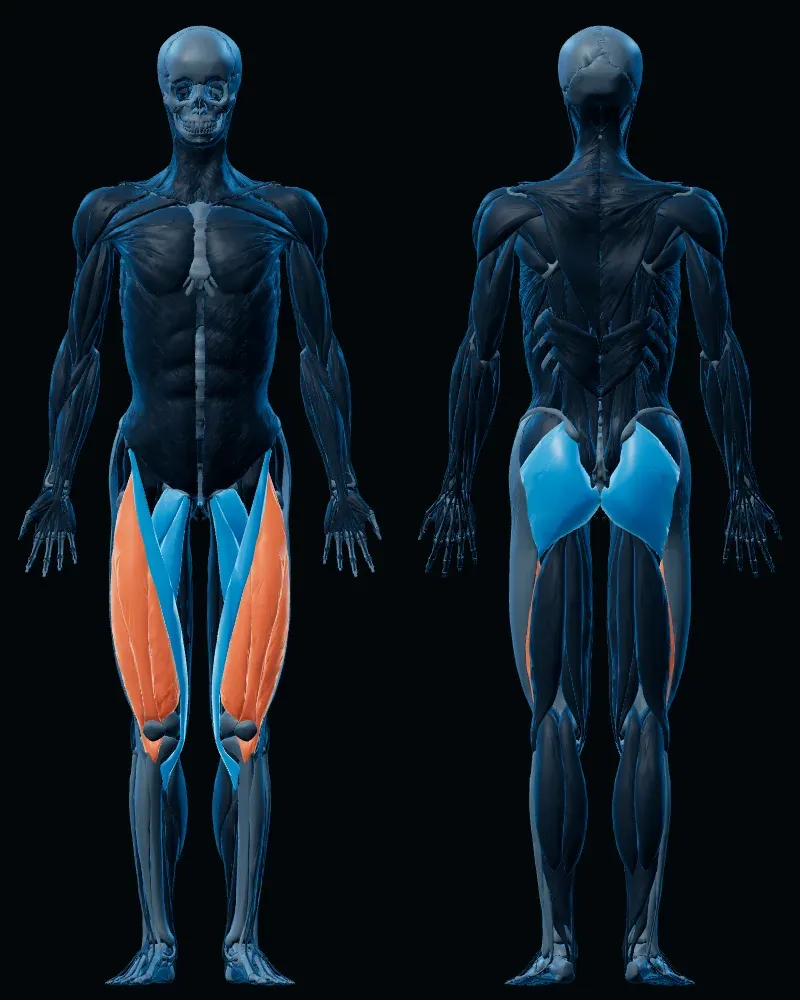
Muscles worked: quads
Main movers: rectus femoris and the three vasti
Assisting: adductors, sartorius and glutes
Table of contents
If you have a long-legged build and your squat never looks like the textbook photo, you are probably not “tight” or “doing it wrong.” Squat mobility with long femurs is mostly a question of lever and hip-socket shape, and those differ from person to person.
That matters because range of motion is a core lever for muscle growth, which we cover in our guide to range of motion and stretch-mediated hypertrophy. But “full range” is not one fixed depth for everyone. It is the deepest position your skeleton lets you reach with a clean, loaded rep.
This article is about adapting depth and setup to your proportions. It is not a diagnosis tool, and it is not a reason to avoid squatting.
Why long femurs change how a squat feels
Picture a squat from the side. The bar should stay over the middle of your foot. If your thigh bones are long relative to your torso and shins, something has to give: your knees travel further forward, your torso leans further forward, or both.
That is plain geometry rather than a research finding (we could not find a controlled study that isolates femur length in lifters, so treat this as mechanical reasoning). The practical result is a squat that feels more hip-dominant, with more forward lean, even when your technique is fine.
The most common mistake here is copying the upright torso of a short-femured lifter. You fight your own levers, round off your lower back or fall forward out of the bottom, and then blame your hips.
If you want a closer look at how this plays out across different exercises, our article on anthropometry and exercise selection covers swapping movements. Here we stay on depth and range of motion.
Hip socket shape: the part stretching cannot change
Two bones form your hip: the ball at the top of the femur and the socket in your pelvis. Their shape varies. How deep the socket is, how the neck of the femur angles off the shaft, and how the socket faces all affect where the bone meets bone when you flex the hip.
So when a deep squat stops at a hard, pinchy block at the front of the hip, no amount of stretching may move it. Soft tissue stretches. Bone does not.
Researchers use the term femoroacetabular impingement (FAI) when abnormal contact between the femoral head-neck and the socket rim causes symptoms. Three things from the literature help keep this in proportion:
- Shape variants are common. In 1,878 hips of people aged 18-50 with no hip symptoms (not professional athletes), the cam-type variant showed up on X-ray in 29.7% and the pincer-type in 24.3% (Morales-Avalos et al., 2021). Shape alone does not mean pain.
- Athletes show it more. A systematic review of 60 studies found cam morphology was more common in athletes than in asymptomatic non-athletes, and symptomatic patients had larger mean alpha angles than either group (Mascarenhas et al., 2016). This is imaging prevalence, not proof that squatting causes the shape.
- Shape does not always limit motion. In 57 people scanned and filmed squatting, a cam deformity alone did not necessarily mean reduced hip motion, while pelvic incidence (how the pelvis sits on the spine) was the measure that helped predict hip range, with higher values linked to less hip motion when walking (Ng et al., 2018).
Notice the mixed picture. Some people with a cam shape have no pain and squat well. Others with a similar shape get pinched. Why the difference is not fully settled, and it likely involves pelvic mobility, muscle strength and training history.
Is forcing full range of motion injuring my hips?
Short answer: pushing through a hard block repeatedly is not a smart bet, and stopping at a clean depth is a sensible choice. But the evidence here is limited, so we will not oversell either direction.
One finite element model (a computer simulation built from the MRI of a single healthy man) found simulated cam shapes raised stress inside the hip and shifted contact toward the rim, even when hip flexion was set lower. The authors suggested caution with deep squats for people with cam morphology, and said neutral or external hip rotation may limit bony contact (Bagwell and Powers, 2017). That is a model with one subject. It generates a hypothesis, not a verdict.
So what do we actually know?
- Hard, pinchy blocks at the front of the hip are a reasonable signal to stop the rep short.
- No trial shows that a controlled, pain-free depth below your personal limit damages healthy hips.
- Persistent groin pain, locking or catching deserves a proper assessment rather than a bigger warm-up.
If you want a broader view of the knee and back concerns people raise about squatting, see our piece on whether squats are bad for your knees.
Does capping depth at parallel cost you muscle?
This is the worry that keeps people forcing depth. The honest answer starts with what the research compared.
A systematic review of six training studies (135 participants, mostly men) concluded that full range of motion training favoured lower-body hypertrophy over partial range (Schoenfeld and Grgic, 2020). Those comparisons were of meaningfully different ranges, not parallel versus a few extra centimetres. They do not tell you that the last few degrees of a deep squat are the key to leg growth.
What the finding supports is this: do not cut range so short that the muscle never gets lengthened under load. What it does not support is the idea that everyone must hit one specific depth, regardless of their bones. For the depth debate in detail, read squat depth science.
A practical take: a squat to your clean, pain-free depth, taken close to failure with a slow, controlled descent, does a lot of work. If your hips cap you at parallel, you can add leg work that stretches the muscle in other ways. A hack squat, leg press or split squat are options, and our piece on hip flexion depth and adductor magnus recruitment explains why depth matters for glutes and adductors.
How to find your own squat depth
Run this test on a light set, not on a heavy day.
- Warm up properly: a few minutes of easy cycling or brisk walking, then bodyweight squats and a couple of light sets with the bar.
- Squat slowly with a camera filming from the side and the front.
- Note where the descent first feels blocked, and what the block feels like.
- Check the video: do the heels lift, do the knees cave, does the pelvis tuck under?
- Retest after changing one variable (stance, toe angle, heel height), not three.
Now use the block to decide what you are dealing with.
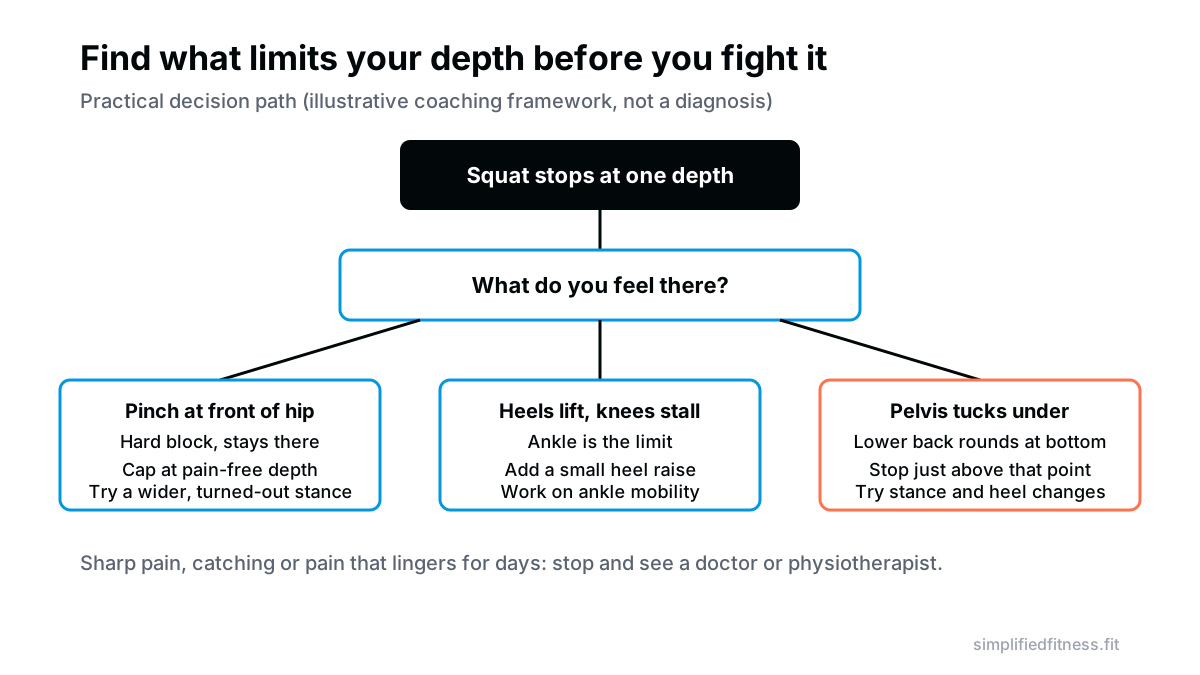
The pattern in plain terms:
- Soft, stretchy pull in hips or adductors: this is a soft-tissue limit, and mobility work plus a slow tempo at the bottom can help over weeks.
- Heels lift or knees stall early: likely the ankle. Try a small heel raise and some calf and ankle work.
- Hard pinch at the front of the hip that does not change when warm: treat it as a structural limit. Cap depth where it feels clean, and experiment with stance.
- Pelvis tucks and back rounds at the bottom: you have run out of clean range, so stop above that point.
Heel elevation: what it can and cannot do
Heel raises are the popular fix, so here is what the evidence says.
A 2026 systematic review and meta-analysis pooled 14 studies (177 healthy adults) and found heel elevation increased ankle motion by about 4.3 degrees and knee motion by about 4.9 degrees, with no significant change at the hip or trunk (Ghasemi et al., 2026). The ankle effect was clear mainly at higher raises (above about 2.5 cm), while knee motion increased at both low and high raises. Meta-regression also suggested higher heels were linked with less hip and trunk motion.
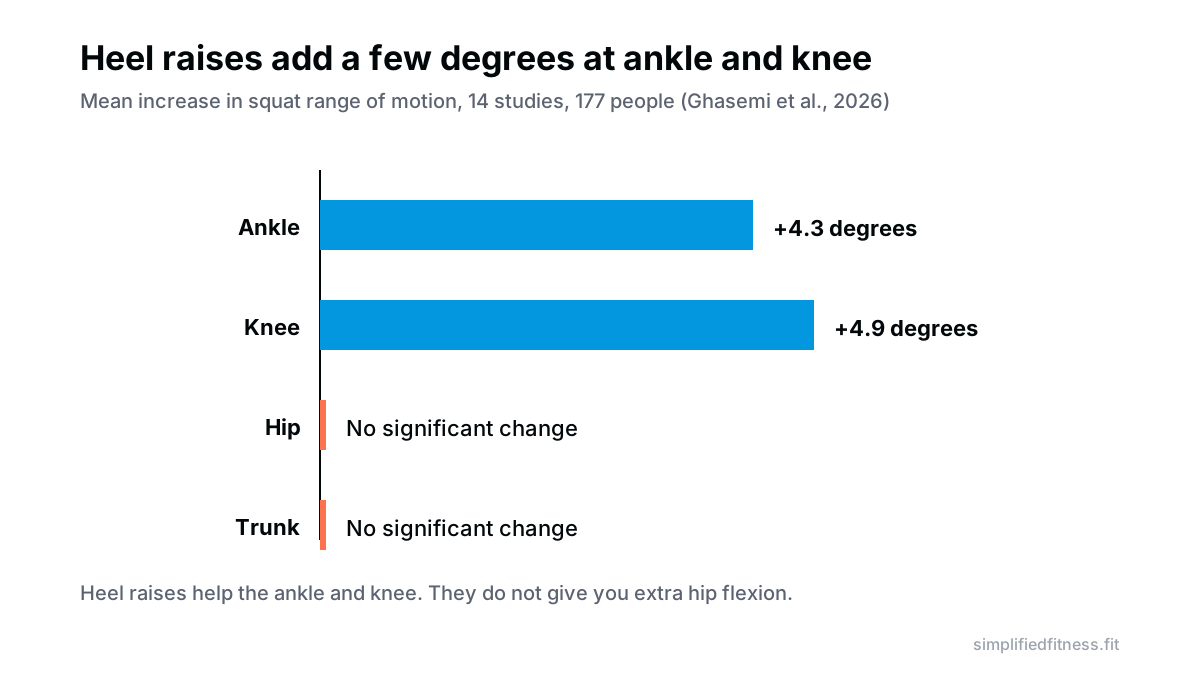
What this means for a long-legged lifter:
- If your ankles are what stop you, a raise (weightlifting shoes or a small plate under the heels) may let you sit lower with a more upright torso.
- If your hip is what stops you, expect little change.
- The review was in healthy adults and mostly measured joint angles, not muscle growth, so it cannot tell you the raise builds more quads.
Start small, test it over several sessions, and judge by how the squat feels, not by how it looks.
Stance width and foot angle for different hips
Stance is the other lever you can pull. A wider, slightly turned-out stance changes the angle between your thigh bone and your pelvis, and some lifters find they get lower with less pinching. That is a coaching observation, not a tested finding.
In one lab study, 14 amateur rugby athletes squatted to femur-parallel with a wide stance (1.5 times greater trochanter width) and a narrow stance (1 times). Knee flexion was greater in the narrow stance, hip flexion did not differ significantly, and the hip-to-knee moment ratio was higher in the wide stance (Lahti et al., 2019). So width changes where the work goes. The study was small and tested only these two widths in rugby players.
There is no single correct width. A decent method:
- Start at about shoulder width with toes turned out 10-30 degrees.
- Move your feet out a couple of centimetres, or turn the toes a few degrees.
- Squat to the same depth on two or three light sets.
- Keep the setup where the bottom feels smoothest and strongest.
For more on this, see our guide to stance width and foot placement in squats and leg press. If you squat low-bar or high-bar, the high-bar versus low-bar breakdown helps you choose.
Building a leg day around your proportions
You do not have to make the back squat the only leg exercise. If your levers make it awkward, other options still give a strong stimulus.
- Hack squat or leg press: the machine supports your torso, so forward lean matters less. Control the bottom position and do not let your pelvis tuck.
- Split squats or lunges: useful for quads and glutes, and often friendlier to different hip shapes.
- Romanian deadlifts: many long-legged lifters find hip hinges comfortable, and they load the hamstrings through a long range.
- Leg extensions and leg curls: isolate the muscle without asking the hip for deep flexion.
You can see how these fit together in our free leg day plan. If you need a loading target for any of these, the 1RM calculator gives a starting estimate.
Consistent loading beats an obsession with depth. Pick the version you can push hard, repeat for months and add weight to.
Floor squats and hot gyms
Two practical notes, common in Indian gyms. First, being comfortable in a deep floor squat is no guarantee of a deep barbell squat, because loaded depth also depends on torso position and the load on your back. Second, a hot, humid gym can make you feel loose before you are ready. Take your full warm-up anyway, so you can tell ordinary stiffness apart from a structural block.
When to see a doctor
Please get assessed, rather than training around it, if you notice any of these:
- Sharp pain at the front of the hip or in the groin during or after squatting.
- Catching, clicking with pain, or a feeling that the hip locks.
- Pain that lingers for days after leg day, or pain at night or at rest.
- Pain that does not improve after a few weeks of lowering depth and load.
A doctor or physiotherapist can examine the hip and decide whether imaging is useful. Only they can say whether a finding on a scan is relevant to your pain, given how common shape variants are in people with no symptoms. For knee-related issues, see knee pain and leg workout modifications.
The takeaway
Your skeleton sets the ceiling on squat depth, and that ceiling is not a flaw. The sensible approach is simple: find your clean range, use heels and stance to remove the limits that can be fixed, and cap depth where bone blocks you. Then load that range hard and progress it over months.
This article is educational and not medical advice. It cannot diagnose hip problems.
Frequently Asked Questions
Do long femurs make squatting harder?
Often yes, in practical terms. A longer thigh bone means the knees travel further forward or the torso leans further forward to keep the bar over mid-foot, which changes how the lift feels and which muscles work hardest. That is a lever difference, not a defect, and good setup choices usually get you a squat that works fine.
Why can't I squat deep even though I stretch my hips?
Stretching only changes soft tissue, and sometimes the limit is bone shape instead. The depth of your hip socket and the angle of your thigh bone neck decide where the bones meet, and no stretch changes that. If the block feels hard and pinchy at the front of the hip rather than stretchy, treat it as a structural limit.
What is femoroacetabular impingement (FAI)?
FAI is when the ball of the thigh bone and the rim of the hip socket make abnormal contact during hip movement, usually at deep hip flexion. Imaging signs are common even in people with no pain, so a scan finding alone does not mean your squat is dangerous. Only a doctor can tell you whether your symptoms fit, so get assessed if you have persistent groin pain.
Can you have a hip shape variation and still squat?
Yes, many people do. A 2018 study found a cam deformity alone did not necessarily mean reduced hip motion, and a 2018 lab study found pain-free people with the shape squatted deeper than patients with symptomatic FAI. Choose a depth that feels clean, build hip strength, and see a professional if symptoms appear.
Does squatting to parallel build less muscle than a deep squat?
Not necessarily for you. A 2020 systematic review found full range of motion training favoured lower-body hypertrophy over partial range, but it compared meaningfully different depths, not parallel versus a few extra centimetres. If your hips block you at parallel, a parallel squat taken close to failure still loads the quads and glutes hard.
Does a heel raise help long-legged lifters?
It can help if ankle mobility is the thing that limits you. A 2026 meta-analysis found heel elevation increased ankle and knee motion by roughly 4-5 degrees but not hip or trunk motion. Try small raises such as plates or lifting shoes, and remember it will not fix a hip-socket block.
Should I squat with a wider stance if I have long femurs?
A wider, slightly turned-out stance helps some lifters by changing the angle between the thigh bone and the pelvis. In one study of 14 rugby athletes, a wide stance (1.5 times trochanter width) changed knee and hip loading compared with a narrow one. Test stance width in small steps over several sessions and keep the one that feels strongest and smoothest.
Is it bad to round my lower back at the bottom of a squat?
A small amount of pelvic tuck at the very bottom is common, and there is no good evidence that a little is dangerous. A large tuck under heavy load is a sign you have run out of clean range, and the extra centimetres are unlikely to add much for the legs. A practical rule is to stop the rep just above the point where the tuck becomes obvious.
Are there better squat variations for long femurs?
Many lifters with long femurs prefer low-bar squats, box squats, hack squats or leg presses because they handle the torso lean more comfortably. No variation is mandatory, because the goal is leg muscle growth and any pain-free option that you can load progressively works. Rotate in whichever one you can push hard and repeat consistently.
How do I know if my depth is limited by my ankle or my hip?
Watch where it fails. If your heels lift or your knees stall before your hips go low, the ankle is likely the limit, and a heel raise often helps. If you feel a hard pinch at the front of the hip, or your pelvis tucks under, the hip is the limit and a heel raise will not fix it.
Can poor squat depth hurt my hips?
There is no good evidence that stopping at a comfortable depth harms healthy hips. The concern is forcing end range through a hard pinch again and again, and a finite element model suggested contact stress rose at deep flexion when a cam shape was simulated. If you get ongoing groin pain, clicking with pain, or locking, see a doctor.
When should I see a doctor about hip pain when squatting?
See a doctor if you get sharp pain, catching or locking, pain that lingers for days after training, or pain at night or at rest. These can come from several causes and only an examination, sometimes with imaging, can tell. Back off the painful range in the meantime.
Do leg press and hack squats avoid the hip problem?
They often reduce it, since the machine supports your torso and you can set your own foot position. Hip flexion still happens, so a hard pinch can still show up at the bottom of a deep leg press. Use the same rule: stop where it feels clean.
Sources & References
Every claim above is checked against peer-reviewed research (PubMed, U.S. National Library of Medicine) or guidance from established health bodies. How we fact-check.
- Schoenfeld BJ, et al. Effects of range of motion on muscle development during resistance training interventions: A systematic review. SAGE Open Med. 2020. PMID: 32030125
- Ghasemi M, et al. Heel elevation increases ankle and knee range of motion during squatting in healthy adults: a systematic review with meta-analysis. Sports Biomech. 2026. PMID: 41612762
- Bagwell JJ, et al. The Influence of Squat Kinematics and Cam Morphology on Acetabular Stress. Arthroscopy. 2017. PMID: 28969815
- Ng KCG, et al. Anatomic Predictors of Sagittal Hip and Pelvic Motions in Patients With a Cam Deformity. Am J Sports Med. 2018. PMID: 29517923
- Catelli DS, et al. Asymptomatic Participants With a Femoroacetabular Deformity Demonstrate Stronger Hip Extensors and Greater Pelvis Mobility During the Deep Squat Task. Orthop J Sports Med. 2018. PMID: 30038915
- Mascarenhas VV, et al. Imaging prevalence of femoroacetabular impingement in symptomatic patients, athletes, and asymptomatic individuals: A systematic review. Eur J Radiol. 2016. PMID: 26724652
- Morales-Avalos R, et al. Prevalence of Morphological Variations Associated With Femoroacetabular Impingement According to Age and Sex: A Study of 1878 Asymptomatic Hips in Nonprofessional Athletes. Orthop J Sports Med. 2021. PMID: 33614808
- Lahti J, et al. Effects of barbell back squat stance width on sagittal and frontal hip and knee kinetics. Scand J Med Sci Sports. 2019. PMID: 30230052

Umair Hazrami · Founder & Head Coach, Simplified Fitness
Umair Hazrami founded Simplified Fitness and the Simplified Lifter channel to cut through fitness noise. With 4+ years of consistent training and 10+ coaching clients, he writes every guide from the peer-reviewed research and links the sources so you can check them. Our editorial standards.
Educational content only, not medical advice. If you have a medical condition, are pregnant, or take medication, talk to a qualified doctor before changing your diet, supplements or training. Full disclaimer.
Keep reading
Hypertrophy
Active vs Passive Insufficiency: How Two-Joint Muscles Change Your Exercise Choice
Active vs passive insufficiency explained for lifters: why hamstrings, triceps, quads and calves grow differently depending on your second joint position.
10 min read
Hypertrophy
Dumbbell Pullovers vs Cable Lat Pull-ins: Training Lats at Long Muscle Lengths
Training lats at long muscle lengths: is the dumbbell pullover a lat or chest exercise, and why a cable lat pull-in may keep tension where you want it.
7 min read
Hypertrophy
Full vs Partial Range of Motion: What the Hypertrophy Research Shows
Full vs partial ROM hypertrophy explained: what two meta-analyses and recent trials found, where lengthened partials fit, and how to set your range of motion.
8 min read
Hypertrophy
Why Your Inner Thighs Burn After Deep Squats: Adductor Magnus vs Glute Max
The adductor magnus in a deep squat works as a hip extensor beside your glutes. See what the research shows and how to train depth for bigger thighs.
9 min read