CNS Fatigue vs Muscle Fatigue: Is Your Nervous System Really Fried?
CNS fatigue vs muscle fatigue: what central and peripheral fatigue really are, how long each lasts, and how to tell which one is holding your lifts back.
TL;DR. The short answer
- Peripheral fatigue happens inside the muscle (less force from the same signal). Central fatigue happens upstream (the brain and spinal cord send a weaker command). Hard sets usually produce both.
- In a 2018 study of 10 male athletes, fatigue after maximal squats, jumps and sprints cleared within 72 hours, and it was not mainly explained by the nervous system.
- Training to failure raised muscle-level fatigue and damage markers more than stopping short, while the central measure was similar in both versions (12 trained men).
- Feeling flat for weeks is not 'CNS fatigue' in the lab sense. Check sleep, food, stress and total volume first, and see a doctor if exhaustion is unexplained or persistent.
- A simple fix for most lifters: leave 1-3 reps in reserve on most sets, keep sleep steady, and treat a bad day as a bad day, not damage.
Part of our complete guide: How Muscle Actually Grows: The Natural Lifter's Guide to Hypertrophy Science
Table of contents
When you feel wrecked after a hard session, it is usually both: the muscle is tired and the drive to it is a little blunted. Lab work suggests the muscle side tends to carry more of the load, and that the nervous system part is smaller and shorter-lived than gym folklore suggests. This is the CNS fatigue vs muscle fatigue question in one paragraph, and the rest of this article shows the evidence behind it. It is one piece of our muscle hypertrophy guide for natural lifters.
Here we stay narrow: what the two types of fatigue actually are, how scientists tell them apart, and what you can safely do about each. (For the wider “CNS burnout” conversation, see our deep dive on CNS fatigue mechanisms vs plain lethargy.)
What is the difference between central and peripheral fatigue?
Think of a chain. Your brain decides to lift, the spinal cord relays the order, nerves carry it to the muscle, and the muscle fibres contract. Fatigue can build at any link.
- Peripheral fatigue is trouble at the muscle end. The same signal produces less force, for example because contraction at the fibre level is impaired (researchers call this excitation-contraction coupling).
- Central fatigue is trouble upstream. The command reaching the muscle is weaker, so you cannot recruit the muscle as fully as you could when fresh.
A critical review of resistance exercise fatigue notes that fatigue occurs regardless of the volume and intensity used, and that peripheral mechanisms have been studied and explained in more detail than central ones (Zając et al., 2015). Translation: we understand the muscle side better, and the central side is still a bit of a black box.
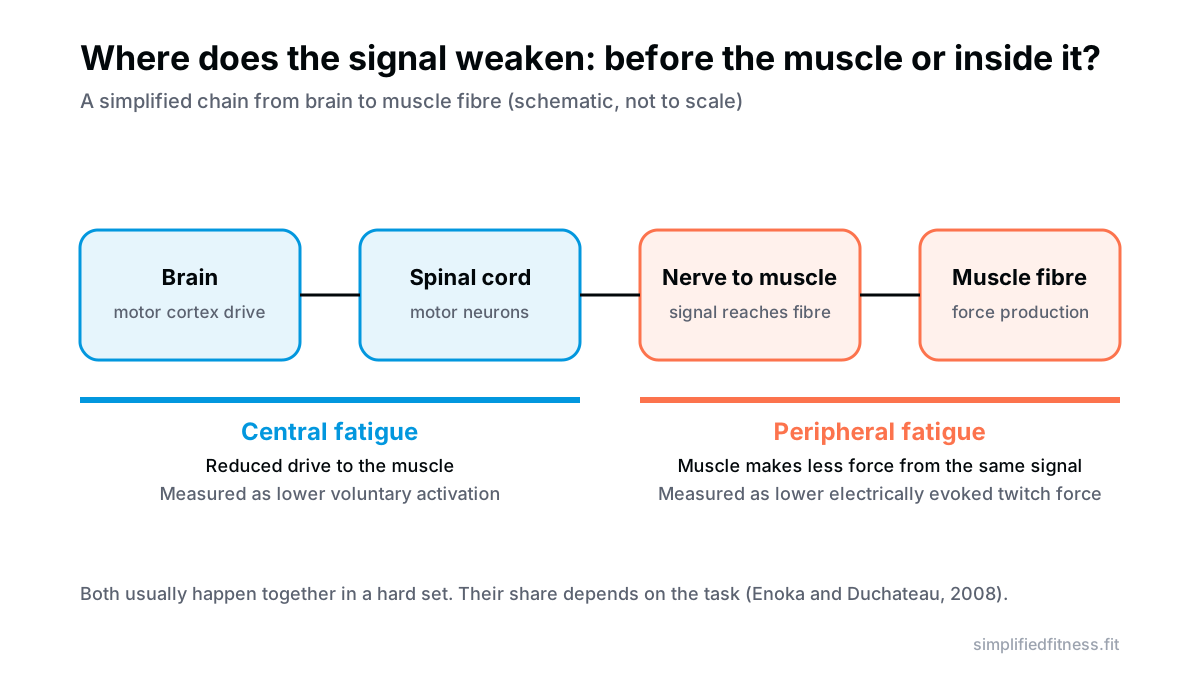
One more point from the physiology literature: there is no single global cause of fatigue. A review in the Journal of Physiology concludes that the mechanisms are specific to the task being performed, ranging from metabolite build-up in the fibres to an inadequate motor command from the motor cortex (Enoka and Duchateau, 2008). A heavy triple and a hard set of 15 will not tire you in quite the same way.
How do researchers tell CNS fatigue from muscle fatigue?
Not with a feeling. They use a technique called twitch interpolation. While a person pushes as hard as they can, a nerve is electrically stimulated. If the stimulus still adds extra force, the brain was not driving the muscle fully. That gap is called voluntary activation. Separately, the muscle is stimulated while relaxed, and the twitch force it produces tells you how well the muscle itself works.
- Lower voluntary activation → a central deficit.
- Lower resting twitch force → a peripheral deficit.
This matters for you because nothing you can do in a gym (bar speed, mood, a “heavy” feeling) cleanly separates the two. Treat any “my CNS is fried” diagnosis as a guess.
How long does CNS fatigue last after lifting?
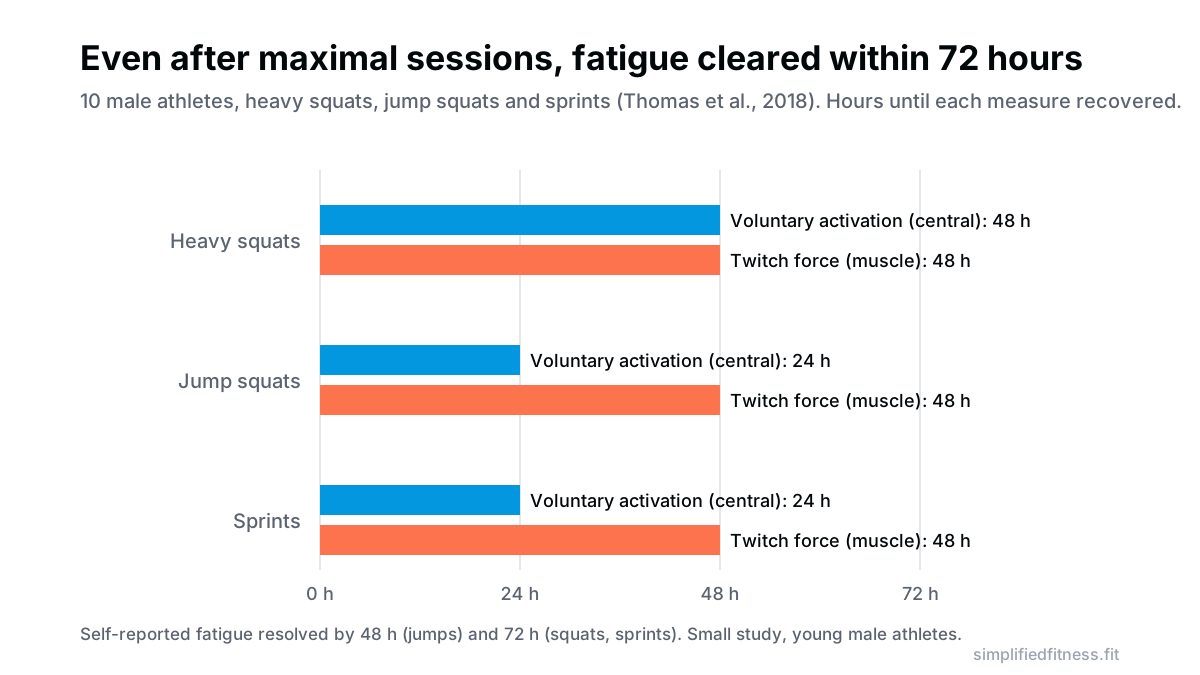
This is where the myth usually breaks. Many programs space maximal sessions by at least 48 hours on the assumption that they cause marked central fatigue. Researchers tested that assumption directly in 10 male athletes who did three maximal sessions: 10 x 5 back squats at 80% of 1RM, 10 x 5 jump squats, and 15 x 30 m sprints (Thomas et al., 2018).
What they found:
- Self-reported fatigue resolved by 48 hours after the jumps and by 72 hours after the squats and sprints.
- Muscle function (potentiated twitch force) stayed reduced for 48 hours after all three.
- Voluntary activation was reduced for 24 hours after jumps and sprints, and 48 hours after the squats.
- No other differences in central function showed up. The authors concluded that the fatigue was not primarily underpinned by decrements in CNS function.
Two cautions. This was ten young male athletes, so do not stretch it to everyone, and single-session lab data cannot tell you what happens across months of heavy training. But as a reality check on the “nervous system takes a week to recover” idea, it is useful. If you want a longer-term framework, our guide to overtraining vs non-functional overreaching covers the weeks-to-months side.
Does training to failure cause more central or peripheral fatigue?
Here is where the studies are most practical (our article on how proximity to failure affects CNS and peripheral fatigue goes further into squats versus curls). In a trial of 12 resistance-trained men, each did 6 sets of full squats with their 10-rep-max load, once to failure and once stopping at 5 reps (González-Hernández et al., 2021).
- Velocity loss across sets was -21.7% with failure versus -3.5% without.
- Markers of peripheral fatigue were generally higher and longer lasting with failure.
- Creatine kinase and AST (muscle damage markers) were higher after the failure session.
- Central fatigue, measured by voluntary activation, was comparable between the two and stayed depressed for up to 48 hours.
So failure seemed to cost the muscle more, not the “CNS.” Tiredness upstream appeared to come with hard sets in general.
A second trial in 12 trained subjects compared a high-intensity resistance circuit with traditional strength training using matched workload (Márquez et al., 2017). Voluntary activation dropped similarly in both, but the circuit produced higher lactate and a larger drop in resting twitch force. The authors suggested the lactate probably impaired excitation-contraction coupling, meaning more peripheral fatigue. How you organise rest changes how much the muscle gets cooked, even when the central picture is similar.
Is going to failure worth the extra fatigue?
For hypertrophy, probably not as a default. A systematic review and meta-analysis of 15 studies found a trivial advantage for sets taken to “set failure” versus non-failure (effect size 0.19, 95% CI 0.00 to 0.37), and no advantage for training to momentary muscular failure versus stopping short (effect size 0.12, 95% CI -0.13 to 0.37) (Refalo et al., 2023). The authors concluded there is no evidence that momentary failure is superior for muscle growth.
Velocity-loss work adds a caution on the other end. In 64 resistance-trained young men training squats for 8 weeks, allowing 20% or 40% velocity loss per set maximised hypertrophy, but 40% was also linked to negative neuromuscular adaptations, such as a drop in early rate of force development, and the authors suggested moderate thresholds (Pareja-Blanco et al., 2020).
Put these together and you get a cautious, practical picture: very high proximity to failure adds fatigue, and the hypertrophy payoff for the last rep or two is small and not consistent across studies. The studies also used different definitions of failure, which is one reason results do not line up neatly. Our reps in reserve guide and the training-to-failure vs RIR meta-analysis breakdown go deeper, and the RIR/RPE calculator helps you set targets.
Why do I feel exhausted if my muscles are fine?
Sometimes the answer is not in the gym at all. A systematic review of 17 studies (quality rated moderate or weak) found that total sleep deprivation had little effect on muscle strength, but consecutive nights of sleep restriction could reduce force output in multi-joint lifts, not single-joint moves (Knowles et al., 2018). The authors suggested that training in a group, caffeine, or training before long periods awake might help when sleep is short.
Notice the pattern: poor sleep seems to hit big compound lifts first, and it may be partly about motivation and effort, not just damaged tissue. If your squat feels heavy and your arm curls feel fine, that is a clue.
Other common culprits in Indian lifters we would check before blaming the nervous system:
- Eating too little, especially a long gap since your last meal before a 6 pm session after a full office day.
- Low protein on a mostly vegetarian diet (dal and roti alone rarely hit your target), which you can check with the protein calculator.
- Heat and poor hydration in a non-air-conditioned gym.
- Stress, late nights, and shift work.
- A week with far more sets than usual.
Practical cues: muscle tired or whole-body tired?
There is no clean field test, but patterns help. These are heuristics, not diagnoses.
| What you notice | More likely local (peripheral) | More likely systemic or central |
|---|---|---|
| Where it shows up | One muscle group, one session | Everything feels heavy, all lifts |
| Soreness | Present, tied to a recent hard session | Often absent |
| Pump and warm-up | Stays weak even after warming up | Warm-up helps a bit, motivation low |
| Timeline | Back to normal in 2-3 days | Drags on beyond a week |
| Other signs | Local stiffness, reduced reps | Poor sleep, low mood, low appetite |
If a muscle is the issue, rotate volume to other muscles and let it recover. If everything feels flat, look at sleep, food and life stress. If it lasts beyond 1-2 weeks, a lighter week is a reasonable test. Our guide to signs you need a deload walks through that checklist.
How should I train around fatigue?
A simple setup, in order of priority:
- Leave 1-3 reps in reserve on most sets, and push closer on the last set of isolation exercises such as lateral raises or cable flys.
- Keep sleep as steady as you can. A consistent bedtime matters more than a perfect one.
- Eat before you train. A banana and curd, or poha and a glass of milk, is a decent budget option.
- Spread weekly sets across the week rather than cramming them into one session. Our free training plans already do this.
- Use a bad day as information. Drop the top set, do the rest at lower load, and move on.
When to see a doctor
Normal training fatigue improves with rest, sleep and food. See a doctor if you have exhaustion that does not improve over a couple of weeks, unexplained weight loss, frequent illness, a racing or irregular heartbeat, chest pain, fainting or dizziness, persistently low mood, or dark urine with severe muscle pain after training. None of these should be explained away as “CNS fatigue.”
The bottom line
Muscles get tired, and the drive to them can dip a little too. Based on the trials we have, the nervous system part is smaller and shorter-lived than the folklore suggests, and weeks of flat performance are usually about sleep, food, total volume or life stress. Stay a rep or two from failure, protect your sleep, and judge fatigue by trends over time, not one rough session.
Frequently Asked Questions
What is the difference between CNS fatigue and muscle fatigue?
Muscle (peripheral) fatigue is a drop in the force the muscle itself can produce, while CNS (central) fatigue is a drop in the drive the brain and spinal cord send to it. Researchers separate them by electrically stimulating the nerve: if twitch force falls, the muscle is tired, and if voluntary activation falls, the drive is reduced. In the gym, assume both are involved and judge by how long it lasts and what else is going on in your life.
Is CNS fatigue real?
Yes, reduced voluntary activation after hard exercise has been measured in lab studies. The evidence suggests it is usually modest and short-lived, though, and not a mysterious state that explains weeks of poor training. Use the term carefully and look for simpler causes first.
How long does CNS fatigue last after lifting?
In a 2018 trial of 10 male athletes, reductions in voluntary activation lasted 24 hours after jump squats and sprints and 48 hours after heavy squats. The sample was small and young, so individual times will vary. If you still feel drained after a few days, look at sleep, food and training volume rather than waiting it out.
How do I know if my muscles or my nervous system are tired?
You cannot tell for certain without lab equipment. Local soreness, a pump that will not come back and weakness in one muscle point more to peripheral fatigue, while low motivation, heavy limbs everywhere and poor sleep point toward systemic or central causes. Track a few key lifts and mood for two weeks to see the pattern.
Does training to failure fry your CNS?
In 12 resistance-trained men, sets to failure produced more muscle-level fatigue and damage markers than non-failure sets, but central fatigue measured by voluntary activation was comparable. So failure seems to cost your muscles more than your nervous system. Stop most sets 1-3 reps short and use failure on the last set of isolation work.
Do heavy singles or deadlifts cause more CNS fatigue than hypertrophy sets?
Popular belief says yes, but the trial data are thin. In the 2018 study, heavy squat sets, jumps and sprints all produced fatigue that resolved within 72 hours and was not mainly central. Plan around how you recover, not around a label.
Can poor sleep make me feel like I have CNS fatigue?
Yes, and it is one of the most common explanations. A systematic review of 17 studies found that consecutive nights of sleep restriction could reduce force in multi-joint lifts, though study quality was moderate to weak. Fix your sleep before you change your program.
Should I take a week off if my lifts are dropping?
One bad session is not a reason to stop, but a downward trend across two or more weeks is worth acting on. Cutting sets by about a third for a week is a reasonable way to test whether fatigue was the cause. If strength does not return, check food, sleep and health.
Is CNS fatigue the same as overtraining?
No. A tough session leaves you tired for a day or two, while overtraining describes a prolonged drop in performance with other symptoms that takes weeks or months to resolve. Most gym fatigue is the first kind. See a doctor if you feel persistently exhausted, low in mood or ill.
Do I need to avoid training the same muscle on back-to-back days?
Not strictly. Muscle-level fatigue after hard sets took up to 48-72 hours to resolve in the trials we have, so giving a muscle a day or two before hitting it hard again is sensible. Spread weekly sets across the week and use the soreness and performance trend as your guide.
Do caffeine and pre-workout fix central fatigue?
A sleep and strength review lists caffeine, along with training in a group, as possible ways to support motivation when sleep is short. It does not repair a tired muscle, though, and if you use it, keep total caffeine moderate and avoid it late in the day so it does not wreck the next night's sleep. Use it to get through a poor-sleep session, not as a replacement for recovery.
Can I just train through nervous system fatigue?
On a tired day, yes, with sensible loads. Lift with one or two extra reps in reserve and drop the heaviest top set rather than skipping the gym. If the tiredness comes with illness, chest pain, dizziness or low mood, stop and talk to a doctor.
Sources & References
Every claim above is checked against peer-reviewed research (PubMed, U.S. National Library of Medicine) or guidance from established health bodies. How we fact-check.
- Zajac A, et al. Central and peripheral fatigue during resistance exercise: a critical review. J Hum Kinet. 2015. PMID: 26839616
- Enoka RM, et al. Muscle fatigue: what, why and how it influences muscle function. J Physiol. 2008. PMID: 17702815
- Thomas K, et al. Neuromuscular fatigue and recovery after heavy resistance, jump, and sprint training. Med Sci Sports Exerc. 2018. PMID: 30067591
- Marquez G, et al. Peripheral and central fatigue after high intensity resistance circuit training. Muscle Nerve. 2017. PMID: 28346689
- Gonzalez-Hernandez JM, et al. Resistance training to failure vs. not to failure: acute and delayed markers of mechanical, neuromuscular, and biochemical fatigue. J Strength Cond Res. 2021. PMID: 33306589
- Refalo MC, et al. Influence of resistance training proximity-to-failure on skeletal muscle hypertrophy: a systematic review with meta-analysis. Sports Med. 2023. PMID: 36334240
- Pareja-Blanco F, et al. Velocity loss as a critical variable determining the adaptations to strength training. Med Sci Sports Exerc. 2020. PMID: 32049887
- Knowles OE, et al. Inadequate sleep and muscle strength: implications for resistance training. J Sci Med Sport. 2018. PMID: 29422383

Umair Hazrami · Founder & Head Coach, Simplified Fitness
Umair Hazrami founded Simplified Fitness and the Simplified Lifter channel to cut through fitness noise. With 4+ years of consistent training and 10+ coaching clients, he writes every guide from the peer-reviewed research and links the sources so you can check them. Our editorial standards.
Educational content only, not medical advice. If you have a medical condition, are pregnant, or take medication, talk to a qualified doctor before changing your diet, supplements or training. Full disclaimer.
Keep reading

Hypertrophy
Anabolic Resistance in Older Adults: Why Muscle Responds Less and How to Beat It
Anabolic resistance in older adults explained: why muscle responds less to protein and lifting after 50, plus the protein dose, leucine and sets that help.
8 min read

Hypertrophy
How Blood Flow Restriction Builds Muscle: Venous Occlusion, Metabolites and Cell Swelling
BFR training hypertrophy mechanisms explained: how a cuff and 20% 1RM can match heavy lifting for size. Metabolites, swelling, mTOR, myostatin and cuff safety.
8 min read

Hypertrophy
Exercise-Induced Muscle Damage (EIMD): Why Chasing Soreness Is Counterproductive
Muscle damage and hypertrophy are not the same thing. See what Z-disc streaming studies show, why soreness is a poor gauge of growth, and what to track.
8 min read
Hypertrophy
Genetics and Muscle Growth: Are You a Non-Responder to Lifting?
Muscle building genetics explained: why the same program gives wildly different growth, what 'non-responder' really means, and how more volume can help.
9 min read