High-Load vs Low-Load Hypertrophy: Do Light Weights Build Equal Muscle?
High load vs low load hypertrophy: do light weights build as much as heavy ones? See what meta-analyses show, where strength differs and when to go light.
TL;DR. The short answer
- When sets are taken close to failure, loads from roughly 30% to 80% of 1RM can build similar amounts of muscle in most trials. A 2021 network meta-analysis found no significant hypertrophy difference between low (more than 15RM), moderate and high (8RM or fewer) loads.
- Heavy loads still win for strength. The same meta-analysis found high-load training clearly superior to low-load training for strength gains.
- The lightest end is the weak spot. In one 12-week trial, 20% 1RM grew muscle less than 80% 1RM even with equated volume, so very light is not a free pass.
- Light sets to failure take longer per set, and many lifters find the burn and breathlessness harder to tolerate, though that part is common experience more than measured data. The trade is comfort for your joints against discomfort in your lungs and legs.
- A practical default is a mix. Use about 5-10 reps on main compound lifts, 10-20 on machines and isolation work, 15-30 where heavy loads bother a joint, and keep sets near failure.
Part of our complete guide: How Muscle Actually Grows: The Natural Lifter's Guide to Hypertrophy Science
Table of contents
High load vs low load hypertrophy is less of a fight than the gym makes it sound. When sets are taken close to failure, loads from roughly 30% to 80% of your one-rep max (1RM) can build similar amounts of muscle in many trials. Heavy lifting still wins when the goal is strength, and the very lightest loads look a little less reliable.
That is the short version of what we cover in our muscle hypertrophy guide for natural lifters. Here we zoom in on one question: does the weight on the bar decide how much muscle you build, or does the effort you put into each set?
What does the 8-12 rep “hypertrophy zone” actually claim?
You have seen it on posters. Heavy sets of 1-5 for strength, 8-12 for size, and 15 or more for “endurance and toning”. It is called the repetition continuum, and it has shaped gym programs for decades.
The authors of a 2021 review argue the evidence does not support some of its core assumptions. They propose a different picture, where muscle adaptations can be obtained, and sometimes optimised, across a wide spectrum of loading zones (Schoenfeld et al., 2021). It is a narrative review, so treat it as a framework and not as a trial result. The trial data below is what gives it weight.
Do light weights build as much muscle as heavy weights?
Often, yes. The best single answer comes from a 2021 network meta-analysis of 28 studies and 747 healthy adults, restricted to sets taken to volitional failure. It split loads into low (more than 15RM), moderate (9-15RM) and high (8RM or fewer). No significant differences in hypertrophy were found between the three, overall or in the higher-quality subgroup (Lopez et al., 2021).
Two other details from that paper matter. Untrained people showed bigger hypertrophy gains, and lifters with some training background got more out of doing more sessions. Strength went the other way: high-load and moderate-load training beat low-load training clearly.
An earlier meta-analysis (2016) was less clear-cut. It compared training at 60% 1RM or less against 65% or more, and found only a trend toward greater hypertrophy with heavy loads (p = 0.076), with the authors noting that few studies existed at the time (Schoenfeld et al., 2016). It also found that loads of 50% 1RM or less produced substantial strength and size gains in untrained people.
Why the difference? The 2016 analysis was small, with only 8 studies and 191 people in its hypertrophy analysis, and it split loads at 60% versus 65% 1RM. The 2021 analysis pooled 28 studies and only counted sets taken to volitional failure. More data and a stricter effort rule are the likeliest reasons the trend faded.
What happens in trained lifters?
Beginners grow from almost anything. The fairer test is people who already lift.
In one trial, 49 resistance-trained men did 12 weeks of whole-body training. One group used about 30-50% 1RM for 20-25 reps, the other about 75-90% 1RM for 8-12 reps, all sets to failure. Lean mass and both type I and type II muscle fibre area rose with no significant difference between groups. Only the bench press 1RM favoured the heavier group (Morton et al., 2016).
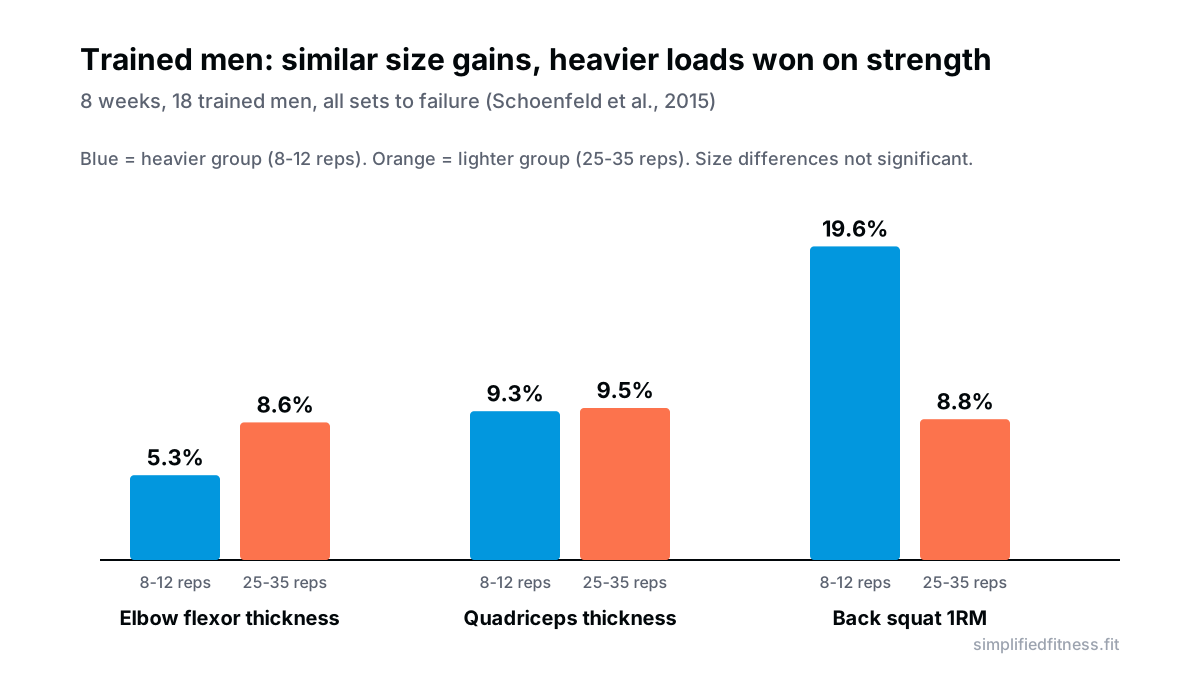
A smaller 8-week trial of 18 well-trained men found a similar story. Elbow flexor thickness rose 5.3% with 8-12 reps and 8.6% with 25-35 reps. Quadriceps thickness rose about 9.3% and 9.5%. Neither difference was significant. Back squat 1RM, however, rose 19.6% with heavier loads versus 8.8% with lighter ones (Schoenfeld et al., 2015).
Is there a floor? What about 20% or 30% of 1RM?
Yes, probably, and this is where the “30-80% works” headline needs a footnote.
In a within-subject trial, 30 men trained one arm and leg at 20% 1RM to failure, and the opposite limbs at 40%, 60% or 80% 1RM with volume-matched sets. After 12 weeks, muscle cross-sectional area rose similarly at 40%, 60% and 80%. The 20% condition grew less, and only 80% was significantly better than 20% (Lasevicius et al., 2018). Vastus lateralis area increased 8.9% at 20% versus 19.5% at 80%. Elbow flexors went up 11.4% versus 25%.
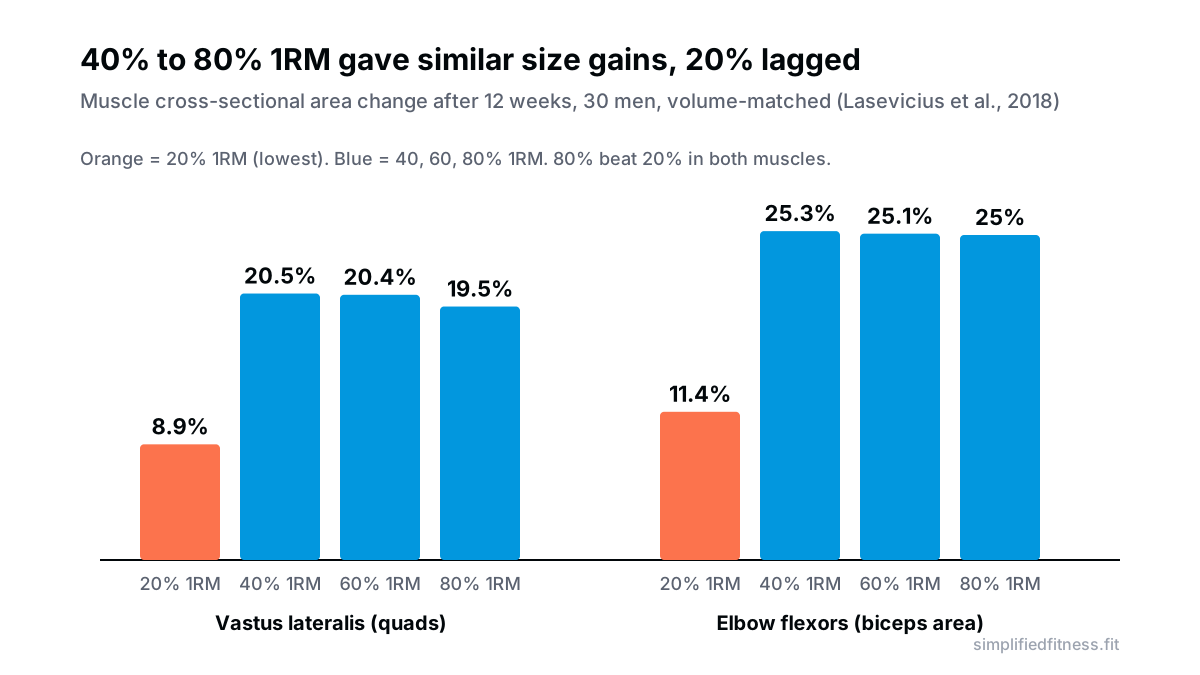
Now compare that with Morton, where 30-50% 1RM was enough. The difference may be rep range and effort: 20-25 reps at 30-50% versus an extremely light 20% that likely pushes reps very high and may end sets because of discomfort or boredom before the muscle is truly taxed. That is a hypothesis, not something the trials proved.
The cautious takeaway: from about 30% upward, loads can work when you truly train hard. Below that, expect diminishing returns.
Does proximity to failure matter more than load?
This is the thread that ties everything together, and we cover it properly in the hypertrophy rep spectrum guide. The short version from a 2023 meta-analysis of 15 studies: training to failure gave at most a trivial edge over stopping short, and relative load did not change that result (Refalo et al., 2023).
So load matters less once sets are hard, and failure matters less once you are close. Pick a load you can control, then get within about 0-3 reps of failure. Our guide to training to failure vs RIR goes deeper, and the RIR and RPE calculator helps you judge it.
Why does heavy still win for strength?
Strength is partly skill. If you only ever lift 35% of your max, you are not practising the movement pattern, speed and coordination of a near-maximal rep. The 2021 network meta-analysis found strength was superior with high and moderate loads compared with low loads, with the heavy-versus-moderate gap not statistically significant (Lopez et al., 2021).
The 2026 ACSM position stand overview, which synthesised 137 systematic reviews, reached a similar conclusion. Voluntary strength was enhanced by lifting heavier loads (80% 1RM or more), whereas hypertrophy was enhanced by higher volumes (10 sets or more per week). It also noted that few prescription variables consistently affected the main adaptations (Currier et al., 2026).
If you are curious how heavy your 80% is, the 1RM calculator gives a decent estimate.
What do light sets cost you? Fatigue, discomfort and time
The research on size is fairly reassuring. The cost side is more about how it feels, and the evidence there is thinner.
Light sets to failure last longer. A set of 25-30 reps takes a while, and the burn can show up before your muscle actually fails. Many lifters describe breathlessness and a racing heart on high-rep leg work. That is anecdote and common gym experience, not a measured finding from the studies above.
One small acute study offers a hint. In eight trained men, fatigue (the drop in maximal isometric torque) differed between protocols, with the lighter-load (30%) protocol differing significantly from both the heavier-load (80%) and forced-rep protocols. Perceived effort and discomfort did not differ significantly (Fisher et al., 2017). With only eight participants and a single session, it does not settle how light training feels over a full workout.
What about time? The trials above did not measure session length as a main outcome, so any time-efficiency claim should be hedged. Intuitively, heavy sets of 6-10 reps with a good rest finish faster than 30-rep sets, but light loads let you move between machines quickly because there is no plate loading. Net effect depends on your gym.
Are lighter loads kinder to your joints?
They can be, in a common-sense way. Lower load per rep means less force through the elbow, knee or shoulder, which is why many lifters with irritable joints lean on lighter, higher-rep work. But none of the studies I cited measured injury rates by load, so this is a reasonable coaching idea and not a proven benefit.
Practical version. If heavy barbell pressing aggravates your shoulder, a 15-20 rep set on a machine press is a sensible way to keep training the muscle. If it still hurts, or pain lingers or wakes you at night, see a doctor or physiotherapist and do not just keep pushing. Our guide on joint-friendly hypertrophy covers exercise swaps in more detail.
High reps for beginners and older lifters
Untrained people gain from most reasonable loads. The 2016 meta-analysis found loads of 50% 1RM or less produced substantial strength and hypertrophy increases in untrained individuals. Starting lighter lets you learn the movement and build tolerance.
Most of the trials above studied healthy young men, so extrapolating to older adults or women involves some guesswork. For older lifters, see our guide to strength training for older adults. Check with your doctor before starting if you have heart, blood pressure or joint conditions.
Can you go even lighter with blood flow restriction?
Light loads combined with a cuff that restricts blood flow are a separate topic with their own research. We do not cover it here. See blood flow restriction and hypertrophy if you want the mechanism.
So what should you actually do?
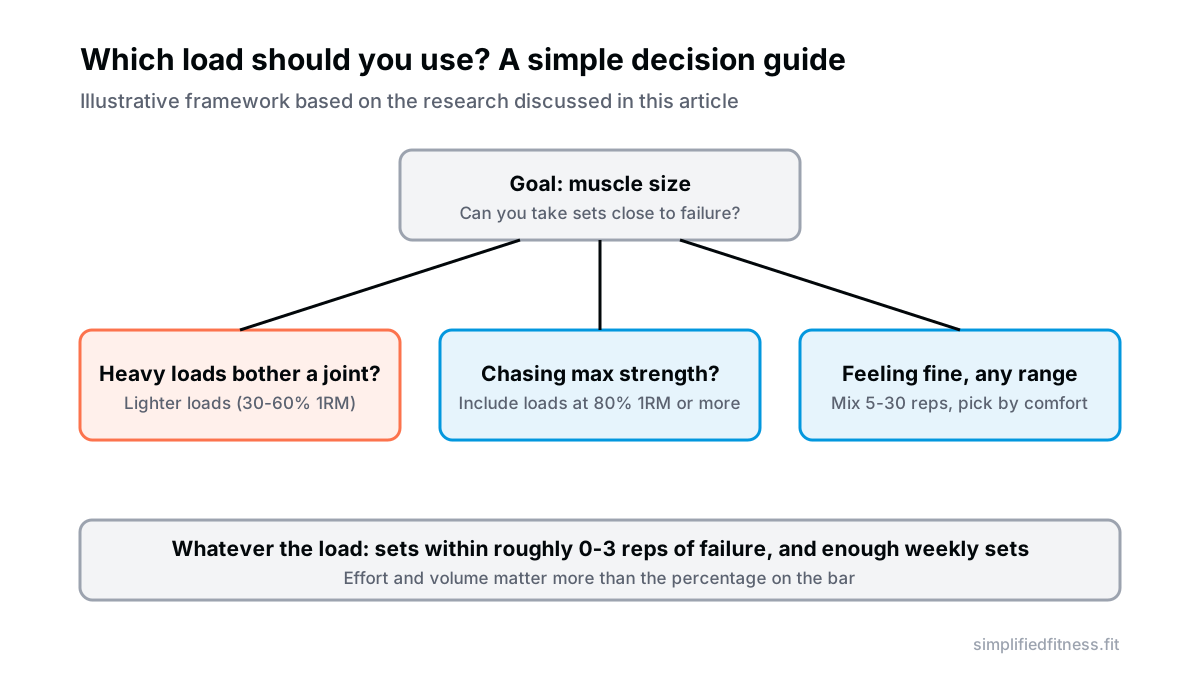
A simple template that fits the evidence:
- Main compound lifts: 5-10 reps, leaving about 1-3 reps in the tank. This builds strength and trains skill.
- Machines and isolation work: 10-20 reps, close to failure. Easy to adjust, easy on technique.
- Joint-sensitive moves: try 15-30 reps when heavy loads irritate you, but stay above roughly 30% 1RM and truly work hard.
- Volume: hit enough weekly hard sets per muscle. Load is the smaller lever.
For dal, paneer and soya eaters, none of this changes your protein needs. Muscle growth under light or heavy loads still needs enough protein, and our protein calculator gives a target for your body weight. For how rep ranges fit across your whole program, see the rep spectrum from 5 to 30 reps and the pillar on load, rep ranges, RIR and rest intervals.
The bottom line
Hypertrophy looks largely load-independent between roughly 30% and 80% 1RM when sets are taken near failure, based on meta-analyses and trials in trained men. The caveats are real: trials are short, mostly in young men, the lightest loads lag, and strength still favours heavy training. Use that freedom to pick loads that suit your joints, your gym and your patience, then make every working set hard.
Frequently Asked Questions
Do light weights build as much muscle as heavy weights?
Often, yes, as long as sets are taken close to failure. A 2021 network meta-analysis of 28 studies found no significant hypertrophy difference between low, moderate and high loads when sets went to volitional failure. Light loads do not build strength as well, so keep some heavier work if strength matters to you.
Can you build muscle with 30% of your 1RM?
Yes, it can work, but only when you push each set very hard. In trained men, 30-50% 1RM for 20-25 reps to failure produced muscle fibre growth similar to 75-90% 1RM for 8-12 reps over 12 weeks. Use it on machines or isolation exercises where reaching true effort is safe and the weight is easy to adjust.
Is high-rep training worse for muscle growth than 8-12 reps?
Not in the studies that matched effort. A trained-men trial using 25-35 reps versus 8-12 reps found no significant difference in muscle thickness after 8 weeks, with all sets taken to failure. High reps are mostly harder on your lungs and patience, not worse for size.
What is the minimum weight to build muscle?
There is no single cut-off, but very light loads look less reliable. In a volume-matched 12-week trial, 20% 1RM gave smaller gains than 80% 1RM, while 40% and 60% were similar to 80%. Staying above about 30% 1RM and finishing sets near failure is a sensible floor.
Why do heavy weights build more strength if size is the same?
Strength is partly a skill, so practising heavy loads likely trains the exact task being tested. Meta-analyses show high-load training beats low-load for strength even when hypertrophy is similar. If you want a bigger 1RM, you need to lift heavy at least some of the time.
Is low-load training easier on the joints?
It can be, since each rep puts less force through your joints and tendons. Evidence on injury rates by load is thin, so this is a reasonable practical idea rather than a proven rule. If a heavy exercise aggravates a joint, try lighter loads with controlled reps and see a physio if pain persists.
Why does light training to failure feel so brutal?
Long sets build up fatigue, burning and breathlessness before the muscle itself gives out. Perceived effort and discomfort were not statistically different between 30% and 80% protocols in one small trial, but many lifters report light sets as more unpleasant. Rest a little longer and choose stable machine exercises for the long sets.
Do I need to train to failure with light weights?
You need to get close to it. Light sets that stop far from failure are probably too easy to challenge the muscle, so they tend to underperform. Aim to finish within about 0-3 reps of failure, and use our RIR calculator if you struggle to judge it.
How many reps count as low load?
In the 2021 network meta-analysis, low load meant more than 15 reps to failure, moderate meant 9-15 and high meant 8 or fewer. In practice, 15-30 reps is where most lifters feel the 'light weight, long set' effect. Pick the range you can stay consistent with.
Is it better to mix heavy and light training?
For many lifters, mixing makes sense. Heavy work builds strength and trains skill, while lighter sets let you add volume with less joint stress. A 2026 ACSM position stand overview found few training variables clearly changed hypertrophy, so choose what you can recover from and repeat.
Is light-weight training good for older adults or beginners?
Beginners and untrained people gain from almost any reasonable load, including low loads. A 2016 meta-analysis found loads of 50% 1RM or less produced substantial gains in untrained people. Older adults should still check with their doctor before starting and progress the load gradually.
Does the percentage of 1RM matter more than proximity to failure?
For hypertrophy, effort close to failure appears to matter more than the exact percentage. A 2023 meta-analysis found no evidence that going to momentary failure beats stopping short, which suggests the relationship is not simply linear. Choose a load you can control, then take sets hard enough to be truly challenging.
Sources & References
Every claim above is checked against peer-reviewed research (PubMed, U.S. National Library of Medicine) or guidance from established health bodies. How we fact-check.
- Schoenfeld BJ, et al. Loading Recommendations for Muscle Strength, Hypertrophy, and Local Endurance: A Re-Examination of the Repetition Continuum. Sports (Basel). 2021. PMID: 33671664
- Refalo MC, et al. Influence of Resistance Training Proximity-to-Failure on Skeletal Muscle Hypertrophy: A Systematic Review with Meta-analysis. Sports Med. 2023. PMID: 36334240
- Lopez P, et al. Resistance Training Load Effects on Muscle Hypertrophy and Strength Gain: Systematic Review and Network Meta-analysis. Med Sci Sports Exerc. 2021. PMID: 33433148
- Schoenfeld BJ, et al. Muscular adaptations in low- versus high-load resistance training: A meta-analysis. Eur J Sport Sci. 2016. PMID: 25530577
- Schoenfeld BJ, et al. Effects of Low- vs. High-Load Resistance Training on Muscle Strength and Hypertrophy in Well-Trained Men. J Strength Cond Res. 2015. PMID: 25853914
- Morton RW, et al. Neither load nor systemic hormones determine resistance training-mediated hypertrophy or strength gains in resistance-trained young men. J Appl Physiol. 2016. PMID: 27174923
- Lasevicius T, et al. Effects of different intensities of resistance training with equated volume load on muscle strength and hypertrophy. Eur J Sport Sci. 2018. PMID: 29564973
- Fisher JP, et al. Acute fatigue, and perceptual responses to resistance exercise. Muscle Nerve. 2017. PMID: 28321881
- Currier BS, et al. American College of Sports Medicine Position Stand. Resistance Training Prescription for Muscle Function, Hypertrophy, and Physical Performance in Healthy Adults: An Overview of Reviews. Med Sci Sports Exerc. 2026. PMID: 41843416

Umair Hazrami · Founder & Head Coach, Simplified Fitness
Umair Hazrami founded Simplified Fitness and the Simplified Lifter channel to cut through fitness noise. With 4+ years of consistent training and 10+ coaching clients, he writes every guide from the peer-reviewed research and links the sources so you can check them. Our editorial standards.
Educational content only, not medical advice. If you have a medical condition, are pregnant, or take medication, talk to a qualified doctor before changing your diet, supplements or training. Full disclaimer.
Keep reading
Hypertrophy
Anabolic Resistance in Older Adults: Why Muscle Responds Less and How to Beat It
Anabolic resistance in older adults explained: why muscle responds less to protein and lifting after 50, plus the protein dose, leucine and sets that help.
8 min read

Hypertrophy
How Blood Flow Restriction Builds Muscle: Venous Occlusion, Metabolites and Cell Swelling
BFR training hypertrophy mechanisms explained: how a cuff and 20% 1RM can match heavy lifting for size. Metabolites, swelling, mTOR, myostatin and cuff safety.
8 min read
Hypertrophy
CNS Fatigue vs Muscle Fatigue: Is Your Nervous System Really Fried?
CNS fatigue vs muscle fatigue: what central and peripheral fatigue really are, how long each lasts, and how to tell which one is holding your lifts back.
9 min read
Hypertrophy
Exercise-Induced Muscle Damage (EIMD): Why Chasing Soreness Is Counterproductive
Muscle damage and hypertrophy are not the same thing. See what Z-disc streaming studies show, why soreness is a poor gauge of growth, and what to track.
8 min read