Muscle Fiber Types (Type I vs Type II): Can You Target Slow vs Fast Twitch Fibers?
Can you target muscle fiber types with reps? Muscle biopsy studies show high and low reps grow both slow and fast twitch fibers. Here is what to do instead.

TL;DR. The short answer
- You cannot meaningfully target slow-twitch or fast-twitch fibers with a rep range. In a 49-man biopsy study of trained lifters, heavy sets of 8-12 and light sets of 20-25, all taken to failure, grew both fiber types with no significant difference between groups, and a second trial found similar muscle growth from 3-5 and 20-25 rep sets.
- Heavy training tends to grow type II fibers more than type I in the studies we have, but that is a tendency, not a switch you can flip with a rep target.
- Fibers are not just two boxes. Human muscle has type I, IIa and IIx fibers plus hybrids, and 12 weeks of lifting mostly converted hybrids into pure type IIa.
- Your starting mix of fibers is partly inherited, with older estimates putting roughly 45% of the variation in type I proportion down to genetics. You cannot train your way to a different muscle type.
- A mix of heavy and moderate sets, taken close to failure and progressed over time, covers every fiber without needing a fiber-specific plan.
Part of our complete guide: How Muscle Actually Grows: The Natural Lifter's Guide to Hypertrophy Science
Table of contents
Short answer: no, you cannot meaningfully target muscle fiber types with a rep range. When light and heavy sets are both taken close to failure, biopsy studies in trained lifters find that both slow-twitch (type I) and fast-twitch (type II) fibers grow, and overall muscle gains end up similar.
So the idea that “high reps for slow-twitch, low reps for fast-twitch” gives you a tidy fiber-specific program is mostly gym folklore. This article sits inside our complete muscle hypertrophy guide, and here we focus on one question: what do the biopsies actually show?
What are type I and type II muscle fibers?
Muscle fibers are classified by the myosin heavy chain (MHC) they express, which sets how fast they contract. Type I fibers are the slow ones and are abundant in elite endurance athletes such as distance runners and cyclists. Fast-twitch IIa and IIx fibers are more abundant in elite power athletes such as weightlifters and sprinters (Plotkin et al., 2021).
In plain gym language:
- Type I: slow, fatigue resistant, good for long efforts.
- Type IIa: fast and moderately fatigue resistant, the all-rounder.
- Type IIx: fastest, tires quickly.
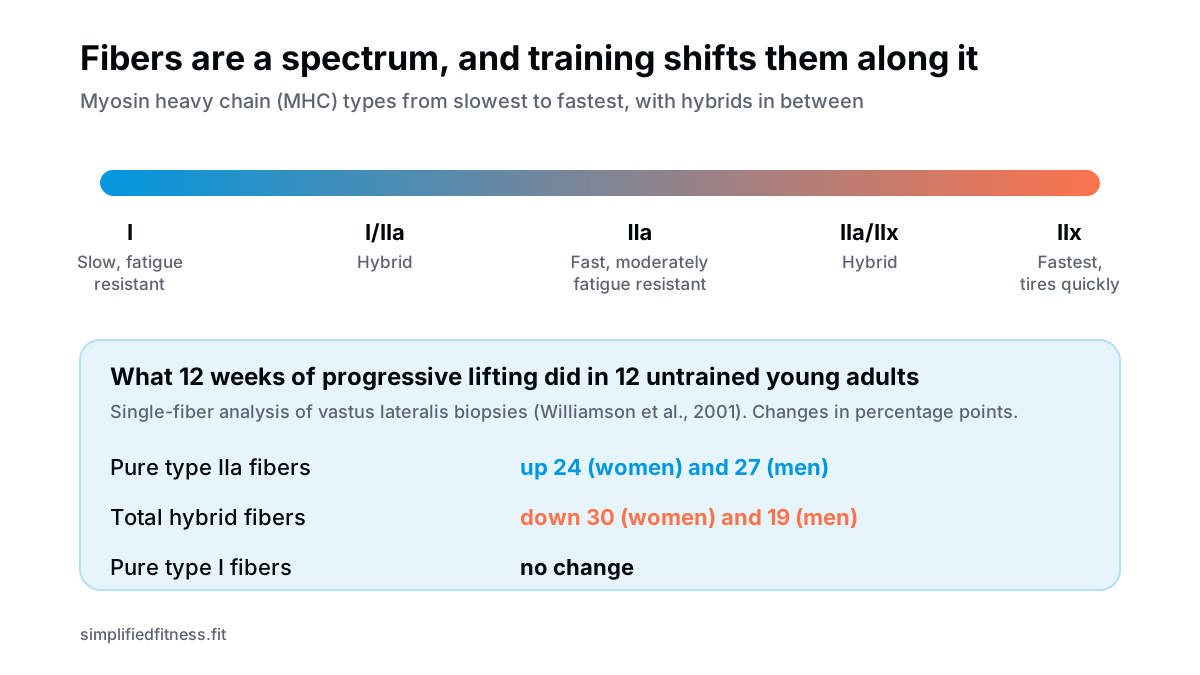
Here is the part most gym explanations skip. Fibers are not two clean boxes. Hybrid fibers, which express more than one MHC type (I/IIa, IIa/IIx), can make up a significant proportion of fibers, and spotting them requires single-fiber analysis (Plotkin et al., 2021). Think of a dimmer switch, not an on/off switch.
Does training change your fiber type?
A little, and mostly within the fast group. In a 12-week progressive resistance training study, 12 untrained young adults (6 men, 6 women) had biopsies taken before and after. Pure type IIa fibers rose by 24 percentage points in women and 27 in men, total hybrid fibers dropped by 30 points in women and 19 in men, and pure type I fibers did not change (Williamson et al., 2001).
Notice the pattern. Lifting did not turn slow fibers fast. It tidied up the in-between fibers into type IIa.
The wider evidence is less settled. A 2021 review says longitudinal data have not clearly converged on slow-to-fast shifts, partly because fiber identification methods vary, though studies using the best techniques show fibers can move between hybrid and pure types and between slow and fast types (Plotkin et al., 2021). So the honest takeaway is: shifts happen, they are gradual, and no one has shown a rep range that steers them on purpose.
Do high reps build slow twitch fibers and low reps build fast twitch fibers?
This is the heart of the myth, so let’s look at the studies built to test it.
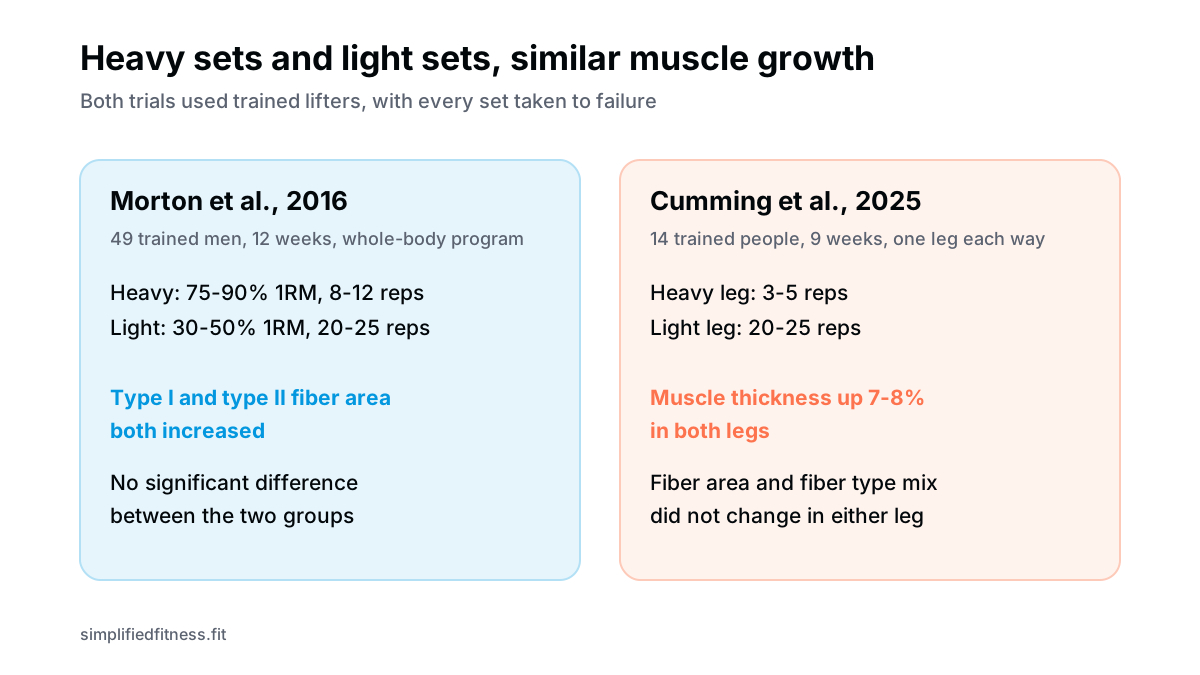
In one trial, 49 resistance-trained men did 12 weeks of whole-body training. One group lifted about 75-90% of 1RM for 8-12 reps, the other about 30-50% of 1RM for 20-25 reps, every set to failure. Type I and type II fiber cross-sectional area both increased, with no significant difference between groups (Morton et al., 2016).
A newer within-person trial in 14 trained men and women had each person train one leg with 3-5 reps and the other with 20-25 reps for 9 weeks, every set to failure. Muscle thickness rose by about 7-8% regardless of regimen. Oddly, the biopsies showed no measurable change in fiber area or fiber type composition in either leg, so this trial tells us the two loads matched each other at the whole-muscle level, not that either one grew a particular fiber type (Cumming et al., 2025).
A 2017 meta-analysis of 21 studies agrees at the whole-muscle level. Hypertrophy was similar between low-load and high-load training when sets were taken to failure, while 1RM strength gains favoured heavy loads (Schoenfeld et al., 2017).
Where the research gets messier
Here is the part that keeps this from being a clean “debunked.” A 2023 systematic review of low-load blood flow restriction (LL-BFR) found type I fiber growth was at least as large as, and sometimes greater than, type II growth. In contrast, with high-load training, type II growth tended to be substantially greater than type I. The authors add that few studies directly compare LL-BFR with normal light or heavy training, so strong conclusions are not possible (Schoenfeld et al., 2023).
So two fair readings exist side by side:
- What the 2023 review suggests: heavy loading leans toward bigger type II gains, and BFR may shift emphasis toward type I.
- What a 2023 trial suggests: in older adults, 6 weeks of low-load BFR produced a uniform increase of about 20% in both type I and type II fiber area (Wang et al., 2023). That trial had 23 people with a mean age of 66, so it may not apply to a 25-year-old.
Why might results differ? Different ages, training status, muscles, volumes and ways of measuring fibers. The cautious takeaway: if a fiber-type bias exists, it looks small compared with the shared growth both fibers get from hard sets. You do not need to build a program around it. If you want a primer on the technique, our piece on blood flow restriction mechanisms goes deeper.
Is my muscle fiber type genetic?
Partly. Estimates summarized in a 1995 paper say about 25% of North American Caucasian men and women had either under 35% or over 65% type I fibers in the vastus lateralis. About 45% of the variance in type I proportion was linked to inherited factors, about 40% to environmental factors, and about 15% to sampling and technical error (Simoneau and Bouchard, 1995).
Treat those numbers as estimates from one muscle, in one population, from older methods. They do suggest your starting mix is not fully under your control. They do not suggest a limit on how much muscle you can build, and for that bigger picture see our article on genetics and individual variability in lifting responders.
Does fiber type decide whether you are a “runner” or a “lifter”?
It may nudge you, but it does not decide it. Elite athletes do differ: distance runners and cyclists tend to carry more type I fibers, and weightlifters and sprinters more fast-twitch fibers (Plotkin et al., 2021). The catch is that these are comparisons between athletes who have already trained for years, so they cannot tell us whether fibers made them good or training shaped their fibers.
For a regular gym-goer, this means the friend who “was born for cricket fast bowling” and the one who “can run forever” are not stuck with their muscle type. Both can add muscle with the same basic recipe: hard sets, progressive overload, enough food and sleep. Fiber mix may change how a given rep range feels, such as how quickly you fade at 20 reps, but it does not change the rule that effort and progression drive growth.
Why a mixed approach still makes sense
If rep range does not target fibers, why vary it at all? Not for fiber reasons.
A broader loading spectrum has practical benefits. Heavy sets build 1RM strength better, as the 2017 meta-analysis found (Schoenfeld et al., 2017). Lighter sets are kinder on joints and easier to push close to failure on isolation moves. Our guide to the 5-30 rep spectrum lays out how to do this, and the sibling article on the high-load vs low-load spectrum covers the load question in more depth.
One more point many people miss: fibers are recruited based on demand, not on a label you choose. How motor units are called up as a set gets harder is covered in our piece on Henneman’s size principle.
What to do instead of fiber-specific training
Skip the fiber-type spreadsheets. Here is a simpler setup.
- Use mostly 6-15 reps on compound lifts and machines. Add a few heavier sets (4-6 reps) on big lifts and a few lighter sets (15-25 reps) on isolation moves if you like.
- Take sets close to failure. Our article on training to failure vs RIR explains how. The RIR/RPE calculator helps you pick loads.
- Track weekly hard sets per muscle with the training volume calculator.
- Progress over time: add a rep or a little weight when you can.
- Eat enough protein and sleep. Dal, paneer, curd, soya chunks, eggs or chicken can all cover protein needs when planned.
Quick comparison: what the evidence says
| Claim | What the research shows | Confidence |
|---|---|---|
| High reps only grow slow-twitch fibers | Light loads to failure grew type I and II fibers in trained lifters | Moderate-high |
| Heavy lifting only grows fast-twitch fibers | Heavy training tends to favour type II growth but also grows type I | Moderate |
| Training turns slow fibers into fast fibers | Hybrids convert to pure IIa; slow-to-fast shifts are less clear | Moderate |
| Fiber mix is partly inherited | About 45% of variance in type I proportion (older estimates) | Moderate |
| BFR targets type I fibers | Mixed, few direct comparisons | Low |
When to see a doctor
Muscle fiber type is a normal feature of healthy muscle, and you do not need testing to train well. If you notice unexplained weakness, persistent muscle pain, dark urine after hard training, or muscle wasting, speak to a doctor rather than self-diagnosing.
The takeaway
Fiber-specific training sounds scientific but the biopsy evidence does not back it for ordinary lifters. Train hard, use a mix of loads, progress steadily, and let fibers sort themselves out. If you want the full framework, head back to the muscle hypertrophy guide.
Frequently Asked Questions
Can you target slow twitch and fast twitch muscle fibers?
Not in any way that matters for a normal lifter. In a 49-man biopsy trial in trained lifters, heavy and light loads taken to failure both grew type I and type II fibers, with no significant difference between groups. Pick a rep range you can progress and train hard instead of chasing a fiber type.
Do high reps build slow twitch fibers and low reps build fast twitch fibers?
This is an oversimplification. When light-load and heavy-load training are both taken close to failure, studies find similar overall muscle growth, and fiber-level differences are smaller than the myth suggests. Heavy loads do seem to favour type II fiber growth a bit more, so mixing rep ranges is a sensible hedge.
What is the difference between type 1 and type 2 muscle fibers?
Type I fibers contract slowly and resist fatigue, while type II fibers contract faster and tire sooner. The difference comes from the myosin heavy chain isoform each fiber expresses: I, IIa or IIx, from slowest to fastest. Both kinds can grow with resistance training, so you do not need to choose one.
What are type IIa and IIx fibers?
Type IIa fibers are fast and moderately fatigue resistant, while type IIx fibers are the fastest and tire quickly. In a 12-week trial in untrained adults, resistance training increased pure type IIa fibers and reduced hybrid fibers, with a small drop in pure IIx fibers in the women. In practice, a lifting program tends to push fibers toward IIa, which is a useful middle ground.
What are hybrid muscle fibers?
Hybrid fibers express more than one myosin heavy chain type, such as I/IIa or IIa/IIx. They can be a large share of fibers, and they shift toward pure types with training. This is why a simple slow-versus-fast split does not describe real muscle very well.
Can training change my muscle fiber type?
Training can shift fibers between hybrid and pure types, and possibly between slow and fast types, but the evidence on slow-to-fast shifts is less clear. A 2021 review notes that results depend on how fibers are measured, and that single-fiber analysis is the most reliable method. Expect gradual shifts within the fast group more than a wholesale change in muscle type.
Is my muscle fiber type genetic?
Partly. Estimates summarized in a 1995 paper put about 45% of the variation in type I fiber proportion down to inherited factors, about 40% to environment and activity, and about 15% to measurement error. Your starting mix influences what you are naturally good at, but it does not set a ceiling on muscle growth.
Do I have more fast twitch fibers if I am good at lifting?
Not necessarily. Elite power athletes tend to have more fast-twitch fibers and elite endurance athletes more slow-twitch fibers, but that is a cross-sectional comparison, not proof that fibers decide your potential. Technique, training age and recovery also matter a lot.
Do slow twitch fibers grow at all?
Yes. In a trial of 49 trained men, both type I and type II fiber area increased after 12 weeks with no significant difference between heavy and light training. Type I fibers just tend to grow less than type II fibers under heavy loads, so do not skip them.
Does blood flow restriction target slow twitch fibers?
Possibly, but the evidence is mixed. A 2023 systematic review found type I growth was at least as large as type II with low-load blood flow restriction, yet few studies compared it against normal training. Treat it as a useful option when heavy lifting is not possible, not as a proven fiber hack.
Should I train endurance athletes and powerlifters differently for fiber type?
Train for the sport's demands rather than for a fiber type. Both groups grow muscle with hard sets near failure, and fiber mix is only one input. Use the rep ranges that suit your goal and progress them.
What rep range is best then?
For muscle size, a wide range works. A 2017 meta-analysis found hypertrophy was similar between low-load and high-load training taken to failure, while heavier loads gave greater 1RM strength gains. Use mostly 6-15 reps and add some heavier and lighter work if your joints and schedule allow.
Sources & References
Every claim above is checked against peer-reviewed research (PubMed, U.S. National Library of Medicine) or guidance from established health bodies. How we fact-check.
- Plotkin DL, et al. Muscle Fiber Type Transitions with Exercise Training: Shifting Perspectives. Sports (Basel). 2021. PMID: 34564332
- Williamson DL, et al. Reduction in hybrid single muscle fiber proportions with resistance training in humans. J Appl Physiol. 2001. PMID: 11641330
- Simoneau JA, Bouchard C. Genetic determinism of fiber type proportion in human skeletal muscle. FASEB J. 1995. PMID: 7649409
- Morton RW, et al. Neither load nor systemic hormones determine resistance training-mediated hypertrophy or strength gains in resistance-trained young men. J Appl Physiol. 2016. PMID: 27174923
- Cumming KT, et al. Divergent strength gains but similar hypertrophy after low-load and high-load resistance exercise training in trained individuals: many roads lead to Rome. J Appl Physiol. 2025. PMID: 40827709
- Schoenfeld BJ, et al. Strength and Hypertrophy Adaptations Between Low- vs. High-Load Resistance Training: A Systematic Review and Meta-analysis. J Strength Cond Res. 2017. PMID: 28834797
- Schoenfeld BJ, et al. Fiber-Type-Specific Hypertrophy with the Use of Low-Load Blood Flow Restriction Resistance Training: A Systematic Review. J Funct Morphol Kinesiol. 2023. PMID: 37218848
- Wang J, et al. Low-load blood flow-restricted resistance exercise produces fiber type-independent hypertrophy and improves muscle functional capacity in older individuals. J Appl Physiol. 2023. PMID: 36825645

Umair Hazrami · Founder & Head Coach, Simplified Fitness
Umair Hazrami founded Simplified Fitness and the Simplified Lifter channel to cut through fitness noise. With 4+ years of consistent training and 10+ coaching clients, he writes every guide from the peer-reviewed research and links the sources so you can check them. Our editorial standards.
Educational content only, not medical advice. If you have a medical condition, are pregnant, or take medication, talk to a qualified doctor before changing your diet, supplements or training. Full disclaimer.
Keep reading

Hypertrophy
Anabolic Resistance in Older Adults: Why Muscle Responds Less and How to Beat It
Anabolic resistance in older adults explained: why muscle responds less to protein and lifting after 50, plus the protein dose, leucine and sets that help.
8 min read

Hypertrophy
How Blood Flow Restriction Builds Muscle: Venous Occlusion, Metabolites and Cell Swelling
BFR training hypertrophy mechanisms explained: how a cuff and 20% 1RM can match heavy lifting for size. Metabolites, swelling, mTOR, myostatin and cuff safety.
8 min read
Hypertrophy
CNS Fatigue vs Muscle Fatigue: Is Your Nervous System Really Fried?
CNS fatigue vs muscle fatigue: what central and peripheral fatigue really are, how long each lasts, and how to tell which one is holding your lifts back.
9 min read

Hypertrophy
Exercise-Induced Muscle Damage (EIMD): Why Chasing Soreness Is Counterproductive
Muscle damage and hypertrophy are not the same thing. See what Z-disc streaming studies show, why soreness is a poor gauge of growth, and what to track.
8 min read