Do Post-Workout Growth Hormone and Testosterone Spikes Drive Muscle Growth?
Do hormone spikes build muscle? Controlled trials show post-workout GH and testosterone surges do not boost growth. See what to focus on instead.

TL;DR. The short answer
- No. In a 15-week trial, arms grew about the same whether or not a heavy leg session spiked growth hormone, IGF-1 and testosterone afterwards (12% vs 10%, no significant difference).
- Across cohorts of 23 to 56 young men, trained and untrained, the size of the post-workout hormone rise did not predict who gained the most muscle or strength.
- Squats do not make your arms grow through hormones. They grow your legs, and your arms grow from the sets you do for your arms.
- Hormones matter in two other ways: low baseline testosterone limits growth, and drug-level doses clearly build muscle. Neither is the same as a gym spike.
- What does predict growth sits inside the muscle, such as local signalling and androgen receptor content, so spend your effort on hard, well-recovered sets.
Part of our complete guide: How Muscle Actually Grows: The Natural Lifter's Guide to Hypertrophy Science
Table of contents
For years the gym rule was simple: lift in a way that spikes growth hormone and testosterone, and your whole body grows faster. So do hormone spikes build muscle? In the controlled trials we have, no. The short rise after a hard session did not add extra growth or strength, and the size of the spike did not predict who gained the most.
That is a hard one to let go of if you were raised on “squat to grow your arms.” In this article, part of our complete muscle hypertrophy guide for natural lifters, we go through the landmark trials, where hormones do matter, and what to do with this in your training. Mostly young men were studied, so we will flag where that limits the conclusions.
Where did the hormone spike idea come from?
It is not a stupid idea. It was a reasonable guess that went unchallenged for too long.
Here is the logic. Testosterone and growth hormone (GH) are clearly anabolic in some settings. Hard resistance training raises both for a short time afterwards. Moderate loads with short rests tend to raise them more than heavy, long-rest strength work. So people connected the dots: spike more → grow more.
The problem is that a correlation between “this workout raises hormones” and “people who lift build muscle” does not show that the first causes the second. As one review of the hormone hypothesis puts it, some researchers have questioned it, and have even suggested the exercise-induced rise may be there to mobilise fuel stores rather than build tissue (Schoenfeld, 2013). The hypothesis had support in the literature, but it needed a proper test.
Do hormone spikes build muscle? The arm-and-leg trial
Researchers at McMaster University ran the test. It is one of the cleanest experiments in this area.
Twelve healthy young men trained their two elbow flexors (the biceps and friends) independently for 15 weeks, on separate days. In the “low hormone” condition, they did arm curls only, which did not raise GH, IGF-1 or testosterone. In the “high hormone” condition, they did the same arm work followed straight away by a high volume of leg exercise, which raised all three significantly immediately and 15 and 30 minutes afterwards (West et al., 2010).
Same arm exercise, very different hormones. So what happened to the muscle?
Muscle cross-sectional area rose 12% in the low-hormone arm and 10% in the high-hormone arm, with no significant difference between them. Type I and type II fibre area increased in both, and strength gains were not different either. The authors concluded that acute exercise-induced hormone elevations enhanced neither hypertrophy nor strength in young men (West et al., 2010).
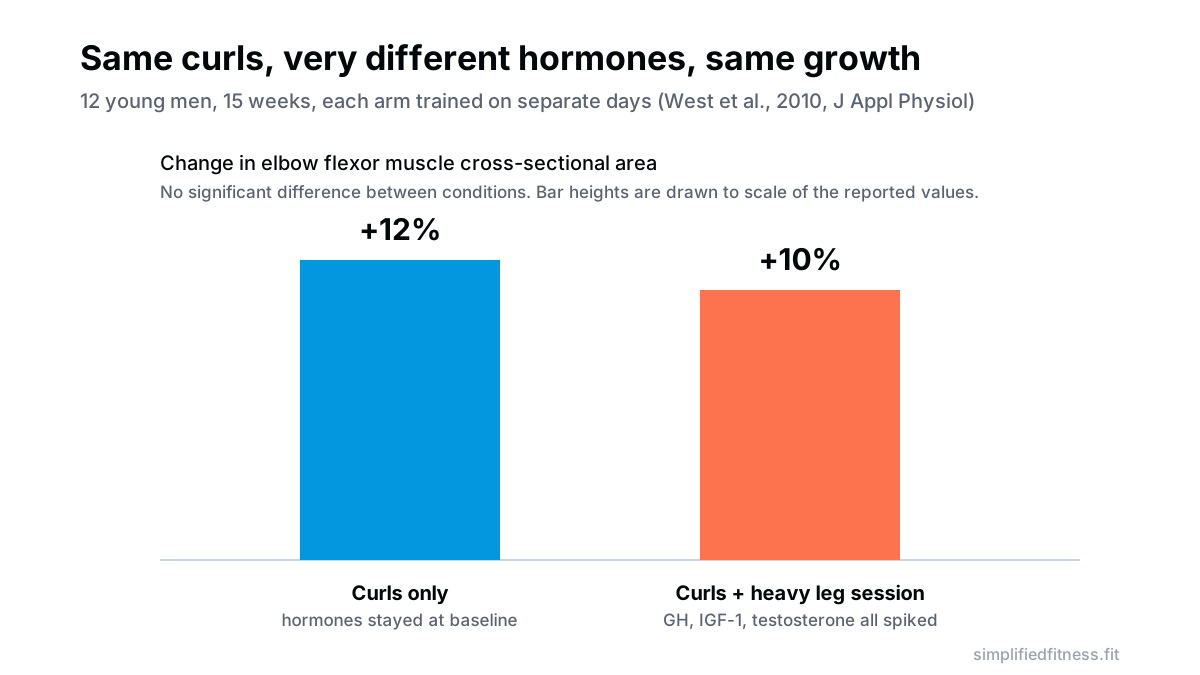
This is a single trial in 12 healthy young men. It is a strong design, but one study never settles anything. So let us look at what the others found.
What do the larger studies of hormone responses show?
The same group has repeatedly looked at whether the size of the hormone response predicts who grows.
56 young men, 12 weeks. Hormone responses to a hard leg session were measured midway through training. There were no significant correlations between GH, free testosterone or IGF-1 rises and gains in lean mass or leg press strength. Cortisol, the supposedly “catabolic” hormone, showed a weak positive correlation with lean mass gain (r = 0.29) and type II fibre area (r = 0.35). GH showed weak correlations with fibre area (r = 0.28 to 0.36) but not lean mass (West and Phillips, 2012). Weak and inconsistent correlations like these are not a case for chasing GH.
23 young men, 16 weeks. Fibre area rose by an average of 20%, with a huge range (from -7% to 80%). There was no relationship between post-exercise free testosterone, GH or IGF-1 changes and fibre hypertrophy. The authors concluded that post-exercise rises in circulating hormones are not related to hypertrophy (Mitchell et al., 2013).
49 resistance-trained men, 12 weeks. Some people say “that is only beginners.” So the team repeated it in trained men. No significant correlation between the acute post-exercise rise in any purported anabolic hormone and the change in strength or hypertrophy was found (Morton et al., 2016).
Different cohorts, different training programmes, same answer.
Do squats make your arms grow?
This is the marketing claim in its purest form. “Squat heavy, release testosterone, and your arms will grow too.”
The arm-and-leg trial was basically built to test it. The arms that received the post-leg hormone surge did not grow more. That does not mean squats are useless. They are great for legs, and they load a huge amount of muscle for the time they take. But the evidence does not support using them as an arm-growth hack.
Why is the spike irrelevant? Local signalling beats systemic hormones
If hormones are not the trigger, what is? The leading explanation is local to the muscle you are loading.
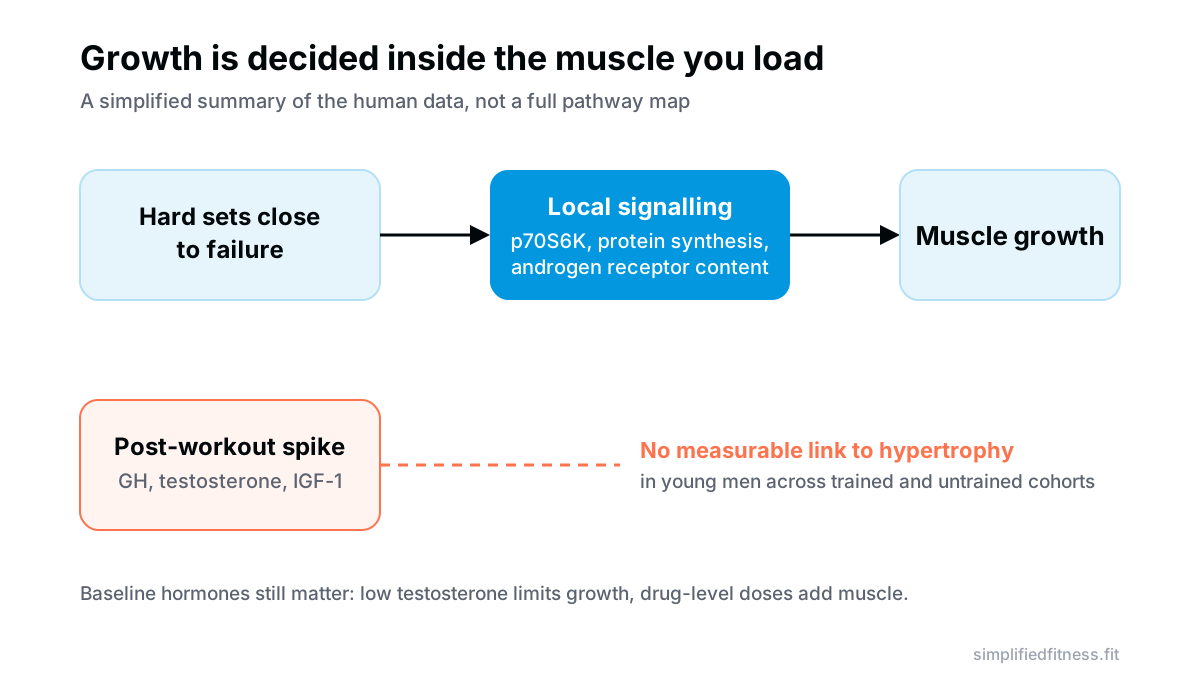
Loaded contractions create mechanical tension, which switches on signalling inside the fibre and raises muscle protein synthesis. Mechanical tension being transduced into anabolic signals is the starting point of the hypertrophy process described in the hormone hypothesis review itself (Schoenfeld, 2013). In the 23-man cohort, phosphorylation of p70S6K (a classic marker of that signalling) five hours after exercise was correlated with fibre growth (r = 0.54), while hormone rises were not. The authors read this as implicating intramuscular rather than systemic processes (Mitchell et al., 2013).
Simple version: your muscle decides how much to grow based on what happened to that muscle.
Does androgen receptor content matter more than hormone levels?
This is where it gets more interesting, and a bit messier.
In the 49 trained men from the 2018 analysis, no hormone in blood or muscle differed between the ten highest and ten lowest responders. What did differ was androgen receptor (AR) content: it was higher in the high responders at all time points, and AR content had a linear relationship with changes in lean mass and fibre size. The authors concluded that intramuscular AR content, not circulating or intramuscular hormones, influenced hypertrophy in previously trained young men (Morton et al., 2018). The 23-man cohort also found a correlation between changes in AR content and fibre area (r = 0.60) (Mitchell et al., 2013).
Two things to keep in mind. First, these are correlations in small subgroups, so they suggest rather than prove. A 6-week study of 30 previously trained men did not find muscle androgen receptor levels changing differently in its high and low responders, so the finding is not settled (Haun et al., 2019). Second, this does not give you something to act on, because you cannot measure or train your AR content at home. It tells us that the interesting variation between people probably lives inside the muscle, which fits with the broader picture in our article on local IGF-1 vs systemic hormones.
When do hormones actually matter?
None of this means hormones are irrelevant. It means gym spikes are the wrong thing to chase.
| Situation | What the evidence shows |
|---|---|
| Brief post-workout rise in GH, testosterone, IGF-1 | No measured benefit for growth or strength in young men |
| Low baseline testosterone | Can limit muscle gain and should be assessed by a doctor |
| Drug-level testosterone | Dose-dependent gains in fat-free mass in healthy men |
| Short-term GH injections in experienced lifters | No increase in muscle protein synthesis |
In a dose-response trial, 61 healthy men aged 18 to 35 had their own testosterone suppressed and then received weekly testosterone at five different doses for 20 weeks. Fat-free mass increased dose-dependently at the higher doses (3.4, 5.2 and 7.9 kg at 125, 300 and 600 mg a week), and the change correlated with testosterone concentration (Bhasin et al., 2001). So testosterone is a powerful lever. It is just not one you pull by choosing a rep range. Those are sustained, supraphysiological exposures, and they carry real health risks, so this is not a how-to.
GH is different again. In seven experienced male weight lifters, 14 days of GH injections raised IGF-1 but did not increase muscle protein synthesis (Yarasheski et al., 1993). That was a small study, and short term, but it fits the rest of the picture.
What should you do with this?
Practical, not preachy.
- Stop programming for hormones. Pick rep ranges, rest periods and exercises for stimulus, performance and recovery.
- Train each muscle you want bigger. Do not rely on squats for arms or deadlifts for back width.
- Take hard sets close to failure. Local loading is the signal. Our load and rep-range guide and the free RIR and RPE calculator help you gauge proximity to failure.
- Do not fear long rests. If a longer rest lets you lift better on the next set, you lose nothing hormonally that matters. See rest intervals for hypertrophy.
- Protect the basics. Eat enough protein (dal, paneer, curd, eggs, soya, chicken, whatever fits your diet), sleep properly, and be consistent. Our sleep and growth hormone article explains the sleep side.
- Skip the testosterone-booster aisle. If a short-term hormone bump does not build muscle, paying to nudge one is a poor deal. We go through the claims in natural testosterone boosters.
If you want to check whether your weekly sets are in a sensible range, try the training volume calculator.
When should you see a doctor?
Gym spikes are not a diagnosis, and neither is a missing pump. If you have persistent low energy, low sex drive, unexplained loss of muscle or strength, erectile problems, or you are not recovering despite good sleep and food, see a doctor and ask for proper blood tests. Do not self-diagnose from a supplement ad, and do not start hormones without medical supervision.
What are the limits of this evidence?
Worth being straight about.
- Most of these trials used young men. Findings may not apply the same way to women, older adults, or people with clinical hormone deficiencies. Receptor findings in particular should not be copied across sexes without sex-specific data.
- Several studies were run by the same research group. The conclusions are consistent across their cohorts, but independent replication is always welcome.
- Correlation studies cannot rule out small effects. The most direct test was the 15-week arm trial, with 12 men.
- The research tells us that spikes are not a useful target. It does not say that hormones in general are irrelevant.
The practical takeaway survives all of those caveats: train the muscle, recover properly, and ignore the hormone chase.
Frequently Asked Questions
Do hormone spikes build muscle?
Not in any way that has been measured in healthy young men. In a controlled trial, a big post-workout rise in growth hormone, IGF-1 and testosterone did not add extra arm growth or strength. Train each muscle with hard sets and stop chasing the spike.
Do squats and deadlifts boost testosterone and make all muscles grow?
Heavy leg work can raise testosterone and growth hormone for a short time, but that rise did not improve growth in the arms that were trained alongside it. Muscle responds mainly to the loading it receives itself. Squat for your legs and train arms directly if you want arm growth.
Does post-workout growth hormone build muscle?
In people with normal growth hormone levels there is no evidence that the short exercise-induced rise drives muscle growth. A 14-day injection study in experienced lifters did not increase muscle protein synthesis, so focus on training quality.
How long does the testosterone rise after lifting last?
In the 15-week trial, hormone levels were elevated immediately and at 15 and 30 minutes after the high-hormone session. That makes it a short, transient blip compared with your daily and weekly hormone levels. It is not something you can bank for later growth.
Is the anabolic window real because of hormone spikes?
The hormone spike is not what opens any window. In a 16-week study, growth tracked local signalling inside the trained muscle, not the size of the post-workout hormone rise. Eat enough protein across the day instead of racing to a shaker.
Do short rest periods increase growth hormone and therefore growth?
Short rests and moderate loads do tend to produce bigger hormone spikes than heavy strength work. Bigger spikes have not been shown to produce bigger muscles, so rest periods should be chosen for performance and recovery. See our guide to rest intervals for the practical side.
Does low testosterone stop muscle growth?
Low baseline testosterone can limit muscle gain, and graded testosterone doses in healthy men produced dose-dependent gains in fat-free mass. That is a different question from the brief spike after a workout. If you have symptoms such as low drive, fatigue or loss of muscle, see a doctor for proper blood tests.
Do natural testosterone boosters help me build muscle?
The research above does not support the idea that nudging a short-term hormone number is what builds muscle. Even a genuine temporary rise did not translate to extra growth in the trials discussed here. Spend the money on protein foods like dal, paneer, eggs and curd instead.
What actually predicts who builds muscle faster?
In 49 resistance-trained men, androgen receptor content inside the muscle was linearly related to gains in lean mass and fibre size, while no circulating hormone was. This suggests local factors matter more than systemic ones, though a later 6-week study in trained men did not replicate a clear receptor link. You cannot test or change it at home, so control training, protein, sleep and consistency.
Does cortisol really destroy muscle after training?
Not in the data we have. In a cohort of 56 young men, the post-workout cortisol response was weakly and positively correlated with gains in lean mass and type II fibre size. Cortisol is a normal exercise response, so there is no need to fear it.
Should I stop doing leg day for hormones?
No, but do it for your legs, not for a hormone effect. Leg training builds the biggest muscles in your body and burns plenty of energy. Just do not expect it to speed up your arms.
Do women need to worry about this as well?
Most of the controlled trials discussed here were in young men, so we should be careful about applying them directly to women. The practical message is similar though, since training the muscle hard is what stimulates it. Our article on [sex differences in hypertrophy](/blog/sex-differences-muscle-hypertrophy-men-vs-women) goes deeper.
Can I test whether I am a high or low responder?
Not meaningfully. Even in the studies that biopsied muscle, hormone levels in blood and muscle did not separate high and low responders. Track your own lifts and measurements for 8 to 12 weeks and adjust from there.
Sources & References
Every claim above is checked against peer-reviewed research (PubMed, U.S. National Library of Medicine) or guidance from established health bodies. How we fact-check.
- West DW, et al. Elevations in ostensibly anabolic hormones with resistance exercise enhance neither training-induced muscle hypertrophy nor strength of the elbow flexors. J Appl Physiol. 2010. PMID: 19910330
- West DW, et al. Associations of exercise-induced hormone profiles and gains in strength and hypertrophy in a large cohort after weight training. Eur J Appl Physiol. 2012. PMID: 22105707
- Morton RW, et al. Neither load nor systemic hormones determine resistance training-mediated hypertrophy or strength gains in resistance-trained young men. J Appl Physiol. 2016. PMID: 27174923
- Morton RW, et al. Muscle androgen receptor content but not systemic hormones is associated with resistance training-induced skeletal muscle hypertrophy in healthy, young men. Front Physiol. 2018. PMID: 30356739
- Mitchell CJ, et al. Muscular and systemic correlates of resistance training-induced muscle hypertrophy. PLoS One. 2013. PMID: 24130904
- Bhasin S, et al. Testosterone dose-response relationships in healthy young men. Am J Physiol Endocrinol Metab. 2001. PMID: 11701431
- Yarasheski KE, et al. Short-term growth hormone treatment does not increase muscle protein synthesis in experienced weight lifters. J Appl Physiol. 1993. PMID: 8366011
- Haun CT, et al. Pre-training skeletal muscle fiber size and predominant fiber type best predict hypertrophic responses to 6 weeks of resistance training in previously trained young men. Front Physiol. 2019. PMID: 30971942
- Schoenfeld BJ. Postexercise hypertrophic adaptations: a reexamination of the hormone hypothesis and its applicability to resistance training program design. J Strength Cond Res. 2013. PMID: 23442269

Umair Hazrami · Founder & Head Coach, Simplified Fitness
Umair Hazrami founded Simplified Fitness and the Simplified Lifter channel to cut through fitness noise. With 4+ years of consistent training and 10+ coaching clients, he writes every guide from the peer-reviewed research and links the sources so you can check them. Our editorial standards.
Educational content only, not medical advice. If you have a medical condition, are pregnant, or take medication, talk to a qualified doctor before changing your diet, supplements or training. Full disclaimer.
Keep reading
Hypertrophy
Anabolic Resistance in Older Adults: Why Muscle Responds Less and How to Beat It
Anabolic resistance in older adults explained: why muscle responds less to protein and lifting after 50, plus the protein dose, leucine and sets that help.
8 min read
Hypertrophy
How Blood Flow Restriction Builds Muscle: Venous Occlusion, Metabolites and Cell Swelling
BFR training hypertrophy mechanisms explained: how a cuff and 20% 1RM can match heavy lifting for size. Metabolites, swelling, mTOR, myostatin and cuff safety.
8 min read
Hypertrophy
CNS Fatigue vs Muscle Fatigue: Is Your Nervous System Really Fried?
CNS fatigue vs muscle fatigue: what central and peripheral fatigue really are, how long each lasts, and how to tell which one is holding your lifts back.
9 min read

Hypertrophy
Exercise-Induced Muscle Damage (EIMD): Why Chasing Soreness Is Counterproductive
Muscle damage and hypertrophy are not the same thing. See what Z-disc streaming studies show, why soreness is a poor gauge of growth, and what to track.
8 min read