Muscle Growth in a Calorie Deficit: What mTORC1 and AMPK Really Do
Can you build muscle in a calorie deficit? See how AMPK and mTORC1 sense energy, what the human trials show, and how protein and lifting offset the brake.

TL;DR. The short answer
- Muscle growth in a calorie deficit is possible but blunted. Meta-analysis data show lean mass gains are impaired in a deficit, while strength gains are largely preserved.
- Low cellular energy activates AMPK, which can suppress mTORC1, the main switch for building muscle protein. In humans, a short deficit lowered resting muscle protein synthesis by about 27%.
- A hard lifting session plus protein brought muscle protein synthesis back to normal levels in the deficit, and protein pushed it above resting energy balance in a dose-dependent way.
- The people most likely to gain muscle while losing fat are those with more body fat, a modest deficit, or a new training stimulus. Lean, advanced lifters mostly aim to keep what they have.
- Practical levers: a modest deficit, hard sets near failure, and a high protein intake (the ISSN position stand lists 1.6-2.2 g/kg for muscle anabolism and higher for lean lifters on a cut).
Part of our complete guide: How Muscle Actually Grows: The Natural Lifter's Guide to Hypertrophy Science
Table of contents
Muscle growth in a calorie deficit is possible, but it is slower and less certain than growth in maintenance or a surplus. A 2022 meta-analysis found lean mass gains were impaired in a deficit while strength gains were largely preserved (Murphy et al., 2022). Inside your muscle cells, an energy sensor called AMPK pushes against the growth switch mTORC1, and hard lifting plus enough protein pushes back.
This article is the cell-level companion to our complete muscle hypertrophy guide. It explains why the deficit costs you something, what the human trials show, and why some lifters still add muscle while losing fat. If you want the diet setup instead, our guide on body recomposition covers it.
One honest caveat first. Much of the pathway biology comes from cell studies. The human data come mostly from short trials in young adults. I will flag which is which.
How do mTORC1 and AMPK control muscle growth?
Think of mTORC1 as the accelerator and AMPK as the brake.
mTORC1 sits at the centre of the signal that tells a muscle cell to build more protein. It listens to mechanical tension from lifting and to amino acids from food. AMPK listens to something else: how much usable energy the cell has left. When energy is low, AMPK switches on. In cell experiments, it directly phosphorylates a partner protein of mTOR called raptor, and that is required for energy stress to inhibit mTORC1 (Gwinn et al., 2008). Growth is expensive. A starving cell postpones it.
That is the logic behind the claim that a deficit and muscle growth do not mix.
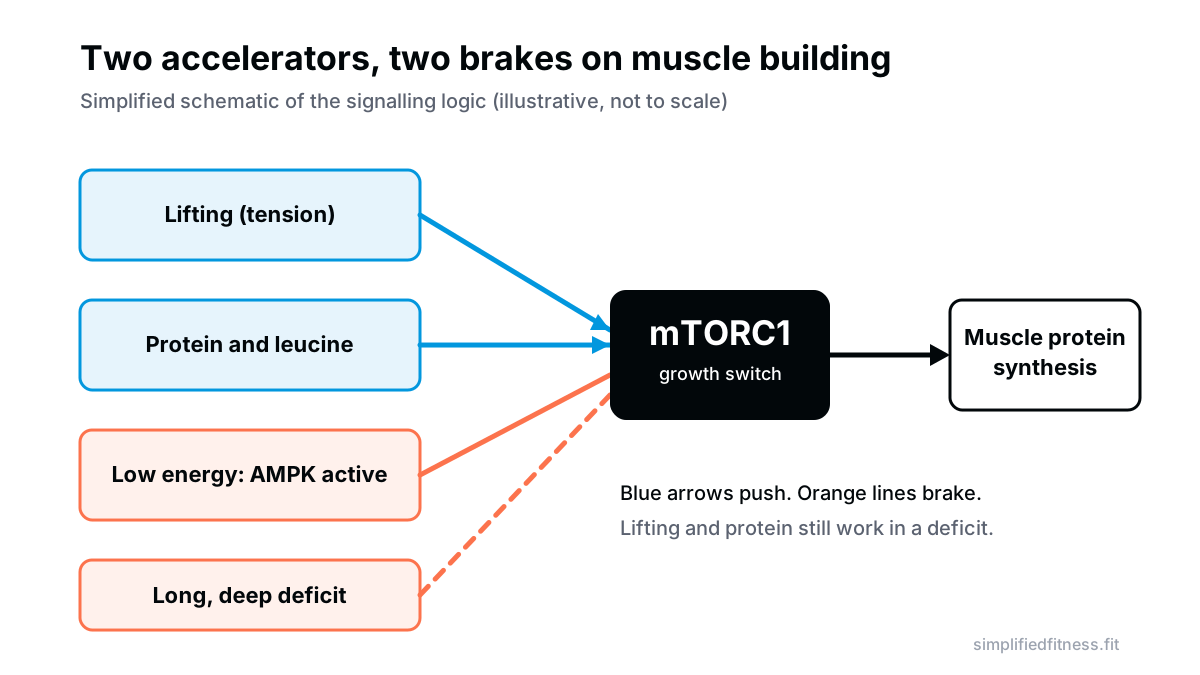
But look at what the cell actually experiences during a workout. In a study of 11 people, AMPK activity rose right after resistance exercise and a protein linked to translation initiation (4E-BP1) became less phosphorylated, which fits with synthesis being suppressed during the session. Then, one to two hours later, synthesis increased alongside activation of mTOR signalling (Dreyer et al., 2006). So the brake and the accelerator both fire around training. The timing matters.
Does a calorie deficit really lower muscle protein synthesis?
Yes, in the short-term human trials we have.
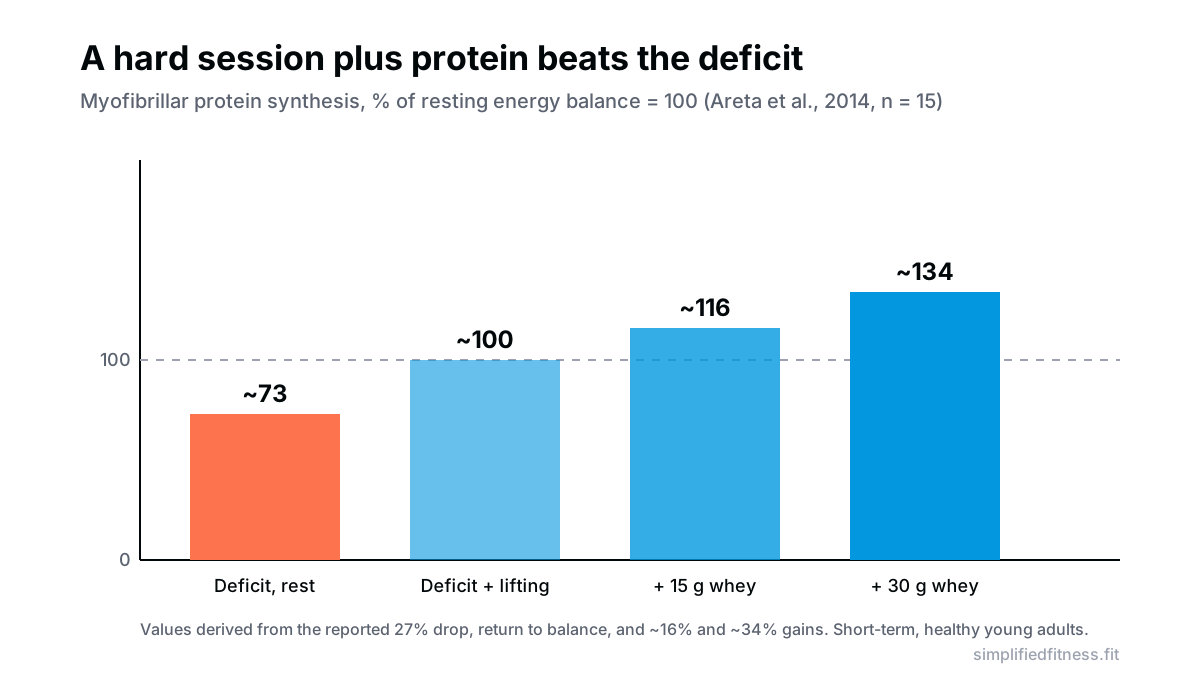
Researchers put 15 young men and women through 5 days at 30 kcal per kg of fat-free mass, versus 45 kcal at energy balance. Resting myofibrillar protein synthesis was 27% lower in the deficit (Areta et al., 2014). Then they added a bout of resistance exercise. Synthesis rose back to the level seen at rest in energy balance. Adding 15 g or 30 g of whey after training pushed it about 16% and 34% above resting energy balance.
Another trial of men on a 10-day, 40% energy cut came to a similar conclusion from a different angle. Synthesis dropped in the deficit, and the exercised leg held up better than the rested leg. Muscle protein breakdown did not change. The authors concluded that a reduction in synthesis is the main mechanism behind early lean mass loss in a cut (Hector et al., 2018).
Read that again. In this trial, the problem was too little building, not too much breaking down. That is good news, because lifting and protein are exactly the tools that drive building.
What does anabolic resistance in cutting actually mean?
“Anabolic resistance” gets thrown around online as if a cut makes your muscle deaf to protein. The evidence is milder than that.
In the Areta trial, the muscle still responded to protein after exercise during a deficit, and the response grew with the dose. The deficit lowered the resting baseline, but it did not stop the response (Areta et al., 2014). Both trials above were short, with young adults, so I would not stretch them to months of dieting or to older people.
There is also a related system worth knowing about. Cells have to move amino acids in before mTORC1 can read them. One transporter often discussed for this is LAT1. A 2021 human study found that LAT1 and its partner SNAT2 did not change acutely after amino acids or resistance exercise, and that basal levels did not positively predict how much leucine or phenylalanine got built into muscle protein (Mazzulla et al., 2021). That was in 14 healthy young men given an amino acid and carbohydrate drink, not in a deficit, so it does not show the transporter is irrelevant in cutting. It does suggest that “boost your transporters” is not a practical lever.
What about leucine itself? In cell work, the protein Sestrin2 binds leucine, and mutating that site raises the leucine concentration needed to activate mTORC1 (Saxton et al., 2016). Lovely mechanism, but still a cell study. The takeaway I draw is “eat enough good protein at each meal,” not “buy a leucine tub.”
Why do some people still build muscle while losing fat?
Because the brake is not the same size for everyone, and your training age and body fat change what happens.
A systematic review of six studies in lean, resistance-trained athletes on energy restriction found that fat-free mass fell in nine of 13 groups. Six groups gained, held, or lost non-significant amounts. Five of those six were among the highest in body fat, lowest in caloric restriction, or doing a new training stimulus (Helms et al., 2014). So the people who beat the deficit tended to have more energy stored, a smaller deficit, or a fresh stimulus.
That fits the cell logic. More stored fat means the body has fuel to spare, and a new stimulus gives a bigger growth signal than the hundredth repeat of the same routine. I would treat this as a pattern across a small number of studies rather than a law. The review was of six studies, so be cautious.
Here is how that sorts out in practice.
| Situation | What to expect (evidence-based, general) |
|---|---|
| New lifter, more body fat, modest deficit | Muscle gain alongside fat loss is realistic |
| Returning after a break | Often similar, given a new or renewed stimulus |
| Intermediate lifter, moderate deficit | Mostly maintain, small gains possible |
| Lean, advanced, aggressive deficit | Aim to keep muscle, not add it |
Rows two to four are practical reading of the pattern above, not tested categories. Our deeper dive on who can actually recomp goes through the limits.
How big can the deficit be before muscle gain stops?
Murphy and Koehler’s meta-regression suggests it does not take much. Across randomized trials of 3 weeks or longer, an energy deficit of about 500 kcal a day prevented gains in lean mass. They advised that people trying to build lean mass avoid prolonged energy deficiency, and that those trying to preserve it avoid deficits above that level (Murphy et al., 2022).
Strength is a different story. In their analysis, strength gains were comparable between the deficit and control conditions. So if your squat keeps climbing on a cut, that is not proof your muscle is growing at the same rate. Strength can improve through better skill and nervous system efficiency even when lean mass is not.
If you want to size a deficit, our calorie calculator is a fair place to start. Our guide on setting the optimal deficit goes further.
Can more protein overcome the energy brake?
It helps, and the best controlled evidence is encouraging. It is also short and in young men.
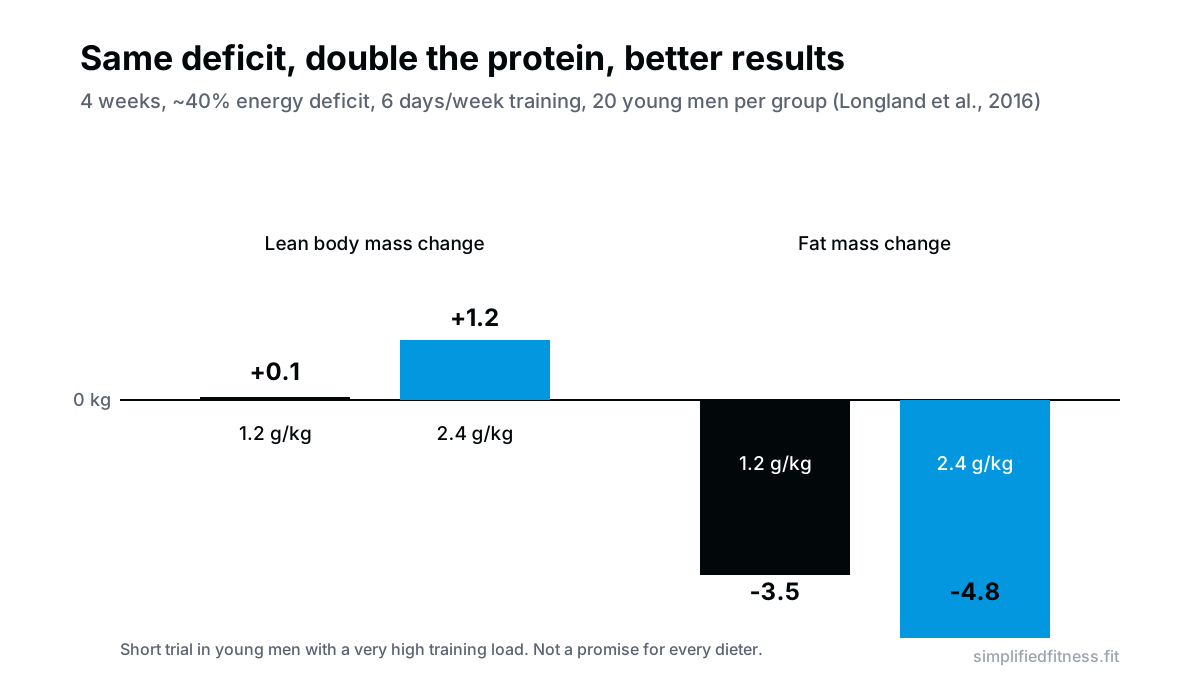
In the Longland trial, 40 young men ate about 40% below their energy needs for 4 weeks while training six days a week with resistance exercise plus high-intensity intervals. Half ate 1.2 g/kg of protein and half ate 2.4 g/kg. The higher-protein group gained 1.2 kg of lean body mass versus 0.1 kg in the lower-protein group, and lost more fat (4.8 kg versus 3.5 kg) (Longland et al., 2016). Exercise performance improved similarly in both groups.
The ISSN position stand on diets for weight reduction gives wider guidance. It says resistance training and sufficient protein are indispensable for limiting lean mass loss in a sustained deficit. It lists 1.6-2.2 g/kg a day with resistance training to optimize muscle anabolism, and 1.9-3.2 g/kg to maximize lean mass retention in lean, resistance-trained people in a deficit. It also notes that total daily protein is of primary importance, with distribution a secondary concern (Aragon et al., 2026). For lean athletes specifically, the earlier review proposed 2.3-3.1 g/kg of fat-free mass, scaling upward with leanness and severity of restriction (Helms et al., 2014).
For the food side, our guide to protein while cutting shows how to fill the target on a budget.
What training signal beats the energy deficit?
Local tension. Your muscle does not read your weekly calorie balance directly. It reads what you just did to it.
The Areta data show that resistance exercise alone restored synthesis to resting energy-balance rates in a deficit, without any protein. That is the point where mechanical tension does its job. Lift hard sets close to failure, keep progressive overload, and do not let your sessions turn into soft, easy circuits because you feel flat. Our article on mechanical tension versus muscle damage explains why tension is the driver, and how long muscle protein synthesis stays elevated shows the time window you are working with.
One more practical note. A cut is not the time to add three new sports. Hard cardio piles on fatigue and uses calories, so keep it sensible. Our piece on cardio during a cut covers the balance.
If you eat extremely little, sleep badly, feel dizzy, lose your period, or find yourself preoccupied with food, stop and speak to a doctor or registered dietitian. No muscle goal is worth that.
So should you cut, bulk or recomp?
The honest answer is that it depends on where you are starting.
- Higher body fat and fairly new to lifting: a modest deficit with high protein and hard training is a reasonable plan. Recomposition is realistic.
- Intermediate, want visible muscle: consider short, focused phases. Build with a small surplus, then cut. Our cut, bulk or recomp decision guide walks through it.
- Already lean and advanced: treat a cut as maintenance for muscle. If the scale and mirror move the right way and your lifts hold, you are winning.
All of this sits inside the broader energy balance framework, which covers surplus, deficit and maintenance together.
The bottom line
A deficit lowers the resting muscle-building signal, and AMPK sits in the cellular machinery that does it. That is real. It is also not a wall. In the human trials above, hard lifting and enough protein pulled muscle protein synthesis back to normal or higher, and people with more body fat, a gentle deficit or a new stimulus tended to hold or gain muscle.
Keep the deficit small. Lift hard. Hit your protein. Everything else is secondary.
Frequently Asked Questions
Can you build muscle in a calorie deficit?
Yes, but how much depends on who you are. A 2022 meta-analysis found lean mass gains were impaired in a deficit compared with eating at maintenance or above, though strength gains were comparable. Beginners, people with more body fat, and anyone returning after a break have the best odds, so keep the deficit modest and train hard.
What is the difference between mTOR and AMPK?
mTORC1 is a growth switch that turns on muscle protein building when nutrients and mechanical tension are present. AMPK is an energy sensor that activates when cellular energy is low and can suppress mTORC1. Think of AMPK as the brake and mTORC1 as the accelerator, with lifting and protein pushing the accelerator even when energy is short.
Does AMPK stop muscle growth?
Not outright. In human muscle, AMPK activity rose right after a bout of resistance exercise and a signalling protein tied to protein synthesis went down, yet synthesis rose over the next one to two hours. The brake is temporary and context dependent, so do not fear it from a single hard workout.
Why is it harder to build muscle when cutting?
A deficit lowers resting muscle protein synthesis, and that drop appears to be the main reason lean mass is lost early in a cut. One 10-day trial in men found synthesis fell while muscle protein breakdown did not change. Resistance training and enough protein offset much of that drop.
What is anabolic resistance during a cut?
It is the idea that muscle responds less to protein and exercise when energy is low. Short-term trials show resting synthesis falls in a deficit, but resistance exercise restored it to normal levels. The effect looks real but modest, and it can be offset with training and protein.
How much protein do I need in a deficit?
The ISSN position stand lists 1.6-2.2 g/kg a day with resistance training for muscle anabolism, and 1.9-3.2 g/kg for lean, resistance-trained people holding a deficit. A review of lean athletes proposed 2.3-3.1 g/kg of fat-free mass, scaling up with leanness and deficit size. Most people sit comfortably at the lower end of those ranges, and our protein calculator gives a personal number.
How big a calorie deficit still allows muscle gain?
A meta-regression found that a deficit of about 500 kcal a day prevented lean mass gains on average. People trying to preserve muscle were advised to avoid deficits above that. Smaller deficits of 200-300 kcal are a reasonable starting point if gaining muscle matters to you, and that is a practical judgement rather than a tested cutoff.
Does leucine really switch on mTOR?
In cell studies, yes. A 2016 structural study showed that Sestrin2 binds leucine and that this binding is part of how leucine activates mTORC1. That is cell biology, not a human training trial, so it supports eating adequate protein rather than chasing a leucine hack.
Who gets the best recomposition results?
People with more body fat, newer lifters, and those starting a novel training stimulus. A systematic review of lean, resistance-trained athletes found that most groups that held or gained fat-free mass were among the highest in body fat, lowest in energy restriction, or used new training stimuli. Advanced, lean lifters should expect to maintain muscle rather than add much.
Does cardio blunt mTOR in a deficit?
Hard endurance work can raise AMPK, but the human data here do not show that sensible cardio cancels out lifting. The practical issue is usually total fatigue and calories burned, not signalling. Keep cardio moderate, do it away from your hardest lifting if you can, and watch your recovery.
Is muscle protein breakdown or synthesis the problem in a deficit?
In a 10-day trial of men on a 40% energy cut, reduced muscle protein synthesis was the main mechanism of lean mass loss early on. Breakdown did not change. That is why training and protein, which target synthesis, matter so much.
Should I eat at maintenance or in a deficit if I want muscle?
If building muscle is the priority, eating at maintenance or a small surplus gives the strongest signal, because lean mass gains are impaired in a deficit. If fat loss is the priority, accept slower or no muscle gain and focus on keeping what you have. You can alternate phases instead of forcing both at once.
Can women or older adults expect the same results?
The Areta trial included men and women, but most trials here are in young adults, so the picture for older people is less clear. Older muscle is generally thought to respond less to protein, which would make training and protein even more important. If you are older or managing a condition, check your plan with a doctor or dietitian.
Sources & References
Every claim above is checked against peer-reviewed research (PubMed, U.S. National Library of Medicine) or guidance from established health bodies. How we fact-check.
- Murphy C, et al. Energy deficiency impairs resistance training gains in lean mass but not strength: A meta-analysis and meta-regression. Scand J Med Sci Sports. 2022. PMID: 34623696
- Areta JL, et al. Reduced resting skeletal muscle protein synthesis is rescued by resistance exercise and protein ingestion following short-term energy deficit. Am J Physiol Endocrinol Metab. 2014. PMID: 24595305
- Hector AJ, et al. Pronounced energy restriction with elevated protein intake results in no change in proteolysis and reductions in skeletal muscle protein synthesis that are mitigated by resistance exercise. FASEB J. 2018. PMID: 28899879
- Longland TM, et al. Higher compared with lower dietary protein during an energy deficit combined with intense exercise promotes greater lean mass gain and fat mass loss: a randomized trial. Am J Clin Nutr. 2016. PMID: 26817506
- Helms ER, et al. A systematic review of dietary protein during caloric restriction in resistance trained lean athletes: a case for higher intakes. Int J Sport Nutr Exerc Metab. 2014. PMID: 24092765
- Gwinn DM, et al. AMPK phosphorylation of raptor mediates a metabolic checkpoint. Mol Cell. 2008. PMID: 18439900
- Dreyer HC, et al. Resistance exercise increases AMPK activity and reduces 4E-BP1 phosphorylation and protein synthesis in human skeletal muscle. J Physiol. 2006. PMID: 16873412
- Saxton RA, et al. Structural basis for leucine sensing by the Sestrin2-mTORC1 pathway. Science. 2016. PMID: 26586190
- Mazzulla M, et al. LAT1 and SNAT2 protein expression and membrane localization of LAT1 are not acutely altered by dietary amino acids or resistance exercise nor positively associated with leucine or phenylalanine incorporation in human skeletal muscle. Nutrients. 2021. PMID: 34836160
- Aragon AA, et al. International Society of Sports Nutrition position stand: diets for body weight reduction. J Int Soc Sports Nutr. 2026. PMID: 42867412

Umair Hazrami · Founder & Head Coach, Simplified Fitness
Umair Hazrami founded Simplified Fitness and the Simplified Lifter channel to cut through fitness noise. With 4+ years of consistent training and 10+ coaching clients, he writes every guide from the peer-reviewed research and links the sources so you can check them. Our editorial standards.
Educational content only, not medical advice. If you have a medical condition, are pregnant, or take medication, talk to a qualified doctor before changing your diet, supplements or training. Full disclaimer.
Keep reading

Hypertrophy
Anabolic Resistance in Older Adults: Why Muscle Responds Less and How to Beat It
Anabolic resistance in older adults explained: why muscle responds less to protein and lifting after 50, plus the protein dose, leucine and sets that help.
8 min read

Hypertrophy
How Blood Flow Restriction Builds Muscle: Venous Occlusion, Metabolites and Cell Swelling
BFR training hypertrophy mechanisms explained: how a cuff and 20% 1RM can match heavy lifting for size. Metabolites, swelling, mTOR, myostatin and cuff safety.
8 min read

Hypertrophy
CNS Fatigue vs Muscle Fatigue: Is Your Nervous System Really Fried?
CNS fatigue vs muscle fatigue: what central and peripheral fatigue really are, how long each lasts, and how to tell which one is holding your lifts back.
9 min read

Hypertrophy
Exercise-Induced Muscle Damage (EIMD): Why Chasing Soreness Is Counterproductive
Muscle damage and hypertrophy are not the same thing. See what Z-disc streaming studies show, why soreness is a poor gauge of growth, and what to track.
8 min read