Genetics and Muscle Growth: Are You a Non-Responder to Lifting?
Muscle building genetics explained: why the same program gives wildly different growth, what 'non-responder' really means, and how more volume can help.
TL;DR. The short answer
- Muscle building genetics matter, but they shape how fast you respond, not whether you respond. In one study of 585 people on the same 12-week arm program, muscle size change ranged from -2% to +59%.
- True 'non-responders' look rarer than the label suggests. In older adults who did not grow on 1 set per exercise, 4 sets produced more muscle and strength gain on the other leg.
- Researchers have linked better growth to ribosome build-up in muscle, muscle androgen receptor content and fiber traits, but each factor explains only a modest slice of the variation.
- Blood testosterone and growth hormone levels did not reliably predict who grew in a 12-week trial of trained men.
- If you are stuck, fix the levers you control first: logged progression, effort close to failure, weekly hard sets, protein, calories and sleep. See a doctor if progress is poor alongside other unexplained symptoms.
Part of our complete guide: How Muscle Actually Grows: The Natural Lifter's Guide to Hypertrophy Science
Table of contents
Muscle building genetics are real, but they are not a verdict. They change how fast you grow, not whether you can. Research shows some people gain very little from a given program while others gain a lot, and “non-responder” usually just means “needs a different dose.”
If you are two years in, eating dal and paneer, training four days a week and still look the same, this article is for you. It sits under our complete guide to muscle hypertrophy for natural lifters, and it focuses on one thing: what the research says about individual differences and what to change when your results lag.
Do muscle building genetics decide how much you grow?
They influence it a lot, but the clearest evidence for how much comes from a huge trial, not from gym lore.
In 2005, researchers had 585 people (342 women, 243 men) do 12 weeks of progressive elbow flexor training on one arm and measured the result with MRI. Muscle size changes ranged from -2% to +59%. One-rep max gains ranged from 0% to +250%. Some participants gained almost nothing; others increased muscle cross-sectional area by more than 10 square centimetres and roughly doubled their strength (Hubal et al., 2005).
Same program. Same weeks. Very different outcomes.
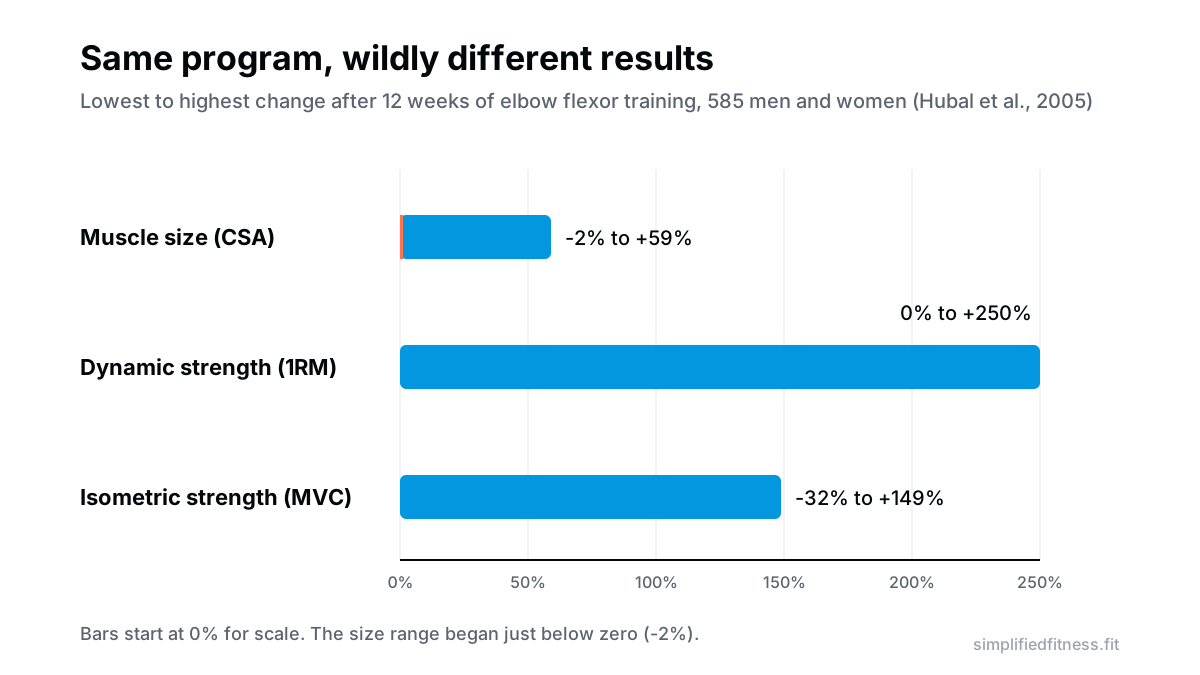
Two details matter for fairness. Men gained about 2.5% more in muscle size than women, but women gained more in relative strength (Hubal et al., 2005). And this was one muscle group in a mixed population, with a short training block. It shows the spread exists, not why.
What does “non-responder” actually mean?
It is a statistical label, not a diagnosis.
Researchers pick an outcome (say, thigh muscle cross-sectional area), measure it before and after a program, and call someone a non-responder if the change falls inside the measurement error of the test. Change the program, the muscle, or the measuring tool and the same person can move categories.
A good example: in a 2017 study, 376 older women did 12 weeks of resistance training at either low or high weekly volume. Non-responsiveness was not apparent in any participant, because every woman improved on at least one measured outcome (Barbalho et al., 2017). The authors concluded that low-volume training still improved strength and function with no evidence of non-responsiveness. Those were older women and the outcomes were mostly strength and function tests, so this does not prove everyone grows muscle on any dose.
Another way to put it: “non-responder” often means “did not respond to this particular dose.” That is why the next study is so useful.
Can more volume turn a non-responder into a responder?
In older adults, the evidence says it often can.
In a 2024 trial, 85 older adults (average age 68) trained one leg with 1 set and the other leg with 4 sets of knee extensions for 10 weeks, twice a week. Using MRI typical error, 51 people were classified as non-responders to the 1-set protocol and 34 as responders. In the non-responders, the 4-set leg gained significantly more muscle and strength than the 1-set leg. Responders grew on both legs, with a tendency toward more benefit from 4 sets (Lixandrao et al., 2024).
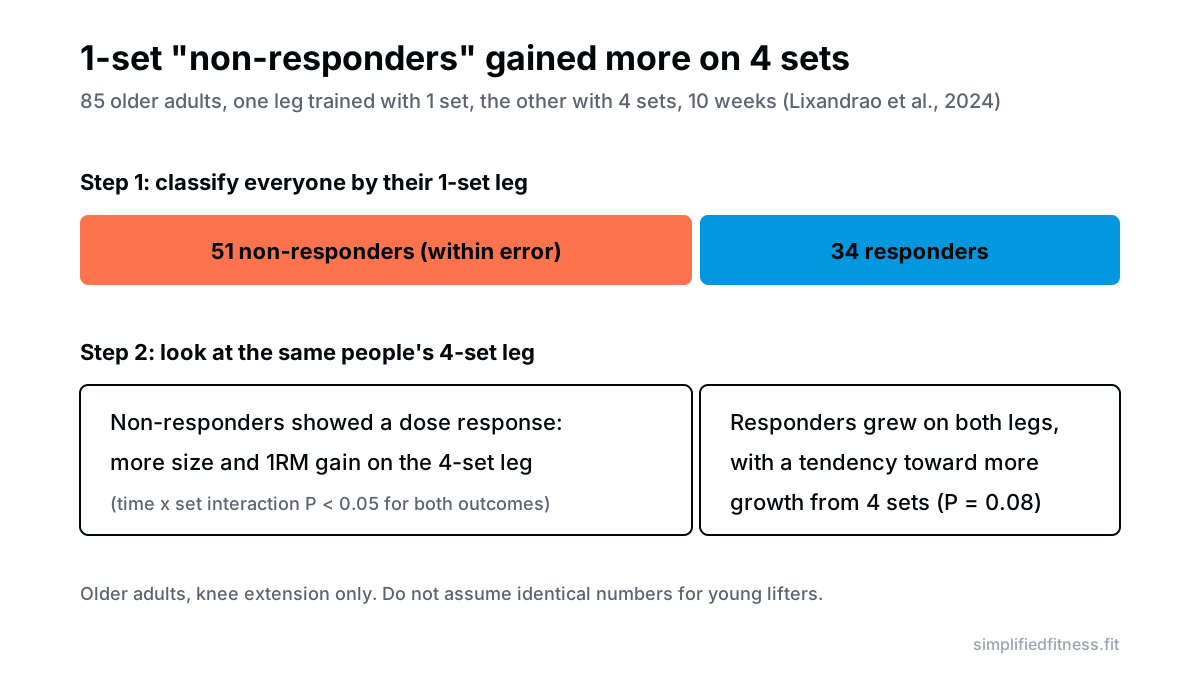
Because the design compared each person’s two legs, genetics, diet and sleep were identical for both sides. That makes the volume effect hard to explain away. The caveat: these were older adults doing one exercise, so the exact numbers should not be copied to a 24-year-old training chest and back.
The bigger evidence base points the same way. A meta-analysis of 15 studies (34 treatment groups) found a graded dose-response: each additional weekly set was associated with an extra 0.37% gain in muscle size, and higher volumes produced about 3.9% more growth than lower ones (Schoenfeld et al., 2017). If you want the full picture on how many sets, our guide to training volume and frequency for hypertrophy and the weekly set dose-response curve go deeper.
Does the evidence agree? A fair look at the conflict
Not entirely, and it is worth being honest about that.
What study A found: in older adults, more sets rescued non-responders (Lixandrao et al., 2024).
What study B found: in 20 trained young men, an 8-week 2019 trial had each person train one leg with a standard progressive program and the other with systematically varied training variables (more total volume, a slightly higher muscle protein synthesis response). Muscle size gain was similar between legs, and all participants were responders. Between-person variability was about 40-fold greater than the difference between legs (Damas et al., 2019).
Why they may differ: the populations are different (older adults versus trained young men), the volume contrast is different (1 set versus 4 sets, which is a big jump, versus two already-sensible programs), and the endpoints differ. A lifter at 1 set per exercise is far from the dose-response plateau. A trained lifter already doing a solid program may be closer to it.
Cautious takeaway: if you are doing very little, adding volume is the cheapest experiment. If you are already doing a reasonable program, expect individual factors to matter more than clever tweaks, and be patient.
What biology might explain fast and slow responders?
Several candidates, and none is a silver bullet.
A review from the Auburn group summarises what is known. Differences in ribosome biogenesis (building more protein-making machinery) seem to explain some of the variation. High responders may also show a bigger satellite cell response, a more favourable muscle microRNA profile, and higher androgen receptor content in muscle. The same review is blunt about single genes: candidates such as myostatin and IGF-1 variants typically share only marginal variance with hypertrophy (Roberts et al., 2018). Many of the mechanisms still need more studies to validate.
Here is what the individual studies found.
| Factor | What a study found | Population | Limits |
|---|---|---|---|
| Ribosome build-up (total RNA) | Not significantly increased in low responders, increased in moderate and high responders (Mobley et al., 2018) | 67 untrained young men, 12 weeks | Explained only about 8-11% of variance in growth |
| Starting muscle size | Lower pre-training thickness linked to greater growth (Mobley et al., 2018) | Same untrained men | Weak correlation (r2 about 0.11) |
| Fiber traits | Larger pre-training type II fibers in low responders; higher type II fiber percentage predicted better response (Haun et al., 2019) | 30 previously trained young men, 6 weeks | Small sample, authors flag limits |
| Androgen receptor content | Higher in the highest responders at all time points; linear link to growth (Morton et al., 2018) | 49 resistance-trained men, 12 weeks | Top and bottom 10 only; not replicated in a 6-week trained-men study (Haun et al., 2019) |
| Circulating hormones | No hormone consistently predicted growth (Morton et al., 2018) | Same trained men | Men only |
Two points stand out. First, the hormone story is not what the supplement industry tells you: blood testosterone and similar measures did not consistently predict growth in that study. If you want the wider context, see our article on the post-workout hormone spike myth. Second, a satellite cell or ribosome difference is not something you can fix with a supplement. These are descriptions of why people differ, not treatment targets. For the cell biology itself, see satellite cells and myonuclear addition.
Why muscle size at the start can mislead you
The Auburn trials show something counterintuitive. In untrained young men, those who ended up as low responders actually started with about 12% greater thigh muscle thickness than high responders, and finished about 12% smaller (Mobley et al., 2018). In previously trained men over 6 weeks, low responders had about 18% larger type II fibers before training (Haun et al., 2019).
A plausible reading, which the authors frame as suggestive, is that people who already carry more muscle have less room to add quickly. The practical lesson: if you are naturally decently muscled, slow visible gains may reflect a higher starting point and not a defective response. Fiber type percentage may also play a part in this; the trained-men study found that a higher type II percentage predicted a better response, but with a small sample.
“Genetic limits” versus “slow right now”
These are different problems, and most lifters confuse them.
A genetic ceiling means the maximum muscle you can carry naturally. You can estimate your position with our FFMI calculator, but treat it as a rough guide, because it relies on body fat estimates and was built from specific populations.
Slow right now is something else: the rate of progress this year. Responders and non-responders are defined by a short block, usually 6 to 12 weeks. Rate is more trainable than ceiling. Most people who feel cursed are somewhere between “undertrained” and “under-recovered” and will never find out which unless they run a clean experiment.
How to adjust if you are a slow responder
Work down this order. Each step is cheap compared with the next.
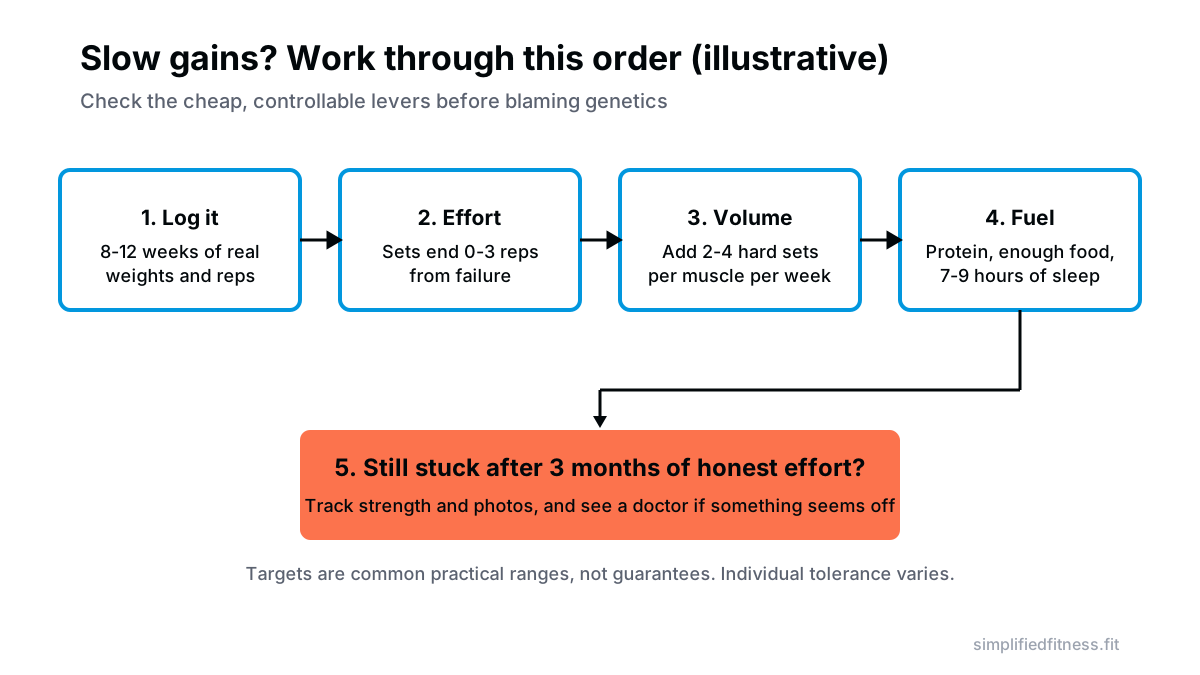
1. Log everything for 8-12 weeks. You cannot judge response from the mirror. A training logbook shows if your working weights and reps are going up, which is the first sign of progress for most lifters.
2. Check effort. The most common mistake here is stopping sets far from failure because the set “feels hard.” Most hypertrophy sets work well ending roughly 0-3 reps short of failure. If you finish sets with 6 reps in reserve, you are probably under-dosing.
3. Raise weekly hard sets gradually. Add 2-4 hard sets per muscle per week, hold for 3-4 weeks, then judge. Use our training volume calculator to count sets per muscle across the week. Do not jump from 8 to 25 sets. The mesocycle progression guide shows a sane ramp.
4. Check recovery and food. Protein, total calories and sleep set the ceiling on what training can do. For a vegetarian lifter, that usually means building protein around dal, paneer, curd, soya chunks and eggs if you eat them, spread across 3-4 meals. Our protein calculator gives a target for your body weight. If you are in a calorie deficit, growth will be slower for everyone.
5. Use personal tolerance, not a template. Some people recover well from higher volume; some need less. The article on individual recovery profiling and volume tolerance covers how to read your own signs.
6. Reassess after 3 months. If the logbook shows strength rising, you are responding, even if the mirror lags. If the logbook is flat after consistent, effortful training and good food, a systematic plateau troubleshooting flowchart is the next stop.
What if nothing works?
Be patient first, and then be practical.
Responses vary, and some people do end up on the slow end of the spectrum. That is not a failing of effort. Two sensible mindsets help. First, strength is also progress, and Hubal’s data show strength and size responses are not tightly matched in every person (Hubal et al., 2005). Second, health benefits of lifting do not depend on how big you look.
Frequently Asked Questions
Do genetics determine how much muscle you can build?
Genetics influence how quickly and how far you grow, but they do not decide whether you grow. In a study of 585 people on the same program, changes in muscle size ranged from -2% to +59%, so the spread is large. Judge yourself against your own starting point, not against the biggest guy in the gym.
What is a non-responder in resistance training?
A non-responder is someone whose measured muscle growth after a program stays within measurement error. That label depends on the program, the muscle and the test used, so it describes one result, not a fixed trait. In one trial, 51 of 85 older adults were non-responders to 1 set, yet as a group they gained more on 4 sets.
Are there really people who cannot build muscle?
Evidence suggests complete inability is rare in healthy people. One study of 376 older women found that every participant improved on at least one outcome, even with low volume. If you are truly not changing at all, check your effort, food and sleep, and see a doctor if other symptoms are present.
Why do some people grow muscle faster than others?
Research points to several contributors, including how much ribosome capacity muscle builds during training, androgen receptor content in muscle, fiber type and size at the start, and possibly microRNA and satellite cell activity. No single factor explains more than a small share of the difference. You cannot test most of these at home, so focus on what you can control.
Can low responders become high responders?
Sometimes, because responsiveness is not fixed to one program. A trial of older adults found that higher training volume offset non-responsiveness to a 1-set protocol. Raise weekly hard sets gradually and track whether growth improves.
Does testosterone level predict muscle growth?
In a 12-week study of resistance-trained men, no circulating or intramuscular hormone measured was consistently linked to muscle growth. Androgen receptor content inside the muscle did show a linear relationship with growth. So a normal blood result does not make you a poor responder.
How many sets should a slow responder do per week?
There is no proven number for slow responders, but meta-analysis shows a graded dose-response, with more weekly sets producing more growth on average. Start by adding 2-4 hard sets per muscle per week and keep the change if your strength and size trend upward. Stop adding if recovery or joints complain.
How long should I wait before deciding I am not responding?
Give it at least 8-12 weeks of consistent, logged training, because early changes are small and measurement is noisy. Studies that classify responders typically use 6 to 12 week blocks. Compare your logbook, tape measurements and photos across that window.
Are Indian lifters genetically disadvantaged for muscle gain?
The studies in this article did not test Indian populations, so no firm claim can be made. What is clear is that individual differences within any group are large. Adequate protein from dal, paneer, curd, eggs or soya, enough calories and consistent progressive training matter far more than ancestry guesses.
Does age change how responsive you are?
Older adults still gain muscle with training, though responses vary as widely as in younger people. The 1-set versus 4-set trial and the older women study both used adults around 68-72 years. Younger lifters may respond differently, so treat those numbers as supporting evidence rather than exact targets.
Does muscle size before training predict your response?
It may play a small role. In young untrained men, lower pre-training thigh muscle thickness was linked to greater growth, but it explained only a small share of variance. In trained men, larger pre-training type II fibers were linked to a poorer response. These are weak signals, not a verdict.
Should I get a genetic test to see if I will build muscle?
Current evidence does not support using a consumer genetic test to predict your muscle gain. Single genes, including myostatin and IGF-1 variants, share only marginal variance with growth after training. Spend that money on food and a good program.
Do I need steroids if I am a low responder?
No. A slow response usually means the training dose, food or recovery needs adjusting, and drugs carry real health risks. If you are worried about hormones, ask a doctor for proper testing rather than guessing or self-medicating.
Sources & References
Every claim above is checked against peer-reviewed research (PubMed, U.S. National Library of Medicine) or guidance from established health bodies. How we fact-check.
- Hubal MJ, et al. Variability in muscle size and strength gain after unilateral resistance training. Med Sci Sports Exerc. 2005. PMID: 15947721
- Lixandrao ME, et al. Higher resistance training volume offsets muscle hypertrophy nonresponsiveness in older individuals. J Appl Physiol. 2024. PMID: 38174375
- Barbalho MSM, et al. There are no no-responders to low or high resistance training volumes among older women. Exp Gerontol. 2017. PMID: 28918362
- Damas F, et al. Myofibrillar protein synthesis and muscle hypertrophy individualized responses to systematically changing resistance training variables in trained young men. J Appl Physiol. 2019. PMID: 31268828
- Schoenfeld BJ, et al. Dose-response relationship between weekly resistance training volume and increases in muscle mass: A systematic review and meta-analysis. J Sports Sci. 2017. PMID: 27433992
- Roberts MD, et al. Physiological differences between low versus high skeletal muscle hypertrophic responders to resistance exercise training: current perspectives and future research directions. Front Physiol. 2018. PMID: 30022953
- Mobley CB, et al. Biomarkers associated with low, moderate, and high vastus lateralis muscle hypertrophy following 12 weeks of resistance training. PLoS One. 2018. PMID: 29621305
- Morton RW, et al. Muscle androgen receptor content but not systemic hormones is associated with resistance training-induced skeletal muscle hypertrophy in healthy, young men. Front Physiol. 2018. PMID: 30356739
- Haun CT, et al. Pre-training skeletal muscle fiber size and predominant fiber type best predict hypertrophic responses to 6 weeks of resistance training in previously trained young men. Front Physiol. 2019. PMID: 30971942

Umair Hazrami · Founder & Head Coach, Simplified Fitness
Umair Hazrami founded Simplified Fitness and the Simplified Lifter channel to cut through fitness noise. With 4+ years of consistent training and 10+ coaching clients, he writes every guide from the peer-reviewed research and links the sources so you can check them. Our editorial standards.
Educational content only, not medical advice. If you have a medical condition, are pregnant, or take medication, talk to a qualified doctor before changing your diet, supplements or training. Full disclaimer.
Keep reading

Hypertrophy
Anabolic Resistance in Older Adults: Why Muscle Responds Less and How to Beat It
Anabolic resistance in older adults explained: why muscle responds less to protein and lifting after 50, plus the protein dose, leucine and sets that help.
8 min read

Hypertrophy
How Blood Flow Restriction Builds Muscle: Venous Occlusion, Metabolites and Cell Swelling
BFR training hypertrophy mechanisms explained: how a cuff and 20% 1RM can match heavy lifting for size. Metabolites, swelling, mTOR, myostatin and cuff safety.
8 min read
Hypertrophy
CNS Fatigue vs Muscle Fatigue: Is Your Nervous System Really Fried?
CNS fatigue vs muscle fatigue: what central and peripheral fatigue really are, how long each lasts, and how to tell which one is holding your lifts back.
9 min read

Hypertrophy
Exercise-Induced Muscle Damage (EIMD): Why Chasing Soreness Is Counterproductive
Muscle damage and hypertrophy are not the same thing. See what Z-disc streaming studies show, why soreness is a poor gauge of growth, and what to track.
8 min read