Anabolic Resistance in Older Adults: Why Muscle Responds Less and How to Beat It
Anabolic resistance in older adults explained: why muscle responds less to protein and lifting after 50, plus the protein dose, leucine and sets that help.

TL;DR. The short answer
- Anabolic resistance means older muscle makes less new protein from the same meal. In a pooled analysis, muscle protein synthesis plateaued at about 0.40 g/kg of protein per meal in older men versus 0.24 g/kg in younger men.
- It is not a wall. Lifting sensitises muscle to amino acids, and after a session older men still showed dose-dependent gains up to 45 g of protein.
- For adults over 65 who train, the PROT-AGE group advises at least 1.2 g/kg/day of protein, with more for people living with illness.
- Leucine helps, but the exact 3 g trigger is a rule of thumb, not a proven threshold. A bigger overall protein dose per meal matters more.
- Low weekly training volume can still build muscle in healthy older adults, but people who do not respond to one set often do better with about four.
Part of our complete guide: How Muscle Actually Grows: The Natural Lifter's Guide to Hypertrophy Science
Table of contents
If you are over 50 and your lifts and your muscle are not responding the way they did at 30, you are probably not imagining it. Anabolic resistance in older adults is a real, measurable blunting of how much new muscle protein your body builds from the same meal or the same workout. The fix is not a magic supplement. It is a bigger protein dose per meal, consistent lifting, and enough weekly sets to push past a weaker signal.
This article covers why it happens, what the research says about protein and leucine, and how to set up your training. For the wider picture on how muscle grows, start with our complete guide to muscle hypertrophy for natural lifters.
What is anabolic resistance in older adults?
Anabolic resistance is an age-related blunting of the muscle protein synthesis response to a given dose of protein or amino acids (Aragon et al., 2023). Same chicken breast, same dal, smaller growth signal.
Notice what it is not. Resting muscle protein synthesis was similar in older and younger men in one pooled analysis (Moore et al., 2015). The gap shows up when you feed or train the muscle, which is why it matters for lifters.
The authors of that review also point out that it is not just an age effect. Obesity and sedentary living can worsen or bring it on, partly through insulin resistance and systemic inflammation (Aragon et al., 2023). That is good news. Some of the drag is modifiable.
What causes it? The cellular story
Three mechanisms are proposed in the Aragon review, and they stack.
- Decreased anabolic signalling. The muscle cell responds less strongly to the same amino acid dose.
- Reduced capillary recruitment. Insulin normally opens up small blood vessels in muscle after a meal. With age this is blunted, so fewer amino acids get delivered.
- Higher splanchnic retention. More of the protein you eat is used by the gut and liver before it reaches muscle.
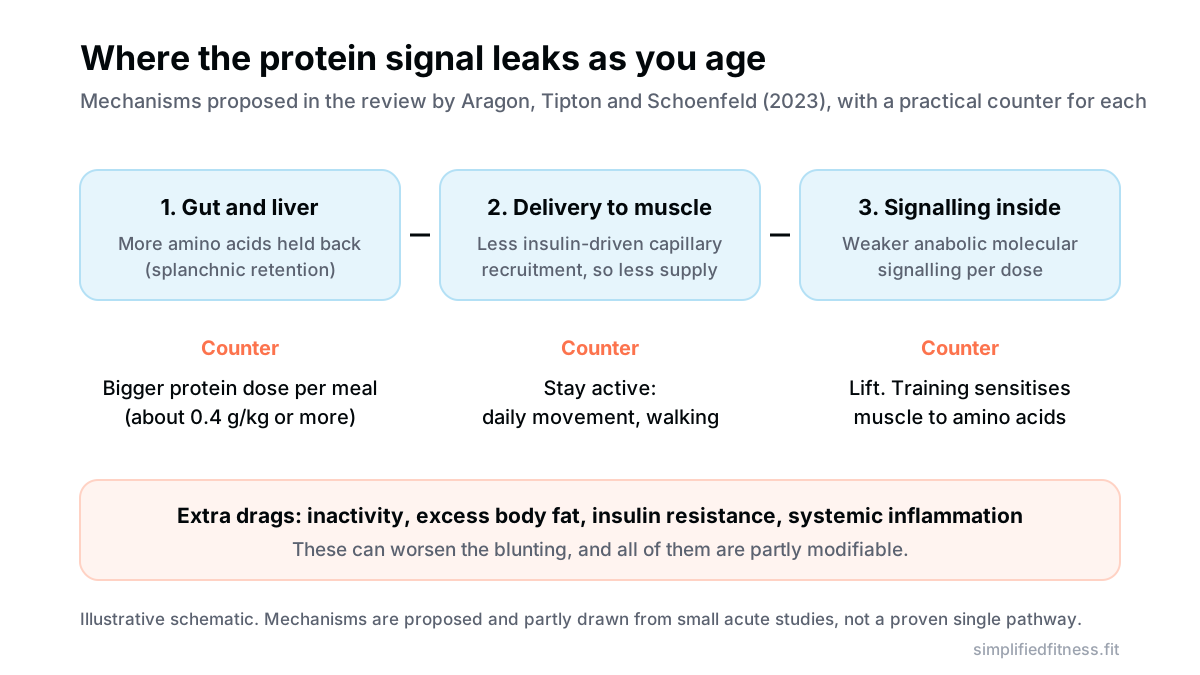
Chronic low-grade inflammation, sometimes called inflammaging, is the fourth suspect. The review links systemic inflammation with anabolic resistance, especially alongside obesity and inactivity (Aragon et al., 2023). The causal chain is not fully proven, so treat it as a likely contributor rather than the single villain.
One caution on all of this. Much of the mechanistic work comes from small, acute lab studies in healthy older volunteers. They show what happens in a few hours after a drink, not years of real training.
How much protein per meal do older lifters need?
This is the question with the clearest numbers. The pooled Moore analysis measured muscle protein synthesis in healthy men of about 71 and about 22 years after different protein doses. The response plateaued at roughly 0.40 g/kg body mass in older men and 0.24 g/kg in younger men, or 0.60 versus 0.25 g/kg lean mass (Moore et al., 2015). The spread was wide, and the body-mass difference only just missed the usual significance cut-off (p = .055).
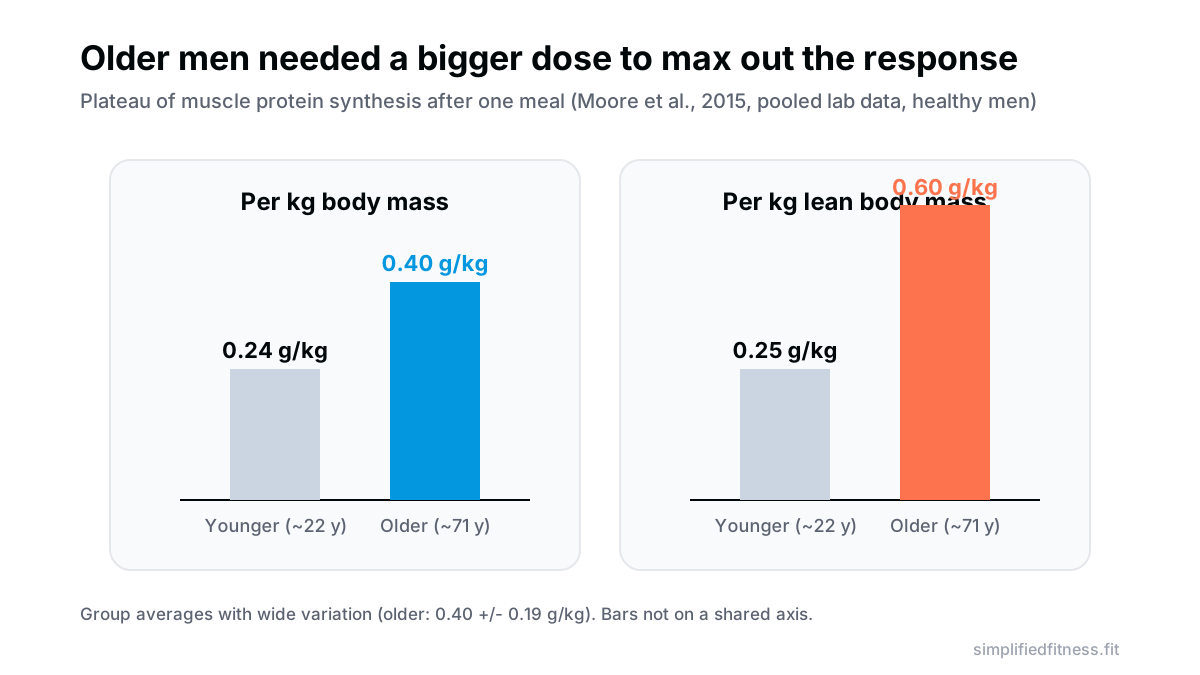
For a 70 kg person, 0.40 g/kg is about 28 g. Given the variation (the older group’s average was 0.40 plus or minus 0.19), many coaches round up to 30-40 g per meal. That is a practical choice, not a number from the study.
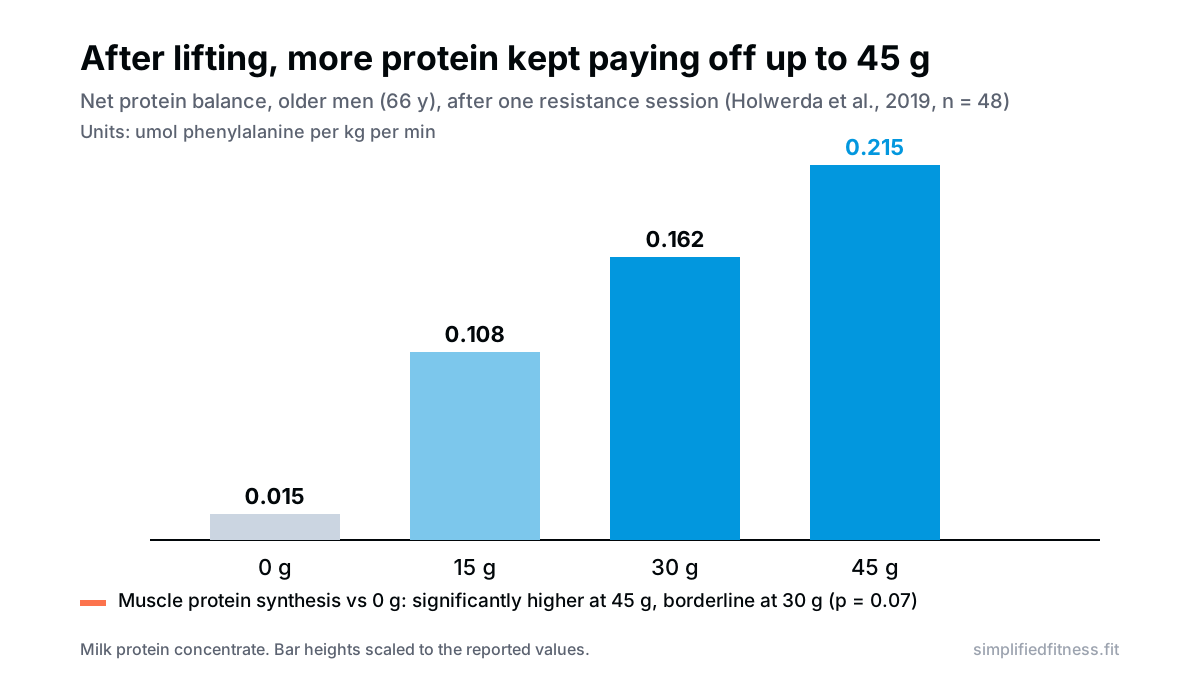
A trial in 48 healthy older men (average age 66) gave 0, 15, 30 or 45 g of milk protein after a leg and upper-body session. Net protein balance rose with every step. Muscle protein synthesis was significantly higher than 0 g at 45 g, with 30 g close behind (p = 0.07), which led the authors to conclude that 30 g or more is needed (Holwerda et al., 2019).
How much per day?
For people over 65, the PROT-AGE position paper recommends at least 1.0-1.2 g/kg/day, and at least 1.2 g/kg/day for those who exercise. People with acute or chronic disease often need 1.2-1.5 g/kg/day. The exception is severe kidney disease (eGFR below 30 mL/min/1.73 m2, not on dialysis), where protein may need to be limited (Bauer et al., 2013). The same paper says evidence on protein timing and quality is not yet strong enough for firm rules.
Work out your own number with the protein intake calculator. For how protein needs compare across age groups, see protein requirements for older adults.
Is the 3 g leucine rule real?
You will often see “3 g of leucine per meal” for older lifters. Here is what the research does and does not say.
What supports it. A small controlled study gave 6.7 g of essential amino acids. In older people, a mix with 26% leucine did not significantly raise muscle protein synthesis, while a 41% leucine mix did. In young people, both worked (Katsanos et al., 2006). So more leucine seems to rescue the response in older muscle, at least with a small amino acid dose.
What complicates it. A 2021 systematic review of 29 studies found 16 supported the “leucine trigger” idea, 13 of those in older adults. It also found the idea fits isolated proteins better than whole foods (Zaromskyte et al., 2021).
Why the mixed picture? Studies use different doses, proteins, exercise states and ages. A food matrix with fibre, fat and other amino acids changes digestion.
In practice, a 30-40 g serving from whey, eggs, paneer, curd, milk or soya chunks usually gets you close. Dal and roti alone are lower in protein per bite than most people assume, so pair them with curd, paneer or an egg. Our leucine threshold guide covers the mechanism in detail, and the vegetarian protein food list helps you plan.
How to train to overcome anabolic resistance
Lifting is the best-supported counter. Resistance exercise sensitises muscle to amino acids, as the Holwerda authors put it. Training and protein together do more than either alone.
Low volume works, but one set may not be enough for everyone
A 2025 network meta-analysis of 151 randomised trials (n = 6,306, people 60 and over) found low-volume training was the most effective for lean mass and muscle hypertrophy, while moderate and high volume gave bigger strength gains (Radaelli et al., 2025). Results mainly applied to healthy older adults, with limited evidence for people who were physically impaired.
A different design points the other way for non-responders. In 85 older people (average 68), each leg did either one or four sets of knee extensions for 10 weeks. Of those, 51 did not respond to the one-set leg, and they showed greater gains in muscle size and strength with four sets (Lixandrao et al., 2024).
Why do they differ? The meta-analysis compared programmes across many trials with different participants, and “low” was a relative category. The unilateral trial used the same person on both legs, which is a cleaner test of dose for one muscle. A cautious takeaway: start with a low, sustainable volume, and if your size and strength stall for several weeks, add sets before you add exercises.
A starter structure
- Frequency: 2-3 full-body sessions per week.
- Exercises: one leg movement, one push, one pull, one hinge or core exercise each session.
- Sets: begin with 2 sets per exercise, move to 3-4 on the movements you want to grow.
- Effort: 8-15 reps, finishing with a couple of reps in reserve. The trial above used 8-15 RM.
- Progress: add a rep, then add weight.
Our free push, pull and leg day plans can be scaled down for this. For a deeper read on lifting in later decades, see strength training for older adults and sarcopenia and joint-friendly hypertrophy.
Other levers worth knowing about
Move regularly. Inactivity is listed as a factor that can worsen anabolic resistance, so daily walking and lifting both count.
Spread your protein. Many Indian diets load protein at dinner and run light at breakfast (poha, upma, a paratha). Since the per-meal dose matters, aim for a real serving at each of three meals. Our protein distribution guide goes further.
Watch body fat and inactivity. The review lists both as factors that can worsen anabolic resistance.
Putting it together: a one-day example
| Meal | Example | Approx. protein |
|---|---|---|
| Breakfast | 3 eggs, curd, a roti | 25-30 g |
| Lunch | Dal, rice, paneer bhurji or soya chunks | 30-40 g |
| Dinner | Chicken or fish, or paneer, with sabzi and roti | 30-40 g |
| Snack | Whey or a big katori of Greek-style curd | 15-25 g |
These are rough estimates that vary by brand, portion and recipe. Check labels, and scale to your weight.
When to see a doctor
Unexplained weight or muscle loss, new weakness, trouble standing from a chair, or falls deserve a medical check, not just a protein upgrade. Get advice before raising protein if you have kidney disease, since the PROT-AGE paper flags a lower limit for severe cases. A clinician can screen for sarcopenia and other causes.
The bottom line
Anabolic resistance in older adults is real, but it is a dial, not a switch. Use a bigger protein dose per meal (about 0.4 g/kg or more, 30-40 g for many people), reach at least 1.2 g/kg/day if you train, lift 2-3 times a week, and add sets if progress stalls. The leucine number is useful as a guide, not as gospel.
Most of the evidence is from healthy older volunteers in short studies, so individual results will vary. Track your lifts for 8-12 weeks and adjust from there.
Frequently Asked Questions
What is anabolic resistance in older adults?
It is an age-related blunting of the muscle protein synthesis response to a given dose of protein or amino acids. The proposed causes include weaker anabolic signalling, less capillary recruitment, and more amino acids held back in the gut and liver. In practice, you need a larger protein dose per meal and regular lifting to get a similar response to a younger person.
At what age does anabolic resistance start?
There is no clean birthday. Studies compare people of about 20 with people of about 70, so the exact onset is not well pinned down, and inactivity, extra body fat and inflammation can bring it on earlier. The practical move is to lift and eat enough protein before you notice any loss, not after.
How much protein per meal do older adults need?
A pooled analysis found muscle protein synthesis plateaued at about 0.40 g/kg per meal in older men, compared with 0.24 g/kg in younger men, though the spread was wide. For a 70 kg person that is roughly 28 g, and many people aim for 30-40 g to be safe. A trial after lifting found 45 g clearly raised muscle protein synthesis in older men (30 g was close, but not statistically significant), and net protein balance kept improving up to 45 g.
How much protein should a 60-year-old eat per day?
The PROT-AGE group recommends at least 1.0-1.2 g/kg/day for people over 65, and at least 1.2 g/kg/day for those who exercise. People with acute or chronic disease often need 1.2-1.5 g/kg/day. Use our protein calculator for a number at your weight, and check with a doctor first if you have kidney disease.
Is the 3 g leucine rule real?
It is a useful rule of thumb, not a proven cutoff. One small study found a leucine-enriched amino acid mix restored the response in older people, and a systematic review found the leucine trigger idea fits older adults best, but 13 of 29 studies did not support it. Aim for a full protein serving of 30-40 g from dairy, eggs, soya or whey, which usually gets you close to 3 g anyway.
Can older adults still build muscle?
Yes. Network meta-analysis of 151 trials in people aged 60 and over found resistance training improved muscle size, lean mass and function, even at low volumes. Response varies between people, but most gain something. Start with a manageable programme and build slowly.
How many sets per week do older lifters need?
A network meta-analysis found low-volume training was enough for muscle size and function in healthy older adults, while moderate and high volume gave larger strength gains. In a 10-week trial, people who did not respond to one set of knee extensions grew more with four sets. Start low, and add sets if progress stalls and recovery is good.
What is inflammaging and does it matter for muscle?
Inflammaging is chronic low-grade inflammation that tends to rise with age. The Aragon review links systemic inflammation, with obesity and inactivity, to anabolic resistance, though the causal chain is not fully proven. Staying active, keeping body fat in a healthy range and lifting regularly are the practical levers.
Do vegetarians face more anabolic resistance?
Not as a rule, but plant proteins are usually lower in leucine per gram, so older vegetarians may need a larger portion. Soya, paneer, curd, milk and whey blends cover this well. Spread protein across meals rather than loading it into dinner.
Should older adults take creatine or HMB?
This article does not cover them in depth, and the evidence here is separate from protein dose. Creatine is the better studied of the two for lean mass in older people. Speak to your doctor before adding supplements, especially with kidney issues.
Does body fat make anabolic resistance worse?
It can. The Aragon review lists obesity and sedentary living as factors that can worsen or facilitate anabolic resistance, partly through insulin resistance and inflammation. Losing excess fat gradually while keeping protein high and lifting is a sensible approach, and a doctor can advise if you have diabetes.
When should I see a doctor about muscle loss?
See a doctor if you are losing strength or weight without trying, struggle to rise from a chair, or have kidney disease before raising protein. Unexplained muscle loss can have medical causes that diet and lifting will not fix. A clinician can also check for sarcopenia and vitamin D status.
Sources & References
Every claim above is checked against peer-reviewed research (PubMed, U.S. National Library of Medicine) or guidance from established health bodies. How we fact-check.
- Aragon AA, et al. Age-related muscle anabolic resistance: inevitable or preventable? Nutr Rev. 2023. PMID: 36018750
- Bauer J, et al. Evidence-based recommendations for optimal dietary protein intake in older people: a position paper from the PROT-AGE Study Group. J Am Med Dir Assoc. 2013. PMID: 23867520
- Moore DR, et al. Protein ingestion to stimulate myofibrillar protein synthesis requires greater relative protein intakes in healthy older versus younger men. J Gerontol A Biol Sci Med Sci. 2015. PMID: 25056502
- Holwerda AM, et al. Dose-dependent increases in whole-body net protein balance and dietary protein-derived amino acid incorporation into myofibrillar protein during recovery from resistance exercise in older men. J Nutr. 2019. PMID: 30722014
- Katsanos CS, et al. A high proportion of leucine is required for optimal stimulation of the rate of muscle protein synthesis by essential amino acids in the elderly. Am J Physiol Endocrinol Metab. 2006. PMID: 16507602
- Zaromskyte G, et al. Evaluating the leucine trigger hypothesis to explain the post-prandial regulation of muscle protein synthesis in young and older adults: a systematic review. Front Nutr. 2021. PMID: 34307436
- Radaelli R, et al. Effects of resistance training volume on physical function, lean body mass and lower-body muscle hypertrophy and strength in older adults: a systematic review and network meta-analysis of 151 randomised trials. Sports Med. 2025. PMID: 39405023
- Lixandrao ME, et al. Higher resistance training volume offsets muscle hypertrophy nonresponsiveness in older individuals. J Appl Physiol. 2024. PMID: 38174375

Umair Hazrami · Founder & Head Coach, Simplified Fitness
Umair Hazrami founded Simplified Fitness and the Simplified Lifter channel to cut through fitness noise. With 4+ years of consistent training and 10+ coaching clients, he writes every guide from the peer-reviewed research and links the sources so you can check them. Our editorial standards.
Educational content only, not medical advice. If you have a medical condition, are pregnant, or take medication, talk to a qualified doctor before changing your diet, supplements or training. Full disclaimer.
Keep reading

Hypertrophy
How Blood Flow Restriction Builds Muscle: Venous Occlusion, Metabolites and Cell Swelling
BFR training hypertrophy mechanisms explained: how a cuff and 20% 1RM can match heavy lifting for size. Metabolites, swelling, mTOR, myostatin and cuff safety.
8 min read
Hypertrophy
CNS Fatigue vs Muscle Fatigue: Is Your Nervous System Really Fried?
CNS fatigue vs muscle fatigue: what central and peripheral fatigue really are, how long each lasts, and how to tell which one is holding your lifts back.
9 min read

Hypertrophy
Exercise-Induced Muscle Damage (EIMD): Why Chasing Soreness Is Counterproductive
Muscle damage and hypertrophy are not the same thing. See what Z-disc streaming studies show, why soreness is a poor gauge of growth, and what to track.
8 min read
Hypertrophy
Genetics and Muscle Growth: Are You a Non-Responder to Lifting?
Muscle building genetics explained: why the same program gives wildly different growth, what 'non-responder' really means, and how more volume can help.
9 min read