Does a Gym Pump Build Muscle? Swelling vs Real Hypertrophy
Does gym pump build muscle? Learn what the pump really is, what research says about cell swelling, and which signals actually predict growth.

TL;DR. The short answer
- The pump is temporary fluid in and around the muscle after hard sets. It is not new muscle tissue, and it fades within hours.
- Cell swelling is a proposed, weakly supported growth signal. A 2025 review by Van Every and colleagues concluded that claims the pump meaningfully contributes to hypertrophy are not supported by the evidence.
- In 22 untrained men, bigger swelling after the first session did correlate with more growth after 6 weeks (rho = 0.44), but that is a modest link and does not prove swelling caused the growth.
- Mechanical tension, meaning hard sets close to failure with a good range of motion, remains the primary driver. A great pump with easy sets still means little.
- Use the pump as a feedback cue that you hit the target muscle, then judge progress by reps, load and slow measurements.
Part of our complete guide: How Muscle Actually Grows: The Natural Lifter's Guide to Hypertrophy Science
Table of contents
Does gym pump build muscle? Not directly. The pump is temporary fluid in and around the muscle, and the best current evidence says it is a side effect of hard training, not the thing that makes you grow. It can still be a useful cue, as long as you know what it is and what it is not.
This article is part of our complete guide to muscle hypertrophy for natural lifters. Here we isolate one question: you finished a set of lateral raises, your shoulders feel like they will burst, so did you just build muscle?
What is the gym pump, exactly?
Hard sets with fairly short rests leave the working muscle bigger, tighter and fuller for a while. That feeling is the pump.
The measurable part is real. In 22 untrained young men, quadriceps thickness rose 8.3% straight after one session of knee extensions (3 sets of 8 at 80% of one-rep max) (Hirono et al., 2022). Nobody grows 8% of muscle in 20 minutes. That is fluid.
Where does the fluid go? One study of 18 untrained men used bioimpedance after three exhaustive sets of knee extensions. Muscle thickness rose alongside the ratio of extracellular to intracellular water, and the authors concluded the acute increase in size was at least partly explained by a relative rise in extracellular water, the fluid outside the muscle cells (Taniguchi et al., 2020). That suggests the “cell swelling” label may be partly a misnomer: some of the pump looks like fluid around the cells, not only inside them. This was a small sample of untrained men, so hold the details loosely.
Swelling vs real hypertrophy: how do they differ?
Hypertrophy is a lasting increase in muscle size: more contractile protein, built over weeks of repeated training. Swelling is acute and reversible. Same muscle, completely different timescale.
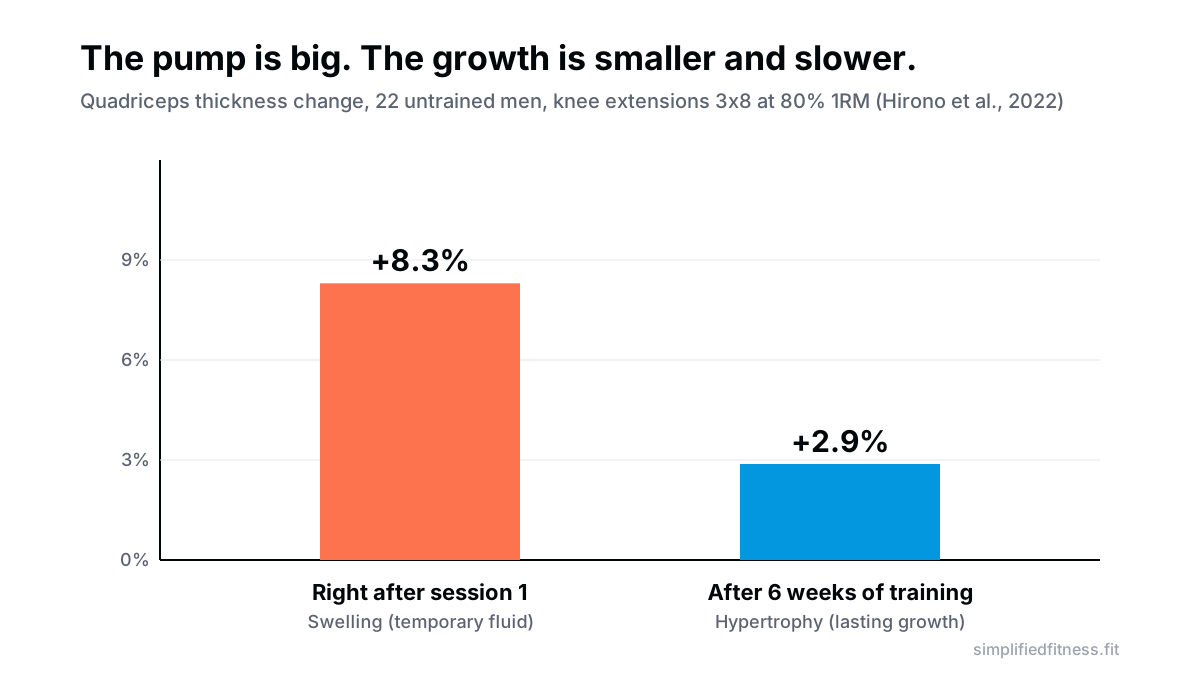
The same study put numbers on it: after 6 weeks of training three days a week, muscle thickness was up only 2.9% (Hirono et al., 2022).
A second small study (nine men, four sets of curls at 70% 1RM, three sessions over 8 days) showed how researchers tell the two apart. Resting muscle thickness did not rise beyond what the first naive bout produced, and differences from a non-exercise control arm only appeared right after each bout, the signature of acute swelling. The authors suggest the acute response can be used to separate swelling from growth. They also found that an already swollen muscle could not appreciably swell further (Buckner et al., 2017). Again, untrained men and a tiny sample.
Short version: swelling comes and goes with each session. Growth is what is left after weeks of sessions.
What does the research say about cell swelling and muscle growth?
This is where the evidence gets mixed, so let’s lay out both sides.
The case for swelling as a signal. Schoenfeld’s 2013 review proposed that metabolic stress could help muscle growth through several routes: more fibre recruitment, higher hormone production, local myokines, reactive oxygen species and cell swelling (Schoenfeld, 2013). The same review states that mechanical stress is the primary driver and that mechanical stress alone can start anabolic signalling. The older 2010 review similarly lists mechanical tension, muscle damage and metabolic stress as all able to play a role (Schoenfeld, 2010). Blood-flow restriction research is often cited here, since light-load training can grow muscle, though even that literature says the relative importance of each proposed mechanism, including swelling, still needs exploring (Pearson & Hussain, 2015).
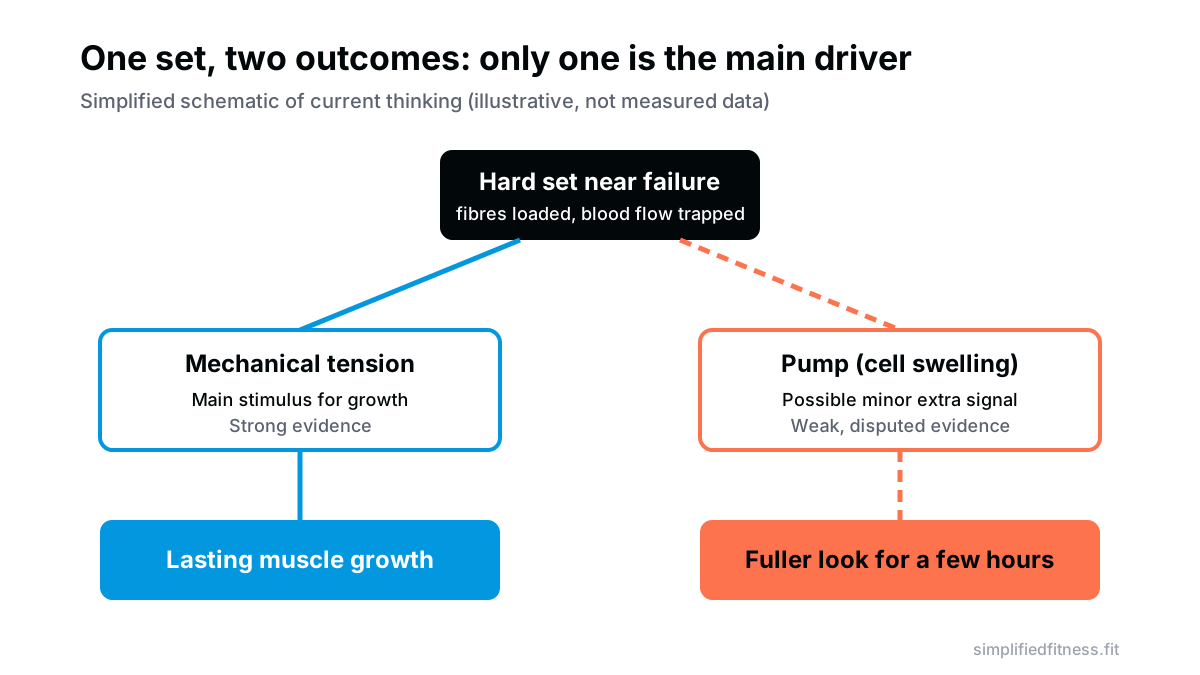
The case against. A 2025 review from Van Every and colleagues (Stuart Phillips is the senior author) went the other way. It concluded that claims acute hormonal responses, metabolic stress, cell swelling or “the pump” meaningfully contribute to hypertrophy are not supported by scientific evidence, and that mechanical tension is the primary stimulus (Van Every et al., 2025).
A middle data point. In the 22 untrained men above, the lifters who swelled more after session one tended to grow more after six weeks (rho = 0.443, p = 0.039) (Hirono et al., 2022). That is a moderate correlation in untrained people, not a controlled test of causation. People who work harder, or who respond more strongly to training, might simply do both: swell more and grow more.
Why do these views differ? One side is working from mechanistic reasoning and indirect evidence. The other is weighing which claims have actually been tested in humans. Right now no study has shown that increasing the pump while holding tension constant produces more growth.
Do I need a pump to grow muscle?
No. Heavy sets of 5-8 on a squat or row can grow muscle with little pump at all, and plenty of lifters chase a pump with junk sets and gain nothing extra.
The practical difference is where the effort goes. A pump chaser asks “does this feel full?” A progress chaser asks “did I beat last week’s reps or load, with sets close to failure?” The second question tracks what the research says matters. Our guide to mechanical tension vs muscle damage covers that stimulus in more depth.
Do light weights and high reps give a better pump?
Often, yes, at least acutely. In a study of eight resistance-trained men, a low-load protocol (four sets at 50% 1RM) and a high-load protocol (ten sets at 85% 1RM, volume equated) both raised elbow-flexor thickness and blood lactate. The difference between them was not statistically significant, but the magnitude favoured the low-load session, which also had more reps, more time under tension and higher training density (Agentilho et al., 2023).
The takeaway is limited. It tells us light, dense sets swell the muscle more acutely. It does not tell us they grow it more. That study only measured the session itself, with eight trained men, so it cannot answer the growth question.
If you like moderate and higher reps for isolation work, great. Just pick a load you can progress, and take the set close to failure. Our high-load vs low-load hypertrophy article goes into the rep range question.
What about pump supplements, sodium and creatine?
Plenty of products are sold around the pump: citrulline, glycerol, salt-heavy pre-workouts. These may change how full a muscle feels. I would not assume a bigger supplement pump means more growth, given how weak the evidence is for the pump itself driving growth. See our notes on citrulline malate vs pure citrulline for dosing details.
Creatine is a different case. It pulls water into the muscle cell and may make you look fuller on the scale and in the mirror, but that is a separate story from the exercise pump. We explain it in creatine water weight vs bloating.
So how should I use the pump in training?
Think of it as feedback, not as a goal.
- A quick check. If you do cable flyes and feel nothing in the chest but a lot in the front delts, adjust the setup. A pump in the target muscle is a reasonable sign it did work.
- Not a verdict. A big pump does not mean the session was good. A flat feeling does not mean it was bad, especially on heavy compounds or when you are tired or under-fuelled.
- Do not add junk volume. If you already did your hard sets, extra sets for the burn are likely wasted effort. Our junk volume explainer and the weekly set volume curve show where returns flatten.
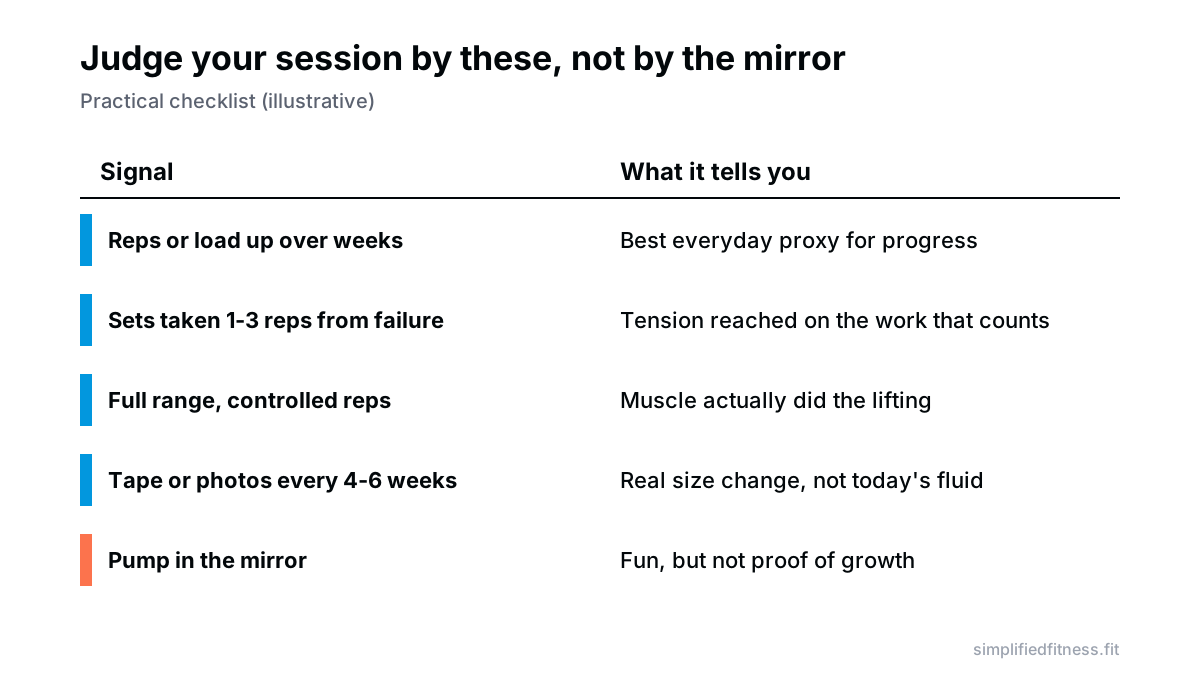
- Track real signals. Reps, load, sets close to failure, then tape and photos every 4-6 weeks. You can log your sets with the training volume calculator.
If you want these principles in a ready-made structure, our free push, pull and legs plan is built around hard sets with progression rather than pump chasing.
When to see a doctor
A pump is normal, short lived and painless in the muscle you trained. Get medical advice if you have swelling that is one-sided, very painful, hot, red, or lingers for days, if you have dark urine or severe weakness after a hard session, or if you have chest pain or breathlessness during training. Those are not pump features. This is general information and not a diagnosis.
The bottom line
The pump is real fluid, not new muscle. It feels great and may sometimes be a small bonus signal, but the evidence that it drives growth is weak and disputed, while mechanical tension from hard, progressing sets has the strongest support.
Enjoy the pump. Just do not let it decide whether your workout counted. Beat your logbook instead.
Frequently Asked Questions
Does gym pump build muscle?
Not directly. The pump is temporary fluid shifting into and around the muscle, and a 2025 review concluded that claims it meaningfully contributes to hypertrophy are not supported by the evidence. Mechanical tension from hard sets is the main stimulus, so chase progressive overload first and treat the pump as a bonus feeling.
Is muscle swelling the same as hypertrophy?
No. Swelling is acute and reversible, while hypertrophy is a lasting increase in muscle size built over weeks. In one study muscle thickness rose 8.3% right after a session but only 2.9% after 6 weeks of training. Measure growth over weeks, not minutes.
How long does a muscle pump last?
Usually a few hours, though the exact time varies with the session and the person. In a small study of nine men, resting muscle thickness differed from a control arm only immediately after exercise, which points to swelling being short lived. Do not judge a workout by how you look in the mirror two hours later.
What actually causes the pump?
Hard, repeated contractions with short rests push extra blood and fluid into the working muscle while the contracting muscle partly traps blood flow. Research using bioimpedance suggests the acute rise in muscle size is at least partly explained by a relative increase in extracellular water. Expect it most with higher reps, moderate rests and isolation work.
Is cell swelling a real anabolic signal?
It is a proposed mechanism, not an established one. Schoenfeld's 2013 review lists cell swelling alongside fibre recruitment and local myokines as ways metabolic stress might help, while the 2025 Van Every review argues it does not meaningfully contribute. Treat it as an unproven extra, and do not build a program around it.
Do I need a pump to grow muscle?
No. Heavy low-rep work and well-run moderate sets can grow muscle without a dramatic pump. The evidence points to mechanical tension as the main driver. If you get little pump on heavy compound lifts, keep the load progressing and the sets close to failure.
Do low reps with light weight give a better pump?
Higher-rep, lighter sets tend to give more acute swelling. In eight trained men, a low-load protocol (4 sets at 50% 1RM) showed a larger, though not statistically different, rise in muscle thickness than a high-load one with equal volume. Bigger swelling is not proven to mean bigger growth, so pick loads you can progress.
Do pump supplements like citrulline or glycerol build muscle?
They may change how full a muscle feels, but there is no good evidence that a bigger pump from a supplement means more growth. The pump is a side effect of training, not the stimulus. Spend money on protein and food before pump pills, and see our citrulline guide for the specifics.
Can a pump tell me I am training the right muscle?
Sometimes it is a handy cue, but it is not a reliable proof. A pump in the target muscle suggests it did real work, yet you can also get one from sloppy, momentum-driven reps. Pair it with full range, controlled tempo and reps taken close to failure.
Why do I get a weaker pump as I get more experienced?
Experienced lifters often report less swelling for the same work, though I am not aware of strong trial data on this. One small study found that a muscle already swollen from a bout earlier that day could not swell appreciably more, which hints the response has a ceiling, but it did not compare beginners with experienced lifters. A smaller pump does not mean your training stopped working.
Does the pump disappear when I stop training?
Yes, the acute pump fades within hours of each session, and that is normal. The lasting size you carry on rest days is genuine tissue plus normal fluid balance. If you stop training for a long time you can lose some muscle, but that is separate from the daily pump.
Should I do blood flow restriction training for a bigger pump?
Only if you have a specific reason. Blood-flow restriction with light loads can grow muscle, and reviews suggest metabolic stress and tension may both contribute, but the exact mechanisms are not settled. It is a niche tool, so check with a doctor if you have a cardiovascular or clotting condition.
Sources & References
Every claim above is checked against peer-reviewed research (PubMed, U.S. National Library of Medicine) or guidance from established health bodies. How we fact-check.
- Van Every DW, et al. Load-induced human skeletal muscle hypertrophy: Mechanisms, myths, and misconceptions. J Sport Health Sci. 2025. PMID: 41276164
- Schoenfeld BJ. The mechanisms of muscle hypertrophy and their application to resistance training. J Strength Cond Res. 2010. PMID: 20847704
- Schoenfeld BJ. Potential mechanisms for a role of metabolic stress in hypertrophic adaptations to resistance training. Sports Med. 2013. PMID: 23338987
- Hirono T, et al. Relationship between muscle swelling and hypertrophy induced by resistance training. J Strength Cond Res. 2022. PMID: 31904714
- Buckner SL, et al. Differentiating swelling and hypertrophy through indirect assessment of muscle damage in untrained men following repeated bouts of resistance exercise. Eur J Appl Physiol. 2017. PMID: 28012037
- Taniguchi M, et al. Acute effect of multiple sets of fatiguing resistance exercise on muscle thickness, echo intensity, and extracellular-to-intracellular water ratio. Appl Physiol Nutr Metab. 2020. PMID: 31299164
- Agentilho GI, et al. Low-load x high-load resistance exercise: greater cell swelling after a training session. Int J Exerc Sci. 2023. PMID: 37622037
- Pearson SJ, et al. A review on the mechanisms of blood-flow restriction resistance training-induced muscle hypertrophy. Sports Med. 2015. PMID: 25249278

Umair Hazrami · Founder & Head Coach, Simplified Fitness
Umair Hazrami founded Simplified Fitness and the Simplified Lifter channel to cut through fitness noise. With 4+ years of consistent training and 10+ coaching clients, he writes every guide from the peer-reviewed research and links the sources so you can check them. Our editorial standards.
Educational content only, not medical advice. If you have a medical condition, are pregnant, or take medication, talk to a qualified doctor before changing your diet, supplements or training. Full disclaimer.
Keep reading
Hypertrophy
Anabolic Resistance in Older Adults: Why Muscle Responds Less and How to Beat It
Anabolic resistance in older adults explained: why muscle responds less to protein and lifting after 50, plus the protein dose, leucine and sets that help.
8 min read

Hypertrophy
How Blood Flow Restriction Builds Muscle: Venous Occlusion, Metabolites and Cell Swelling
BFR training hypertrophy mechanisms explained: how a cuff and 20% 1RM can match heavy lifting for size. Metabolites, swelling, mTOR, myostatin and cuff safety.
8 min read
Hypertrophy
CNS Fatigue vs Muscle Fatigue: Is Your Nervous System Really Fried?
CNS fatigue vs muscle fatigue: what central and peripheral fatigue really are, how long each lasts, and how to tell which one is holding your lifts back.
9 min read

Hypertrophy
Exercise-Induced Muscle Damage (EIMD): Why Chasing Soreness Is Counterproductive
Muscle damage and hypertrophy are not the same thing. See what Z-disc streaming studies show, why soreness is a poor gauge of growth, and what to track.
8 min read