Post-Activation Performance Potentiation (PAPP): Using Heavy Singles to Prime Sets
Post activation performance potentiation can make a set feel faster after a heavy single, but only in a narrow window. See the research and how to test it.
TL;DR. The short answer
- A heavy single can acutely raise power or speed in the next effort for some lifters, but the average effect in meta-analyses is small and the evidence is mostly for jumps, sprints and throws, not muscle growth.
- The classic mechanism is phosphorylation of myosin regulatory light chains, which makes fast-twitch fibres more responsive to calcium. That effect fades within minutes, so it is not the whole story.
- Rest timing is a trade-off. Meta-analyses point to roughly 3-10 minutes as the usual window (7-10 minutes did best in one, 5-7 minutes in another), but individual responses differ a lot.
- No trial shows that priming sets builds more muscle. Treat it as an optional performance tool, and keep your normal warm-up, volume and proximity to failure.
- If you try it, use one heavy single with reps left in the tank, rest several minutes, and keep it only if bar speed or reps at the same load actually improve.
Part of our complete guide: How Muscle Actually Grows: The Natural Lifter's Guide to Hypertrophy Science
Table of contents
Post activation performance potentiation is the idea that a heavy single can make your next set move faster or feel lighter. The short answer: it can happen, but the effect is small on average, it depends on the lifter and the rest time, and nobody has shown that it builds more muscle.
It is still worth understanding if you are an advanced lifter who wants a tool for your first big compound. This article sits under our complete guide to muscle hypertrophy for natural lifters, and it covers the mechanism, the timing trade-off and a protocol you can test yourself. For the basic warm-up that comes first, see warm-up protocols and ramping sets without fatigue.
What is post activation performance potentiation?
Two related terms get mixed up, and the difference matters.
Post-activation potentiation (PAP) is the lab version. After a strong contraction, a muscle’s twitch force goes up, and that effect has a short half-life of roughly 28 seconds (Blazevich & Babault, 2019).
Post-activation performance enhancement (PAPE) is what lifters actually care about: better voluntary force, jump height or bar speed several minutes after a heavy effort. The same review points out that the time course of classic PAP rarely matches the time course of PAPE. Changes in muscle temperature, cell water content and muscle activation may explain part of it.
So when someone says “I potentiate with a heavy single,” the honest summary is: something real often happens, and the classic mechanism is probably only part of it. This article uses PAPP as shorthand for the practical gym version.
What is the mechanism behind priming sets?
The textbook answer is myosin regulatory light chain (RLC) phosphorylation.
During a hard contraction, calcium rises and activates an enzyme called skeletal muscle myosin light chain kinase. It attaches a phosphate group to the myosin RLC. Phosphorylated myosin heads sit closer to the actin filaments, so the fibre produces more force at a given level of calcium. In mice lacking this kinase, the potentiation after repetitive stimulation was reduced, which points to RLC phosphorylation as a main biochemical driver in fast-twitch muscle (Zhi et al., 2005).
Two caveats are worth stating plainly. That study used isolated mouse muscle, not lifters. And Blazevich and Babault note that the phosphorylation effect is most prominent in type II fibres and decays quickly, which is why it may not explain a boost felt many minutes later.
What about the H-reflex?
You will see claims that heavy singles “excite the nervous system” through the H-reflex. The data are messier than that.
One study in 14 trained males used repeated 6-second maximal isometric calf contractions. Twitch torque and rate of torque development rose in every set, yet the H-reflex measure did not change on the trials where twitch torque peaked. The highest H-reflex in each set did rise in one calf muscle, but at a different moment from the torque peak (Xenofondos et al., 2023). A 2026 study in 10 young males found that H-reflex amplitude actually fell by 29% after a 10-second maximal contraction, even as twitch torque rose and other spinal measures suggested facilitation (Kalc et al., 2026).
Both are small, short-term lab studies on the calf muscle, so be careful about generalising to a barbell squat. The takeaway: neural changes are involved, but “bigger H-reflex equals stronger set” is not what the data show.
Does it actually make the next set better?
On average, a little. Not dramatically.
A 2016 meta-analysis of 47 studies and 1,954 participants found small effects after a conditioning activity for jumps (effect size 0.29), throws (0.26) and upper-body ballistic work (0.23), with a moderate effect for sprints (0.51). The effect was larger in stronger, more experienced lifters (Seitz & Haff, 2016).
A 2013 meta-analysis of 32 studies found an overall effect size of 0.38 on muscle power, and training status mattered a lot: 0.14 in untrained people versus 0.81 in athletes (Wilson et al., 2013).
Now the conflicting part. A 2025 meta-analysis of 62 studies (1,039 participants) found only a trivial effect from before to after the conditioning activity (0.12) and a small effect against control groups (0.30). The authors rated the evidence as high risk of bias and low certainty. The effect against control was partly inflated because control groups got worse during the rest period, and it was basically trivial after a comprehensive warm-up (Xu et al., 2025).
Why the difference? The older reviews included many studies where the comparison warm-up was minimal. If your baseline is a thorough ramp-up, there is less left to gain. A reasonable reading: priming may add a little on top of poor preparation, and much less on top of good preparation.
What is the best rest time after a heavy single?
This is the part everyone wants a number for. The honest answer is a range.
- 7-10 minutes gave a power effect size of 0.70 in the 2013 meta-analysis, versus 0.54 for 3-7 minutes and 0.02 for more than 10 minutes (Wilson et al., 2013).
- 5-7 minutes was the best window in a meta-analysis of the bench press throw in 174 resistance-trained men. For conditioning sets above 85% 1RM, rests of 4 minutes or less actually had a slightly negative effect (-0.13) (Krzysztofik et al., 2020).
- Shorter rests suited stronger lifters in the 2016 review, while weaker lifters did better with longer rests (Seitz & Haff, 2016).
- Inverted U shape: the 2025 meta-analysis saw a rise and fall with recovery time, and in some cases an effect under 1 minute (Xu et al., 2025).
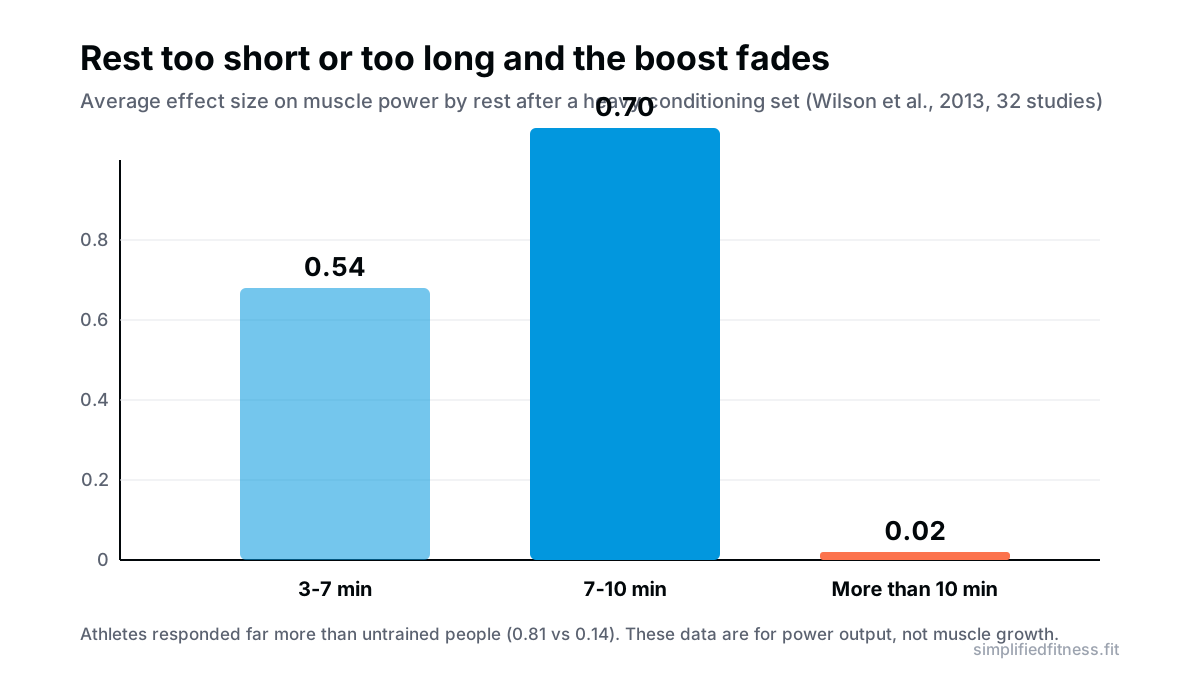
So where does the “4-8 minutes” figure you may have heard come from? It sits in the middle of these ranges, and it is a sensible place to start. It is not a proven number for hypertrophy training, because these studies measured power, not growth.
Why fatigue and potentiation fight each other
Right after the single, you have both effects at once. Fatigue is high. Potentiation is high. Your actual performance is the net. At first fatigue usually wins, which is why a set right after a heavy single can feel worse, not better. Wait a few minutes and, if fatigue recedes faster than potentiation does, the net can turn positive. This is the standard model researchers use to explain the timing data, not something measured directly in your squat.
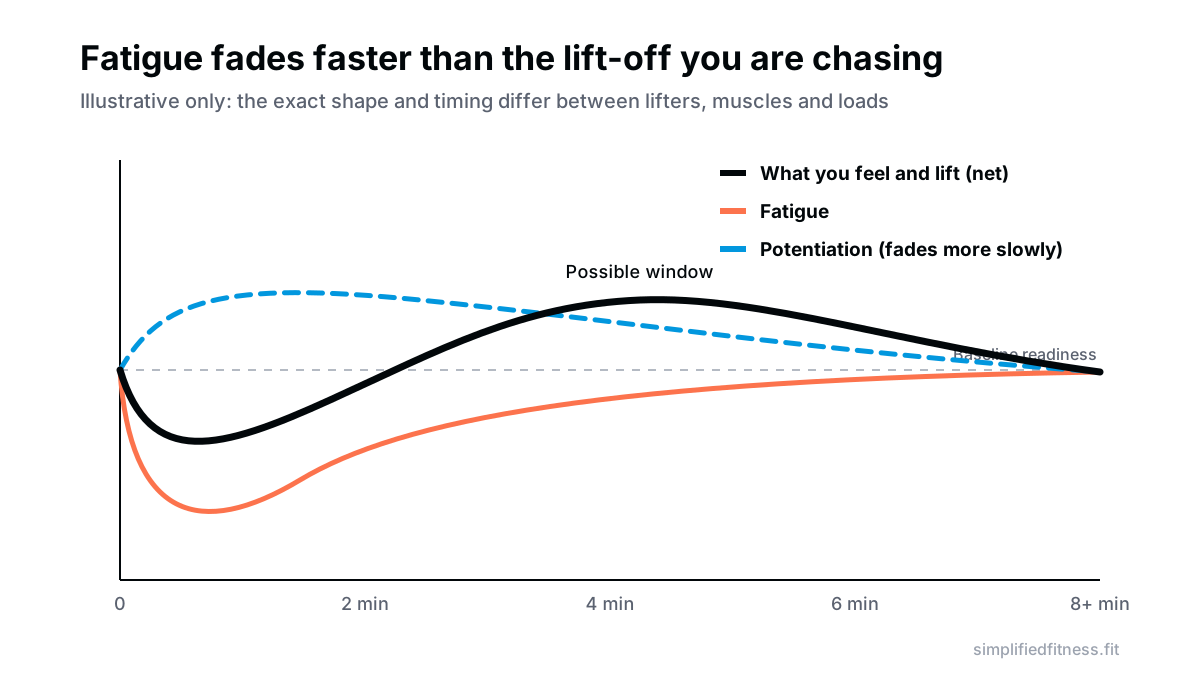
That timing is individual. In the 2016 review, stronger lifters did better with shorter rests and weaker lifters with longer ones, but you will not find your own window from a graph. You find it out by testing.
Can priming sets help hypertrophy?
The title says “prime sets”, so let’s be direct about what that does and does not mean. There is no trial showing that priming sets build more muscle than normal training.
The research above measures acute power, jumps and throws, mostly in athletes. Hypertrophy depends on weekly volume, load, effort and recovery over months. The only plausible route from priming to growth is indirect: if a heavy single lets you move a working load slightly faster or get one more quality rep, total effective volume might creep up. That is a hypothesis, not a finding.
There is also a cost. Long rests stretch your session, and a heavy single adds a little fatigue. For muscle growth, hard sets taken close to failure with enough weekly volume matter far more. You can read how rest affects hypertrophy in rest intervals for hypertrophy: 2 to 3 minutes versus short, and how heavy you need to go in Henneman’s size principle and motor unit recruitment.
How to try a heavy single before your working set
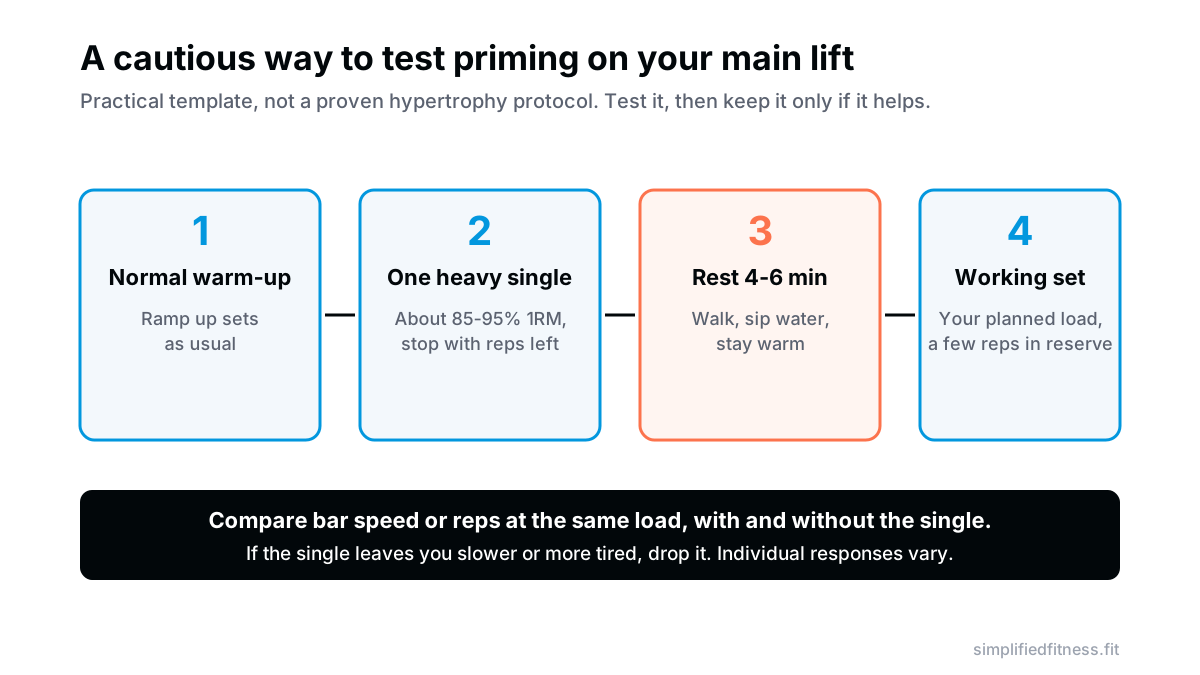
If you are an experienced lifter and curious, here is a cautious way to test it.
- Warm up properly first. Do your normal ramp-up sets. The 2025 meta-analysis suggests the benefit is smaller after a thorough warm-up, so do not skip this and hope the single does the job.
- Pick one lift. Use your first main compound only, such as a squat, bench or deadlift variation.
- Choose the load. Around 85-95% of your 1RM is a common practical starting point, and that is our judgement rather than a tested prescription. The evidence on the best intensity is mixed: moderate loads (60-84%) beat heavy loads in the 2013 power meta-analysis, while repetition-maximum loads gave larger effects in the 2016 review. Use our 1RM calculator to estimate your numbers.
- Stop with reps in reserve. Do one crisp single, not a grinder. Our RIR and RPE calculator helps you judge how hard the single really was.
- Rest about 4-6 minutes, then adjust in 1-2 minute steps across sessions. Walk around and stay warm.
- Do your working set at the planned load, with the usual reps in reserve.
- Compare. Over a few sessions, track bar speed (if you have a way to measure it) or the reps you hit at the same load, with and without the single.
Who should skip it?
Skip it, or at least put it low on the list, if any of these apply.
- You are a beginner. The effect is smaller in untrained people (0.14 versus 0.81 in athletes in the 2013 review). Your gains will come from technique and progressive overload. See progressive overload, deloads and plateaus.
- You are short on time. A 5-minute rest per primed lift is a real cost.
- You train alone without safeties. Near-maximal singles without a spotter or pins are not worth the risk.
- You have a heart condition, a joint injury, or uncontrolled blood pressure. Check with your doctor before doing maximal efforts. This article is general education, not medical advice.
If you are unsure where your training should focus, start with load, rep ranges, RIR and rest intervals before layering on advanced tricks.
The bottom line on post activation performance potentiation
Post activation performance potentiation is real in the lab and sometimes real in the gym, but small on average and highly individual. The classic mechanism is myosin light chain phosphorylation, but it fades fast, so muscle temperature, water content and activation probably explain more of what you feel minutes later. Rest of roughly 3-10 minutes is the usual window, and a good warm-up already captures some of the benefit.
For hypertrophy specifically, it is an optional experiment with no direct evidence of added growth. Try it on one lift, measure the result, and drop it if it does not clearly help. Heavy singles are a seasoning, not the meal.
Frequently Asked Questions
What is post-activation performance potentiation?
It is a short-lived improvement in force, power or bar speed after a heavy or maximal muscle contraction. The classic explanation is higher myosin light chain phosphorylation in fast-twitch fibres, though other factors such as muscle temperature and activation also play a role. In practice, you test it by doing one heavy single and seeing whether the next set moves better.
What is the difference between PAP and PAPE?
PAP usually refers to the twitch-level effect measured with electrical stimulation, which has a half-life of only about 28 seconds. PAPE refers to the voluntary performance boost seen minutes later in real lifts and jumps. The two do not always share a time course, so gym results should be judged by how the lift actually feels and moves.
Do heavy singles make your next set stronger?
Sometimes, but the average effect is small and varies between people. A 2016 meta-analysis of 47 studies found small effects for jumps, throws and upper-body ballistic efforts, and larger effects in stronger, more experienced lifters. Test it on one lift for a few weeks and track bar speed or reps before committing.
How long should I rest after a heavy single?
Most studies land somewhere between 3 and 10 minutes. One meta-analysis found 7-10 minutes gave the largest power effect, while another found 5-7 minutes worked best for bench press throws. Start with about 4-6 minutes, then adjust based on how your own sets feel.
Does PAPP build more muscle?
There is no direct evidence that it does. The research measures acute power, jump height or throw performance, not muscle size after months of training. Any hypertrophy benefit would be indirect, through slightly better quality reps, and that has not been shown.
Is a heavy single the same as a warm-up set?
Not quite. A warm-up ramps you up gradually, while a potentiating single is a near-maximal effort placed just before the working set. A 2025 meta-analysis found the effect was trivial after a comprehensive warm-up, so a good ramp-up may capture much of the benefit already.
How heavy should the potentiating single be?
Evidence is mixed. A 2013 meta-analysis found moderate loads (60-84%) beat heavy loads (over 85%) for power, while a 2016 meta-analysis found repetition-maximum loads gave larger effects, especially in stronger lifters. A practical middle ground is a single around 85-95% of 1RM that you stop well short of grinding.
Can the single make me too tired?
Yes. Fatigue and potentiation happen together, and your performance is the net of both. If rest is too short, or the single is a grind, you can end up weaker. Keep it crisp and use our 1RM calculator to pick a load you can handle without failing.
Does PAPP work for beginners?
It seems to work less well. A 2013 meta-analysis found effect sizes of 0.14 in untrained people versus 0.81 in athletes, and the 2016 review found stronger lifters respond more. Beginners are better off spending the time on technique and simple progressive overload.
Is the H-reflex the reason heavy singles work?
The evidence does not support that simple story. A 2023 study in 14 trained males found peak twitch torque rose without matching changes in H-reflex measures, and a 2026 study found H-reflex amplitude dropped by 29% while twitch torque rose. The nervous system is involved, but it is not a neat 'more excitability' effect.
Can I use PAPP on every set of a workout?
It is not practical or necessary. Repeated heavy singles add fatigue and long rest periods, which cuts into your session time and may blunt the benefit. Reserve it for your first main compound lift if you want to test it.
Does PAPP work for isolation exercises like curls?
The research is mostly on big movements such as squats, bench press throws, jumps and sprints. There is little evidence for small isolation lifts, so any benefit there is speculation. Spend your effort on a good warm-up and close-to-failure working sets instead.
Is PAPP safe?
For healthy lifters it is just a heavy single with a long rest, so the main risks are the usual ones: poor technique, no spotter, and grinding reps. Use safeties or a spotter and stop well before failure. If you have a heart condition, joint injury or uncontrolled blood pressure, check with your doctor before doing maximal efforts.
Sources & References
Every claim above is checked against peer-reviewed research (PubMed, U.S. National Library of Medicine) or guidance from established health bodies. How we fact-check.
- Wilson JM, et al. Meta-analysis of postactivation potentiation and power: effects of conditioning activity, volume, gender, rest periods, and training status. J Strength Cond Res. 2013. PMID: 22580978
- Seitz LB, et al. Factors modulating post-activation potentiation of jump, sprint, throw, and upper-body ballistic performances: a systematic review with meta-analysis. Sports Med. 2016. PMID: 26508319
- Xu K, et al. Optimizing post-activation performance enhancement in athletic tasks: a systematic review with meta-analysis for prescription variables and research methods. Sports Med. 2025. PMID: 39853660
- Krzysztofik M, et al. Post-activation performance enhancement in the bench press throw: a systematic review and meta-analysis. Front Physiol. 2020. PMID: 33519506
- Blazevich AJ, et al. Post-activation potentiation versus post-activation performance enhancement in humans: historical perspective, underlying mechanisms, and current issues. Front Physiol. 2019. PMID: 31736781
- Zhi G, et al. Myosin light chain kinase and myosin phosphorylation effect frequency-dependent potentiation of skeletal muscle contraction. Proc Natl Acad Sci U S A. 2005. PMID: 16299103
- Xenofondos A, et al. Postactivation potentiation and the asynchronous action of muscular and neural responses. Int J Sports Physiol Perform. 2023. PMID: 37295786
- Kalc M, et al. Spinal mechanisms in postactivation potentiation: facilitation of presynaptic inhibition contrasts H-reflex amplitude reduction. J Neurophysiol. 2026. PMID: 42065627

Umair Hazrami · Founder & Head Coach, Simplified Fitness
Umair Hazrami founded Simplified Fitness and the Simplified Lifter channel to cut through fitness noise. With 4+ years of consistent training and 10+ coaching clients, he writes every guide from the peer-reviewed research and links the sources so you can check them. Our editorial standards.
Educational content only, not medical advice. If you have a medical condition, are pregnant, or take medication, talk to a qualified doctor before changing your diet, supplements or training. Full disclaimer.
Keep reading
Hypertrophy
Anabolic Resistance in Older Adults: Why Muscle Responds Less and How to Beat It
Anabolic resistance in older adults explained: why muscle responds less to protein and lifting after 50, plus the protein dose, leucine and sets that help.
8 min read
Hypertrophy
How Blood Flow Restriction Builds Muscle: Venous Occlusion, Metabolites and Cell Swelling
BFR training hypertrophy mechanisms explained: how a cuff and 20% 1RM can match heavy lifting for size. Metabolites, swelling, mTOR, myostatin and cuff safety.
8 min read
Hypertrophy
CNS Fatigue vs Muscle Fatigue: Is Your Nervous System Really Fried?
CNS fatigue vs muscle fatigue: what central and peripheral fatigue really are, how long each lasts, and how to tell which one is holding your lifts back.
9 min read

Hypertrophy
Exercise-Induced Muscle Damage (EIMD): Why Chasing Soreness Is Counterproductive
Muscle damage and hypertrophy are not the same thing. See what Z-disc streaming studies show, why soreness is a poor gauge of growth, and what to track.
8 min read