Active vs Passive Insufficiency: How Two-Joint Muscles Change Your Exercise Choice
Active vs passive insufficiency explained for lifters: why hamstrings, triceps, quads and calves grow differently depending on your second joint position.
TL;DR. The short answer
- Active insufficiency means a two-joint muscle is so shortened across both joints that it cannot generate much force. Passive insufficiency means it is so stretched across both joints that it runs out of length and limits movement.
- In a 12-week MRI trial, seated leg curls grew the whole hamstrings more than prone leg curls (+14% vs +9%), and overhead cable triceps extensions grew the whole triceps more than neutral ones (+19.9% vs +13.9%).
- Standing calf raises (knee straight) grew the gastrocnemius far more than seated ones in untrained adults (lateral head +12.4% vs +1.7%), while the soleus grew about the same either way.
- Pick exercises so the second joint keeps the muscle long, then use a pain-free full range. The evidence is mostly from untrained people and single muscles, so treat it as a strong lean, not a law.
Part of our complete guide: Muscle Length, Range of Motion and Stretch-Mediated Hypertrophy: What the Research Actually Shows
Table of contents
Active vs passive insufficiency is a simple idea with a big gym payoff. A muscle that crosses two joints can be stretched or shortened by either one, so the position of the second joint changes how well it produces force and how stretched it is during a lift. In recent trials, setups that kept two-joint muscles lengthened (seated leg curls, overhead triceps extensions, standing calf raises, and a reclined rather than upright leg extension) grew those muscles more than the alternatives.
This article is part of our guide to range of motion and stretch-mediated hypertrophy. Here we stick to one thing: muscles that cross two joints, and what that means for picking exercises.
What are biarticular (two-joint) muscles?
Most muscles you train move one joint. A few cross two, and these are the ones that behave oddly.
- Hamstrings cross the hip and the knee (the short head of biceps femoris is the exception, crossing only the knee).
- Rectus femoris, the quad muscle on the front of the thigh, crosses the hip and the knee.
- Triceps long head crosses the shoulder and the elbow.
- Gastrocnemius, the visible calf muscle, crosses the knee and the ankle.
- Biceps also crosses the shoulder and the elbow.
Their one-joint neighbours (vastus lateralis, soleus, the lateral and medial triceps heads) only care about one angle. A two-joint muscle cares about two. Change the hip angle and you change what the knee exercise does to the hamstrings. That is the whole story, and everything below is a version of it.
Active vs passive insufficiency: what the terms mean
Active insufficiency happens when a two-joint muscle is shortened across both joints at the same time. It simply cannot generate much force from that position. Try this: stand tall or lie face down with your hip straight, curl your heel toward your glutes, and squeeze. It often feels weak, crampy and hard to hold. That is a hamstring shortened at both the hip and the knee, running out of useful length.
Passive insufficiency is the opposite. The muscle is stretched across both joints, runs out of length, and limits how far a joint can move. Straighten your knee with your hip flexed and the stretch you feel behind the thigh is the hamstring saying no more.
Neither one is a flaw. They are just how muscles with two jobs work. The useful part for lifters is that you choose the second joint position through the exercise you pick.
Do biarticular muscles grow more when the second joint keeps them lengthened?
This is the question that matters, and recent trials have started to answer it. Most share a design: the same person trains one limb one way and the other limb the other way, and MRI measures muscle volume afterwards. That controls for genetics and effort quite well. The catch is that the participants were mostly untrained, so keep that in mind throughout.
Broader context helps first. A systematic review of range of motion studies found that full range of motion appears to benefit lower body hypertrophy compared with partial range, while the upper body evidence was limited and mixed, and some evidence suggested the response may be muscle-specific (Schoenfeld and Grgic, 2020). Two-joint muscles are one reason it may be muscle-specific.
Hamstrings: why hip position matters in leg curls
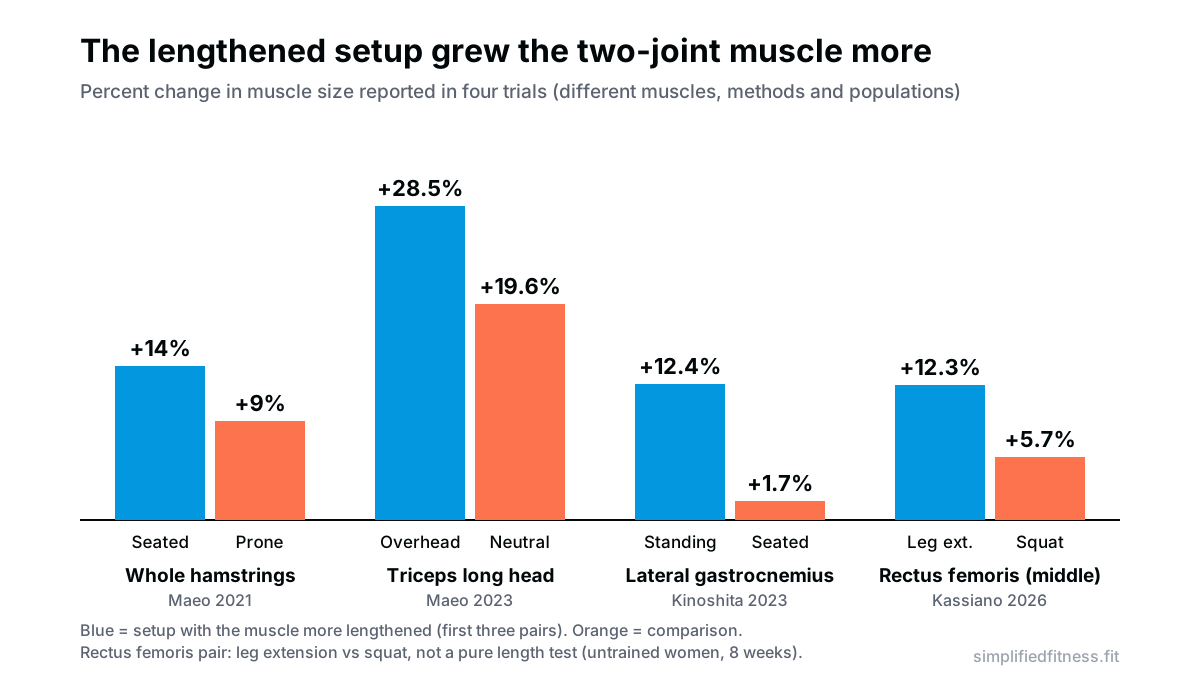
In a 12-week trial, 20 healthy adults did seated leg curls with one leg and prone (lying) leg curls with the other, at 70% of 1RM, 10 reps, 5 sets, twice a week. MRI showed larger gains for the whole hamstrings in the seated leg (+14% vs +9%). The difference showed up in the two-joint hamstring muscles (+8-24% vs +4-19%) but not the one-joint short head (+10% vs +9%) (Maeo et al., 2021). Both setups protected equally against damage from a later eccentric bout.
Why? Sitting puts the hip in flexion, which stretches the hamstrings at the hip while the knee does the curl. Lying prone leaves the hip straight, so the muscle starts shorter. The one-joint short head did not care, which fits the idea neatly.
There is a flip side. Hip-extension exercises such as stiff-leg deadlifts load the hamstrings at the hip rather than the knee. A review on hamstring injury prevention reports that biceps femoris long head and semimembranosus activity tend to be higher in hip extension movements, while semitendinosus and biceps femoris short head are more active in knee flexion movements (Bourne et al., 2018). That is muscle activation, not growth, so it is a reason to include both a hinge and a curl, not proof that one is better. For a deeper comparison see our seated vs lying leg curl guide.
Triceps long head: arm position changes the exercise
The triceps long head crosses the shoulder, so lifting the arm overhead stretches it. In a 12-week trial, 21 adults did cable elbow extensions with one arm overhead and the other in a neutral position (hands near the sides). The overhead arm grew more across the board: long head +28.5% vs +19.6%, whole triceps +19.9% vs +13.9%. It happened even though the overhead arm lifted loads about 34-39% lighter (Maeo et al., 2023).
Even the one-joint lateral and medial heads grew more overhead (+14.6% vs +10.5%). The abstract does not settle why, so leave room for uncertainty.
The practical read: if you only have room for one triceps exercise, make it an overhead extension. Pushdowns are fine as a second movement. Our guides on overhead vs neutral triceps training and overhead cable extensions vs pushdowns go deeper.
Calves: why the gastrocnemius needs a straight knee
The gastrocnemius crosses the knee as well as the ankle. Bend the knee 90 degrees, as in a seated calf raise, and the muscle shortens at the knee. That is the textbook example of active insufficiency: the gastrocnemius has less to give at the ankle, so the one-joint soleus is thought to take on more of the work.
A 12-week trial in 14 untrained adults compared standing (knee straight) and seated (knee bent) calf raises, one leg each. Standing raises produced larger muscle volume gains in the lateral gastrocnemius (12.4% vs 1.7%), medial gastrocnemius (9.2% vs 0.6%) and whole triceps surae (5.6% vs 2.1%). The soleus grew similarly either way (2.1% vs 2.9%) (Kinoshita et al., 2023). The seated leg’s gastrocnemius changes were not significant.
The practical read: do your main calf work standing. Seated raises are a supporting act for the soleus. More on the anatomy in straight-leg vs bent-knee calf raises.
Rectus femoris: why leg extensions are not redundant
The rectus femoris is the odd one out. It flexes the hip as well as extending the knee, so it is longest with the hip extended and the knee bent. In a squat, the hip and knee flex together: the muscle shortens at the hip while it lengthens at the knee, so its overall length changes less than a one-joint quad muscle. On a normal upright leg extension, the hip is flexed, which actually shortens the rectus femoris at the hip while the knee does the work.
So the squat versus leg extension trials are not a clean test of muscle length, but they are still useful. A 2026 trial randomized 63 untrained young women to Smith machine squats or leg extensions (3 sets of 8-12, twice a week, 8 weeks). Leg extensions grew the rectus femoris more at all three sites (proximal +11.4% vs +2.0%, middle +12.3% vs +5.7%, distal +17.5% vs +7.9%), whereas squats grew the vastus lateralis more at the distal site (+18.2% vs +11.2%) (Kassiano et al., 2026). An earlier trial with equal volume and intensity also found all three rectus femoris regions grew in the leg extension group, while only the central vastus lateralis grew in the squat group (Zabaleta-Korta et al., 2021).
The cleaner length test is within the leg extension itself. In a 10-week trial, 22 untrained men trained one leg with the hip at 40 degrees of flexion (backrest reclined) and the other at 90 degrees (upright). The reclined leg showed greater rectus femoris growth, with “extreme” Bayesian evidence, while the vastus lateralis grew about the same either way (Larsen et al., 2025). That is exactly what the two-joint idea predicts: lengthen the muscle at the hip, and the two-joint part of the quads responds more.
So is lengthened always better? The caveats
The trials above point the same way, and the authors of several suggest training at long muscle lengths promotes hypertrophy. Still, a few honest limits apply.
- Untrained participants. Most of these trials used untrained adults. Trained lifters may respond differently.
- Short and small. Eight to twelve weeks, with 14 to 63 people. The results are useful but not final.
- One variable at a time. Seated vs prone also changes machine design, stability and range of motion in practice.
- No injury or comfort verdict. None of these papers says deep stretch positions are right for every joint. If a position hurts, it is not worth it.
The cautious takeaway is to lean toward lengthened setups for two-joint muscles and keep them in the mix, not to throw out the others. Our long muscle length training guide covers how far to take this.
How to pick exercises for two-joint muscles
A simple order of operations:
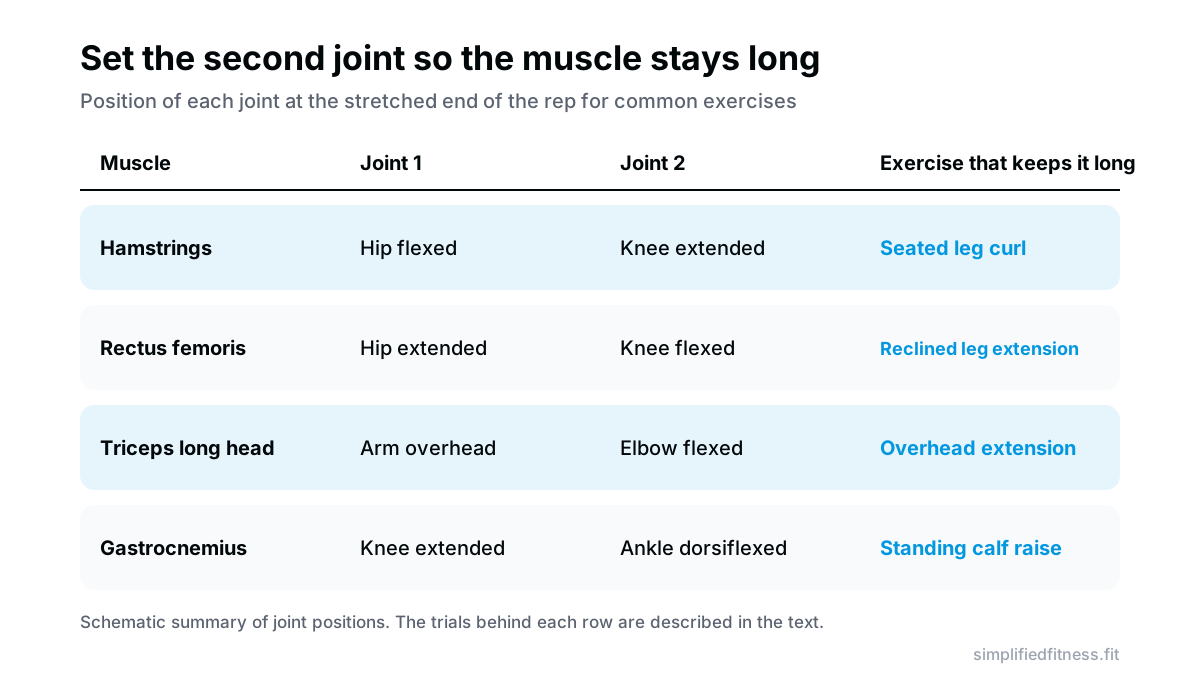
- Name the muscle’s two joints. Hamstrings: hip and knee. Triceps long head: shoulder and elbow. Gastrocnemius: knee and ankle.
- Choose the setup that keeps the muscle long. Seated leg curl. Overhead extension. Standing calf raise. Leg extension with the backrest reclined for the rectus femoris.
- Use a full, pain-free range. The stretch is the point, so do not bounce out of it.
- Keep one shortened or neutral option as a second movement if you like it: lying curls, pushdowns, seated calf raises.
- Check fatigue and recovery. A deep stretch under load can be sore at first, so ramp volume up gradually.
Here is how that looks in a plain table.
| Muscle | Longer setup | Shorter setup | Notes |
|---|---|---|---|
| Hamstrings | Seated leg curl | Prone leg curl | Seated grew whole hamstrings more in one 12-week trial |
| Triceps long head | Overhead extension | Neutral pushdown | Overhead grew more even with lighter loads |
| Gastrocnemius | Standing calf raise | Seated calf raise | Seated is mainly soleus work |
| Rectus femoris | Reclined leg extension | Upright leg extension | Leg extensions in general grew rectus femoris more than squats; squats still won for distal vastus lateralis and squat strength |
If you want to put this into a week of training, our leg day plan already includes the leg curl, extension and calf work above. For tracking weekly sets per muscle, use the training volume calculator.
When to see a doctor
Muscle soreness from a new stretched position is normal. Sharp pain, a pop, bruising, swelling, numbness or pain that lingers for days is not, and hamstrings in particular can strain. Stop and see a doctor or physiotherapist if that happens. This article is general education and cannot diagnose anything.
The bottom line
Active insufficiency shortens a two-joint muscle across both joints, and passive insufficiency stretches it across both. For lifters, the lesson is practical: pick the setup that keeps the muscle long. In the studies we covered, seated leg curls, overhead triceps extensions, standing calf raises and reclined leg extensions gave the larger gains for the targeted two-joint muscle, mostly in untrained people. That is a strong lean, not a law. Use a pain-free range, keep a mix of exercises, and give each change several weeks before you judge it.
Frequently Asked Questions
What is the difference between active and passive insufficiency?
Active insufficiency is when a two-joint muscle is shortened across both joints at once and can no longer produce much force. Passive insufficiency is when it is stretched across both joints at once and has no more length to give, so the movement stops. In the gym, you notice the first as a weak, cramping squeeze and the second as a hard stretch limit, such as tight hamstrings stopping a hip hinge.
What are biarticular muscles?
Biarticular muscles cross two joints, so they can move both. Examples are the hamstrings (hip and knee), rectus femoris (hip and knee), triceps long head (shoulder and elbow), biceps (shoulder and elbow) and gastrocnemius (knee and ankle). Their length depends on both joint angles, which is why the same muscle can feel very different in two exercises.
Which muscles are biarticular?
The main ones lifters train are the hamstrings (except the short head of biceps femoris), rectus femoris, gastrocnemius, triceps long head and biceps brachii. Single-joint muscles such as the vastus lateralis, soleus and brachialis cross only one joint. Knowing which is which tells you where the second joint position matters.
Does active insufficiency mean I should avoid shortened positions?
No. It means a two-joint muscle is a weak force producer when shortened at both joints, not that shortened positions are useless. Current research suggests lengthened positions often grow more muscle, but the evidence is limited and mostly from untrained people. Use shortened-position exercises as a supplement if you enjoy them, not as the foundation.
Why are seated leg curls better than lying leg curls for hamstrings?
In one 12-week MRI study, seated leg curls grew the whole hamstrings more than prone ones (+14% vs +9%), mainly in the two-joint hamstring muscles. Sitting puts the hip in flexion, which stretches the hamstrings at the hip while the knee curls. If your gym has a seated machine, use it for most of your leg curl sets.
Are overhead triceps extensions better than pushdowns?
For the long head, evidence points that way. A 12-week MRI trial found overhead cable extensions grew the whole triceps more than neutral-arm extensions (+19.9% vs +13.9%), even with lighter loads. Pushdowns still train all three heads, so keep them if you like them, but put an overhead movement first.
Should I do standing or seated calf raises?
Standing, if you want the gastrocnemius to grow. In a 12-week trial in untrained adults, standing calf raises grew the lateral gastrocnemius by 12.4% versus 1.7% seated, while the soleus grew about the same either way. Add a seated set only if you also want extra soleus work.
Why is the rectus femoris hard to train with squats?
In a squat the hip and knee bend together, so the rectus femoris shortens at the hip while it lengthens at the knee, and its overall length changes less than you might expect. In one trial in untrained women, leg extensions grew the rectus femoris more than Smith machine squats at all three measured sites. Squats still grew the vastus lateralis more at the distal site, so use both.
Do leg extensions or squats grow the quads better?
Neither wins on everything. A 2026 trial of 63 untrained women found leg extensions grew the rectus femoris more, while squats grew the distal vastus lateralis more and improved squat strength more. Training both covers more of the quads.
Why do my hamstrings cramp on leg curls?
Cramping near the end of a curl can happen when the hamstrings are already shortened at the hip, as on a lying curl with the hip straight, and then squeezed hard at the knee. That is the situation active insufficiency describes, where a two-joint muscle runs short of useful force. Try a seated version or a slightly lighter load, and see a doctor if cramps are severe or happen outside training.
Do biarticular muscles grow differently in different regions?
They can. Studies show growth is not uniform along a muscle, and exercise choice shifts which region grows most. For example, leg extension training grew the proximal, middle and distal rectus femoris in untrained women, whereas squats grew it less. The mechanism is still debated, so vary exercises instead of relying on one.
Do I need to stretch to fix passive insufficiency?
Usually not as a hypertrophy tool. Passive insufficiency simply means a two-joint muscle runs out of length when both joints stretch it, so an exercise that stops you early is limited by that. Train hamstrings through a full, comfortable range under load, and if a limit is painful or sudden, ask a physio.
Is any of this research done on advanced lifters?
Most of the key trials used healthy untrained adults, often training one limb one way and the other limb another way. That design controls well for the person, but results in advanced lifters may be smaller or different. Take the direction of the finding seriously and the exact percentages loosely.
Sources & References
Every claim above is checked against peer-reviewed research (PubMed, U.S. National Library of Medicine) or guidance from established health bodies. How we fact-check.
- Maeo S, et al. Greater hamstrings muscle hypertrophy but similar damage protection after training at long versus short muscle lengths. Med Sci Sports Exerc. 2021. PMID: 33009197
- Maeo S, et al. Triceps brachii hypertrophy is substantially greater after elbow extension training performed in the overhead versus neutral arm position. Eur J Sport Sci. 2023. PMID: 35819335
- Kinoshita M, et al. Triceps surae muscle hypertrophy is greater after standing versus seated calf-raise training. Front Physiol. 2023. PMID: 38156065
- Kassiano W, et al. Comparison of muscle hypertrophy and strength adaptations induced by back squat and leg extension resistance exercises. J Strength Cond Res. 2026. PMID: 41379528
- Larsen S, et al. The effects of hip flexion angle on quadriceps femoris muscle hypertrophy in the leg extension exercise. J Sports Sci. 2025. PMID: 39699974
- Zabaleta-Korta A, et al. The role of exercise selection in regional muscle hypertrophy: a randomized controlled trial. J Sports Sci. 2021. PMID: 34743671
- Bourne MN, et al. An evidence-based framework for strengthening exercises to prevent hamstring injury. Sports Med. 2018. PMID: 29116573
- Schoenfeld BJ, Grgic J. Effects of range of motion on muscle development during resistance training interventions: a systematic review. SAGE Open Med. 2020. PMID: 32030125

Umair Hazrami · Founder & Head Coach, Simplified Fitness
Umair Hazrami founded Simplified Fitness and the Simplified Lifter channel to cut through fitness noise. With 4+ years of consistent training and 10+ coaching clients, he writes every guide from the peer-reviewed research and links the sources so you can check them. Our editorial standards.
Educational content only, not medical advice. If you have a medical condition, are pregnant, or take medication, talk to a qualified doctor before changing your diet, supplements or training. Full disclaimer.
Keep reading
Hypertrophy
Squat Mobility With Long Femurs: Adapting Range of Motion to Your Hips
Squat mobility with long femurs is mostly a lever and hip-socket issue, not a flaw. Learn how to adjust depth, stance and heels without risking your hips.
10 min read
Hypertrophy
Dumbbell Pullovers vs Cable Lat Pull-ins: Training Lats at Long Muscle Lengths
Training lats at long muscle lengths: is the dumbbell pullover a lat or chest exercise, and why a cable lat pull-in may keep tension where you want it.
7 min read
Hypertrophy
Full vs Partial Range of Motion: What the Hypertrophy Research Shows
Full vs partial ROM hypertrophy explained: what two meta-analyses and recent trials found, where lengthened partials fit, and how to set your range of motion.
8 min read
Hypertrophy
Why Your Inner Thighs Burn After Deep Squats: Adductor Magnus vs Glute Max
The adductor magnus in a deep squat works as a hip extensor beside your glutes. See what the research shows and how to train depth for bigger thighs.
9 min read