Local IGF-1 vs Blood Hormones: How Muscle Really Grows
Local IGF-1 muscle hypertrophy explained: why growth is driven by signals inside the trained muscle, not your blood test, and what MGF is. Studies linked.
TL;DR. The short answer
- Local IGF-1 muscle hypertrophy means growth is driven mainly by signals produced and sensed inside the muscle you loaded, not by hormone levels in your blood.
- In 49 resistance-trained men, the post-workout rise in anabolic hormones did not correlate with 12-week gains in muscle size or strength.
- Mechano growth factor (MGF) is a splice form of the IGF-1 gene whose mRNA rises in loaded muscle. A natural MGF peptide has not been isolated from tissue, so injectable 'MGF' is not the same thing.
- A mouse study found overloaded muscle still grew with a dominant-negative IGF-1 receptor, which suggests IGF-1 is one of several overlapping signals rather than the single switch.
- A routine blood panel tells you about health and hormone status, not how well your biceps will respond to training.
Part of our complete guide: How Muscle Actually Grows: The Natural Lifter's Guide to Hypertrophy Science
Table of contents
Local IGF-1 muscle hypertrophy is the idea that growth is decided inside the muscle you trained, not in your bloodstream. The best human evidence supports it: post-workout hormone spikes do not predict who gains muscle, while tension-sensing and growth signalling in the loaded fibres do.
If you have stared at a blood report wondering why your testosterone or IGF-1 number says nothing about your chest, this is for you. It sits under our complete guide to muscle hypertrophy for natural lifters and goes deeper into the molecular side. For the broader hormone question, start with the post-workout hormone spike myth.
How does muscle actually grow: local or systemic?
Here is a simple test. Train one arm hard for 12 weeks and leave the other alone. Both arms bathe in the same blood, the same testosterone, the same growth hormone. Only one gets bigger.
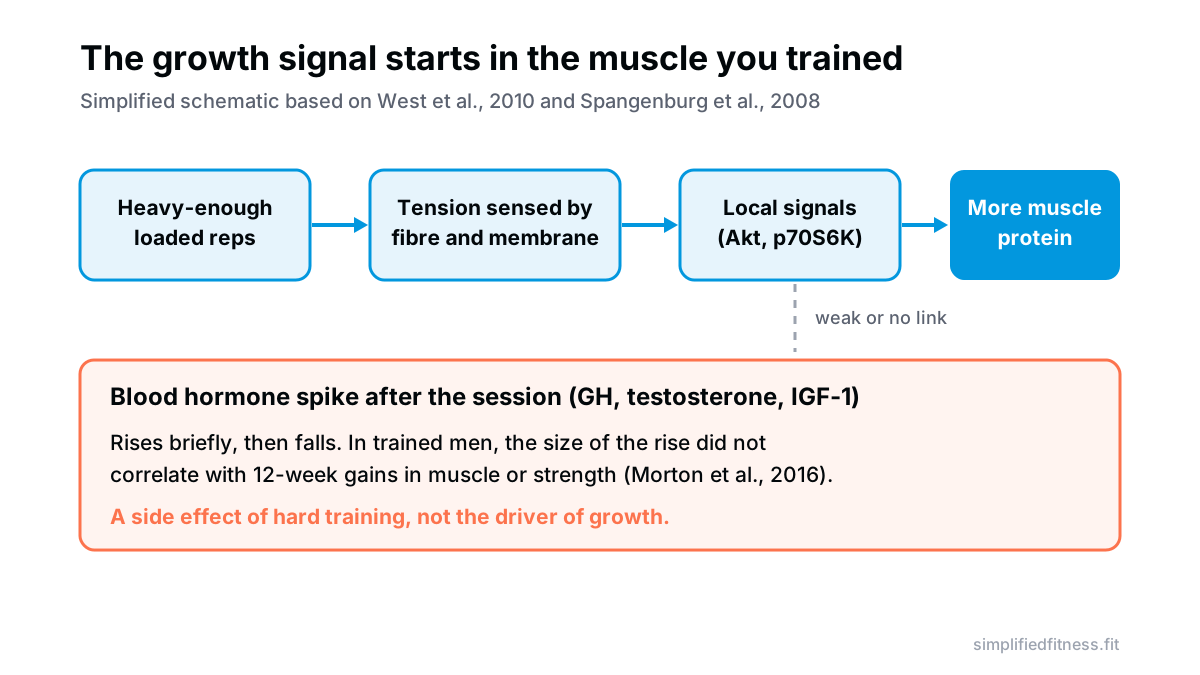
That is the core logic. A muscle fibre is post-mitotic, meaning it cannot divide, so it grows by adding protein to its existing structure. West and colleagues describe how loading triggers immediate events (calcium influx, cross-bridge cycling, stress on the cytoskeleton, membrane and extracellular matrix) followed by slower events such as the production of local growth factors like IGF-1 (West et al., 2010). Their conclusion: local mechanisms activated by the stress of loading prime the muscle for protein gain.
What is the difference between autocrine, paracrine and endocrine signals?
Three words, one idea each.
- Endocrine: a hormone is released into the blood and acts far away. Think liver IGF-1 or testosterone from the testes.
- Paracrine: a cell releases a signal that acts on its neighbours, such as satellite cells next to a muscle fibre.
- Autocrine: the same cell makes and responds to the signal.
The IGF-1 gene is the classic example of why this matters. The same gene can give rise to the circulating hormone and to several locally expressed splice forms (IGF-1Ea, and the one named MGF). The naming is confusing: the review below uses IGF-1Eb as another name for MGF, while the human studies further down measure MGF and IGF-1Eb as two separate variants. When people say “IGF-1” on a blood test, they are reporting the circulating endocrine pool. That is not the same as what is happening in your quads on the day after squats.
What is mechano growth factor (MGF), and is it real?
MGF is a name for one splice variant of IGF-1 mRNA that responds strongly to mechanical stress. It is real as a measurable mRNA. Whether it works as its own peptide hormone is a different story.
A 2010 review in Endocrinology explains the background. After muscle injury, IGF-1Eb (MGF) mRNA rises first and correlates with satellite cell and myoblast proliferation, and IGF-1Ea rises later and correlates with differentiation into mature fibres (Matheny et al., 2010). But the same review points out that no analogous peptide product has been identified in or isolated from cultured cells, their medium, animal tissues or biological fluids, and it separates the actions of synthetic MGF peptide from any known product of the IGF-1 gene.
In plain gym language: the mRNA finding is solid, the “MGF peptide” you see sold online is a different thing, and nobody has shown a sprayed or injected version builds muscle in healthy lifters. I have not found human trial evidence that it does.
What happens to local IGF-1 after a heavy session?
Human data come from muscle biopsies, so the studies are small. Still, they show a pattern.
In a study of eight young men (25-36 years) and seven older men (70-82 years), participants did 10 sets of 6 reps of single-leg knee extension at 80% of 1RM. Biopsies from the exercised and control legs were taken 2.5 hours later. MGF mRNA rose significantly in the young but not the older men, while IGF-1Ea mRNA did not change in either group. At rest, MGF levels were roughly 100-fold lower than IGF-1Ea (Hameed et al., 2003). The authors read the older group’s blunted response as a sign of age-related desensitivity to mechanical loading.
Notice the design: it compared the trained leg with the control leg inside the same person. Same blood, different local response. That is exactly the local-versus-systemic point.
A second study looked at elderly men (about 74 years) given resistance training with placebo, training plus recombinant growth hormone, or growth hormone alone. After 5 weeks of training, MGF mRNA rose by 163%, IGF-1Ea by 68% and IGF-1Eb by 75%. Training plus GH pushed MGF up by 456%. GH alone did not change MGF at 5 weeks, though it did raise it by 80% after 12 weeks (Hameed et al., 2004).
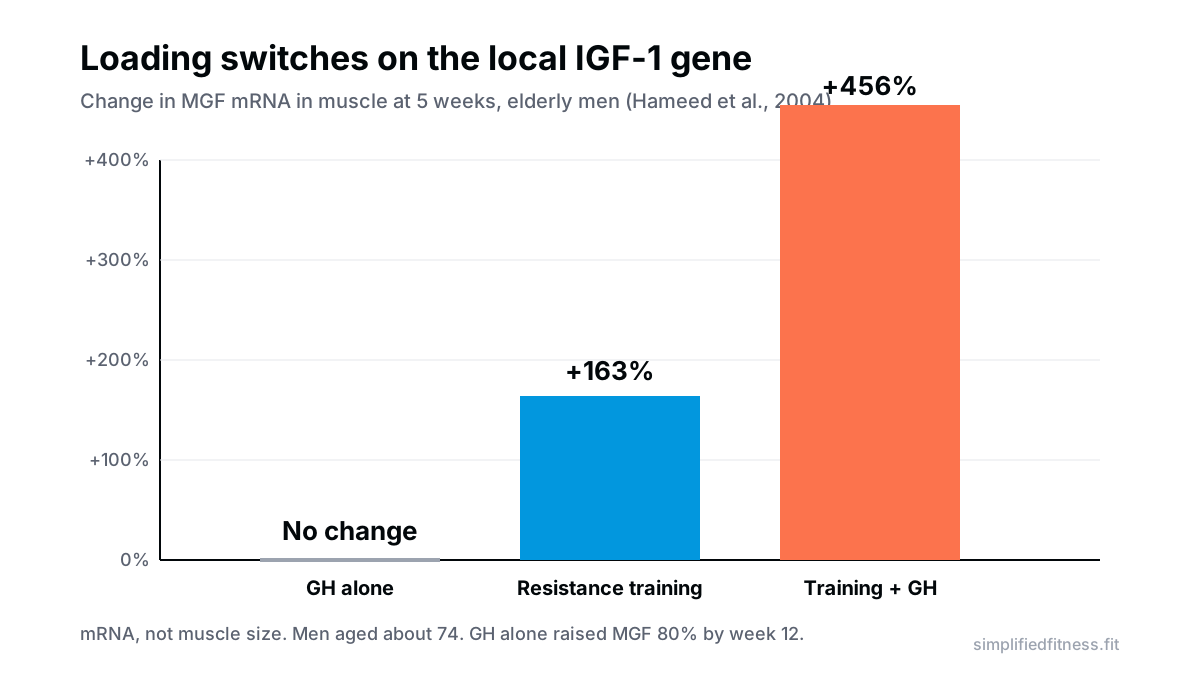
Two cautions. These are mRNA levels, not muscle size, and mRNA does not guarantee protein or growth. And the participants were older men, so we should not assume the same magnitude in a 25-year-old lifter. The 2003 and 2004 studies also differ on whether older muscle responds: the first saw no MGF rise after a single bout, the second saw one after weeks of training. A cautious reading is that older muscle may respond more slowly to a single session, but still responds to consistent training.
Does the blood hormone spike after training build muscle?
This is where local and systemic ideas collide, and where the data are clearest.
Morton and colleagues put 49 resistance-trained men (average age 23) through 12 weeks of whole-body training, randomised to higher reps with lighter loads (about 30-50% 1RM, 20-25 reps) or lower reps with heavier loads (about 75-90% 1RM, 8-12 reps), all sets to failure. Lean mass and fibre cross-sectional area rose in both groups with no significant differences, and no significant correlation was found between the acute post-exercise rise in any purported anabolic hormone and the change in strength or hypertrophy (Morton et al., 2016).
West and Phillips reached a similar conclusion in a review: exercise-induced hormonal elevations did not enhance anabolic signalling or acute myofibrillar protein synthesis in their experiments, and they argue the local mechanisms intrinsic to the working muscle are predominant (West and Phillips, 2010). The same review is careful about the other side: testosterone is a potent anabolic agent when supplemented, and GH can raise lean mass and strength in clinical GH deficiency. It is the transient exercise bump they question.
If IGF-1 is so important, why can muscle grow without its receptor?
The conflicting finding is worth sitting with. For years the story was simple: load raises local IGF-1, IGF-1 activates Akt and mTOR, muscle grows.
Spangenburg and colleagues tested it in mice with a dominant-negative IGF-1 receptor in skeletal muscle. After functional overload of the plantaris, wild-type mice gained 26% in muscle mass at 7 days and 100% at 35 days, while the receptor-impaired mice gained 62% and 122%, and the degree of hypertrophy never differed significantly between genotypes. Akt and p70S6K phosphorylation rose in both (Spangenburg et al., 2008). The authors concluded that load can induce hypertrophy and activate these kinases independent of a functioning IGF-1 receptor.
Why might this differ from the IGF-1-centred model? One possibility is redundancy: the cell has several tension-sensing routes, so blocking one does not stop growth. Another is that overload in mice is a far stronger stimulus than a gym session. And mice are not humans. The practical takeaway is cautious: IGF-1 is probably one of several signals, and the loading itself is what you control. For the tension side of the story, see mechanical tension vs muscle damage. A broader review of mechanisms names mechanical tension, muscle damage and metabolic stress as contributors (Schoenfeld, 2010).
What does this mean for your training and your blood tests?
Short version: stop optimising hormones that your session does not control, and start optimising the stimulus that it does.
| Question | What the evidence suggests | What to do |
|---|---|---|
| Do post-workout hormone spikes matter? | No link to growth in trained men | Ignore “spike” hacks |
| Does the muscle I train decide where I grow? | Yes, local loading drives the response | Train each muscle directly with hard sets |
| Is “MGF” worth buying? | Unproven, natural peptide not isolated | Skip it |
| Can a blood panel predict my gains? | No | Use it for health checks only |
| Do older lifters respond? | Slower or blunted MGF response in one study, but training still raised it | Train consistently, hard and often |
In an Indian context, this also saves money. The budget that goes into “IGF-1 boosters” and imported sprays is far better spent on dal, paneer, curd, eggs or soya for protein and on a gym membership you actually attend. Genes and consistency set your ceiling; read why lifters respond so differently for the variability side.
When should you see a doctor about hormones?
Blood tests have a proper job. If you have persistent unexplained fatigue, loss of libido, a sudden fall in strength despite good training and sleep, unexplained weight change, or signs of a thyroid problem, see a doctor. Hormone problems are real and treatable. Nothing here says clinical deficiency does not matter; it says normal fluctuations around a workout do not explain your biceps. I cannot diagnose you from an article, and neither can a supplement label.
Never use injectable growth factors, GH or anabolic drugs on your own to chase size. The risks are real and the evidence for benefit in healthy people, for products like MGF, is lacking.
Related reading
- Blood flow restriction training for another local mechanism.
- Neural adaptations vs muscle growth in early training for why early gains feel fast.
- Anabolic resistance in older adults for the age angle.
Frequently Asked Questions
Is muscle growth driven by local or systemic hormones?
Evidence from human training studies points mainly to local mechanisms inside the loaded muscle. Reviews from the McMaster group conclude that transient post-exercise rises in systemic GH, testosterone and IGF-1 are of little consequence to hypertrophy in healthy people. Focus on hard, progressive training of the muscle you want to grow.
What is local IGF-1 in muscle?
It is IGF-1 produced by the muscle tissue itself rather than released from the liver into the blood. The IGF-1 gene is spliced into several forms, and loading changes how these are expressed within the trained muscle. It acts on nearby cells, which is why researchers call it an autocrine or paracrine signal.
What is the difference between autocrine, paracrine and endocrine signalling?
Autocrine signals act on the cell that made them, paracrine signals act on neighbouring cells, and endocrine signals travel through the blood to distant tissues. Muscle hypertrophy research suggests the first two matter a lot because the growth stays in the muscle that was worked. Think of it as a local message versus a broadcast.
What is mechano growth factor (MGF)?
MGF is the name given to a splice variant of IGF-1 mRNA that rises after mechanical loading or injury. A 2010 review notes that no matching peptide has been isolated from cells or tissues, and that synthetic MGF peptide is different from anything the gene is known to produce. Treat claims about MGF as mostly unproven.
Do MGF injections or sprays build muscle?
There is no good human evidence that they do, and the gene-expression findings do not show that a synthetic peptide behaves like a natural product. These products are also unregulated and can be contaminated or banned in sport. Spend that money on food and coaching, and speak to a doctor before using any injectable.
Why do only the muscles I train grow?
Because the loading signal is local. Tension and stress in the worked fibres switch on growth pathways in those fibres, while a non-trained limb sees the same blood but not the same mechanical stimulus. That is why one arm trained alone grows more than the resting arm.
Do post-workout testosterone and growth hormone spikes build muscle?
In studies of trained young men, the size of the acute post-exercise hormone rise did not predict gains in muscle or strength. Those rises are brief and sit within normal physiological ranges. See our breakdown of the post-workout hormone spike myth for the full picture.
Does IGF-1 matter at all for muscle?
Yes, but its role is more complicated than a single on-switch. In a mouse study, overload-induced growth still occurred when the muscle IGF-1 receptor was blocked, which suggests other signals can compensate. In humans, IGF-1 splice variants rise after loading, and age may blunt the MGF response.
Should I get my hormones tested to see if I can build muscle?
A blood test is useful for spotting a medical issue such as low testosterone, thyroid problems or deficiencies, but it will not predict how much muscle you can gain. If you have symptoms like persistent fatigue, low libido or unexplained loss of strength, see a doctor. Otherwise, your training log is a better progress marker than a hormone number.
Can I raise my IGF-1 naturally to grow more muscle?
There is little evidence that nudging blood IGF-1 within the normal range changes how much muscle you gain from training. Adequate calories, protein and sleep support normal hormone function, which is worth doing anyway. Do not chase supplements marketed as IGF-1 boosters.
Does MGF response get weaker with age?
In one small study, MGF mRNA rose after a heavy leg session in young men but not in men aged 70-82, which hints at age-related desensitivity to loading. Another study showed that elderly men training for 5 weeks did increase MGF mRNA. Older lifters should keep training hard and consistently; see our guide on anabolic resistance in older adults.
Does this mean hormones are irrelevant to muscle growth?
No. Hormones clearly drive growth during childhood and puberty, testosterone is strongly anabolic at supraphysiological drug doses, and treating a clinical GH deficiency can increase muscle size or strength. The point is narrower: normal day-to-day variation and the short post-exercise bumps do not explain who grows after a workout. Medical hormone problems deserve medical care.
How should I train to activate local growth pathways?
Take sets close to failure using loads and ranges you can control, and progressively add reps or weight over weeks. Reviews describe mechanical tension as a key driver of hypertrophy. Track your hard sets per muscle each week and add load or reps when you can.
Sources & References
Every claim above is checked against peer-reviewed research (PubMed, U.S. National Library of Medicine) or guidance from established health bodies. How we fact-check.
- West DW, et al. Human exercise-mediated skeletal muscle hypertrophy is an intrinsic process. Int J Biochem Cell Biol. 2010. PMID: 20541030
- West DW, et al. Anabolic processes in human skeletal muscle: restoring the identities of growth hormone and testosterone. Phys Sportsmed. 2010. PMID: 20959702
- Morton RW, et al. Neither load nor systemic hormones determine resistance training-mediated hypertrophy or strength gains in resistance-trained young men. J Appl Physiol. 2016. PMID: 27174923
- Hameed M, et al. Expression of IGF-I splice variants in young and old human skeletal muscle after high resistance exercise. J Physiol. 2003. PMID: 12562960
- Hameed M, et al. The effect of recombinant human growth hormone and resistance training on IGF-I mRNA expression in the muscles of elderly men. J Physiol. 2004. PMID: 14565994
- Spangenburg EE, et al. A functional insulin-like growth factor receptor is not necessary for load-induced skeletal muscle hypertrophy. J Physiol. 2008. PMID: 17974583
- Matheny RW, et al. Minireview: Mechano-growth factor: a putative product of IGF-I gene expression involved in tissue repair and regeneration. Endocrinology. 2010. PMID: 20130113
- Schoenfeld BJ. The mechanisms of muscle hypertrophy and their application to resistance training. J Strength Cond Res. 2010. PMID: 20847704

Umair Hazrami · Founder & Head Coach, Simplified Fitness
Umair Hazrami founded Simplified Fitness and the Simplified Lifter channel to cut through fitness noise. With 4+ years of consistent training and 10+ coaching clients, he writes every guide from the peer-reviewed research and links the sources so you can check them. Our editorial standards.
Educational content only, not medical advice. If you have a medical condition, are pregnant, or take medication, talk to a qualified doctor before changing your diet, supplements or training. Full disclaimer.
Keep reading

Hypertrophy
Anabolic Resistance in Older Adults: Why Muscle Responds Less and How to Beat It
Anabolic resistance in older adults explained: why muscle responds less to protein and lifting after 50, plus the protein dose, leucine and sets that help.
8 min read

Hypertrophy
How Blood Flow Restriction Builds Muscle: Venous Occlusion, Metabolites and Cell Swelling
BFR training hypertrophy mechanisms explained: how a cuff and 20% 1RM can match heavy lifting for size. Metabolites, swelling, mTOR, myostatin and cuff safety.
8 min read
Hypertrophy
CNS Fatigue vs Muscle Fatigue: Is Your Nervous System Really Fried?
CNS fatigue vs muscle fatigue: what central and peripheral fatigue really are, how long each lasts, and how to tell which one is holding your lifts back.
9 min read

Hypertrophy
Exercise-Induced Muscle Damage (EIMD): Why Chasing Soreness Is Counterproductive
Muscle damage and hypertrophy are not the same thing. See what Z-disc streaming studies show, why soreness is a poor gauge of growth, and what to track.
8 min read