Returning to the Gym After an Injury: The Traffic Light Pain Model and Gradual Reloading
Returning to the gym after injury? Use a 0-10 traffic light pain model and four reloading phases to get back under the bar without re-injuring yourself.
TL;DR. The short answer
- Returning to the gym after injury works best as gradual, pain-guided loading, not complete rest. In a randomized trial of Achilles tendinopathy, continuing pain-monitored loading did no worse than stopping activity for 6 weeks.
- A simple traffic light on the 0-10 pain scale: 0-3 green (continue), 4-5 yellow (hold the load and monitor), 6 or more red (modify). These cut-offs are a practical convention, not a validated universal rule.
- Judge a session by the next morning. Pain that settles back to baseline within about 24 hours suggests you can repeat or slowly progress the load.
- Total rest costs more than it saves. One week of strict bed rest cost healthy young men 1.4 kg of lean tissue and about 7% of leg strength.
- Persistent, worsening, night or numb-tingling pain, a joint that gives way, or a pop with immediate swelling needs a clinician before any lifting.
Part of our complete guide: Joint-Friendly Lifting & Fitness Myths: A Guide for Over-40s, Teens and Sore Backs
Table of contents
Returning to the gym after injury does not mean waiting until it stops hurting. For most strains, sprains and tendon problems, the evidence favours gradual loading guided by a 0-10 pain score, with the next morning acting as your check. This article is the practical protocol for that. It sits inside our wider guide to joint-friendly lifting and myth busting.
One boundary first. This is for mild to moderate muscle strains, joint sprains and overuse irritation, once a serious injury has been ruled out. It is not a diagnosis, and it does not replace a physio.
Why complete rest is a poor plan
The instinct after an injury is to stop everything. A few days of protecting the area is sensible. Weeks of doing nothing is where the damage starts.
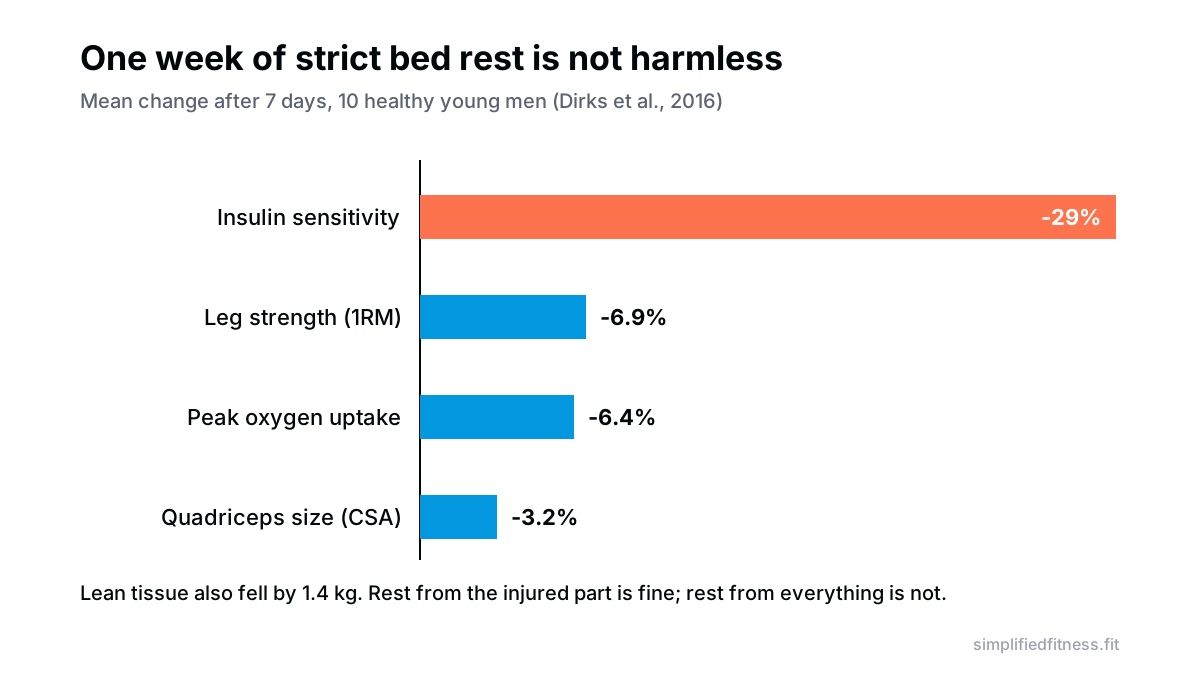
In a controlled study, ten healthy young men did one week of strict bed rest. They lost 1.4 kg of lean tissue, quadriceps cross-sectional area fell 3.2%, and leg 1RM dropped 6.9%. Insulin sensitivity fell 29% (Dirks et al., 2016). That is extreme rest in healthy people, not a typical injured lifter, but it shows how fast the body detrains.
A pooled analysis of 318 healthy adults across bed rest studies (5-120 days) found strength and muscle loss are fastest early and then plateau, and strength falls faster than muscle size in the first two weeks (Marusic et al., 2021). The authors estimate about 79% of the strength loss is explained by muscle shrinkage, with the rest likely down to neural and other factors. The early weeks are where most of the loss happens, which is another reason to keep loading what you can.
Fear is part of the injury
The second cost of rest is psychological. A clinical review of athletes found that fear of reinjury is common and can impair physical recovery, reduce function and block a successful return to sport (Hsu et al., 2017).
In a 5-year follow-up of Achilles tendinopathy patients treated with exercise, higher kinesiophobia (fear of movement) correlated with worse recovery of heel-rise work. The authors suggested a pain-monitoring model be used when treating with exercise (Silbernagel et al., 2011). That was a case series, so it shows an association, not proof of cause.
The opposite extreme is just as unhelpful: ignoring pain completely to prove the injury is “fine”. Fear and bravado both drop the monitoring. The traffic light replaces both with a number.
What is the traffic light pain model?
You rate pain from 0 (none) to 10 (worst imaginable) at three moments: during the set, right after, and the next morning.
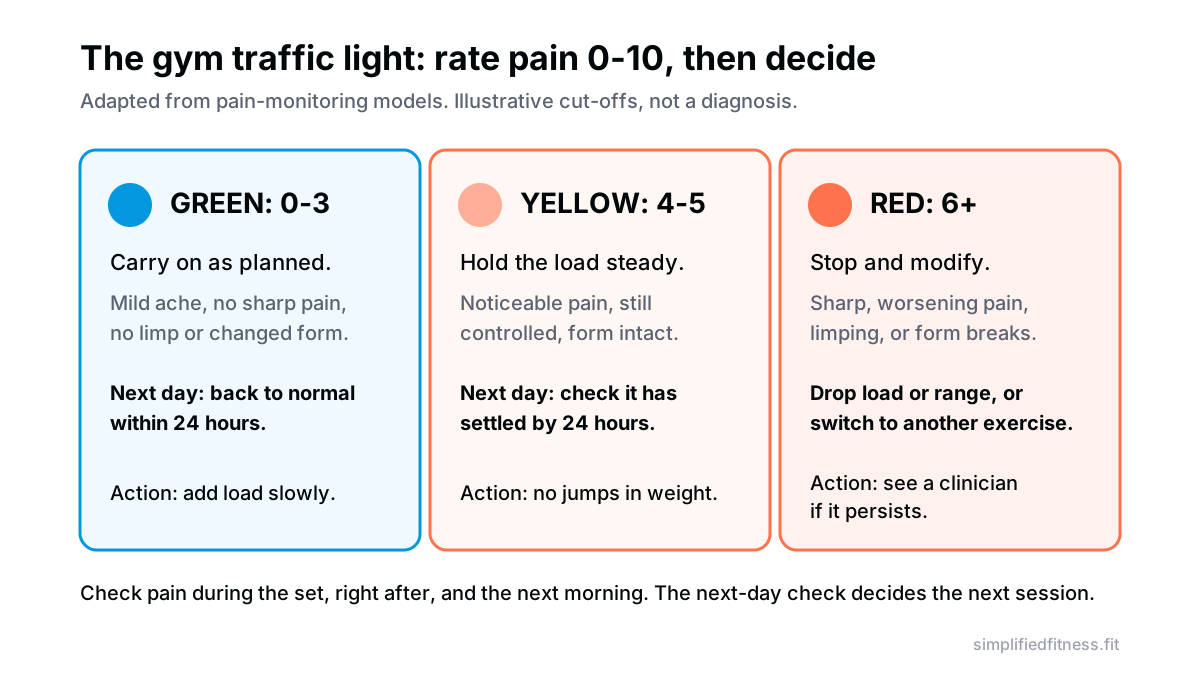
- Green (0-3): continue. Mild ache, normal movement.
- Yellow (4-5): monitor. Keep the load where it is, do not add weight, and see how tomorrow feels.
- Red (6+): modify. Cut the load or range, change the exercise, or stop for the day.
Where does this come from? In a randomized trial, 38 patients with Achilles tendinopathy followed an identical loading programme. One group continued running and jumping using a pain-monitoring model; the other stopped those activities for 6 weeks. Improvement rates did not differ significantly. VISA-A-S scores went from 57 to 85 at 12 months in the continuing group and from 57 to 91 in the active rest group, and the authors found no negative effects from continued pain-monitored loading (Silbernagel et al., 2007).
A small pilot in patellar tendinopathy tested pain-guided activity against pain-free activity alongside a heavy slow resistance programme. It mainly showed feasibility problems: only 15 of 47 eligible people enrolled, so it cannot tell us which approach is better (Sprague et al., 2021).
The 24-hour rule
The during-session number is only half the story. A set that felt like a 3 but leaves you at 6 the next morning was too much. A set that hit 4 and was back to baseline by the next day is usually a safe repeat. Write both numbers in your log.
If you already use effort scales for working sets, our RIR and RPE calculator is a good companion, but note that it measures effort, not pain. Keep the two separate.
What are the phases of progressive reloading?
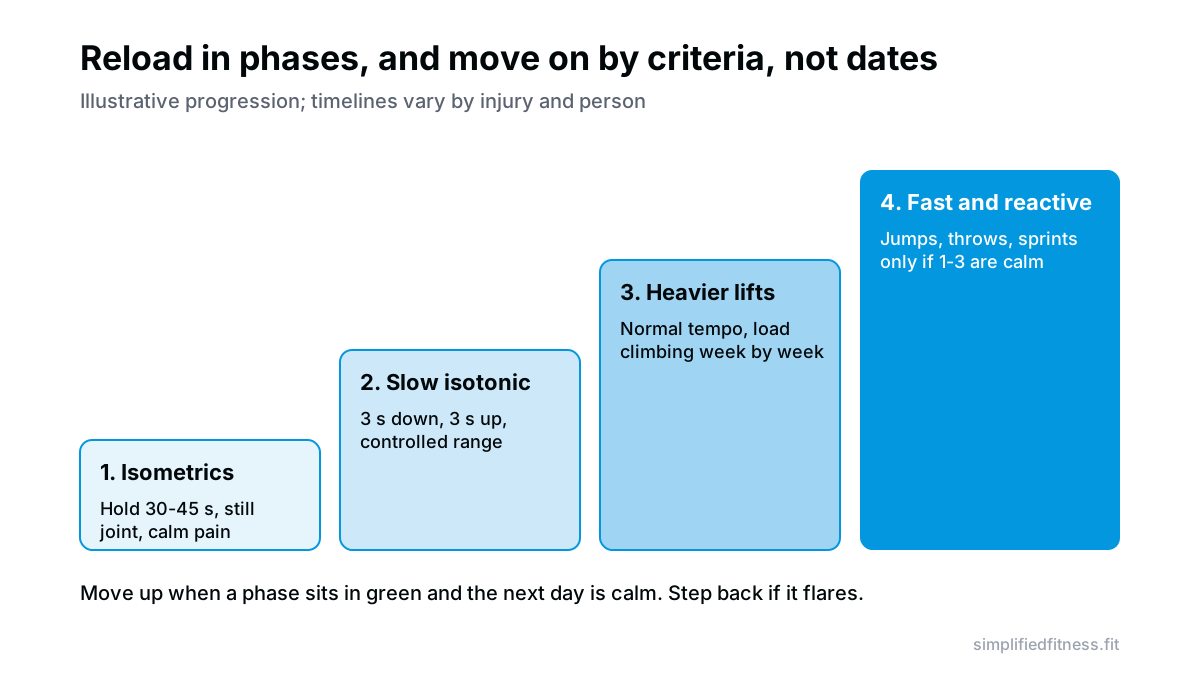
Think in four steps and move on by how the tissue responds, not by the calendar.
Phase 1: isometrics
Muscle works, joint does not move. Examples are a wall sit, a held split squat, or a glute bridge hold. Try 30-45 second holds, a few sets, at a pain level of 0-3.
Isometrics are often used because they can calm pain. In a small crossover of six volleyball players with patellar tendinopathy, isometric holds dropped pain on a single-leg decline squat from 7.0 to 0.17 out of 10, and the relief lasted at least 45 minutes (Rio et al., 2015). But a larger crossover of 21 people found only a small average drop of 0.9 points, no better than dynamic exercise, and it did not last 45 minutes (Holden et al., 2020).
These two disagree on size. Both tested a single session. The first was tiny (n = 6) and in volleyball players with high baseline pain; the second was larger (n = 21), pre-registered, and blinded participants to the hypothesis. Practical takeaway: isometrics may help you get started more comfortably, but do not expect a dramatic effect or stay in this phase longer than needed.
Phase 2: slow isotonic work
Now the joint moves. Use a controlled tempo (about 3 seconds up and 3 down), a pain-free or green-zone range, and moderate load. Think tempo goblet squats, slow leg curls, or a controlled calf raise. This phase retrains movement and rebuilds muscle size and tolerance. Our guide to tendon versus muscle adaptation explains why tendons need patience.
Phase 3: heavier lifts
Normal tempo, heavier loads, and the lifts you actually want back. Add load in small steps, such as 2.5 kg or one extra rep, and only when the previous session sat in green with a calm next day. This is where you move back into squats, presses and pulls with sensible modifications.
Phase 4: fast and reactive work
Jumps, sprints, throws and plyometrics come last, because they are the highest-demand loading. Only start when phases 2 and 3 feel easy and stable. For hamstring rehab, an international expert panel reached 83-100% agreement on statements about running and sprinting in rehabilitation, and 73-92.7% on criteria to progress exercise (Paton et al., 2023). That is consensus opinion, which is a lower level of evidence than trials, but it supports progressing by criteria.
What does exercise-based rehab achieve after a sprain?
For ankle sprains, a meta-analysis of 7 trials (n = 1417) found exercise-based rehabilitation reduced reinjury compared with usual care. The trend at 3-6 months was not significant (OR 0.87, 95% CI 0.48-1.58), but at 7-12 months the odds of reinjury were lower (OR 0.53, 95% CI 0.38-0.73). The authors note there is no consensus on the best exercise content or volume (Bleakley et al., 2019). So rehab matters, but the exact recipe is still open.
A worked example: sprained ankle, week by week
This is illustrative, not a prescription.
- Days 1-3: protect it, walk as pain allows, train upper body and the other leg normally.
- Week 1: isometric calf holds and seated work in green. Check the next morning.
- Weeks 2-3: slow calf raises, tempo squats, balance work. Hold at yellow, do not add load.
- Weeks 3-6: heavier squats, deadlift variations and single-leg work, adding small loads only after calm next days.
- After: if stable, add skipping, jumps and cutting drills gradually.
A moderate sprain or strain can need longer. Severe ones need medical assessment.
How do I rebuild confidence under the bar?
Confidence returns through evidence you collect yourself.
- Start with a load that you can complete in green, even if it looks embarrassingly light.
- Repeat it until the next morning is calm, so your nervous system learns that the movement is safe.
- Progress in small steps and log them.
- Return to the exercises you fear last, and with a spotter or safeties where relevant.
If you find yourself avoiding movements even after being cleared, talk to your physio. Fear is a recognised barrier, and there are approaches to address it directly.
Common mistakes
- Jumping straight back to your old working weight because you “feel fine” (muscle strength can feel back before tendon and ligament tolerance is).
- Ignoring the next morning and only judging pain during the set.
- Using painkillers before a session so the traffic light reads falsely green.
- Skipping all training instead of working around the injury.
- Progressing two variables (load and range) in the same week.
For general returns after a long layoff that was not injury related, see returning to the gym after a long break. For the difference between productive and harmful pain, read good pain versus bad pain. Tennis and golfer’s elbow have their own specifics in elbow tendinopathy and lifting.
When to see a doctor or physio
Get assessed before lifting if any of these apply:
- you heard or felt a pop followed by quick swelling
- you cannot put weight on the limb
- the joint gives way or locks
- numbness, tingling or weakness spreads down the limb
- pain wakes you at night or keeps climbing
- there is no improvement after 1-2 weeks
If you have a long-term condition, are pregnant, or take regular medication, check with your doctor first. For persistent problems a physiotherapist can grade the injury and set personal limits.
The bottom line
Complete rest is a weak strategy and ignoring pain is a risky one. Use the traffic light: green continue, yellow hold, red modify, and always check the next morning. Move through isometrics, slow isotonic work, heavier lifts and finally fast work in that order. The trials behind pain-monitoring are small and mostly in tendon injuries, so use these numbers as a starting guide and let a clinician tune them. If you need a structured plan around the injury, our free training plans can cover the rest of your week.
Frequently Asked Questions
How do I start working out again after an injury?
Start with the injured area at a level that stays in the green zone (0-3 out of 10 pain) and train everything else normally. Pain-guided loading has been tested in tendon injuries and did not slow recovery compared with stopping activity. Begin with gentle isometric holds, then slow controlled reps, and add load only when the next morning feels like baseline.
Is it okay to lift with pain after an injury?
Mild discomfort of about 0-3 out of 10 that settles within 24 hours is generally considered acceptable in rehab practice. Pain-monitoring models used in trials let people keep loading a sore tendon within agreed limits and did not show harm. Sharp, worsening or form-changing pain is a stop sign, so lower the load or switch exercises.
What is the traffic light pain model?
It is a way to rate pain on a 0-10 scale and act on the number: green (0-3) continue, yellow (4-5) hold and monitor, red (6 or more) modify. The idea comes from pain-monitoring models such as the one tested by Silbernagel and colleagues in Achilles tendinopathy. The exact cut-offs vary between clinicians, so treat these numbers as a starting guide, and ask your physio to adjust them.
How long should I rest after a muscle strain or sprain?
Usually only the first few days of protecting the area, then movement and loading begin. Exercise-based rehab after ankle sprain reduced reinjury at 7-12 months compared with usual care alone in a meta-analysis. How long exactly depends on severity, so get a grade and a plan from a clinician for anything beyond a mild strain.
Does complete rest make an injury heal faster?
There is no good evidence that total rest speeds healing, and there is clear evidence it costs muscle and fitness. In one study, 7 days of strict bed rest reduced quadriceps size by 3.2% and leg strength by 6.9% in healthy young men. Rest the painful movement briefly, then reload it in steps.
What are isometric exercises and why use them first?
Isometrics are holds where the muscle works but the joint does not move, such as a wall sit or a held calf raise. In a small crossover study of six volleyball players with patellar tendinopathy, isometric holds cut pain during a decline squat from 7.0 to 0.17 out of 10 for at least 45 minutes. A larger crossover study of 21 people found only a small benefit, so use them as a pain-calming warm-up, not a miracle.
When can I go from isometrics to normal lifting?
When the holds are calm (green zone) during and the next morning, move to slow controlled reps through a pain-free range. Then raise load in small steps, rather than by the calendar. If a step flares your symptoms above yellow for more than a day, return to the previous phase for a week.
When can I run, jump or do plyometrics again?
Only after slow and heavy strength work feels easy and calm in the green zone. Fast, high-impact loading demands more from healing tissue, so it comes last. For hamstring injuries, an international expert consensus emphasises criteria-based progression and graded running, with 83-100% agreement on running and sprinting statements.
Why am I scared to lift after my injury?
Fear of reinjury is a common psychological response and it can slow rehabilitation and affect return to sport. A review in athletes reported that high fear of reinjury was linked with poorer recovery and function. Start with loads you can control, track the next-day response, and let the evidence from your own body rebuild trust.
Can I train other body parts while injured?
Yes, in most cases you should. Keeping the rest of the body training protects muscle and fitness, which are lost quickly with disuse. Choose exercises that do not load the injured area, for example seated upper body work with a sore knee, and keep the same weekly routine.
Should I use ice and anti-inflammatories before lifting?
Evidence for these as ways to speed return to training is limited, so do not rely on them to mask pain you are supposed to be monitoring. Pain relief that hides the signal makes the traffic light unreliable. Ask your doctor or pharmacist what is safe for you, particularly if you take other medication.
When should I see a doctor instead of self-managing?
See a doctor if you heard a pop with immediate swelling, cannot bear weight, feel the joint give way, have numbness or tingling, have night pain, or are not improving after 1-2 weeks. These can signal a tear, fracture or nerve problem that needs proper assessment. Self-guided reloading is for mild to moderate strains and sprains once a serious injury has been ruled out.
How do I know if my pain is a flare-up or just soreness?
Normal muscle soreness is dull, spread over the muscle and eases with movement over a day or two. Injury pain tends to be sharper, localised, and may change how you move. If it sits in the red zone or is clearly worse the next morning, treat it as a flare and drop back a step.
Sources & References
Every claim above is checked against peer-reviewed research (PubMed, U.S. National Library of Medicine) or guidance from established health bodies. How we fact-check.
- Silbernagel KG, et al. Continued sports activity, using a pain-monitoring model, during rehabilitation in patients with Achilles tendinopathy: a randomized controlled study. Am J Sports Med. 2007. PMID: 17307888
- Silbernagel KG, et al. The majority of patients with Achilles tendinopathy recover fully when treated with exercise alone: a 5-year follow-up. Am J Sports Med. 2011. PMID: 21084657
- Sprague AL, et al. Pain-guided activity modification during treatment for patellar tendinopathy: a feasibility and pilot randomized clinical trial. Pilot Feasibility Stud. 2021. PMID: 33632313
- Dirks ML, et al. One week of bed rest leads to substantial muscle atrophy and induces whole-body insulin resistance in the absence of skeletal muscle lipid accumulation. Diabetes. 2016. PMID: 27358494
- Marusic U, et al. Nonuniform loss of muscle strength and atrophy during bed rest: a systematic review. J Appl Physiol. 2021. PMID: 33703945
- Rio E, et al. Isometric exercise induces analgesia and reduces inhibition in patellar tendinopathy. Br J Sports Med. 2015. PMID: 25979840
- Holden S, et al. Isometric exercise and pain in patellar tendinopathy: a randomized crossover trial. J Sci Med Sport. 2020. PMID: 31735531
- Bleakley CM, et al. Rehabilitation exercises reduce reinjury post ankle sprain, but the content and parameters of an optimal exercise program have yet to be established: a systematic review and meta-analysis. Arch Phys Med Rehabil. 2019. PMID: 30612980
- Paton BM, et al. London International Consensus and Delphi study on hamstring injuries part 3: rehabilitation, running and return to sport. Br J Sports Med. 2023. PMID: 36650032
- Hsu CJ, et al. Fear of reinjury in athletes. Sports Health. 2017. PMID: 27590793

Umair Hazrami · Founder & Head Coach, Simplified Fitness
Umair Hazrami founded Simplified Fitness and the Simplified Lifter channel to cut through fitness noise. With 4+ years of consistent training and 10+ coaching clients, he writes every guide from the peer-reviewed research and links the sources so you can check them. Our editorial standards.
Educational content only, not medical advice. If you have a medical condition, are pregnant, or take medication, talk to a qualified doctor before changing your diet, supplements or training. Full disclaimer.
Keep reading
Health & Longevity
Are Deadlifts Bad for Your Lower Back? What Spinal Loading Research Shows
Are deadlifts bad for lower back health? The research shows spinal loads are high but tolerable, and trials use loaded lifting for back pain. How to hinge.
9 min read

Health & Longevity
Are Squats Bad for Your Knees? What the Research Actually Says
Are squats bad for your knees? Research on deep squats, kneecap stress and the knees-over-toes rule shows where the myth came from and how to squat safely.
9 min read

Health & Longevity
Why Tendons Adapt Slower Than Muscles: Connective Tissue Timelines for Lifters
Tendon adaptation vs muscle growth: why your tendons lag behind your strength gains, what studies show about timelines, and how to add load without tendonitis.
8 min read

Health & Longevity
Desk Worker Workout Routine: Fix Pelvic Tilt, Weak Glutes and a Rounded Upper Back
A desk worker workout routine built on evidence: what sitting really does to your hips, why pelvic tilt is mostly normal, and 3 gym correctives that help.
8 min read