Does Cardio Kill Gains? The Real Science of the Interference Effect
Does cardio kill gains? A 43-study review found moderate cardio barely dents muscle size. Learn what the interference effect is and how to program around it.
TL;DR. The short answer
- Cardio does not kill gains. A 2022 meta-analysis of 43 studies found no meaningful difference in muscle size or max strength between lifting alone and lifting plus cardio.
- The interference effect is real but small and conditional. Older data tie it to running and to more frequent, longer cardio, and explosive power is more vulnerable than muscle size.
- The AMPK versus mTOR story is mostly a lab and rodent finding. In trained men, cycling-induced AMPK activation did not block mTORC1 signalling after lifting.
- To protect muscle, lift first when you share a session, separate sessions by a few hours when you can, and favour cycling, walking or rowing over high-volume running.
- Anyone with heart disease, chest pain or unexplained breathlessness should see a doctor before ramping up cardio.
Part of our complete guide: Joint-Friendly Lifting & Fitness Myths: A Guide for Over-40s, Teens and Sore Backs
Table of contents
Does cardio kill gains? For most lifters, no. A 2022 meta-analysis of 43 studies found that adding aerobic training to a lifting plan did not compromise muscle size or maximal strength compared with lifting alone (Schumann et al., 2022). What the data does show is a smaller, conditional “interference effect” that depends on how much cardio you do and what kind. For the full programming blueprint, see our concurrent training guide. This piece sits inside the wider joint-friendly lifting myth-busting guide, because the cardio fear stops a lot of lifters from doing the thing that protects their heart and joints.
Let us separate the myth from the real, much narrower effect.
Where the “cardio kills gains” idea came from
The idea has an actual scientific origin. Research on concurrent training (lifting and endurance work in the same programme) started with studies of endurance athletes and rodents, and some of the early human trials showed lifters who also trained for endurance gained less strength than those who only lifted. A 2014 review put it plainly: current evidence suggested that combining the two may attenuate gains in muscle mass, strength and power compared with resistance training alone (Fyfe et al., 2014).
Then gym culture rounded “may attenuate” up to “cardio eats muscle.” Not the same sentence.
What the meta-analyses actually found
Three big reviews are worth knowing, and they do not say the same thing.
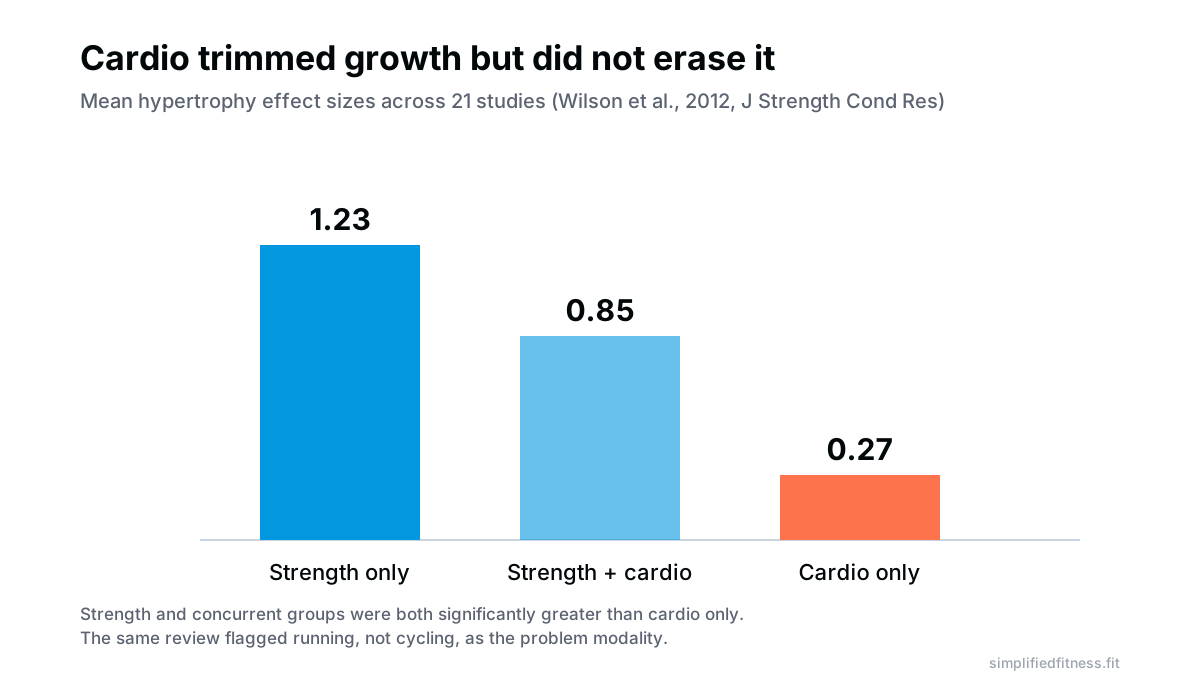
Wilson et al. (2012) pooled 21 studies and 422 effect sizes. The mean hypertrophy effect size was 1.23 for strength training alone, 0.85 for concurrent training and 0.27 for endurance alone. Strength and concurrent groups were both significantly greater than endurance only, and the review concluded that interference depends on the modality, frequency and duration of the endurance work (Wilson et al., 2012).
Schumann et al. (2022) updated the picture with 43 studies. Comparing identical strength training with and without added aerobic work, the standardised mean differences were close to zero for maximal strength (-0.06) and muscle hypertrophy (-0.01). Explosive strength was the exception (-0.28) (Schumann et al., 2022).
Lundberg et al. (2022) zoomed in on single muscle fibres across 15 studies and found a small negative effect on overall fibre hypertrophy (SMD -0.23, borderline at p = 0.050) (Lundberg et al., 2022).
So whole-muscle growth looks fine, fibre-level growth may take a small hit, and power is the most vulnerable. If you want maximum bicep or quad size, the practical difference is likely tiny. If you play a sport that needs jump and sprint power, it deserves more thought.
Does running hurt more than cycling?
This is where the reviews genuinely conflict, so here is each side.
Wilson et al. reported that lifting while also running, but not cycling, led to significant decrements in both hypertrophy and strength. Lundberg et al. found a negative effect on type I fibre size when the aerobic work was running but not cycling (SMD -0.81), and they called this preliminary. Schumann et al., on the other hand, found no significant difference between cycling and running for muscle size or strength.
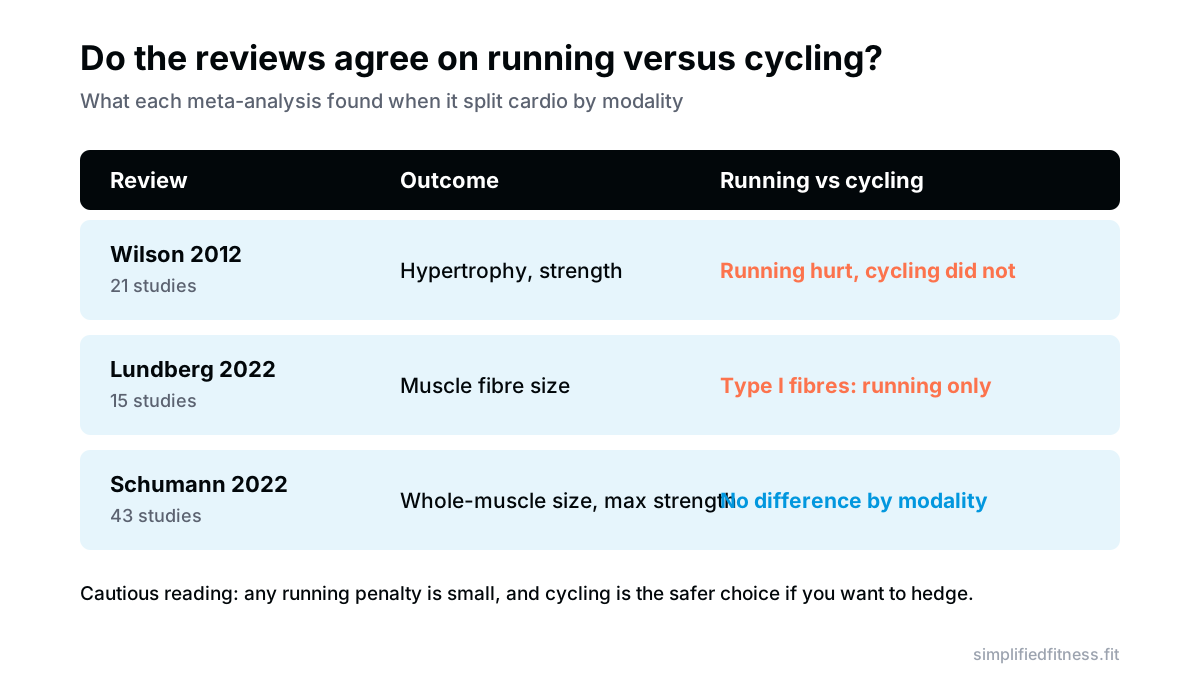
Why might they differ? Running has an eccentric component (muscle lengthening under load with every foot strike), so it may leave more soreness and muscle damage than cycling. That is a plausible mechanism, but the abstracts above do not measure it, so treat it as an explanation, not a proven cause. Study designs, running volumes and populations also differ.
The cautious takeaway: if you run a lot and your legs feel flat in the gym, swapping some running for cycling, rowing or incline walking is a low-cost experiment. Our deeper comparison is in cycling vs running for lifters.
What is the AMPK vs mTOR story, and does it hold up?
The molecular version goes like this. Endurance exercise activates AMPK, an energy sensor. Lifting activates mTORC1, the pathway that switches on muscle protein synthesis. In rodents and cell studies, activated AMPK can inhibit mTORC1. So the theory says cardio flips a switch that blocks the growth signal.
The theory is tidy. In humans it is messier. Fyfe et al. noted that human studies had not observed the molecular interference after acute concurrent exercise that would explain reduced hypertrophy (Fyfe et al., 2014).
A direct test used eight trained men who either lifted only, or did interval cycling before lifting. AMPK was raised in the cycling condition. Yet S6K1 activity (a marker of mTORC1 signalling) rose the same in both trials. The authors concluded that cycling-induced AMPK did not inhibit mTORC1 signalling, though a marker of protein breakdown (MuRF1) did rise after the combined session (Apró et al., 2015).
Eight men is a small sample, and one session is not months of training. Still, it is the most direct human test of the idea, and the clean “AMPK blocks mTOR” story did not show up in it. For a fuller explanation, see our piece on the molecular interference effect.
What cardio can do for a lifter
Here is the upside the myth hides. A 2025 meta-regression of 353 studies for mitochondria and 131 for capillaries found that low or moderate intensity continuous training raised mitochondrial content by about 23% and capillaries per fibre by about 15%. High-intensity intervals gave similar gains. The changes were larger in people with a lower starting fitness, and capillary gains were seen mainly in untrained to moderately trained participants and in the early weeks (Mølmen et al., 2025).
Translation: easy cardio builds the aerobic machinery inside your muscle, and people starting from a lower fitness level get the biggest return. Some coaches argue this helps you recover between sets and between sessions. That sounds reasonable, but the studies above did not test it directly, so call it plausible rather than proven. Our guide to Zone 2 cardio for lifters covers the practical side.
There is also the health side. The US Physical Activity Guidelines recommend at least 150-300 minutes a week of moderate aerobic activity, or 75-150 minutes of vigorous activity, along with muscle-strengthening on 2 or more days a week (Piercy et al., 2018). Lifting alone does not cover the aerobic part.
Does this apply if you are over 50?
Mostly yes, with the usual caveat about checking in with your doctor. A 2025 meta-analysis of 53 randomised trials (2873 people aged 50 and over) concluded that concurrent training was as effective as resistance training for increasing muscle mass, and as effective as aerobic training for reducing body fat measures (Khalafi et al., 2025). In that age group, adding cardio did not cost muscle compared with lifting alone.
How to do cardio without losing muscle: the practical rules
Here is what the evidence supports, plus some coaching judgement where the evidence is thin.
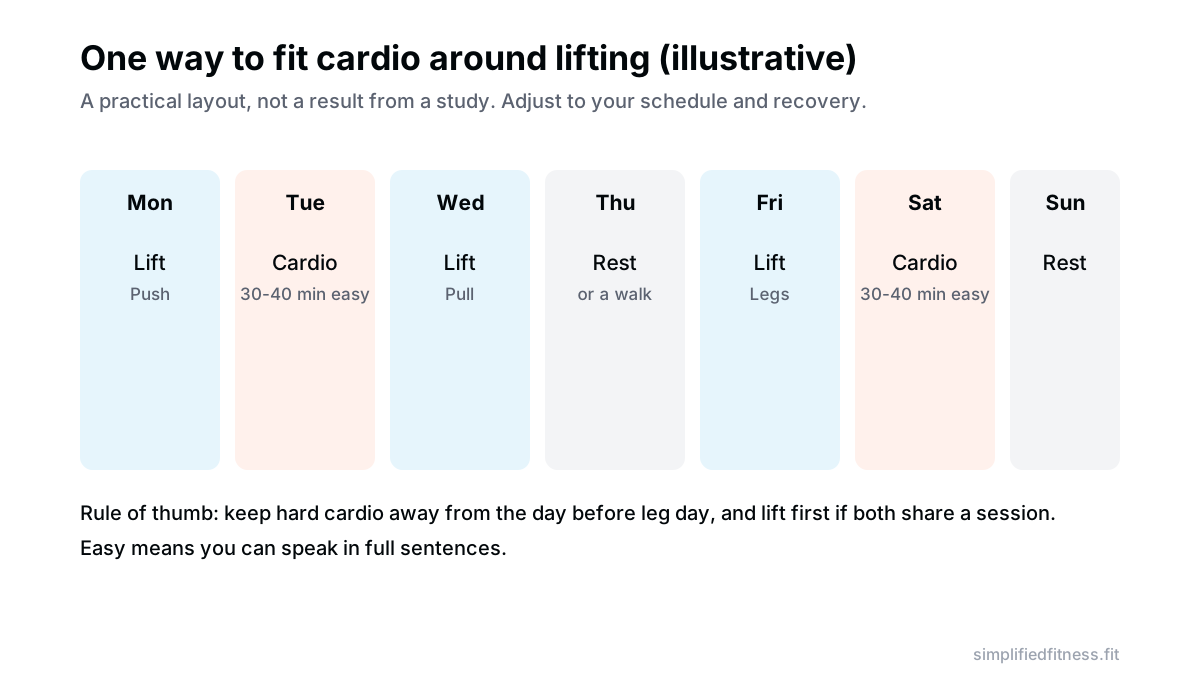
- Lift first when you share a session. Cardio first leaves you tired for the heavy work. (This is a practical rule. The 2022 fibre-size review found no effect of same-session order on fibre growth, so it is about the quality of your heavy sets.)
- Separate sessions when you can. Schumann et al. found explosive strength was attenuated more with same-session training than with sessions at least 3 hours apart (Schumann et al., 2022). For many people, a morning run and an evening lift is a neat split.
- Pick the gentle modality. Cycling, rowing, incline walking and the cross trainer are easier on your legs than high mileage running. More on timing and sequencing in timing cardio and weights.
- Start with 2-3 easy sessions a week. There is no proven ceiling, but that range fits well around a 3-4 day lifting plan. Wilson et al. linked higher frequency and duration of endurance work with smaller gains, so if your lifts stall, trim the cardio first.
- Keep the heavy lifting heavy. Do not swap strength sessions for cardio. In a calorie deficit, keep protein around 1.6-2.2 g/kg and keep progressing your lifts.
- Eat for the total work. More training burns more fuel. Dal, paneer, curd, eggs, soya chunks and roti or rice around training all help, especially in hot weather when you sweat a lot and drink less than you think.
Common mistakes lifters make with cardio
The most common mistake is going from zero cardio to five hard sessions a week, then blaming “interference” when the squat stalls. That is just too much new fatigue.
Another is doing a long run the day before leg day. Your legs will not recover, and the interference you feel is soreness and tiredness, not a molecular switch.
A third is cutting calories, adding cardio and dropping lifting volume all at the same time. When muscle shrinks in that situation, the deficit and the missing training are the likelier culprits. We cover the threshold question in can cardio cause muscle loss.
When to see a doctor
Cardio is safe for most people, but speak to a doctor before increasing it if you have known heart or lung disease, diabetes, high blood pressure that is not controlled, or you are returning after a long break. Stop and get medical advice if you notice chest pain, unusual breathlessness, dizziness or fainting during exercise.
The bottom line
Cardio does not kill gains. High volumes of running may shave a little off muscle growth, and explosive power is the thing most worth protecting, but for most lifters moderate cardio is a fair trade for a stronger heart and better work capacity. Lift first, space sessions out, favour cycling or walking when your legs matter, and keep your lifting heavy. If you want the full picture of how endurance and strength fit into one plan, see the maximal strength guide.
Frequently Asked Questions
Does cardio kill gains?
No, not at normal training volumes. A 2022 meta-analysis of 43 studies found that adding aerobic training to lifting did not reduce muscle hypertrophy or maximal strength compared with lifting alone. Keep your lifting volume and protein steady and add cardio in moderate doses.
What is the interference effect in concurrent training?
It is the idea that doing endurance and strength training together blunts the gains you would get from strength training alone. Older reviews found it, but newer and larger ones show it is small for muscle size and mostly affects explosive strength. It depends on how much, how often and what type of cardio you do.
How much cardio is too much for muscle growth?
There is no single proven cutoff. A 2012 meta-analysis found that longer and more frequent endurance training was linked with smaller gains, but a 2022 meta-analysis found no frequency effect on average. Start with 2-3 easy sessions a week and watch whether your lifting numbers keep climbing.
Is cycling better than running for keeping muscle?
Possibly, but the evidence is mixed. A 2012 meta-analysis linked running, not cycling, to worse outcomes, and a 2022 fibre-size analysis found the same for type I fibres only, while a 2022 whole-muscle analysis found no difference between the two. If leg day is your priority, cycling is a safe, lower-impact choice.
Should I do cardio before or after weights?
Lift first if both are in the same session. Cardio before lifting leaves your legs fatigued, which cuts the quality of your heavy sets. When it is practical, a gap of 3 or more hours between sessions seemed to protect explosive strength in one meta-analysis.
Does AMPK block mTOR and stop muscle growth?
In rodent and cell work, yes, activated AMPK can inhibit mTORC1. In a study of eight trained men, though, interval cycling raised AMPK but did not block mTORC1 signalling after resistance exercise. Treat the pathway as a hypothesis, not a reason to avoid cardio.
Can I do cardio on leg day?
You can, but do the lifting first and keep the cardio short and easy. Heavy squats and hard intervals compete for the same legs and the same recovery. A better option is cardio on a separate day, or an upper body day.
How do I do cardio without losing muscle?
Keep eating enough protein, keep your lifting heavy and progressive, and add cardio in modest amounts. When lifters lose muscle while doing more cardio, a large calorie deficit and reduced lifting are often part of the picture. If you are in a deficit, roughly 1.6-2.2 g/kg protein daily is a commonly used target.
Is Zone 2 cardio good for lifters?
It is a sensible choice because it is low impact and easy to recover from. Reviews show easy continuous training improves mitochondrial content and capillarization, mostly in people who are not already very fit. There is no direct proof yet that it helps your rest between heavy sets, so treat that as plausible, not established.
Does concurrent training work for older adults?
Yes. A 2025 meta-analysis of 53 trials in people over 50 found combined training increased muscle mass as effectively as lifting alone. It also lowered body fat measures as well as cardio alone. If you have any health conditions, check with your doctor about intensity first.
How much cardio do I need for health if I lift?
The US Physical Activity Guidelines recommend 150-300 minutes a week of moderate cardio, or 75-150 minutes of vigorous, plus muscle strengthening on 2 or more days. That fits comfortably around a 3-4 day lifting plan. Walking after meals counts, and it is very easy on recovery.
Will HIIT hurt my gains more than steady cardio?
The evidence does not give a clean answer in humans. HIIT is more fatiguing, so it is easier to overdo and it can crowd out lifting quality. If you like intervals, keep them to once or twice a week and away from heavy leg sessions.
Sources & References
Every claim above is checked against peer-reviewed research (PubMed, U.S. National Library of Medicine) or guidance from established health bodies. How we fact-check.
- Wilson JM, et al. Concurrent training: a meta-analysis examining interference of aerobic and resistance exercises. J Strength Cond Res. 2012. PMID: 22002517
- Schumann M, et al. Compatibility of concurrent aerobic and strength training for skeletal muscle size and function: an updated systematic review and meta-analysis. Sports Med. 2022. PMID: 34757594
- Lundberg TR, et al. The effects of concurrent aerobic and strength training on muscle fiber hypertrophy: a systematic review and meta-analysis. Sports Med. 2022. PMID: 35476184
- Fyfe JJ, et al. Interference between concurrent resistance and endurance exercise: molecular bases and the role of individual training variables. Sports Med. 2014. PMID: 24728927
- Apró W, et al. Resistance exercise-induced S6K1 kinase activity is not inhibited in human skeletal muscle despite prior activation of AMPK by high-intensity interval cycling. Am J Physiol Endocrinol Metab. 2015. PMID: 25605643
- Mølmen KS, et al. Effects of exercise training on mitochondrial and capillary growth in human skeletal muscle: a systematic review and meta-regression. Sports Med. 2025. PMID: 39390310
- Khalafi M, et al. The effects of concurrent training versus aerobic or resistance training alone on body composition in middle-aged and older adults: a systematic review and meta-analysis. Healthcare (Basel). 2025. PMID: 40218073
- Piercy KL, et al. The Physical Activity Guidelines for Americans. JAMA. 2018. PMID: 30418471

Umair Hazrami · Founder & Head Coach, Simplified Fitness
Umair Hazrami founded Simplified Fitness and the Simplified Lifter channel to cut through fitness noise. With 4+ years of consistent training and 10+ coaching clients, he writes every guide from the peer-reviewed research and links the sources so you can check them. Our editorial standards.
Educational content only, not medical advice. If you have a medical condition, are pregnant, or take medication, talk to a qualified doctor before changing your diet, supplements or training. Full disclaimer.
Keep reading
Health & Longevity
Are Deadlifts Bad for Your Lower Back? What Spinal Loading Research Shows
Are deadlifts bad for lower back health? The research shows spinal loads are high but tolerable, and trials use loaded lifting for back pain. How to hinge.
9 min read

Health & Longevity
Are Squats Bad for Your Knees? What the Research Actually Says
Are squats bad for your knees? Research on deep squats, kneecap stress and the knees-over-toes rule shows where the myth came from and how to squat safely.
9 min read

Health & Longevity
Why Tendons Adapt Slower Than Muscles: Connective Tissue Timelines for Lifters
Tendon adaptation vs muscle growth: why your tendons lag behind your strength gains, what studies show about timelines, and how to add load without tendonitis.
8 min read

Health & Longevity
Desk Worker Workout Routine: Fix Pelvic Tilt, Weak Glutes and a Rounded Upper Back
A desk worker workout routine built on evidence: what sitting really does to your hips, why pelvic tilt is mostly normal, and 3 gym correctives that help.
8 min read