The Muscle Toning Myth: Why Light Weights and High Reps Don't Tone
The muscle toning myth explained: muscle can only grow, shrink or stay the same. See what the research says about light weights, high reps and fat loss.

TL;DR. The short answer
- There is no special type of exercise that 'tones' muscle. Muscle can grow, shrink or stay the same, and the toned look is simply enough muscle with a modest amount of body fat over it.
- Light weights can build muscle, but only when sets are taken close to failure. A meta-analysis of 21 trials found similar muscle growth with low and high loads when every set went to failure.
- You cannot choose where fat comes off. In a 12-week arm training study of 104 people, MRI showed fat loss across the whole arm, not just the trained muscle.
- To get the toned look without getting bulky, lift progressively 2-3 times a week, eat enough protein (about 1.6 g/kg a day), and keep a gentle calorie deficit if you want to lose fat.
- Muscle gain is slow for most people, so the 'bulky' fear is rarely a real risk in the first months of training.
Part of our complete guide: Joint-Friendly Lifting & Fitness Myths: A Guide for Over-40s, Teens and Sore Backs
Table of contents
The muscle toning myth says there is a special way to train, with light weights and lots of reps, that firms muscle without making it bigger. There is not. Muscle can only get bigger, get smaller or stay the same, and the “toned” look is just a reasonable amount of muscle with a modest layer of body fat on top.
This article is part of our joint-friendly lifting and myth busting guide. Here we take apart the word “toning”, look at what really happens when you do 50 reps with a tiny dumbbell, and lay out how to get the lean, shaped look using normal progressive training and food.
What does “toned” actually mean?
Ask ten people and you get ten answers. Firm arms. Visible shoulders. A flat stomach with a little definition. A lifted look in the glutes.
Every one of those descriptions comes down to two things you can see from the outside: how much muscle you have and how much fat covers it. That is the whole picture.
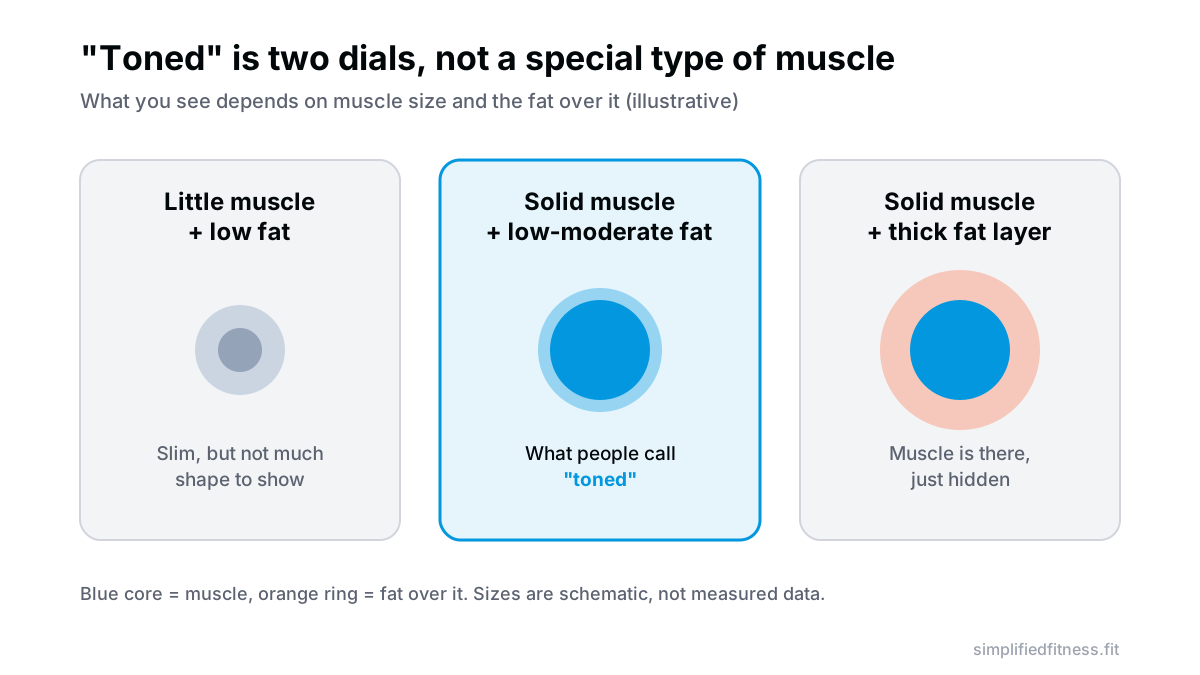
You may also hear that “tone” means the slight tension in a resting muscle. That is a real physiological idea (muscle tone, or tonus), and it is regulated by the nervous system, not by how many reps you do. It is not what a fitness ad means when it promises “long, lean, toned” muscles. The ad is selling a look, and the look is built from the two dials above.
Where did the “toning” idea come from?
I cannot point to a single origin study, because it is a marketing word rather than a scientific one. What is clear is who it was aimed at. Pink dumbbells, “sculpt” classes and “long, lean” workouts were sold mostly to women who were told, directly or not, that lifting would make them look bulky.
The fear sold the product. If heavy lifting is scary, then a light, high-rep alternative sounds safe. The trouble is that the alternative is often too easy to cause much change, while the fear itself is largely unfounded (we deal with it properly in will lifting heavy make women bulky).
Do light weights and high reps tone muscle?
Here is the nuance, and it is where most “toning is a myth” posts overcorrect. Light weights can build muscle. High reps can build muscle. What matters is how close each set gets to failure.
A 2017 systematic review and meta-analysis compared low-load training (60% of one-rep max or less) with high-load training (above 60%) across 21 studies, all with sets taken to momentary failure. Strength on a one-rep max test favoured heavy loads, but changes in muscle size were similar between conditions. The authors concluded that muscle hypertrophy can be achieved equally across a spectrum of loading ranges (Schoenfeld et al., 2017).
A 2020 meta-analysis of muscle fibre size agreed in direction, finding no significant difference between low and high loads, though it also warned that the confidence intervals were very wide and more research is needed (Grgic, 2020). A later review proposed that muscular adaptations can be obtained, and sometimes optimised, across a wide range of loading zones rather than only in a “hypertrophy zone” (Schoenfeld et al., 2021).
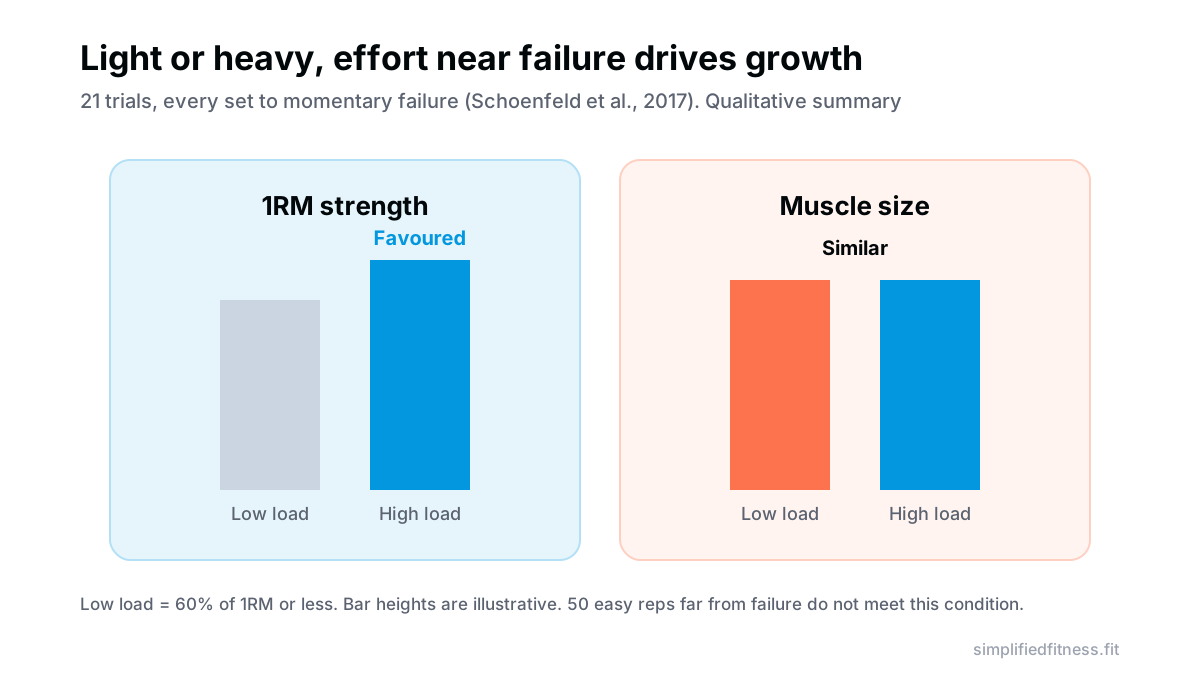
So why does the myth still hold up as advice? Because of that failure condition.
What happens when you lift 2 kg dumbbells for 50 reps?
For most healthy adults, probably very little, and here is the reasoning. The low-load studies behind the meta-analysis had participants take every set to momentary failure. Fifty reps with a light dumbbell that you could keep lifting for 100 is not that. It ends from boredom, a mild burn or a clock, not because the muscle ran out of steam.
That is my interpretation of the research, not a result from a specific 50-rep trial, so treat it as reasoning rather than proof. The practical point is simple: the weight needs to be heavy enough, or the set long enough, that the last few reps are genuinely hard.
There is a joint-friendly upside here too. If your knees, shoulders or elbows dislike heavy loads, a moderate weight taken close to failure is a legitimate way to train. See the load and rep range guide for how to choose.
Can you tone one body part? The spot reduction question
This is the second pillar of the toning industry: the idea that inner-thigh work removes inner-thigh fat, or crunches shrink the belly.
The best-known study here trained the non-dominant arm of 104 adults (45 men and 59 women) for 12 weeks and compared the trained arm with the untrained arm. Skinfold calipers suggested fat dropped in the trained arm of men but not women. MRI, which looks along the whole upper arm, found a generalised fat loss that did not differ between arms. The authors concluded that MRI supports the idea that spot reduction does not occur with resistance training (Kostek et al., 2007).
Not everything points the same way. A small 2023 randomised trial in 16 overweight men (average age 43) compared 10 weeks of abdominal endurance exercise plus running against running alone. Trunk fat fell by about 700 g more in the abdominal group, and the authors concluded that spot reduction exists in adult males (Brobakken et al., 2023).
How do we reconcile these? The 2023 study was tiny, male-only, in overweight middle-aged men, and used a heavy dose of abdominal work, so it is hard to generalise to, say, a 25-year-old woman doing a few sets of leg raises. The 2007 study was far larger but tested only the arm over 12 weeks. A cautious reading is that any local effect, if real, is small and not something to build a programme around. Whole-body fat loss remains the dependable route.
Does resistance training help you lose fat?
A little, yes, which is part of why it helps the “toned” look. A systematic review of 58 randomised trials in healthy adults (54 in the meta-analysis) found that resistance training, compared with no exercise, reduced body fat percentage by about 1.46 percentage points, fat mass by about 0.55 kg and visceral fat as well (Wewege et al., 2022). Training volume and sex did not clearly change the result.
Those are modest numbers. Lifting alone will rarely change how you look dramatically, because the effect on fat loss itself is small. What lifting does well is protect and build the muscle that makes a smaller body look shaped rather than just smaller. If you want more fat loss, a modest calorie deficit is what moves the needle, and our calorie calculator is a reasonable starting point. For the reverse side of this, see does sweat equal fat loss.
How to tone muscle without getting bulky
Short answer: the same way everyone builds muscle, just at a pace you control. Bulk does not sneak up on you. Gaining noticeable size takes sustained progressive training and a lot of eating.
How fast does muscle really grow? Individual responses vary enormously. In 585 adults (342 women, 243 men) who trained one arm for 12 weeks, muscle size changes ranged from a small decrease to about a 59% increase, and men had only a slight advantage in relative size gains (Hubal et al., 2005). A 2025 meta-analysis of 29 studies similarly found relative increases in muscle size were similar between sexes, with absolute gains slightly favouring males (Refalo et al., 2025). Women are not locked out of results, but nobody blows up overnight either.
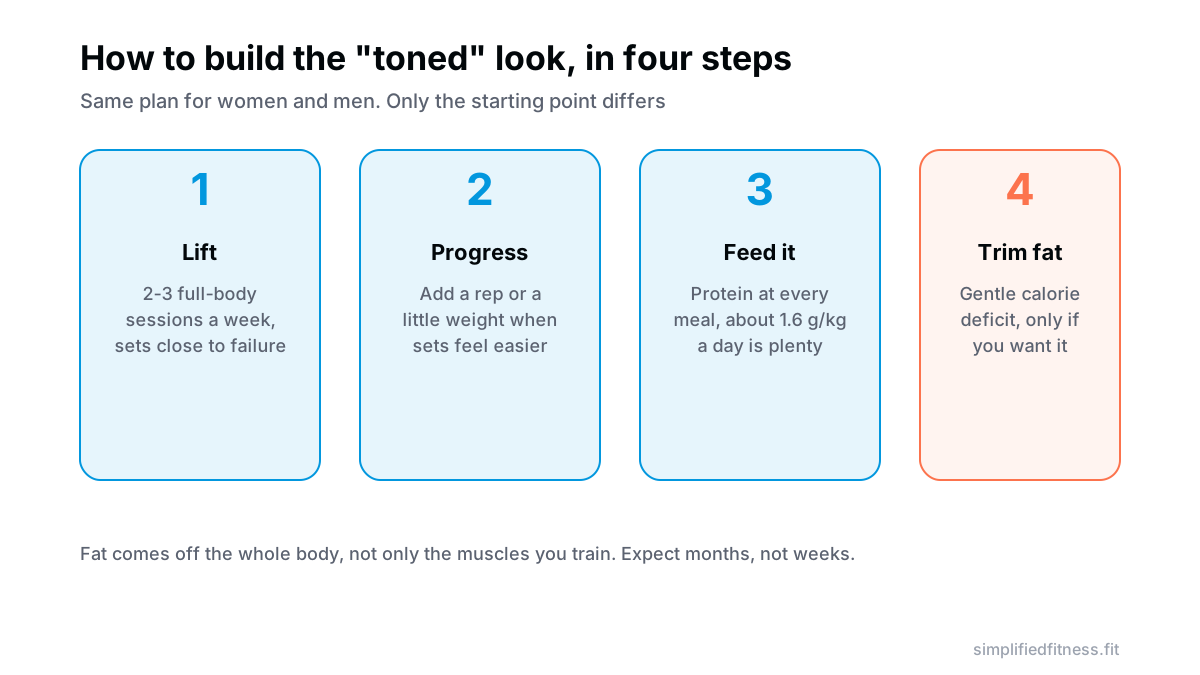
Step 1 and 2: lift, then progress
Train each major muscle group with sets that get close to failure, ideally spread over two or more sessions a week. An overview of 137 systematic reviews underpinning the American College of Sports Medicine position stand found that muscle hypertrophy was enhanced by higher volumes, around 10 or more sets per week, while many other training variables made little consistent difference (Currier et al., 2026). Beginners often grow on less, so starting with 6-10 hard sets per muscle per week is reasonable. You can plan this with the training volume calculator.
Progression is the engine. Add a rep, then add a little weight. If you want a simple rule, our double progression guide covers it, and the muscle confusion myth explains why changing exercises every session works against you.
Step 3: eat enough protein
A 2018 meta-analysis of 49 trials with 1,863 participants found protein supplementation modestly increased muscle and strength gains during resistance training, with no further gains in fat-free mass beyond total intakes of roughly 1.6 g/kg per day (Morton et al., 2018). Note that the benefit was small on average (about 0.3 kg of fat-free mass). For a 60 kg person, 1.6 g/kg is about 96 g a day.
In an Indian kitchen that can look like: eggs or paneer at breakfast, dal and curd with lunch, a soya chunk or chicken dish at dinner, and a protein shake only if the food falls short. Work out your own number with the protein calculator. For a deeper look, read optimal daily protein intake for hypertrophy.
Step 4: trim fat only if you want to
If you are happy with your fat level, skip this step. If you want a leaner look, eat slightly below maintenance and keep lifting so the muscle you already have stays. Losing fat while holding or adding muscle is possible for many beginners, as covered in body recomposition. The body fat calculator gives a rough marker to track.
A simple week that works
You do not need a “toning” programme. You need a plain full-body or upper-lower plan you can repeat.
| Day | Session | Notes |
|---|---|---|
| Mon | Full body A | Squat or leg press, press, row, curl |
| Wed | Full body B | Hip hinge, incline press, pulldown, lateral raise |
| Fri | Full body C | Lunge, shoulder press, row, triceps |
| Other days | Walk, rest, play | Steps help with fat loss |
Each exercise: 2-3 sets of 8-15 reps, stopping a few reps short of failure on compound lifts and closer to failure on isolation lifts. If you want ready-made sessions, our free push day, pull day and leg day plans fit this approach.
Is there anything to watch out for?
Two things. First, if you have a medical condition, are pregnant, have joint pain or an injury, or are returning after a long break, check with a doctor or physiotherapist before ramping up loads. Second, if you find yourself fixating on a body shape, restricting food heavily or feeling distress about your body, please talk to a doctor or qualified mental health professional. A training article cannot diagnose or treat that.
The bottom line
“Toning” is a marketing word for something real: a bit more muscle and a bit less fat. Light weights can work if you push sets close to failure, and heavier ones work well too. Spot reduction is not a dependable plan. What reliably works is slow progressive lifting, enough protein, patience and, if you want it, a gentle calorie deficit.
If your next question is whether lifting will make you bulky, that is the whole point of our article on women and heavy lifting. Until then, put down the 2 kg dumbbell and pick one that makes the last reps hard.
Frequently Asked Questions
Is muscle toning a myth?
Mostly, yes. Muscle does not have a 'toned' setting, because it can only grow (hypertrophy), shrink (atrophy) or stay about the same. What people call toned is usually a decent amount of muscle plus a low enough body fat level for the shape to show. The practical action is to train for strength and size, then adjust food if you also want less fat.
Do light weights and high reps tone muscle?
They can, but not because of the rep count. A 2017 meta-analysis found muscle growth was similar with light and heavy loads when sets were taken to momentary failure. If you stop 20 reps short of failure with a tiny dumbbell, there is little reason for the muscle to grow, so pick a weight that makes the last few reps hard.
What does toned mean in fitness?
It is not a scientific term. In everyday use it means visible muscle shape with relatively little fat covering it. That comes from two levers you can control, which are building muscle and, if needed, losing body fat, so set goals around both rather than around a vague word.
How do I tone my body without getting bulky?
Lift with a progressive plan, eat enough protein, and keep calories near maintenance or slightly below. Gaining large amounts of muscle takes years of hard training and plenty of food for most people, so it does not happen by accident. If your shape changes faster than you want, you can simply lower training volume or eat a little more or less.
What is the difference between toning and building muscle?
There is no physiological difference. Both mean resistance training that makes muscle fibres slightly bigger or stronger, with the visible result depending on how much fat sits on top. Treat 'toning' as a marketing word for building a modest amount of muscle and use the same progressive training either way.
Can you tone one body part, like arms or belly?
Not reliably. Training a muscle makes it stronger or bigger, but the fat over it does not simply melt away. In a 12-week study of 104 adults, MRI found fat loss spread across the whole arm rather than concentrated on the trained muscle. A smaller 2023 trial in overweight men found extra trunk fat loss after abdominal training, so the question is not fully settled, but whole-body fat loss is the dependable route.
How many reps should I do to tone?
A wide range of rep counts can build muscle if the set is taken close to failure. A 2017 meta-analysis found similar growth with loads at or below 60% of one-rep max and heavier loads when sets went to failure. Choose a range you enjoy, such as 8-15 reps, and stop each set with a few reps left in the tank or at failure on safe exercises.
How many sets per week do I need to see muscle?
An overview of 137 systematic reviews found muscle growth was enhanced by higher volumes of about 10 or more sets per week. Beginners often progress with fewer, so start with 6-10 and add sets only if progress stalls. Our training volume calculator can help you plan it.
Will lifting weights make women bulky?
Unlikely. A 2025 meta-analysis found relative muscle size gains were similar in females and males, and absolute gains slightly favoured males, but neither group balloons quickly. Visible, bulky size takes sustained training, big calorie intake and often years. We cover this in depth in a separate article on women and heavy lifting.
Why do I look softer even though I lift?
Muscle may be growing while a layer of body fat still covers it, so the shape does not show yet. A resistance training meta-analysis in healthy adults found modest fat loss from lifting alone, about 1.5 percentage points of body fat on average. To change how you look, combine lifting with a gentle calorie deficit and give it months.
How much protein do I need to build muscle?
A 2018 meta-analysis of 49 trials found extra protein helped muscle gains up to about 1.6 g/kg of body weight per day, with no added benefit beyond that. For a 60 kg person that is roughly 96 g, which dal, curd, paneer, eggs, soya and chicken can cover. Spread it across meals and use the protein calculator to find your number.
Is 2 kg dumbbell work for 50 reps useful?
For most healthy adults it is not very useful for building muscle, because the set ends from boredom or mild burn, not from muscle being pushed near its limit. Low-load studies that showed growth took sets to failure, and that would take far more effort than casual 50-rep sets. Use a heavier dumbbell so you reach 12-20 hard reps instead.
How long does it take to see a toned look?
It varies a lot between people. In one study of 585 adults doing 12 weeks of arm training, muscle size change ranged from a small loss to about 59 percent growth. Expect to notice strength first, then shape over a few months, and track strength, photos and waist rather than only scale weight.
Sources & References
Every claim above is checked against peer-reviewed research (PubMed, U.S. National Library of Medicine) or guidance from established health bodies. How we fact-check.
- Schoenfeld BJ, et al. Strength and hypertrophy adaptations between low- vs. high-load resistance training: a systematic review and meta-analysis. J Strength Cond Res. 2017. PMID: 28834797
- Schoenfeld BJ, et al. Loading recommendations for muscle strength, hypertrophy, and local endurance: a re-examination of the repetition continuum. Sports (Basel). 2021. PMID: 33671664
- Kostek MA, et al. Subcutaneous fat alterations resulting from an upper-body resistance training program. Med Sci Sports Exerc. 2007. PMID: 17596787
- Brobakken MF, et al. Abdominal aerobic endurance exercise reveals spot reduction exists: a randomized controlled trial. Physiol Rep. 2023. PMID: 38010201
- Wewege MA, et al. The effect of resistance training in healthy adults on body fat percentage, fat mass and visceral fat: a systematic review and meta-analysis. Sports Med. 2022. PMID: 34536199
- Hubal MJ, et al. Variability in muscle size and strength gain after unilateral resistance training. Med Sci Sports Exerc. 2005. PMID: 15947721
- Refalo MC, et al. Sex differences in absolute and relative changes in muscle size following resistance training in healthy adults: a systematic review with Bayesian meta-analysis. PeerJ. 2025. PMID: 40028215
- Currier BS, et al. American College of Sports Medicine position stand. Resistance training prescription for muscle function, hypertrophy, and physical performance in healthy adults: an overview of reviews. Med Sci Sports Exerc. 2026. PMID: 41843416
- Morton RW, et al. A systematic review, meta-analysis and meta-regression of the effect of protein supplementation on resistance training-induced gains in muscle mass and strength in healthy adults. Br J Sports Med. 2018. PMID: 28698222
- Grgic J. The effects of low-load vs. high-load resistance training on muscle fiber hypertrophy: a meta-analysis. J Hum Kinet. 2020. PMID: 33312275

Umair Hazrami · Founder & Head Coach, Simplified Fitness
Umair Hazrami founded Simplified Fitness and the Simplified Lifter channel to cut through fitness noise. With 4+ years of consistent training and 10+ coaching clients, he writes every guide from the peer-reviewed research and links the sources so you can check them. Our editorial standards.
Educational content only, not medical advice. If you have a medical condition, are pregnant, or take medication, talk to a qualified doctor before changing your diet, supplements or training. Full disclaimer.
Keep reading
Health & Longevity
Are Deadlifts Bad for Your Lower Back? What Spinal Loading Research Shows
Are deadlifts bad for lower back health? The research shows spinal loads are high but tolerable, and trials use loaded lifting for back pain. How to hinge.
9 min read

Health & Longevity
Are Squats Bad for Your Knees? What the Research Actually Says
Are squats bad for your knees? Research on deep squats, kneecap stress and the knees-over-toes rule shows where the myth came from and how to squat safely.
9 min read

Health & Longevity
Why Tendons Adapt Slower Than Muscles: Connective Tissue Timelines for Lifters
Tendon adaptation vs muscle growth: why your tendons lag behind your strength gains, what studies show about timelines, and how to add load without tendonitis.
8 min read

Health & Longevity
Desk Worker Workout Routine: Fix Pelvic Tilt, Weak Glutes and a Rounded Upper Back
A desk worker workout routine built on evidence: what sitting really does to your hips, why pelvic tilt is mostly normal, and 3 gym correctives that help.
8 min read