Lower Back Friendly Leg and Back Workout: Train Hard During a Flare-up
A lower back friendly leg workout and back routine for flare-ups: chest-supported rows, belt squats and hip thrusts, with the research and a safe reload plan.

TL;DR. The short answer
- A lower back friendly leg workout swaps barbell back squats for belt squats, leg press or machines, so the load never sits on your spine. Leg size can keep growing while your back settles.
- In a 2009 biomechanics study, the standing bent-over row produced the largest lumbar spine load of three rows, while the inverted row produced the lowest. Chest-supported rows were not tested, but the pad removes the hinged position that makes bent-over rows demanding.
- Hip thrusts load the glutes heavily without a bar on the spine, but a 4-week trial found they did not raise isolated lumbar extension strength, so they are a swap, not a back-strengthening exercise.
- For chronic non-specific low back pain, exercise (including resistance training) beats no treatment for pain, and advice to stay active beats bed rest for acute episodes.
- Pain spreading down a leg, numbness, weakness, fever or loss of bladder or bowel control needs a doctor, not a workout tweak.
Part of our complete guide: Joint-Friendly Lifting & Fitness Myths: A Guide for Over-40s, Teens and Sore Backs
Table of contents
A lower back friendly leg workout keeps the bar off your spine: belt squats, leg press, leg curls and hip thrusts replace back squats and deadlifts, and chest-supported rows replace bent-over rows. You can keep training hard, and keep building muscle, while a sensitive back settles.
This guide is part of our joint-friendly lifting and myth-busting guide. It covers non-specific flare-ups (the “I bent down and my back grabbed” kind), not diagnosed injuries. If yours is diagnosed, your doctor or physio has the final say.
Why does axial loading trigger flare-ups?
Axial loading means weight pressing down along your spine: a bar across your shoulders, or a barbell pulled off the floor while you hold a hinged position. Your back muscles have to brace under that load for the whole set.
When the area is irritated, that sustained bracing can be the thing that keeps it irritated. It is not that squats or deadlifts are “bad” (we cover that in are deadlifts bad for your lower back). It is that during a flare-up, you want the legs and upper back working hard while the spine does less. For the recovery side of this outside of flare-ups, see axial vs non-axial loading.
Chest-supported row vs bent-over row for back pain
The bent-over row asks your lower back to hold a hinged torso against gravity while you pull. That is a lot of static work for an area that is already unhappy.
The best direct evidence is a biomechanics lab study of 7 healthy men comparing three rows. The standing bent-over row produced large activation across the whole back but also the largest lumbar spine load. The inverted row had the lowest erector spinae activation and the lowest spine load, while still giving the highest lat activation (Fenwick et al., 2009). The authors note that people wanting to spare the low back may choose the inverted row.
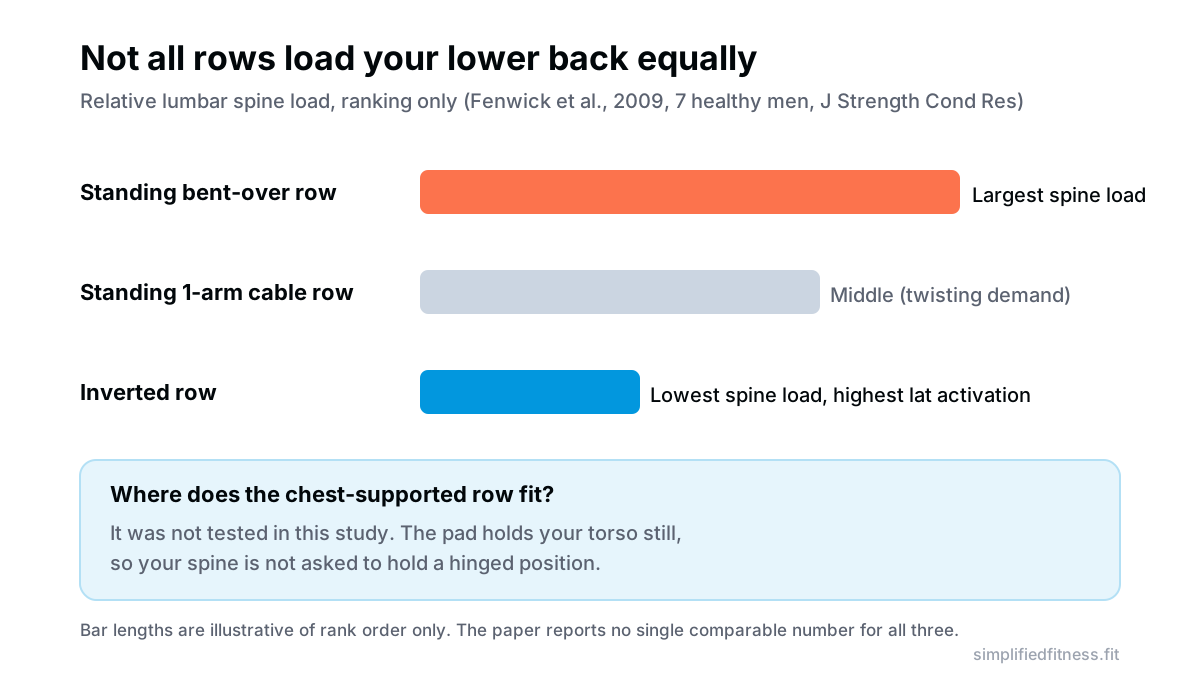
Be clear about the limits. That study did not test chest-supported rows, had only 7 healthy young men, and measured muscle activity and spine load, not pain. The case for the chest-supported row is a reasoned inference: the pad holds your torso so your spine does not have to hold the hinge. It is a sensible swap, not a proven one. We cover technique in chest-supported rows for upper back hypertrophy, and the other side in bent-over rows and spinal load.
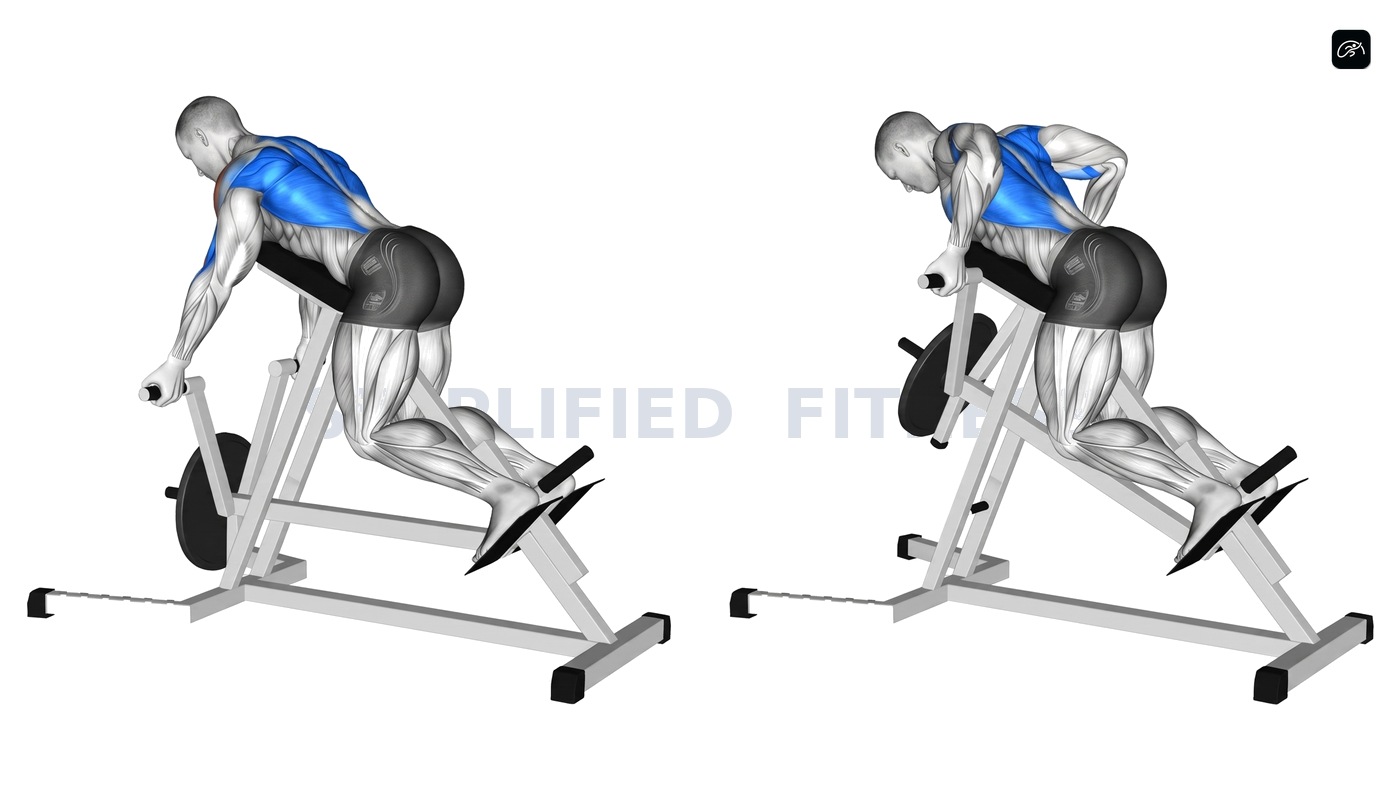
Good back friendly back exercises, in rough order of how little they ask of the spine:
- Chest-supported T-bar or machine row
- Inverted row or seated cable row with a tall, supported torso
- Wide-grip lat pulldown
- Straight-arm pulldown and cable pullovers
Belt squat for lower back pain
A belt squat is a machine squat where the weight hangs from a belt around your hips. Nothing sits on your shoulders, so the bar-on-spine loading is gone. I have not found trials that measured spine load in belt squats directly, so treat the benefit as mechanical logic, not proven fact.
On muscle work, a 2019 study of 31 lifters (16 men, 15 women) tested a 5-rep max in both. Glute activation was significantly lower in the belt squat than in the back squat, while quad measures were not reported as different (Evans et al., 2019). A separate systematic review still placed the belt squat in its “very high” glute activation group, above 60% of maximal voluntary contraction (Neto et al., 2020).
Do not have a belt squat machine? Plenty of gyms do not. A leg press with your lower back flat against the pad or a hack squat does a similar job. See leg press foot placement and keep your hips from curling off the seat at the bottom.
Hip thrusts instead of deadlifts
The hip thrust loads the glutes with the bar over your hips and your upper back on a bench. A systematic review of 16 studies listed traditional barbell hip thrusts among the exercises with very high glute activation (above 60% MVIC), alongside the conventional deadlift (Neto et al., 2020).
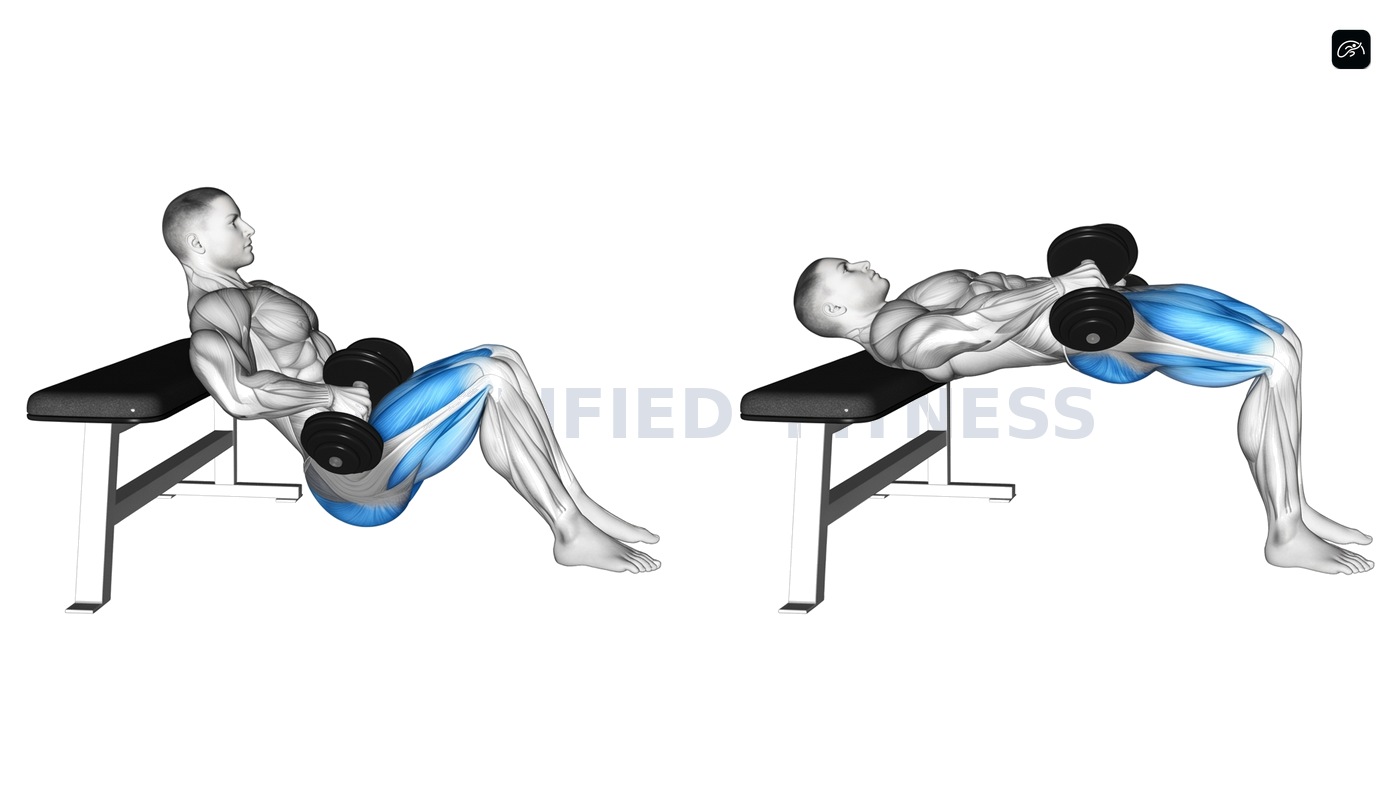
One caution. In a 4-week trial of 14 trained men, neither barbell hip thrusts nor back squats significantly improved isolated lumbar extension strength (Hammond et al., 2019). So hip thrusts are a way to keep training hips and glutes, not a way to rebuild a weak lower back. The trial was small and short, so hold that loosely. For the glute comparison, see hip thrust vs squats for glutes.
Keep thrusts clean: ribs down, chin tucked, stop when your hips are in line with your torso, and do not arch your lower back at the top.
A lower back friendly leg workout you can run
Here is a simple session built from supported lifts. Treat sets as a starting point, not a prescription.
| Exercise | Sets x reps | Notes |
|---|---|---|
| Belt squat or leg press | 3 x 8-12 | Lower back flat on the pad |
| Seated leg curl | 3 x 10-15 | Seat pad holds you still |
| Single-leg extension | 2-3 x 10-15 | Stop 1-2 reps short of failure at first |
| Hip thrust | 2-3 x 8-12 | Neutral top position |
| Standing calf raise | 3 x 10-15 | Light, controlled |
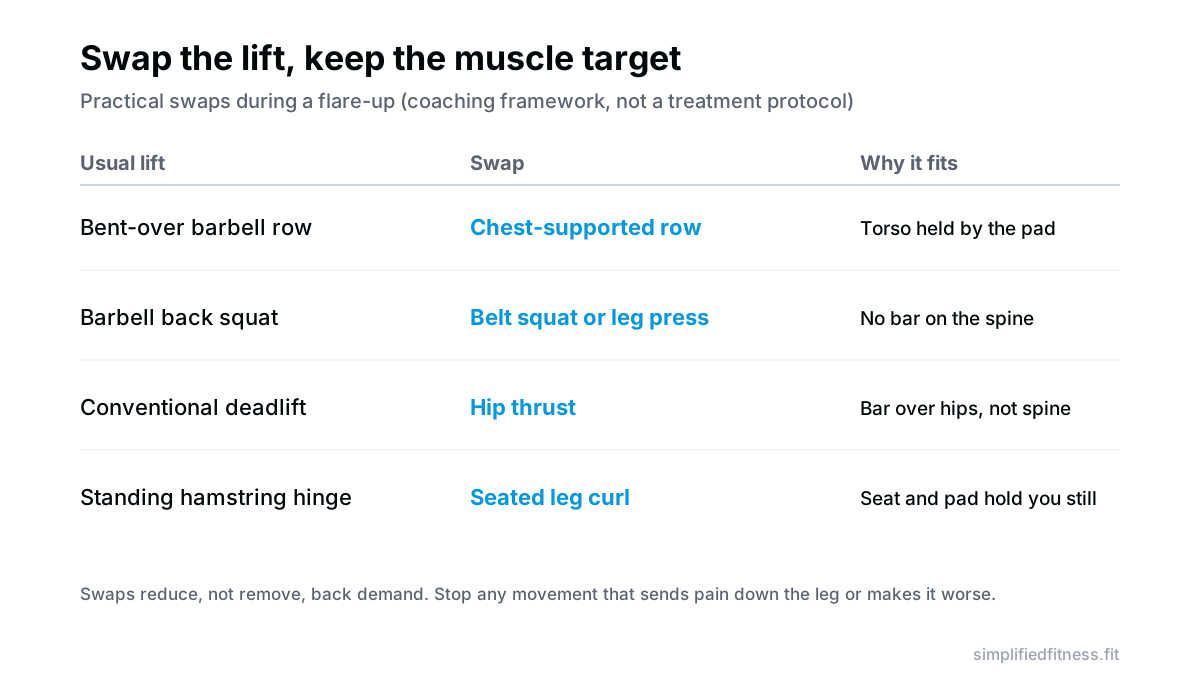
For upper back, pair chest-supported rows with lat pulldowns and a rear-delt machine. Our pull day plan and leg day plan show how to structure the week, and you can swap in the options above.
Will I lose muscle on lighter, supported work?
Probably not much, especially short term. A meta-analysis of randomised trials found that loads at or below 50% of 1RM built strength and muscle in untrained people, with a trend favouring heavier loads that did not reach significance (Schoenfeld et al., 2016). That evidence came from mostly untrained participants, so it may not map exactly to experienced lifters.
The practical takeaway: machines with sets taken close to failure are a sensible way to keep stimulus high while your spine calms down. You can estimate your working loads with the 1RM calculator if you are unsure where to start.
What does the research say about training with back pain?
Exercise helps, and it does not need to be gentle forever. A Cochrane review of 249 trials in chronic non-specific low back pain found moderate-certainty evidence that exercise reduces pain compared with no treatment, usual care or placebo at the earliest follow-up (mean difference -15.2 points on a 0-100 scale, which the authors counted as clinically important) (Hayden et al., 2021). The effect on functional limitations was small and did not reach the authors’ threshold for clinical importance.
A 2026 meta-analysis of 10 trials with 434 participants found resistance training improved pain intensity, with only the pain result reaching clinical significance, and moderate certainty (Rodriguez-Dominguez et al., 2026). Its authors suggested structured, progressive programs of at least 12 weeks.
For acute episodes, a Cochrane review of ten trials found small benefits in pain and function for advice to stay active compared with bed rest, although for sciatica there was little to no difference (Dahm et al., 2010). The trials had varying risk of bias, and none of these reviews tells you which specific exercise is best. So choose by what you tolerate.
How do I reload after a flare-up?
There is no research-backed timeline for reloading squats and deadlifts, so use symptoms, not the calendar. A simple ladder:
- Supported: machines, pads, chest-supported rows.
- Add hips: hip thrusts and belt squats, adding load slowly.
- Light hinge: a light Romanian deadlift or back extension for easy reps.
- Spine-loaded: squats, rows and deadlifts, at a reduced load first.
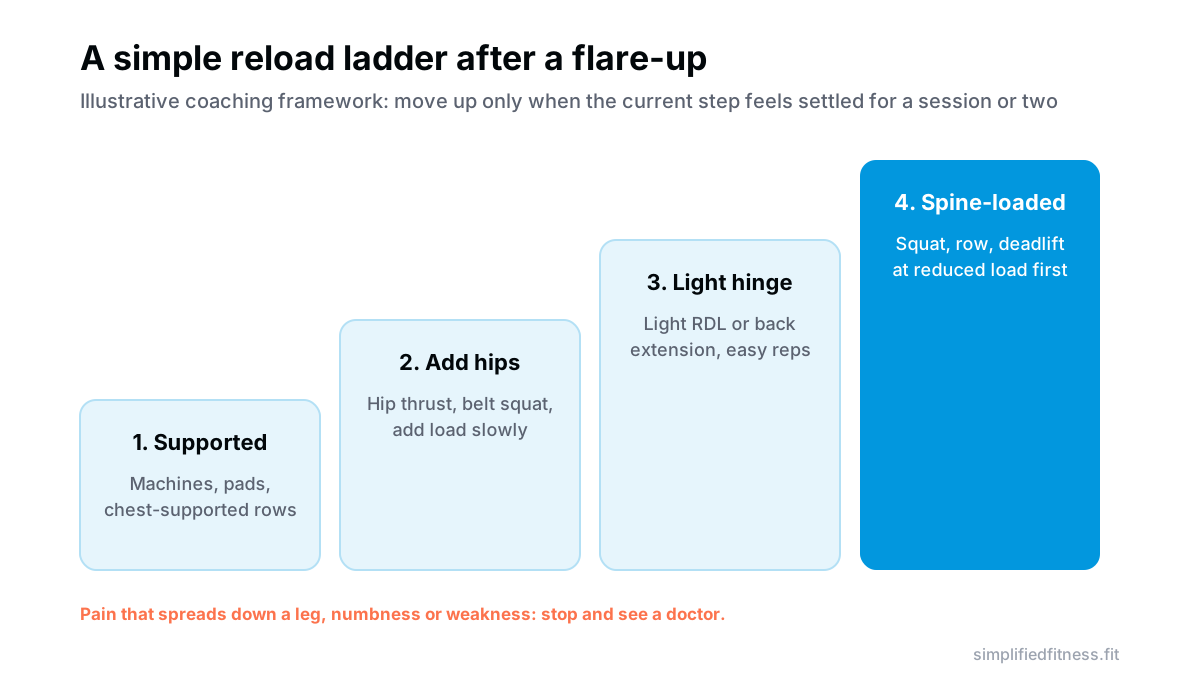
Move up when the last step felt fine afterwards and the next morning. Drop back a step if pain sharpens. Mild, familiar achiness that fades within a day is different from pain that gets worse. Our traffic light model for returning post-injury goes deeper on that distinction.
When to see a doctor
A flare-up that improves over days to a few weeks is common. But stop training and get assessed if you notice:
- Pain that travels below the knee, or numbness or tingling in a leg or the groin area
- Leg weakness, or a foot that drags
- Fever with back pain, or unexplained weight loss
- Any change in bladder or bowel control
- Pain after a fall or significant impact, or pain that wakes you at night and keeps worsening
This article is general education, not a diagnosis. If you are unsure, an in-person assessment beats any list.
The bottom line
A lower back friendly leg workout is not a “lite” workout. It is the same effort moved to places your spine does not have to carry. Chest-supported rows, belt squats or leg press, leg curls and hip thrusts keep your muscles busy, while exercise and staying active are the best-supported tools for most non-specific back pain. Evidence on the exact swaps is thinner than people claim, so go gradually and listen to your symptoms. Our full joint-friendly guide and pain-free hypertrophy tips are good next reads.
Frequently Asked Questions
What is a good lower back friendly leg workout?
Build it around leg press or belt squat, a leg curl, a leg extension and calf raises, all of which keep the bar off your spine. These machines let you push close to failure with your torso supported, so the legs still get a hard stimulus. Start with 2-3 sets per exercise and add load only when the previous session felt fine.
Are chest-supported rows better than bent-over rows for back pain?
They are usually easier on a sensitive back, though no study here compared them head to head. A 2009 study found the bent-over row produced the largest lumbar load of the rows it tested, and the chest pad removes that hinged, braced position. If you have a flare-up, a chest-supported row is the lower-risk choice.
Is a belt squat good for lower back pain?
It is a reasonable option because the weight hangs from a belt at your hips instead of sitting on your shoulders. That removes the bar on the spine, though I am not aware of trials measuring belt squat spine load directly. Start light, keep your torso upright and stop if pain travels down the leg.
Do belt squats work the same muscles as back squats?
Largely, yes. A 2019 study of 31 lifters found similar quad activation, with slightly lower glute activation in belt squats than back squats. Add hip thrusts or lunges if you want extra glute work.
Can I build muscle with a lower back injury?
Usually yes, if the injury is not an emergency and you pick exercises that do not aggravate it. Machines, cables and supported movements let you train hard while the back calms down. Get a diagnosis first if the pain is severe, new, or travels down a leg.
Are hip thrusts safe for lower back pain?
Many people with back sensitivity tolerate hip thrusts well because the bar rests on the hips, not the spine. A systematic review rated barbell hip thrusts among exercises with very high glute activation. Keep the top position neutral and avoid arching your lower back to force extra range.
Do hip thrusts strengthen the lower back?
Not meaningfully, according to one small trial. In 14 trained men, 4 weeks of hip thrusts or back squats did not significantly improve isolated lumbar extension strength. If your back needs targeted strength later, add dedicated extension work gradually.
Should I rest completely when my back flares up?
For most non-specific flare-ups, staying gently active is better than bed rest. A Cochrane review found small benefits in pain and function for advice to stay active in acute low back pain. Walk, do pain-free training, and rest the specific movements that hurt.
Is resistance training good for chronic low back pain?
Evidence says yes for non-specific chronic low back pain. A 2026 meta-analysis of 10 trials (434 people) found reduced pain with resistance training, with moderate certainty. Programs were structured and progressive, so ask a physio or doctor to help set yours.
How do I reload squats and deadlifts after a flare-up?
Go back in steps: supported exercises first, then hip-dominant work, then light hinges, then spine-loaded lifts at reduced weight. There is no single research-backed timeline, so let symptoms guide you. Move up only after a step feels settled across a couple of sessions.
Are 45-degree back extensions safe during a flare-up?
They load the lower back directly, so they are better kept for later in the reload process than for the worst days. Start with bodyweight and a short range once daily movement feels normal. If it provokes pain, drop back to hip thrusts for now.
When should I see a doctor for lower back pain?
See a doctor if pain spreads down a leg, you have numbness, leg weakness, fever, or any change in bladder or bowel control, or pain follows a significant injury. Those signs can mean something other than a simple flare-up. Do not train through them and get assessed first.
Do I need heavy weights to keep my muscle while my back recovers?
Not necessarily. A meta-analysis found loads at or below 50% of 1RM built muscle in untrained people, with a trend favouring heavy loads. Lighter sets taken close to failure on machines are a sensible bridge while your back settles.
Sources & References
Every claim above is checked against peer-reviewed research (PubMed, U.S. National Library of Medicine) or guidance from established health bodies. How we fact-check.
- Fenwick CM, et al. Comparison of different rowing exercises: trunk muscle activation and lumbar spine motion, load, and stiffness. J Strength Cond Res. 2009. PMID: 19620925
- Evans TW, et al. Comparison of muscle activation between back squats and belt squats. J Strength Cond Res. 2019. PMID: 28595237
- Neto WK, et al. Gluteus maximus activation during common strength and hypertrophy exercises: a systematic review. J Sports Sci Med. 2020. PMID: 32132843
- Hammond A, et al. The effects of a 4-week mesocycle of barbell back squat or barbell hip thrust strength training upon isolated lumbar extension strength. PeerJ. 2019. PMID: 31388473
- Hayden JA, et al. Exercise therapy for chronic low back pain. Cochrane Database Syst Rev. 2021. PMID: 34580864
- Rodriguez-Dominguez AJ, et al. Does resistance training improve pain intensity, quality of life, and disability in people with chronic nonspecific low back pain? A systematic review and meta-analysis. Disabil Rehabil. 2026. PMID: 41065407
- Dahm KT, et al. Advice to rest in bed versus advice to stay active for acute low-back pain and sciatica. Cochrane Database Syst Rev. 2010. PMID: 20556780
- Schoenfeld BJ, et al. Muscular adaptations in low- versus high-load resistance training: a meta-analysis. Eur J Sport Sci. 2016. PMID: 25530577

Umair Hazrami · Founder & Head Coach, Simplified Fitness
Umair Hazrami founded Simplified Fitness and the Simplified Lifter channel to cut through fitness noise. With 4+ years of consistent training and 10+ coaching clients, he writes every guide from the peer-reviewed research and links the sources so you can check them. Our editorial standards.
Educational content only, not medical advice. If you have a medical condition, are pregnant, or take medication, talk to a qualified doctor before changing your diet, supplements or training. Full disclaimer.
Keep reading
Health & Longevity
Are Deadlifts Bad for Your Lower Back? What Spinal Loading Research Shows
Are deadlifts bad for lower back health? The research shows spinal loads are high but tolerable, and trials use loaded lifting for back pain. How to hinge.
9 min read

Health & Longevity
Are Squats Bad for Your Knees? What the Research Actually Says
Are squats bad for your knees? Research on deep squats, kneecap stress and the knees-over-toes rule shows where the myth came from and how to squat safely.
9 min read

Health & Longevity
Why Tendons Adapt Slower Than Muscles: Connective Tissue Timelines for Lifters
Tendon adaptation vs muscle growth: why your tendons lag behind your strength gains, what studies show about timelines, and how to add load without tendonitis.
8 min read

Health & Longevity
Desk Worker Workout Routine: Fix Pelvic Tilt, Weak Glutes and a Rounded Upper Back
A desk worker workout routine built on evidence: what sitting really does to your hips, why pelvic tilt is mostly normal, and 3 gym correctives that help.
8 min read