The Muscle Confusion Myth: Why Switching Exercises Every Workout Stalls Progress
The muscle confusion myth says you must change exercises constantly. See what trials show, when swapping helps, and how to rotate without losing progress.

TL;DR. The short answer
- Muscle confusion is a marketing idea, not a mechanism. Muscles respond to enough effort, volume and gradually rising demand, not to being surprised.
- A 2022 systematic review of 8 studies found some planned exercise variation can help regional growth and strength, while excessive random variation may compromise gains.
- A 2026 trial in untrained women found progressive overload roughly doubled triceps growth (+22.9% vs +11.6%) compared with training at the same load for 8 weeks.
- Swap an exercise when you have stalled for several weeks, when it hurts a joint, or to hit a muscle region differently. Do not swap it because it feels stale after two sessions.
- A simple default is to keep your main lifts for 6-12 weeks, track every session, and rotate one or two accessory exercises on a plan.
Part of our complete guide: Joint-Friendly Lifting & Fitness Myths: A Guide for Over-40s, Teens and Sore Backs
Table of contents
If you have been told you must “confuse your muscles” so they never adapt, the short version is that the muscle confusion myth is a marketing line, not a finding. Muscles grow when you train hard enough, with enough volume, and ask a little more of them over time. Changing exercises is a tool for specific problems, not a growth trigger in itself.
This is one of the classic myths in our joint-friendly lifting and myth busting guide, and it deserves its own page because it quietly wrecks more training plans than almost any other idea. Below we go through what the research shows, where variation really helps, and how to rotate exercises without losing your progress.
Where did the “muscle confusion” idea come from?
It is a sales phrase. It was popularised by home-workout programmes and infomercials that needed a reason to hand you a new routine every few weeks. I could not find a scientific mechanism behind it, and none of the studies cited here use it as one.
The logic sounds neat. Your body “adapts” to a workout, so you need to keep it guessing. The flaw is that adaptation is the whole point. A muscle that has adapted to 60 kg for 10 reps is ready for 62.5 kg or 11 reps. That is progress, not a problem to be solved.
Do you need to confuse your muscles to grow?
No, and the cleanest evidence comes from head-to-head trials of fixed versus varied training.
In a 2014 trial, 49 people trained twice a week for 12 weeks in four setups: same exercise or varied exercise, each with either constant or varied intensity. Whole-quadriceps size rose in every training group, about 11.6% with the same exercise and the same intensity, and about 11.6% with varied exercise and the same intensity (Fonseca et al., 2014). The authors concluded that once training intensity reaches a threshold, hypertrophy is similar regardless of intensity and exercise variation.
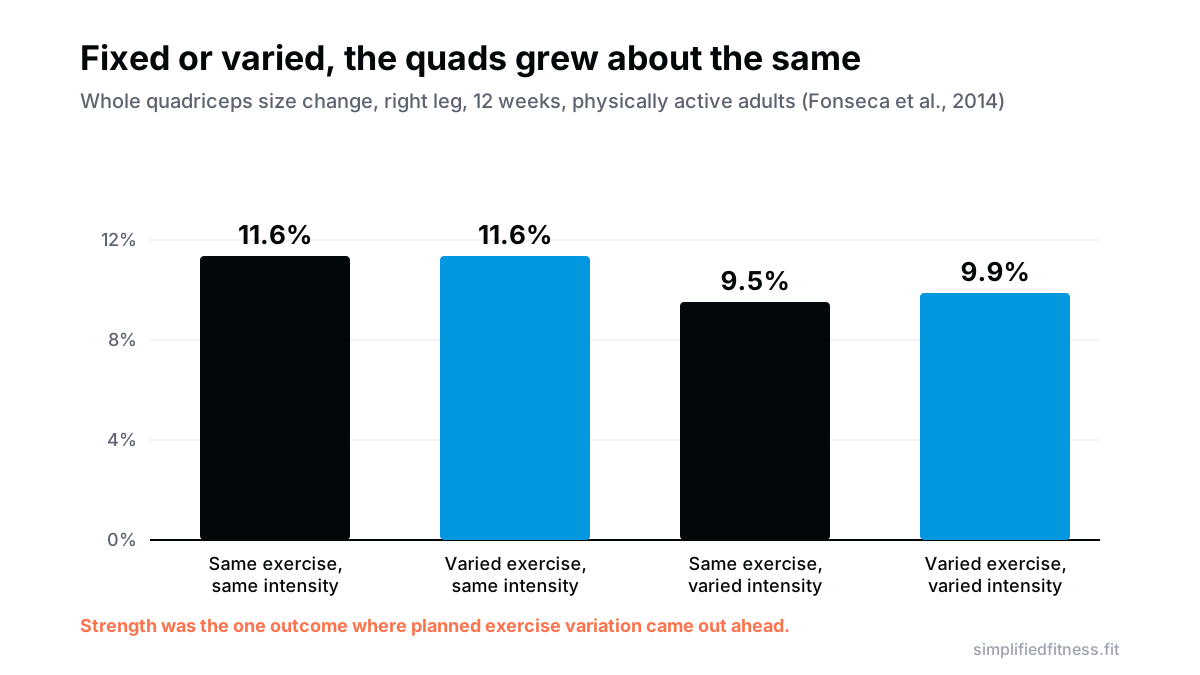
Same exercise, same intensity. That group grew just as much as the people being “confused”.
That does not make variation worthless, and I will come back to it. But it does knock out the idea that you must keep surprising the muscle.
Why changing exercises every workout backfires
The problem is not that new exercises are bad. It is that rotating every session breaks the one thing that reliably drives results: progressive overload.
A 2022 systematic review of 8 studies (241 young men in total) looked at exactly this question. Its conclusion was that some systematic variation may enhance regional hypertrophy and dynamic strength, whereas excessive, random variation may compromise gains, and that using different exercises that give a redundant stimulus, or rotating too often, may hinder adaptations (Kassiano et al., 2022). Notice the hedging. Only 8 studies qualified and every participant was a young man, so this is a pattern, not a law.
Here is what that looks like in a real gym week:
- Week 1: incline dumbbell press, 3x10 at 24 kg. Feels new, a bit wobbly.
- Week 2: switch to a machine chest press because “the muscle adapted.” You have no comparable number, so you pick a weight by feel.
- Week 3: switch to cable flyes. Again, no comparison.
Three weeks, zero progressions you can verify. A common mistake is calling this “variety” when it is really three weeks of starting from scratch. A training logbook only works if the lift stays put long enough to beat last time.
Progressive overload vs muscle confusion: what the trials show
A 2026 trial gave progressive overload a direct test. Fifty-five untrained young women had each arm randomly assigned to one of three conditions: progressive overload, same load, or no exercise. The trained arms did one-arm triceps extensions (3 sets of 8-12 reps, 3 days a week, 8 weeks). The progressive arms raised the load whenever they reached the top of the rep range, while the same-load arms kept the same load and reps for all 8 weeks (Kassiano et al., 2026).
Summed triceps thickness rose 22.9% with progressive overload, 11.6% without it, and 1.8% in controls. Growth was about twice as large when load went up.
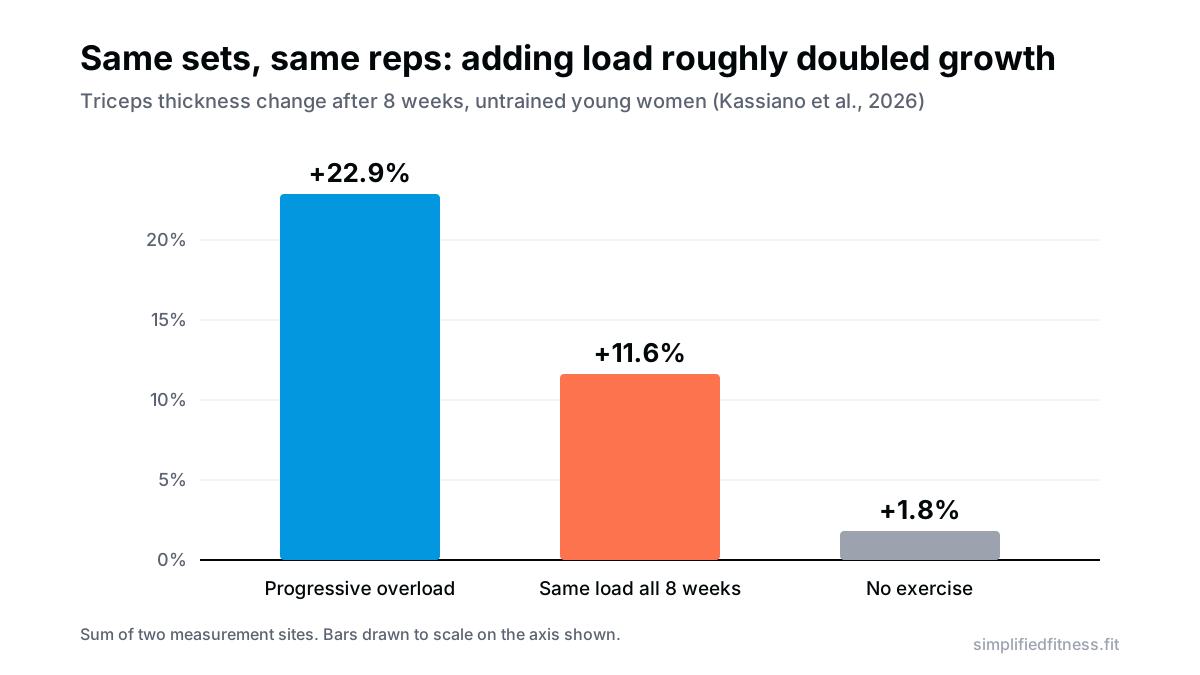
Two honest caveats. These were untrained women training their arms for 8 weeks, so the result may not match trained lifters. And the authors note that training without progression still built muscle in this group, though they could not say how that holds up over longer periods.
The ACSM’s 2026 position stand, built from 137 systematic reviews, lands in the same place. Its conclusion is that healthy adults should perform progressive resistance training, and it found that variables such as periodization, set structure and equipment type did not consistently change outcomes (Currier et al., 2026). Notice what is not on its list of winners: surprise.
Does a “neural adaptation curve” mean you should keep switching?
This is where the myth gets a pseudo-scientific costume, so let us be careful.
Early in a new exercise, strength tends to rise faster than muscle size. A classic review explains that strength training can change the nervous system so you activate your prime movers more fully and coordinate the relevant muscles better, producing more force in the intended direction (Sale, 1988). That is a skill-learning effect, and skills are specific to the movement.
The constant-switching argument gets this backwards. If part of your early progress is learning a movement, changing the movement resets that learning. You keep paying the “new skill” tax and never collect the benefit.
Be careful with exact timelines, though. You will see “neural gains last 4-8 weeks” repeated online. I could not find a trial showing a clean cutoff, and surface EMG, the tool often used to claim neural change, can mislead. A simulation study found that EMG increases early in training should not be directly related to changes in neural drive (Arabadzhiev et al., 2014). Treat “a few weeks” as a rough coaching guide, not a measured fact.
Early size gains can also be misleading. In ten untrained men, whole-muscle size rose about 2.7% by week 3 of a 10-week programme, but the authors concluded that early increases are not purely hypertrophy because swelling from muscle damage accounted for a large part (Damas et al., 2016). In other words, the “pump” and soreness from a new exercise are not clean evidence of better growth.
Soreness from a new exercise is not proof it works better
A new movement feels harder because your body is not used to it. Soreness is largely a novelty effect, and the repeated-bout effect means the same session hurts less the second time.
That is exactly why “I was so sore, it must have worked” is a bad yardstick. A review of the topic notes that hypertrophy can occur in the relative absence of muscle damage, and that damage can have detrimental short-term effects on performance (Schoenfeld, 2012). Better evidence of a good session is a rep or a kilo more than last time, with the same clean form.
When does changing exercises actually make sense?
Now the fair counterpoint. Variation is not useless. It is useful for reasons, and “to confuse the muscle” is not one of them.
1. Regional growth. In a 2021 trial, two groups did equal-volume training with either Smith machine squats or leg extensions. All three regions of the rectus femoris grew in the leg extension group, while only the central region of the vastus lateralis grew in the squat group (Zabaleta-Korta et al., 2021). Exercise choice can shift where a muscle grows. Pairing a squat pattern with a leg extension, for example, covers more of the quadriceps than either alone.
2. Strength with planned variation. In the 2014 trial above, the group that varied exercise but kept intensity constant had greater strength gains than the other groups, and the varied-exercise groups grew every quadriceps head while some fixed groups did not (Fonseca et al., 2014). That was in physically active, not highly trained, people, and the abstract does not say how often exercises rotated. So this supports planned variation, not weekly shuffling.
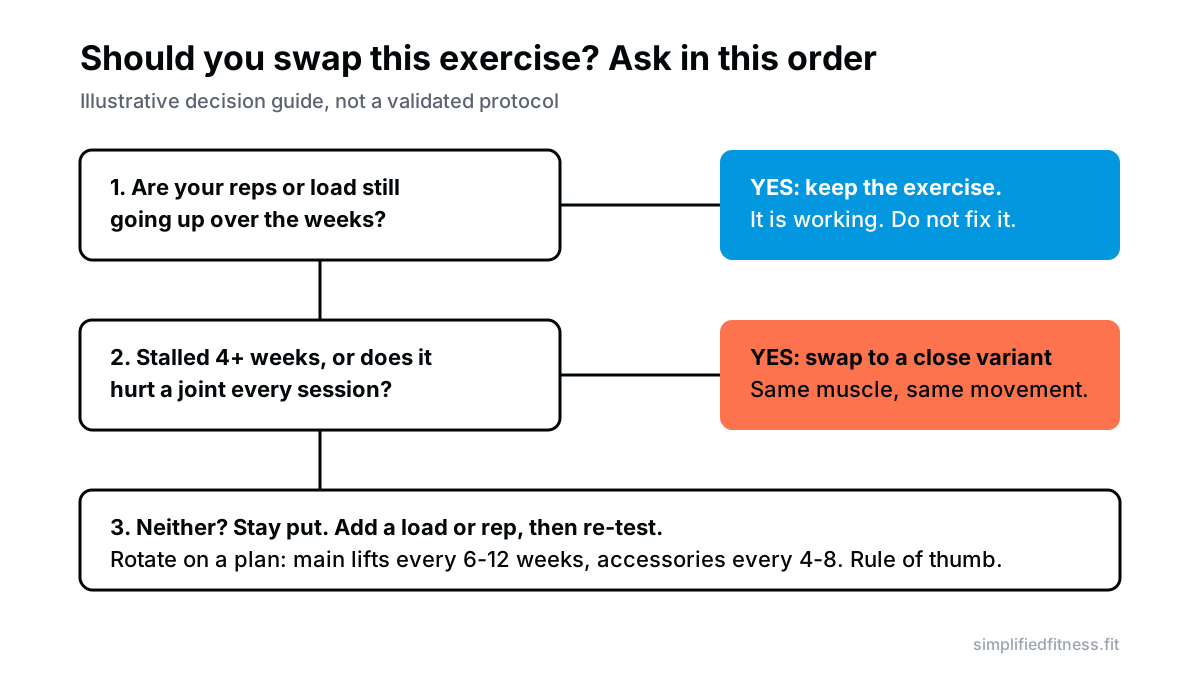
3. Stalled lifts. If a lift has not moved for 4 or more weeks despite good sleep, food and effort, a close variant gives you a fresh progression ladder.
4. Joint comfort. If barbell back squats irritate your knees or hips, a leg press or a goblet squat can keep the muscle trained while the joint settles. Persistent pain is a reason to see a doctor or physio, not just to rotate.
5. Equipment and boredom. Crowded gym, no free bench, a long break. Adherence matters more than purity.
Variation vs. periodization: they are not the same thing
Periodization means planned change in volume or intensity over time. Muscle confusion means unplanned change for novelty. Different animals.
A 2022 meta-analysis of 35 studies, with total volume equated, found periodized training favoured 1RM strength (effect size 0.31) but did not differ from non-periodized training for muscle growth, and undulating periodization beat linear for 1RM in trained participants only (Moesgaard et al., 2022). The authors suggested the strength effect may relate to neurophysiological adaptations. So structured change has some support for strength, and even there the effect is modest. For a deeper look, see our guides on rep-range periodization and novice to intermediate periodization.
| Approach | What it looks like | What the research suggests |
|---|---|---|
| Muscle confusion | New exercises every session, no tracking | Excessive random variation may compromise gains |
| Fixed and progressive | Same lifts, add reps or load over weeks | Reliable growth; progression grew more than same-load training |
| Planned variation | 1-2 accessories rotated every 4-8 weeks | May help regional growth and strength |
| Periodization | Scheduled shifts in volume or intensity | Small strength edge, no clear size edge (volume equated) |
How to rotate exercises without losing progress
Here is a simple structure that suits most lifters. It is a coaching default, not a trial-proven protocol. For the full how-often question, including how to lay out a rotation across training blocks, see our exercise rotation strategy guide.
- Keep 1-2 main lifts per muscle group for 6-12 weeks. Squat, bench, row, overhead press, Romanian deadlift. Progress them.
- Rotate 1-2 accessories every 4-8 weeks, choosing a variant that trains the same muscle at a different angle or length.
- Change one variable at a time (exercise, rep range, or set count), so you can see what worked.
- Log every session. Use a notebook or an app. No log, no overload.
- Use a ladder. Add 1 rep per set each week until you hit the top of the rep range, then add the smallest plate you have. A volume check with our training volume calculator helps keep sets in a sensible range.
If you do not want to plan this yourself, our free push, pull and legs plans keep main lifts fixed and give you a clear place to add reps and weight. For how long to run each block and when to back off, see our guide to progressive overload, deloads and plateaus.
If you want to understand why some exercises give more growth for the fatigue they cost, our piece on stimulus-to-fatigue ratio pairs well with this one.
When to see a doctor
Switching exercises to dodge pain is fine for ordinary soreness. If you have sharp pain, pain that wakes you at night, numbness or tingling, swelling, or discomfort that lasts for days after training, stop and get it checked by a doctor or physiotherapist. Rotating exercises will not fix an injury, and this page cannot diagnose one.
The bottom line
Muscle confusion is a slogan. The evidence supports consistent, hard, progressively overloaded training, with planned, purposeful variation for specific jobs: filling regional gaps, getting past a stall, or keeping a joint happy.
Pick your main lifts. Log them. Beat last week by a rep. Change an accessory when there is a reason, and write the reason down.
Frequently Asked Questions
Is muscle confusion real?
Not as a training principle. No study I found shows that surprising a muscle drives growth, and the research that exists points to effort, volume and progressive overload instead. Use variety for a reason (plateau, joint comfort, a lagging muscle region), not for the sake of surprise.
Do you need to confuse your muscles to grow?
No. In a 12-week trial, groups that kept the same exercise grew their quadriceps by about 11.6%, essentially the same as groups that varied exercises. Muscles adapt to repeated, increasing demand, so the practical move is to keep the lift and add a rep or a little load over time.
How often should you change your workout routine?
A sensible default is every 6-12 weeks for main lifts, with small accessory swaps in between if needed. This is a coaching rule of thumb rather than a number proven in trials. Change sooner only if you are stalled for 4 or more weeks or an exercise irritates a joint. Our exercise rotation strategy guide covers this question in detail.
Is changing exercises every workout bad?
It is usually counterproductive. The 2022 systematic review concluded that excessive rotation, meaning a high frequency of change, may hinder muscular adaptations. You cannot compare this week to last week if the lift changes, so overload becomes hard to track and easy to skip.
Why does a new exercise make me so sore?
Unfamiliar movements tend to cause more soreness because your body has not adapted to them yet. That soreness reflects novelty, not a better stimulus. A repeated-bout effect means the same session hurts less the second time, so soreness is a poor yardstick for progress.
Does muscle soreness mean muscle growth?
No. Schoenfeld's 2012 review notes that hypertrophy can occur in the relative absence of muscle damage, and that damage may hurt short-term performance. Judge a session by whether you beat your logbook, not by how stiff you feel the next morning.
How long does it take to get good at a new exercise?
There is no single published number, but most lifters feel noticeably smoother after a few weeks of repeating the same movement. Early strength gains reflect the nervous system learning to use muscle more effectively, according to a classic review. Give a new lift at least 4-6 weeks before judging it, and log it from day one.
Does varying exercises build more muscle?
Sometimes, in specific ways. A 12-week trial found varied-exercise groups grew every quadriceps head, while some fixed-exercise groups did not grow all of them, and a 2021 trial showed leg extensions and Smith machine squats grew different regions of the thigh. Total growth was similar, so use variety to cover gaps, not to chase novelty.
Can I do the same workout every week?
Yes, as long as the load, reps or quality of reps are creeping up. Trials in which people repeated the same training still showed growth, although one 2026 study found progression added more. Keep the plan, track it, and change something only when progress stops.
What should I change when I plateau?
Check sleep, food and logging first, then change one thing at a time. Swapping to a close variant of the stalled lift, adjusting the rep range, or adding a set are all reasonable moves. Changing everything at once makes it impossible to know what worked.
Is periodization the same as muscle confusion?
No. Periodization is planned change on a schedule, while muscle confusion is random change for novelty. A 2022 meta-analysis found periodized programs gave a small strength edge over non-periodized ones with volume equated, but no clear difference for muscle size.
What is better for beginners, variety or consistency?
Consistency, for most. Beginners get the biggest gains from repeating a handful of basic lifts and adding a little weight, and constantly changing exercises slows the skill learning that makes those gains possible. Pick 4-6 core movements, repeat them for 8-12 weeks and log each session.
Can I swap exercises because of joint pain?
Yes, and that is one of the best reasons to swap. Choose a variant that trains the same muscle with a joint angle that feels fine. If pain is sharp, lasts after training or keeps getting worse, see a doctor or physiotherapist rather than just rotating exercises.
Sources & References
Every claim above is checked against peer-reviewed research (PubMed, U.S. National Library of Medicine) or guidance from established health bodies. How we fact-check.
- Kassiano W, et al. Does Varying Resistance Exercises Promote Superior Muscle Hypertrophy and Strength Gains? A Systematic Review. J Strength Cond Res. 2022. PMID: 35438660
- Fonseca RM, et al. Changes in exercises are more effective than in loading schemes to improve muscle strength. J Strength Cond Res. 2014. PMID: 24832974
- Kassiano W, et al. Progressive Overload Affects the Magnitude of Muscle Hypertrophy. Med Sci Sports Exerc. 2026. PMID: 41718594
- Zabaleta-Korta A, et al. The role of exercise selection in regional Muscle Hypertrophy: A randomized controlled trial. J Sports Sci. 2021. PMID: 34743671
- Moesgaard L, et al. Effects of Periodization on Strength and Muscle Hypertrophy in Volume-Equated Resistance Training Programs: A Systematic Review and Meta-analysis. Sports Med. 2022. PMID: 35044672
- Sale DG. Neural adaptation to resistance training. Med Sci Sports Exerc. 1988. PMID: 3057313
- Arabadzhiev TI, et al. The increase in surface EMG could be a misleading measure of neural adaptation during the early gains in strength. Eur J Appl Physiol. 2014. PMID: 24789744
- Damas F, et al. Early resistance training-induced increases in muscle cross-sectional area are concomitant with edema-induced muscle swelling. Eur J Appl Physiol. 2016. PMID: 26280652
- Schoenfeld BJ. Does exercise-induced muscle damage play a role in skeletal muscle hypertrophy? J Strength Cond Res. 2012. PMID: 22344059
- Currier BS, et al. American College of Sports Medicine Position Stand. Resistance Training Prescription for Muscle Function, Hypertrophy, and Physical Performance in Healthy Adults: An Overview of Reviews. Med Sci Sports Exerc. 2026. PMID: 41843416

Umair Hazrami · Founder & Head Coach, Simplified Fitness
Umair Hazrami founded Simplified Fitness and the Simplified Lifter channel to cut through fitness noise. With 4+ years of consistent training and 10+ coaching clients, he writes every guide from the peer-reviewed research and links the sources so you can check them. Our editorial standards.
Educational content only, not medical advice. If you have a medical condition, are pregnant, or take medication, talk to a qualified doctor before changing your diet, supplements or training. Full disclaimer.
Keep reading
Health & Longevity
Are Deadlifts Bad for Your Lower Back? What Spinal Loading Research Shows
Are deadlifts bad for lower back health? The research shows spinal loads are high but tolerable, and trials use loaded lifting for back pain. How to hinge.
9 min read

Health & Longevity
Are Squats Bad for Your Knees? What the Research Actually Says
Are squats bad for your knees? Research on deep squats, kneecap stress and the knees-over-toes rule shows where the myth came from and how to squat safely.
9 min read

Health & Longevity
Why Tendons Adapt Slower Than Muscles: Connective Tissue Timelines for Lifters
Tendon adaptation vs muscle growth: why your tendons lag behind your strength gains, what studies show about timelines, and how to add load without tendonitis.
8 min read

Health & Longevity
Desk Worker Workout Routine: Fix Pelvic Tilt, Weak Glutes and a Rounded Upper Back
A desk worker workout routine built on evidence: what sitting really does to your hips, why pelvic tilt is mostly normal, and 3 gym correctives that help.
8 min read