Will Lifting Heavy Make Women Bulky? What Hormones Actually Say
Will lifting heavy make women bulky? Here is what testosterone, hypertrophy research and realistic muscle gain say, plus why you may feel bulky early on.

TL;DR. The short answer
- No. Natural women do not accidentally become bulky from lifting heavy. Circulating testosterone in men is more than 15 times that of women, so muscle gain in women is gradual and takes years of consistent training and eating.
- In a meta-analysis of men and women on the same programme, relative muscle growth did not differ significantly between sexes. Women grow muscle at a similar rate relative to their starting size, but the absolute amount is smaller.
- Feeling bulky in the first weeks is far more often fluid, soreness or an eating surplus than new muscle. Give it a few weeks, check the mirror and the tape, and adjust food rather than abandoning the weights.
- Lighter loads can build muscle too, so heavy lifting is not required. Heavy sets are simply an efficient option, and the choice is yours.
- Have irregular periods, rapid unexplained changes in body hair, voice or muscle, or a known hormone condition? Speak to a doctor rather than guessing.
Part of our complete guide: Joint-Friendly Lifting & Fitness Myths: A Guide for Over-40s, Teens and Sore Backs
Table of contents
No, lifting heavy will not make a natural woman bulky. Women carry far less circulating testosterone than men, so muscle arrives slowly, in small amounts, over years of consistent training and eating. The “bulky” look people fear belongs to competitive physique athletes who chase it deliberately for years with targeted training and diets, and in some cases with drugs.
This is one of the biggest things keeping women out of the weight room, so it deserves a proper answer. Below we go through the hormones, the actual growth data, why you might still feel bulky early on, and what to do about it. (It sits alongside our wider guide to joint-friendly lifting and myth busting, and it pairs well with the muscle toning myth.)
Will lifting heavy make women bulky? The hormone reality
Testosterone is the main reason men build more absolute muscle. After puberty, circulating testosterone in men is more than 15 times that of women at any age, and there is a reproducible dose-response relationship between circulating testosterone and muscle mass and strength in both men and women (Handelsman et al., 2018). That gap is the main reason for the sex difference in muscle mass and strength.
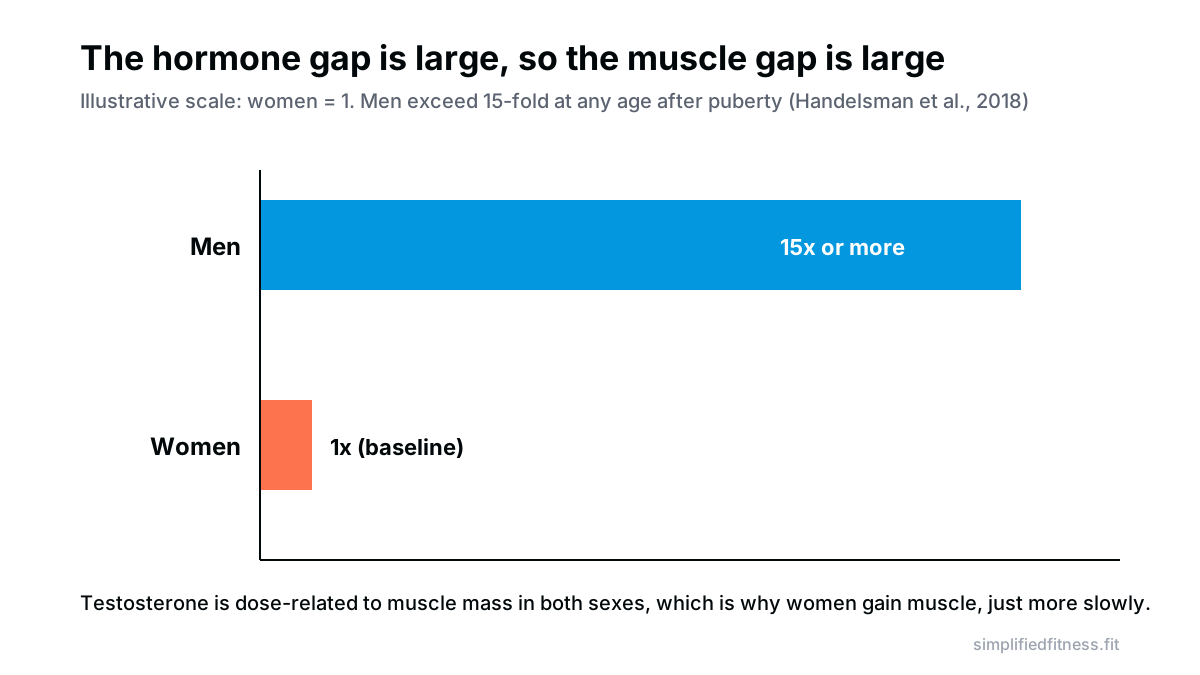
Two things follow from this, and people tend to hear only half of it.
First, because the hormone gap is so large, a woman lifting at natural hormone levels simply does not have the conditions to grow muscle like a man on a heavy bulk. Second, testosterone still matters to women. It is not that women do not build muscle, it is that they build it at a lower ceiling and a slower absolute pace.
What happens when women get extra testosterone
A useful natural experiment comes from a 2020 randomised trial. Thirty-five young, recreationally trained women took either 10 mg of testosterone daily or a placebo for 10 weeks. Their testosterone rose 5.1-fold, and they gained about 1.9% lean mass, with muscle fibre size up about 8.2% (Horwath et al., 2020).
Read that carefully. Even with a five-fold hormone increase, which is a medical intervention and not something lifting does, the lean mass change was modest over ten weeks. It also shows the hormone does matter: it is a lever, and lifting alone does not pull it. We cannot say from this study what longer or higher doses would do, and it is not advice to use testosterone.
Do women build muscle slower than men?
Relative to where they start, not by much. This is where the “bulky” fear and the data really part ways.
A 2020 meta-analysis compared young to middle-aged men and women on the same resistance training protocol. For hypertrophy (12 outcomes from 10 studies) there was no significant difference between sexes. For upper-body strength (19 outcomes from 17 studies) the effect actually favoured females, and lower-body strength showed no significant difference (Roberts et al., 2020). The authors point out the strength finding may reflect short study durations, so it is not proof that women are better at lifting.
A large earlier study tells a similar story. In 585 people (342 women, 243 men) who trained one arm for 12 weeks, men gained about 2.5% more in relative muscle size, and women’s relative strength gains were greater than men’s (Hubal et al., 2005). The same paper also found a huge spread between individuals: size changes ranged from a slight loss to a gain of about 59%, and that variability existed in both sexes.
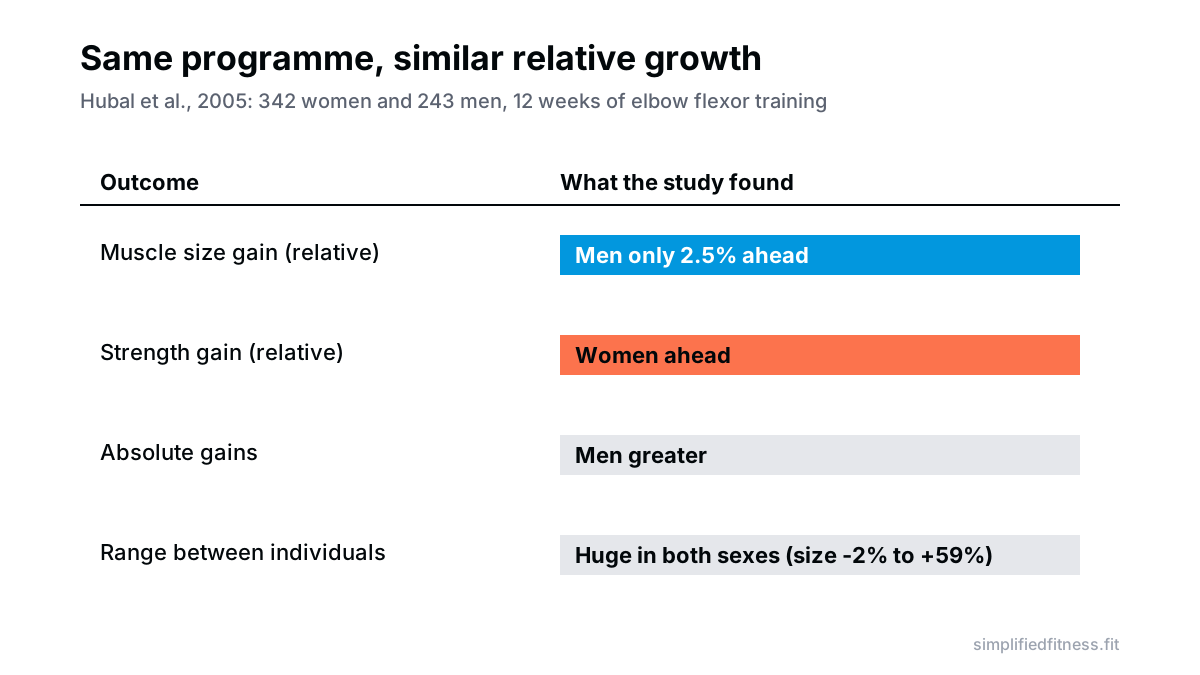
So what is different? Absolute amounts. If a man and a woman each add 10% to their muscle size, the man ends up with more tissue because he began with more. That is arithmetic, not endocrinology. We cover the full men-versus-women comparison in our piece on sex differences in muscle hypertrophy, so here we will stay with the aesthetic question.
What does realistic muscle gain look like for a natural woman?
Realistic means gradual and visible only over months. Here are the findings that frame it, and the limits of what we can say.
A 2024 meta-analysis of 40 trials (1,312 healthy young women, aged 18 to 35) found that resistance-based programmes improved lean mass or hypertrophy by 0.4 standardised mean difference, strength by 1.2 SMD, and reduced body fat percentage by 0.4 SMD. A higher total number of sessions was associated with greater lean mass gains (Molinari et al., 2024).
Notice what that says. Lean mass moved, fat percentage fell, and strength changed far more than size in standardised terms. For most women the main early change is strength, not bulk. These numbers are for healthy young women in trials, so they may not map neatly to every age, body or training history.
In practice, the usual pattern looks like this, though individuals vary a lot:
- Weeks 1 to 8: mostly strength and coordination. Exercises feel easier, weights go up.
- Months 3 to 12: visible shape changes in shoulders, glutes, legs and back for many people, if training and protein are consistent.
- Years: further gains, slowing down. Anything resembling an open-class physique takes a long time and a very deliberate approach.
That timeline is a generic coaching expectation, not a number from a single study. It is meant to give you a sense of pace.
Why you might feel bulky when you start lifting
This is the part most articles skip, and it is why the myth survives. People do feel bulkier in the early weeks. It is usually not muscle.
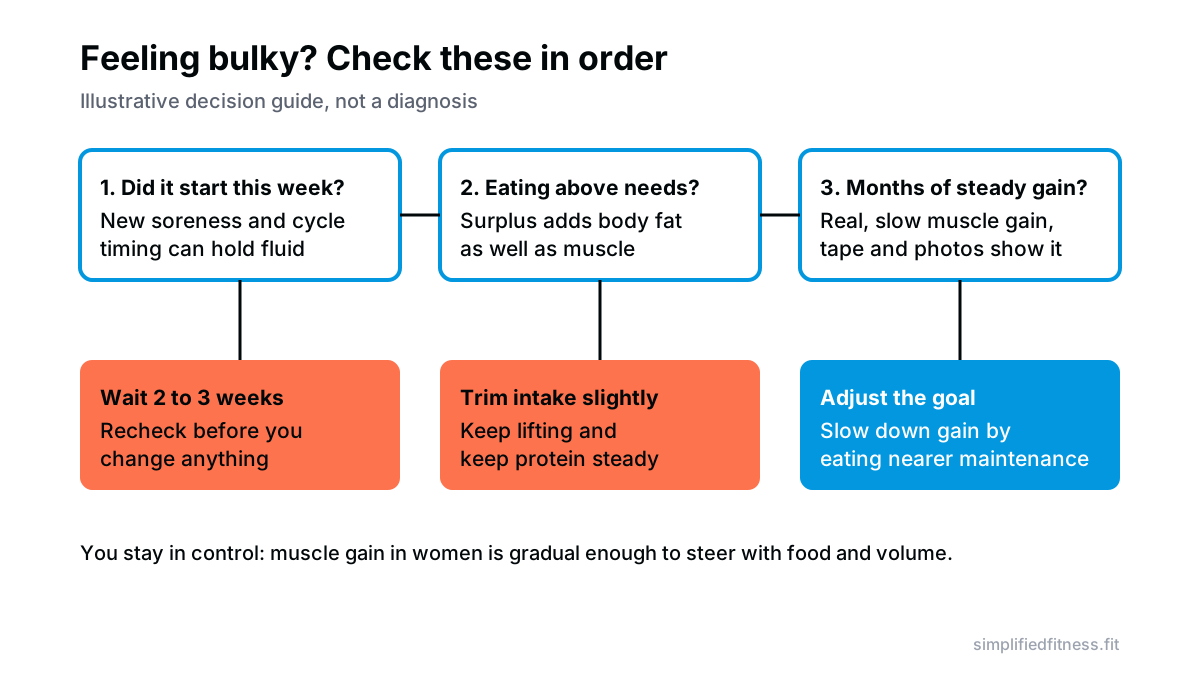
Fluid and soreness. Hard new training makes muscles sore and can temporarily hold fluid. Many women also notice weight and puffiness shift across the menstrual cycle. These shifts are usually short-lived and are not muscle gain. None of the studies cited here measured how big this effect is, so treat the size as unknown.
An eating surplus. Lifting often raises appetite. If you eat above your needs, you add body fat alongside any muscle, and that can feel like “getting bigger from lifting.” The cause is food, not the barbell. If this sounds familiar, our guide to body recomposition explains how to lose fat and build muscle together, and the body fat calculator can give you a rough baseline.
Mirror and scale misreads. Muscle sits under whatever fat you already carry. Early on, you may feel firmer and stronger without looking different, and the scale may not drop even as you change shape. Track a few things: photos every four weeks, a tape measure at the same spots, and your lifts.
If you ever want to slow down muscle gain for any reason, the lever is simple: train as you like and eat nearer maintenance, rather than dropping the weights. You stay in control of the pace.
Do you need to lift heavy at all?
Not necessarily. “Heavy” is a tool, not a requirement.
A meta-analysis of randomised trials compared low-load training (60% of 1RM or lighter) against high-load training (65% or more). Both groups improved, loads of 50% 1RM or less still promoted substantial strength and size gains in untrained people, and there was a non-significant trend favouring heavier loads. The authors note the number of studies was small (Schoenfeld et al., 2016).
So if heavy lifting feels intimidating, you can still progress with moderate weights taken close to failure. If you like heavier sets, they are efficient and they will not make you bulky. Our guide to load, rep ranges, RIR and rest helps you choose.
Benefits of lifting for women beyond the mirror
Looks are only one reason, and for many women not the main one. A 2022 systematic review and meta-analysis of 16 prospective cohort studies found muscle-strengthening activity was associated with a 10-17% lower risk of all-cause mortality, cardiovascular disease, total cancer and diabetes, with the largest benefit at roughly 30-60 minutes per week (Momma et al., 2022). This is observational data, and the studies were not limited to women, so it shows an association, not proof that lifting caused the benefit.
The same analysis found the benefit curve was J-shaped, so more is not clearly better. A modest, regular dose is a reasonable target.
Eating enough protein, Indian kitchen edition
If you want muscle without extra body fat, protein matters more than most supplements. Dal, paneer, curd, soya chunks, eggs, fish and chicken all fit, and plenty of vegetarians reach their target with planning. Spread protein across meals instead of loading it all at dinner. The protein calculator gives a starting number for your weight, and our article on optimal daily protein intake explains the research.
A word on soya: some women worry it affects hormones. We deal with that directly in our piece on soy protein, phytoestrogens and testosterone.
When to see a doctor
Normal lifting does not change your hormones to male levels, so see a doctor if you notice things that do not fit that picture. These include very irregular or absent periods, rapid unexplained changes in body hair, voice or muscle size, or severe acne alongside those changes. Conditions such as polycystic ovary syndrome can affect hormones and need medical assessment, which an article cannot provide. If you are pregnant, postpartum or managing a health condition, check with your doctor about training before you start.
What to do next
- Pick two or three full-body sessions a week you can keep for months.
- Progress gradually, using loads that challenge you at the end of each set.
- Eat enough protein and avoid a big surplus unless you want to gain weight.
- Judge changes over four to twelve weeks using photos, a tape and your lifts.
- Adjust food, not the barbell, if you want a different pace of change.
Women who lift consistently usually describe the result as stronger, firmer and more capable, not bulky. The research supports that picture.
Frequently Asked Questions
Will lifting heavy make women bulky?
No, not in the way people fear. Women's circulating testosterone is a fraction of men's, so muscle builds slowly and in small absolute amounts. Lift progressively, eat sensibly and judge changes over months, not days.
Why don't women get as big as men from lifting?
The main reason is hormonal. Men have more than 15 times the circulating testosterone of women, and testosterone is dose-related to muscle mass in both sexes. Women also start with less muscle, so even a similar percentage gain is a smaller absolute change.
Do women build muscle slower than men?
Relative to their starting size, not by much. A 2020 meta-analysis found no significant sex difference in hypertrophy, and a large 12-week arm study found men were only about 2.5% ahead in relative size gains. In absolute terms men gain more, simply because they start with more muscle.
Why do I feel bulky after starting weight training?
Early on, it is usually temporary fluid and soreness, or an eating surplus, rather than muscle. Wait two or three weeks, keep training, and recheck with photos and a tape before changing anything.
Is it true women need to lift light weights to tone?
No. Toning is just muscle gain plus fat loss, and heavier loads work well for both. Light loads can build muscle if sets are taken close to failure, so choose what you can do consistently. See our guide to the toning myth for more.
How long does it take a woman to build noticeable muscle?
It varies a lot between people. In one 585-person study, size changes after 12 weeks ranged from a small loss to a large gain. Most people see strength rise within weeks and visible shape change over several months of consistent training and enough protein.
Can women get big from lifting if they eat a lot?
Eating above needs adds body fat as well as muscle, which can make you look and feel bigger. That is a food effect, not a hormone effect of lifting. If you do not like the direction, trim intake slightly and keep the training.
Does testosterone matter for women's muscle growth?
Yes, but the picture is more nuanced than 'more is better'. One 2025 study of 27 untrained women found total testosterone did not predict muscle gain from training, though bioavailable testosterone did. Women still respond well to training at their natural levels.
What happens if women take testosterone?
Muscle can increase, but that is a medical and doping topic, not a lifting outcome. In a 10-week trial, young women given 10 mg daily had a 5.1-fold rise in testosterone and gained about 1.9% lean mass. Never use testosterone without a doctor, and lifting alone will not do this.
Do I need to lift heavy to get results as a woman?
No. A meta-analysis found both low and high loads build muscle in untrained people, with a non-significant trend favouring heavier loads. Pick a load that lets you train hard and safely, and progress it over time.
Will lifting weights make me look manly?
Lifting changes shape by adding some muscle and often reducing fat, which most women describe as firmer and more athletic. It does not shift your hormones toward male levels. If you notice sudden voice, hair or cycle changes, see a doctor, since those have other causes.
How often should a beginner woman lift?
Two to three full-body sessions a week is a practical start. In a meta-analysis of trials in young women, a higher total number of sessions was linked with greater lean mass gains, so consistency over weeks and months is the lever. Start with a number you can keep for months, then build.
Do Indian women need special advice for building muscle?
Not special training, but food planning matters, especially on a vegetarian diet. Dal, paneer, curd, soya and eggs can cover protein needs when portions are planned. Use a protein calculator for your weight and spread intake across the day.
Are there health benefits of lifting for women beyond looks?
Yes. A 2022 meta-analysis of cohort studies linked muscle-strengthening activity with a 10-17% lower risk of all-cause mortality, cardiovascular disease and total cancer. The data are observational, so they show association, not proof of cause.
Sources & References
Every claim above is checked against peer-reviewed research (PubMed, U.S. National Library of Medicine) or guidance from established health bodies. How we fact-check.
- Roberts BM, et al. Sex differences in resistance training: a systematic review and meta-analysis. J Strength Cond Res. 2020. PMID: 32218059
- Hubal MJ, et al. Variability in muscle size and strength gain after unilateral resistance training. Med Sci Sports Exerc. 2005. PMID: 15947721
- Handelsman DJ, et al. Circulating testosterone as the hormonal basis of sex differences in athletic performance. Endocr Rev. 2018. PMID: 30010735
- Horwath O, et al. Fiber type-specific hypertrophy and increased capillarization in skeletal muscle following testosterone administration in young women. J Appl Physiol. 2020. PMID: 32191598
- Alexander SE, et al. Bioavailable testosterone and androgen receptor activation, but not total testosterone, are associated with muscle mass and strength in females. J Physiol. 2025. PMID: 39393048
- Molinari T, et al. Moderators of resistance training effects in healthy young women: a systematic review and meta-analysis. J Strength Cond Res. 2024. PMID: 38090747
- Schoenfeld BJ, et al. Muscular adaptations in low- versus high-load resistance training: a meta-analysis. Eur J Sport Sci. 2016. PMID: 25530577
- Momma H, et al. Muscle-strengthening activities are associated with lower risk and mortality in major non-communicable diseases: a systematic review and meta-analysis of cohort studies. Br J Sports Med. 2022. PMID: 35228201

Umair Hazrami · Founder & Head Coach, Simplified Fitness
Umair Hazrami founded Simplified Fitness and the Simplified Lifter channel to cut through fitness noise. With 4+ years of consistent training and 10+ coaching clients, he writes every guide from the peer-reviewed research and links the sources so you can check them. Our editorial standards.
Educational content only, not medical advice. If you have a medical condition, are pregnant, or take medication, talk to a qualified doctor before changing your diet, supplements or training. Full disclaimer.
Keep reading
Health & Longevity
Are Deadlifts Bad for Your Lower Back? What Spinal Loading Research Shows
Are deadlifts bad for lower back health? The research shows spinal loads are high but tolerable, and trials use loaded lifting for back pain. How to hinge.
9 min read

Health & Longevity
Are Squats Bad for Your Knees? What the Research Actually Says
Are squats bad for your knees? Research on deep squats, kneecap stress and the knees-over-toes rule shows where the myth came from and how to squat safely.
9 min read

Health & Longevity
Why Tendons Adapt Slower Than Muscles: Connective Tissue Timelines for Lifters
Tendon adaptation vs muscle growth: why your tendons lag behind your strength gains, what studies show about timelines, and how to add load without tendonitis.
8 min read

Health & Longevity
Desk Worker Workout Routine: Fix Pelvic Tilt, Weak Glutes and a Rounded Upper Back
A desk worker workout routine built on evidence: what sitting really does to your hips, why pelvic tilt is mostly normal, and 3 gym correctives that help.
8 min read