Overcoming the All-or-Nothing Mindset: How Perfectionism Wrecks Long-Term Fitness
The all-or-nothing mindset in fitness turns one missed workout into a lost month. Here is the research, the never-miss-twice rule and a 20-minute fallback plan.

TL;DR. The short answer
- The all-or-nothing mindset treats fitness as 100% compliant or total failure. In weight-loss research, this kind of dichotomous thinking predicted weight regain in one 54-woman study (Byrne et al., 2004).
- A short session keeps the habit alive. A maintenance-dosing trial found that muscle size in young adults was preserved on one-third or one-ninth of the original training dose, and strength held up well.
- The 'never miss twice' rule is a practical guardrail, not a proven law. One miss rarely costs you anything physical; the damage comes from the story you tell about it.
- After a binge or off-plan day, self-kindness is linked with less negative emotion and a stronger sense of control in dieters, though it did not by itself predict weight loss.
- If perfectionism shows up as compulsive exercise, fear of rest days or rigid food rules that distress you, talk to a doctor or a mental health professional.
Part of our complete guide: Body Composition, Muscle Memory and Habits: A Lifter's Guide to Tracking
Table of contents
You missed Monday. By Tuesday night you had decided the week was ruined, by Friday you had skipped the rest, and now it is three months later. That is the all-or-nothing mindset in fitness, and for a lot of lifters it does more damage than a bad program.
The short answer: a missed workout almost never costs you muscle. The rule you break in your head costs you far more. This article, part of our wider guide to body composition, muscle memory and adherence, covers what the research says about black-and-white thinking, why a 20-minute session beats skipping, and how to recover after a binge without the shame spiral.
What is the all-or-nothing mindset in fitness?
It is dichotomous thinking. A session is either perfect or worthless. A diet day is either clean or blown. There is no middle category called “decent.”
You hear it in phrases like “I already ate a samosa, so I might as well order the whole thing” or “I only have 25 minutes, there’s no point going.” Clinicians call this a cognitive distortion. It is not a character flaw, and it is not laziness. It is a thinking habit, which means it can be changed.
Here is the part that matters for lifters. Fitness is built on repeated, imperfect effort over years. A mindset that only recognises perfect weeks will, sooner or later, count most of your weeks as failures.
What does the research say about black-and-white thinking?
The best-known data come from weight-loss research, not from gyms, so treat the findings as relevant but indirect.
In a study of 54 women with obesity who had lost 10% of their body weight at slimming clubs, researchers followed them for a year. Dichotomous thinking was one of two prospective predictors of weight regain, alongside maximum lifetime weight (Byrne et al., 2004). It was a small sample of women only, and it does not prove cause and effect.
A web survey of 241 adults found something similar from a different angle. Dichotomous beliefs about food and eating appeared to mediate the link between rigid dietary restraint and weight regain (Palascha et al., 2015). Self-reported, cross-sectional, so again: a pattern, not a verdict.
A third study compared 53 people after a 16-week weight maintenance period. Those who kept the weight off showed stronger problem-solving skills and, in interviews, described more planning and were more accepting of mistakes than those who regained (Dibb-Smith et al., 2019).
Put these together and a consistent picture forms. People who handle slip-ups flexibly tend to keep their results. People who see slip-ups as proof of failure tend not to. None of this is a trial of lifters, so the honest takeaway is “likely relevant,” not “proven for the gym.”
Why does one missed workout turn into a lost month?
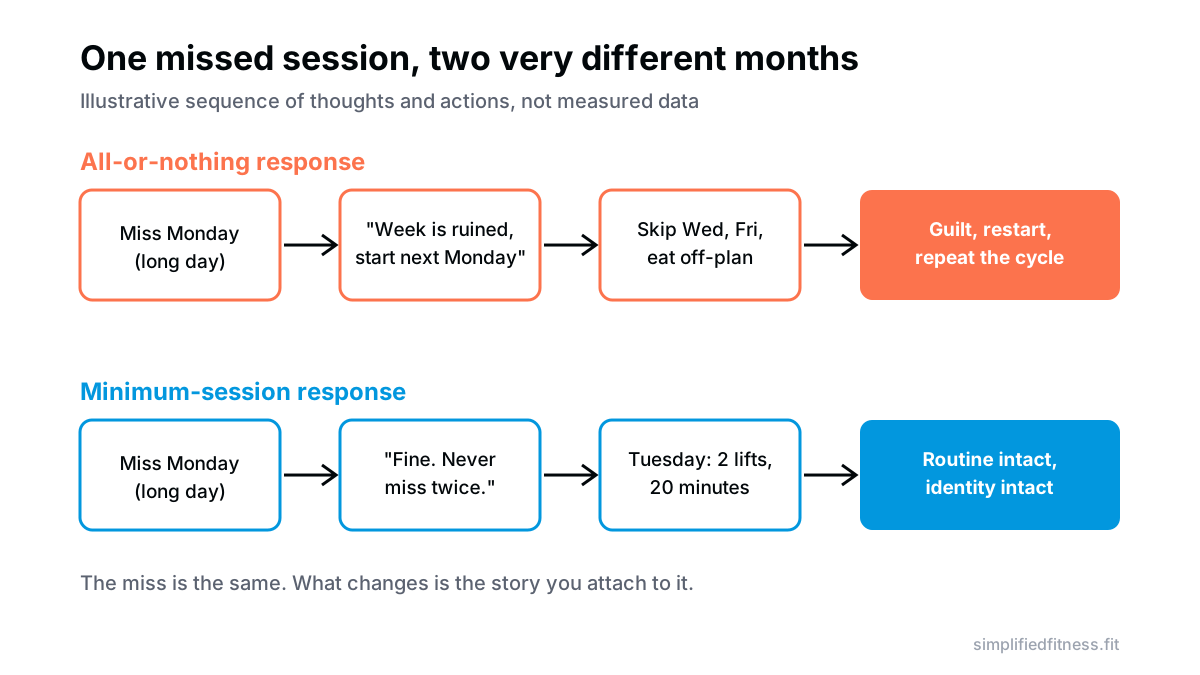
Think about what actually happens. You skip a session. That is a tiny physical event. Then three things pile on.
- The rule breaks. “I train four times a week, no exceptions” is now false.
- The emotion arrives. Guilt, frustration, a little shame.
- The easy exit appears. “I’ll restart Monday” feels like a plan. It is really permission to skip until Monday.
Dieters have a name for the emotional part. After a slip, people can feel demoralized enough to abandon their goals altogether, and that demoralization has received surprisingly little research attention (Hagerman et al., 2023). The calories from the slip are small. The decision to quit is large.
In the gym this looks like: skipped Wednesday, “fell off” Thursday, ignored the logbook for a fortnight, and a new gym membership in January.
Does a 20-minute workout really beat skipping?
For muscle and strength, the evidence says a reduced dose is far better than zero, and it often holds your gains better than people expect.
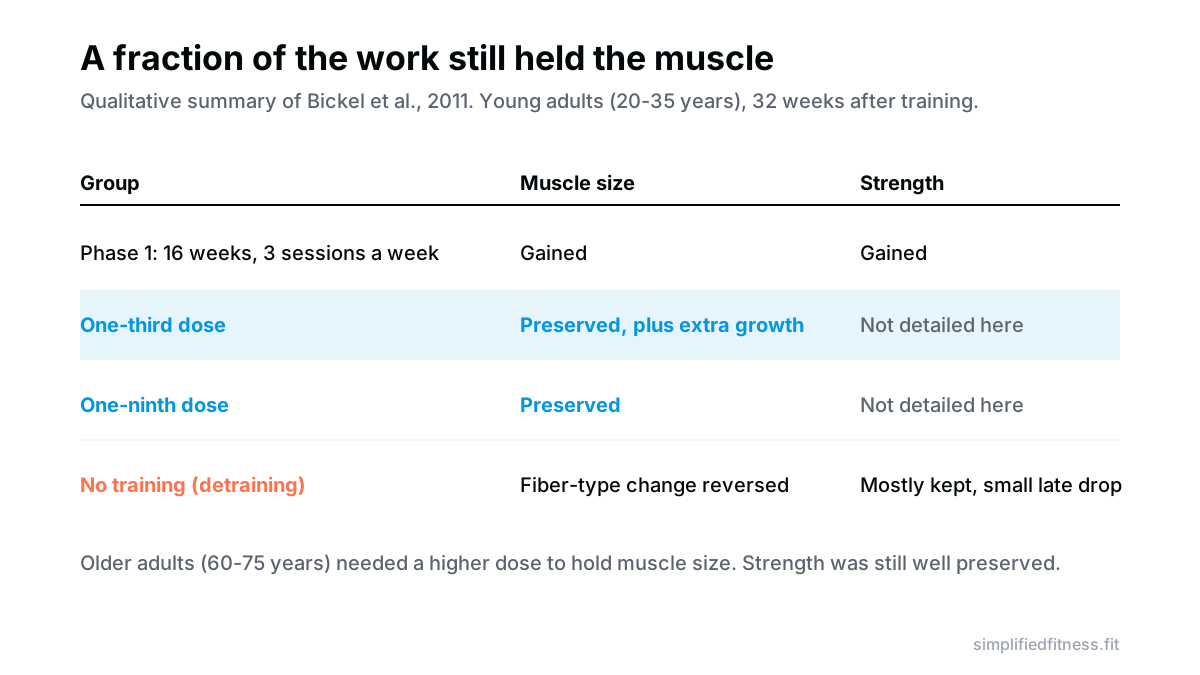
The clearest trial here is Bickel and colleagues. They had 70 adults train three days a week for 16 weeks, then split them for 32 weeks into detraining or maintenance at one-third or one-ninth of the original dose. In the young group (20-35 years), both maintenance doses preserved muscle hypertrophy, and the one-third dose led to additional myofiber growth. Strength gained in the first phase was largely retained even through detraining, with only a slight drop at the end. The older group (60-75 years) did not hold muscle size as well, so they needed a higher dose (Bickel et al., 2011).
A later review by Spiering and colleagues reached a similar conclusion. Strength and muscle size in younger people could be maintained for up to 32 weeks with as little as one strength session a week and one set per exercise, as long as the relative load stayed the same. Older people may need up to two sessions and two to three sets per exercise. The reviewers’ main conclusion was that intensity seems to be the key variable for maintaining performance, even when frequency and volume fall considerably (Spiering et al., 2021).
What does this mean for a Tuesday evening when you have 20 minutes?
- A short session keeps your muscles supplied with a stimulus.
- It keeps the habit running. The behaviour is the thing you are protecting.
- It keeps your identity as someone who trains, which is easy to lose when you only count perfect weeks.
One caveat. This research involved structured training programs, and the maintenance phases were about holding gains, not building more. If your goal is fast progress, short sessions are a bridge, not the long-term plan. For a deeper look at how little volume is enough, see our article on maintenance volume and how little training keeps muscle.
The never-miss-twice rule: how to use it properly
The idea is simple. Missing once is an accident. Missing twice is the start of a new pattern. So the day after any miss, you do something, even a small something.
Be clear about what this rule is. It is a popular coaching heuristic, not a law with a trial behind it. It works because it is easy to remember and because it replaces “restart Monday” with “go tomorrow.”
How to run it in real life:
- Decide the fallback in advance. Write down your three session sizes (below) while you feel fine.
- Run the fallback the next day. Not a catch-up session, not a double day.
- Move on. No extra cardio, no skipped dinner.
Do not turn the rule into a new perfect standard. “I must never miss twice or I’m a failure” is the same all-or-nothing thinking in a nicer jacket. If life genuinely blocks two days, such as illness, travel or a family emergency, restart without a speech. Our guide to fitness during high-stress life disruptions covers those weeks properly.
Build a three-size workout plan
Perfectionism needs a menu. Give yourself three sizes of workout, and a rule that picking any of them counts as training.
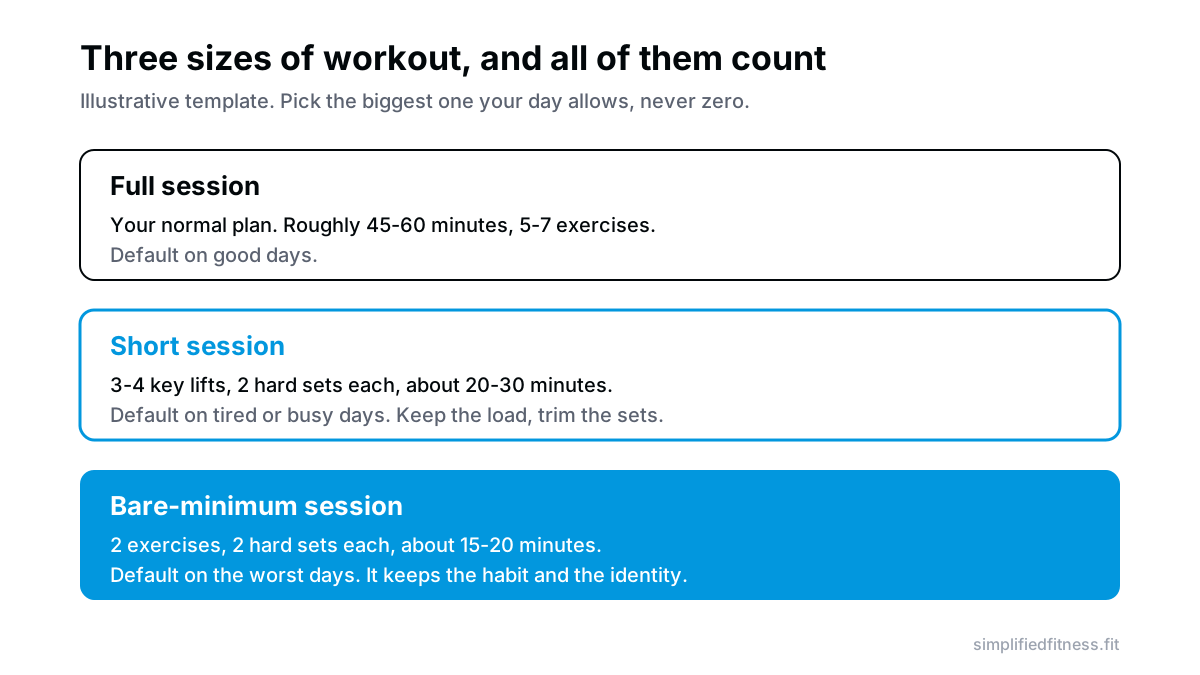
| Size | Time | What it looks like | When to use it |
|---|---|---|---|
| Full | 45-60 min | Your normal program | Good days |
| Short | 20-30 min | 3-4 key lifts, 2 hard sets each | Busy or tired days |
| Bare minimum | 15-20 min | 2 lifts, 2 hard sets each | Worst days |
Two practical notes. First, keep the load honest. The research above points to intensity as the thing worth protecting, so trim sets, not the weight on the bar. Second, if you are not sure how many weekly sets you are actually doing, our training volume calculator gives you a quick count, and the free workout plans have ready-made sessions you can shorten.
A food version works the same way. Instead of “perfect macros or nothing,” set a floor: for example, a protein source at every meal (dal, paneer, curd, eggs, chicken or soya chunks) and vegetables once or twice a day. On a messy day, hit the floor and call it a pass.
How do I get back on track after a binge or off-plan day?
This is where the shame spiral usually starts, so be deliberate.
Eat your next planned meal normally. No skipping breakfast, no “detox,” no punishment cardio.
Look at the size of the event. One off-plan day is a small slice of your weekly energy intake. It rarely changes fat or muscle in any measurable way, and it certainly does not erase weeks of work.
Respond with kindness, not excuses. There is some research on this. In an Ecological Momentary Assessment study of 140 adults in a behavioral weight loss trial, higher self-compassion after a lapse went with less negative emotion. Higher self-kindness in particular was linked to a greater sense of control over weight-management behaviours in the following hours. Self-compassion did not predict whether people lapsed again that same day (Hagerman et al., 2023).
A separate study of 56 overweight or obese adults trying to lose weight found a similar pattern. Self-compassion after lapses was linked to stronger intentions and self-efficacy to keep dieting, and guilt carried part of that link. It did not predict weight loss (Thøgersen-Ntoumani et al., 2021).
Read those two carefully. They suggest self-kindness helps people stay in the game emotionally. They do not show it makes the scale move. That is still useful, because staying in the game is the whole point.
Is perfectionism ever helpful for training?
Mixed. High standards help many people stay disciplined. The trouble starts when the standard is rigid and tied to self-worth.
A 2025 systematic review and preliminary meta-analysis of seven studies (3,117 participants, mostly young adults) found significant positive pooled associations between perfectionism and compulsive exercise: total perfectionism r = 0.37, perfectionistic strivings r = 0.33, and perfectionistic concerns r = 0.32. The authors flagged the small number of studies and the largely cross-sectional designs, which rule out conclusions about cause (Bills et al., 2025).
So where does that leave a normal lifter? Probably here:
- Wanting to train well is fine.
- Needing every session to be perfect, or feeling intense anxiety about a rest day, is a flag.
- Exercising through illness or injury to avoid guilt is a bigger flag.
If that last list sounds familiar, a conversation with a doctor, psychologist or counsellor is worth having. This article is not a diagnosis, and it cannot tell you whether what you are experiencing is a clinical problem.
A practical weekly reset
Sunday, five minutes, three questions.
- What did I do this week, not what did I miss? Count sessions of any size.
- What got in the way? Time, energy, travel, a hot commute at 6 pm in an Indian summer. Fix the obstacle, not yourself.
- What are my three session sizes for next week? Write down which day gets which one.
Then adjust the plan to your actual life. If you have only ever managed three days a week, a four-day plan is a recipe for a “failed” week every week. Build the plan you will actually follow. For habit cues and friction reduction, see our piece on the behavioral science of gym habits. For the motivation side when training feels like a chore, read gym burnout and how to reignite motivation. And to shift from outcome pressure to controllable targets, try process goals versus outcome goals.
The bottom line
All-or-nothing thinking turns small slips into big exits. The research on dichotomous thinking is mostly from weight-loss samples and mostly observational, so hold it loosely. The research on reduced-dose training is stronger for muscle and strength, and it points the same way: some training beats none, and heavy-enough short sessions can hold a lot of what you built.
Pick your three session sizes. Run the smallest one on the bad days. Never miss twice. And if guilt or compulsion around exercise and food starts to run your life, get support from a professional rather than trying to out-discipline it.
Frequently Asked Questions
What is the all-or-nothing mindset in fitness?
It is dichotomous thinking applied to training and food: you are either perfectly on plan or you have failed. Researchers describe this black-and-white style as a cognitive pattern, and it has been linked to weight regain in people who lost weight. The fix is to define a minimum acceptable day in advance so that 'less than perfect' still counts as a win.
Why do I quit the gym after missing one workout?
Usually because the miss breaks a rule you set for yourself, and the guilt makes the next session feel heavier. In dieting research this is called demoralization, and it can lead people to abandon their goals altogether. Plan a smaller backup session before you need it, so a miss is followed by a 20-minute workout instead of a three-month gap.
Does missing one workout ruin progress?
No. One missed session is a tiny fraction of your weekly training, and muscle and strength take weeks, not days, to fade. A review of minimal-dose training concluded that strength and muscle size can be maintained for long periods on far less than a full program. Book your next session within 48 hours and move on.
Is a 20-minute workout really worth it?
Yes, particularly when the alternative is nothing. A review of minimal-dose research concluded that intensity (relative load) is the key variable for maintaining performance, even when frequency and volume drop a lot. Do two or three key lifts at a normal working weight and stop when the sets are done.
What is the never miss twice rule?
It means a single missed workout is allowed, but you do not miss two in a row. The logic is that one miss is an accident while two start to become a new routine. Pick your fallback session now, and run it the day after any miss.
How do I stop feeling guilty about skipping the gym?
Treat guilt as information, not a verdict. In studies of dieters, self-compassion after a lapse was associated with less negative affect and stronger intentions to continue, and guilt carried part of that effect. Talk to yourself the way you would to a friend who missed a session, then schedule the next one.
How do I get back on track after a binge or off-plan day?
Resume your normal meals at the very next meal, with no punishment workout and no skipped breakfast. Research on dietary lapses notes that a slip hurts in two ways: the extra calories, and the demoralization that can make people give up altogether. Log it neutrally, eat your usual protein and vegetables, and keep tomorrow's training as planned.
Is perfectionism good or bad for training?
It depends on the type. A 2025 meta-analysis of seven studies found perfectionism was positively correlated with compulsive exercise (pooled r around 0.3 to 0.4), though the data were mostly cross-sectional. High standards can be fine, but if they turn rigid and tied to your self-worth, build in flexible minimums and watch for compulsive patterns.
How do I stop falling off the wagon?
Stop treating the plan as a wagon you can fall off. Build a plan with three sizes (full, short, bare minimum) so that bad days have a place to land. Review it every Sunday and adjust the plan, not your self-worth.
Should I do a punishment workout after overeating?
No. Compensating for food with extra exercise feeds the cycle of guilt and restriction, and in people prone to disordered eating it can become compulsive. One day of extra calories does not undo weeks of progress. Return to your normal plan, and see a doctor or therapist if you feel driven to exercise to offset food.
How many workouts per week do I need to keep my muscle?
A 2021 review found that muscle size in younger people can be maintained for up to 32 weeks with as little as one strength session per week and one set per exercise, if the load stays heavy. Older adults appear to need more, around two sessions and two to three sets per exercise. Use the training volume calculator to check your weekly sets.
Can I lose muscle if I only do short workouts for a few weeks?
It is unlikely if the short sessions are hard. In a trial of 70 adults, young participants kept their muscle size on one-third or one-ninth of their earlier training dose over 32 weeks, while older adults did not fully keep it. Keep the weights challenging and treat the short version as a bridge, not a permanent plan.
When should I see a doctor about my exercise habits?
See a doctor or mental health professional if you exercise through injury or illness, feel intense anxiety when you rest, or use training to punish yourself for eating. These can be signs of compulsive exercise or disordered eating, which are treatable. This article is education, not a diagnosis.
Sources & References
Every claim above is checked against peer-reviewed research (PubMed, U.S. National Library of Medicine) or guidance from established health bodies. How we fact-check.
- Byrne SM, et al. Psychological predictors of weight regain in obesity. Behav Res Ther. 2004. PMID: 15381442
- Palascha A, et al. How does thinking in Black and White terms relate to eating behavior and weight regain? J Health Psychol. 2015. PMID: 25903250
- Hagerman CJ, et al. The role of self-compassion and its individual components in adaptive responses to dietary lapses. Appetite. 2023. PMID: 37619622
- Thøgersen-Ntoumani C, et al. Does self-compassion help to deal with dietary lapses among overweight and obese adults who pursue weight-loss goals? Br J Health Psychol. 2021. PMID: 33368932
- Bickel CS, et al. Exercise dosing to retain resistance training adaptations in young and older adults. Med Sci Sports Exerc. 2011. PMID: 21131862
- Spiering BA, et al. Maintaining physical performance: the minimal dose of exercise needed to preserve endurance and strength over time. J Strength Cond Res. 2021. PMID: 33629972
- Bills E, et al. Perfectionism and compulsive exercise: a systematic review and preliminary meta-analysis. Eat Weight Disord. 2025. PMID: 39820893
- Dibb-Smith AE, et al. A mixed-methods investigation of psychological factors relevant to weight maintenance. J Health Psychol. 2019. PMID: 27899447

Umair Hazrami · Founder & Head Coach, Simplified Fitness
Umair Hazrami founded Simplified Fitness and the Simplified Lifter channel to cut through fitness noise. With 4+ years of consistent training and 10+ coaching clients, he writes every guide from the peer-reviewed research and links the sources so you can check them. Our editorial standards.
Educational content only, not medical advice. If you have a medical condition, are pregnant, or take medication, talk to a qualified doctor before changing your diet, supplements or training. Full disclaimer.
Keep reading

Health & Longevity
How to Build a Gym Habit: The Behavioral Science of Sticking With It
How to build a gym habit using habit science: how long it takes, why cues and low friction beat willpower, and what identity can and cannot do for consistency.
8 min read

Health & Longevity
Best Way to Measure Body Fat: DEXA, Bod Pod, Calipers and 4C Compared
The best way to measure body fat percentage is the same tool, under the same conditions, every time. See how DEXA, Bod Pod, calipers and 4C really compare.
8 min read

Health & Longevity
Body Recomposition Limits: Who Can Recomp, and When Advanced Lifters Must Choose a Surplus or Deficit
Body recomposition limits explained: who can still lose fat and gain muscle at once, why advanced lifters stall, and how to choose a cut or lean bulk.
9 min read

Health & Longevity
How Long Does It Take to Lose Muscle? A Realistic Detraining Timeline
How long does it take to lose muscle after you stop lifting? A week-by-week look at glycogen, strength and muscle size, with every study linked and sourced.
9 min read