Is 'No Pain, No Gain' True? Muscle Burn vs Joint Pain in the Gym
Is no pain no gain true? Learn how muscle burn differs from joint pain, with a red, yellow, green pain guide and the research on training near failure.

TL;DR. The short answer
- No pain, no gain is mostly false. Muscle burn and effort near failure are normal, but pain is not the thing that builds muscle, and a 2023 meta-analysis found no clear advantage for training to momentary failure over stopping short.
- Muscle burn is diffuse, builds late in a set and fades within a minute or so. Joint warning pain tends to be sharp, localised, appears at a specific point in the rep and lingers.
- Use a traffic light: green (burn, heaviness) means continue, yellow (dull joint ache) means adjust load, range or angle, red (sharp, stabbing, swelling, giving way) means stop and swap the exercise.
- Pain is not a precise damage meter. Mild, stable pain during rehab exercise can be acceptable under guidance, but pain that persists or worsens deserves a doctor or physio.
Part of our complete guide: Joint-Friendly Lifting & Fitness Myths: A Guide for Over-40s, Teens and Sore Backs
Table of contents
Is no pain no gain true? Only in a very narrow sense. Hard sets feel uncomfortable, and a muscle burn near the end of a set is normal. But pain is not the signal that makes you grow, and sharp or lingering joint pain is a warning, not a badge of effort.
The trick is telling the two apart in the moment. This article is part of our joint-friendly lifting myth-busting guide, and it gives you a simple way to sort pain into “keep going”, “adjust” and “stop”, plus the research behind it.
This is general education, not a diagnosis. If you have pain that worries you, a doctor or physiotherapist needs to look at it.
Where “no pain, no gain” came from
The slogan survives because it contains a grain of truth. Training that challenges you does feel hard. Your muscles burn, your breathing climbs, and the last two reps of a good set feel heavy.
The problem is the jump from “hard feels uncomfortable” to “pain means it is working”. Those are different things. Effort is the stimulus. Pain, especially sharp pain in a joint, is mostly your nervous system saying something about load, position or irritation.
A review of exercise-related pain in healthy adults found that many modes, intensities and durations of exercise can induce pain, including pain within hours of eccentric work (Dannecker and Koltyn, 2014). So pain after exercise is common. Common does not mean it is the goal.
The muscle burn: what is actually happening
During hard sets, the working muscle fills with metabolic by-products. Reviews of the physiology describe group III and IV muscle afferents, the small sensory nerve fibres in muscle, as responding to metabolites such as lactate, ATP and protons and sending feedback to the central nervous system (Amann et al., 2015). The review focuses on how that feedback drives fatigue, and these same nerves are the leading explanation for the burn.
The same review describes evidence, mostly from animal work, for two subtypes of these afferents: one responding to normal levels of metabolites during ordinary exercise, another responding only to higher, noxious levels. That fits what you feel in the gym: the sensation builds as metabolites pile up late in a hard set and fades as they clear with rest. It is information about the muscle’s chemistry, not proof of tissue damage.
The common gym line “that’s lactic acid” is a bit of a shortcut. Lactate is one of several metabolites involved, and it is not the cause of the soreness you feel a day or two later. That is a different mechanism.
Is no pain no gain true for muscle growth?
If pain drove growth, training closer to failure, where the burn is highest, should always win. The data are more nuanced.
A 2023 meta-analysis of 15 studies in healthy adults found a trivial advantage for training to “set failure” (any definition) versus not, with an effect size of 0.19 (95% CI 0.00 to 0.37). When it looked only at momentary muscular failure versus non-failure, there was no advantage (effect size 0.12, 95% CI -0.13 to 0.37). The authors concluded there is no evidence that momentary failure is superior to non-failure training for hypertrophy (Refalo et al., 2023).
A 2024 meta-regression took a different approach, treating proximity to failure as a continuous number of reps in reserve. It found strength gains were similar across a wide range of reps in reserve, while muscle growth tended to improve as sets ended closer to failure, with the caveat that the reps in reserve values were estimated from study descriptions (Robinson et al., 2024).
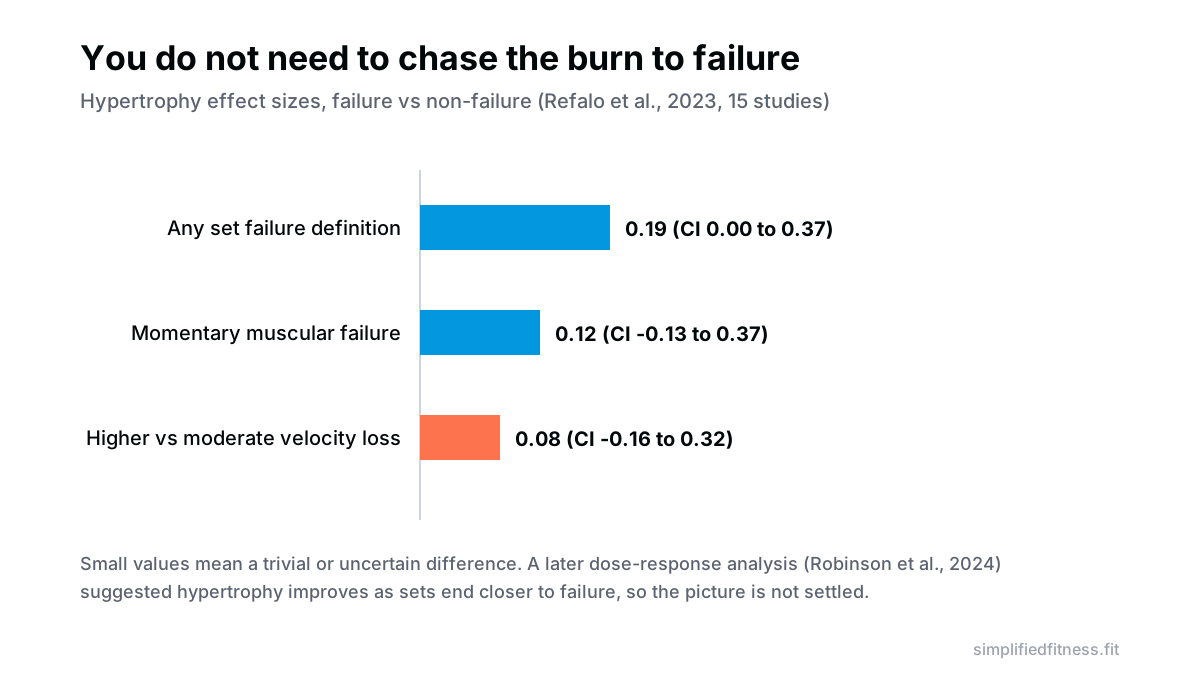
Why might the two disagree? They ask different questions (categorical comparisons versus a dose-response curve) and use different ways of defining “close to failure”. A cautious reading is that getting reasonably close to failure helps, but you do not need to grind every set into a painful finish. Our guide to training volume and effort for back growth shows how that plays out in a real program.
For you, this means effort is the lever, discomfort is a by-product, and sharp joint pain contributes nothing.
Muscle burn vs joint pain: how to tell the difference
You will not get certainty from a diagram, but a few questions sort most situations.
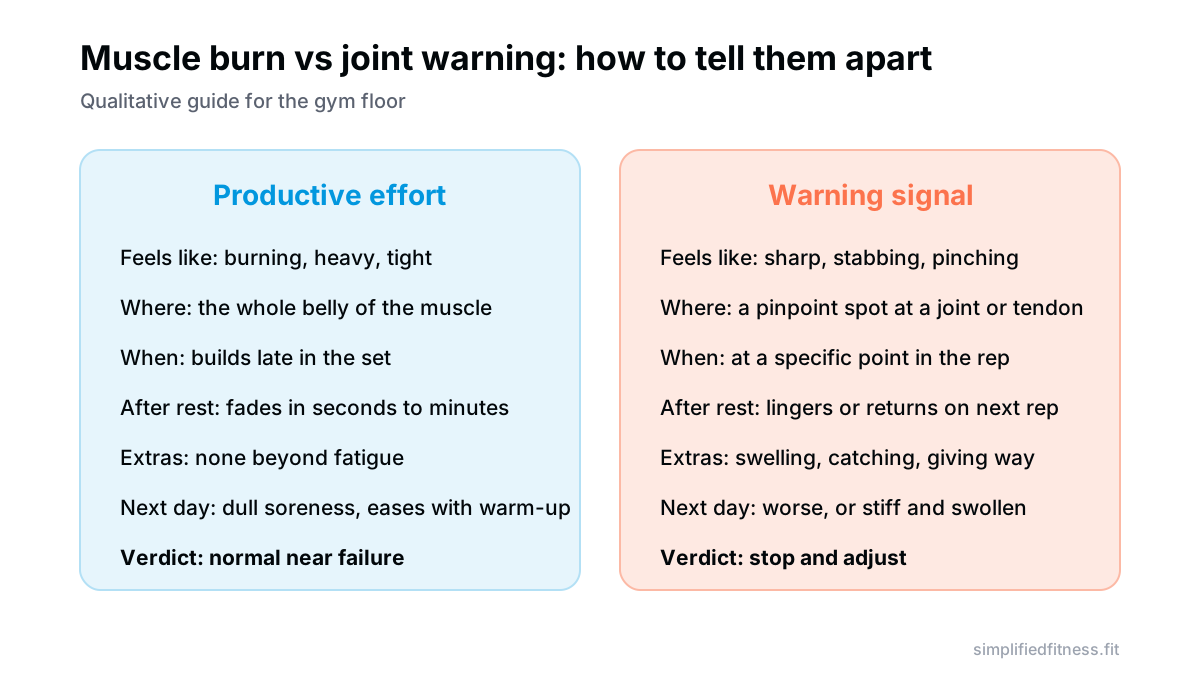
- Where is it? A broad area across the muscle belly points to effort. A single point at a joint line or tendon attachment points to irritation.
- What does it feel like? Burning, heavy or tight versus sharp, stabbing or pinching.
- When does it start? Late in a set, as fatigue builds, versus at the same angle every rep, even with a light weight.
- What happens when you rest? Burn drops within seconds to a minute or two. Joint pain tends to hang around or return on the next rep.
- Any extras? Swelling, catching, locking, a joint that gives way, numbness or tingling are not part of normal effort.
A note on why pain is not a perfect alarm. Pain is an output of the nervous system that weighs many inputs, not a direct readout of tissue damage. That works in both directions: some real injuries hurt little at first, and some painful movements are harmless. This is why a rule of thumb plus common sense beats either “push through everything” or “stop at any twinge”.
A red, yellow, green pain guide for the gym floor
This is a coaching framework, not a medical tool. It is loosely inspired by the pain-monitoring models used in tendon rehab.
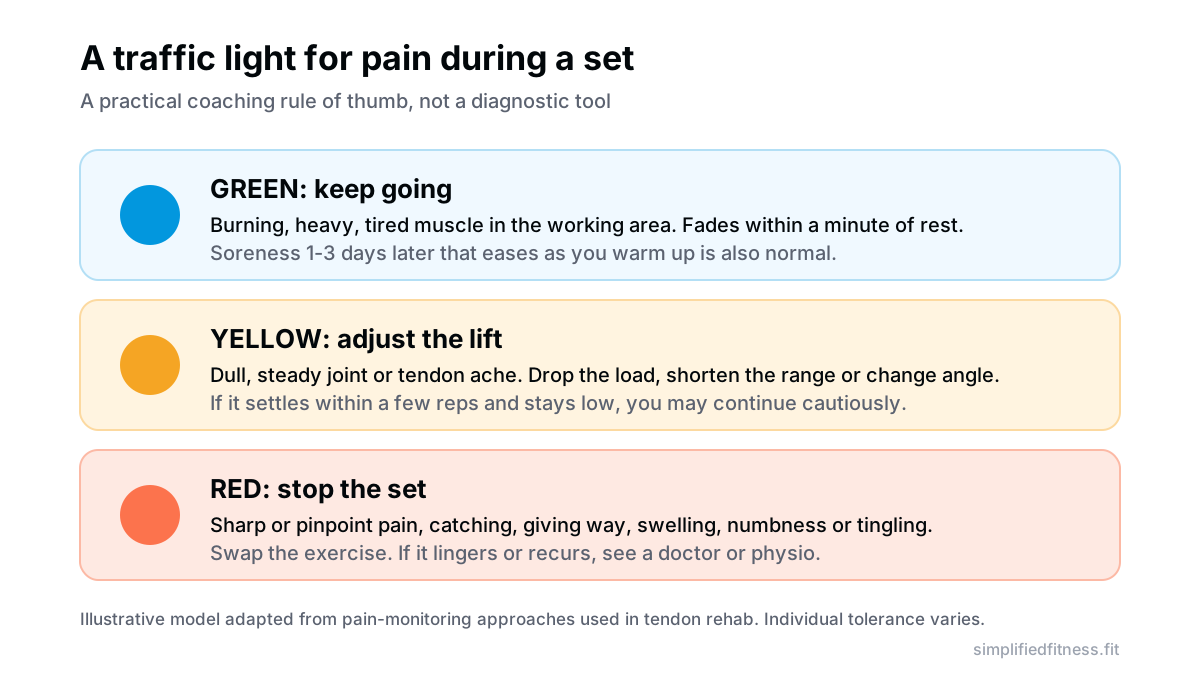
Green: keep going. Burning, heaviness or fatigue in the working muscle that clears quickly. Soreness the next day that eases as you warm up.
Yellow: adjust. A dull ache at a joint or tendon, mild and steady. Drop the weight, shorten the range, slow the tempo, change the grip or angle. If it settles and stays low, continue cautiously. If it climbs, move to red.
Red: stop the set. Sharp, stabbing or pinpoint pain. Catching, locking or giving way. Swelling. Numbness or tingling. Swap to an exercise that does not provoke it and watch it over the next few days.
Can you train through pain? What the rehab research says
There is a legitimate nuance here, and it is where “lifting through pain” myths get tangled.
In a randomised trial of 38 patients with Achilles tendinopathy, one group continued running and jumping using a pain-monitoring model while doing a tendon-loading program, and the other rested from those activities for six weeks. Both groups improved significantly over baseline and there were no significant differences between them, so continuing pain-monitored activity showed no negative effects (Silbernagel et al., 2007). A five-year follow-up case series of 34 patients found 80% fully recovered with exercise alone, and the authors noted that fear of movement may reduce how well exercise works (Silbernagel et al., 2011).
What does this tell you? That mild, stable pain during guided loading is not always a reason to stop completely, and that avoiding all movement is not automatically safer. What it does not tell you is that you should push through sharp pain on your own. Those were small studies in a specific tendon condition, run with a clinician and a defined plan.
Exercise can also change pain itself. A review of exercise-induced hypoalgesia notes that in pain-free people a single bout of aerobic or resistance exercise typically reduces pain sensitivity for some time afterward, but this response is more variable and often impaired in people with chronic pain (Rice et al., 2019). That is one reason a joint can feel fine mid-workout and worse afterwards. Judge by how it behaves over the following 24 to 48 hours, not just in the moment.
Why training through sharp pain usually backfires
Nobody has good numbers on how often pushing through sharp pain turns into a layoff, so this section is coaching logic rather than trial data. The logic is simple, though.
- Pain changes how you move. Compensations shift load onto other tissue.
- If the cause is irritation or overload, repeating the same stimulus at the same load tends to keep the tissue irritated.
- You cannot progress a lift you cannot perform. A few weeks of managed training beats a few weeks forced off an exercise.
The most common mistake is not an injury at all but a slow slide: ignoring a yellow light for weeks until it becomes a red one. Respond early, with small changes, and most problems stay small.
How to push hard without hurting your joints
- Warm up with the lift. Two or three lighter ramp-up sets of the exercise you are about to do.
- Stop one or two reps short on most sets. The failure data above suggest you give up little, and you skip the grinding reps that feel worst. See joint-friendly hypertrophy for how to structure this.
- Control the lowering phase. Unaccustomed eccentric work is a common source of delayed soreness (Hody et al., 2019), so add it gradually.
- Pick joint-friendly angles. If barbell squats pinch your hips, try a different stance or machine. Our piece on whether squats are bad for your knees covers this.
- Progress gradually. Small increases in load or sets week to week, not big jumps.
- Eat and sleep for recovery. In India, that usually means enough dal, paneer, curd, eggs or soya across the day. Check your target with the protein calculator.
If you are coming back from a layoff or injury, the traffic light return-to-gym model goes deeper, and how tendons adapt differently from muscle explains why joints and tendons need more patience than your muscles do.
When to see a doctor
Get it checked rather than guessing if you notice:
- Sharp pain that persists beyond a few days or keeps coming back in the same movement
- Swelling, warmth or visible bruising around a joint
- Numbness, tingling, or weakness in an arm or leg
- A joint that locks, catches or gives way
- Pain at night or at rest, or after a fall or a pop
- Chest, jaw or arm pain during exertion (stop and seek urgent care)
None of this page replaces an examination. A physiotherapist can help you modify training instead of simply banning it, which is usually the better outcome.
The bottom line
Is no pain no gain true? Effort is required. Pain is not. A muscle burn near the end of a hard set is normal and usually clears quickly. Sharp, pinpoint, lingering or swelling joint pain is a warning to adjust or stop.
Use the traffic light, keep a rep or two in the tank on most sets, and change one variable at a time. If you want a structured program that bakes in that logic, start with our free push, pull and legs plans.
Frequently Asked Questions
Is no pain no gain true?
Mostly no. Effort and a muscle burn are normal when you train hard, but pain itself is not what drives growth. A 2023 meta-analysis found no clear hypertrophy advantage for training to momentary failure over stopping short, so you can make progress without chasing discomfort.
What is the difference between good pain and bad pain in the gym?
Good pain is diffuse burning or heaviness in the working muscle that builds late in a set and fades soon after you rest. Bad pain is sharp, stabbing or pinpoint, often at a joint or tendon, and it lingers or returns on the next rep. If you cannot say which it is, lower the load and reassess.
How do I know if it is muscle burn or joint pain?
Ask where, when and for how long. Burn sits in the muscle belly, arrives near the end of a set and fades within seconds to a minute, while joint pain tends to sit at one spot and show up at the same point in the rep. Rerack, rest, and test an easier version before deciding.
What causes the burning feeling when lifting?
It is thought to come from chemical changes inside the working muscle during hard sets. Reviews describe group III and IV muscle afferents, small sensory nerves in muscle, responding to metabolites such as lactate, ATP and protons and signalling the central nervous system. Rest between sets and the sensation usually clears within a minute or two.
Is lactic acid what makes my muscles sore the next day?
No, next-day soreness is a different process. Delayed-onset muscle soreness is linked to unaccustomed eccentric contractions and builds over a day or so, not to leftover lactate. Repeating moderate sessions and increasing load gradually is the most useful way to reduce it.
Should I train through pain?
Not through sharp or worsening pain. Mild, stable discomfort can be acceptable in some rehab settings when pain is monitored, as in an Achilles tendinopathy trial, but that was guided care, not a gym mantra. For a new or sharp pain, stop, change the exercise and see a professional if it persists.
Is it normal for joints to hurt after lifting?
A mild, brief stiffness can happen, but ongoing joint pain is a signal to change something. Check load, range of motion, tempo and recovery before blaming the exercise itself. If it lasts more than a few days, swells or limits movement, get it assessed.
How sore should I be after a workout?
Soreness is not a measure of a good session. Healthy adults can feel pain after many kinds of exercise, especially eccentric work, but no soreness does not mean no progress. Aim for gradual progression and stay with the session if soreness eases as you warm up.
Do I have to train to failure to build muscle?
No. A 2023 meta-analysis of 15 studies found no evidence that momentary failure beats non-failure training for hypertrophy. Stopping a rep or two short still works well, and it makes the sessions less punishing. A 2024 analysis did suggest growth improves as sets end closer to failure, so train hard, just not always to the last possible rep.
Can I train a sore or injured joint safely?
Sometimes, but only with a plan. In one randomised trial of 38 people with Achilles tendinopathy, those who kept running and jumping within a pain-monitored limit during rehab did as well as those who rested from those activities. For anything beyond mild irritation, see a doctor or physio first, who can set limits for your case.
What does a pinching pain at the front of my shoulder mean?
It could be several things and only an examination can tell. Pinching or catching at a specific point in a press or raise is a yellow-to-red flag, so lower the load, change the angle or swap the lift. If it persists or you feel weakness, numbness or night pain, see a doctor.
How long should I rest if I feel sharp pain in a lift?
Stop that exercise for the session and test an alternative that does not provoke pain. Many minor irritations settle within days when you reduce load, but there is no universal timeline. If pain persists past a week or worsens, get assessed.
When should I see a doctor about gym pain?
See a doctor for pain that is sharp and persistent, comes with swelling, numbness, tingling, a feeling of the joint giving way, pain at night or after a fall. These can signal more than a muscle strain. Do not self-diagnose from the internet, including this page.
Sources & References
Every claim above is checked against peer-reviewed research (PubMed, U.S. National Library of Medicine) or guidance from established health bodies. How we fact-check.
- Refalo MC, et al. Influence of Resistance Training Proximity-to-Failure on Skeletal Muscle Hypertrophy: A Systematic Review with Meta-analysis. Sports Med. 2023. PMID: 36334240
- Robinson ZP, et al. Exploring the Dose-Response Relationship Between Estimated Resistance Training Proximity to Failure, Strength Gain, and Muscle Hypertrophy: A Series of Meta-Regressions. Sports Med. 2024. PMID: 38970765
- Amann M, et al. Autonomic responses to exercise: group III/IV muscle afferents and fatigue. Auton Neurosci. 2015. PMID: 25458423
- Hody S, et al. Eccentric Muscle Contractions: Risks and Benefits. Front Physiol. 2019. PMID: 31130877
- Dannecker EA, et al. Pain during and within hours after exercise in healthy adults. Sports Med. 2014. PMID: 24668291
- Silbernagel KG, et al. Continued sports activity, using a pain-monitoring model, during rehabilitation in patients with Achilles tendinopathy: a randomized controlled study. Am J Sports Med. 2007. PMID: 17307888
- Silbernagel KG, et al. The majority of patients with Achilles tendinopathy recover fully when treated with exercise alone: a 5-year follow-up. Am J Sports Med. 2011. PMID: 21084657
- Rice D, et al. Exercise-Induced Hypoalgesia in Pain-Free and Chronic Pain Populations: State of the Art and Future Directions. J Pain. 2019. PMID: 30904519

Umair Hazrami · Founder & Head Coach, Simplified Fitness
Umair Hazrami founded Simplified Fitness and the Simplified Lifter channel to cut through fitness noise. With 4+ years of consistent training and 10+ coaching clients, he writes every guide from the peer-reviewed research and links the sources so you can check them. Our editorial standards.
Educational content only, not medical advice. If you have a medical condition, are pregnant, or take medication, talk to a qualified doctor before changing your diet, supplements or training. Full disclaimer.
Keep reading
Health & Longevity
Are Deadlifts Bad for Your Lower Back? What Spinal Loading Research Shows
Are deadlifts bad for lower back health? The research shows spinal loads are high but tolerable, and trials use loaded lifting for back pain. How to hinge.
9 min read

Health & Longevity
Are Squats Bad for Your Knees? What the Research Actually Says
Are squats bad for your knees? Research on deep squats, kneecap stress and the knees-over-toes rule shows where the myth came from and how to squat safely.
9 min read

Health & Longevity
Why Tendons Adapt Slower Than Muscles: Connective Tissue Timelines for Lifters
Tendon adaptation vs muscle growth: why your tendons lag behind your strength gains, what studies show about timelines, and how to add load without tendonitis.
8 min read

Health & Longevity
Desk Worker Workout Routine: Fix Pelvic Tilt, Weak Glutes and a Rounded Upper Back
A desk worker workout routine built on evidence: what sitting really does to your hips, why pelvic tilt is mostly normal, and 3 gym correctives that help.
8 min read