Desk Worker Workout Routine: Fix Pelvic Tilt, Weak Glutes and a Rounded Upper Back
A desk worker workout routine built on evidence: what sitting really does to your hips, why pelvic tilt is mostly normal, and 3 gym correctives that help.

TL;DR. The short answer
- A good desk worker workout routine does three things: opens the front of the hips, trains the glutes through a full range, and builds the upper back with rows. None of it needs special equipment beyond a normal gym.
- Anterior pelvic tilt is not a defect. In one study of 120 healthy, pain-free young adults, 85% of males and 75% of females had it.
- 'Glute amnesia' is a gym phrase, not a diagnosis. Sitting may leave glutes under-used, but the fix is simply loading them with hip thrusts, bridges and squats.
- Evidence that sitting posture itself causes back pain is mixed. Moving often, and training your whole body, is better supported than chasing a perfect spine.
- Persistent or worsening pain, numbness, or weakness is a reason to see a doctor or physiotherapist, not to add more stretches.
Part of our complete guide: Joint-Friendly Lifting & Fitness Myths: A Guide for Over-40s, Teens and Sore Backs
Table of contents
The best desk worker workout routine is not a list of scary corrections. It is a normal, well-built lifting plan with three jobs added: open the front of your hips, load your glutes properly, and train your upper back with rows. That is it.
If you sit for eight hours, you have probably been told that your pelvis is tilted, your glutes have “gone to sleep” and your shoulders are collapsing forward. Some of that is exaggerated. In this guide we will separate what research actually supports from the gym folklore, then build a plan you can run this week. (This sits inside our wider guide to joint-friendly lifting and fitness myths.)
Is anterior pelvic tilt actually a problem?
Mostly, no. Anterior pelvic tilt means the front of your pelvis rotates slightly downward, which increases the curve in your lower back. Online, it gets blamed for back pain, a “pot belly” and weak glutes.
But look at what researchers found when they simply measured healthy people. In a study of 120 pain-free adults (65 males, 55 females, mean age 23.8), 85% of males and 75% of females had an anterior pelvic tilt. Only 6% of males and 7% of females had a posterior tilt, and 9% of males and 18% of females were neutral (Herrington, 2011).
So a tilt is the typical finding in people with no symptoms at all.
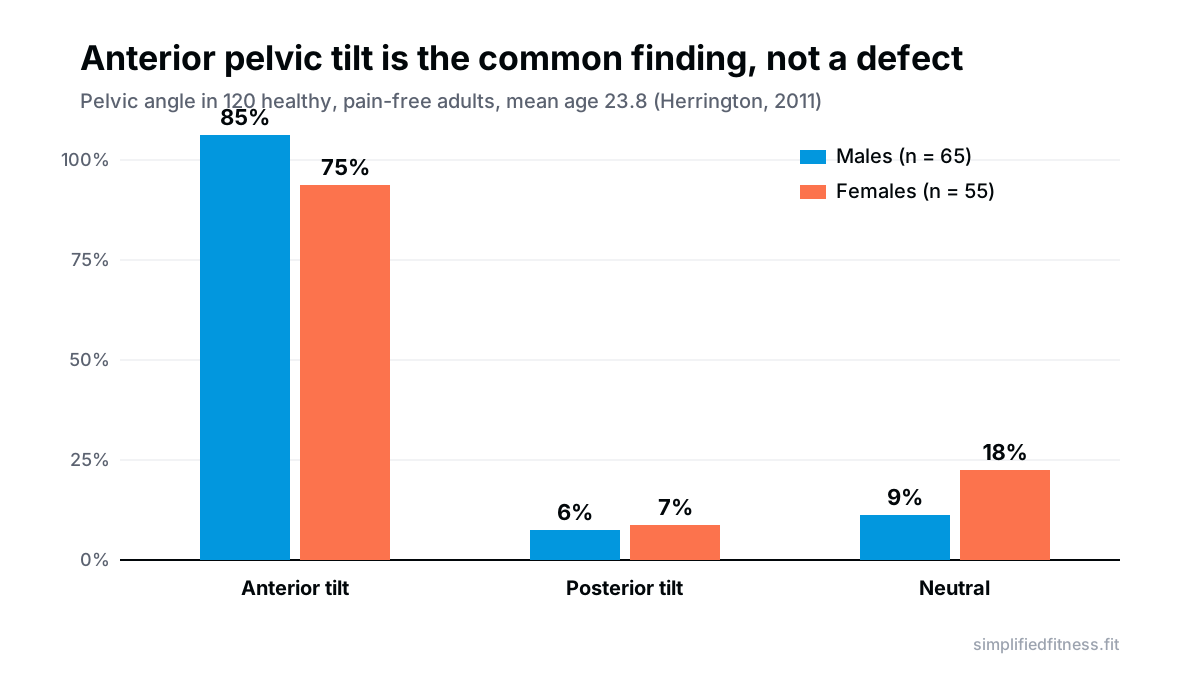
This was a small study of young, healthy people, measured with a palpation meter, so it does not tell us about every age group or about people in pain. It also does not prove sitting is harmless. It just shows that “you have a tilt” is weak evidence of a problem.
The lumbar curve itself is also less clear-cut than gym content suggests. A meta-analysis of 13 studies (796 people with low back pain, 927 healthy controls) found that people with back pain tended to have a smaller lumbar lordotic angle, not a larger one, although the studies were heterogeneous (Chun et al., 2017). More curve is not automatically worse.
Does sitting all day cause back pain?
This is where honest answers get messy. A 2020 umbrella review of 41 systematic reviews found both positive and null associations between spine posture, prolonged sitting, bending and back pain. Meta-analyses leaned towards an association, but reviews limited to prospective studies were less consistent, and the authors concluded there was no consensus on causality (Swain et al., 2020).
Put simply: sitting and back pain often go together, but nobody has shown that sitting itself is the cause.
That matters for how you train. If posture were a precise cause, exact correction would be the answer. Since it is not, the sensible plan is to build capacity (stronger glutes, back and trunk) and to break up long sitting, rather than to chase a perfect spine position.
What does sitting do to your hips and glutes?
Here is the plausible theory. Sitting keeps your hips flexed for hours. Your hip flexors may adapt to that shorter position, and your glutes do little work while you are seated. Then you stand up and your hips feel stiff and your glutes feel hard to find.
Notice the wording: plausible theory. I could not find a trial that follows desk workers and shows their glutes switching off or their hip flexors permanently shortening. So treat “glute amnesia” as a gym nickname for glutes that are under-trained, not a medical condition. Nothing in the evidence suggests your glutes are damaged.
The practical read is more boring and more useful. Glutes respond to load like any other muscle. If you do not train them hard, they stay weak relative to your quads and your back.
The 3 gym correctives worth programming
You do not need 15 drills. Three jobs cover most of it.
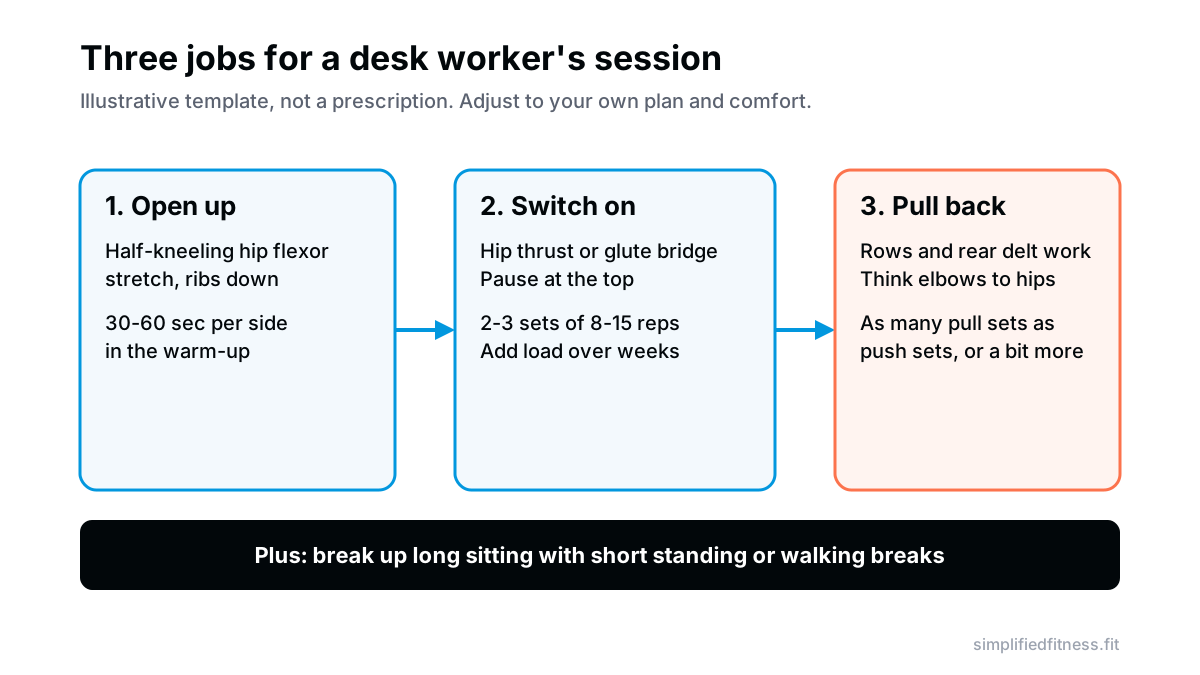
1. Open the hip flexors (couch stretch or half-kneeling stretch)
Kneel with one knee down, the other foot in front, and squeeze the glute of the kneeling leg. Tuck your pelvis slightly under and keep your ribs stacked over your hips. You should feel the stretch at the front of the hip, not in your lower back.
What can this actually do? A 3-week home stretching program in 20 healthy people with limited passive hip extension did increase passive hip extension. But it did not change pelvic tilt, active hip extension or lumbar extension during running (Mettler et al., 2019).
So stretching can make your hips more open. It is not a proven way to “fix” a tilt. Use 30-60 seconds per side in your warm-up if it feels good and makes your squat or lunge position easier.
2. Load the glutes (hip thrust, bridge, squat)
For glutes, the hip thrust is a good choice. In a study of 13 trained women using estimated 10-rep-max loads, the barbell hip thrust produced greater upper gluteus maximus (69.5% vs 29.4% mean activity), lower gluteus maximus (86.8% vs 45.4%) and biceps femoris activity than the back squat, with no difference for vastus lateralis (Contreras et al., 2015). That is surface EMG, which shows activation, not guaranteed growth, and the study authors themselves called for longer training studies.
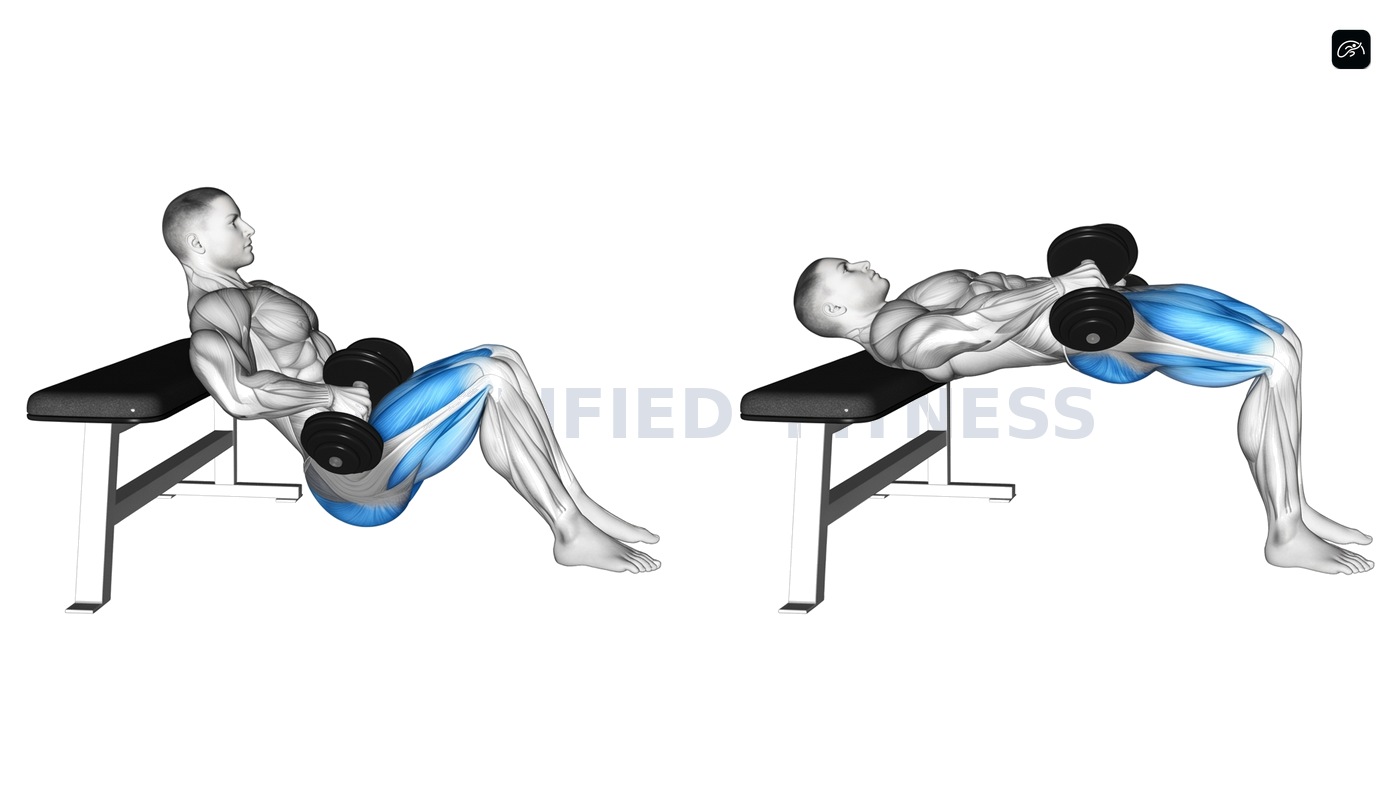
So treat it as a sound tool, not a magic one. Keep squats or deadlift variations in your plan too. Our deeper breakdown is in hip thrusts versus squats for glute growth.
How to do it well:
- Stop at a flat torso and straight line from knee to shoulder. Do not hyperextend the lower back.
- Pause for a beat at the top.
- Chin slightly tucked, ribs down.
- 2-3 sets of 8-15 reps, adding weight when you can hit the top of the range.
No bench or barbell? Glute bridges, single-leg bridges and a backpack load work well at home.
3. Strengthen the mid-back (rows and rear delts)
The “upper cross” pattern is a name for rounded shoulders plus a forward head position. A 2023 systematic review and meta-analysis of 18 studies found that physiotherapy improved craniovertebral angle, kyphotic angle and rounded shoulder versus no treatment (SMD -1.78, 95% CI -2.68 to -0.87), and the authors reported exercise therapy as beneficial for postural alignment (Chaudhuri et al., 2023).
Two cautions. The included studies varied a lot in design, and “better posture on a measurement” is not the same as “less pain”. So use this as support for training your upper back, not as proof of a cure.
In the gym, that means rows. Chest-supported versions take your lower back out of the equation, which is handy if you are already tired of sitting.
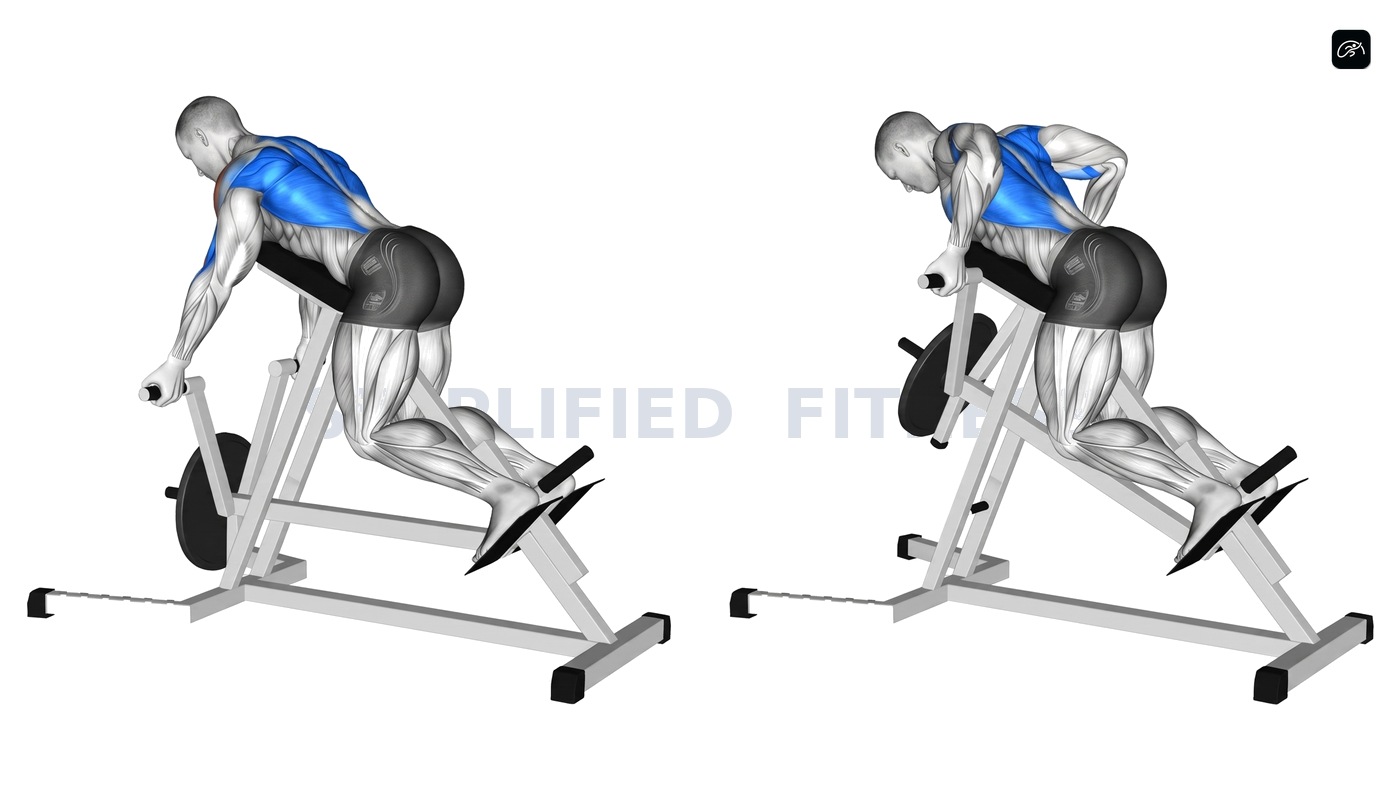
A simple rule of thumb, not a study finding, is to do at least as many pulling sets as pressing sets. Ideas for variations are in our guide to chest-supported rows for upper back growth, and rear delt flies and face pulls are good add-ons. Do not force the shoulder blades back and down until your neck tightens. Think “elbows to hips”.
A sample desk worker workout routine
Here is a template, not a prescription. Three days a week, 45-60 minutes, using any normal split. If you already have a plan, simply add these pieces. Our free leg day and pull day plans already include hip and back work you can build around.
| Slot | Exercise | Sets x reps |
|---|---|---|
| Warm-up | Half-kneeling hip flexor stretch | 1 x 30-60 sec per side |
| Warm-up | Glute bridge or banded walk | 2 x 10-15 |
| Main lift | Squat, leg press or deadlift variation | 3 x 6-10 |
| Glutes | Hip thrust | 3 x 8-12 |
| Pull | Chest-supported or cable row | 3 x 8-12 |
| Pull | Rear delt fly or face pull | 2-3 x 12-20 |
| Push | Dumbbell press (any angle) | 3 x 8-12 |
Add weight gradually. If a movement causes sharp or lingering pain, swap it and, if it persists, get it checked. For a quick warm-up flow you can borrow from, see our 7-minute dynamic warm-up.
Do micro-breaks matter more than correctives?
They probably help, and they cost nothing. A 2020 systematic review and meta-analysis (42 studies, 37 in the meta-analysis) found that breaking up prolonged sitting with physical activity lowered post-meal glucose (SMD -0.54) and insulin (SMD -0.56) moderately, and triglycerides to a smaller degree (SMD -0.26), compared with continuous sitting (Loh et al., 2020). Those are metabolic markers, not back pain or posture outcomes, so the finding supports movement for general health rather than as a spine fix.
Some easy habits:
- Take calls standing or walking.
- Refill your water bottle at the far end of the office or home.
- Do a few hip circles or a short stroll every so often.
- Walk after lunch. More ideas in our post on NEAT and daily steps for fat loss.
In hot weather, or if your commute is long, a few minutes indoors counts. There is no magic interval in the research I have cited here, so pick one you will actually keep.
Does fixing pelvic tilt actually work?
This is the honest weak spot. A systematic review of non-surgical treatments for excessive anterior pelvic tilt found only two randomized trials (72 people) and two non-randomized studies (23 people). One trial reported a small reduction of less than 2 degrees in non-symptomatic men, and the review concluded there was no overall evidence for treatment effects, with very low quality evidence (Falk Brekke et al., 2020).
That does not mean exercise is useless. It means we cannot promise a changed angle. A better aim is to feel better and move better, and to get stronger in the muscles you under-use at work.
When to see a doctor
Posture is rarely dangerous. These are different. See a doctor or physiotherapist if you have pain that persists or gets worse, pain at night, numbness or tingling down a leg or arm, new weakness, or pain after a fall or injury. This article is general education, not a diagnosis, and it cannot tell you what is causing your own symptoms.
Frequently Asked Questions
What is the best desk worker workout routine?
A simple full-body plan three days a week works well, with a hip flexor stretch and glute activation in the warm-up, then squats or hinges, a hip thrust, rows, and a pressing movement. The goal is to train the muscles sitting leaves under-used while keeping the rest of your training balanced. Start with the sample session in this article and add weight slowly.
Does sitting all day cause anterior pelvic tilt?
Not in any way research has proven. A study of 120 healthy, pain-free young adults found most had some anterior tilt, so it is a common finding in people without symptoms. That study did not measure sitting habits. If you want to test your own habits, track how you feel and move, not how your pelvis looks in a mirror.
Is anterior pelvic tilt bad for you?
Usually not by itself. A 2011 study of asymptomatic adults found anterior tilt was the most common finding, and a 2017 meta-analysis found back pain linked to less lumbar curve, not more. If you have pain, the cause is rarely one angle, so see a physiotherapist rather than assuming your pelvis is the culprit.
What is glute amnesia?
It is an informal term for glutes that feel weak or hard to 'feel working', often blamed on sitting. There is no formal diagnosis behind it, and the term overstates what happens. Training glutes with hip thrusts, bridges and squats at a challenging load is the practical answer.
What are the best exercises for anterior pelvic tilt?
There is no proven exercise set that reduces pelvic tilt. A systematic review found only very low quality evidence, with one trial reporting a change of under 2 degrees in non-symptomatic men. Hip flexor stretches, glute work and core bracing are reasonable for how your body feels and moves, not for fixing an angle.
Does the couch stretch work?
It can raise passive hip extension range, but that may not change how you move. In a 3-week study of 20 healthy people with limited hip extension, a hip flexor stretching program increased passive extension but did not change pelvic tilt or lumbar extension while running. Use it as a warm-up tool if it feels good, and keep your ribs down so you stretch the hip, not your lower back.
How do I fix upper cross syndrome?
Upper cross syndrome describes a pattern of rounded shoulders and a forward head. A 2023 systematic review of 18 studies found physiotherapy improved posture measures versus no treatment, and reported exercise therapy as beneficial for alignment. Rows, rear delt work, and neck and chest mobility are sensible, and a physiotherapist can tailor it if you have pain.
Can I do this routine at home?
Yes. Glute bridges, single-leg bridges, a resistance band or backpack row, and the half-kneeling stretch all work without a gym. Progress by adding reps, slowing the lowering phase, or loading a bag with books.
How often should a desk worker take breaks from sitting?
There is no single proven interval. A 2020 meta-analysis found activity breaks during sitting moderately lowered blood sugar and insulin spikes after meals. Standing or walking for a couple of minutes now and then, such as on a phone call, is an easy habit to start.
Will standing desks fix my posture?
Not by themselves. Posture advice and gadgets have a weak evidence base, and a review of reviews found no consensus that sitting or spine posture causes low back pain. A standing desk is a way to vary position, so alternate between sitting, standing and walking.
How long until I notice a difference?
There is no study that sets a timeline for this. Passive hip extension improved after 3 weeks of stretching in one small trial, and strength usually takes longer to build with consistent loading. Track your hip thrust and row weights as a more reliable progress marker.
Should I see a doctor about my posture?
See one if you have pain that is persistent or getting worse, numbness or tingling down a leg or arm, weakness, or pain at night. Posture alone is rarely dangerous, but these symptoms need a proper assessment. Until then, keep moving within comfort and avoid pushing through sharp pain.
Sources & References
Every claim above is checked against peer-reviewed research (PubMed, U.S. National Library of Medicine) or guidance from established health bodies. How we fact-check.
- Herrington L. Assessment of the degree of pelvic tilt within a normal asymptomatic population. Man Ther. 2011. PMID: 21658988
- Falk Brekke A, et al. Non-surgical interventions for excessive anterior pelvic tilt in symptomatic and non-symptomatic adults: a systematic review. EFORT Open Rev. 2020. PMID: 32071772
- Chun SW, et al. The relationships between low back pain and lumbar lordosis: a systematic review and meta-analysis. Spine J. 2017. PMID: 28476690
- Swain CTV, et al. No consensus on causality of spine postures or physical exposure and low back pain: a systematic review of systematic reviews. J Biomech. 2020. PMID: 31451200
- Chaudhuri S, et al. Physiotherapeutic interventions for upper cross syndrome: a systematic review and meta-analysis. Cureus. 2023. PMID: 37859911
- Mettler JH, et al. Effects of a hip flexor stretching program on running kinematics in individuals with limited passive hip extension. J Strength Cond Res. 2019. PMID: 29927892
- Contreras B, et al. A comparison of gluteus maximus, biceps femoris, and vastus lateralis electromyographic activity in the back squat and barbell hip thrust exercises. J Appl Biomech. 2015. PMID: 26214739
- Loh R, et al. Effects of interrupting prolonged sitting with physical activity breaks on blood glucose, insulin and triacylglycerol measures: a systematic review and meta-analysis. Sports Med. 2020. PMID: 31552570

Umair Hazrami · Founder & Head Coach, Simplified Fitness
Umair Hazrami founded Simplified Fitness and the Simplified Lifter channel to cut through fitness noise. With 4+ years of consistent training and 10+ coaching clients, he writes every guide from the peer-reviewed research and links the sources so you can check them. Our editorial standards.
Educational content only, not medical advice. If you have a medical condition, are pregnant, or take medication, talk to a qualified doctor before changing your diet, supplements or training. Full disclaimer.
Keep reading
Health & Longevity
Are Deadlifts Bad for Your Lower Back? What Spinal Loading Research Shows
Are deadlifts bad for lower back health? The research shows spinal loads are high but tolerable, and trials use loaded lifting for back pain. How to hinge.
9 min read

Health & Longevity
Are Squats Bad for Your Knees? What the Research Actually Says
Are squats bad for your knees? Research on deep squats, kneecap stress and the knees-over-toes rule shows where the myth came from and how to squat safely.
9 min read

Health & Longevity
Why Tendons Adapt Slower Than Muscles: Connective Tissue Timelines for Lifters
Tendon adaptation vs muscle growth: why your tendons lag behind your strength gains, what studies show about timelines, and how to add load without tendonitis.
8 min read
Health & Longevity
Does Cardio Kill Gains? The Real Science of the Interference Effect
Does cardio kill gains? A 43-study review found moderate cardio barely dents muscle size. Learn what the interference effect is and how to program around it.
8 min read