How to Build a Gym Habit: The Behavioral Science of Sticking With It
How to build a gym habit using habit science: how long it takes, why cues and low friction beat willpower, and what identity can and cannot do for consistency.

TL;DR. The short answer
- To build a gym habit, repeat the same workout in the same context (same time, same place, same cue) until it runs on autopilot. Motivation gets you started, but context does the heavy lifting.
- A 2024 systematic review found habits can start forming in about two months (median 59-66 days across four studies), but individual times ranged from 4 to 335 days. Do not expect a magic 21 days.
- In 111 new gym members, training at least four times a week for six weeks was the minimum for an exercise habit to form. Consistency, low complexity, a supportive environment and enjoyment all predicted stronger habits.
- Planning interventions (specific if-then plans) improved physical activity in a meta-analysis of 35 randomized trials, with a small to moderate effect (SMD 0.35).
- Identity ('I am someone who trains') can be shifted by interventions, but the evidence is newer and weaker than for planning and repetition. Treat it as a helpful extra, not a replacement for structure.
Part of our complete guide: Body Composition, Muscle Memory and Habits: A Lifter's Guide to Tracking
Table of contents
If you want to know how to build a gym habit, the short answer is this: stop trying to feel motivated and start making the session the easy, default thing to do. Repeat the same workout in the same setting, remove the small obstacles, and give it a couple of months. That is the core of what habit research suggests, and it is the reason a fixed routine beats a clever one.
This article is part of our complete guide to body composition, muscle memory and adherence. Here we stay on the psychology: how habits form, how long it realistically takes, and what you can change in your environment this week.
Why willpower is the wrong tool
Plenty of people who quit the gym do not quit because they stopped caring. They quit because showing up depended on a daily decision, and daily decisions lose to a long workday, a hot evening commute or a bad night of sleep.
Habit researchers describe it differently. A review in the Annual Review of Psychology explains that people tend to repeat the same behaviours in recurring contexts, and that habits are the efficient, default mode of response, working alongside deliberate goal pursuit (Wood and Runger, 2016). The practical reading: if the same cue (a time, a place, a previous action) reliably leads to the same response, you spend less mental effort each time.
Notice what that does not say. It does not say motivation is useless. Motivation helps you pick a plan and begin. Context is what keeps it going when motivation dips.
How long does it take to build a gym habit?
You have probably heard “21 days.” There is no good research behind that number for health behaviours.
A 2024 systematic review pooled 20 studies with 2,601 participants and looked at how long health habits take to form. Across the four studies that reported time to habit formation, median times were 59-66 days and mean times were 106-154 days, with huge individual differences (4 to 335 days) (Singh et al., 2024). The authors concluded habits can start forming within about two months, but the time varies a lot between people.
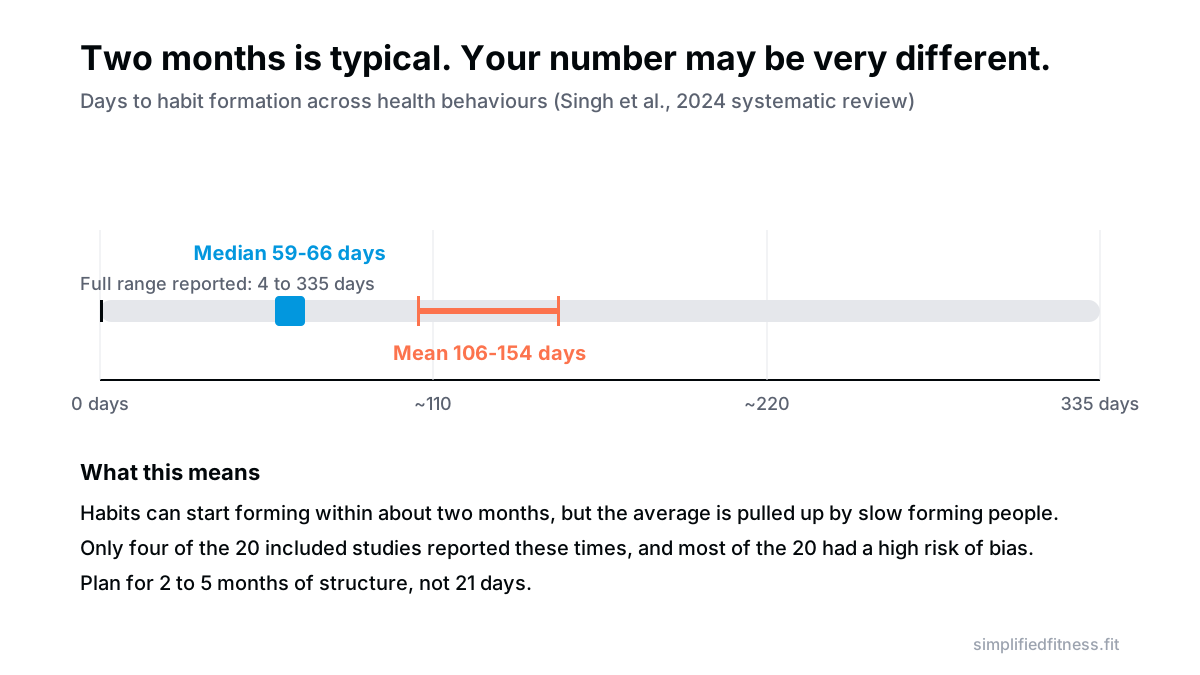
Two honest caveats. Most of the included studies had a high risk of bias. And the behaviours were mixed (flossing, diet, drinking water and physical activity), so gym training specifically is only part of the picture.
The mean being so much higher than the median tells you something useful: a minority of people take far longer. If you are in that group, you are not broken. You just need more repetitions before it feels easy.
What about gym members specifically?
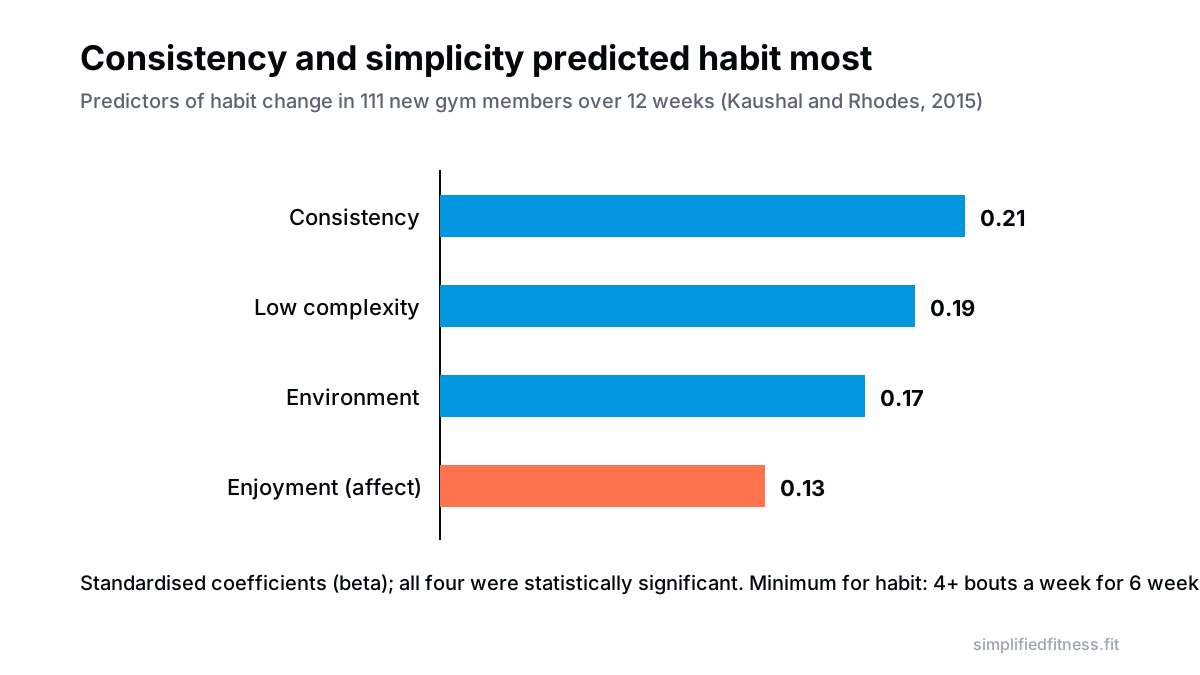
One longitudinal study followed 111 new gym members across 12 weeks. It found that exercising at least four times a week for six weeks was the minimum requirement to establish an exercise habit. Habit and intention predicted exercise behaviour in parallel, and the authors suggested trainers focus on consistency, which could lead to habit formation in nearly six weeks (Kaushal and Rhodes, 2015).
That is one study of new members, so do not read “four days for six weeks” as a rule for everyone. It is still a sensible working assumption: treat the first 6-8 weeks as the fragile stretch, when structure matters most.
How does reducing friction make the gym automatic?
Friction is the extra effort between intending to train and actually training. Habit-forming is easier when that gap is small, and the gym member data supports the idea: low behavioural complexity predicted stronger habit formation (Kaushal and Rhodes, 2015).
Think of friction in three layers.
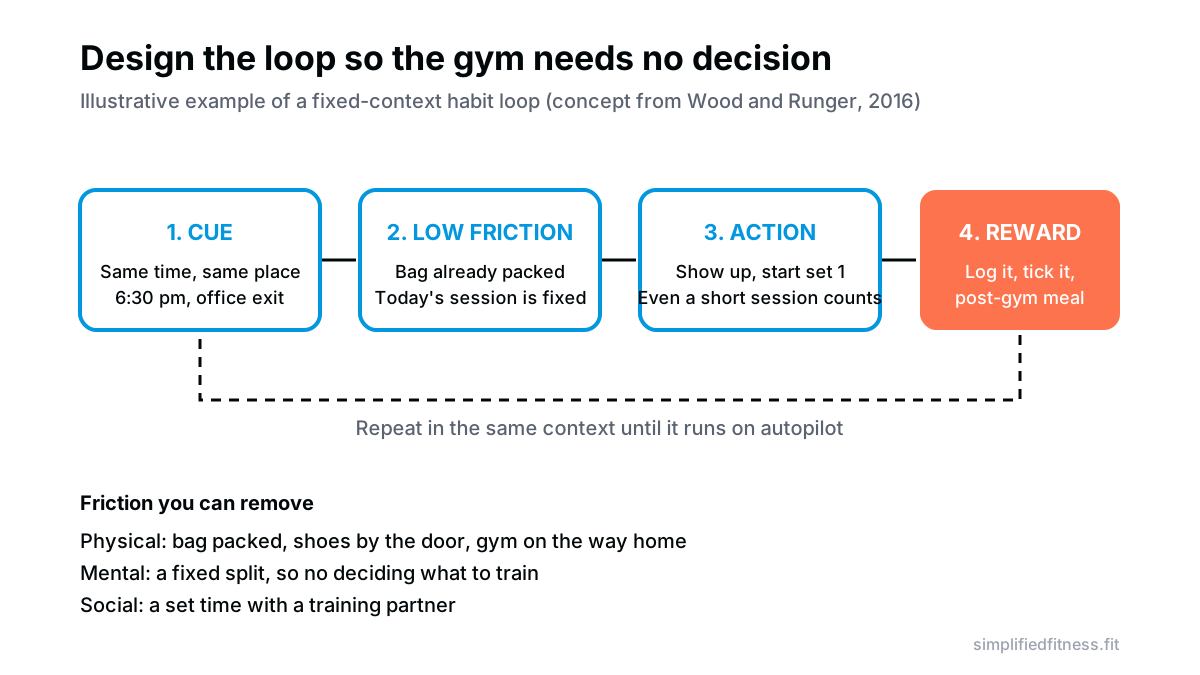
Physical friction. Distance, gear and logistics. Pack your bag the night before and leave it by the door. Keep shoes and a water bottle in it. If you can, pick a gym on your route home rather than one that needs a detour. In an Indian summer, a gym you can reach without a long hot ride is a real advantage.
Mental friction. Deciding what to train, how heavy to go, which machine to start with. This is where a fixed split earns its keep. A simple 3-day structure such as push, pull and legs (see our push day plan and the full training plans) means that when you walk in, the decision is already made.
Social and scheduling friction. Vague plans (“I’ll go sometime after work”) leave room for excuses. A set time, a training partner or a coach slot makes skipping more costly.
Does planning ahead really help? (Implementation intentions)
An implementation intention is a specific if-then plan: “If it is Monday, Wednesday or Friday at 6:30 pm, then I go straight from work to the gym.”
The evidence is encouraging but not dramatic. A 2022 meta-analysis of 35 randomized trials (from a review of 41 trials and 5,439 participants) found that planning interventions improved physical activity compared with controls (SMD = 0.35, 95% CI 0.25-0.44), with effects that varied by context (Peng et al., 2022). An earlier meta-analysis of 13 randomized trials found implementation intentions increased physical activity when the strategy was reinforced (effect 0.25, 95% CI 0.05-0.45) (Silva et al., 2018).
Two cautions. Heterogeneity was substantial in the larger review (I2 about 61%), and many of these trials looked at general physical activity, not strength training. So plans help, probably modestly, and the effect is stronger when you revisit and reinforce the plan rather than writing it once.
A simple template:
- Write down your days, times and place for the next 2 weeks.
- Add a coping plan: “If I am too tired, then I do the first two exercises only.”
- Review it every Sunday.
What about habit-formation interventions and apps?
A 2023 meta-analysis of 10 studies found interventions designed around habit formation increased physical activity habit strength (SMD = 0.31, 95% CI 0.14-0.48). Effects were larger at follow-up of 12 weeks or less, and problem solving was linked to better results, while social reward was linked to weaker results (Ma et al., 2023).
Two takeaways. First, the effect is real but small to moderate, so there is no app that will do this for you. Second, the “problem solving” finding fits what coaches see: when you spot what stops you (late meetings, no clean kit, a crowded gym at 6 pm) and fix that one thing, adherence improves. Do not rely on likes and social praise to hold the habit together.
Can “I am a lifter” identity keep you going?
Identity-based thinking says that you stay consistent more easily when training is part of who you are, not just a goal you are chasing. It is intuitive, and many lifters find it helpful.
The research is younger. A 2025 meta-analysis of 40 effect sizes (4,939 adults) found that interventions can change physical activity identity (g = 0.18, 95% CI 0.11-0.24). In the subset of studies that also measured activity (k = 30), the pooled effect on activity was larger (g = 0.61), but there was heterogeneity and signs of possible publication bias. The authors concluded identity can change, though the effect may be smaller than changes in behaviour in these interventions (Rhodes et al., 2025).
So what can we honestly say? Identity can shift, and it may go hand in hand with more activity. The review does not show that identity protects against lapses better than outcome goals, so treat that claim as a plausible idea, not a proven one.
In practice, the useful move is small and behavioural: define your identity by an action you control. “I am someone who trains Monday, Wednesday and Friday” holds up better than “I am someone who is getting shredded by December,” because a missed scale target does not invalidate it. For more on this, see our guide to process versus outcome goals.
A 4-week plan to make training automatic
This is a practical synthesis of the studies above, not a protocol tested as a package.
| Week | Focus | What to do |
|---|---|---|
| 1 | Cue and schedule | Pick 3 fixed days and times. Write the if-then plan. Pack your bag the night before each session. |
| 2 | Cut decisions | Follow a fixed split. Write the session in a note or logbook before you leave home. |
| 3 | Add a coping plan | Define your minimum session (for example 2 exercises, 15 minutes) for low-energy days. |
| 4 | Reward and review | Tick off each session. Check what blocked you and fix one obstacle. |
Then keep going. Remember the fragile window runs through roughly 6-8 weeks, and plenty of people take longer.
What to do when the habit breaks
It will break at some point: travel, exams, illness, a new job. Plan for the restart, not just the streak.
- Resume at the next scheduled session, not “next Monday.”
- Lower the first session on purpose. The point is to reconnect the cue and the action.
- Keep the same time and place if you can.
- If stress is the real issue, see how to train through busy or stressful periods. If you feel flat and uninterested, our guide to gym burnout and apathy goes deeper.
- If you catch yourself thinking “I missed one session, so the week is ruined,” that is a separate thinking trap, which we cover in the all-or-nothing mindset.
When to see a doctor
Habit tricks are not medical advice. See a doctor before starting a program if you have chest pain, unexplained breathlessness, dizziness or fainting, a known heart, kidney or metabolic condition, diabetes, are pregnant, or have been inactive for a long time with health concerns. Persistent low mood or loss of interest in everything, not just training, is also worth discussing with a healthcare professional.
The bottom line
Building a gym habit is mostly an environment and scheduling problem, not a character problem. Fix the cue, shrink the friction, repeat the same sessions for at least two months, and expect your personal timeline to differ from the average. The strongest support comes from habit science and planning trials. The identity angle is promising but less proven.
Not sure what to run? Use our free training plans as a fixed split, and let your calendar do the work.
Frequently Asked Questions
How long does it take to build a gym habit?
There is no fixed number. A 2024 systematic review reported median times of 59-66 days to reach habit formation, with individual times ranging from 4 to 335 days. Aim for a consistent routine for at least two to three months before judging whether it feels automatic.
Is it true that it takes 21 days to form a habit?
No, the 21-day figure is a popular myth, not a research finding. Studies that tracked real behaviour found most people needed about two months or more, and some much longer. Plan for months of structure, and treat the first 6-8 weeks as the fragile period.
How many times a week should I go to the gym to form a habit?
In one study of 111 new gym members, exercising at least four times per week for six weeks was the minimum requirement for an exercise habit. That is one study with a specific group, so it is a guide, not a law. If four days feels unrealistic, a fixed 3-day split done every week is a better start than an ambitious plan you abandon.
Why do I lose motivation to go to the gym?
Motivation naturally rises and falls, and it is a weak foundation when you are tired, busy or stressed. Habit research shows repeated behaviour in a stable context becomes the default response, so you rely less on feeling like it. Build the routine so that starting requires the fewest decisions, and save motivation for pushing harder once you are there.
What is friction in habit formation?
Friction is any extra effort between you and the behaviour: a bag you have to pack, a long commute, or deciding what to train. In the new gym member study, low behavioural complexity predicted stronger habit formation. Remove steps before you try to add willpower, for example by packing your bag the night before and following a fixed split.
Does motivation matter at all for building habits?
Yes, but mostly at the start. A habit review describes habits as the efficient default response while deliberate goal pursuit still guides behaviour alongside it. Use motivation to choose the routine and begin, then use cues and repetition to keep it going.
What are implementation intentions and do they work for exercise?
They are specific if-then plans, such as 'If it is 6:30 pm on Monday, then I go to the gym.' A 2022 meta-analysis of 35 randomized trials found planning interventions improved physical activity (SMD 0.35), and a 2018 meta-analysis found a benefit when the strategy was reinforced. Write down the day, time and place for each session this week.
Can an identity like 'I am a lifter' really help me stay consistent?
It may help, but the evidence is early. A 2025 meta-analysis found interventions can shift physical activity identity (g = 0.18) and that identity and activity changed together in studies measuring both, though it flagged possible publication bias. Pair the identity with action: count each session as a vote for it, rather than waiting to feel like a lifter.
What should I do if I miss a week of workouts?
Resume at your next scheduled session, and do not wait for a fresh Monday. Habits are built from repeated context-linked behaviour, so one gap does not erase the pattern, although long gaps can weaken it. Do a shorter, easier session first to restore the cue-action link.
Is it better to work out in the morning to build a habit?
There is some evidence for it. The 2024 review found morning practices and self-selected habits generally had greater strength, although most included studies were not about gym training specifically. Choose the time you can protect most reliably, since a consistent slot matters more than the hour itself.
Do habit apps and reminders help?
They can help as cues, but the evidence is mixed and depends on design. A 2023 meta-analysis found habit formation interventions increased physical activity habit strength (SMD 0.31), with problem solving linked to better effects. Use reminders to prompt a planned session, and fix the obstacles that stop you actually going.
Should I follow a fixed split or change my workouts often?
For habit building, a fixed schedule is easier because it removes the daily decision about what to do. Low complexity predicted habit formation in new gym members. Pick a simple split such as push, pull and legs, and stay with it for at least 8 weeks.
When should I speak to a doctor before starting?
See a doctor first if you have chest pain, unexplained breathlessness, dizziness, a heart or kidney condition, diabetes, are pregnant, or have not exercised in years and have health concerns. Habit strategies do not replace medical advice. Start gently and let a professional set limits if you are unsure.
Sources & References
Every claim above is checked against peer-reviewed research (PubMed, U.S. National Library of Medicine) or guidance from established health bodies. How we fact-check.
- Singh B, et al. Time to Form a Habit: A Systematic Review and Meta-Analysis of Health Behaviour Habit Formation and Its Determinants. Healthcare (Basel). 2024. PMID: 39685110
- Wood W, et al. Psychology of Habit. Annu Rev Psychol. 2016. PMID: 26361052
- Kaushal N, et al. Exercise habit formation in new gym members: a longitudinal study. J Behav Med. 2015. PMID: 25851609
- Ma H, et al. Effects of habit formation interventions on physical activity habit strength: meta-analysis and meta-regression. Int J Behav Nutr Phys Act. 2023. PMID: 37700303
- Peng S, et al. The Effectiveness of Planning Interventions for Improving Physical Activity in the General Population: A Systematic Review and Meta-Analysis of Randomized Controlled Trials. Int J Environ Res Public Health. 2022. PMID: 35742582
- Silva MAVD, et al. Impact of implementation intentions on physical activity practice in adults: A systematic review and meta-analysis of randomized clinical trials. PLoS One. 2018. PMID: 30427874
- Rhodes RE, et al. Intervention effects on physical activity identity: a systematic review and meta-analysis. Health Psychol Rev. 2025. PMID: 40008714

Umair Hazrami · Founder & Head Coach, Simplified Fitness
Umair Hazrami founded Simplified Fitness and the Simplified Lifter channel to cut through fitness noise. With 4+ years of consistent training and 10+ coaching clients, he writes every guide from the peer-reviewed research and links the sources so you can check them. Our editorial standards.
Educational content only, not medical advice. If you have a medical condition, are pregnant, or take medication, talk to a qualified doctor before changing your diet, supplements or training. Full disclaimer.
Keep reading

Health & Longevity
Overcoming the All-or-Nothing Mindset: How Perfectionism Wrecks Long-Term Fitness
The all-or-nothing mindset in fitness turns one missed workout into a lost month. Here is the research, the never-miss-twice rule and a 20-minute fallback plan.
10 min read

Health & Longevity
Best Way to Measure Body Fat: DEXA, Bod Pod, Calipers and 4C Compared
The best way to measure body fat percentage is the same tool, under the same conditions, every time. See how DEXA, Bod Pod, calipers and 4C really compare.
8 min read

Health & Longevity
Body Recomposition Limits: Who Can Recomp, and When Advanced Lifters Must Choose a Surplus or Deficit
Body recomposition limits explained: who can still lose fat and gain muscle at once, why advanced lifters stall, and how to choose a cut or lean bulk.
9 min read

Health & Longevity
How Long Does It Take to Lose Muscle? A Realistic Detraining Timeline
How long does it take to lose muscle after you stop lifting? A week-by-week look at glycogen, strength and muscle size, with every study linked and sourced.
9 min read