Chest Workouts for Bad Shoulders: Bench Press Alternatives That Hurt Less
Chest workouts for bad shoulders: neutral-grip dumbbell presses, floor presses and machine swaps that keep you training chest, plus when to see a doctor.

TL;DR. The short answer
- Chest workouts for bad shoulders work best when you change the press, not stop pressing: neutral-grip dumbbells, a floor press or a converging machine often feel easier on the shoulder than a straight barbell bench.
- In a survey of 1387 recreational lifters, shoulder was the most common pain site, and free-weight exercises had a higher pain rate (19.94%) than guided machines (11.54%).
- Tucking the elbows to roughly 45 degrees from the torso and pressing in a slightly angled path are practical comfort tweaks. Direct trials proving a specific angle protects the shoulder are limited.
- Strengthening may help rotator cuff related shoulder pain, but the trial evidence is low certainty, so treat it as a sensible, low-risk option rather than a guaranteed fix.
- Night pain, sudden weakness, a pop, numbness or pain spreading into the arm or chest needs a clinician, not a workaround.
Part of our complete guide: Joint-Friendly Lifting & Fitness Myths: A Guide for Over-40s, Teens and Sore Backs
Table of contents
If your shoulder complains every time you bench, you do not have to give up pressing. The usual answer for chest workouts for bad shoulders is to swap the lift, not drop it: neutral-grip dumbbells, a floor press or a converging machine tend to feel better than a straight barbell for many lifters, and a small change in elbow angle often matters more than a new exercise.
This guide sits inside our joint-friendly lifting pillar. Here we stay practical: what to press instead, how to set it up, and when pain means “stop and get it checked”. I am not a clinician, and nothing here diagnoses your shoulder.
Why does the bench press bother so many shoulders?
Start with the numbers. In an online survey of 1387 recreational lifters, 53.1% reported pain linked to training, and the shoulder was the most commonly affected region. The back squat, deadlift, bench press and triceps dips were the exercises most often tied to pain, and people who wrote their own plans reported pain more often (Bernstorff et al., 2023).
That is a survey, so it shows association, not cause. Still, one result is useful here.
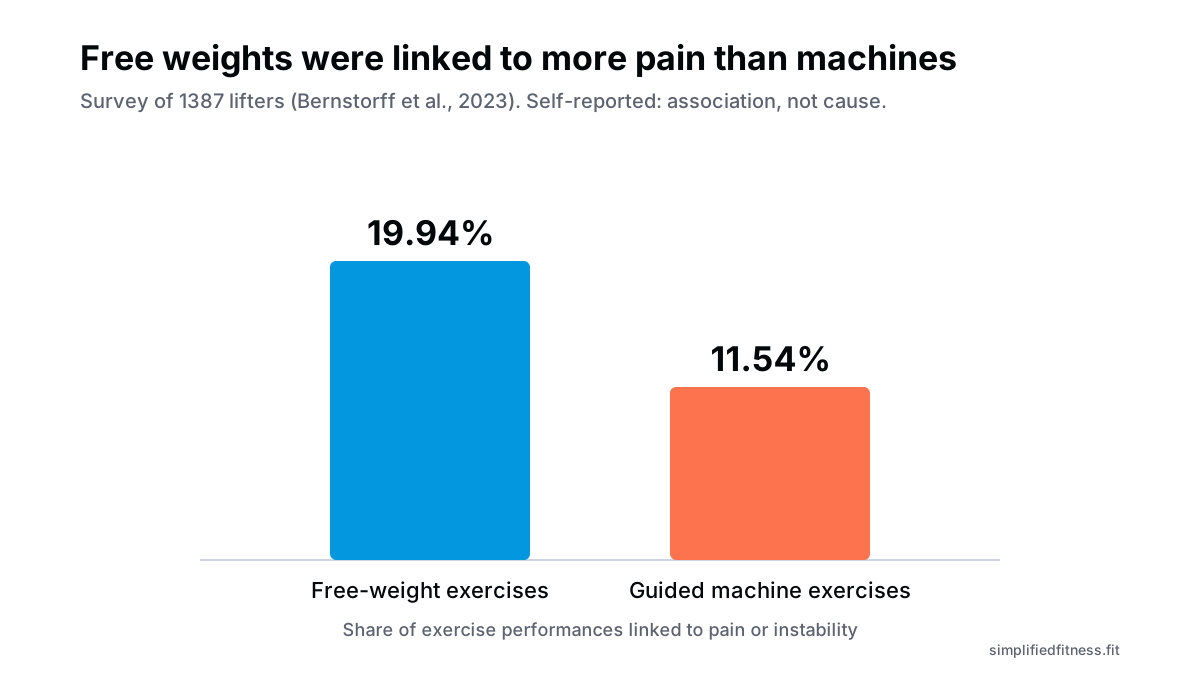
Why would a flat barbell be a common trouble spot? A few plausible contributors, none of them proven as the single cause:
- Heavy loading, very often. High-intensity benching (one-rep max above 1.5 times body weight) was strongly linked to a collarbone-end problem called distal clavicular osteolysis in a retrospective MRI review of 262 men with it and 227 without, while lighter benching was not (Nevalainen et al., 2016). Benching more than once a week and for over five years were also risk factors.
- A fixed bar. Your hands cannot rotate or drift, so the shoulder has to cope with whatever path the bar demands.
- A deep, stretched bottom with elbows flared out.
- Pec minor overload. One small case series described “bench-presser’s shoulder”, pain near the front of the shoulder from the pectoralis minor tendon, in seven sportsmen, five of whom were aggravated by benching (Bhatia et al., 2007).
What is the best way to train chest with bad shoulders?
Here is the short list. Pick the one that matches where it hurts, as in the chooser below.
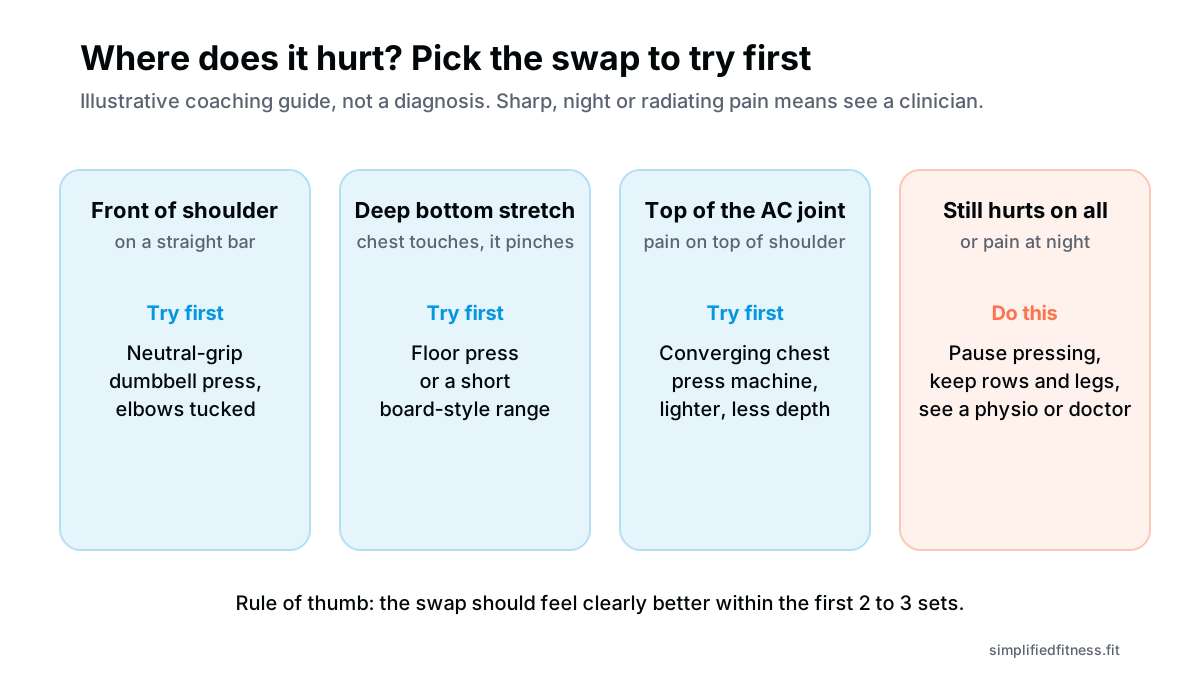
1. Neutral-grip dumbbell press
Palms face each other, elbows sit at roughly 45 degrees from your ribs, and each arm finds its own path. Many people with irritated shoulders find this noticeably more comfortable than a straight bar, probably because the wrist and elbow are not locked into a set width. I would call it a comfort trick, not a proven protection. No trial I found shows it prevents shoulder injury.
If you have a bench and dumbbells, an incline of about 15-30 degrees is often kinder than flat. Our dumbbell vs barbell pressing breakdown covers how pec recruitment compares.
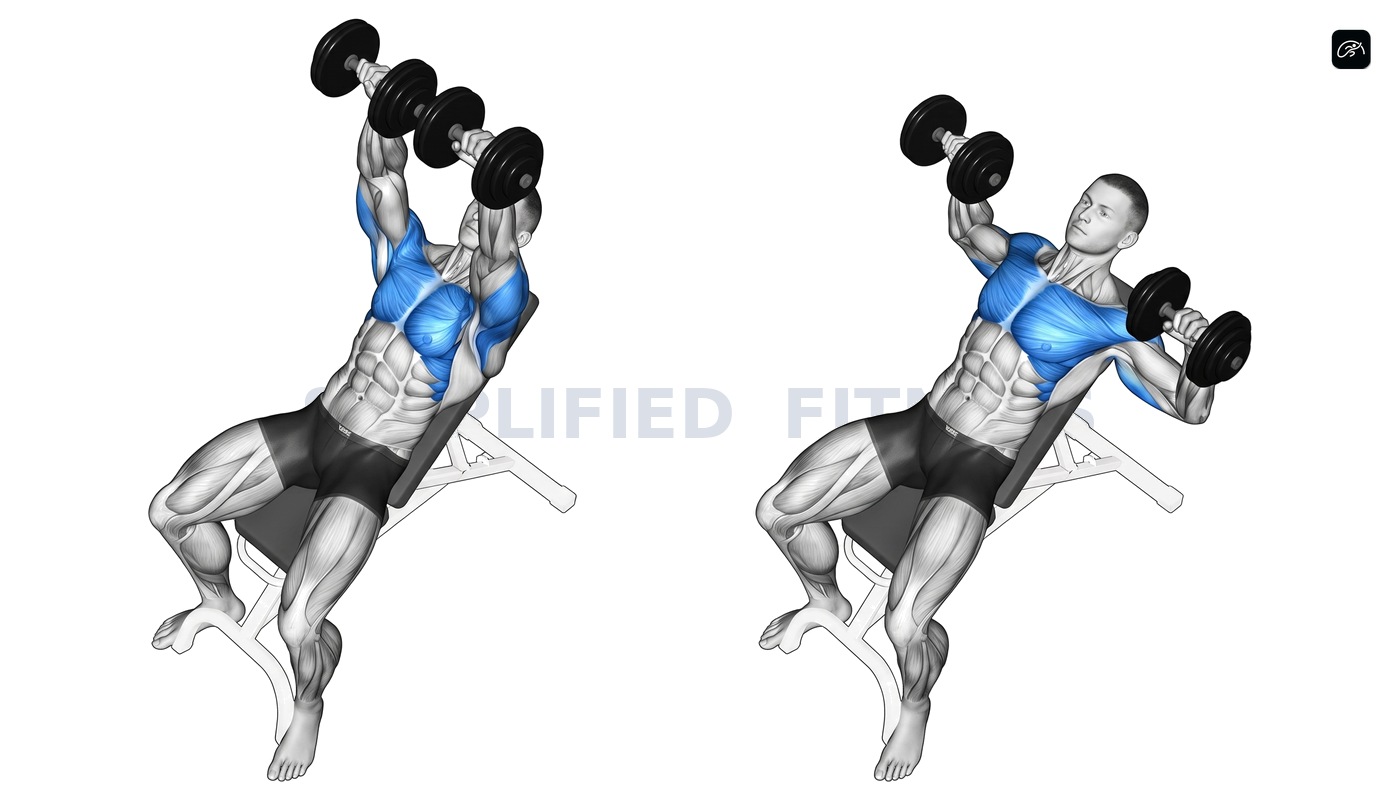
2. Floor press
You lie on the floor, so your upper arms stop when the triceps touch down. That cuts the deepest stretched part of the rep, which is exactly the position many people find irritating. The trade-off: you lose some range of motion at the bottom. For a deeper look at the exercise itself, see floor press for hypertrophy and shoulder rehab.
Use dumbbells if the bar feels fixed and awkward. Keep your forearms vertical and your elbows tucked a little rather than flared out.
3. Converging chest press machine
The handles follow a set arc and the load stays steady, which removes balance demands. If the top of your shoulder (the AC joint) is the sore spot, stay light and avoid reaching for the very end of the stretch. We cover setup in converging machine pressing for AC joint comfort.
4. Push-up variations
Hands on the floor, shoulder blades free to move. Raise your hands on a bench or rack to make the lift easier, and progress slowly. Our push-up progressions for chest has the ladder.
5. Flyes, with a caution
Pec deck and cable flyes keep the chest working with less triceps involvement. One lab study of 20 healthy adults found peak shoulder joint moments were larger for cable pulley exercises than for bench press, and cable cross-over in particular needed proper joint stabilisation (Schutz et al., 2022). So flyes are an option, but keep the stretch modest and the weight light.
Does elbow angle and grip really change shoulder load?
A little, and the research here is thin, so hold the numbers loosely.
In one study, 14 bench-press-trained males performed one-rep maxes with narrow, medium and wide grips. They lifted 109.8 kg with the wide grip, 108.9 kg with the medium and 103.7 kg with the narrow grip. The wide and medium grips produced larger horizontal shoulder moments than the narrow grip (Larsen et al., 2020). Those were healthy people, not people with shoulder pain, and a joint moment is not the same as an injury risk.
So what do we do with that? Treat the elbow tuck and grip width as dials. If a wide grip with flared elbows bothers you, narrow the grip a little and bring the elbows in toward roughly 45 degrees. Watch what your shoulder tells you. Our bench press grip width article goes deeper on chest versus triceps trade-offs.
What about the scapular plane and that 90 to 45 degree claim?
You will see a tidy claim online that moving the arm from 90 to 45 degrees of abduction “dramatically” cuts subacromial pressure. I could not confirm that exact claim from the studies I checked, so I will not repeat it as fact.
What the literature does support is the general idea behind scapular plane work. A review of shoulder rehabilitation exercises reports that, compared with scapular protraction, scapular retraction increases the subacromial space and supports supraspinatus force during humeral elevation. It also reports that the “full can” position (thumbs up) carries less impingement risk than the “empty can” (thumbs down) (Escamilla et al., 2009).
In practice, that means:
- Set your shoulder blades back and down on the bench before you unrack.
- Press with your elbows a bit in front of your body rather than straight out to the sides.
- On overhead work, move the arms slightly forward of the side of your body and keep thumbs up or palms neutral. Our piece on the overhead press and shoulder impingement separates what is myth from what is mechanics.
If you want the mechanics of the barbell version in detail, see shoulder pain bench press biomechanical fixes.
Does rotator cuff strengthening actually help?
Here the research is genuinely mixed, so let’s lay both sides out.
A 2025 network meta-analysis compared seven types of exercise for rotator cuff related shoulder pain across 15 to 16 randomised trials (about 900 to 950 patients). Concentric strengthening ranked best for improving both pain and dysfunction. Eccentric and motor control work were reasonable alternatives (Zhang et al., 2025).
A different review reached a more cautious conclusion. Seven trials (468 participants) comparing progressive resisted exercise or non-resisted exercise with placebo or no treatment found uncertain clinical benefit at more than six weeks to six months, with low certainty evidence, although adverse events were mild and seldom reported (Naunton et al., 2020). The Cochrane review of manual therapy and exercise for rotator cuff disease included 60 trials, but only 10 addressed the main comparisons, and the risk of bias was high in 43 of the 60 (Page et al., 2016).
Why might they differ? Different comparators (head-to-head versus placebo or no treatment), different programmes and small trials. What is a reasonable takeaway? Strengthening is a low-risk option with plausible benefit, and the evidence does not yet prove one best programme. Our guide to rotator cuff strengthening for shoulder health has the exercises, and subacromial impingement lifting solutions covers the pinching-type pain.
How should I program chest when my shoulder is touchy?
A simple template that also works in a crowded gym, where a machine is often the free option:
- Warm up for 5 minutes: light rows or band pull-aparts, then two light ramp-up sets of your first press.
- Pick one main press from the list above. Work in about 6-12 reps, stopping 2-3 reps short of failure. Our RIR and RPE calculator helps you gauge that.
- Add 2-3 hard sets of a fly or push-up variation.
- Keep rows and rear delt work going. Your back does not need a break just because pressing hurts, and many lifters find their shoulders feel better when pulling stays in the plan.
- Log pain on a 0-10 scale during and the next morning.
A common coaching rule is that mild discomfort (roughly 3 out of 10 or less) that settles within a day is usually acceptable, while rising or lingering pain means regress the lift. That threshold is a convention, not a research-backed cut-off. If you are building a week around it, our push day plan shows how to arrange the lifts.
Meanwhile, keep protein and calories steady so you do not lose muscle during a lighter patch. A bowl of dal, paneer or curd with rice and roti still does the work.
When should I see a doctor about shoulder pain?
Get assessed if you notice any of these:
- Pain at night or that wakes you.
- Weakness when lifting the arm, or the arm will not go overhead.
- A pop or sudden sharp pain during a lift.
- Numbness, tingling or pain running down the arm.
- A visible deformity or swelling after a fall or heavy rep.
- No clear improvement after about four weeks of modified training.
Shoulder pain with chest pressure, breathlessness, sweating or pain spreading to the jaw or left arm is an emergency. Call for urgent help.
A physiotherapist or sports medicine doctor can tell you whether you are dealing with rotator cuff irritation, a tear, an AC joint problem or something else, and that changes what you should train.
The practical bottom line
You do not need a perfect pressing angle. You need a press that your shoulder tolerates, enough hard sets to keep growing, and the sense to back off when the pain tells you to. Neutral-grip dumbbells, a floor press and a converging machine are the three I would try first. Pick one, change one variable at a time, and log how it feels.
Frequently Asked Questions
What are the best chest workouts for bad shoulders?
Neutral-grip dumbbell presses, floor presses, push-up variations and converging chest press machines are the usual first choices because they let you shorten the range or change the arm path. Each one reduces how far the shoulder travels or how rigidly the hands are fixed, which is why many lifters find them calmer than a barbell bench. Start with the option that feels clearly better in the first two or three sets.
Can I still bench press with shoulder pain?
Sometimes, but only if the pain stays mild and settles quickly afterwards. Pain that is sharp, grows during the set or lingers into the next day is a signal to change the lift. Swap to a friendlier press and keep the weight where you stay in control.
Is the floor press better for bad shoulders?
For many people it feels better, because your upper arms stop on the floor and the shoulder does not travel into the deepest stretched position. That shortened range is the likely reason it is popular in shoulder-friendly training, though there are few direct trials on pain. Try it with dumbbells first, since they let your wrists and elbows settle into a natural path.
Why does bench press hurt the front of my shoulder?
Common contributors are very heavy or very frequent benching, elbows flared wide, a rounded upper back and a deep bottom position with a fixed bar. Surveys list shoulder as the most frequent pain site in gym training, and the bench press is among the exercises most often linked with pain. Check your setup, tuck the elbows a little and see a clinician if the pain does not settle.
Are neutral-grip dumbbell presses safer than a barbell?
They are often more comfortable, not proven safer. A neutral grip lets the palms face each other, and dumbbells let each arm choose its own path, which many people with irritated shoulders prefer. No trial has shown that one reliably prevents injury, so judge it by how your shoulder responds.
What angle should my elbows be when I press?
A common coaching range is about 45 degrees away from the torso, between a tight tuck and a wide flare. A 2020 study on 14 trained males found that grip width changed the shoulder moments during the bench press, which is why small setup changes can matter. Adjust in small steps and keep whichever angle is quieter on your shoulder.
Should I train chest with a rotator cuff injury?
Many people with rotator cuff related pain keep training with modifications, but a diagnosed tear or recent injury needs individual advice. Exercise therapy is a common first-line approach, although the evidence base is low certainty and the right exercises depend on the problem. Ask a physiotherapist or sports doctor what range and load are safe for you.
Are push-ups good for shoulder pain?
They can be, because your hands are fixed on the floor and your shoulder blades move freely. Many lifters find incline push-ups easier on irritated shoulders than a flat barbell. Raise the hands on a bench or rack until the movement is comfortable, then progress slowly.
What is AC joint pain from bench pressing?
It is pain on the top of the shoulder where the collarbone meets the shoulder blade. One study of 489 men aged 20 to 40 found that heavy bench pressing, with a one-rep max above 1.5 times body weight, was strongly linked to a collarbone-end problem called distal clavicular osteolysis. If the top of your shoulder is tender, reduce the load and range and get it checked.
How do I know if shoulder pain is serious?
Night pain that wakes you, weakness lifting the arm, numbness or tingling, a pop with sudden pain, or pain spreading into the chest or down the arm are reasons to be assessed. Shoulder pain with chest tightness, breathlessness or sweating should be treated as an emergency. In every other case, a few weeks without improvement is still a good reason to book a physio or doctor.
Can I build chest without any pressing?
Yes, for a while. Cable flyes, pec deck flyes and push-up variations all train the chest through different joint paths, although flyes can load the shoulder too if you stretch very deep. Choose a range that feels comfortable and keep logging reps so you can still progress.
How long until the shoulder feels better?
It varies a lot with the cause, so no honest timeline fits everyone. Mild irritation from training often settles over several weeks once you remove the trigger, while tears, nerve problems or persistent night pain need professional input. If you are not clearly improving after about four weeks, get assessed rather than waiting.
Sources & References
Every claim above is checked against peer-reviewed research (PubMed, U.S. National Library of Medicine) or guidance from established health bodies. How we fact-check.
- Bernstorff MA, et al. Popular Gym Fitness Sport: An Analysis of 1387 Recreational Athletes Regarding Prone to Pain Exercises and the Corresponding Localisations. Sports (Basel). 2023. PMID: 38251286
- Nevalainen MT, et al. Distal clavicular osteolysis in adults: association with bench pressing intensity. Skeletal Radiol. 2016. PMID: 27550324
- Bhatia DN, et al. The bench-presser's shoulder: an overuse insertional tendinopathy of the pectoralis minor muscle. Br J Sports Med. 2007. PMID: 17138640
- Escamilla RF, et al. Shoulder muscle activity and function in common shoulder rehabilitation exercises. Sports Med. 2009. PMID: 19769415
- Larsen S, et al. A Biomechanical Analysis of Wide, Medium, and Narrow Grip Width Effects on Kinematics, Horizontal Kinetics, and Muscle Activity on the Sticking Region in Recreationally Trained Males During 1-RM Bench Pressing. Front Sports Act Living. 2020. PMID: 33554113
- Schutz P, et al. Chest Exercises: Movement and Loading of Shoulder, Elbow and Wrist Joints. Sports (Basel). 2022. PMID: 35202059
- Zhang W, et al. Effects of seven types of exercise in the treatment of rotator cuff-related shoulder pain (RCRSP): a systematic review and Bayesian network meta-analysis. J Orthop Surg Res. 2025. PMID: 41276811
- Naunton J, et al. Effectiveness of progressive and resisted and non-progressive or non-resisted exercise in rotator cuff related shoulder pain: a systematic review and meta-analysis of randomized controlled trials. Clin Rehabil. 2020. PMID: 32571081
- Page MJ, et al. Manual therapy and exercise for rotator cuff disease. Cochrane Database Syst Rev. 2016. PMID: 27283590

Umair Hazrami · Founder & Head Coach, Simplified Fitness
Umair Hazrami founded Simplified Fitness and the Simplified Lifter channel to cut through fitness noise. With 4+ years of consistent training and 10+ coaching clients, he writes every guide from the peer-reviewed research and links the sources so you can check them. Our editorial standards.
Educational content only, not medical advice. If you have a medical condition, are pregnant, or take medication, talk to a qualified doctor before changing your diet, supplements or training. Full disclaimer.
Keep reading
Health & Longevity
Are Deadlifts Bad for Your Lower Back? What Spinal Loading Research Shows
Are deadlifts bad for lower back health? The research shows spinal loads are high but tolerable, and trials use loaded lifting for back pain. How to hinge.
9 min read

Health & Longevity
Are Squats Bad for Your Knees? What the Research Actually Says
Are squats bad for your knees? Research on deep squats, kneecap stress and the knees-over-toes rule shows where the myth came from and how to squat safely.
9 min read

Health & Longevity
Why Tendons Adapt Slower Than Muscles: Connective Tissue Timelines for Lifters
Tendon adaptation vs muscle growth: why your tendons lag behind your strength gains, what studies show about timelines, and how to add load without tendonitis.
8 min read

Health & Longevity
Desk Worker Workout Routine: Fix Pelvic Tilt, Weak Glutes and a Rounded Upper Back
A desk worker workout routine built on evidence: what sitting really does to your hips, why pelvic tilt is mostly normal, and 3 gym correctives that help.
8 min read