Does Sweating Burn Fat? Sweat Suits, Saunas and the Dehydration Illusion
Does sweating burn fat? No. Sweat is cooling, not fat loss. See why sweat suits only shed water weight, what the research says and the real risks.
TL;DR. The short answer
- Sweating does not burn fat. Sweat is water your body evaporates to cool itself, and the scale drop after a sweaty session is almost entirely water that returns when you drink.
- How much you sweat depends on heat, humidity, clothing, fitness and individual physiology, so a dry shirt does not mean a weak workout and a soaked one does not mean a great one.
- Sweat suits, plastic bags and hot rooms raise the risk of overheating without extra fat loss. In one small study, wrestlers who sweated off about 5% of body weight in 12 hours lost anaerobic and aerobic performance.
- Fat loss comes from a sustained energy deficit, adequate protein and training that keeps muscle. Judge progress by weekly averages, not by post-workout sweat or scale drops.
- Dizziness, confusion, vomiting, stopping sweating in the heat or a very high body temperature need urgent medical care, not more training.
Part of our complete guide: Joint-Friendly Lifting & Fitness Myths: A Guide for Over-40s, Teens and Sore Backs
Table of contents
Does sweating burn fat? No. Sweat is water your skin releases so evaporation can cool you down, and the weight you lose in a sweaty session is almost entirely water that comes back as soon as you drink. Fat is lost over weeks through a calorie deficit, not through a wet T-shirt.
This is one of the most common myths in beginner gyms, and it is part of the wider set of misconceptions we cover in our joint-friendly lifting and myth-busting guide. It is also one of the few myths that can land someone in hospital, so it deserves a proper look.
What is sweat actually for?
Your body wants to stay near 37 degrees. Muscles generate heat when you work, and that heat has to go somewhere. When your core temperature starts rising, your brain tells your eccrine sweat glands (the ones covering most of your skin) to release fluid. As that fluid evaporates, it carries heat away.
That is the whole job. Sweat is a radiator, not a fat-burning meter.
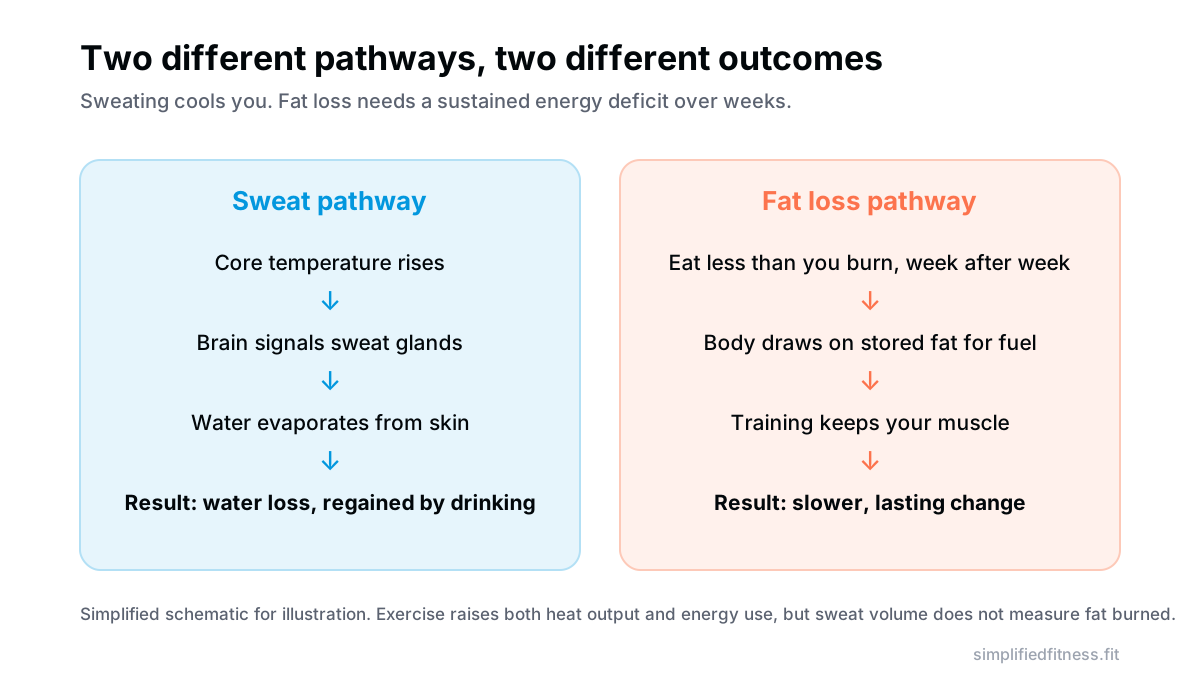
Sweat is mostly water with some electrolytes, mainly sodium. The simplest and most accurate way to measure how much you lose is the change in body mass across a session, which is exactly how sports scientists estimate whole-body sweat rate (Baker, 2017). That is also the clue to the myth: what the scale registers after sweating is fluid, because that is what left your body.
Why does the scale drop after a sweaty workout?
Because you are lighter by the weight of the fluid you lost. Not by the weight of fat you burned.
The American College of Sports Medicine states that individual sweat rates can be estimated by weighing yourself before and after exercise, and that the goal after training is to replace the fluid and electrolyte deficit (ACSM, 2007). If a kilogram of fluid left, a kilogram of fluid goes back in. The “weight loss” disappears with a bottle or two of water and a meal.
If you want the broader picture of why scale weight bounces around, our guide on scale weight fluctuations from water, sodium and glycogen goes through it, and the water retention and whoosh effect article explains the mirror-image problem when fat loss is hiding behind water.
Here is the practical version. If you step on the scale right after a hot session and feel proud, you are celebrating dehydration.
Does sweating more mean you burn more calories?
Not in any way that is useful to you. Two people can do the same session and one finishes drenched while the other is barely damp, with similar energy use. Sweat reflects cooling demand and how responsive your sweat glands are, not your calorie burn.
I could not find strong trial evidence that extra sweating itself meaningfully raises calorie burn, and the physiology gives no reason to expect it. If you want a rough idea of energy used, a tool based on work done is more sensible than your shirt. Try our calories burned calculator as a ballpark, and treat the result as an estimate.
The same logic applies to heat. Training in a hot room might make the session feel harder and make you sweat more, but that is not the same as being a better fat-loss session. We could say the same for the numbers on a cardio machine. Treat them as approximations.
Why do some people sweat buckets and others barely sweat?
Because sweat rate is highly individual. Baker’s review lists exercise intensity, environmental conditions, heat acclimatization, aerobic capacity, body size and composition, protective equipment, sex, maturation, aging, diet and hydration status as factors behind differences in sweating rate (Baker, 2017). That is a long list, and none of it is “how much fat you are burning.”
A few specifics worth knowing:
- Fitness often raises sweat output. In a cycling study with 37 participants, trained men and women sweated more than untrained ones at the same relative intensities, mainly because each gland put out more sweat (Ichinose-Kuwahara et al., 2010). So heavy sweating can be a sign of a well-trained cooling system.
- Heat adaptation is inconsistent. A meta-analysis of athletes and military personnel relocating to a hot climate found lower resting heart rate and core temperature trends, but sweat rate changes were conflicting, mainly because two studies showed a reduction (Brown et al., 2024). The authors did conclude an increase in sweat rate is attainable, depending on conditions.
- Environment matters more than effort. A humid Mumbai monsoon evening makes a 30-minute walk look like a marathon. A cool, ventilated gym floor can make a hard leg session look easy.
So does sweating mean you had a good workout? Only by accident. Use the sweat as a hydration cue, not a scorecard.
Do sweat suits and plastic bags work for weight loss?
They work for losing water. They do nothing for fat. And they add risk.
The best-known research here comes from wrestling. In a 1990 study of seven intercollegiate wrestlers, the 36-hour weight loss period (mimicking pre-competition practice) cut 3.3 kg, about 4.9% of body weight, all within the last 12 hours before weigh-in, using exercise in a rubberized sweat suit. Anaerobic power fell from 81.4 to 63.9 kgm/s, peak aerobic power fell 6.7% and treadmill time to exhaustion fell 12.4% (Webster et al., 1990).
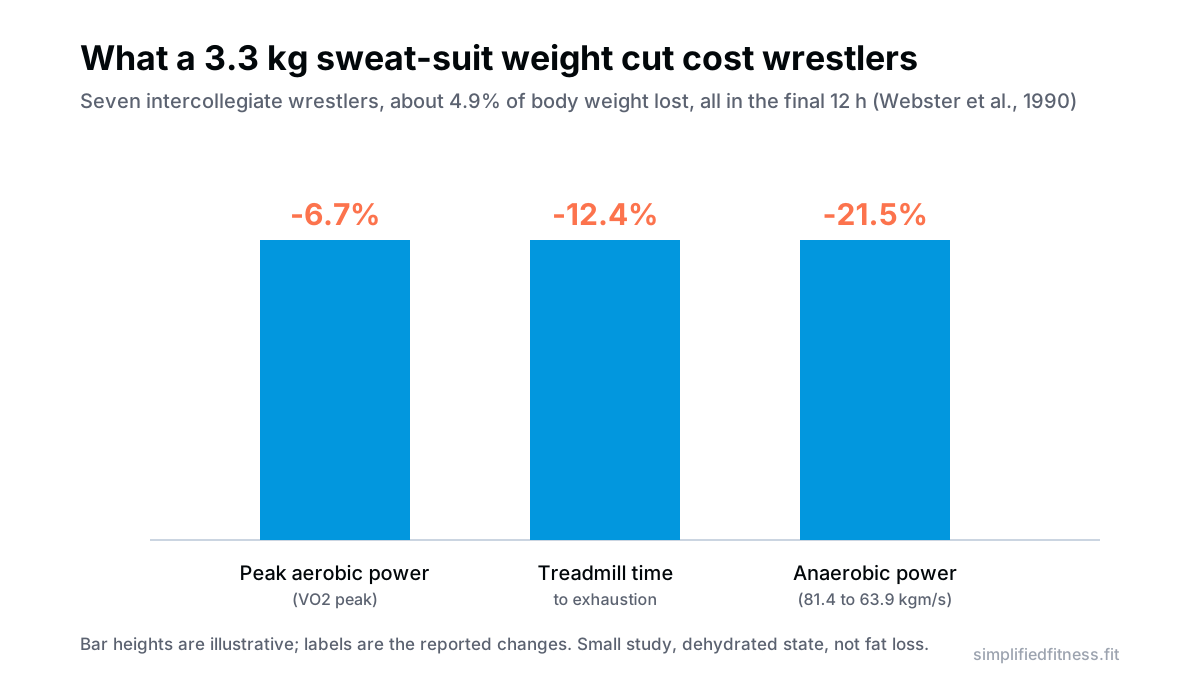
Note the limits. This was seven people, an older study, and it measured performance, not body fat. It is useful for showing what dehydrating yourself does, not for telling you how an office worker in a sweat suit will fare. But the direction matches the broader picture below.
Why would a sweat suit be worse than just exercising normally? Because plastic or neoprene traps sweat against your skin. Evaporation is the cooling mechanism, and without it your body keeps heating while you keep losing fluid. The National Athletic Trainers’ Association describes exertional heat stroke as one of the leading causes of sudden death during sport (Casa et al., 2015).
Do saunas and steam rooms burn fat?
Not in a way you can bank. Sitting in heat makes you sweat, and the scale shows the fluid loss. I did not find trial evidence in my search that sauna sessions cause meaningful fat loss, so I will not claim they do.
Saunas may have a place for relaxation and recovery, which we cover in our sauna and heat therapy guide. Just do not count them toward your calorie deficit. If you have heart problems, are pregnant, or take medication that affects blood pressure or heat tolerance, check with your doctor before using one.
What is the difference between weight cutting and fat loss?
Weight cutting is a short-term, dehydration-based tactic used in combat sports to hit a weight class, followed by quick rehydration. Fat loss is a slow process measured in weeks.
Here is how they compare.
| Weight cutting (dehydration) | Fat loss (energy deficit) | |
|---|---|---|
| What is lost | Mostly water | Mostly stored fat, while training protects muscle |
| Timescale | Hours to days | Weeks to months |
| Comes back? | Largely, with rehydration | Only if habits change |
| Main risks | Heat illness, kidney strain, lower performance | Hunger, low energy if the deficit is too large |
| Who uses it | Competitors with weigh-ins | Anyone wanting a leaner body |
What does the research say about weight cutting? A meta-analysis of combat athletes found that performance was unchanged between before the cut and after rapid weight gain (g = 0.22; 95% CI, -0.18 to 0.62), but small reductions in maximal strength and repeated high-intensity efforts were seen immediately after the cut. The authors say it remains unclear whether these are restored by regaining weight (Brechney et al., 2022).
So the studies do not fully agree. The 1990 wrestler study found clear deficits in a dehydrated state, while the 2022 meta-analysis found performance broadly preserved once athletes had time to regain weight. The likely reason is timing: the first looks at the dehydrated state, the second includes a recovery window of 3 to 36 hours. The cautious takeaway is that dehydration costs performance while you are dehydrated, and the recovery picture is uncertain.
Then there is the health side. A systematic review of rapid weight loss of about 5% of body weight within a week or less found that creatinine, blood urea nitrogen and urine specific gravity increased in most studies. The authors interpret this as dehydration with subsequent acute kidney damage (Lakicevic et al., 2021). That is a review of combat athletes, so it tells you about competitors who cut hard, not about a casual gym-goer sweating more than usual. But it is a good reason to avoid copying their methods.
How much sweat loss is too much?
ACSM’s position stand says the goal of drinking during exercise is to prevent excessive dehydration, defined as more than 2% of body weight lost from water deficit, and to avoid compromised performance (ACSM, 2007). For a 70 kg person, 2% is 1.4 kg.
You can find your own number with a cheap test. Weigh yourself before and after a typical session, in the same light clothing, after using the toilet. Add what you drank. The difference is your approximate sweat loss. Baker’s review notes that non-sweat sources of mass change and trapped sweat in clothing can confound the figure, so treat it as a rough guide (Baker, 2017).
In India, where many people train in warm, humid conditions without air conditioning, this matters. A few simple habits help:
- Drink water through the day, not just during the session.
- Take small sips during training rather than gulping at the end.
- In long or very sweaty sessions, replace sodium too. Dal-chawal, salted chaas (buttermilk), or a pinch of salt in nimbu pani all help. Our guide on electrolyte powders versus salt water covers this, and our water intake calculator gives a starting point.
- If you also care about performance, read our piece on hydration and strength.
When should you stop and see a doctor?
Stop exercising and cool down if you feel dizzy, faint, nauseated, get a pounding headache or notice cramping that will not settle. These can be early warning signs of heat illness.
Get urgent medical help if someone is confused, behaves oddly, collapses, has hot skin with a very high body temperature, or stops sweating in the heat. Do not wait to see if it passes. The NATA statement exists precisely because exertional heat illness can progress fast and exertional heat stroke can be fatal (Casa et al., 2015).
If you sweat heavily for no obvious reason, wake up drenched often, or the pattern is new, mention it to your doctor. It can have many causes, and this article cannot tell you which, if any, applies to you.
What should you do instead for fat loss?
Aim at the real levers.
- Set a modest calorie deficit. Use our calorie calculator for a starting estimate, then adjust from your weekly weight trend. Our guide on setting an optimal calorie deficit explains how big to make it.
- Eat enough protein and lift. Resistance training and protein help you keep muscle while losing fat. Our free push, pull and leg day plans are a simple start.
- Move more through the day. Steps and general activity add up, as we discuss in NEAT versus intense cardio.
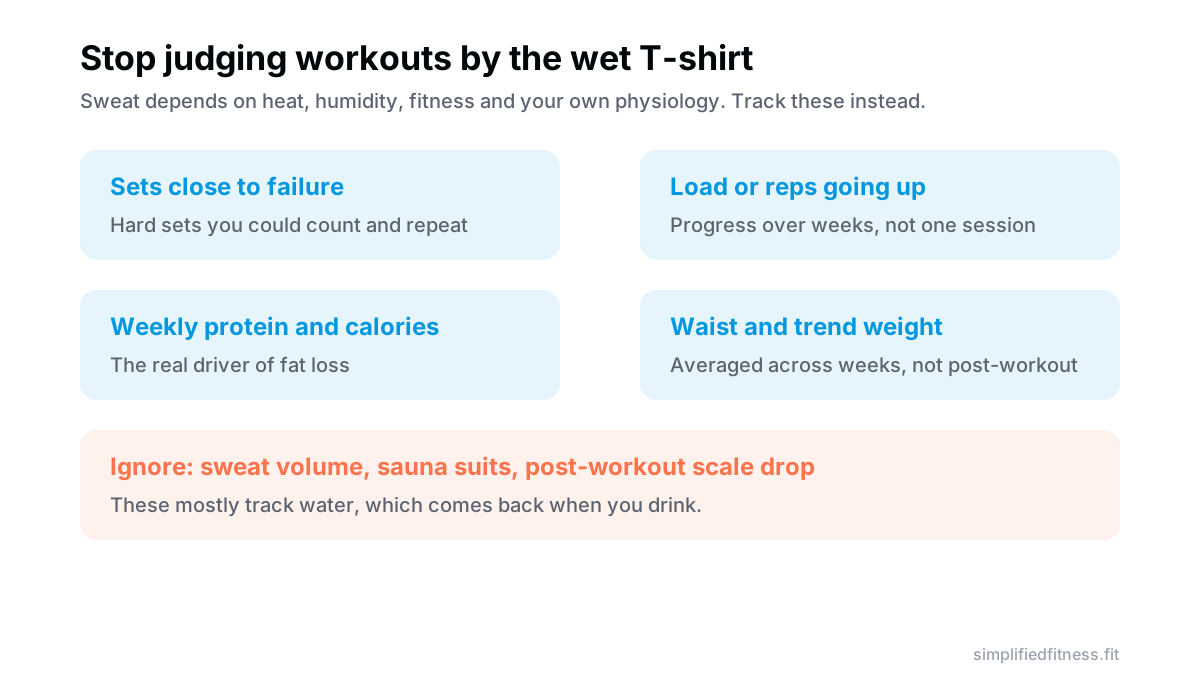
- Judge progress weekly. Average your morning weight over seven days and add a waist measurement. Ignore the scale right after training.
- Be patient. Water moves in hours. Fat moves in weeks.
Quick recap
Sweat is cooling. Scale drops after sweating are fluid. Sweat suits and hot rooms add risk without adding fat loss. Hydrate, eat enough, lift, track weekly trends and see a doctor for any red-flag symptoms.
Frequently Asked Questions
Does sweating burn fat?
No, sweating does not burn fat. Sweat is mostly water released by your skin so evaporation can cool you, and it is not made from stored fat. Judge fat loss by weekly calorie intake, training and trend weight instead of how wet your shirt gets.
Does sweating mean you are having a good workout?
Not reliably. Sweat rate varies a lot between individuals and within the same person depending on temperature, humidity, intensity, fitness and acclimatization, according to a review of sweat variability in athletes [(Baker, 2017)](https://pubmed.ncbi.nlm.nih.gov/28332116/). Rate a session by effort, reps and load progression, not by sweat.
Do sweat suits help you lose weight?
Sweat suits make you lose water, not fat. In a small 1990 study, wrestlers who lost about 3.3 kg using exercise in a rubberized sweat suit also lost anaerobic and aerobic performance [(Webster et al., 1990)](https://pubmed.ncbi.nlm.nih.gov/2355820/). Skip the suit and put the effort into a modest, steady calorie deficit.
Why did I lose weight after a sweaty workout?
The drop is mostly fluid lost through sweat and breathing, plus a little from burned fuel. ACSM guidance says you can estimate your own sweat loss by weighing yourself before and after exercise [(ACSM, 2007)](https://pubmed.ncbi.nlm.nih.gov/17277604/). Drink to replace it and expect the scale to return to normal.
Do people who sweat more burn more calories?
There is no good evidence that sweating more means burning more calories. Sweat output reflects cooling demand and how your sweat glands respond, and trained people often sweat more at the same effort [(Ichinose-Kuwahara et al., 2010)](https://pubmed.ncbi.nlm.nih.gov/20696786/). If you want to know energy use, look at the work done, not the wetness.
Why do I sweat so much even when I am barely working out?
Sweat volume is strongly individual and is affected by body size, fitness, heat acclimatization, sex and environment. Baker's review lists all of these as sources of variability [(Baker, 2017)](https://pubmed.ncbi.nlm.nih.gov/28332116/). If sweating seems excessive for no reason or is new, ask a doctor to check.
Why do I barely sweat in the gym but still feel wrecked?
Light sweating can happen in cool, air-conditioned or well-ventilated gyms, and sweat does not measure muscular effort. Resistance training stress shows up in how close your sets get to failure, not in perspiration. Track reps and load and keep your hard sets honest.
Is it safe to exercise in a sauna suit or plastic bag?
It is not recommended. Clothing that traps sweat blocks evaporative cooling, and the National Athletic Trainers' Association describes exertional heat stroke as one of the leading causes of sudden death in sport [(Casa et al., 2015)](https://pubmed.ncbi.nlm.nih.gov/26381473/). Train in breathable clothes and stop if you feel dizzy, confused or nauseated.
How much weight can you lose by sweating?
Short-term water loss can be a kilogram or more, but it is not fat and it returns once you drink and eat. ACSM suggests avoiding body weight losses of more than 2% from water deficit during exercise [(ACSM, 2007)](https://pubmed.ncbi.nlm.nih.gov/17277604/). Weigh before and after sessions to learn your own loss and replace it.
Does sitting in a sauna or steam room burn fat?
No, sauna sessions cause fluid loss rather than fat loss, and I did not find trial evidence showing a meaningful fat-loss effect. Weight lost there is water that returns with rehydration. Use heat for recovery if you enjoy it and see our [sauna and heat therapy guide](/blog/sauna-heat-therapy-muscle-recovery-health) for what it can and cannot do.
Do boxers and wrestlers burn fat by dehydrating before weigh-ins?
No, they mostly shed water and then regain it. A meta-analysis of weight cutting in combat athletes found small reductions in maximal strength and repeated high-intensity performance right after the cut, with unclear recovery [(Brechney et al., 2022)](https://pubmed.ncbi.nlm.nih.gov/35523423/). It is a competition tactic with health risks, not a fat-loss method.
Can dehydration damage your kidneys?
It can, in extreme or repeated cases. A systematic review of rapid weight loss in combat athletes found that creatinine, blood urea nitrogen and urine specific gravity rose in most studies, and the authors interpret this as dehydration with acute kidney strain [(Lakicevic et al., 2021)](https://pubmed.ncbi.nlm.nih.gov/34072641/). Avoid forced dehydration and speak to a doctor if you have kidney disease.
Will I sweat less as I get fitter?
Often the opposite, since training improved the sweating response in both sexes in a cycling study with trained and untrained men and women [(Ichinose-Kuwahara et al., 2010)](https://pubmed.ncbi.nlm.nih.gov/20696786/). Heat acclimatization changes sweat rate inconsistently across studies [(Brown et al., 2024)](https://pubmed.ncbi.nlm.nih.gov/38051495/). Do not read your sweat rate as a fitness score either way.
What actually burns fat?
A sustained calorie deficit does, supported by protein and resistance training so you keep muscle. Exercise adds to energy use, but your diet usually sets the size of the deficit. Start with our [calorie calculator](/tools/calorie-calculator) and give it several weeks.
Sources & References
Every claim above is checked against peer-reviewed research (PubMed, U.S. National Library of Medicine) or guidance from established health bodies. How we fact-check.
- Sawka MN, et al. American College of Sports Medicine position stand. Exercise and fluid replacement. Med Sci Sports Exerc. 2007. PMID: 17277604
- Baker LB. Sweating Rate and Sweat Sodium Concentration in Athletes: A Review of Methodology and Intra/Interindividual Variability. Sports Med. 2017. PMID: 28332116
- Ichinose-Kuwahara T, et al. Sex differences in the effects of physical training on sweat gland responses during a graded exercise. Exp Physiol. 2010. PMID: 20696786
- Brown HA, et al. Quantifying Exercise Heat Acclimatisation in Athletes and Military Personnel: A Systematic Review and Meta-analysis. Sports Med. 2024. PMID: 38051495
- Casa DJ, et al. National Athletic Trainers' Association Position Statement: Exertional Heat Illnesses. J Athl Train. 2015. PMID: 26381473
- Webster S, et al. Physiological effects of a weight loss regimen practiced by college wrestlers. Med Sci Sports Exerc. 1990. PMID: 2355820
- Brechney GC, et al. Effects of Weight Cutting on Exercise Performance in Combat Athletes: A Meta-Analysis. Int J Sports Physiol Perform. 2022. PMID: 35523423
- Lakicevic N, et al. Effects of Rapid Weight Loss on Kidney Function in Combat Sport Athletes. Medicina (Kaunas). 2021. PMID: 34072641

Umair Hazrami · Founder & Head Coach, Simplified Fitness
Umair Hazrami founded Simplified Fitness and the Simplified Lifter channel to cut through fitness noise. With 4+ years of consistent training and 10+ coaching clients, he writes every guide from the peer-reviewed research and links the sources so you can check them. Our editorial standards.
Educational content only, not medical advice. If you have a medical condition, are pregnant, or take medication, talk to a qualified doctor before changing your diet, supplements or training. Full disclaimer.
Keep reading
Health & Longevity
Are Deadlifts Bad for Your Lower Back? What Spinal Loading Research Shows
Are deadlifts bad for lower back health? The research shows spinal loads are high but tolerable, and trials use loaded lifting for back pain. How to hinge.
9 min read

Health & Longevity
Are Squats Bad for Your Knees? What the Research Actually Says
Are squats bad for your knees? Research on deep squats, kneecap stress and the knees-over-toes rule shows where the myth came from and how to squat safely.
9 min read
Health & Longevity
Why Tendons Adapt Slower Than Muscles: Connective Tissue Timelines for Lifters
Tendon adaptation vs muscle growth: why your tendons lag behind your strength gains, what studies show about timelines, and how to add load without tendonitis.
8 min read

Health & Longevity
Desk Worker Workout Routine: Fix Pelvic Tilt, Weak Glutes and a Rounded Upper Back
A desk worker workout routine built on evidence: what sitting really does to your hips, why pelvic tilt is mostly normal, and 3 gym correctives that help.
8 min read