Golfer's Elbow and Tennis Elbow in Lifters: Why It Happens and How to Train Through It
Golfers elbow lifting weights? See why heavy rows, curls and pull-ups irritate the elbow tendon, and which slow-loading rehab and grip fixes have research.

TL;DR. The short answer
- Inner elbow pain (golfer's elbow) comes from the wrist flexor tendon, and outer elbow pain (tennis elbow) from the wrist extensor tendon. Heavy gripping, rowing, curling and chin-ups can overload either one.
- Exercise beats passive treatment for tennis elbow in the long run, but the effect is small and the evidence is low certainty (30 trials, 2123 people).
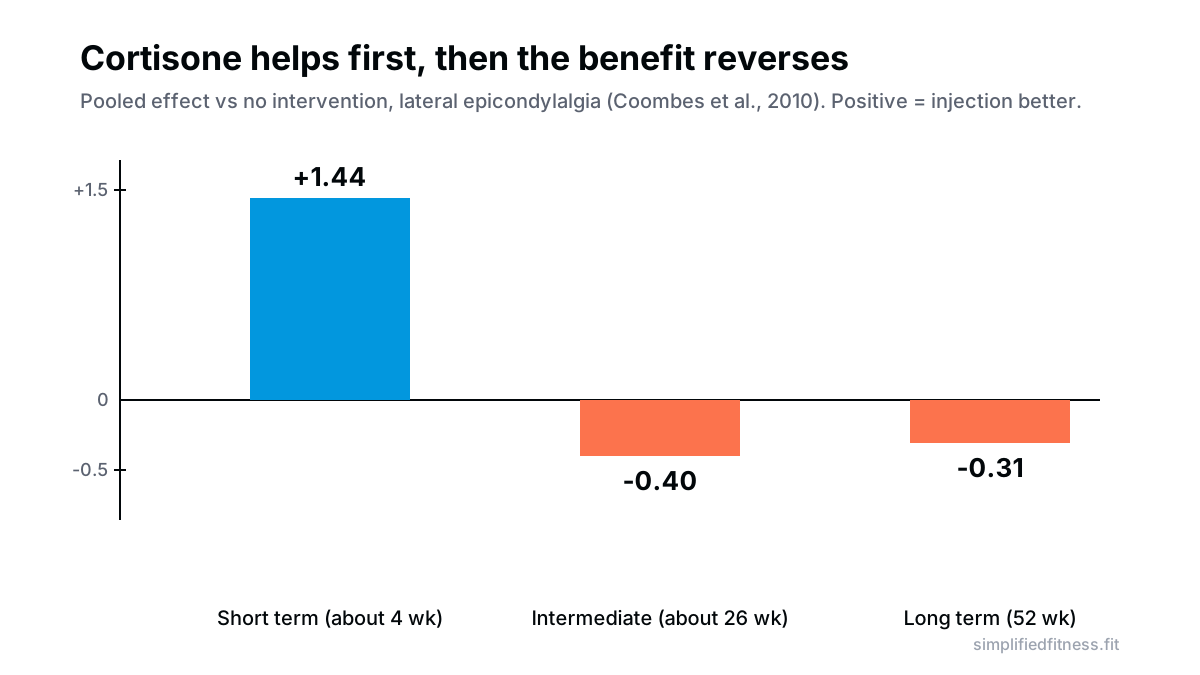
- Cortisone injections work fastest for pain, then the benefit reverses: in pooled trials, no treatment beat injection by about 6 months and 1 year.
- For golfer's elbow, eccentric wrist flexor exercise looks promising, but the research is small and low certainty (5 studies, 143 patients).
- Strap, neutral-grip and EZ-bar swaps let you keep training while the tendon settles. See a doctor if there is numbness, swelling, or pain after a fall.
Part of our complete guide: Joint-Friendly Lifting & Fitness Myths: A Guide for Over-40s, Teens and Sore Backs
Table of contents
If you get golfers elbow lifting weights, the culprit is usually the tendon that attaches your wrist flexors to the inside of the elbow, overloaded by heavy gripping, rowing, curling and chin-ups. Tennis elbow is the mirror image on the outside, from the wrist extensors. For both, the best-supported fix is gradually loaded exercise plus smart grip and exercise swaps, not complete rest.
This page is the clinical-style companion to our joint-friendly lifting guide, which covers the general rules. I will stick to the inner and outer elbow tendons here. One honest note first: the research is thinner than you would hope, and I will flag where.
Inner vs outer elbow pain: which one do you have?
Both conditions are now usually called tendinopathy or epicondylalgia, because the problem is a tendon that has become sensitive and less tolerant to load, not just “inflammation.”
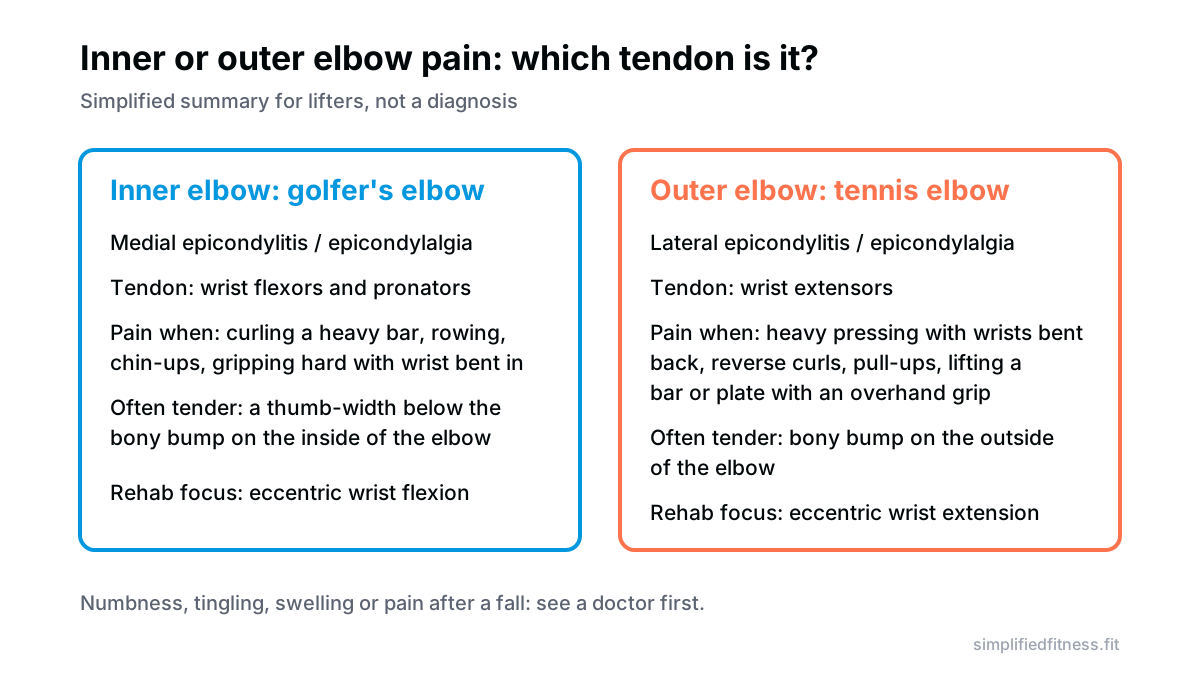
Golfer’s elbow (medial epicondylitis) is linked to repeated forced wrist extension and forearm supination during activities that involve wrist flexion and pronation (Amin et al., 2015). In the gym, that is a heavy barbell row where your grip is fighting the bar, hard curls, and chin-ups on a thick or awkward grip.
Tennis elbow (lateral epicondylitis) often shows up in lifters who press with the wrists bent backward, do heavy reverse curls, or hold deadlift-style loads with an overhand grip for long sets.
Pain at the front of the elbow, near the biceps tendon, is a different problem. Our distal biceps tendonitis guide covers that one.
Why do heavy pulling and pressing set it off?
Think of it as a load mismatch. Your back may be ready for 100 kg on a row, but your forearm tendons are the weak link holding the bar. When grip becomes the limiter, the flexor tendon at the inside of the elbow does extra work every rep, set after set, week after week.
Common triggers lifters report (coaching observations, not tested causes):
- A sudden jump in pulling volume (new program, extra back day).
- Thick-handled or fixed overhand grips on pull-ups and rows.
- Heavy barbell curls with a straight bar, which fix the wrist and forearm in one position.
- Presses where the wrist bends back under the bar.
- Poor recovery: short sleep and high stress may make any irritated tissue less tolerant of load.
None of this proves a single cause. Tendon pain is multifactorial, and I cannot tell from an article which of these applies to you.
Does rest, cortisone or exercise work best?
Here is what the better studies show.
Exercise beats passive treatment, but modestly. A 2021 systematic review and meta-analysis of 30 trials (2123 participants) in lateral elbow tendinopathy found exercise outperformed corticosteroid injections on all outcomes at all time points except short-term pain, with low certainty. Compared with wait-and-see, it helped on some outcomes only, with very low certainty. The authors concluded the effects are small, and noted that exercise programmes varied a lot in load, duration and frequency (Karanasios et al., 2021).
Cortisone is a short-term trade. A Lancet meta-analysis found corticosteroid injections had a large effect on pain for lateral epicondylalgia versus no intervention in the short term (SMD 1.44), but no intervention was favoured at intermediate term (SMD -0.40) and long term (SMD -0.31) (Coombes et al., 2010). Serious adverse events were rare in that review (one tendon rupture among 991 injected people).
The single trial behind that picture is easy to read too. In 198 adults with tennis elbow, injection looked best at 6 weeks, but 47 of 65 early successes later regressed, and long-term outcomes were worse than physiotherapy (elbow manipulation plus exercise). Physiotherapy beat wait-and-see early, but at 52 weeks most people in both groups reported success (Bisset et al., 2006).
The cautious takeaway: tennis elbow often settles on its own, injection can buy short-term relief at a possible long-term cost, and exercise is a reasonable middle path. Whether to inject is a conversation for your doctor.
Eccentric wrist exercises: do they work?
Eccentric means lowering a load slowly. For the elbow, that is the lowering phase of a wrist curl or wrist extension.
In a randomized trial of 120 people with tennis elbow lasting over three months, daily eccentric exercise (lowering a weight) for three months with gradually increasing load reduced pain faster than concentric exercise (lifting it), with about a 10% higher responder rate, and strength also rose more. Function and quality of life did not differ between groups (Peterson et al., 2014).
So eccentrics look useful, but not magical. Honest summary: a modest edge, in one trial population.
What about the Tyler twist for golfer’s elbow?
Golfer’s elbow has far less research than tennis elbow, and I want to be upfront about that.
The Tyler twist uses a rubber bar. You twist it with your good hand, then slowly untwist it using the sore arm’s wrist flexors. In a 2014 study, 20 patients with chronic medial epicondylosis who had failed earlier treatments added this eccentric exercise (3 x 15, twice daily) to standard physical therapy. DASH disability scores improved from 34.7 to 7.9 on average, over about 6 weeks (Tyler et al., 2014).
Sounds impressive, but there was no control group, and patients also received stretching, ultrasound, massage and heat or ice. A 2026 systematic review of 5 studies (143 patients) concluded eccentric exercise may reduce pain and improve function in golfer’s elbow, but certainty is low and larger trials are needed (See et al., 2026).
Is heavy slow resistance right for the elbow?
Heavy slow resistance (HSR) uses slow, heavy reps, usually 3 seconds up and 3 down. It is well known for knee and Achilles tendons, but the elbow evidence is much thinner.
A 2024 Norwegian feasibility trial randomised 60 people with tennis elbow to HSR, shockwave therapy, or information and advice. Only 6 of 19 people (32%) complied with HSR, mainly due to pain aggravation, and outcomes improved in all three groups. The authors suggested HSR may not be suitable for tennis elbow (Sveinall et al., 2024). It was a feasibility study, not a test of which treatment works best.
My read: slow, controlled loading makes sense, but starting “heavy” on a cranky elbow tendon is a recipe for flaring it. Build up.
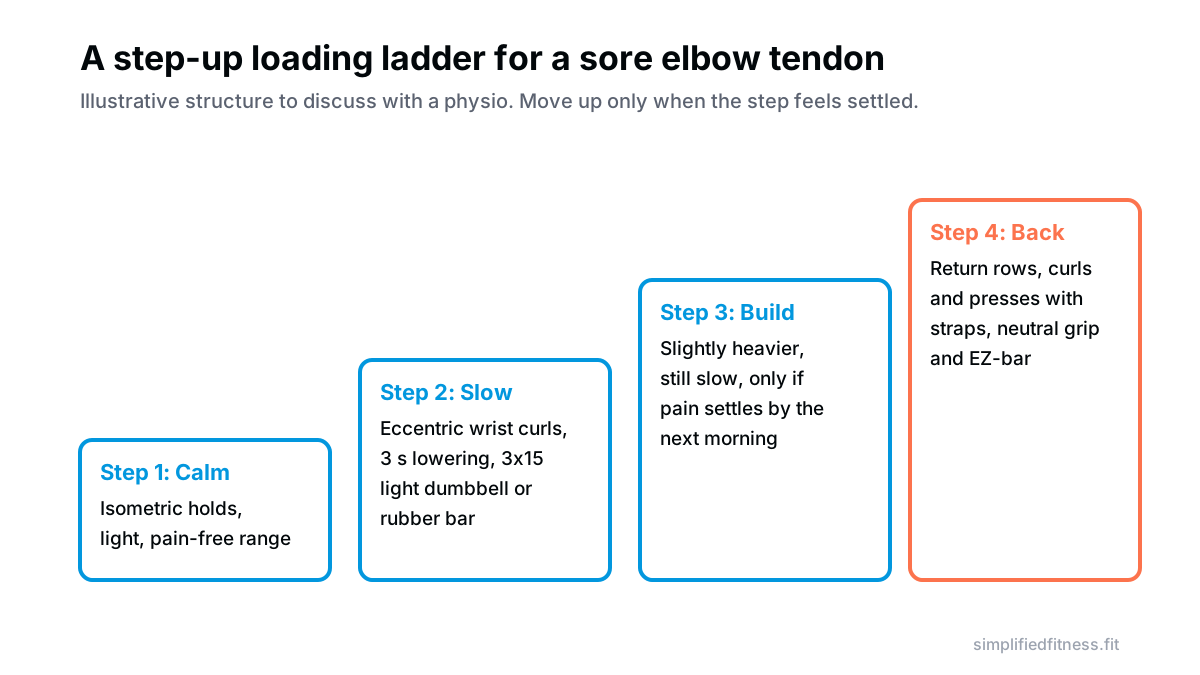
A sensible structure, to confirm with a physio (illustrative, not a prescribed protocol):
- Calm it. Light isometric holds of the wrist in the pain-free range.
- Go slow. Eccentric wrist curls (inner elbow) or wrist extensions (outer elbow) with a light dumbbell, 3 seconds lowering.
- Add load gradually. Slightly heavier, still slow, only if pain stays low and settles by the next day.
- Return to lifts. Bring rows, curls and presses back with the swaps below.
For a general rule on how much pain is acceptable, see our guide to good vs bad pain and the traffic light model for returning after injury.
Gym fixes: straps, neutral grips and EZ-bars
This is where you keep training without feeding the problem.
| Problem lift | Swap or fix | Why it may help |
|---|---|---|
| Barbell row, pull-up | Lifting straps on the heaviest sets | Takes load off gripping forearm muscles |
| Straight-bar curl | EZ-bar or neutral-grip hammer curl | Less forced wrist angle |
| Overhand pull-ups | Neutral-grip handles or lat pulldown | Eases wrist and forearm position |
| Heavy bench press | Dumbbell or neutral-grip press, bar over forearm | Keeps wrist from bending back |
| Heavy deadlift hold | Straps or mixed grip on top sets only | Grip stops being the limiter |
I want to be clear: these are coaching adjustments based on how the tendons are loaded, not treatments proven in trials. I did not find a controlled study of lifting straps for elbow tendinopathy. If you want the full back-day case for straps, see lifting straps for back hypertrophy.
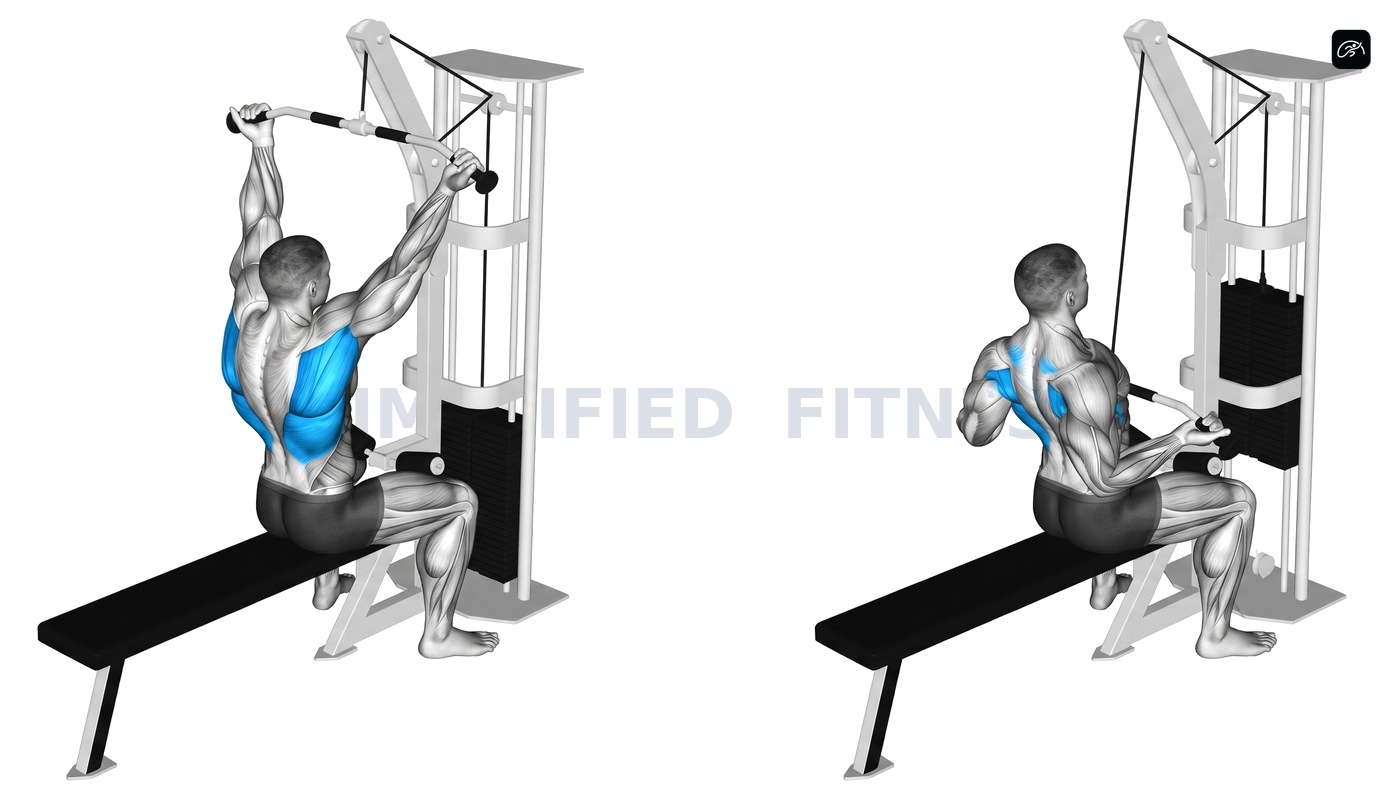
Straps are unlikely to cost you much back development. When grip gives out before your lats do, straps let the back keep working while the forearm tendon gets a break. Save grip-specific work for separate light, controlled days, and see our arm and forearm guide and grip strength protocols for that.
What to do this week
- Find which side is tender (inner or outer) and note which lifts spike it.
- Swap those lifts using the table above. Keep training everything else.
- Start light eccentric wrist work on the correct side and progress slowly.
- Keep pain low and settled by the next morning. If it is worse after two sessions, pull back a step.
- Put the exercises into a balanced split, for example our free push day and pull day plans, and edit the exercises that irritate you.
When to see a doctor
Get it checked if you have numbness or tingling in your fingers, visible swelling, a sudden pop followed by weakness, pain after a fall or hit, pain at night that does not ease, or no improvement after several weeks of sensible changes. These can mean a nerve, joint or partial tendon tear needs a proper exam. This article is general information, not a diagnosis.
The bottom line
Elbow tendinopathy in lifters is usually a load problem: pulling and pressing volume grew faster than the forearm tendons could handle. Exercise is better supported than rest or injections over the long run, though effects are small and evidence is low certainty. Eccentric work is a sensible tool, slow heavy loading needs a gradual build, and straps, neutral grips and EZ-bars let you keep training. Stay patient, and bring in a clinician early if it does not budge.
Frequently Asked Questions
What is the difference between golfer's elbow and tennis elbow?
Golfer's elbow (medial epicondylitis) affects the inside of the elbow where the wrist flexors and forearm pronators attach, while tennis elbow (lateral epicondylitis) affects the outside where the wrist extensors attach. Both are now usually described as tendinopathy, a load-related tendon problem, rather than simple inflammation. Tap the bony bump on each side to find where it is tender, then tell a physio which side it is.
Can lifting weights cause golfer's elbow?
It can contribute. Golfer's elbow is linked to repeated forced wrist extension and forearm supination during activities that load wrist flexion and pronation, and heavy gripping, rows and curls plausibly add to that load [(Amin et al., 2015)](https://pubmed.ncbi.nlm.nih.gov/26001427/). Look at how fast your pulling volume jumped and whether your grip is the limiting factor.
Can I still train with elbow tendinopathy?
Usually yes, if you change what irritates it. Exercise is the best-supported approach for tennis elbow compared with passive treatments, so total rest is rarely the answer. Keep pain low and settling within 24 hours, and swap the exercises that spike it.
Do lifting straps help elbow pain?
Straps take some of the gripping job away from your forearm flexors on pulling exercises, which is why many lifters find back days easier on a sore inner elbow. I could not find a controlled trial testing straps for elbow tendinopathy, so this is a practical coaching tool, not a proven treatment. Use them on the heaviest back sets and keep your grip training separate.
What is the Tyler twist?
It is an eccentric wrist flexor exercise using a rubber bar: you twist the bar with the healthy hand, then slowly release the twist using the sore arm. In a 2014 study of 20 people with chronic golfer's elbow who had failed earlier treatment, adding it to standard care was followed by a large drop in DASH disability scores. There was no control group, so ask a physio to guide it.
How long does golfer's elbow take to heal?
Timelines vary a lot between people, and I will not promise a number. In the Tyler study the average treatment period was about 6 weeks, but those patients were also getting other physio treatments. Plan on weeks to months of patient, consistent loading, and see a clinician if nothing improves.
Are cortisone injections a good idea for tennis elbow?
They give fast short-term relief but tend to do worse later. A meta-analysis found a large short-term pain benefit versus no intervention, reversed at intermediate and long-term follow-up [(Coombes et al., 2010)](https://pubmed.ncbi.nlm.nih.gov/20970844/). Talk through the trade-off with your doctor before accepting one.
Is eccentric or concentric training better for tennis elbow?
In a trial of 120 people with chronic tennis elbow, eccentric exercise gave faster pain reduction and bigger strength gains than concentric exercise, with no difference in function or quality of life [(Peterson et al., 2014)](https://pubmed.ncbi.nlm.nih.gov/24634444/). The edge was modest, about a 10% higher responder rate. Pick the version you will actually do consistently.
Why does my elbow hurt during pull-ups and chin-ups?
Hanging and pulling load the gripping muscles of the forearm at the elbow, so a tendon that is already sensitive can flare. Reducing reps, using neutral handles, or trying a lat pulldown with straps lowers that load. Our guide on [pull-ups vs chin-ups](/blog/pull-ups-vs-chin-ups-lat-biceps-biomechanics) covers grip options.
Does bench press cause tennis elbow?
It can irritate the outer elbow if the wrists collapse backward under the bar, because the wrist extensors then work hard to hold position. Stack the bar over your forearm, keep the wrist roughly straight, and consider a neutral-grip dumbbell press while it settles. Check our [grip width and wrist position guide](/blog/grip-width-wrist-orientation-lifting-biomechanics).
Is heavy slow resistance good for elbow tendinopathy?
It is unproven for the elbow and may be too aggressive early on. In a 2024 feasibility trial in tennis elbow, only 6 of 19 people (32%) complied with heavy slow resistance, mainly because it aggravated pain, and the authors suggested it may not suit these patients [(Sveinall et al., 2024)](https://pubmed.ncbi.nlm.nih.gov/39806585/). Start light and let a physio progress the load.
When should I see a doctor about elbow pain?
See a doctor for numbness or tingling in the hand, visible swelling, a pop followed by weakness, pain after a fall, night pain that does not ease, or no improvement after several weeks of sensible changes. These can point to nerve, joint or tendon problems that need a proper exam. Do not self-diagnose from an article.
Sources & References
Every claim above is checked against peer-reviewed research (PubMed, U.S. National Library of Medicine) or guidance from established health bodies. How we fact-check.
- Karanasios S, et al. Exercise interventions in lateral elbow tendinopathy have better outcomes than passive interventions, but the effects are small: a systematic review and meta-analysis of 2123 subjects in 30 trials. Br J Sports Med. 2021. PMID: 33148599
- Peterson M, et al. A randomized controlled trial of eccentric vs. concentric graded exercise in chronic tennis elbow (lateral elbow tendinopathy). Clin Rehabil. 2014. PMID: 24634444
- See ZH, et al. Eccentric exercise therapy for medial epicondylitis: A systematic review of clinical outcomes. Complement Ther Med. 2026. PMID: 41887339
- Tyler TF, et al. Clinical outcomes of the addition of eccentrics for rehabilitation of previously failed treatments of golfers elbow. Int J Sports Phys Ther. 2014. PMID: 24944855
- Coombes BK, et al. Efficacy and safety of corticosteroid injections and other injections for management of tendinopathy: a systematic review of randomised controlled trials. Lancet. 2010. PMID: 20970844
- Sveinall H, et al. Heavy slow resistance training, radial extracorporeal shock wave therapy or advice for patients with tennis elbow in the Norwegian secondary care: a randomised controlled feasibility trial. BMJ Open. 2024. PMID: 39806585
- Bisset L, et al. Mobilisation with movement and exercise, corticosteroid injection, or wait and see for tennis elbow: randomised trial. BMJ. 2006. PMID: 17012266
- Amin NH, et al. Medial epicondylitis: evaluation and management. J Am Acad Orthop Surg. 2015. PMID: 26001427

Umair Hazrami · Founder & Head Coach, Simplified Fitness
Umair Hazrami founded Simplified Fitness and the Simplified Lifter channel to cut through fitness noise. With 4+ years of consistent training and 10+ coaching clients, he writes every guide from the peer-reviewed research and links the sources so you can check them. Our editorial standards.
Educational content only, not medical advice. If you have a medical condition, are pregnant, or take medication, talk to a qualified doctor before changing your diet, supplements or training. Full disclaimer.
Keep reading
Health & Longevity
Are Deadlifts Bad for Your Lower Back? What Spinal Loading Research Shows
Are deadlifts bad for lower back health? The research shows spinal loads are high but tolerable, and trials use loaded lifting for back pain. How to hinge.
9 min read

Health & Longevity
Are Squats Bad for Your Knees? What the Research Actually Says
Are squats bad for your knees? Research on deep squats, kneecap stress and the knees-over-toes rule shows where the myth came from and how to squat safely.
9 min read

Health & Longevity
Why Tendons Adapt Slower Than Muscles: Connective Tissue Timelines for Lifters
Tendon adaptation vs muscle growth: why your tendons lag behind your strength gains, what studies show about timelines, and how to add load without tendonitis.
8 min read

Health & Longevity
Desk Worker Workout Routine: Fix Pelvic Tilt, Weak Glutes and a Rounded Upper Back
A desk worker workout routine built on evidence: what sitting really does to your hips, why pelvic tilt is mostly normal, and 3 gym correctives that help.
8 min read