Does Lifting Weights Stunt Growth in Teens? What the Research Says
Does lifting weights stunt growth? Reviews of youth training found no effect on height and very few injuries. See the evidence and a safe teen starting plan.

TL;DR. The short answer
- No good evidence shows that supervised, well-coached lifting stunts growth. A 2006 evidence-based review of 22 training studies in pre- and early-pubertal youth found no effect on height or weight growth.
- In that same review, only 3 injuries were reported across the studies that tracked them. The studies used low instructor-to-participant ratios, so the safety result depends on good supervision.
- Real injury risk comes from poor technique, ego loading, dropped equipment and no supervision, not from the barbell itself. A 2026 review of US emergency data found most youth weightlifting fractures were finger and toe injuries from improper use.
- Youth resistance training improves strength and motor skills such as jumping and sprinting. Evidence for a bone density benefit from lifting alone is less clear than for jumping.
- Start with technique, light loads, 2-3 full-body sessions a week and an adult who knows what they are doing. See a doctor for lingering pain near a joint or growth area.
Part of our complete guide: Joint-Friendly Lifting & Fitness Myths: A Guide for Over-40s, Teens and Sore Backs
Table of contents
Does lifting weights stunt growth? Based on the best available evidence, no. Supervised, well-coached resistance training has not been shown to reduce height or damage growth in kids and teenagers, and position statements from sports medicine and strength organisations support it.
The real risks are the same ones adults face: bad technique, too much weight too soon and nobody watching. This guide sits inside our joint-friendly lifting and myth busting guide, and it is written for teens and for parents who want a straight answer.
Where did the stunted growth myth come from?
The fear is old, and it feels logical. Growth plates, the zones of developing cartilage near the ends of long bones, are where bones lengthen. Heavy loads sound dangerous for anything still “under construction.”
The problem is that the fear ran ahead of the data. Over the past decades researchers actually put young people through lifting programs and measured what happened. That is a different thing from worry or anecdote.
Here is a useful rule: a growing bone is not a fragile bone. Kids run, jump off walls, tackle each other and land awkwardly every day. Controlled lifting, at a load that a child can handle with clean form, is a small part of the forces growing bones deal with in normal life and sport.
What does the research say about growth and injuries?
The main anchor is a 2006 evidence-based review by Malina. It examined 22 experimental training reports in pre- and early-pubertal youth, mostly using machines and free weights, 2-3 days per week, for 8-12 weeks. Programs did not influence growth in height and weight (Malina, 2006).
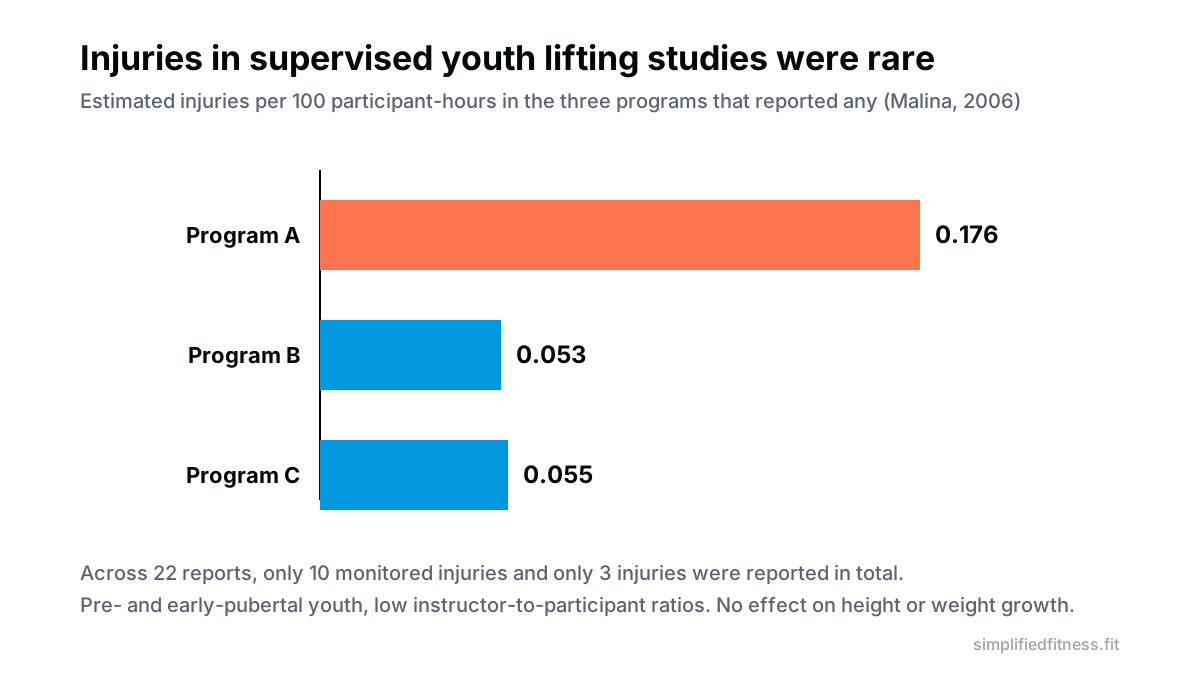
Injuries were rare too. Only 10 of those studies tracked injuries systematically, and only three injuries were reported, with estimated rates of 0.176, 0.053 and 0.055 per 100 participant-hours in the respective programs. The author concluded that protocols with supervision and low instructor-to-participant ratios are relatively safe.
Two caveats matter, and I want to be straight about them. First, this was pre- and early-pubertal youth, in structured research programs. It does not describe a 16-year-old maxing out alone on the bench at a crowded gym. Second, these were short programs, 8-12 weeks, so they tell us little about a decade of heavy training.
What do the major position statements say?
The National Strength and Conditioning Association (NSCA) updated its youth position in 2009. It states that many of the benefits of adult resistance training are attainable by children and adolescents who follow age-specific guidelines, and it describes qualified acceptance of youth training by medical, fitness and sport organisations as becoming universal (Faigenbaum et al., 2009). It also notes that school-aged youth should accumulate 60 minutes or more of moderate to vigorous activity daily, and that resistance training can add unique benefits to aerobic activity.
In 2014 an international consensus statement was published in the British Journal of Sports Medicine. It was adapted from the UK Strength and Conditioning Association position and reviewed and endorsed by leading professional organisations in sports medicine, exercise science and paediatrics (Lloyd et al., 2014).
A 2022 narrative review of weightlifting for children and adolescents reached a similar place. Injuries can occur, but the incidence and rate appear relatively low and severe injury is uncommon. If training and competition are age-appropriate and properly supervised, the authors describe the sport as substantially safe (Pierce et al., 2022).
Is the gym safe for teenagers? Where injuries really come from
Safe does not mean careless. Look at where youth weight-related injuries actually happen.
A 2026 review of US emergency department data counted an estimated 32,955 weightlifting-related fractures in people aged 0-18 from 2014 to 2023. Of these, 28,647 were from improper use, dropped weights, crush injuries or falls. The most fractured body parts were the finger (38.9%) and toe (38%), and many injuries happened at home or at recreation settings (Jain et al., 2026).
Read that carefully. It is a surveillance database with its own limits, it is US data, and it does not give an injury rate per hour of training. But the pattern is clear. Dropped plates on toes and fingers caught in equipment are not growth plate stories. They are supervision and equipment stories.
What are the benefits of lifting for teens?
There are real upsides, though some are better supported than others.
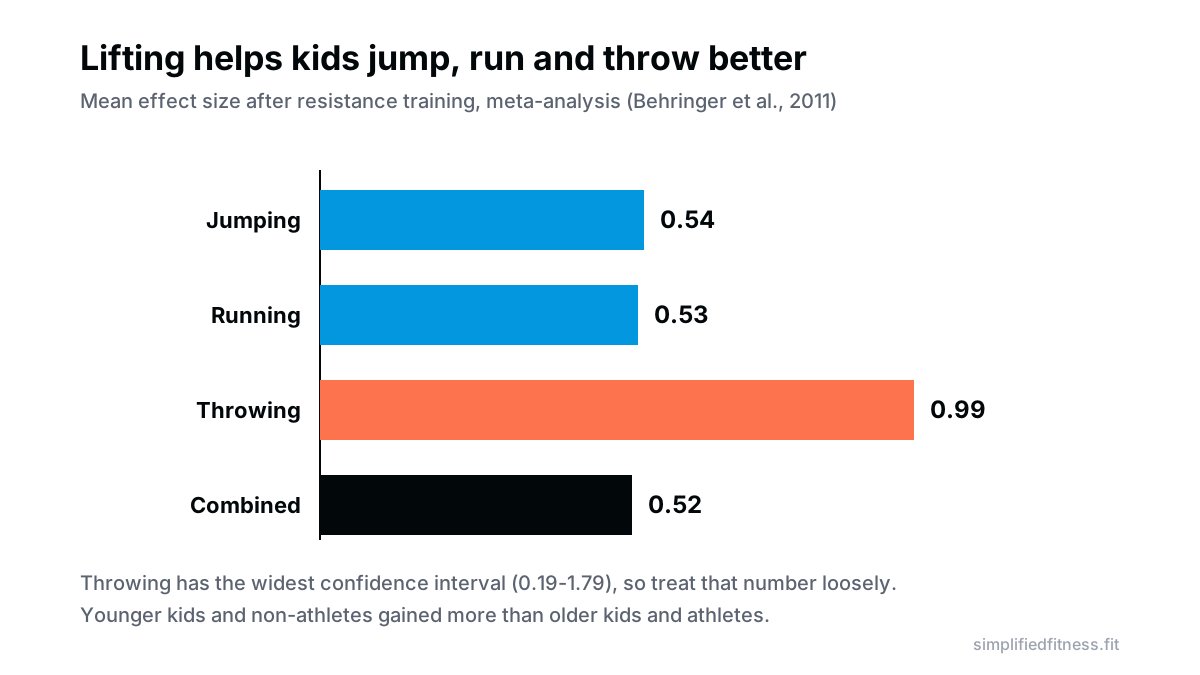
Strength and motor skills. A meta-analysis found a combined mean effect size of 0.52 for jumping, running and throwing after resistance training in children and adolescents. Younger people and non-athletes gained more than older people and athletes (Behringer et al., 2011).
Body composition. A 2023 systematic review of 22 studies in prepubertal children found strength increased in 100% of the programs recorded, with body fat percentage falling and lean mass rising across several of them. It also noted results in girls were more heterogeneous because fewer girls were studied (Sanchez Pastor et al., 2023).
Bone health: the honest picture. You will often read that lifting builds bone in teens. The evidence is less tidy. A 2025 meta-analysis of 12 studies with 940 participants found that high-impact jumping significantly improved bone mineral content at the lumbar spine and femoral neck, especially in girls. Resistance exercise did not produce statistically significant gains, though the authors say this may reflect a small number of studies and methodological limits (Miao et al., 2025). The practical reading: do not sell lifting as a bone fix, and keep jumping, running and sport in the week.
Confidence and habits. It is plausible that learning a skill like lifting helps some teens feel more capable and at home in a gym. None of the studies above measured self-esteem, so treat that as a possible side benefit, not a headline.
What age can teens start lifting weights?
There is no hard cut-off in the research. The NSCA statement defines children as those without secondary sex characteristics (roughly up to 11 years in girls and 13 in boys) and adolescents as roughly 12-18 in girls and 14-18 in boys, and says benefits come with age-specific guidelines (Faigenbaum et al., 2009).
In practice, the better question is readiness. Can the young person follow instructions, stay focused for a session and handle a light load with control? If yes, learning basic patterns is reasonable. If they are goofing around or chasing a number to impress friends, wait or add more supervision.
For a 13-14 year old, think body-weight squats, push-ups, rows, light dumbbell work and machines. For 16-18, the same approach with more load over time works fine. There is no need to rush into a barbell squat. Our beginner plans are written for adults, so teens should use them only with adult guidance and lighter loads.
How should a teen train? A simple youth coaching checklist
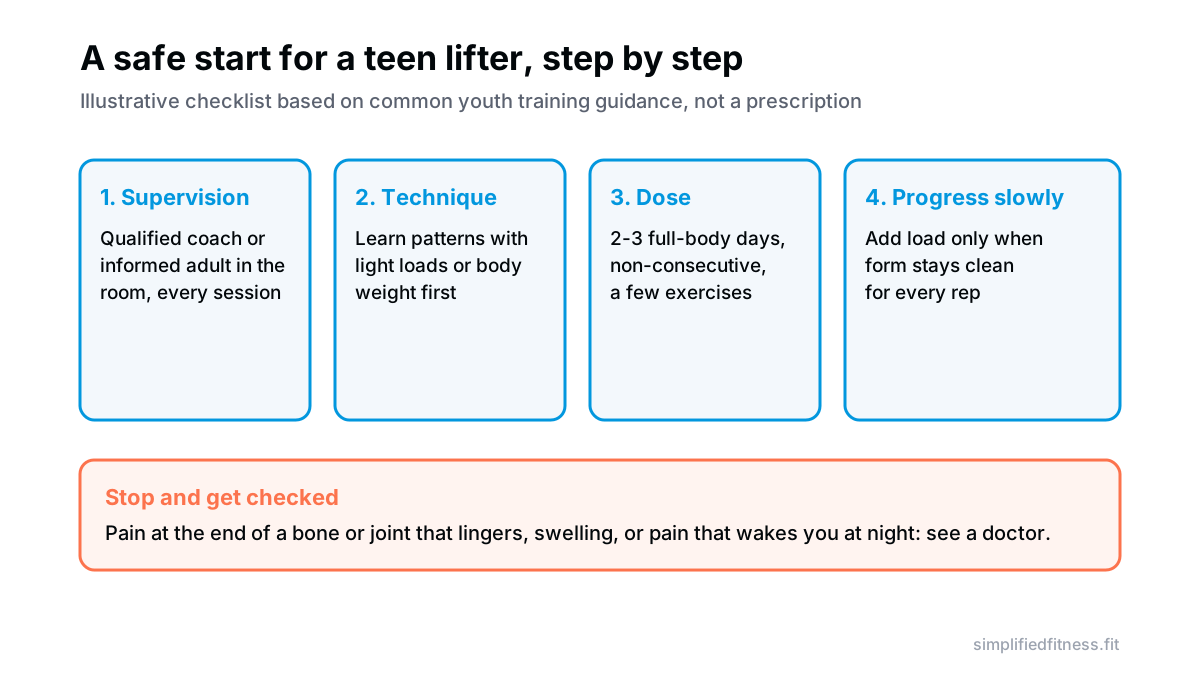
- Get supervision. A qualified coach or an informed adult who actually watches form. Close supervision was a feature of the studies that reported so few injuries.
- Learn patterns first. Squat, hinge, push, pull and carry with light loads or body weight. Once the pattern is boring, add weight.
- Two to three days per week. Full-body, non-consecutive days. That matches what most programs in the 2006 review used.
- 8-12 reps, clean form. Stop a set when form slips. Skip true max attempts and ego lifting early on.
- Progress slowly. Add a little load only when every rep looks the same. This is the same logic as in our progressive overload guide.
- Warm up and finish with a cool-down. Five to ten minutes of easy movement beats jumping straight under the bar.
- Keep other sport and play. Resistance training adds to activity, it does not replace it.
- Sleep and eat enough. Teens are still growing. Dieting hard while lifting is not a good mix.
Sports teens already play still matter. Lifting is a support act for cricket, football and kabaddi, not a replacement for them.
Food, supplements and Indian realities
Most teens do not need protein powder. A day with dal, curd, paneer, eggs, soya chunks, roti, rice and some chicken or fish covers protein for most. If you want a rough number for an adult body, you can try our protein calculator, though teen needs are best checked with a doctor or dietitian.
Supplements are a different story. Research in adolescents is more limited than in adults, so I would not push creatine or pre-workouts on a school-age lifter. See our guide on creatine, protein powders and caffeine for the adult evidence.
Also watch the climate and the exam calendar. Training in a hot, humid gym with little water and little sleep is a poor trade. Drop to one or two sessions in exam weeks, and keep them short.
Will lifting make girls or boys bulky?
That worry often rides alongside the growth one. For the adult version of the question, see our article on whether lifting heavy makes women bulky. For teens, the studies above measured strength, motor skills and body composition, and reported small to moderate changes, not dramatic bulk.
When to see a doctor
Lifting-related soreness is normal. These are not:
- sharp pain, swelling or tenderness at the end of a bone or around a joint that does not settle in a few days
- pain that wakes you up at night or gets worse with rest
- any injury after a dropped weight or a fall
- a growth, puberty or menstrual concern, in which case a doctor should review it regardless of training
Get these checked by a doctor or sports physician. For how to separate normal training discomfort from the kind that needs attention, read good pain versus bad pain in training and our wider guide to pain-free hypertrophy.
The bottom line
Does lifting weights stunt growth? Not on the evidence we have. Supervised, age-appropriate training has not been linked to reduced height, and injuries in the studies were rare. The bigger dangers are ego loading, no coaching and dropped equipment.
Start light, learn technique, train two to three days a week and keep playing other sports. Treat the bone benefit as a possible bonus, not a promise. The rest, a good program, regular meals and enough sleep, does the work.
Frequently Asked Questions
Does lifting weights stunt your growth?
No, current evidence does not show that supervised lifting stunts growth. A 2006 evidence-based review of 22 experimental programs in pre- and early-pubertal youth found no influence on height or weight growth. Choose supervised sessions with sensible loads and focus on technique.
What are growth plates and can weights damage them?
Growth plates are areas of developing cartilage near the ends of long bones where growth in length happens. Injuries to them are possible in youth sport and from accidents, but supervised lifting programs in the research reported very few injuries of any kind. Avoid maximal attempts, sloppy technique and unsupervised heavy lifting to keep the risk low.
Is the gym safe for teenagers?
It can be, when training is supervised and sensibly programmed. Position statements describe youth resistance training as safe and beneficial under those conditions, while a 2026 US injury review found most weight-related fractures in youth came from improper use of equipment or dropped weights. Pick a gym with coaching, learn technique first and never train heavy alone.
What age can kids start lifting weights?
There is no single minimum age. The NSCA position statement says that many adult training benefits are reachable by children and adolescents who follow age-specific guidelines. In practice, readiness to listen and follow coaching matters more than a birthday. Start with body weight and light loads once a child can do that.
Can a 13 or 14 year old go to the gym?
Yes, with supervision and a beginner program. In a review of training studies in younger, pre- and early-pubertal children, programs most often ran 2-3 sessions a week for 8-12 weeks, with strength gains and few injuries. Start with machines or light free weights, keep the reps clean and have a coach or informed adult watching.
How many days a week should a teenager lift?
Two to three non-consecutive days of full-body training is a sensible starting point. Most experimental programs reviewed in 2006 used 2- and 3-day protocols, and teens also need sports, play and recovery time. Add a third day only if sleep, school load and energy allow.
Should teenagers lift heavy or stick to light weights?
Learn technique with light loads first, then raise load gradually as form holds. A meta-analysis found that higher intensity showed a positive dose-response for motor performance within traditional programs, so loads should not stay trivially light forever. Progress when every rep looks the same, and avoid testing true one-rep maxes early on.
Does lifting make teenagers shorter?
There is no evidence that it does when training is appropriate. Height is mainly driven by genetics, nutrition, sleep and the timing of puberty, and training studies in youth reported no effect on height. If you are worried about your growth, track it with a doctor rather than blaming the gym.
Is it better for teens to do bodyweight exercises or use weights?
Both work, and they are not opposites. Resistance training includes body weight, bands, machines and free weights, and research on children shows strength improves in essentially all programs reviewed. Begin with push-ups, squats and rows to learn patterns, then add external load.
Do girls need to worry about lifting weights during puberty?
No special growth concern has been identified for girls, but studies in girls are fewer. A 2023 systematic review noted results were more heterogeneous in girls because of the small number of studies. Girls can follow the same supervised beginner approach and see a doctor if they have pain or menstrual or growth concerns.
Can teens take creatine or protein powder for lifting?
Food first is the safest approach for most teens. Protein needs are normally met with dal, eggs, paneer, curd, soya and meat or fish, and supplement research in adolescents is more limited than in adults. Talk with a doctor before using any supplement, and see our guide on creatine and protein powders for the adult evidence.
What are the signs a teen should stop training and see a doctor?
Stop if there is sharp pain, swelling, or pain at the end of a bone near a joint that does not settle within a few days. Overuse and acute injuries around growing bones deserve a proper exam rather than guesswork. A doctor or sports physician can check it, and training can restart in a modified form once cleared.
Sources & References
Every claim above is checked against peer-reviewed research (PubMed, U.S. National Library of Medicine) or guidance from established health bodies. How we fact-check.
- Malina RM. Weight training in youth-growth, maturation, and safety: an evidence-based review. Clin J Sport Med. 2006. PMID: 17119361
- Faigenbaum AD, et al. Youth resistance training: updated position statement paper from the National Strength and Conditioning Association. J Strength Cond Res. 2009. PMID: 19620931
- Lloyd RS, et al. Position statement on youth resistance training: the 2014 International Consensus. Br J Sports Med. 2014. PMID: 24055781
- Pierce KC, et al. Weightlifting for children and adolescents: a narrative review. Sports Health. 2022. PMID: 34781771
- Behringer M, et al. Effects of strength training on motor performance skills in children and adolescents: a meta-analysis. Pediatr Exerc Sci. 2011. PMID: 21633132
- Sanchez Pastor A, et al. Influence of strength training variables on neuromuscular and morphological adaptations in prepubertal children: a systematic review. Int J Environ Res Public Health. 2023. PMID: 36981742
- Miao T, et al. Effects of high-impact jumping versus resistance exercise on bone mineral content in children and adolescents: a systematic review and meta-analysis. PeerJ. 2025. PMID: 40611942
- Jain C, et al. Pediatric weight training fractures due to improper use: a review of national injury data, 2014-2023. Phys Sportsmed. 2026. PMID: 41633951

Umair Hazrami · Founder & Head Coach, Simplified Fitness
Umair Hazrami founded Simplified Fitness and the Simplified Lifter channel to cut through fitness noise. With 4+ years of consistent training and 10+ coaching clients, he writes every guide from the peer-reviewed research and links the sources so you can check them. Our editorial standards.
Educational content only, not medical advice. If you have a medical condition, are pregnant, or take medication, talk to a qualified doctor before changing your diet, supplements or training. Full disclaimer.
Keep reading
Health & Longevity
Are Deadlifts Bad for Your Lower Back? What Spinal Loading Research Shows
Are deadlifts bad for lower back health? The research shows spinal loads are high but tolerable, and trials use loaded lifting for back pain. How to hinge.
9 min read

Health & Longevity
Are Squats Bad for Your Knees? What the Research Actually Says
Are squats bad for your knees? Research on deep squats, kneecap stress and the knees-over-toes rule shows where the myth came from and how to squat safely.
9 min read

Health & Longevity
Why Tendons Adapt Slower Than Muscles: Connective Tissue Timelines for Lifters
Tendon adaptation vs muscle growth: why your tendons lag behind your strength gains, what studies show about timelines, and how to add load without tendonitis.
8 min read

Health & Longevity
Desk Worker Workout Routine: Fix Pelvic Tilt, Weak Glutes and a Rounded Upper Back
A desk worker workout routine built on evidence: what sitting really does to your hips, why pelvic tilt is mostly normal, and 3 gym correctives that help.
8 min read