How to Train Legs With Bad Knees: Swaps, Angles and Tendon Protocols
How to train legs with bad knees: knee pain squat alternatives, isometric holds and slow heavy loading, with the research behind each swap and what to avoid.

TL;DR. The short answer
- You can usually keep training legs with knee pain. Swap the exercise that triggers it for a hip-dominant or shorter-range option, and keep pain low and settling within a day.
- For patellar tendinopathy, isometric holds can reduce pain quickly: in a small 2015 crossover study of 6 volleyball players, pain on a single-leg decline squat fell from 7.0 to 0.17 out of 10 straight after the holds.
- Over weeks, reviews favour heavy slow resistance or eccentric loading for long-term pain and knee function, although the trials are small and head-to-head comparisons are limited.
- Patellofemoral pain responds to exercise therapy, and adding hip strengthening to knee strengthening reduced pain more in a 2025 meta-analysis of 6 trials.
- Sudden swelling, locking, giving way, night pain or a knee that will not straighten needs a doctor or physio before you train through it.
Part of our complete guide: Joint-Friendly Lifting & Fitness Myths: A Guide for Over-40s, Teens and Sore Backs
Table of contents
How to train legs with bad knees comes down to three moves: swap the exercise that triggers pain for one that loads the same muscles differently, use isometric holds to calm a sore tendon, then rebuild with slow, heavy, progressive work. Most people do not need to stop leg day. They need a different version of it.
This guide is the hands-on, “what do I do on Monday” companion to our joint-friendly lifting and myth busting guide. If you want the bigger question of whether squats damage knees at all, read are squats bad for your knees first. Here we assume your knee already hurts and you want options.
One honest limit up front: I cannot diagnose your knee from a screen, and nobody else can either. Use this as a framework to discuss with a doctor or physio, not a replacement for one.
First: what kind of knee pain is it?
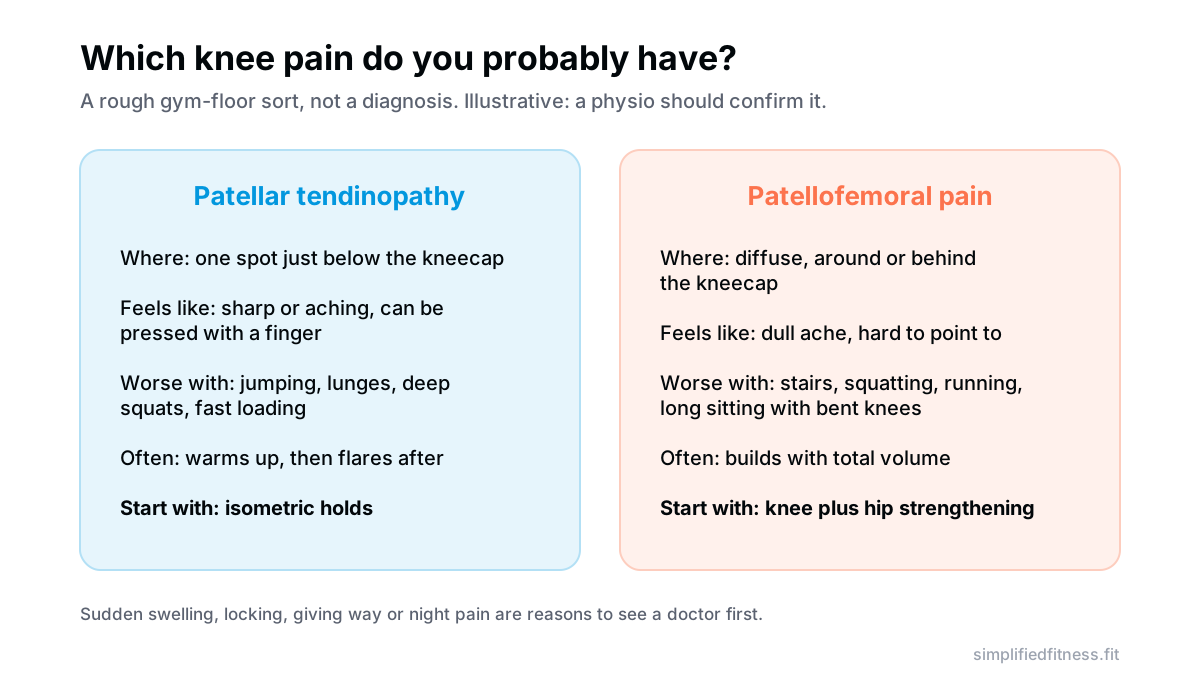
Two overuse problems account for a lot of gym-related knee pain, and they respond a little differently.
Patellar tendinopathy is pain in the tendon that connects your kneecap to your shin. It tends to sit in one spot just below the kneecap and flares with jumping, lunges and heavy loaded knee bends.
Patellofemoral pain is a dull ache around or behind the kneecap. It tends to show up on stairs, deep squats, running and long periods sitting with bent knees (van der Heijden et al., 2015).
Do I have to stop squatting?
Usually not. The default treatment for both conditions is exercise, not rest. The 2024 best-practice guide for patellofemoral pain, built from 65 high-quality trials with 3,796 participants plus patient and expert interviews, recommends knee-targeted exercise therapy, with or without hip-targeted work, plus education, as the primary approach (Neal et al., 2024).
The Cochrane review reached a similar direction but with a big caveat. Exercise therapy beat control for short-term pain during activity (mean difference -1.46 points on a 0-10 scale across five studies, 375 participants), yet the review rated the evidence as very low quality because of small trials and design flaws (van der Heijden et al., 2015). Translation: exercise probably helps, and we are not certain how much.
So the goal is not “no squats forever.” It is “find a dose your knee tolerates, then build.”
Knee pain squat alternatives: the swap table
Here is the logic. Many knee-irritating moves share a feature: the knee travels well forward over the toes with a lot of bend. Swaps that keep the shin more upright or move work to the hips often feel better. These are coaching choices, not proven cures, so test each one against your own symptoms.
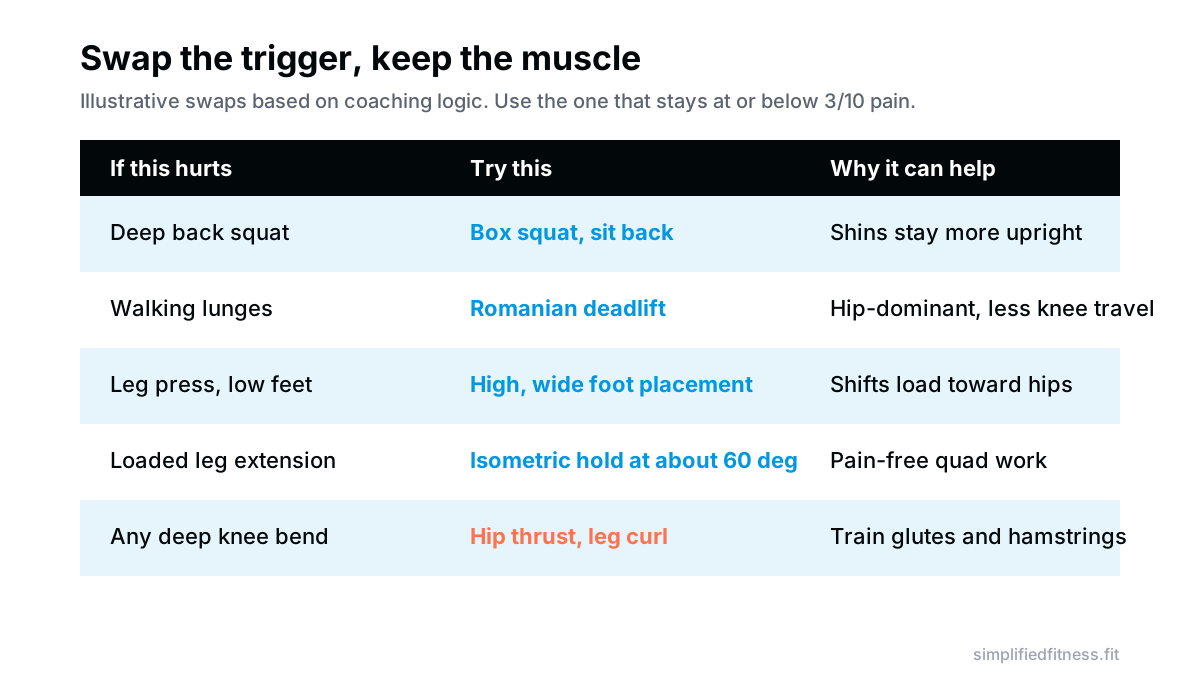
Box squat (knee friendly). Sit back to a bench or box so your shins stay closer to vertical. Pause briefly, then stand. The box also gives you a consistent depth, which makes it easy to progress by load instead of range. Start above parallel if deeper hurts.
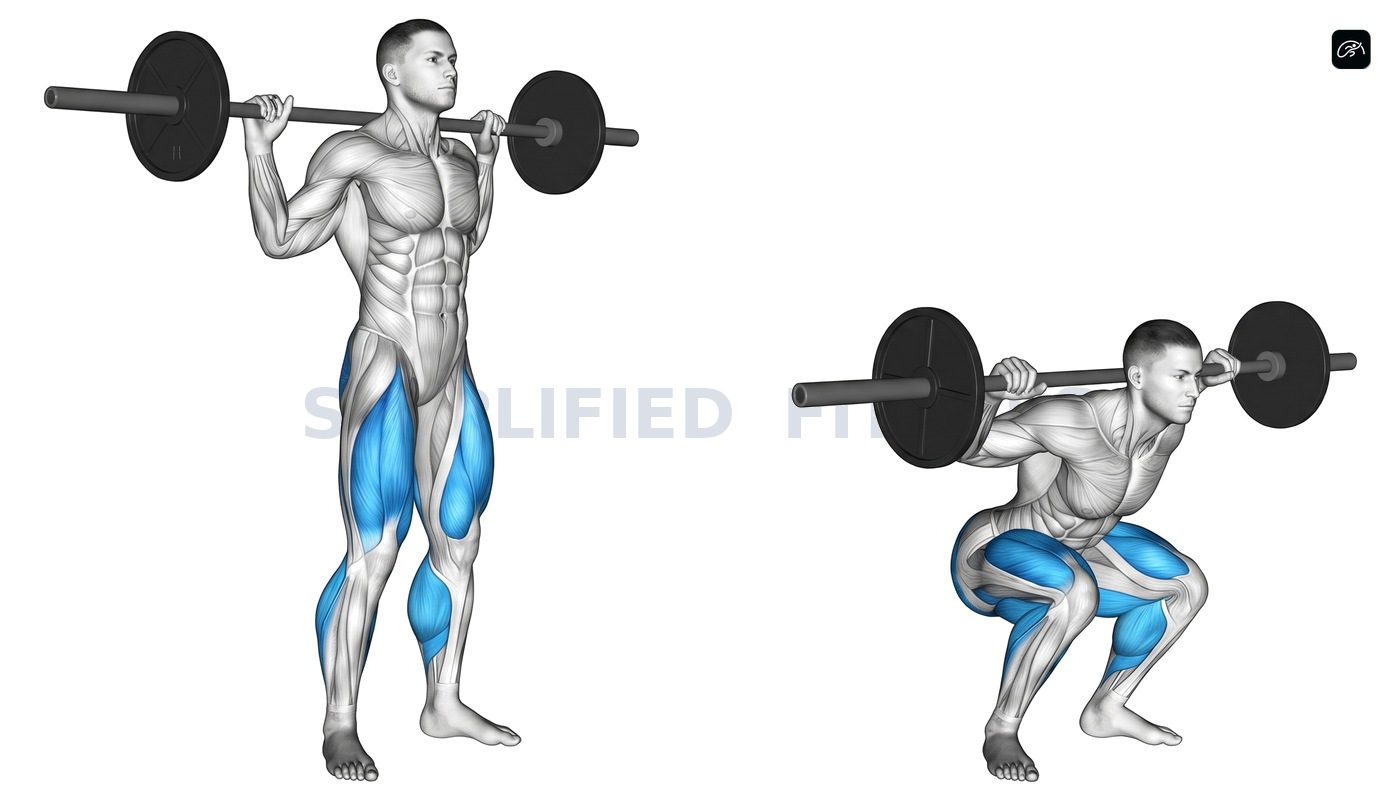
Romanian deadlift. A hip hinge with soft knees. It trains hamstrings and glutes hard with minimal knee bend, so it keeps your legs working while the front of the knee settles. Our stiff-leg style version works too, as long as your lower back is comfortable.
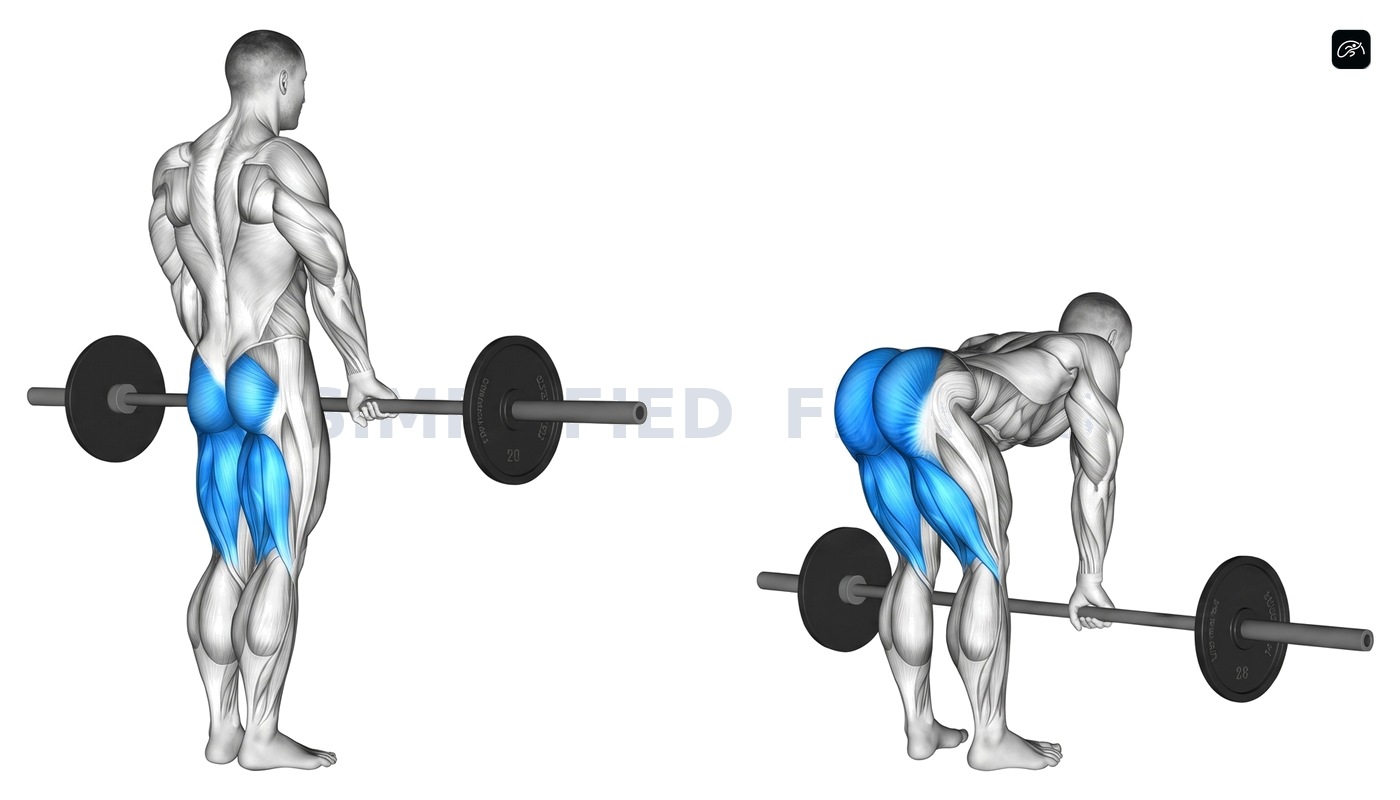
High, wide foot placement on the leg press. Placing your feet higher on the platform reduces how far the knee bends and tends to shift more of the work toward the hips and less to the quads. Use a controlled range and do not let your hips curl off the pad.
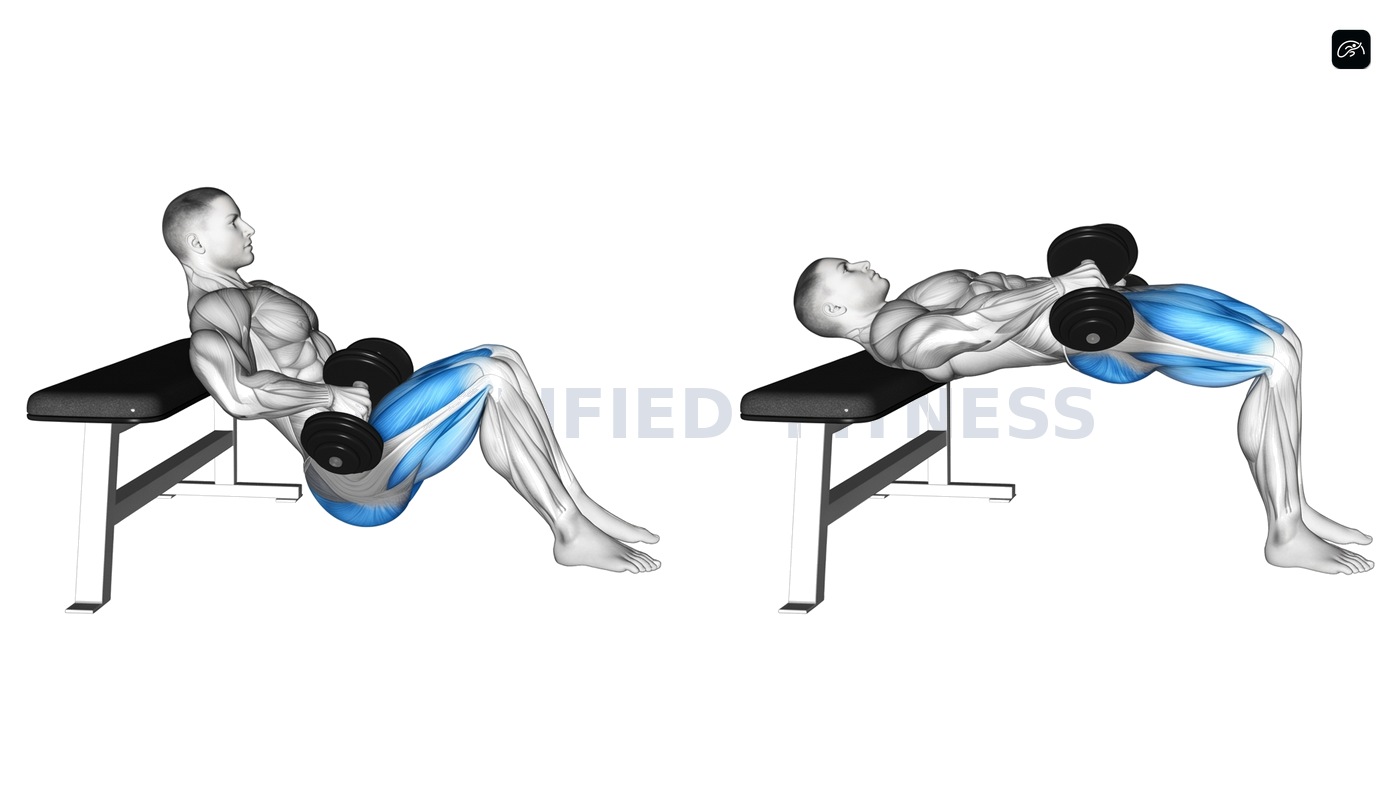
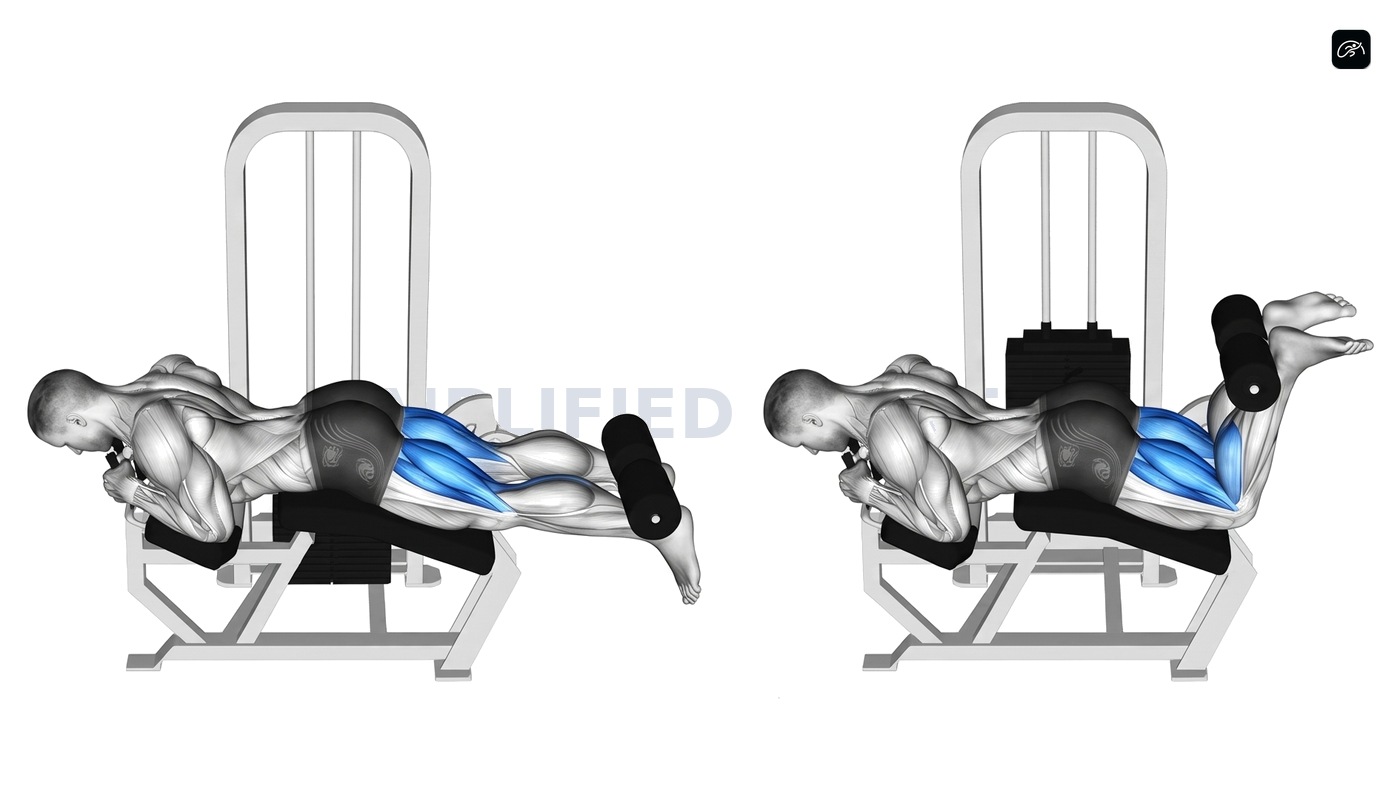
Hip thrust and leg curl. Zero deep knee bend, real hamstring and glute work. They will not replace quad training, but they keep your lower body progressing while the knee calms down.
Seated leg curl. Hamstring strength matters for the whole knee, and the movement is usually friendlier than a lunge.
Patellar tendinopathy leg exercises: start with isometrics
If your pain matches the tendon picture, isometric holds have the best support for quick, short-term pain relief.
In a small randomised crossover study, 6 volleyball players with patellar tendinopathy did either isometric or isotonic quad contractions. Pain during a single-leg decline squat dropped from 7.0 to 0.17 out of 10 after isometrics, versus 6.33 to 3.75 after isotonic work. The isometric effect was still there 45 minutes later, and quad strength measured by maximal voluntary contraction rose by 18.7% (Rio et al., 2015).
That is a striking result, but six players is a very small sample, and it measured immediate pain, not long-term healing.
A follow-up trial in 20 in-season volleyball and basketball players compared isometric leg extension holds at 60 degrees of knee bend (at 80% of maximal effort) with isotonic leg extensions, four times a week for four weeks. Isometrics gave greater immediate pain relief, though both protocols appeared effective (Rio et al., 2017). A separate in-season randomised trial of 29 jumping athletes found pain improved in both isometric and isotonic groups after four weeks, with no significant difference between them (van Ark et al., 2016).
So where does that leave you? Isometrics seem to be a reliable way to take the edge off quickly. Whether they beat plain isotonic work over a month is unclear.
Wall sits and Spanish squats
A wall sit or a Spanish squat is simply a way to hold a quad contraction without a leg extension machine. For a Spanish squat, loop a strap or heavy band behind your knees, anchor it behind you, lean back into it and sit so your shins stay close to vertical. Hold. The trials above used leg extension holds, so I would not claim a Spanish squat is better than those. It is a convenient, popular option when you only have a band and a rack.
A reasonable starting dose is several holds of about 30-45 seconds with a minute of rest between, at an effort that is firm but not painful. That is a practical starting point, not a number from a specific study.
How do I rebuild once the pain settles?
Isometrics calm pain. They do not by themselves rebuild a tendon that has been overloaded. The next step is progressive loading.
A systematic review of 15 studies (3 isometric, 2 heavy slow resistance, 10 eccentric) concluded isometrics are best supported for short-term pain relief in season, while heavy slow resistance or eccentric work suits long-term pain reduction and knee function (Lim et al., 2018).
The head-to-head story is less tidy. An earlier systematic review found conflicting evidence that eccentric loading beats other programmes for patellar tendons, and greater evidence supporting heavy slow resistance. In that review, HSR was also linked with tendon changes on imaging and signs of collagen turnover that eccentric loading was not (Malliaras et al., 2013).
Why the disagreement? The trials are small, the athletes differ, and comparing programmes directly is rare. A cautious takeaway: slow, heavy, controlled loading is a sensible long-term direction, and decline-squat eccentrics are optional, not mandatory.
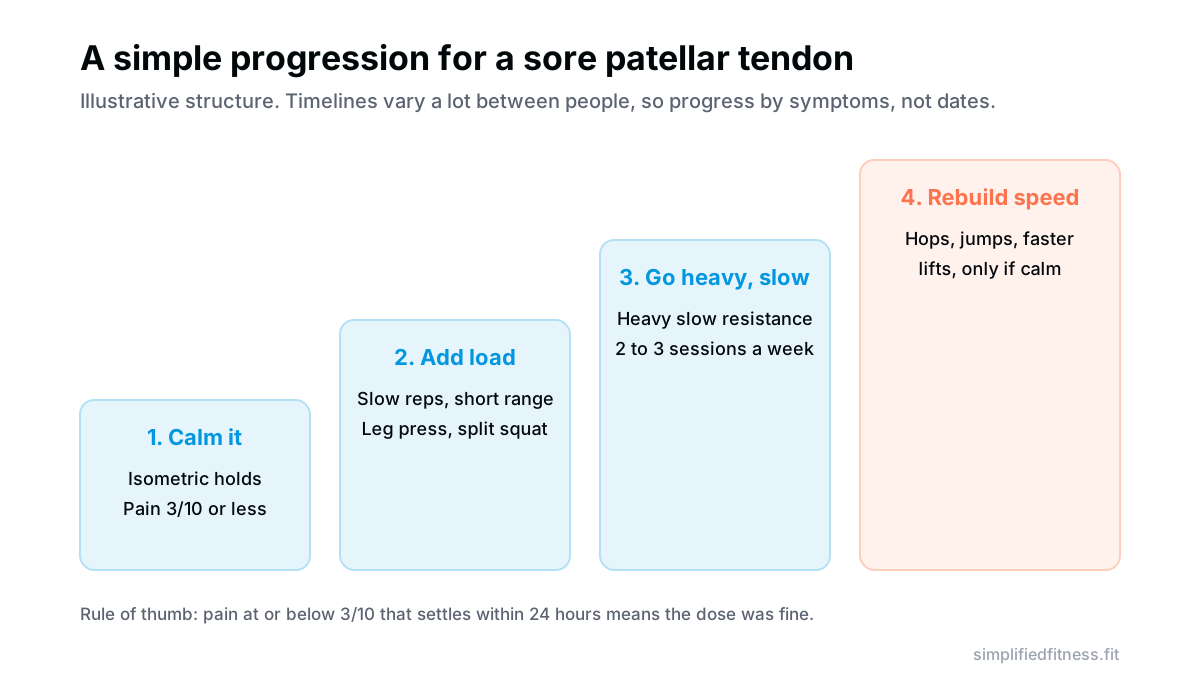
Here is how I would structure it for a lifter. Treat the timelines as illustrative, because tendons vary a lot between people.
- Calm it. Isometric holds most days, pain no higher than about 3 out of 10.
- Add load. Slow reps in a short range: leg press with high feet, a split squat to a comfortable depth, box squat above parallel. Three seconds down, one second up.
- Go heavy and slow. Fewer reps, heavier load, controlled tempo, two to three leg sessions a week. This is the heavy slow resistance idea from the studies above.
- Rebuild speed. Only after the tendon is calm under heavy load, reintroduce jumps, faster lifts and deeper ranges.
For more on why tendons need this kind of patient loading, see how tendons adapt differently from muscle.
Quad exercises for bad knees without the agony
People ask how to grow quads when squats hurt. Muscle growth does not depend on one lift. It depends on enough hard sets close to failure with a load your joint tolerates. We cover that logic in joint-friendly hypertrophy.
Options that often work:
- Isometric leg extension holds at a knee angle that feels strong and quiet.
- High-foot leg press with a shorter range and slow lowering.
- Short-range split squats to a depth that does not bother you.
- Box squats with a slow tempo, adding load before depth.
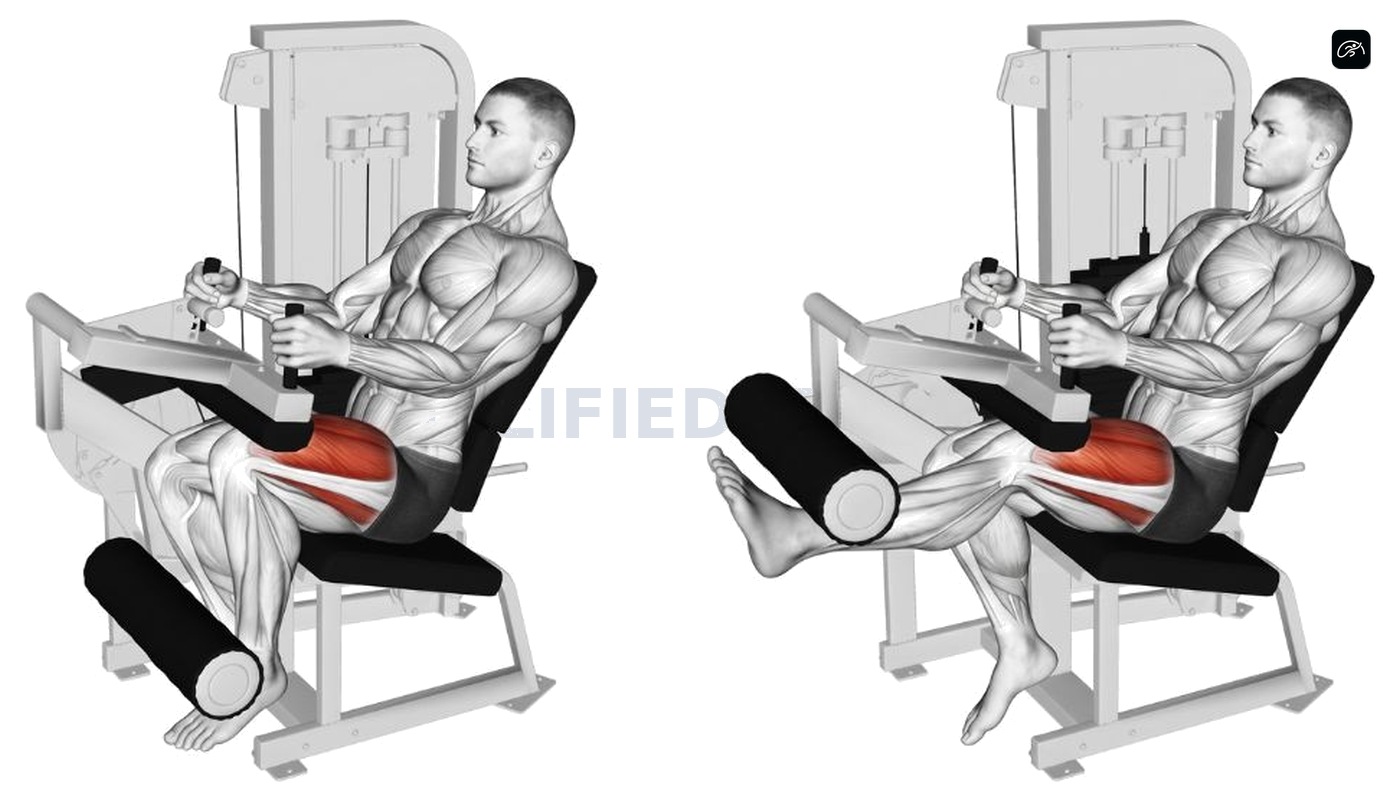
Leg extensions have a bad reputation online, yet the tendinopathy trials above used them because they let you control the angle and effort. If your knee hates the last 30 degrees, shorten the range.
Want a ready-made session? Our leg day plan gives a structure you can adapt with the swaps above.
What about patellofemoral pain? Hips matter
For patellofemoral pain, quad work alone is not the whole answer. A 2025 meta-analysis of 6 randomised trials (241 patients, 96.3% women) found hip plus knee strengthening reduced pain more than knee strengthening alone (SMD -1.29) and improved function, with no significant strength difference (Halabi et al., 2025). The results varied a lot between trials (I2 of 87%), so the exact size of the benefit is uncertain, and most participants were women.
Practically, that means adding glute and hip work, not just leg extensions. Hip thrusts, side-lying hip abduction and Romanian deadlifts are all reasonable.
Training around knee pain on a normal week
A simple template many lifters can adapt:
- Day 1 (quad-biased): box squat or high-foot leg press, isometric hold, leg curl.
- Day 2 (hip-biased): Romanian deadlift, hip thrust, short-range split squat.
- Keep other body parts as usual. Knee pain does not stop upper-body training.
Warm up longer than you think you need, especially in an early-morning session or a cold gym. Many people find a sore knee is crankier in the first set, and a few minutes of easy cycling or brisk walking before the first hold usually helps.
When to see a doctor or physio
Get checked first if you have:
- swelling that appeared quickly after a twist or fall
- locking, catching or giving way
- a knee that will not fully straighten
- pain at night or at rest
- redness, warmth or fever
- no improvement after several weeks of sensible loading
These can point to ligament, meniscus or other problems that exercise swaps will not fix. Returning after a real injury is a different process, covered in our return-to-gym traffic light model.
Frequently Asked Questions
Can I still train legs with bad knees?
Yes, in most cases you can, as long as the cause is an overuse problem like tendon or kneecap pain and not a structural injury. Exercise therapy is the first-line treatment for patellofemoral pain, which means loading the leg is part of the fix, not the enemy. Pick variations that keep pain mild and settled within 24 hours, and see a physio if you cannot.
What are the best squat alternatives for bad knees?
Box squats, Romanian deadlifts, hip thrusts and a leg press with high foot placement are common swaps because they shift work toward the hips. They reduce how far the knee travels forward over the toes, which is a common trigger. They are practical coaching choices rather than proven cures, so test each one against your own pain.
How do I know if it is patellar tendinopathy or patellofemoral pain?
Patellar tendinopathy is usually a specific spot just below the kneecap that hurts with jumping or loaded knee bends. Patellofemoral pain is more diffuse, around or behind the kneecap, and tends to flare with stairs, squats and long sitting. A physio can tell them apart with a short exam, and the treatment emphasis differs, so get it checked if it lasts.
Do isometric wall sits help knee pain?
They can, mainly for patellar tendon pain. In a 2015 crossover study of 6 volleyball players with patellar tendinopathy, isometric contractions cut pain during a single-leg decline squat far more than isotonic ones, and the effect lasted at least 45 minutes. Sample size was tiny, so treat it as a useful tool to try, not a guarantee.
What is a Spanish squat?
It is a squat with a strap or band behind your knees, anchored behind you, so you sit back with a very upright shin and hold the position. It loads the quads heavily with little forward knee travel. It is a popular way to do a quad isometric, though the trials I cite used leg extension holds, so do not assume it beats them.
How long should I hold an isometric for knee pain?
The 2017 trial used leg extension holds at 60 degrees of knee bend at 80% of maximal effort, four times per week for four weeks. Exact set and hold lengths varied by protocol, so a common starting point is several holds of 30-45 seconds with rests between. Keep the effort pain-free or mild and check with a physio if you are unsure.
Is eccentric training or heavy slow resistance better for patellar tendinopathy?
The evidence is mixed. A 2013 systematic review found conflicting evidence that eccentric loading beats other programmes for patellar tendons, and more evidence favouring heavy slow resistance. That makes slow, heavy loading a reasonable next step once the pain settles, with eccentrics as an option rather than a must.
Are leg extensions bad for bad knees?
Not automatically. The patellar tendinopathy trials used leg extension variations as the loading tool, because it isolates the quad and lets you control angle and effort. If full-range extensions hurt, shorten the range, slow down, or switch to holds at a comfortable angle.
Should I stop squatting completely with knee pain?
Usually not. Loading programmes, not rest, are the standard conservative treatment for both tendon and kneecap pain. Cut the depth, load or volume to a level that stays mild and settles quickly, and build back up.
How much knee pain is okay during training?
A common clinical rule of thumb is to keep pain at or below about 3 out of 10, and to make sure it settles within 24 hours. This is a coaching heuristic rather than a result from a specific trial. If pain climbs, lingers into the next day or changes character, reduce the load and get assessed.
What quad exercises are good for bad knees?
Isometric leg extension holds, high-foot leg press, short-range split squats and slow tempo box squats are all options. They let you hit the quads while limiting the angle or speed that aggravates your knee. Choose the one that stays within your pain limit and progress load slowly.
Do hip exercises help knee pain?
For patellofemoral pain, yes. A 2025 meta-analysis of 6 randomized trials (241 patients, mostly women) found hip plus knee strengthening reduced pain more than knee strengthening alone, with a high degree of variability between studies. Add glute work such as hip thrusts and side-lying abduction alongside your quad training.
When should I see a doctor for knee pain?
See a doctor if the knee swells quickly after a twist, locks, gives way, cannot fully straighten, hurts at night or follows a fall. These can point to ligament, meniscus or other problems that exercise swaps will not solve. Do not diagnose yourself from an article, including this one.
Sources & References
Every claim above is checked against peer-reviewed research (PubMed, U.S. National Library of Medicine) or guidance from established health bodies. How we fact-check.
- Rio E, et al. Isometric exercise induces analgesia and reduces inhibition in patellar tendinopathy. Br J Sports Med. 2015. PMID: 25979840
- Rio E, et al. Isometric contractions are more analgesic than isotonic contractions for patellar tendon pain: an in-season randomized clinical trial. Clin J Sport Med. 2017. PMID: 27513733
- van Ark M, et al. Do isometric and isotonic exercise programs reduce pain in athletes with patellar tendinopathy in-season? A randomised clinical trial. J Sci Med Sport. 2016. PMID: 26707957
- Lim HY, et al. Effects of isometric, eccentric, or heavy slow resistance exercises on pain and function in individuals with patellar tendinopathy: a systematic review. Physiother Res Int. 2018. PMID: 29972281
- Malliaras P, et al. Achilles and patellar tendinopathy loading programmes: a systematic review comparing clinical outcomes and identifying potential mechanisms for effectiveness. Sports Med. 2013. PMID: 23494258
- van der Heijden RA, et al. Exercise for treating patellofemoral pain syndrome. Cochrane Database Syst Rev. 2015. PMID: 25603546
- Neal BS, et al. Best practice guide for patellofemoral pain based on synthesis of a systematic review, the patient voice and expert clinical reasoning. Br J Sports Med. 2024. PMID: 39401870
- Halabi MH, et al. The efficacy of hip and knee muscles strengthening versus knee muscle strengthening alone in managing patellofemoral pain syndrome: a systematic review and meta-analysis. Musculoskelet Care. 2025. PMID: 39934098

Umair Hazrami · Founder & Head Coach, Simplified Fitness
Umair Hazrami founded Simplified Fitness and the Simplified Lifter channel to cut through fitness noise. With 4+ years of consistent training and 10+ coaching clients, he writes every guide from the peer-reviewed research and links the sources so you can check them. Our editorial standards.
Educational content only, not medical advice. If you have a medical condition, are pregnant, or take medication, talk to a qualified doctor before changing your diet, supplements or training. Full disclaimer.
Keep reading
Health & Longevity
Are Deadlifts Bad for Your Lower Back? What Spinal Loading Research Shows
Are deadlifts bad for lower back health? The research shows spinal loads are high but tolerable, and trials use loaded lifting for back pain. How to hinge.
9 min read

Health & Longevity
Are Squats Bad for Your Knees? What the Research Actually Says
Are squats bad for your knees? Research on deep squats, kneecap stress and the knees-over-toes rule shows where the myth came from and how to squat safely.
9 min read

Health & Longevity
Why Tendons Adapt Slower Than Muscles: Connective Tissue Timelines for Lifters
Tendon adaptation vs muscle growth: why your tendons lag behind your strength gains, what studies show about timelines, and how to add load without tendonitis.
8 min read

Health & Longevity
Desk Worker Workout Routine: Fix Pelvic Tilt, Weak Glutes and a Rounded Upper Back
A desk worker workout routine built on evidence: what sitting really does to your hips, why pelvic tilt is mostly normal, and 3 gym correctives that help.
8 min read