Why Tendons Adapt Slower Than Muscles: Connective Tissue Timelines for Lifters
Tendon adaptation vs muscle growth: why your tendons lag behind your strength gains, what studies show about timelines, and how to add load without tendonitis.

TL;DR. The short answer
- Muscle responds to training within weeks, while tendon adaptation is slower and shows up on scans and stiffness tests over months. In one small 3-month trial, strength rose before muscle size or tendon stiffness did.
- Tendon collagen is renewed very little in adulthood, based on carbon-14 dating of Achilles tendon tissue, whereas muscle tissue turns over continuously. That is a likely reason injured tendons heal slowly.
- Tendons do adapt. Meta-analyses of healthy adults show clear increases in stiffness, with loading magnitude mattering more than contraction type, and only small changes in size.
- Practical rule: add load in small steps, hold each step for a couple of weeks, and treat tendon ache that lasts into the next day as a signal to hold or reduce, not to push.
- Tendon pain that is sharp, swollen, sudden or lasts beyond a few weeks deserves a physio or doctor, not another heavier set.
Part of our complete guide: Joint-Friendly Lifting & Fitness Myths: A Guide for Over-40s, Teens and Sore Backs
Table of contents
Tendon adaptation vs muscle growth is not a fair race. Your muscles respond to a new training stimulus within weeks, while your tendons change more slowly and are barely renewed at all in adulthood, which is why strength can outrun the tissue that has to transmit it.
That gap is the root cause behind a lot of lifter injuries. If you want the wider picture of training around sore joints, start with our guide to joint-friendly lifting and myth busting. This article stays on the biology: what tendons are, how fast they adapt, and how to progress without paying for it in your knee or elbow.
Why do tendons adapt slower than muscles?
Two things are going on. One is how much the tissue is renewed. The other is how much it responds to load.
On renewal, the contrast is striking. Researchers used the carbon-14 left in the atmosphere by nuclear bomb tests (1955-1963) as a clock. In 28 forensic samples of Achilles tendon core, carbon-14 levels matched the atmosphere of the person’s first 17 years of life, meaning the tendon core had barely been replaced after growth stopped. Muscle samples from the same study showed continuous turnover (Heinemeier et al., 2013). The authors suggest this likely explains why tendon heals so poorly.
Note the limits. These were tissue samples from deceased donors, not a training study, and the muscle comparison rested on only four samples.
The second part is the textbook line that tendon is poorly supplied with blood. That is broadly true compared with muscle, but it is not the whole story. A major review from the Copenhagen group describes tendon metabolic activity, circulation and collagen turnover as more responsive in humans than once thought, and says collagen synthesis and breakdown both rise with loading while inactivity sharply reduces turnover (Kjaer, 2004). So tendons are not inert cables. They respond. They just do it on their own schedule.
How long do tendons take to get stronger?
Nobody can give you an exact number for your Achilles or elbow. What studies do show is that tendon changes take months to measure.
The best direct look at timing is a small one. Kubo and colleagues trained 8 people with isometric knee extensions for 3 months. Strength rose 29.6% and neural activation 7.3% by month 2. Muscle size and tendon stiffness had not changed by then, and only reached significance at the end of month 3 (Kubo et al., 2010). The authors concluded that tendon and muscle-size adaptations lag behind improvements in muscle function.
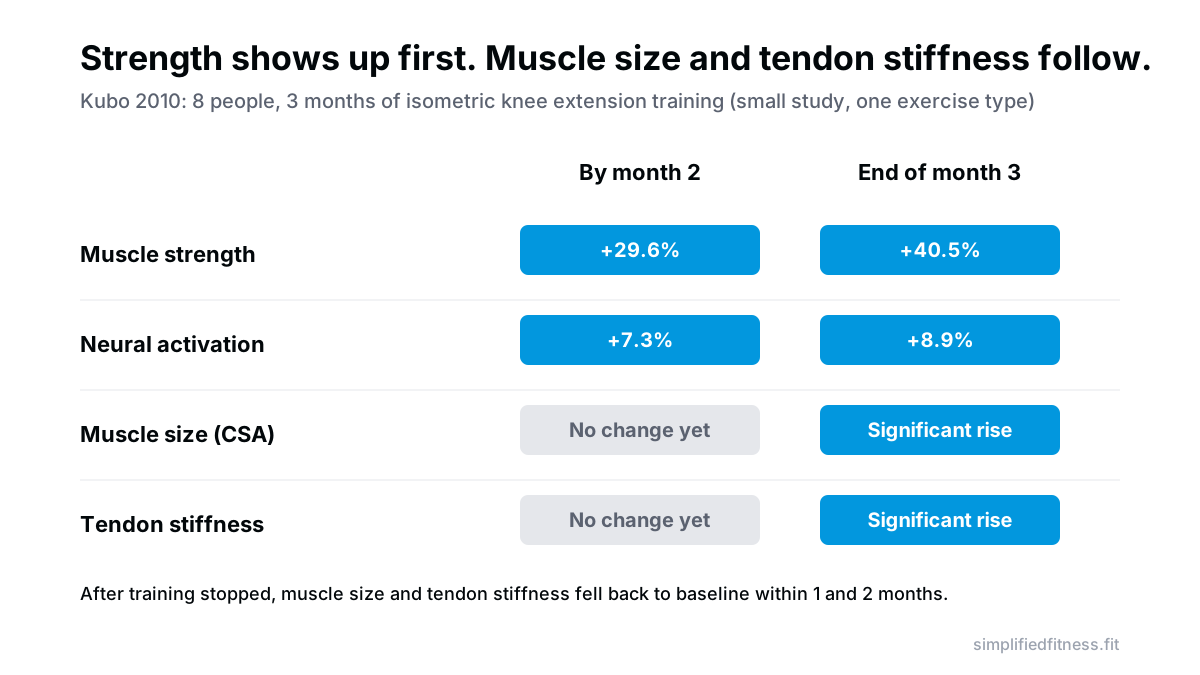
Be careful with this one. Eight people, one exercise, isometric work only. It illustrates the idea that function leads structure. It does not prove tendons need exactly 3 months.
Larger pooled data tell a similar story in different units. A meta-analysis of 27 studies (264 healthy adults aged 18-50, interventions of 8 weeks or longer) found moderate-to-large increases in tendon stiffness (SMD 0.70) and modulus (0.69) but only a small increase in cross-sectional area (0.24) (Bohm et al., 2015). Effects tended to be larger in interventions lasting 12 weeks or longer, though that difference was not statistically significant.
What do tendons actually adapt to?
A later meta-analysis of 61 studies (763 participants, mostly Achilles and patellar tendons, 49 of them resistance training) found moderate increases in stiffness (SMD 0.74), large increases in modulus (0.82) and small increases in cross-sectional area (0.22). Higher-strain resistance training produced bigger changes than low-strain training (Lazarczuk et al., 2022).
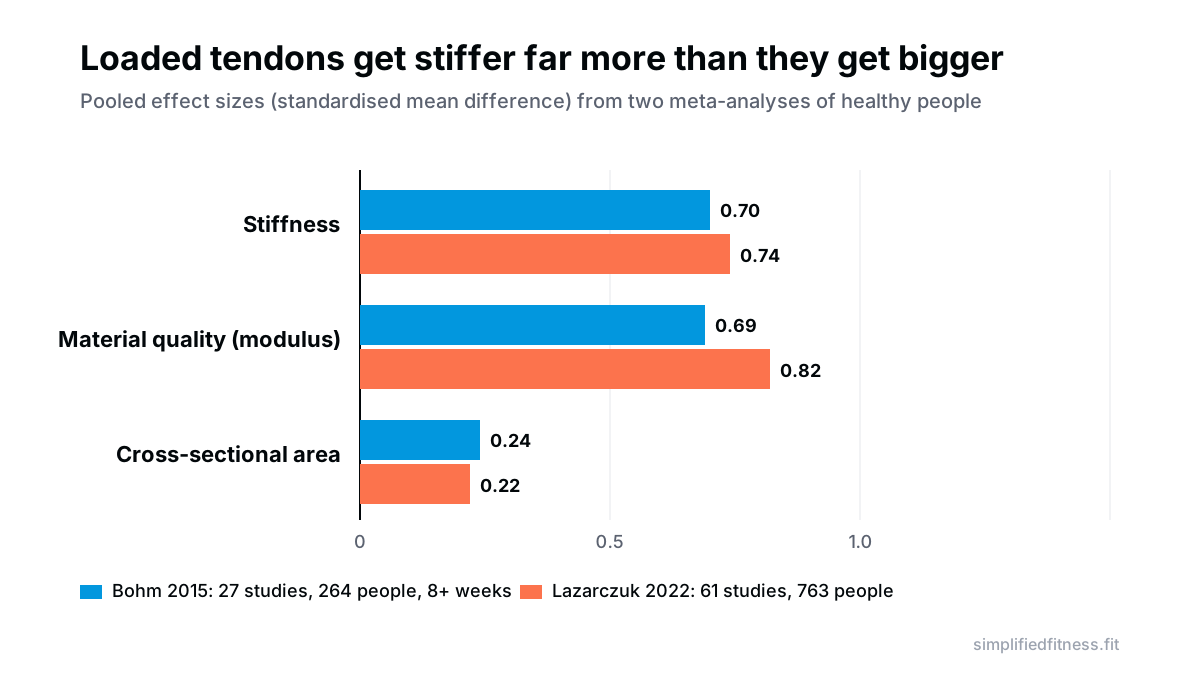
In plain terms, tendons mostly change their material properties, not their size. There is another telling result. Young men with 4 years of heavy-resistance training had 56% more quadriceps volume than untrained men, yet no difference in patellar tendon cross-sectional area. Both 12 weeks and 4 years of training produced similar gains in stiffness at high forces (Massey et al., 2018). Muscle grows; tendon quality changes.
Does tendon training need to be heavy?
The 2015 meta-analysis found that stiffness adaptation depends on loading intensity, but not on contraction type (concentric vs eccentric) (Bohm et al., 2015). This is the research behind the common advice that tendons like heavy, controlled loading.
Heavy slow resistance (HSR) is the clinical version of this idea. In a randomized trial of 39 men with patellar tendinopathy, 12 weeks of HSR improved pain and function, and the gains held at the half-year follow-up while those after corticosteroid injection faded. HSR was also associated with reduced tendon swelling and vascularization and with elevated collagen turnover (Kongsgaard et al., 2009). In 58 patients with chronic Achilles tendinopathy, HSR and eccentric training gave equally good results over 12 weeks and at one year, but adherence was higher with HSR (92% vs 78%) (Beyer et al., 2015).
Those are patient trials. They tell us about rehab, not about how fast a healthy lifter can safely add plates.
There is also a fair counterpoint. In a 14-week trial of 55 men, low-load training with blood flow restriction (20-35% of 1RM) raised Achilles stiffness by 36.1% and heavy training (70-85% 1RM) by 40.7%, with no significant difference between groups (Centner et al., 2019). So “heavy or nothing” is too strict. Heavy loading looks effective and so does a well-run low-load alternative. If you are curious, our practical BFR guide covers how that works.
Why does adding weight too fast cause tendonitis?
Here is the logic, with the caveat that it is partly inference. Muscle strength rises quickly, partly through neural adaptations. Tendon stiffness and structure lag. So there is a window where you can lift a load your muscles are ready for and your tendons are not.
A review of tendinopathy pathogenesis describes tendons as able to adapt to loading, yet vulnerable to repetitive use that leads to pain, tenderness, swelling and disorganized collagen (Magnusson et al., 2010). The same review reports that collagen synthesis after exercise peaks around 24 hours and stays elevated for about 3 days, with degradation peaking earlier. One reasonable inference, not tested directly, is to space hard sessions on the same tendon rather than hammering it every day.
One more finding is worth knowing. In 25 people with Achilles tendinopathy versus 10 healthy controls, healthy tendon collagen had not been replaced in adult life, while tendinopathic tendons showed substantial renewal, and modelling suggested abnormal turnover began years before symptoms (Heinemeier et al., 2018). The authors say it is unclear whether this is a cause or a late sign. So tendon trouble may build quietly well before it hurts.
That is why one honest caveat matters. I did not find a trial that tests “how fast is too fast” in healthy lifters. Anything specific below is coaching judgement built from the timelines above.
How to progress without overloading your tendons
This is the routine I would use as a coach. It is cautious on purpose.
- Use the smallest jump you have. Micro plates, a 1 kg pin on the stack, or an extra rep before extra weight. In India, many gyms skip fractional plates, so carry a pair of 1.25 kg plates.
- Hold each new load for two to three weeks before the next jump on exercises that load a tendon hard (squats, leg press, rows, curls, pressing).
- Judge the next morning. Mild stiffness that clears with a warm-up is fine. Ache that lingers or builds across sessions means hold the load.
- Stay a few reps from failure on the big tendon-loading lifts. Our RIR and RPE calculator helps you gauge it.
- Ramp up. A few lighter sets before the work sets are cheap insurance. See our guide to warm-up protocols and ramping sets.
- Slow down on return. After a layoff, restart below your old weights. In the Kubo study, tendon stiffness returned to baseline within 2 months of stopping.
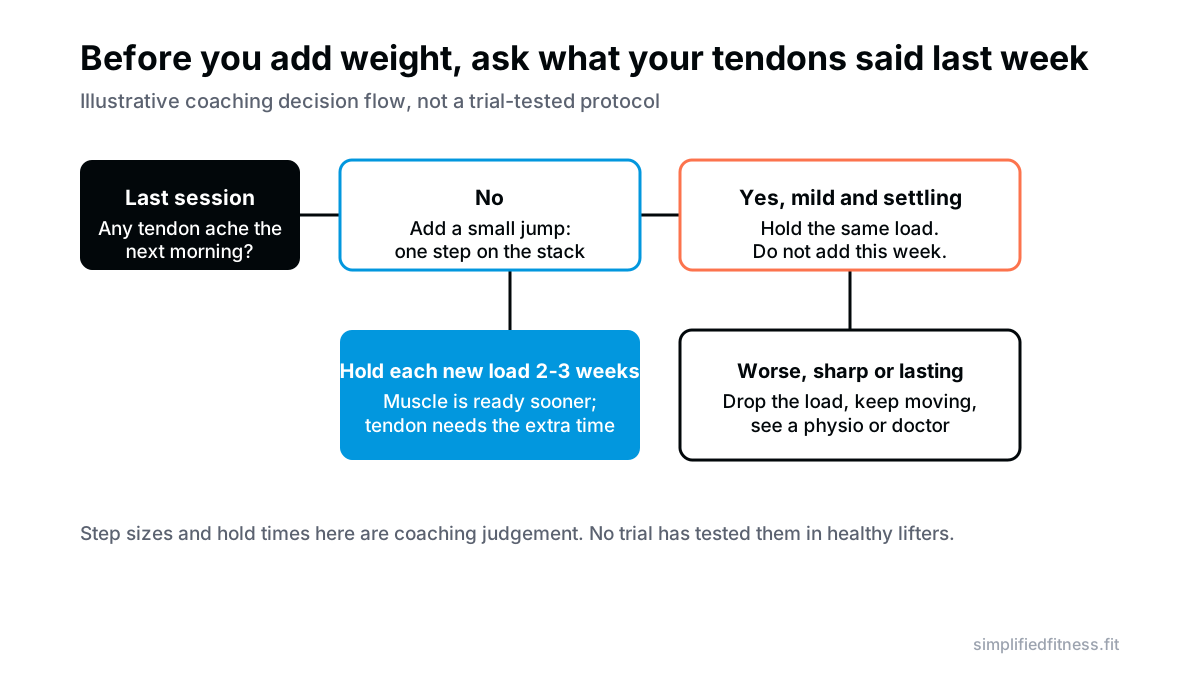
Progression is not just plates. For the wider view, see progressive overload, deloads and plateaus and why changing exercises constantly is no substitute.
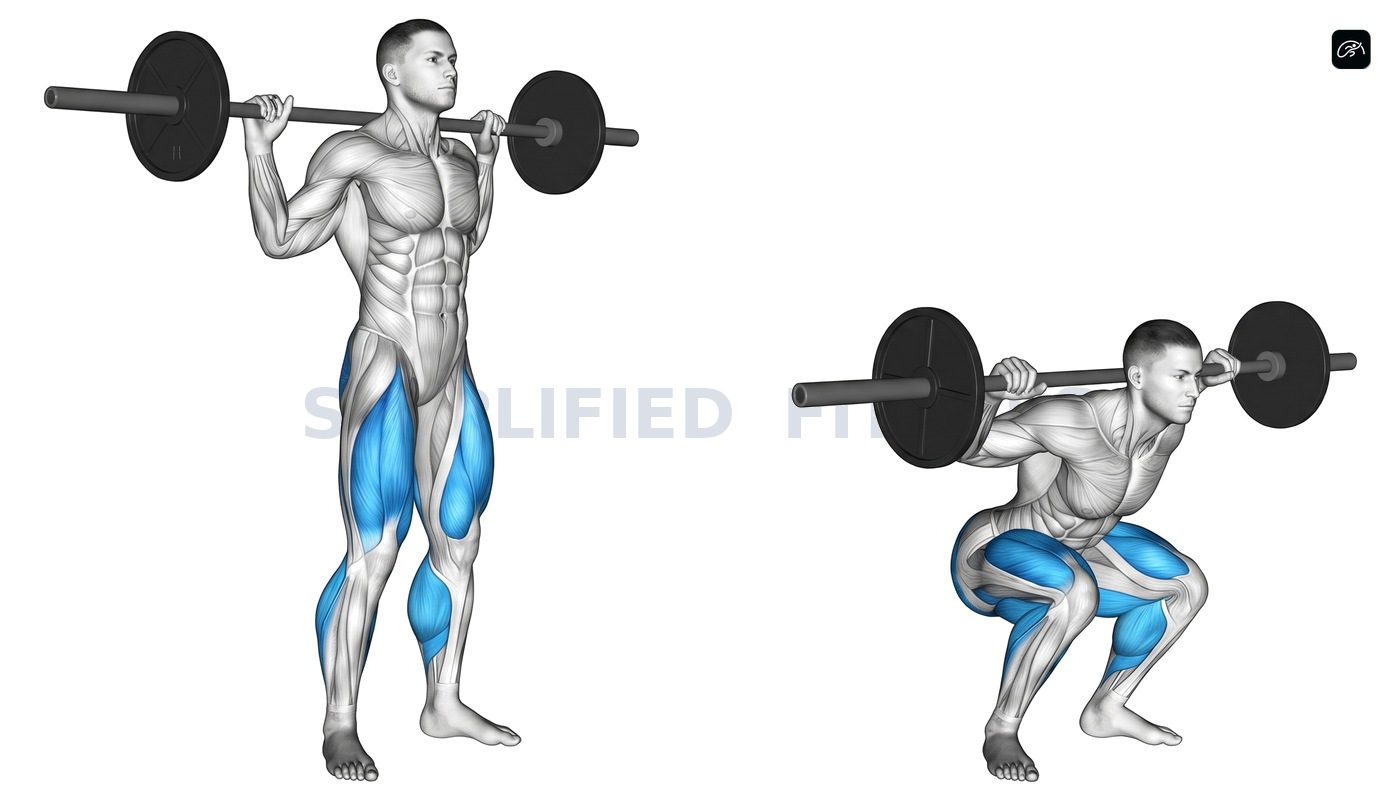
Squats are a good example. They load the patellar tendon heavily, which is useful for conditioning it, but the load needs to build gradually. Programming it into a week is straightforward with our leg day plan.
What about collagen supplements?
The evidence is early. A 2026 systematic review of 8 randomized trials (257 participants, mostly men aged 18-52) found 3 of 4 studies reported greater tendon cross-sectional area gains with collagen, and the two using 15-30 g/day found stiffness benefits. Muscle strength was unaffected, and the authors cite small samples and varying protocols as limitations (Buchalski et al., 2026). So collagen is not a license to skip patient progression. Our collagen peptides protocol covers dosing and timing in more detail. If you try it, treat it as an optional extra.
When to see a doctor
Get tendon pain assessed if it:
- is sharp, swollen, or warm
- began suddenly with a pop or sudden weakness
- does not settle after a couple of weeks of reduced load
- wakes you at night or limits daily tasks
A physiotherapist can confirm what is going on and set up a graded loading plan. This article is general education, not a diagnosis. If you already have symptoms at the knee or elbow, see our guides on knee pain and leg workout modifications and golfer’s and tennis elbow when lifting. For biceps specifically there is a guide to distal biceps tendonitis.
The bottom line
Muscles are quick. Tendons are patient. The evidence says tendons do adapt, mostly by getting stiffer rather than bigger, and the best-studied driver is meaningful load applied consistently over months. The evidence does not tell us an exact safe rate of progression.
So the plan is simple. Add load in small steps, hold each step, let next-morning feedback decide, and get help early if pain lingers. For a structured week to apply this, see the lifting plans.
Frequently Asked Questions
How long do tendons take to get stronger?
There is no single number, but studies on healthy adults typically measure tendon changes over 8-14 weeks or longer. A meta-analysis of interventions lasting at least 8 weeks found significant gains in tendon stiffness. Plan on months, not weeks, and keep progression gradual while you wait.
Why do tendons adapt slower than muscles?
Muscle tissue turns over continuously, while carbon-14 dating suggests the core of the adult Achilles tendon is barely renewed at all. Tendon also tends to have a lower blood supply than muscle, though a major review describes it as more metabolically responsive than once believed. The practical result is that your strength can outrun your tendons, so progress load gradually.
Can tendons get bigger from lifting?
Only a little. Meta-analyses report small increases in tendon cross-sectional area but larger increases in stiffness, and one study found lifters with 4 years of heavy training had no larger patellar tendons than untrained men despite far more muscle. Expect tendons to get stiffer and tougher rather than visibly thicker.
What is heavy slow resistance training?
Heavy slow resistance (HSR) means lifting relatively heavy loads with controlled, slow tempo. In a randomized trial in patellar tendinopathy, 12 weeks of HSR improved pain and function and these improvements held at the half-year follow-up. If you have tendon pain, ask a physiotherapist to set it up for you.
Do I need to lift above 70% of my 1RM for tendons to adapt?
Heavy loading is associated with the biggest tendon changes, and a 2015 meta-analysis found loading magnitude was the key driver of stiffness. But a 14-week trial found low-load training with blood flow restriction (20-35% 1RM) raised Achilles tendon stiffness about as much as 70-85% 1RM training. Mostly heavy work with some variety is a sensible approach.
Why do I get tendonitis when my muscles feel fine?
Muscle recovers and strengthens faster than tendon, so you can lift loads your muscles handle but your tendons are not yet conditioned for. Coaches and clinicians often describe this as a mismatch between the load and what the tendon is conditioned for. Reduce the load that irritates it and rebuild gradually, and see a clinician if it persists.
How fast can I add weight without hurting my tendons?
No trial has tested an exact safe rate in healthy gym lifters, so any number is coaching judgement. A sensible approach is to add the smallest available jump and hold each new load for two to three weeks while watching next-morning tendon ache. Use the RIR and RPE calculator to keep sets honest.
Does collagen supplementation help tendons?
Possibly, but the evidence is early. A 2026 systematic review of 8 small trials (257 mostly male participants) found that 3 of 4 studies measuring tendon size reported larger gains with collagen, and the two higher-dose studies (15-30 g/day) found stiffness gains, but there was no added benefit for muscle strength. Training load still matters most, and the trials were small and varied.
Is tendon pain after workouts normal?
Mild stiffness that settles within a day can happen when training changes. Pain that is sharp, builds across sessions, swells, or is still there the next morning is a warning sign. Hold or reduce the load and get it assessed if it does not settle.
Do tendons lose strength quickly if I stop training?
They can lose adaptations within months. In a small study of 8 people, tendon stiffness fell back to pre-training levels after 2 months of detraining. Return gradually after breaks rather than resuming old weights.
Does tendon adaptation work differently as I age?
The research here is thin. A 2022 meta-analysis found that stiffness and modulus changes differed between age groups, with larger changes in adult participants, but that does not predict how any one person will respond. If you are returning after 40, progress even more patiently.
Do warm-ups prevent tendonitis?
Warm-ups help you rehearse the movement and ramp load, but I could not find trial evidence that warming up by itself prevents tendinopathy. What matters most is not exceeding what your tendons are conditioned for. Ramp up with lighter sets anyway, since it is cheap and it feels better.
Do beginners get tendon injuries more often?
Beginners are a classic risk group, mainly because muscle strength rises quickly while tendon conditioning lags. I could not confirm injury rates from the studies I read, so this is an inference from the adaptation timelines. Start lighter than you think you need to and progress gradually.
Sources & References
Every claim above is checked against peer-reviewed research (PubMed, U.S. National Library of Medicine) or guidance from established health bodies. How we fact-check.
- Bohm S, et al. Human tendon adaptation in response to mechanical loading: a systematic review and meta-analysis of exercise intervention studies on healthy adults. Sports Med Open. 2015. PMID: 27747846
- Lazarczuk SL, et al. Mechanical, material and morphological adaptations of healthy lower limb tendons to mechanical loading: a systematic review and meta-analysis. Sports Med. 2022. PMID: 35657492
- Heinemeier KM, et al. Lack of tissue renewal in human adult Achilles tendon is revealed by nuclear bomb 14C. FASEB J. 2013. PMID: 23401563
- Heinemeier KM, et al. Carbon-14 bomb pulse dating shows that tendinopathy is preceded by years of abnormally high collagen turnover. FASEB J. 2018. PMID: 29570396
- Kubo K, et al. Time course of changes in muscle and tendon properties during strength training and detraining. J Strength Cond Res. 2010. PMID: 19996769
- Massey GJ, et al. Tendinous tissue properties after short- and long-term functional overload: differences between controls, 12 weeks and 4 years of resistance training. Acta Physiol. 2018. PMID: 29253326
- Magnusson SP, et al. The pathogenesis of tendinopathy: balancing the response to loading. Nat Rev Rheumatol. 2010. PMID: 20308995
- Kjaer M. Role of extracellular matrix in adaptation of tendon and skeletal muscle to mechanical loading. Physiol Rev. 2004. PMID: 15044685
- Kongsgaard M, et al. Corticosteroid injections, eccentric decline squat training and heavy slow resistance training in patellar tendinopathy. Scand J Med Sci Sports. 2009. PMID: 19793213
- Beyer R, et al. Heavy slow resistance versus eccentric training as treatment for Achilles tendinopathy: a randomized controlled trial. Am J Sports Med. 2015. PMID: 26018970
- Centner C, et al. Low-load blood flow restriction training induces similar morphological and mechanical Achilles tendon adaptations compared with high-load resistance training. J Appl Physiol. 2019. PMID: 31725362
- Buchalski A, et al. Collagen supplementation on tendon-related structural and performance outcomes: a systematic review. J Funct Morphol Kinesiol. 2026. PMID: 41900537

Umair Hazrami · Founder & Head Coach, Simplified Fitness
Umair Hazrami founded Simplified Fitness and the Simplified Lifter channel to cut through fitness noise. With 4+ years of consistent training and 10+ coaching clients, he writes every guide from the peer-reviewed research and links the sources so you can check them. Our editorial standards.
Educational content only, not medical advice. If you have a medical condition, are pregnant, or take medication, talk to a qualified doctor before changing your diet, supplements or training. Full disclaimer.
Keep reading
Health & Longevity
Are Deadlifts Bad for Your Lower Back? What Spinal Loading Research Shows
Are deadlifts bad for lower back health? The research shows spinal loads are high but tolerable, and trials use loaded lifting for back pain. How to hinge.
9 min read

Health & Longevity
Are Squats Bad for Your Knees? What the Research Actually Says
Are squats bad for your knees? Research on deep squats, kneecap stress and the knees-over-toes rule shows where the myth came from and how to squat safely.
9 min read

Health & Longevity
Desk Worker Workout Routine: Fix Pelvic Tilt, Weak Glutes and a Rounded Upper Back
A desk worker workout routine built on evidence: what sitting really does to your hips, why pelvic tilt is mostly normal, and 3 gym correctives that help.
8 min read
Health & Longevity
Does Cardio Kill Gains? The Real Science of the Interference Effect
Does cardio kill gains? A 43-study review found moderate cardio barely dents muscle size. Learn what the interference effect is and how to program around it.
8 min read