Joint-Friendly Hypertrophy: How to Build Muscle Without Joint Pain
Joint friendly hypertrophy explained: how to keep muscle tension while cutting joint stress, with load, rep, tempo and exercise swaps backed by research

TL;DR. The short answer
- Muscle growth is driven by hard sets close to failure, not by heavy, painful loading. In meta-analyses, hypertrophy was similar across light, moderate and heavy loads when sets were taken to failure.
- If a lift hurts a joint, the first fix is usually moderate weight for 10-20 reps, a controlled lowering phase and a more stable setup, not quitting training.
- Machines and cables can build muscle about as well as free weights, so swapping a barbell for a joint-friendlier version rarely costs you growth.
- Strength is the one trade-off: heavier loads build more maximal strength, so keep some heavier work in lifts that feel fine.
- Pain that lingers, wakes you at night, comes with swelling, numbness or a locked joint needs a doctor or physiotherapist, not another exercise swap.
Part of our complete guide: Joint-Friendly Lifting & Fitness Myths: A Guide for Over-40s, Teens and Sore Backs
Table of contents
Joint friendly hypertrophy, a core idea in our joint-friendly lifting and myth-busting guide, means building muscle with the least joint irritation you can manage, and for most people it is realistic. Your muscle responds to hard, well-controlled sets, not to the specific barbell lift that happens to pinch your shoulder. This guide focuses on what you can actually change at the gym.
Your muscles do not have eyes. They cannot tell whether tension came from a grinding barbell lift or a smooth, stable machine. They respond to effort, enough volume and time.
What does joint friendly hypertrophy actually mean?
It is not “light weights and gentle movements”. It is the idea that mechanical tension on a muscle can be produced in many ways, and some of those ways load your joints more than others.
Think of three dials you can turn without touching the effort:
- Load and reps. Moderate weights for 10-20 reps instead of grinding heavy singles and triples.
- Setup and path. A supported torso, a fixed or cable path, a neutral grip.
- Tempo and range. A controlled lowering phase and a range of motion that feels clean.
Turn one dial at a time. If the joint settles, you have found your version of the lift.
Do you need heavy weights to build muscle?
No, and this is the single biggest relief for anyone lifting with bad joints.
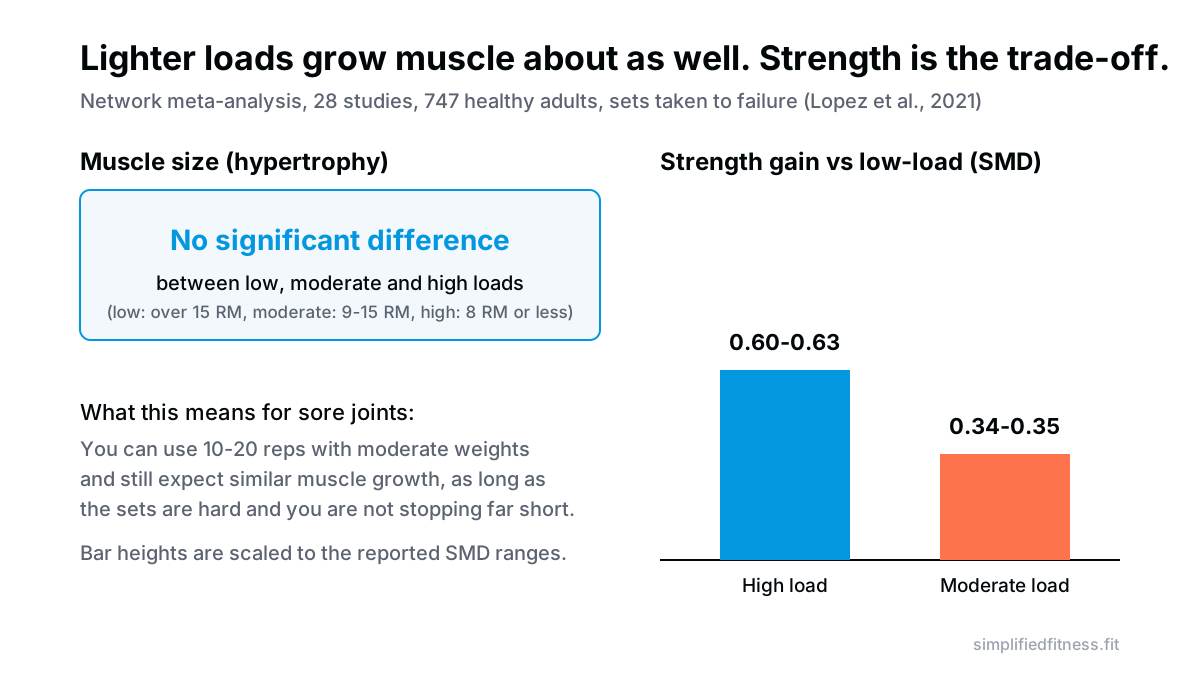
A 2021 network meta-analysis pooled 28 studies with 747 healthy adults, all training to failure. It found no significant differences in hypertrophy between low (over 15 RM), moderate (9-15 RM) and high loads (8 RM or less) (Lopez et al., 2021). Strength was a different story: high and moderate loads beat low loads for strength gains.
An earlier meta-analysis of 21 studies reached the same split. Maximal strength favoured heavy loads, while muscle growth was similar across loading ranges (Schoenfeld et al., 2017).
What about people who already lift? In a small trial of 18 well-trained young men over 8 weeks, a low-load routine and an 8-12 rep routine both grew the quadriceps by about 9%, while the heavier group gained more squat strength (Schoenfeld et al., 2015). It is only 18 people, so treat it as supportive, not final.
Two honest caveats. The sets in those trials went to or near failure, and that is not free: light loads for 20 reps are uncomfortable in a different way. And these are mostly healthy adults, so they do not tell us what happens in someone with an active joint condition.
How many reps should I do when my joints hurt?
Start in the 10-20 range for most exercises, then adjust by feel.
Why it works: a lighter bar means lower peak force through the joint on every rep. The muscle still gets hard work if you finish a set within a couple of reps of failure. (Our RIR and RPE calculator helps you pick a load for a target effort.)
Here is how that looks in a real week:
- Keep a couple of lifts you tolerate well in the 6-10 range, because heavy work builds strength.
- Move the irritating lifts to 12-20 reps.
- Leave 1-3 reps in reserve on the joint-sensitive exercises until the joint calms down.
The trade-off is that very high reps can feel limited by breathing or burning rather than muscle. If the set ends because of cardio fatigue, bump the load up a notch.
Does tempo and a pause protect your joints?
Often it makes sets feel better, mostly by cutting out the bounce and jerk.
A meta-analysis of eight studies found similar hypertrophy with repetition durations from about 0.5 to 8 seconds. Extremely slow reps, over 10 seconds each, looked worse for growth, though the authors noted few controlled trials (Schoenfeld et al., 2015).
So there is a wide safe zone. A practical version:
- Lower for roughly 2-3 seconds.
- Pause for a beat at the bottom of lifts where the joint tends to ache, such as the chest on a press.
- Drive up smoothly, no yanking.
A pause is useful because it forces you to own the hardest position instead of bouncing out of it. Whether a pause itself makes joints healthier is not something these studies tested, so view it as a comfort and control tool.
Machines, cables or free weights: which are kinder?
Often machines and cables. Not because they are magic, but because they remove variables.
A 2023 meta-analysis of 13 studies (1016 participants) compared free-weight and machine training. Only five of those studies measured muscle size, and they showed no difference in hypertrophy between the two. Strength gains were specific to the equipment used for testing (Haugen et al., 2023). A separate 2025 study is only a small trial, but it pointed the same way: 8 untrained women trained one leg with lunges and the other with an inclined leg press for 9 weeks, and quadriceps thickness rose similarly in both (Amanuma et al., 2025).
What a machine gives you is a stable path, back support and an easy way to adjust the seat to your body. A chest-supported row removes lower-back demand. A cable lets you pick the angle that feels clean.
The catch: machines are built for an average body. If the seat or pad does not fit you, it can irritate a joint as much as a barbell. Adjust it, or pick another.
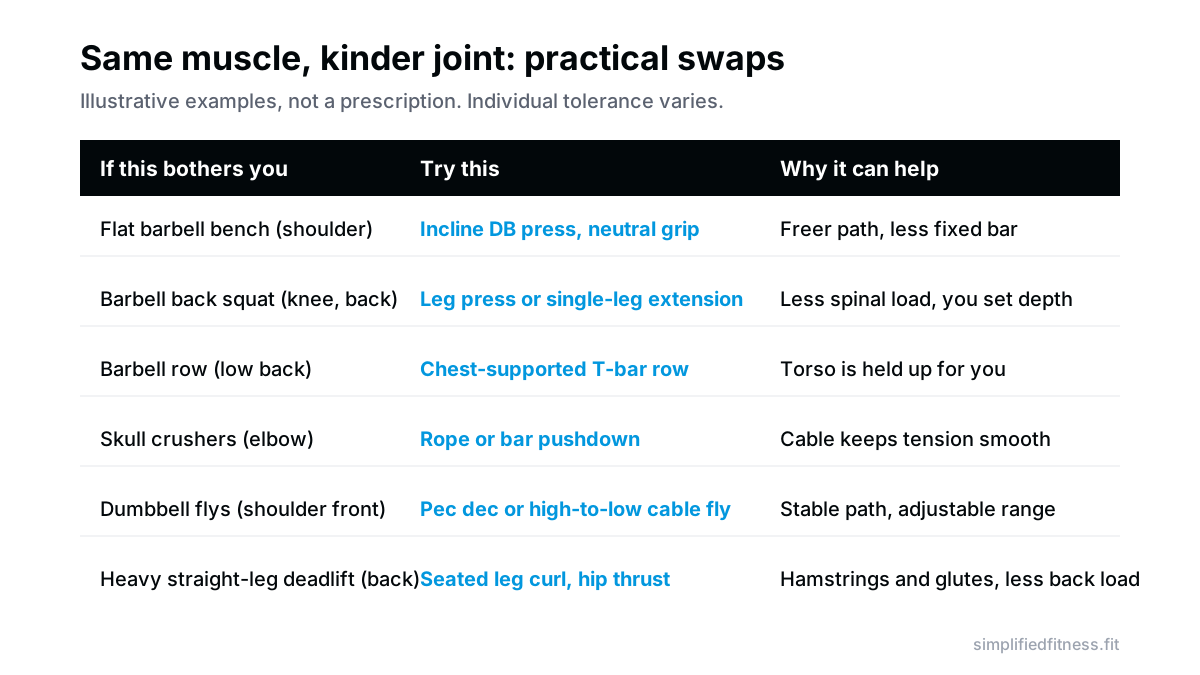
For ideas on how to pick exercises by muscle and resistance curve, see our exercise selection and biomechanics guide. An incline dumbbell press with a neutral grip is a version many people find friendlier on the shoulder than a flat bar.
Does range of motion matter for pain-free muscle building?
Yes, but it is not about the deepest possible range.
A 2020 systematic review of six studies (135 participants) concluded that full range of motion looked beneficial for lower-body hypertrophy compared with partial range. For the upper body, the evidence was limited and conflicting (Schoenfeld and Grgic, 2020). So you should not make a habit of cutting the range short just to protect a joint, but there is no research case for forcing a painful end range either.
The practical version is “the largest range you can control without pain”. If the bottom of a dumbbell press pinches, shorten it slightly and add a pause just above the pain point. Re-test next month, because the comfortable range often grows.
On squats specifically, a 2013 review of more than 160 articles argued that concerns about deep squats damaging healthy knees are unfounded when technique is learned well and loads progress gradually. It also suggested that very heavy half and quarter squats may not be the safer choice (Hartmann et al., 2013). That is a narrative review, not a trial. If you want the full breakdown, see are squats bad for your knees. And if knee pain is your actual problem, training around knee pain covers substitutions in detail.
Is it okay to train through joint pain?
Mild, brief discomfort that settles quickly is common. Sharp, building or lingering pain is a sign to change something.
The best-known framework here is the pain-monitoring model. In a randomised trial of 38 people with Achilles tendinopathy, one group kept running and jumping under pain monitoring while the other rested from those activities for six weeks. Both groups improved significantly, with no significant difference in the rate of improvement between them (Silbernagel et al., 2007).
Two cautions before you stretch that too far. It was one condition (Achilles tendinopathy) in a small trial, and it was supervised rehab, not self-guided gym lifting. It supports the idea that carefully managed loading beats total rest for some tendon problems. It does not mean “ignore pain”.
A simple gym rule many coaches use (this is coaching practice, not a result from the study above): if the pain is mild, does not climb as you go through the sets, and is gone or back to normal within a day, the load was probably tolerable. If it climbs, changes the way you move, or is still there the next morning, drop the load or swap the exercise. For more on what separates the good burn from a warning signal, read no pain, no gain: good pain vs bad pain.
A joint-friendly week of training (illustrative)
This is a template, not a prescription. Adjust it for the joints that bother you.
| Muscle | Example choice | Reps | Notes |
|---|---|---|---|
| Chest | Incline dumbbell press, then pec dec | 8-12, then 12-20 | Neutral grip, pause at the bottom |
| Back | Chest-supported row, lat pulldown | 10-15 | Torso supported, no swinging |
| Quads | Leg press or single-leg extension | 10-20 | Choose a depth that feels clean |
| Hamstrings | Seated leg curl | 10-15 | Control the lowering |
| Shoulders | Dumbbell lateral raise | 12-20 | Stop short of a pinch |
| Arms | Cable pushdown, hammer curls | 10-20 | Elbow friendly angle |
Use two to three hard sets per exercise to start. Our training volume calculator can check your weekly sets per muscle. If your week feels too thin, add sets before adding load. For the joint where you struggle most, the other guides in this series go deeper: shoulder pain and bench press alternatives and lower-back-friendly leg and back training.
Indian gym context: crowded floors, limited machines
Many Indian gyms have two or three machines and a lot of dumbbells, and peak hour means waiting. That is fine.
- No leg press? Use a goblet squat to a bench or step-ups to a low box, for 12-20 reps.
- No chest-supported row? Lie chest-down on an incline bench and row dumbbells.
- Hot, humid gym and you tire fast? Add rest between sets rather than cutting reps short and rushing.
- Protein and recovery matter for joints and muscle alike. Dal, curd, paneer, eggs or soya all work if you are hitting a daily protein target. Our protein calculator can give you a starting number.
When to see a doctor
Exercise swaps help with irritation from loading. They do not fix structural injuries, and I cannot diagnose anything from a description.
See a doctor or physiotherapist if you have:
- Pain that lasts more than a couple of weeks despite sensible changes.
- Night pain or pain at rest.
- Swelling, warmth or redness around a joint.
- Numbness, tingling or weakness in an arm or leg.
- A joint that locks, catches or gives way.
- Pain that followed a clear injury, a pop or a fall.
Getting it looked at early usually shortens the time away from the gym.
Putting it together
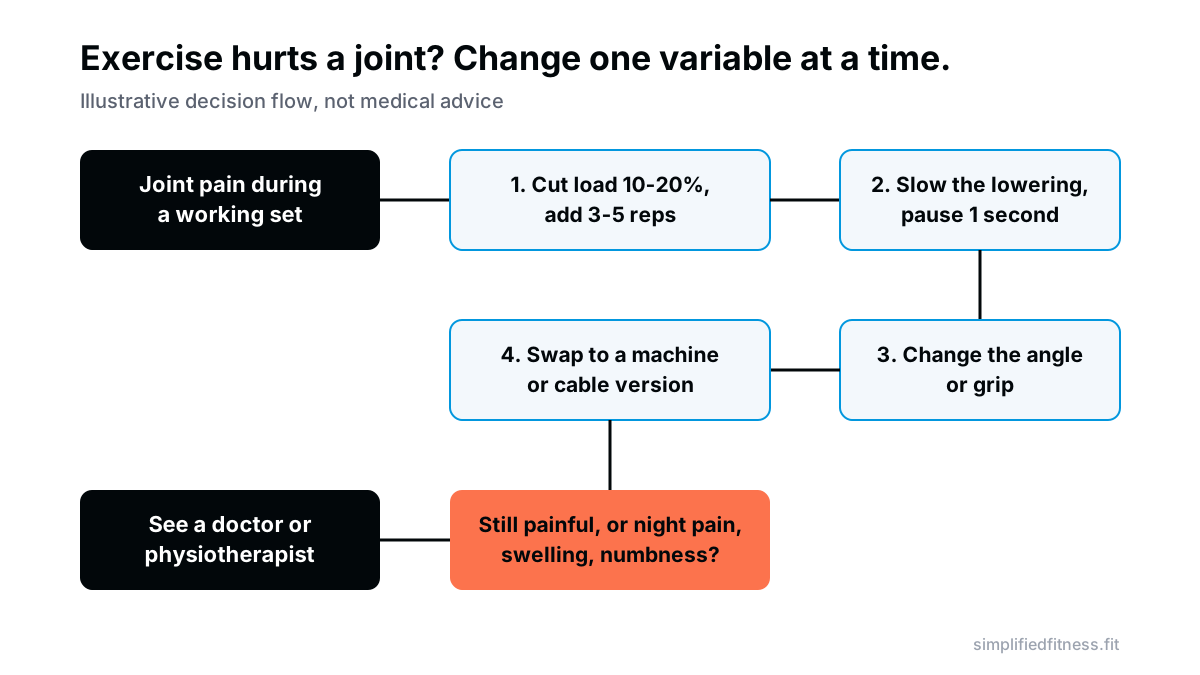
Start with the exercise that bothers you most. Cut the load by 10-20% and add 3-5 reps. Slow the lowering. If it still hurts, change the angle or the grip, then swap to a machine or cable. Keep the set hard. That is joint friendly hypertrophy: the same muscle effort, with less drama in the joint.
Keep one or two comfortable lifts a bit heavier so your strength does not slide. Track your reps and loads so you can see progress even when the exercise list changes. And if the pain does not follow the rules above, get it checked.
Frequently Asked Questions
What is joint friendly hypertrophy?
It is muscle-building training that keeps enough tension on the target muscle while reducing stress on sore or fragile joints. Research shows muscle growth is similar across a wide range of loads when sets are hard, so you do not need the most joint-aggravating version of a lift. In practice that means picking stable exercises, using moderate loads and controlling the lowering phase.
Can you build muscle with bad joints?
Yes, in many cases, because growth depends on how hard the muscle works rather than on one specific painful exercise. Moderate loads for 10-20 reps and machine or cable versions can load the same muscle with less joint stress. If pain is severe, persistent or unexplained, see a doctor or physiotherapist before pushing on.
Do you need heavy weights to build muscle?
No. A network meta-analysis of 28 studies found no significant hypertrophy differences between low, moderate and high loads when sets were taken to failure. Heavy loads do build more maximal strength, so a mix works well. Pick loads you can control, and finish sets close to failure.
Are machines better for your joints than free weights?
Not automatically, but machines are often easier to set up in a stable, comfortable position. A 2023 meta-analysis found no difference in hypertrophy between free-weight and machine training, though only five of its studies measured muscle size. If a barbell bothers your shoulder or lower back, a machine or cable version is a reasonable swap.
How many reps should I do if my joints hurt?
Most people do well in the 10-20 rep range, because lighter loads reduce peak joint force while still growing muscle when sets are hard. The evidence suggests hypertrophy is similar across loading zones, so there is room to experiment. Choose the rep range where the joint feels quiet and the muscle feels worked.
Does lifting slowly protect my joints?
A controlled tempo can help you feel what the joint is doing and cut momentum, which often makes sets more comfortable. A meta-analysis found similar growth from rep durations between 0.5 and 8 seconds, though extremely slow reps (over 10 seconds) looked inferior. Use roughly 2-3 seconds lowering and a short pause where it helps.
Is it okay to train through joint pain?
Mild discomfort that settles quickly is common, but sharp, worsening or lingering pain is a signal to modify the exercise. In one trial of people with Achilles tendinopathy, continuing activity under a pain-monitoring model did not do worse than active rest. That finding is specific to that condition, so use it as a principle and get professional advice for anything persistent.
What is the difference between muscle burn and joint pain?
Muscle effort feels like a broad burn or heavy fatigue in the belly of the muscle that fades soon after the set. Joint pain is usually more localised, sharp, pinching or deep, and may stay after you finish. If you cannot tell the difference, lower the load and try again with a different angle.
Are deep squats bad for your knees?
A 2013 literature review concluded that concerns about deep squats harming healthy knees are unfounded when technique is sound and loads progress gradually. It also argued that partial squats with very heavy loads may not be safer. If squatting hurts your knees, depth is one of several things to adjust, along with stance, load and exercise choice.
How do I swap exercises without losing muscle?
Match the muscle and the resistance curve, not the exact movement. For example, a chest-supported row can replace a barbell row for the back, and a pec dec or cable fly can replace dumbbell flys for the chest. Keep the sets hard and track your reps and loads so progress stays visible.
How long should I rest between sets for joint comfort?
There is no single rest time that protects joints, but longer rests (about 2-3 minutes) let you keep loads and reps steady without grinding through fatigued, sloppy reps. This is coaching practice rather than a finding from the studies cited here. If a joint feels worse as you get tired, extend the rest or stop the set earlier.
When should I see a doctor about joint pain from lifting?
See a doctor or physiotherapist if pain lasts more than a couple of weeks, wakes you at night, comes with swelling, redness, numbness, weakness or a locked or giving-way joint, or follows a clear injury. Exercise swaps help with irritation, not with structural injuries. Getting it checked early usually shortens the time you spend off training.
Sources & References
Every claim above is checked against peer-reviewed research (PubMed, U.S. National Library of Medicine) or guidance from established health bodies. How we fact-check.
- Lopez P, et al. Resistance Training Load Effects on Muscle Hypertrophy and Strength Gain: Systematic Review and Network Meta-analysis. Med Sci Sports Exerc. 2021. PMID: 33433148
- Schoenfeld BJ, et al. Strength and Hypertrophy Adaptations Between Low- vs. High-Load Resistance Training: A Systematic Review and Meta-analysis. J Strength Cond Res. 2017. PMID: 28834797
- Schoenfeld BJ, et al. Effects of Low- vs. High-Load Resistance Training on Muscle Strength and Hypertrophy in Well-Trained Men. J Strength Cond Res. 2015. PMID: 25853914
- Haugen ME, et al. Effect of free-weight vs. machine-based strength training on maximal strength, hypertrophy and jump performance - a systematic review and meta-analysis. BMC Sports Sci Med Rehabil. 2023. PMID: 37582807
- Schoenfeld BJ, Grgic J. Effects of range of motion on muscle development during resistance training interventions: A systematic review. SAGE Open Med. 2020. PMID: 32030125
- Schoenfeld BJ, Ogborn DI, Krieger JW. Effect of repetition duration during resistance training on muscle hypertrophy: a systematic review and meta-analysis. Sports Med. 2015. PMID: 25601394
- Silbernagel KG, et al. Continued sports activity, using a pain-monitoring model, during rehabilitation in patients with Achilles tendinopathy: a randomized controlled study. Am J Sports Med. 2007. PMID: 17307888
- Hartmann H, Wirth K, Klusemann M. Analysis of the load on the knee joint and vertebral column with changes in squatting depth and weight load. Sports Med. 2013. PMID: 23821469
- Amanuma MT, et al. Comparable regional hypertrophy of the knee extensor muscles in response to resistance training with machines versus free weights: a randomized within-subject approach. J Bodyw Mov Ther. 2025. PMID: 41316621

Umair Hazrami · Founder & Head Coach, Simplified Fitness
Umair Hazrami founded Simplified Fitness and the Simplified Lifter channel to cut through fitness noise. With 4+ years of consistent training and 10+ coaching clients, he writes every guide from the peer-reviewed research and links the sources so you can check them. Our editorial standards.
Educational content only, not medical advice. If you have a medical condition, are pregnant, or take medication, talk to a qualified doctor before changing your diet, supplements or training. Full disclaimer.
Keep reading
Health & Longevity
Are Deadlifts Bad for Your Lower Back? What Spinal Loading Research Shows
Are deadlifts bad for lower back health? The research shows spinal loads are high but tolerable, and trials use loaded lifting for back pain. How to hinge.
9 min read

Health & Longevity
Are Squats Bad for Your Knees? What the Research Actually Says
Are squats bad for your knees? Research on deep squats, kneecap stress and the knees-over-toes rule shows where the myth came from and how to squat safely.
9 min read

Health & Longevity
Why Tendons Adapt Slower Than Muscles: Connective Tissue Timelines for Lifters
Tendon adaptation vs muscle growth: why your tendons lag behind your strength gains, what studies show about timelines, and how to add load without tendonitis.
8 min read

Health & Longevity
Desk Worker Workout Routine: Fix Pelvic Tilt, Weak Glutes and a Rounded Upper Back
A desk worker workout routine built on evidence: what sitting really does to your hips, why pelvic tilt is mostly normal, and 3 gym correctives that help.
8 min read