Are Deadlifts Bad for Your Lower Back? What Spinal Loading Research Shows
Are deadlifts bad for lower back health? The research shows spinal loads are high but tolerable, and trials use loaded lifting for back pain. How to hinge.
TL;DR. The short answer
- Deadlifts are not inherently bad for the lower back. In a survey of 245 competitive powerlifters, injury rates were reported as low compared with other sports, though that is self-reported data from people who already tolerate heavy lifting.
- Heavy deadlifts do load the spine hard: modelling studies estimate roughly 5-18 kN of compression and 1.3-3.2 kN of shear. Those are model estimates, and tissues adapt to progressive loading.
- Posterior-chain strength training of 12-16 weeks reduced low back pain and disability more than general exercise in a 2021 meta-analysis, with no difference in adverse events. Later reviews found loaded and unloaded exercise work about equally well.
- Form matters most when the bar gets heavy, because the lower back tends to round more as load rises. Build load slowly, brace, and keep a rep or two in reserve.
- Red-flag symptoms (leg weakness, numbness, bladder or bowel changes) or pain that keeps getting worse need a doctor, not a workaround.
Part of our complete guide: Joint-Friendly Lifting & Fitness Myths: A Guide for Over-40s, Teens and Sore Backs
Table of contents
Are deadlifts bad for lower back health? Not on their own. The deadlift loads your spine heavily, but the research does not show that it injures healthy lifters when load is built up sensibly, and trials in people with back pain have used loaded lifting as treatment.
The fear is understandable, because almost everyone has a story about someone who “threw their back out” lifting something. This article is part of our guide to joint-friendly lifting and myth busting, and it goes through what the studies actually say about spinal loading, rounding, disc worries and who should adjust the lift.
What happens to your spine in a deadlift?
Two kinds of force matter. Compression squeezes the vertebrae and discs together. Shear tries to slide one vertebra forward over the next.
A 2022 narrative review of the deadlift literature reports that heavy deadlifts produce spinal compression of roughly 5-18 kN and shear of roughly 1.3-3.2 kN (Ramirez et al., 2022). Earlier work on national-level powerlifters estimated average L4/L5 compression of up to about 17,000 N (Cholewicki et al., 1991).
Those numbers sound scary. They need context.
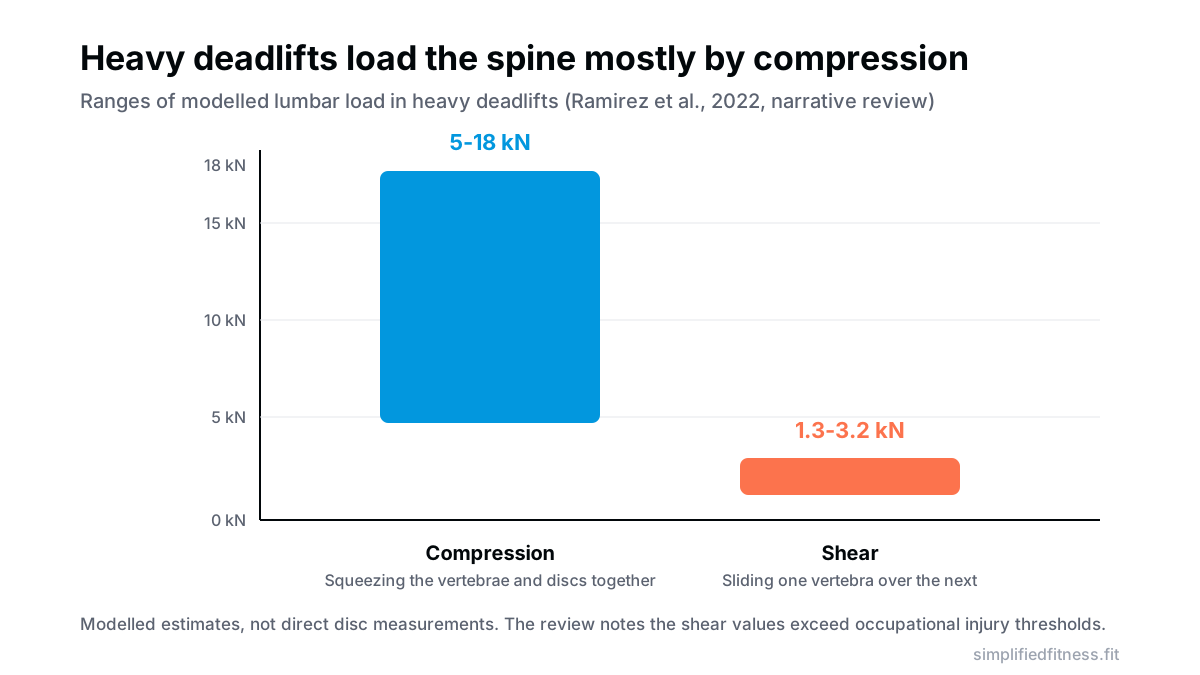
First, these are modelled estimates, not measurements taken inside a disc. Second, the same review notes that shear loads in heavy deadlifts exceed occupational injury thresholds, and it argues that repetitive heavy deadlifting in physically demanding jobs needs more research. It also says outright that no studies of low back biomechanics during repetitive deadlifts were found (Ramirez et al., 2022). The authors accept that trained people likely have stronger musculoskeletal systems than the general population, but they still describe shear forces 2 to 4 times the injury threshold as a concern, especially with repeated heavy pulls. So the thresholds may not map neatly onto a lifter who builds up over months, but the numbers are not something to wave away either.
So the honest read is this. The deadlift is a high-demand lift. High demand is not the same as harmful, any more than a heavy squat is harmful to a trained knee. Load is a dose.
Is deadlifting dangerous for your spine? What injury data says
Here is the data most worth looking at. A 2011 questionnaire study of 245 competitive and elite powerlifters calculated an injury rate of 0.3 injuries per lifter per year, or about one injury per 1,000 hours of training, and the authors described it as low compared with other sports (Siewe et al., 2011). The lower back was among the most commonly injured regions, along with the shoulder and knee.
Two caveats. These are self-reports from people who stayed in the sport, so anyone who quit after a back injury is missing. And powerlifters squat and bench as well, so the lower-back injuries cannot all be pinned on deadlifts.
The same study found that lifters who used weight belts reported more lumbar injuries. That is an association, not proof that belts cause injury (lifters with sore backs may reach for a belt more often).
Deadlift lumbar flexion and disc herniation: how much rounding is too much?
Gym advice says “never round your back”. The research is more nuanced than that, and also not a free pass.
A 2025 motion-capture study of 13 participants lifting at 60%, 70%, 80% and 90% of their one-rep max found that lower thoracic and upper lumbar flexion increased as the load rose, and the pelvis tilted backwards faster with heavier loads (Shoji et al., 2025). The authors suggest that while lumbar flexion can help complete a heavy lift, it may increase stress on the discs, so keeping lordosis and trunk rigidity matters in high-load lifts.
In plain terms: lumbar movement grows as the load gets heavy, and the authors think staying stable is safer for the discs. That study was small, short and did not follow lifters over time to see who got hurt, so nobody can give you a precise number of degrees that is “safe”.
In the gym, this looks like the bar drifting forward, hips shooting up and the lower back folding as the last rep gets ugly. That rep is the one to skip.
Do deadlifts help or hurt people who already have back pain?
This is where the fear-avoidance story gets tested. If heavy lifting were reliably harmful for sore backs, trials would show it.
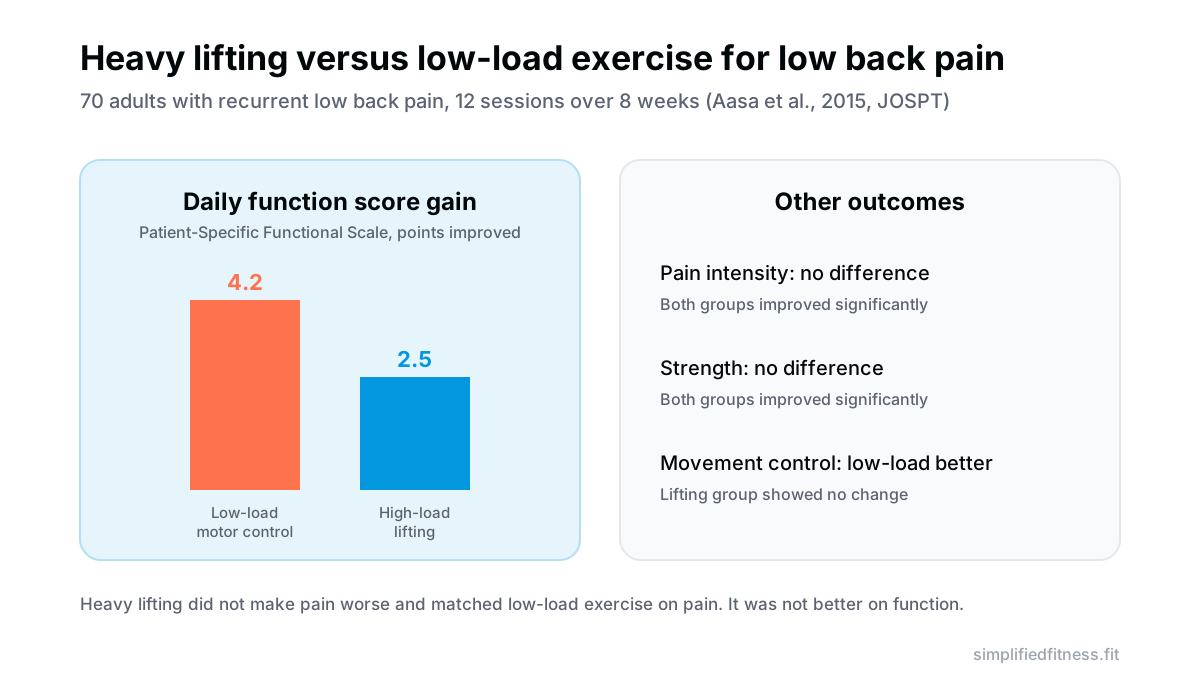
In a Swedish randomized trial, 70 adults with recurrent low back pain did either low-load motor control exercises or a high-load lifting exercise, 12 sessions over 8 weeks, plus pain education. Both groups improved significantly in pain, strength and endurance. The motor control group improved more on a patient-rated function scale (4.2 points versus 2.5), but pain intensity and strength did not differ between groups (Aasa et al., 2015). The abstract describes a high-load lifting exercise rather than naming the deadlift, so read it as supportive but not proof about this exact lift.
A wider look backs the same theme. A 2021 meta-analysis of 8 randomized trials (408 participants) found that 12-16 weeks of posterior-chain resistance training reduced pain and disability, and increased strength, more than general exercise, with no difference in adverse events (Tataryn et al., 2021). The pain result sat right on the edge of statistical significance, and the authors noted that future research should compare specific movements such as the deadlift.
Then there is the newer, more sobering check. A 2025 meta-analysis of 13 trials (778 participants) compared externally loaded resistance training with unloaded exercise in chronic non-specific low back pain. At follow-ups beyond seven weeks it found a small pain benefit for loaded training (about 0.5 points on a 0-10 scale), no differences at short follow-up, and inconsistent disability results (Ranzani et al., 2025). The authors concluded that loaded training is safe and feasible, but works about as well as unloaded exercise, with benefits driven more by exposure and adherence than by load.
A review of systematic reviews reached a similar place: small, mostly short-term benefits across several exercise types, with no major differences between them, and very low to moderate certainty (Grooten et al., 2022).
So what is the cautious takeaway? Deadlifts are not something people with chronic non-specific back pain have to avoid. But they are not magic either. If you enjoy them and tolerate them, keep them. If they flare you, a gentler hinge or other exercise will probably serve you about as well.
How to deadlift safely: a simple checklist
None of this is exotic. Most of it is boring, which is why it works.
- Start lighter than your ego wants. Practise the hinge with a Romanian deadlift (see our RDL guide) before you chase heavy conventional pulls.
- Hinge, do not squat it. Push the hips back, keep the bar close and let the knees bend just enough.
- Brace before you pull. Take a breath into your belly, tighten your midsection, then lift.
- Set your back before the bar moves. Take the slack out of the bar so you are not yanking from a rounded start.
- Add load in small steps. Two to five kilos is plenty. Our 1RM calculator helps you pick working weights without testing a true max.
- Keep reps in reserve. Stop sets when you could still do one or two clean reps. The RIR and RPE calculator is built for this.
- Count your weekly volume. Once or twice a week is usually enough.
Different styles load the spine a little differently. In national-level powerlifters, the sumo style showed an estimated 10% lower L4/L5 joint moment and 8% lower shear force than conventional pulling (Cholewicki et al., 1991). That is a modelled difference in elite lifters, so do not switch just for that. Our conventional vs sumo breakdown covers the trade-offs, and the conventional deadlift analysis looks at what the lift does for back muscle growth.
Who should modify deadlifts (and how)?
Some people should change the lift rather than quit it. These groups deserve extra care.
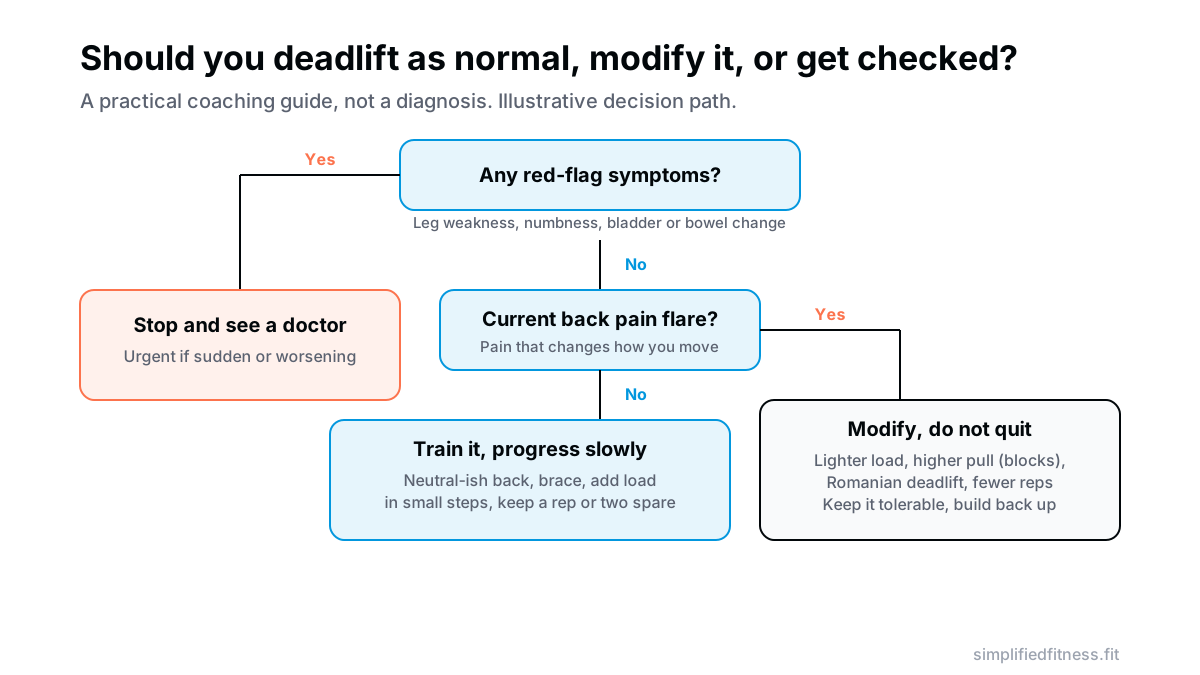
- A current back flare. Reduce load, reduce reps, raise the bar start height (blocks or a trap bar) or switch to RDLs.
- A diagnosed disc problem, spinal condition or recent surgery. Ask your doctor or physio what loading is right for you. The studies above are mostly on non-specific back pain, not on these conditions.
- Beginners and returners. Take a few weeks to groove the hinge before going heavy.
- Long desk days or poor sleep. If your back is stiff and cranky, take an easier session.
- Very tall lifters or long-torso lifters. The range of motion can be harder. Elevating the bar slightly can help.
- Anyone returning after injury. Use a graded plan like our traffic light return-to-gym model.
If the deadlift simply does not feel right for your body, our lower back friendly leg and back workout shows how to keep training hard without it. And if you are wondering whether squats carry the same fear, we cover that in are squats bad for your knees.
What about pain, soreness and fear?
A tight, achy lower back for a day or two after a heavy deadlift day is common, especially in newer lifters. It is not the same as sharp, worsening or shooting pain.
Beliefs matter too. Telling yourself your spine is fragile can make you move stiffly and brace for every rep, which tends to make people avoid lifting more. The trials above included pain education alongside exercise, and the 2025 meta-analysis argues that exposure and adherence seem to matter more than load intensity alone. That does not mean ignore pain. It means treat a sore back as a signal to adjust, not a verdict to stop forever. We cover that distinction in good pain vs bad pain.
When should you see a doctor?
Get checked promptly if you have leg weakness, numbness in the groin or legs, loss of bladder or bowel control, fever with back pain, pain after a significant fall or accident, or pain that is severe or getting worse. Persistent pain beyond a few weeks is also worth a proper assessment. This article is general education, not a diagnosis.
So, are deadlifts bad for your lower back?
For most healthy lifters, no. The deadlift is a heavy, demanding hinge. The loads are large, rounding tends to creep in as the bar gets heavy, and sloppy volume or rushed progress can cause trouble. But injury surveys in powerlifters look modest, and trials in back pain show loaded training is usually tolerated and about as effective as gentler options.
Treat it as a skill, build load slowly, and keep a rep or two in the tank. If you need a structure to follow, our free pull day plan shows where hinging fits into a weekly split.
Frequently Asked Questions
Are deadlifts bad for your lower back?
No, not in themselves. Deadlifts place large loads on the lumbar spine, but spinal tissues adapt to progressive loading, and trials in people with low back pain have used lifting as treatment without worse pain outcomes than other exercise. Build load gradually, keep technique tidy and stop if pain keeps escalating.
Is deadlifting dangerous for the spine?
The risk is real but manageable. Modelling work estimates compression of about 5-18 kN during heavy deadlifts, yet a questionnaire study of 245 powerlifters reported a low injury rate compared with other sports. In coaching practice, trouble usually follows jumping loads too fast, grinding fatigued reps or ignoring symptoms, so progress slowly.
Can deadlifts cause a herniated disc?
There is no clean evidence that a well-progressed deadlift routine causes a disc herniation in healthy lifters. What we do know is that lumbar flexion tends to increase as the load gets heavy, and the authors of one study suggest that may add stress to the discs. If you have been diagnosed with a disc problem, ask your doctor or physio how and when to load it.
Is a rounded back during a deadlift always dangerous?
Not automatically, but it is worth avoiding. A 2025 motion-capture study of 13 lifters found lumbar flexion increased as the load rose, and the authors suggest this may add stress to the discs. No study gives a safe number of degrees, so lower the weight until you can keep a stable, mostly neutral spine.
Can deadlifts help with lower back pain?
They can be part of the answer for many people with chronic non-specific pain. A meta-analysis of eight trials found 12-16 weeks of posterior-chain training reduced pain and disability more than general exercise, but the review could not isolate the deadlift specifically. Start light, progress slowly and work with a physio if pain is significant.
Are deadlifts better than other back exercises for back pain?
Probably not better, and probably not worse. Reviews comparing exercise types for chronic low back pain have found no major differences between them, and a 2025 meta-analysis found loaded exercise only slightly better than unloaded exercise for pain at follow-ups beyond seven weeks. The best exercise is the one you will do consistently, so pick what feels tolerable.
Should I wear a lifting belt for deadlifts?
A belt is optional, not a fix for weak bracing. In the powerlifting survey, belt users reported a higher lumbar injury rate, though that kind of questionnaire data cannot show cause and effect. Learn to brace without one first, then use a belt on heavy sets if you like it.
Sumo or conventional deadlift, which is easier on the back?
Sumo may reduce spinal demand slightly. In national-level powerlifters, sumo showed about a 10% lower L4/L5 joint moment and 8% lower shear force than conventional, though that was an estimate in elite lifters. Pick the stance that suits your hips and proportions and train it well.
How heavy should I deadlift if I have a history of back pain?
Heavy enough to feel challenging but light enough to keep clean technique and no escalating pain. Use a load you could lift for 3-4 more reps, add weight in small steps and stay with it for several weeks, since studies in back pain use programmes of 8 weeks or more. Our RIR and RPE calculator helps you judge effort.
What are the best deadlift variations for a sore back?
Romanian deadlifts, trap bar or block pulls, and lighter conventional pulls often feel more comfortable because they change range of motion or leverage. There are no head-to-head trials proving one is safest, so choose by comfort and keep the hip hinge pattern. Reduce load and reps first before you drop the lift entirely.
How often can I deadlift per week?
Once or twice a week is plenty for most lifters. Deadlifts are demanding on the back and hips, and recovery drives progress as much as the sessions themselves. If your lower back feels beat up for more than a day or two, cut volume or swap one session for a lighter hinge.
When should I see a doctor about back pain from lifting?
See a doctor promptly for leg weakness, numbness in the groin or legs, bladder or bowel changes, fever, pain after a significant fall or injury, or pain that is severe or keeps worsening. These can signal problems that exercise will not fix. Ordinary muscular soreness that settles in a few days is common and usually not an emergency, but get persistent pain checked.
Sources & References
Every claim above is checked against peer-reviewed research (PubMed, U.S. National Library of Medicine) or guidance from established health bodies. How we fact-check.
- Aasa B, et al. Individualized low-load motor control exercises and education versus a high-load lifting exercise and education to improve activity, pain intensity, and physical performance in patients with low back pain: a randomized controlled trial. J Orthop Sports Phys Ther. 2015. PMID: 25641309
- Tataryn N, et al. Posterior-chain resistance training compared to general exercise and walking programmes for the treatment of chronic low back pain in the general population: a systematic review and meta-analysis. Sports Med Open. 2021. PMID: 33683497
- Ranzani M, et al. Is resistance training with external loads superior to unloaded exercise in the management of chronic low back pain? A systematic review and meta-analysis. Arch Physiother. 2025. PMID: 41356326
- Cholewicki J, et al. Lumbar spine loads during the lifting of extremely heavy weights. Med Sci Sports Exerc. 1991. PMID: 1758295
- Ramirez VJ, et al. Low back biomechanics during repetitive deadlifts: a narrative review. IISE Trans Occup Ergon Hum Factors. 2022. PMID: 34875981
- Shoji K, et al. Load-dependent increase in lumbar kyphosis is associated with posterior pelvic tilt during deadlift. Front Sports Act Living. 2025. PMID: 41195113
- Siewe J, et al. Injuries and overuse syndromes in powerlifting. Int J Sports Med. 2011. PMID: 21590644
- Grooten WJA, et al. Summarizing the effects of different exercise types in chronic low back pain: a systematic review of systematic reviews. BMC Musculoskelet Disord. 2022. PMID: 35996124

Umair Hazrami · Founder & Head Coach, Simplified Fitness
Umair Hazrami founded Simplified Fitness and the Simplified Lifter channel to cut through fitness noise. With 4+ years of consistent training and 10+ coaching clients, he writes every guide from the peer-reviewed research and links the sources so you can check them. Our editorial standards.
Educational content only, not medical advice. If you have a medical condition, are pregnant, or take medication, talk to a qualified doctor before changing your diet, supplements or training. Full disclaimer.
Keep reading

Health & Longevity
Are Squats Bad for Your Knees? What the Research Actually Says
Are squats bad for your knees? Research on deep squats, kneecap stress and the knees-over-toes rule shows where the myth came from and how to squat safely.
9 min read

Health & Longevity
Why Tendons Adapt Slower Than Muscles: Connective Tissue Timelines for Lifters
Tendon adaptation vs muscle growth: why your tendons lag behind your strength gains, what studies show about timelines, and how to add load without tendonitis.
8 min read

Health & Longevity
Desk Worker Workout Routine: Fix Pelvic Tilt, Weak Glutes and a Rounded Upper Back
A desk worker workout routine built on evidence: what sitting really does to your hips, why pelvic tilt is mostly normal, and 3 gym correctives that help.
8 min read

Health & Longevity
Does Cardio Kill Gains? The Real Science of the Interference Effect
Does cardio kill gains? A 43-study review found moderate cardio barely dents muscle size. Learn what the interference effect is and how to program around it.
8 min read