Is Overhead Press Bad for Shoulders? The Impingement Myth Explained
Is overhead press bad for shoulders? Healthy pressing rarely pinches the rotator cuff. See how the shoulder blade protects the joint, plus a 6-point form check.

TL;DR. The short answer
- For most healthy lifters, the overhead press is not bad for the shoulders. No study shows that pressing overhead with sound technique causes rotator cuff damage by itself.
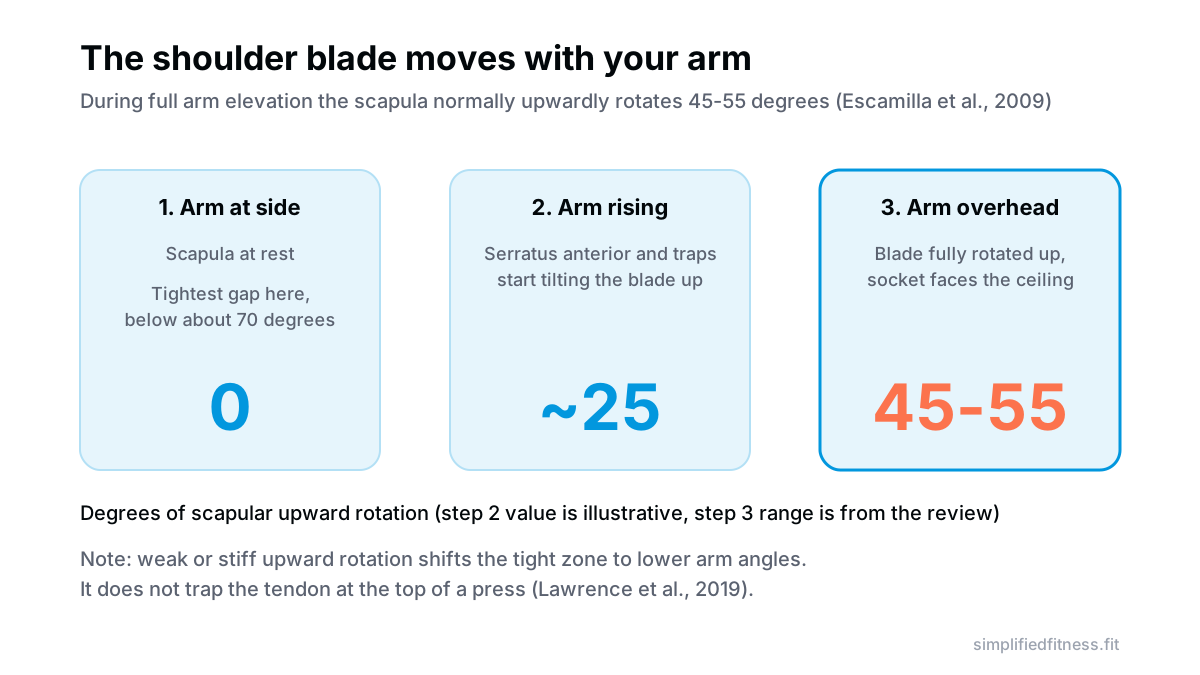
- As your arm goes overhead, the shoulder blade normally rotates upward about 45-55 degrees, which helps keep room for the rotator cuff tendons.
- Imaging work suggests rotator cuff contact against the bone above it is less common than once assumed, and the tightest gap is at lower arm angles, not at the top of a press.
- Behind-the-neck presses and wide-grip pulling put the arm in a more demanding position. The evidence is observational, but it is a fair reason to default to a front press.
- Sharp pinching pain, night pain or weakness that does not settle is a reason to see a doctor or physiotherapist, not to push through.
Part of our complete guide: Joint-Friendly Lifting & Fitness Myths: A Guide for Over-40s, Teens and Sore Backs
Table of contents
Is overhead press bad for shoulders? For most healthy lifters, no. Nothing in the research shows that pressing overhead with sound technique wears out the rotator cuff, and the fear of “pinching” the tendon rests on an idea that has not held up well under direct testing.
That does not mean every press is safe for every shoulder. Technique, load and your own history matter. This article sits inside our joint-friendly lifting myth-busting guide, and it covers the mechanics: what the shoulder blade does, what “impingement” really means, and which versions of pressing and pulling deserve a bit more caution.
What happens in your shoulder during an overhead press
Your shoulder is not one joint. It is a team: the upper arm bone (humerus) sits in the socket of the shoulder blade (scapula), and the scapula glides on your rib cage. When your arm goes overhead, both parts move together. Researchers call this coordinated movement scapulohumeral rhythm.
Over the top of the joint sits a bony roof called the acromion. Under that roof run the rotator cuff tendons, mainly the supraspinatus. The old story was simple: lift your arm, the roof comes down, the tendon gets squeezed. Hence “impingement.”
Reality is more interesting. A review of shoulder rehabilitation exercises reports that during maximum arm elevation the scapula normally rotates upward by about 45-55 degrees, tilts back and turns outward. The serratus anterior, working with the upper and lower trapezius, drives this (Escamilla et al., 2009). As the blade rotates upward, the roof moves up and out of the way.
Does overhead pressing cause impingement?
Short answer: there is no good evidence that it does in healthy shoulders. Here is what the better studies show.
A 2019 fluoroscopy study tracked 40 people while they raised their arms in the scapular plane. Participants with lower scapular upward rotation had a normalized minimum distance between the bony arch and the rotator cuff insertion that was 34.8% smaller with the arm at the side. The distances were generally smallest below 70 degrees of elevation, and contact between the arch and the tendon happened in 45% of participants. The authors concluded that rotator cuff compression may be less common than traditionally presumed (Lawrence et al., 2019).
Read that carefully. The tight zone is lower in the arm’s range, not at the top where you lock out a press. Weak upward rotation shifts the risky zone to lower angles. And even then, contact was not universal. This was a lab study of 40 people, so it shows a pattern, not a verdict on your shoulder.
A second study looked at 40 people without pain, half with obviously abnormal shoulder blade motion and half with normal motion. The gap under the bone at 45 and 90 degrees of active elevation did not differ between the groups (Seitz et al., 2012). When the researchers manually helped the blade rotate up and tilt back, the gap increased in both groups. So blade position does influence the space, but messy-looking motion by itself did not shrink it.
Why the word “impingement” is losing ground
Even clinicians who treat shoulders have been moving away from the picture of a tendon being pinched. One reason is a big surgical trial.
In the CSAW trial, 313 UK patients with subacromial shoulder pain (at least 3 months, intact rotator cuff, previous non-operative care) were randomly assigned to decompression surgery, a placebo “look inside only” arthroscopy, or no treatment. At 6 months, the Oxford Shoulder Score did not differ between the two surgical groups (32.7 versus 34.2 points). Both beat no treatment slightly, but not by a clinically important amount (Beard et al., 2018).
Pause on what that means. If shaving bone to make more room does no better than a sham operation, then “not enough room” cannot be the whole explanation for the pain. Many clinicians now use the broader label rotator cuff-related shoulder pain. It admits what we know: the shoulder can hurt, the tendon can be irritated, and the cause is usually a mix of load, capacity and sensitivity rather than a simple pinch.
Do I need perfect scapular control to press safely?
No. This is where gym advice goes overboard. You will hear that any “winging” or uneven blade means you must not press until a physio signs off.
A 2023 systematic review pooled 34 studies and 2,365 people. Scapular dyskinesis, an abnormal-looking shoulder blade pattern, appeared in about 48% of people without shoulder symptoms and about 60% of people with them. The authors suggest it may be a normal finding in nearly half of asymptomatic people (Salamh et al., 2023). They also note that studies measured it inconsistently.
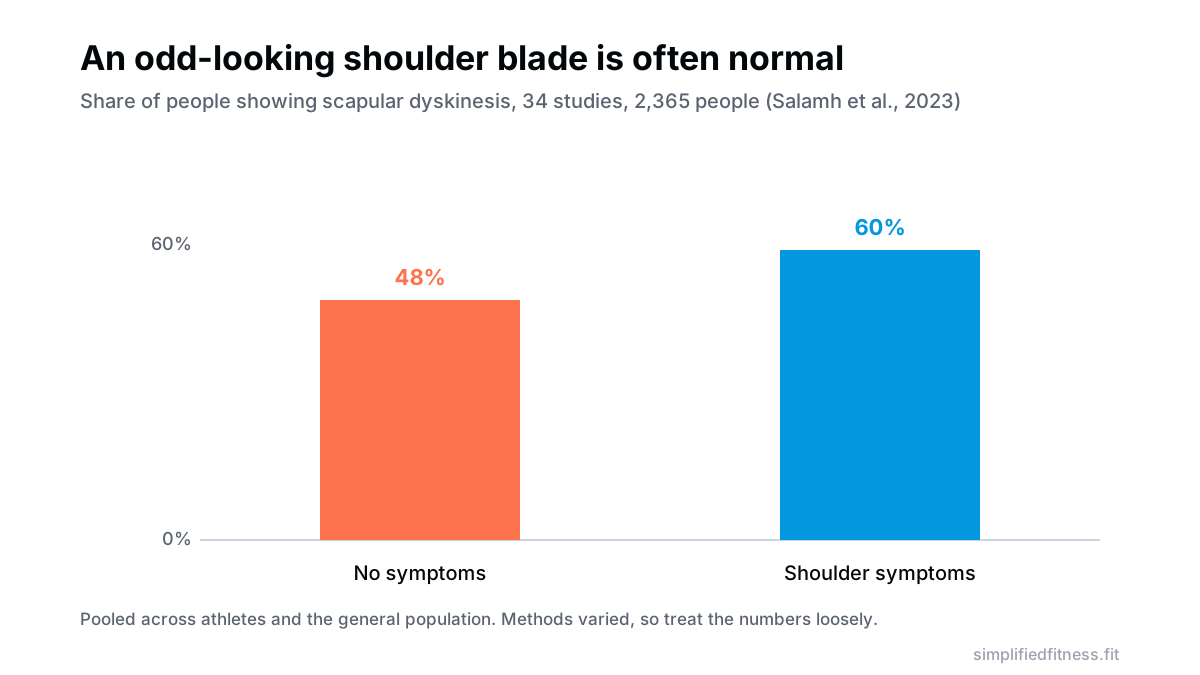
Practical read: if your shoulders feel fine and your pressing strength climbs, an asymmetrical blade is not an emergency. If you have pain, the pattern may be worth addressing with a clinician, but it is one piece of the puzzle.
Scapular rhythm in the gym: what it should look like
You do not need to think about every degree. You need to avoid the things that block the blade from doing its job.
- Let the blades rotate up. At the top of the press a gentle upward shrug is fine and natural. Pinning your shoulder blades down and back for the whole rep is a common “cue” that works against upward rotation.
- Keep the ribs down. A big back arch makes it look like you are getting more overhead range, but you are borrowing it from the lower back, not the shoulder.
- Stay in the plane that suits your shoulder. Pressing with the arms slightly in front of the body, roughly in the scapular plane, is the position most lifters find comfortable. It is also the plane most shoulder studies use for arm elevation, including the fluoroscopy work above.
- Use controlled reps. A review of rehab exercises notes that when weakness, fatigue or abnormal firing patterns disrupt normal shoulder blade motion, the shoulder works less efficiently and injury risk rises (Escamilla et al., 2009). Grinding your last reps with a tilting torso is how technique degrades.
In the gym, the most common mistake here is rushing the rep, bouncing out of the bottom and leaning back until the press becomes an incline press for the upper chest. Slow it down.
Upright rows, behind-the-neck presses and wide pulls: different risk profiles
Overhead pressing in a normal front position is one thing. Some exercises ask the shoulder for more.
Behind-the-neck press and pulldown. These use the so-called “high-five” position, with the upper arms out to the side and rotated back. In a study of 123 weight trainers and 36 non-lifting controls, the weight-training group showed more clinical signs of anterior shoulder instability and hyperlaxity. The performance of behind-the-neck pulldowns and military press was associated with those signs, while external rotator strengthening showed an inverse association (Kolber et al., 2013). The design was cross-sectional, so it cannot prove those lifts caused anything. It does show why many coaches default to the front position.
Wide-grip pulling overhead. A small motion-capture study of 11 people who regularly did pull-ups found that wide and reverse-grip pull-ups produced kinematic patterns the authors linked with increased subacromial impingement risk, and that high arm elevation reduces the subacromial space (Prinold et al., 2016). Eleven young people, no injury outcomes: treat it as a flag, not proof.
Upright rows. I could not find a trial that tests the upright row directly. The caution is a reasoned one: it takes the elbows high with the arms internally rotated, and the rehab review notes that internal rotation of the arm and anterior scapular tilt decrease subacromial space and increase impingement risk in the “empty can” position compared with “full can” (Escamilla et al., 2009). That is an inference, not a proven harm. If your shoulders dislike them, lateral raises are an easy swap, and our upright row modifications guide covers safer setups.
| Exercise | Arm position | Relative demand on the shoulder | Simple swap |
|---|---|---|---|
| Front barbell or dumbbell press | In front of body, near scapular plane | Lower, if technique is controlled | Keep it |
| Landmine press | Angled forward, less overhead | Lower | Good for stiff shoulders |
| Behind-the-neck press | Arms out to the side, rotated back | Higher, needs good mobility | Front press |
| Upright row | Elbows high, arms internally rotated | Higher (reasoned, not trialled) | Lateral raise, face pull |
| Wide-grip pulldown or pull-up | Arms high and wide | Moderate to higher | Neutral grip or close grip |
Who should adjust the overhead press
The research here is solid on mechanics but limited on individual cases. Some lifters will need modifications:
- Limited overhead mobility. A stiff upper back or tight lats forces you to lean back to get the bar overhead. Use a landmine press or a high-incline dumbbell press instead.
- Known structural issues. A marked kyphosis or bony spurs identified on imaging can change which angles are comfortable. This is where a clinician’s advice beats general rules.
- Current shoulder pain. Pressing is not automatically off limits, but it needs a proper plan. A 2017 meta-analysis of trials in people with shoulder impingement found exercise was better than non-exercise controls for pain, though the authors rated the evidence as very low quality (Steuri et al., 2017). For gym alternatives while you wait, see our guide to bench and pressing alternatives for shoulder pain.
The overhead press checklist
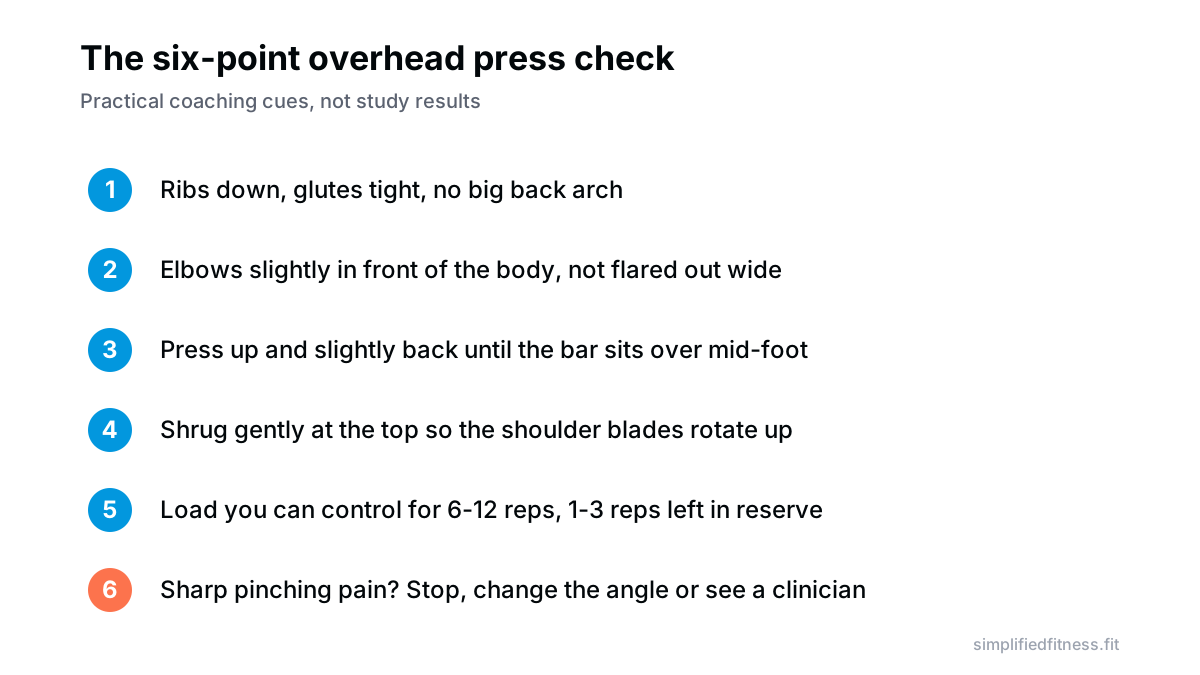
- Ribs down, glutes tight. Brace like a plank. No big arch.
- Elbows slightly in front. Not flared straight out to the sides.
- Bar path. Press up and slightly back so the bar finishes over the middle of your foot, with your head moving through.
- Finish with a gentle shrug. This lets the shoulder blades rotate upward.
- Load you can control. 6-12 reps with 1-3 reps in reserve. Our RIR and RPE calculator helps pick the load.
- Pain check. Sharp or pinching pain means stop and change the angle, or get it assessed.
What if I get pain pressing overhead?
Pain is a signal, but it is not a diagnosis. Shoulder pain has many possible sources, and I cannot tell you which one you have. Reasonable first steps:
- Reduce the load and range to what is pain-free, for example a smaller press range or a landmine press.
- Keep training the shoulder, because rest alone rarely builds capacity.
- Give changes 2-3 weeks. If there is no change, it is time for an assessment.
See a doctor or physiotherapist promptly if you have pain at night, sudden loss of strength, numbness or tingling down the arm, a shoulder that feels like it is slipping out, or pain after a fall. Do not self-diagnose from the internet.
Bringing it together
The idea that overhead pressing ruins the rotator cuff is a myth in its simple form. The shoulder blade is built to rotate upward, imaging work suggests the tendon is contacted less often than assumed, and a placebo-controlled surgical trial undermined the “not enough room” model.
What remains is common sense. Keep your ribs down, let the blades rotate, choose loads you control, and treat behind-the-neck, upright and wide-grip work as optional extras with more demanding positions. For wider context on training around joints, see pain-free hypertrophy training and our look at whether squats are bad for your knees.
Frequently Asked Questions
Is overhead press bad for your shoulders?
For most healthy people, no. Research on shoulder mechanics shows the shoulder blade rotates upward as the arm rises, which helps preserve space for the rotator cuff. Start with a load you can control, keep your ribs down, and stop if you get sharp pinching pain.
Does overhead pressing cause shoulder impingement?
There is no good evidence that well-performed overhead pressing causes impingement in healthy shoulders. A fluoroscopy study found rotator cuff contact with the bony arch above it in 45% of participants, and the tightest gaps occurred below 70 degrees of elevation. If pressing hurts, treat it as a load or technique problem first and get it assessed if it persists.
What is scapulohumeral rhythm?
It is the coordinated movement of the upper arm bone and the shoulder blade during arm elevation. The scapula rotates upward, tilts back and turns outward so the shoulder socket faces the ceiling. Practise slow, controlled reps and a gentle shrug at the top so that rhythm stays smooth.
Which muscles upwardly rotate the scapula?
The serratus anterior is the main driver, working with the upper and lower trapezius. Together they swing the shoulder blade up and around the rib cage as your arm rises. Presses, push-ups and rows done through a full range of motion train this team well.
Is the term shoulder impingement outdated?
Many clinicians now prefer broader terms such as rotator cuff-related shoulder pain, because the old idea of a tendon being squeezed explains only part of the picture. A placebo-controlled trial found that removing bone and tissue to create more space did no better than a sham operation. Treat 'impingement' as a label for a painful pattern, not proof that overhead movement is damaging your shoulder.
Is the behind-the-neck press bad for shoulders?
It places the arm in a more extreme position, and one study in weight trainers linked behind-the-neck pulldowns and military press with signs of anterior shoulder instability. That study was cross-sectional, so it cannot prove cause. A front press, landmine press or dumbbell press gives similar shoulder training with less demand on mobility.
Are upright rows bad for your shoulders?
I could not find a trial that tests upright rows directly, so this is a reasoned caution rather than a proven harm. Pulling the elbows high with the arms internally rotated is the kind of position linked with reduced subacromial space in other exercises. If you like them, use a grip wider than your shoulders, stop the bar at lower chest height, or swap in lateral raises or face pulls.
Should I press with dumbbells or a barbell?
Either works for healthy shoulders, and the best choice is the one that lets you move without pain. Dumbbells let each arm find its own path, which many lifters find friendlier. Try a neutral or slightly angled grip if a straight bar feels cramped.
Can I overhead press with a rotator cuff injury?
Sometimes, but it depends on the injury and should be guided by a clinician. Exercise is the first-line treatment for most rotator cuff-related shoulder pain, and a 2017 meta-analysis found exercise beat non-exercise controls for pain, though the evidence quality was very low. Get a diagnosis first and use our shoulder pain alternatives guide meanwhile.
What if my shoulder blade looks uneven when I lift?
That is common and not automatically a problem. A 2023 systematic review found scapular dyskinesis in about 48% of people with no shoulder symptoms and about 60% of those with symptoms. If it is painless and you are getting stronger, you generally do not need to fix it.
How heavy should I go on overhead press?
Pick a load you can lift for 6-12 clean reps with 1-3 reps left in reserve. Ugly, grinding reps change your shoulder blade and rib cage position and are where form usually breaks down. Add weight in small steps, such as 1-2 kg, once all sets look the same.
Is it normal for the shoulder to click or feel tight when pressing overhead?
Painless clicking is common and usually not a concern. Stiff thoracic spine or tight lats can limit how far your arms go overhead without leaning back. If clicking comes with pain, weakness or a catching sensation, have it checked by a professional.
When should I see a doctor about shoulder pain from pressing?
See a doctor or physiotherapist if you have sharp pain with lifting, pain at night, a sudden loss of strength, numbness or pain that has lasted several weeks. These signs are not specific to one cause and need an in-person assessment. Until then, switch to pain-free ranges and angles instead of pushing through.
Sources & References
Every claim above is checked against peer-reviewed research (PubMed, U.S. National Library of Medicine) or guidance from established health bodies. How we fact-check.
- Lawrence RL, et al. The impact of decreased scapulothoracic upward rotation on subacromial proximities. J Orthop Sports Phys Ther. 2019. PMID: 30658048
- Escamilla RF, et al. Shoulder muscle activity and function in common shoulder rehabilitation exercises. Sports Med. 2009. PMID: 19769415
- Seitz AL, et al. Effects of scapular dyskinesis and scapular assistance test on subacromial space during static arm elevation. J Shoulder Elbow Surg. 2012. PMID: 21444218
- Salamh PA, et al. Is it time to normalize scapular dyskinesis? The incidence of scapular dyskinesis in those with and without symptoms: a systematic review of the literature. Int J Sports Phys Ther. 2023. PMID: 37425102
- Prinold JA, et al. Scapula kinematics of pull-up techniques: avoiding impingement risk with training changes. J Sci Med Sport. 2016. PMID: 26383875
- Kolber MJ, et al. Characteristics of anterior shoulder instability and hyperlaxity in the weight-training population. J Strength Cond Res. 2013. PMID: 22836608
- Beard DJ, et al. Arthroscopic subacromial decompression for subacromial shoulder pain (CSAW): a multicentre, pragmatic, parallel group, placebo-controlled, three-group, randomised surgical trial. Lancet. 2018. PMID: 29169668
- Steuri R, et al. Effectiveness of conservative interventions including exercise, manual therapy and medical management in adults with shoulder impingement: a systematic review and meta-analysis of RCTs. Br J Sports Med. 2017. PMID: 28630217

Umair Hazrami · Founder & Head Coach, Simplified Fitness
Umair Hazrami founded Simplified Fitness and the Simplified Lifter channel to cut through fitness noise. With 4+ years of consistent training and 10+ coaching clients, he writes every guide from the peer-reviewed research and links the sources so you can check them. Our editorial standards.
Educational content only, not medical advice. If you have a medical condition, are pregnant, or take medication, talk to a qualified doctor before changing your diet, supplements or training. Full disclaimer.
Keep reading
Health & Longevity
Are Deadlifts Bad for Your Lower Back? What Spinal Loading Research Shows
Are deadlifts bad for lower back health? The research shows spinal loads are high but tolerable, and trials use loaded lifting for back pain. How to hinge.
9 min read

Health & Longevity
Are Squats Bad for Your Knees? What the Research Actually Says
Are squats bad for your knees? Research on deep squats, kneecap stress and the knees-over-toes rule shows where the myth came from and how to squat safely.
9 min read

Health & Longevity
Why Tendons Adapt Slower Than Muscles: Connective Tissue Timelines for Lifters
Tendon adaptation vs muscle growth: why your tendons lag behind your strength gains, what studies show about timelines, and how to add load without tendonitis.
8 min read

Health & Longevity
Desk Worker Workout Routine: Fix Pelvic Tilt, Weak Glutes and a Rounded Upper Back
A desk worker workout routine built on evidence: what sitting really does to your hips, why pelvic tilt is mostly normal, and 3 gym correctives that help.
8 min read