Resistance Training for Masters Lifters: Building Muscle at 40, 50 and 60+
Resistance training over 40, 50 and 60 still builds muscle. See what trials show on sarcopenia, protein per meal, weekly volume and a 3-day plan to follow.

TL;DR. The short answer
- Yes, you can build muscle in your 40s, 50s, 60s and beyond. Studies in people aged 50 and over show an average lean mass gain of about 1.1 kg, and even frail nursing home residents in their late 80s and 90s got markedly stronger.
- Ageing blunts the response a little, it does not switch it off. Gains tend to be smaller the older you are, so patience and consistency matter more than any trick.
- Two to three full-body sessions a week is a sensible default. A 2025 network meta-analysis of 151 trials found low weekly volume gave benefits for lean mass and physical function in healthy older adults.
- Older muscle needs a bigger protein dose per meal. One lab analysis found about 0.40 g/kg per meal was needed, versus 0.24 g/kg in younger men, and PROT-AGE suggests at least 1.2 g/kg per day for older people who exercise.
- Stop most sets 2-3 reps short of failure, prefer stable machine and dumbbell options, and see a doctor for joint pain that persists, chest pain or dizziness.
Part of our complete guide: Joint-Friendly Lifting & Fitness Myths: A Guide for Over-40s, Teens and Sore Backs
Table of contents
Resistance training over 40 still builds muscle. So does it at 50, 60 and well beyond. A meta-analysis of 49 studies in adults aged 50 and over found an average gain of 1.1 kg of lean mass, with smaller gains in the older participants (Peterson et al., 2011). The adjustments that matter are modest: two to three sessions a week, a bit more protein per meal, a little more room to recover, and machines when your joints complain.
This article covers the masters-specific details. For the wider picture on training around achy joints, see our joint-friendly lifting and myth-busting guide. For the bigger longevity argument, read the lifelong muscle dividend.
Can you build muscle in your 50s and 60s?
Yes. The research on this is older than most people realise.
In 1990, Fiatarone and colleagues put ten frail nursing home residents, about 90 years old, through 8 weeks of high-intensity resistance training. Strength rose by an average of 174% in the nine who finished, midthigh muscle area grew by 9%, and walking speed improved (Fiatarone et al., 1990). There was no control group, so treat the numbers as dramatic but uncontrolled.
The 1994 follow-up was a randomised trial in 100 frail residents, mean age 87. Strength increased by 113% in exercisers versus 3% in non-exercisers over 10 weeks, and gait speed and stair-climbing power also improved. The nutrition supplement alone did nothing (Fiatarone et al., 1994).
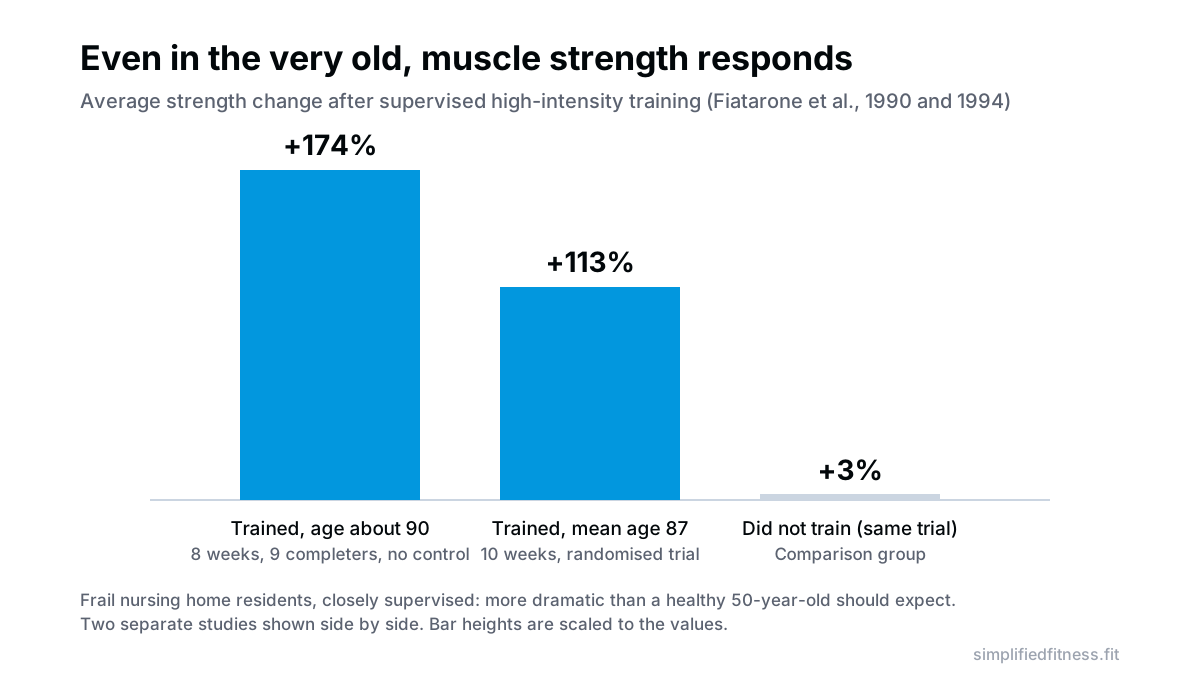
Two honest caveats. Those were frail, closely supervised volunteers, and early strength gains come largely from the nervous system learning the task, not from new muscle. Your gains in your 50s will look slower, not faster.
How often should masters lifters train?
Two to three full-body sessions a week is a very good default. The evidence is not precise, which is the honest part.
A dose-response meta-analysis of 25 randomised trials in healthy adults averaging 65 or older found that two sessions per week looked best for strength, and three per week for muscle size. It also pointed to 2-3 sets per exercise and 7-9 reps. But study quality was poor (mean PEDro score 4.6) and heterogeneity was large, so the authors called the morphology findings preliminary (Borde et al., 2015).
A much larger 2025 network meta-analysis of 151 trials (n = 6,306) in people 60 and over added a useful twist. Low weekly volume ranked most effective for lean body mass, muscle hypertrophy, timed up and go and 6-minute walk. Moderate and high volume were better for lower-limb strength. The effect was mainly seen in healthy older adults, with limited evidence in physically impaired people (Radaelli et al., 2025).
Read those two together. They do not contradict each other as much as they look. Neither says “more is always better.” Both support a modest dose done consistently.
Three days gives you recovery days between. If life gets busy, two is still worth doing. For the general volume science, see training volume and frequency for hypertrophy.
Why recovery feels different after 40
Soreness lingers, tendons grumble, and a bad night’s sleep shows up in the next session. Plenty of lifters over 40 describe this. That is a common experience, not proof that research has pinned down one cause.
The honest version: tendons generally adapt more slowly than muscle, which is one reason masters lifters often feel their elbows, knees and shoulders before their muscles are fully challenged. We explain this in tendon vs muscle adaptation.
One 12-month trial in 36 adults aged 62-70 (33 completed) compared heavy and moderate-load training. Tendon size increased equally in both, but only heavy-load training maintained tendon stiffness, which dropped in controls and moderate-load trainers. Collagen content was unchanged (Eriksen et al., 2019). Small sample, one tendon, but it hints that loading older tendons seriously, and gradually, is not the enemy.
How hard should you push? Reps in reserve for masters lifters
Take most working sets to 2-3 reps in reserve (RIR), meaning you stop when you could have done 2-3 more with decent form. That number is a coaching guideline, not a figure from the studies above.
The reasoning is practical. A set that ends two or three reps short still challenges the muscle, but costs your joints and nervous system less than grinding to failure. You can bring a final set closer to 1 RIR on machines, where a failed rep is low-risk. Our RIR and RPE guide explains how to judge it, and the RIR/RPE load calculator helps you set weights.
How much protein do you need over 40, 50 and 60?
More than most people eat, and slightly more per sitting.
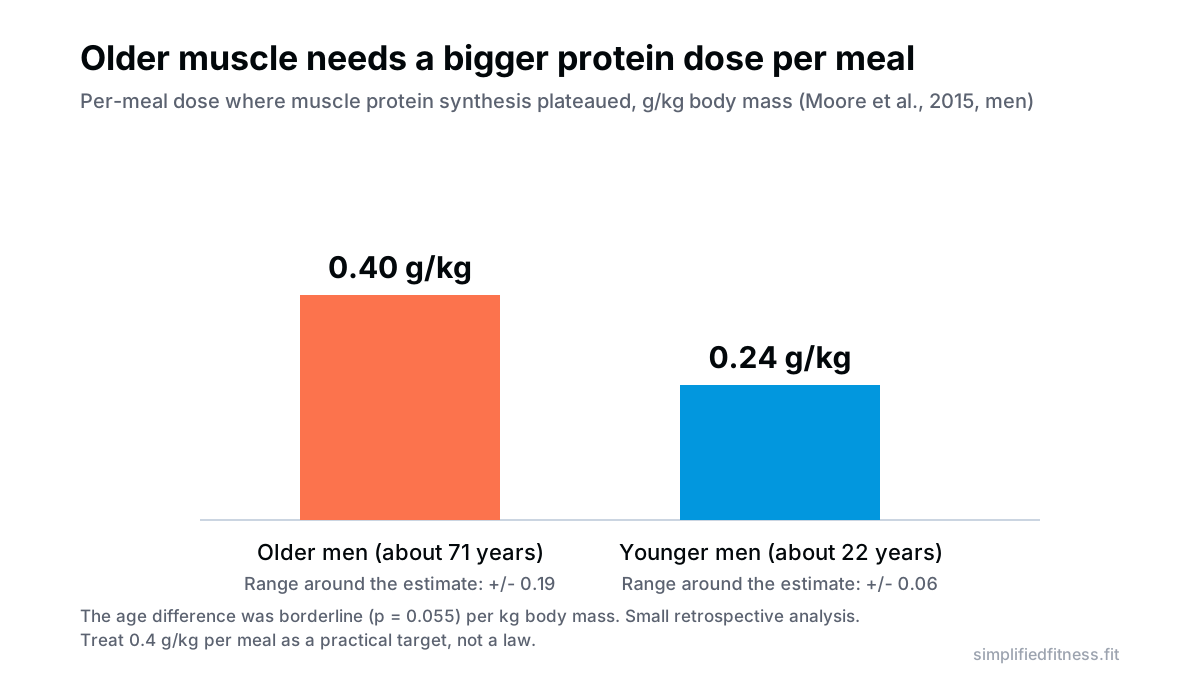
Moore and colleagues re-analysed lab data from healthy older men (about 71 years) and younger men (about 22 years). Muscle protein synthesis plateaued at about 0.40 g/kg of body mass per meal in older men versus 0.24 g/kg in younger men. The age difference was borderline (p = 0.055) per kg of body mass, and it was a retrospective analysis in men (Moore et al., 2015).
For daily totals, the PROT-AGE group recommends at least 1.0-1.2 g/kg per day for people over 65, and at least 1.2 g/kg per day for those who exercise. Those with severe kidney disease (eGFR below 30) are the exception and may need to limit protein (Bauer et al., 2013).
What does this look like on an Indian plate? For a 70 kg lifter, aim for roughly 28 g per main meal: something like 150 g paneer, or eggs plus a katori of dal and curd, or a generous portion of soya chunks with roti. Vegetarians may need to plan a little harder across three meals. Use the protein calculator for your number, and see Indian high-protein nutrition for food ideas. The deeper science is in our protein requirements for older adults guide.
What does sarcopenia training look like?
Sarcopenia is the age-related loss of muscle mass and strength. Resistance training is the main tool against it.
A network meta-analysis of 42 randomised trials (3,728 participants with sarcopenia, median age 72.9, median follow-up 12 weeks) found that resistance exercise, with or without nutrition, and resistance combined with aerobic and balance training gave the best improvements in quality of life. Adding nutrition to exercise had a larger effect on handgrip strength than exercise alone, with a similar effect on other physical function measures (Shen et al., 2023).
A diagnosis of sarcopenia is a medical question. If you are losing strength, struggling with stairs or have had falls, see your doctor, then train with a qualified coach. For the clinical side, read our guide to strength training in older adults, sarcopenia and dynapenia.
Sample 3-day full-body plan for masters lifters
This is an illustration, not a prescription. Adjust to your health and equipment.
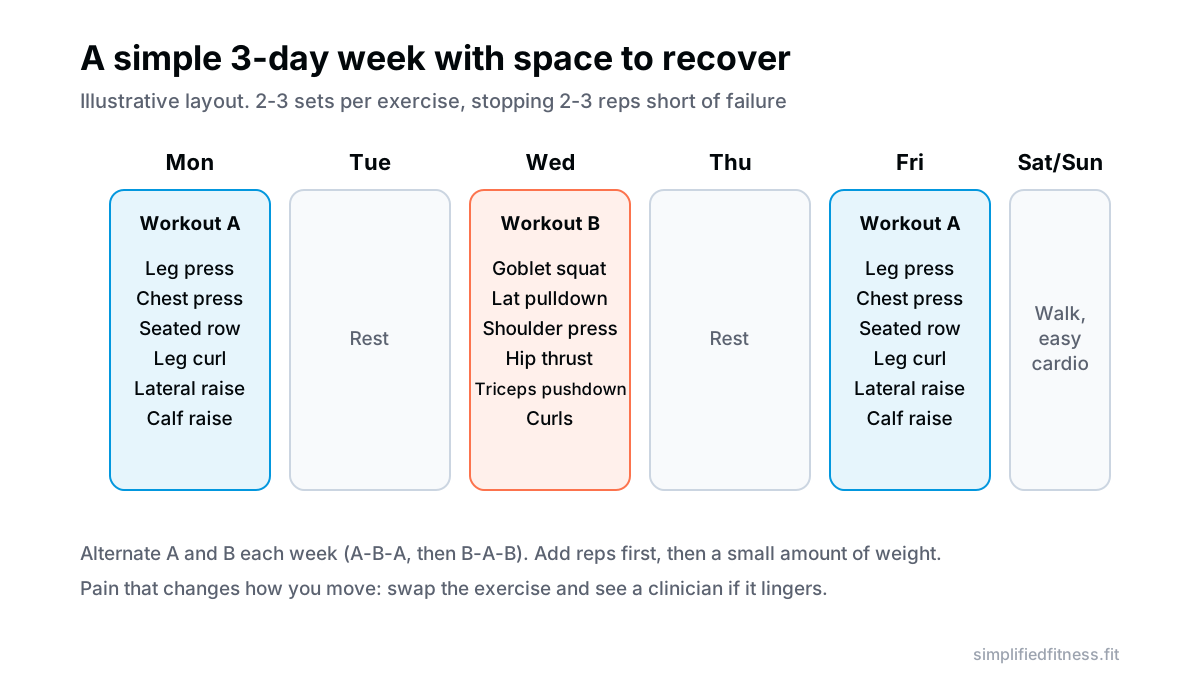
| Pattern | Workout A | Workout B |
|---|---|---|
| Squat or leg press | Leg press | Goblet squat |
| Push | Chest press | Shoulder press |
| Pull | Seated row | Lat pulldown |
| Hinge or curl | Seated leg curl | Hip thrust |
| Extras | Lateral raise, calf raise | Triceps pushdown, curls |
Use 2-3 sets per exercise at 7-12 reps, close to the 2-3 sets of 7-9 reps that one meta-analysis found most effective in healthy older adults (Borde et al., 2015). Stop with 2-3 reps in reserve. Add reps first, then a small amount of weight. Rest 1-2 minutes between sets.
Machines are not a lesser option. Stable, guided movements let you load the target muscle with less balance demand and easier set-up. Keep one or two free-weight movements if they feel fine. Our free plans give a ready template, and our progressive overload guide covers how to progress.
When to see a doctor first
Lifting is safe for most people, and exercise is generally encouraged for older adults. But talk to your doctor before starting if you have:
- heart disease, chest pain or breathlessness on exertion
- uncontrolled high blood pressure
- osteoporosis, a recent fracture or recent surgery
- kidney disease (relevant for protein and supplements)
- diabetes with complications
- joint pain that is getting worse, or dizziness when you train
Stop and get medical advice for chest pain, fainting, or sharp pain that does not settle.
The bottom line
Resistance training over 40, 50 and 60 works. Not as fast as at 25, but well enough to change how you move and feel. Train two or three times a week, keep sets a couple of reps short of failure, eat protein across the day, and treat joints with respect. Start with the plan above and the protein calculator, and give it at least 12 weeks before judging.
Frequently Asked Questions
Can you build muscle after 50?
Yes. A meta-analysis of 49 studies in adults aged 50 and over found resistance training added about 1.1 kg of lean body mass on average. Muscle responds to load at any age, although the response gets somewhat smaller as people get older. Start with two or three sessions a week and progress slowly.
Can you build muscle at 60 or 70?
Yes, and the evidence includes very old people. In a randomised trial of frail nursing home residents with a mean age of 87, strength rose by 113% in the group that trained. Those were closely supervised, frail volunteers, so a healthy 60-year-old should expect a steadier but still real improvement. Begin with machines and moderate loads.
How many days a week should a 50 year old lift weights?
Two or three days is a good range. A dose-response meta-analysis in healthy older adults found two sessions per week looked best for strength and three for muscle size, though the studies were low quality. Pick the number you can sustain with a rest day between sessions.
What is the best workout routine for a 60 year old?
A full-body routine, two or three days a week, built around a leg press or squat pattern, a push, a pull and a hip hinge or leg curl. Trials suggest even low weekly volume gives meaningful gains in healthy older adults. Use the sample three-day week in this article and add reps before weight.
How much protein do older adults need to build muscle?
The PROT-AGE group recommends at least 1.0-1.2 g/kg per day for older people, and at least 1.2 g/kg per day for those who exercise. Older muscle seems less sensitive to small doses, so spreading intake across meals helps. A 70 kg person would aim for roughly 85 g a day or more, with about 28 g at main meals.
What is sarcopenia and can lifting reverse it?
Sarcopenia is the age-related loss of muscle mass and strength. A network meta-analysis of 42 trials in older adults with sarcopenia found resistance exercise improved quality of life, and combined programmes improved gait speed and chair-stand performance. Lifting helps but does not erase ageing, so aim for steady gains. If you suspect sarcopenia, ask your doctor.
Why does recovery take longer after 40?
Recovery varies a lot between people, and age is only one factor next to sleep, stress and training volume. Anecdotally masters lifters feel soreness and tendon aches more, and tendons generally adapt slower than muscle. Do fewer hard sets per session, leave a rest day between workouts and judge progress by how you feel in the next session.
How many reps in reserve should masters lifters use?
Stopping with 2-3 reps in reserve is a practical coaching guideline, not a figure from a specific trial. Training slightly further from failure lowers the joint and fatigue cost while still giving muscle a hard stimulus. Use our RIR/RPE calculator to practise judging it.
Is heavy lifting safe for older adults?
For most healthy people it can be, with sensible progression, good technique and supervision when starting. A 12-month trial in adults aged 62-70 found heavy-load training kept tendon stiffness from declining, which moderate loads did not, though that study looked at tendon properties, not injury rates. See a doctor first if you have heart disease, uncontrolled blood pressure, osteoporosis or recent injuries.
Are machines better than free weights for masters lifters?
Neither is better for everyone. Machines let you load a muscle with less balance demand and an easier set-up, which is helpful for sore joints. Keep a few free-weight or dumbbell movements if they feel fine, because they train stabilisers and carry over to daily life.
Should I do cardio as well?
Yes, a mix helps. In sarcopenia trials, combining resistance with aerobic and balance training was among the best options for quality of life and chair-stand performance. Do your lifting first or on separate days, and add walking or easy cycling.
Do I need supplements after 40?
Mostly no, food comes first. If dal, paneer, curd, eggs or soya do not get you to your protein target, a whey or plant protein powder is a convenient top-up. If you have kidney problems, ask your doctor before changing protein intake or adding any supplement.
When should I see a doctor before lifting?
See a doctor before starting if you have heart disease, chest pain, breathlessness, uncontrolled blood pressure, diabetes complications, kidney disease or osteoporosis. These conditions change what is safe, not whether exercise is useful. Stop and seek help for chest pain, dizziness, or sharp pain that does not settle.
Sources & References
Every claim above is checked against peer-reviewed research (PubMed, U.S. National Library of Medicine) or guidance from established health bodies. How we fact-check.
- Peterson MD, et al. Influence of resistance exercise on lean body mass in aging adults: a meta-analysis. Med Sci Sports Exerc. 2011. PMID: 20543750
- Fiatarone MA, et al. High-intensity strength training in nonagenarians. Effects on skeletal muscle. JAMA. 1990. PMID: 2342214
- Fiatarone MA, et al. Exercise training and nutritional supplementation for physical frailty in very elderly people. N Engl J Med. 1994. PMID: 8190152
- Borde R, et al. Dose-response relationships of resistance training in healthy old adults: a systematic review and meta-analysis. Sports Med. 2015. PMID: 26420238
- Radaelli R, et al. Effects of resistance training volume on physical function, lean body mass and lower-body muscle hypertrophy and strength in older adults: a systematic review and network meta-analysis of 151 randomised trials. Sports Med. 2025. PMID: 39405023
- Moore DR, et al. Protein ingestion to stimulate myofibrillar protein synthesis requires greater relative protein intakes in healthy older versus younger men. J Gerontol A Biol Sci Med Sci. 2015. PMID: 25056502
- Bauer J, et al. Evidence-based recommendations for optimal dietary protein intake in older people: a position paper from the PROT-AGE Study Group. J Am Med Dir Assoc. 2013. PMID: 23867520
- Shen Y, et al. Exercise for sarcopenia in older people: a systematic review and network meta-analysis. J Cachexia Sarcopenia Muscle. 2023. PMID: 37057640
- Eriksen CS, et al. Load magnitude affects patellar tendon mechanical properties but not collagen or collagen cross-linking after long-term strength training in older adults. BMC Geriatr. 2019. PMID: 30704412

Umair Hazrami · Founder & Head Coach, Simplified Fitness
Umair Hazrami founded Simplified Fitness and the Simplified Lifter channel to cut through fitness noise. With 4+ years of consistent training and 10+ coaching clients, he writes every guide from the peer-reviewed research and links the sources so you can check them. Our editorial standards.
Educational content only, not medical advice. If you have a medical condition, are pregnant, or take medication, talk to a qualified doctor before changing your diet, supplements or training. Full disclaimer.
Keep reading
Health & Longevity
Are Deadlifts Bad for Your Lower Back? What Spinal Loading Research Shows
Are deadlifts bad for lower back health? The research shows spinal loads are high but tolerable, and trials use loaded lifting for back pain. How to hinge.
9 min read

Health & Longevity
Are Squats Bad for Your Knees? What the Research Actually Says
Are squats bad for your knees? Research on deep squats, kneecap stress and the knees-over-toes rule shows where the myth came from and how to squat safely.
9 min read

Health & Longevity
Why Tendons Adapt Slower Than Muscles: Connective Tissue Timelines for Lifters
Tendon adaptation vs muscle growth: why your tendons lag behind your strength gains, what studies show about timelines, and how to add load without tendonitis.
8 min read

Health & Longevity
Desk Worker Workout Routine: Fix Pelvic Tilt, Weak Glutes and a Rounded Upper Back
A desk worker workout routine built on evidence: what sitting really does to your hips, why pelvic tilt is mostly normal, and 3 gym correctives that help.
8 min read