The Simplified Lifter Manifesto: Minimal Effective Dose, The Joy of Strength and Lifelong Fitness
The simplified lifter manifesto: 3-4 sessions, 6-10 hard sets per muscle and enough protein, guided by meta-analyses, so you can lift for life without burnout.

TL;DR. The short answer
- The simplified lifter manifesto is four ideas: clarity over clutter, evidence over dogma, consistency over intensity and joy over suffering. In practice that means 3-4 sessions a week, roughly 6-10 hard sets per muscle and adequate protein.
- Weekly training volume has a graded dose-response with muscle growth, but the gains per extra set are small (about 0.37% per set in one meta-analysis), so a modest, repeatable dose still delivers real growth.
- Even one hard set per exercise, 2-3 times a week, produced significant squat and bench strength gains in resistance-trained men in a systematic review of six studies.
- Protein supplementation stopped adding muscle gain beyond about 1.6 g/kg/day in a meta-analysis of 49 trials, so more is not automatically better.
- If food, weighing or training feels compulsive, or you are in pain that does not settle, speak to a doctor or qualified mental health professional.
Part of our complete guide: Joint-Friendly Lifting & Fitness Myths: A Guide for Over-40s, Teens and Sore Backs
Table of contents
The simplified lifter manifesto fits in one sentence: train 3-4 times a week, do roughly 6-10 hard sets per muscle, eat enough protein, and keep doing it for decades. That is enough to build a strong, healthy body for most people. The research says more volume can add a bit more, but each extra set adds only a little, so a dose you can sustain matters more than squeezing out the last few percent.
This is the closing article of our joint-friendly lifting and myth busting guide. The other articles take apart individual myths. This one pulls them into a philosophy you can actually live with.
What is the simplified lifter manifesto?
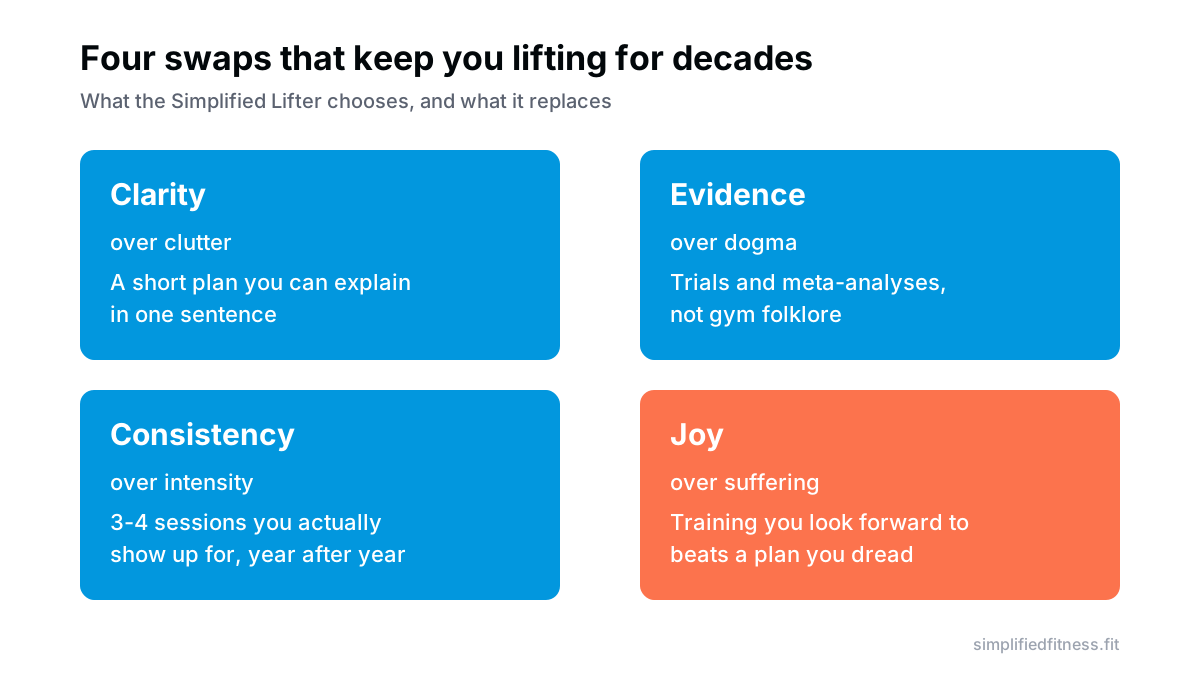
It is four commitments, and each one pushes back on something the fitness industry sells.
- Clarity over clutter. A plan you can explain in a sentence beats a spreadsheet of 14 techniques.
- Evidence over dogma. We trust meta-analyses and trials over gym folklore, and we say so when the evidence is thin.
- Consistency over intensity. The plan you repeat for ten years beats the brutal one you quit in six weeks.
- Joy over suffering. Strength should add to your life, not become a second job.
None of this is anti-effort. You still train hard enough to make progress. The manifesto just refuses to confuse more with better.
How much training is actually enough? The minimal effective dose
Minimal effective dose lifting means finding the smallest dose that delivers the result you want, then protecting it. Here is what the research says about where that dose sits.
Volume has a dose-response, but a gentle one. A 2017 meta-analysis of 15 studies (34 treatment groups) found that more weekly sets were associated with more muscle growth. Each additional set was linked to about a 0.37% bigger gain in muscle size, and the gap between higher and lower volume groups was about 3.9% (Schoenfeld et al., 2017). When the studies were split into under 5, 5-9 and 10 or more weekly sets per muscle, the difference showed only a trend (P = 0.074).
Read that carefully. More volume helped. It also helped in small steps.
Strength tells a similar story. A meta-analysis of nine studies found greater strength gains with high weekly set volume than with low (effect size difference 0.18) (Ralston et al., 2017). But the low-volume groups still improved a lot, with a mean effect size of 0.82 versus 1.01 for high volume.
One set can still work. A systematic review of six studies in resistance-trained men found that a single set done 1-3 times a week produced significant 1RM gains. Pooling five of those studies, the estimated gain was about 17 kg on squat and 8 kg on bench press over roughly 8-12 weeks (Androulakis-Korakakis et al., 2020). The authors call these gains “suboptimal, yet significant”, and note the evidence for deadlift, women and highly trained athletes is thin.
Does training frequency matter?
Less than people think. A 2019 meta-analysis of 25 studies found no significant difference in muscle growth between higher and lower weekly frequencies when volume was matched (Schoenfeld et al., 2019). The authors concluded people can choose a frequency based on preference. Studies where volume was not matched did lean toward higher frequency, with a modest difference between 1 and 3 or more days.
So 3-4 sessions is not magic. It is a sensible way to spread 6-10 sets per muscle without turning every workout into a two-hour slog. For the detail, see 1x vs 2x vs 3x training frequency at equal volume.
What does a simplified training week look like?
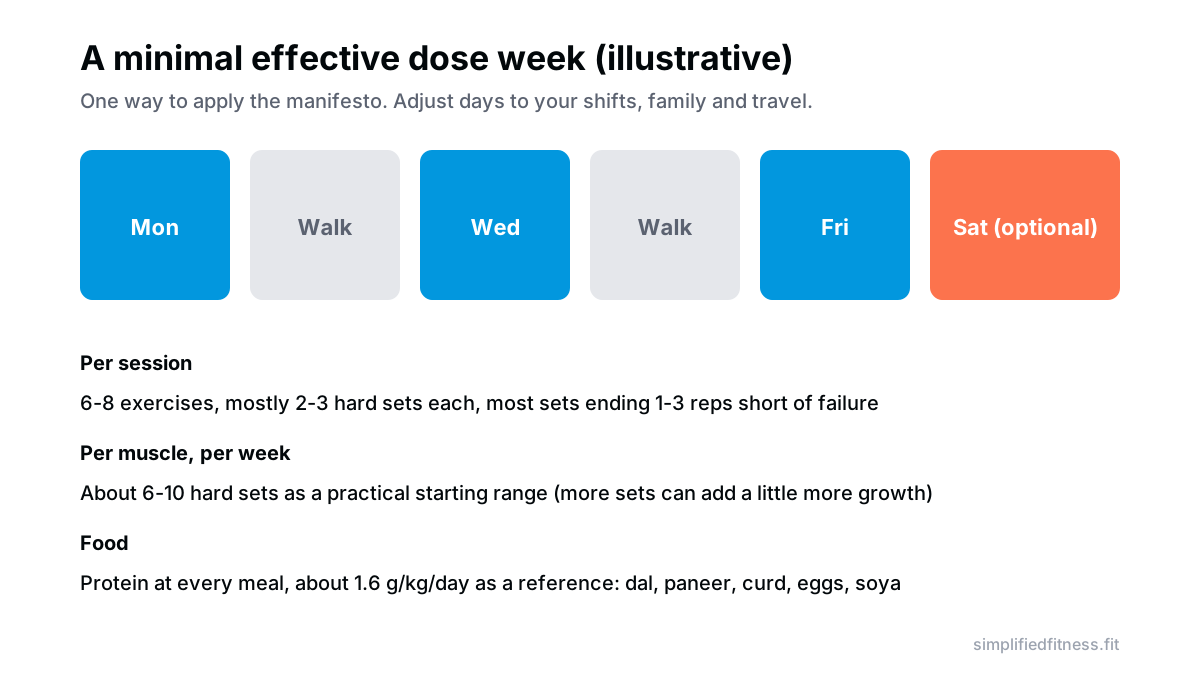
Here is the shape. Three full-body or upper/lower sessions, with an optional fourth. About 6-8 exercises per session, mostly 2-3 hard sets each. Most sets finish one to three reps short of failure, with the last set of an exercise sometimes closer.
A few practical rules we lean on:
- Pick compound lifts you can progress (a squat or leg press, a press, a row, a hinge) and add a few isolation moves for arms, delts and calves.
- Write your lifts down. Progress you cannot see is progress you cannot manage.
- When all sets hit the top of your rep range, add a little weight. That is the engine, and it is covered in our progressive overload and deload guide.
- Take the easy weeks. A lighter week now and then is part of the plan.
Short on time? Our 2-day lifting routine for busy professionals shows how to make two sessions work. Want ready-made sessions? Browse the free workout plans.
Can I maintain muscle if life gets in the way?
This is where sustainability is won or lost. Life will get busy. The question is what you do when it does.
A 2011 trial gave 70 adults 16 weeks of training three days a week, then randomly assigned them for 32 weeks to stop training or to train at one-third or one-ninth of the original dose. In young adults (20-35), both reduced doses preserved the gains in muscle size. In older adults (60-75), they did not. The older group needed a higher weekly dose to keep myofiber size, though their strength gains were well preserved (Bickel et al., 2011).
The practical lesson is simple. Do not quit. Shrink the plan. And if you are over 60, shrink it less. We go deeper in how little training keeps muscle and in our guide for masters lifters.
How much protein is enough?
Protein is the one nutrition lever with solid trial support for lifters, and it also has a ceiling.
A meta-analysis of 49 randomized trials (1,863 participants) found protein supplementation modestly increased fat-free mass, strength and muscle size during resistance training. The benefit was smaller with increasing age and larger in trained people. Beyond a total intake of about 1.62 g/kg/day, there was no further gain in fat-free mass (Morton et al., 2018).
Two cautions. The analysis looked at protein supplementation, so the 1.6 g/kg figure is a reference point, not a hard cap for every person. And one author disclosed funding from the US National Dairy Council, which also supported some of the trials in the review.
For a 70 kg lifter, 1.6 g/kg is about 110 g a day. In an Indian kitchen that can look like:
| Meal | Example | Approx. protein |
|---|---|---|
| Breakfast | 3 eggs or 150 g paneer bhurji | 18-27 g |
| Lunch | 1 cup dal, 2 rotis, a bowl of curd | 20-25 g |
| Snack | A handful (50 g) of roasted chana or a scoop of whey | 10-25 g |
| Dinner | 100 g soya chunks (dry weight) or chicken curry | 30-50 g |
These are rough food-label style estimates and they vary by brand and portion. Use the protein calculator for your own number. Our article on optimal daily protein intake covers the evidence in more depth.
Why does lifting matter beyond the mirror?
The case for lifting for life is bigger than muscle size. A meta-analysis of 16 prospective cohort studies found that muscle-strengthening activities were associated with a 10-17% lower risk of all-cause mortality, cardiovascular disease, total cancer and diabetes. The largest reduction, roughly 10-20%, appeared at about 30-60 minutes a week (Momma et al., 2022).
Be careful with that one. These are observational cohorts. People who lift may differ from people who do not in many ways, so the data show association, not proof that lifting caused the benefit. The authors also note the J-shaped curve means the effect of much higher volumes is unclear.
Still, it fits the manifesto neatly. The health signal sits at a modest weekly dose, not at an extreme one.
How do I lift without burning out?
Burnout is often less a motivation problem than a design problem. The plan asked for more than the life around it could give.
Some design choices that help:
- Build for your worst month, not your best. If the plan only works when work is calm, it is not a plan.
- Leave reps in the tank on most sets. Grinding every set to failure is tiring, and most sets do not need it. Our look at training to failure vs leaving reps in reserve covers the evidence.
- Make the session short enough to start. A 45-minute session you do beats a 90-minute session you skip.
- Pick a few exercises you enjoy. Enjoyment is not a luxury. It is what keeps you coming back in year five.
- Measure more than the scale. Strength, energy, sleep and how your clothes fit tell you more.
- Accept imperfect weeks. Missing a session is data, not failure.
- Make pain the stop signal. Our guide to good pain vs bad pain explains what to push through and what to respect.
When does fitness culture become a problem?
Rejecting dogma also means rejecting rigid food rules and appearance obsession. A 2026 systematic review of 22 studies, mostly cross-sectional and in non-clinical groups, found that higher social media use was associated with more orthorexia nervosa and muscle dysmorphia symptoms. Posts about nutrition, thinness and exercise were particularly linked to orthorexia symptoms (Vintro-Alcaraz et al., 2026). The authors stress that causality is not established and that muscle dysmorphia evidence is preliminary.
What that means for you: if you feel anxious when you break a food rule, cannot rest without guilt, avoid social events because of meals or workouts, or check your body constantly, that is worth raising with a doctor or a mental health professional. A lifting plan cannot fix that, and no article should try to diagnose it.
Likewise, any pain that is sharp, worsening, keeps you up at night, or comes with numbness, weakness or swelling deserves a medical check before you keep loading it.
What is the manifesto, in practice?
Five lines you can put on the fridge:
- Lift 3-4 times a week, with a plan short enough to survive a bad week.
- Aim for roughly 6-10 hard sets per muscle per week, and add only when progress stalls.
- Eat protein at every meal, using a reference of about 1.6 g/kg/day.
- Shrink the plan when life gets busy. Do not stop.
- Judge the plan over years, not weeks.
That is the Simplified Fitness philosophy. It is not the only way to train, and the evidence does not say it is the best possible way. It says it is a very good way you can keep doing. For lifelong strength, that is the one that counts.
Frequently Asked Questions
What is the simplified lifter manifesto?
It is a training philosophy built on clarity over clutter, evidence over dogma, consistency over intensity and joy over suffering. It asks for 3-4 structured sessions, about 6-10 hard sets per muscle per week and enough protein, rather than daily marathon workouts. The aim is a plan you can still follow in five, ten and thirty years.
What is minimal effective dose lifting?
It means doing the smallest amount of training that still produces the result you want, then stopping there. In resistance-trained men, one set per exercise done 2-3 times a week still produced significant squat and bench press strength gains, though smaller than higher-volume plans. Start at the low end, track your lifts, and add sets only when progress stalls.
How many days a week should I lift to build muscle?
Three or four days works well for most people, but frequency matters less than total weekly sets. A 2019 meta-analysis found no meaningful difference in muscle growth between higher and lower frequencies once volume was equated. Pick the number of days you can repeat every week without skipping.
How many sets per muscle per week do I need?
A practical starting range is about 6-10 hard sets per muscle per week. A 2017 meta-analysis found a graded relationship between weekly sets and growth, so more sets can help, but each extra set added only a small amount. Begin in that range and increase only if your progress stops for several weeks.
Is more training volume always better for muscle growth?
Not always. The 2017 dose-response meta-analysis found that higher volume was associated with more growth, but the three-level comparison (under 5, 5-9 and 10 or more sets) only showed a trend, not a clear effect. Recovery, sleep, time and joint comfort limit what you can repeat, so the best volume is the highest one you can recover from and sustain.
Can I maintain muscle with less training?
Often yes, at least in younger adults. In a 2011 trial, cutting training to one-third or one-ninth of the original dose for 32 weeks preserved muscle size in young adults but not in older adults. If you are busy or travelling, drop to a shorter plan rather than stopping, and see our guide on maintenance volume.
How much protein do I need as a lifter?
A reasonable reference point is about 1.6 g/kg of body weight per day. A meta-analysis of 49 trials found no further gain in fat-free mass from protein intakes above roughly 1.62 g/kg/day. For a 70 kg person that is about 110 g a day, which you can reach with dal, paneer, curd, eggs, soya or chicken.
Does lifting weights help you live longer?
Observational data suggest it may. A meta-analysis of 16 cohort studies linked muscle-strengthening activity to a 10-17% lower risk of all-cause mortality, cardiovascular disease and total cancer, with the largest benefit around 30-60 minutes a week. These are cohort studies, so they show association, not proof of cause, but they support lifting as part of a long-term health plan.
How do I avoid burnout in the gym?
Burnout usually comes from a plan that is harder than your life can support. Choose a schedule you could keep through a bad work month, leave one to three reps in reserve on most sets, and let a short session count as a win. If training starts to feel like a punishment or you cannot rest without guilt, talk to a professional.
Do I need to be perfect with diet to build muscle?
No. Protein is the main dietary lever supported by the trial data, and the rest is about eating enough overall and consistently. Rigid food rules can backfire, and a 2026 systematic review linked higher social media use with orthorexia and muscle dysmorphia symptoms, though mostly in cross-sectional studies. If food rules cause anxiety, ask your doctor for support.
How long does it take to see results from a simple plan?
Strength usually improves within the first weeks, while visible muscle change typically takes months of consistent training. The speed varies with training history, sleep, food and genetics, so no honest article can promise a date. Track your lifts and a monthly photo, and judge the plan on a three-month window.
Is it too late to start lifting in my 40s, 50s or 60s?
No, but the dose may need to be a little higher to hold on to muscle. The 2011 maintenance trial found older adults needed a higher weekly dose than younger adults to keep muscle fibre size, although strength was well preserved. Start gently, build up gradually and check with your doctor if you have heart, joint or other health conditions.
Sources & References
Every claim above is checked against peer-reviewed research (PubMed, U.S. National Library of Medicine) or guidance from established health bodies. How we fact-check.
- Schoenfeld BJ, et al. Dose-response relationship between weekly resistance training volume and increases in muscle mass: A systematic review and meta-analysis. J Sports Sci. 2017. PMID: 27433992
- Morton RW, et al. A systematic review, meta-analysis and meta-regression of the effect of protein supplementation on resistance training-induced gains in muscle mass and strength in healthy adults. Br J Sports Med. 2018. PMID: 28698222
- Bickel CS, et al. Exercise dosing to retain resistance training adaptations in young and older adults. Med Sci Sports Exerc. 2011. PMID: 21131862
- Androulakis-Korakakis P, et al. The Minimum Effective Training Dose Required to Increase 1RM Strength in Resistance-Trained Men: A Systematic Review and Meta-Analysis. Sports Med. 2020. PMID: 31797219
- Ralston GW, et al. The Effect of Weekly Set Volume on Strength Gain: A Meta-Analysis. Sports Med. 2017. PMID: 28755103
- Schoenfeld BJ, et al. How many times per week should a muscle be trained to maximize muscle hypertrophy? A systematic review and meta-analysis of studies examining the effects of resistance training frequency. J Sports Sci. 2019. PMID: 30558493
- Momma H, et al. Muscle-strengthening activities are associated with lower risk and mortality in major non-communicable diseases: a systematic review and meta-analysis of cohort studies. Br J Sports Med. 2022. PMID: 35228201
- Vintro-Alcaraz C, et al. Idealized Body Images and Fitness Lifestyles on Social Media: A Systematic Review Exploring the Link Between Social Media Use and Symptoms of Orthorexia Nervosa and Muscle Dysmorphia. Eur Eat Disord Rev. 2026. PMID: 40836642

Umair Hazrami · Founder & Head Coach, Simplified Fitness
Umair Hazrami founded Simplified Fitness and the Simplified Lifter channel to cut through fitness noise. With 4+ years of consistent training and 10+ coaching clients, he writes every guide from the peer-reviewed research and links the sources so you can check them. Our editorial standards.
Educational content only, not medical advice. If you have a medical condition, are pregnant, or take medication, talk to a qualified doctor before changing your diet, supplements or training. Full disclaimer.
Keep reading
Health & Longevity
Are Deadlifts Bad for Your Lower Back? What Spinal Loading Research Shows
Are deadlifts bad for lower back health? The research shows spinal loads are high but tolerable, and trials use loaded lifting for back pain. How to hinge.
9 min read

Health & Longevity
Are Squats Bad for Your Knees? What the Research Actually Says
Are squats bad for your knees? Research on deep squats, kneecap stress and the knees-over-toes rule shows where the myth came from and how to squat safely.
9 min read

Health & Longevity
Why Tendons Adapt Slower Than Muscles: Connective Tissue Timelines for Lifters
Tendon adaptation vs muscle growth: why your tendons lag behind your strength gains, what studies show about timelines, and how to add load without tendonitis.
8 min read

Health & Longevity
Desk Worker Workout Routine: Fix Pelvic Tilt, Weak Glutes and a Rounded Upper Back
A desk worker workout routine built on evidence: what sitting really does to your hips, why pelvic tilt is mostly normal, and 3 gym correctives that help.
8 min read