Jump Rope for Lifters: Ankle Stiffness, Footwork, and Calorie Burn
Is jump rope for lifters worth it? See what studies say about calorie burn, ankle stiffness and footwork, plus a 10-15 minute plan that won't hurt your lifts.

TL;DR. The short answer
- Jump rope can be a good cardio option for lifters: it is cheap, takes 10-15 minutes and trains the feet, calves and coordination, but it is not gentle on the lower legs if you jump into it too fast.
- A classic lab test measured about 12 METs and roughly 14 kcal a minute at 125-145 skips per minute, but that was a hard, continuous 5-minute effort (the women may have been near their maximum), so real intervals with rests burn less.
- Plyometric-type training tends to stiffen the Achilles tendon and lower limb, and a 10-week trial in runners found jump rope improved arch stiffness and 3-km time. Evidence in lifters specifically is thin.
- Start with 10 short rounds, 1-2 days a week, on a forgiving surface and in supportive shoes, and keep it away from the day before heavy squats.
- Persistent shin, Achilles or foot pain, or a history of tendon injury, is a reason to see a physio or doctor before progressing.
Part of our complete guide: Cardio and Concurrent Training: Build Endurance Without Losing Muscle (The Interference Effect)
Table of contents
Jump rope for lifters is a solid conditioning option: it is cheap, it costs 10-15 minutes, and it trains the feet, calves and rhythm that barbell work leaves alone. It will not build much muscle, and it is not “free” on the lower legs, so how you start matters more than whether you start.
This guide covers what the research says about calorie burn, ankle and tendon stiffness, footwork, footwear and surfaces, and how to fit it around your lifting week. It sits inside our wider guide to cardio and concurrent training, which explains why cardio choice affects your gains in the first place.
Is jump rope good for lifters?
For most healthy lifters, yes, with caveats. A 2022 systematic review and meta-analysis pooled 21 trials (1,021 participants) and found small to moderate improvements from jump rope training in resting heart rate, BMI, fat mass, cardiorespiratory endurance, lower- and upper-body maximal strength, jumping, range of motion and sprinting (Singh et al., 2022). Bone mass, lean mass and muscle endurance did not change significantly.
Two limits matter here. Eighteen of the 21 studies used participants with a mean age under 18, so this is mostly teenagers and children, not 30-year-old lifters. And the “strength” gains in those groups likely reflect people who were not already training hard.
So the honest summary: it is good conditioning with some athletic side benefits. It is not a muscle builder.
How many calories does jump rope burn?
The number you will see online is “10-14 kcal a minute”, and the upper end is real but conditional. In a 1980 lab study, 19 men and 11 women skipped for 5 minutes at 125, 135 and 145 skips per minute. Energy expenditure came out at about 58.6, 59.4 and 60.3 kJ a minute, which is roughly 14 kcal a minute, and average METs ranged from 11.7 to 12.5 (Town et al., 1980). Heart rates averaged around 176-177 beats a minute.
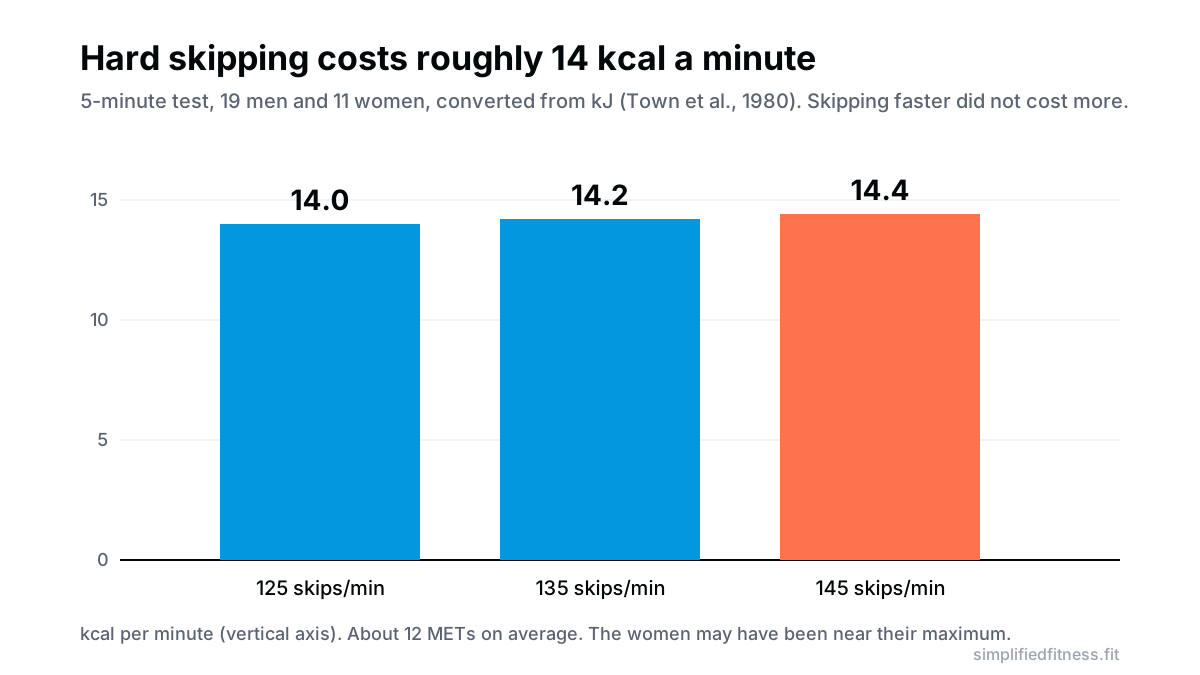
Two reasons not to bank on 14 kcal a minute:
- The authors noted the women may have been exercising close to their maximum. That is an all-out pace, not a steady one.
- Real sessions include rest breaks, tripping and slower rounds, so 10 minutes of intervals will burn less than 10 minutes at that pace.
Also, skipping faster did not raise the cost. Researchers suggested people jump lower as the rate rises, so the work stays about the same.
Need a personal estimate? Plug your weight and time into our calories burned calculator.
Does jump rope help fat loss?
A little, mostly through convenience. The meta-analysis above found improvements in BMI and fat mass compared with controls (Singh et al., 2022), again mostly in young people, so I would not read it as a promise for adult lifters on a cut.
The practical case is simpler. It is a high calories-per-minute activity that fits in a small space, which helps when you are short on time. But fat loss is still decided by weekly energy balance, and the best cardio is the one you can repeat without wrecking your lifting. For the bigger picture, see how cardio fits into a cutting phase.
What is ankle stiffness, and why would a lifter want it?
“Stiffness” here is not tightness or poor mobility. It describes how much the muscle-tendon unit resists being stretched when your foot hits the ground. A stiffer, well-tuned Achilles and arch store and return elastic energy more efficiently, which matters for quick, bouncy movement like sprinting, hopping and boxing footwork. It matters less for slow barbell lifts.
What does the evidence show?
- A 14-week randomized plyometric trial with 19 people found a 35% drop in the Achilles tendon’s dissipation coefficient (less energy lost) and an upward trend in stiffness of 24.1% with no change in tendon cross-sectional area (Fouré et al., 2010). The authors suggested the tendon tissue changed quality, not size.
- A 2022 meta-analysis of 32 plyometric studies in healthy adults reported a moderate effect on tendon stiffness (SMD 0.55) (Ramírez-delaCruz et al., 2022).
- A 2023 meta-analysis found a small effect of plyometric jump training on lower-limb stiffness (ES 0.33), larger in untrained people than trained, and no benefit when programmes exceeded 500 jumps a week (the effect was negative, though not statistically significant) (Moran et al., 2023).
Notice the pattern: these are plyometric studies, not jump rope studies. Jump rope is a lower-amplitude cousin, so it is reasonable to expect a similar but smaller effect. That is an inference, not a measured result.
There is one jump rope trial. In 96 amateur endurance runners, 10 weeks of skipping in the warm-up (2-4 sessions a week, 10-20 minutes a week in total) improved drop-jump reactivity, foot-arch stiffness and 3-km time-trial performance, while the control group did not change (García-Pinillos et al., 2020). Changes in reactivity and arch stiffness were associated with the time-trial gain.
Does jump rope improve footwork and coordination?
Plausibly yes, and this is where it earns its place for boxing-minded lifters. In a trial of 24 junior amateur boxers, 8 weeks of jump rope or plyometrics (30 minutes, 3 days a week) both improved rate of force development in the countermovement jump, punch reaction time and jab velocity, with no difference between the two (Chottidao et al., 2022). Small sample, teenage athletes, so treat it as supportive rather than settled.
The practical gain for a lifter is more mundane: better rhythm, a springier gait, and calves that tolerate impact. If you play cricket, football or badminton on the side, those transfer. If you only lift, they are a bonus.
Skipping does not replace direct calf work. Keep your loaded raises (see standing vs seated calf raises); the rope just teaches the calves and Achilles to handle fast, repeated landings.
Will jump rope interfere with my lifting?
Probably not at modest doses, though no study has tested jump rope against lifting outcomes directly. Here is the relevant context.
A 2012 meta-analysis of 21 studies found that interference from endurance training depends on modality, frequency and duration. Running alongside lifting caused significant decrements in hypertrophy and strength; cycling did not. Higher endurance frequency and duration correlated negatively with strength, hypertrophy and power outcomes (Wilson et al., 2012).
Jump rope is impact-based like running, so the sensible assumption is to keep frequency and duration low and not stack it on top of heavy leg days. This is a cautious inference, not a trial result. For a deeper look at the mechanism, see our article on LISS vs HIIT and muscle preservation.
The most common mistake here is going from zero to 20 minutes of skipping the day before squats. Sore calves will cost you depth and balance under the bar.
Footwear and surface: avoiding shin splints
This is the part most guides skip, and it is where beginners get hurt. Controlled trials comparing jump rope shoes or surfaces are thin, so what follows is practical coaching convention, not trial evidence.
| Choice | Better | Worse |
|---|---|---|
| Surface | Sprung gym floor, rubber mat, wooden floor | Bare concrete, tiled terrace, car park |
| Shoes | Stable, cushioned trainers with flat sole and forefoot padding | Barefoot on hard floor, very soft wobbly runners |
| Rope | Light speed rope at the right length (handles reach armpits when you stand on the middle) | Heavy rope for a beginner, or one far too long or short |
| Style | Small hops, 1-2 cm off the floor | High, bouncing jumps |
In hot, humid conditions, such as an Indian summer, skip early or in an air-conditioned space and drink water. Slippery sweaty floors raise the chance of rolling an ankle.
If you already get shin pain from running or stairs, read our guide to tibialis anterior training and shin splints before adding impact.
A 10-15 minute jump rope protocol for lifters
The research does not hand us a perfect prescription. The runner trial used only 10-20 minutes a week for 10 weeks (García-Pinillos et al., 2020), and the plyometric meta-analysis hints that smaller jump volumes do well (Moran et al., 2023). So the plan below is conservative and illustrative.
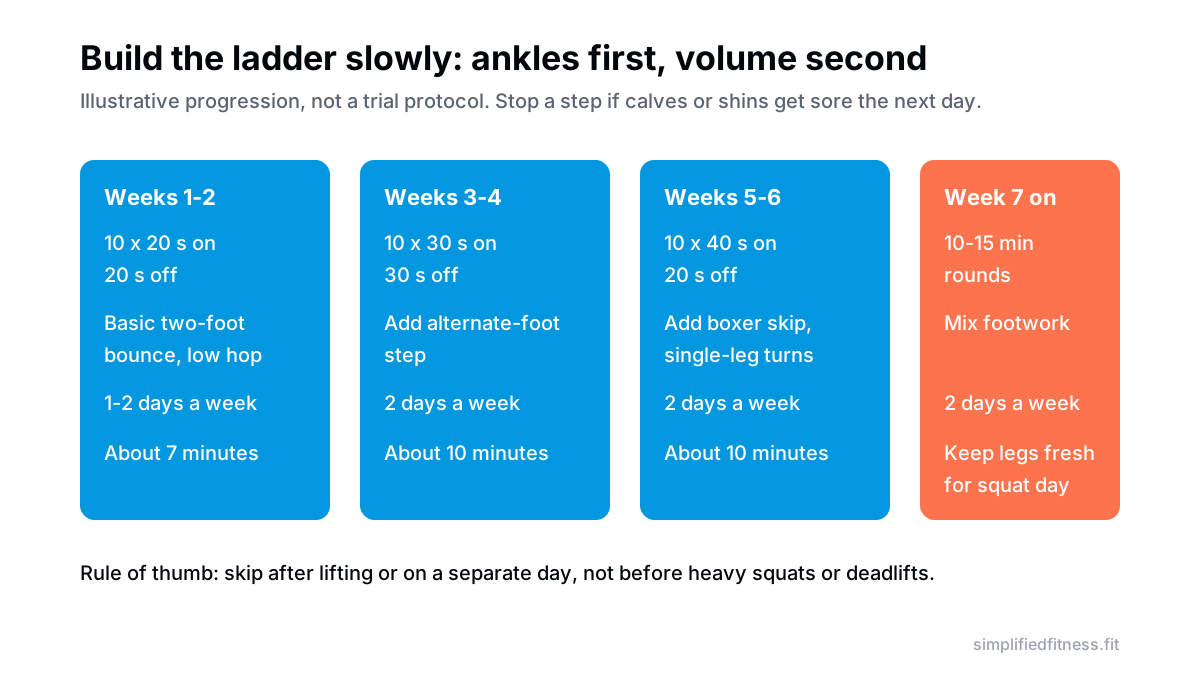
How to use it:
- Warm up for 3-5 minutes with ankle circles, calf raises and easy hops.
- Do the ladder step you are on, resting between rounds.
- Finish with a gentle calf stretch and a few slow bodyweight calf raises.
- Wait a full 48 hours before heavy squats or deadlifts if your calves feel sore.
Want to scale intensity? Use our heart rate zone calculator to check that your rest rounds actually bring your heart rate down.
Where jump rope fits in a lifting week
Here are three common set-ups:
- Finisher: 7-10 minutes after upper-body days. Legs stay fresh for the next lower day.
- Warm-up primer: 3-5 minutes before a session, as in the runner trial, but keep it easy before heavy leg work.
- Separate conditioning slot: 10-15 minutes on a rest day, twice a week.
If you want lower-impact options, see sleds, rowers and air bikes, and for how to build aerobic fitness that supports training quality, see our guide on aerobic conditioning and work capacity. Planning your leg day around it? Check our leg day plan.
Who should skip it or check first
Jump rope is high-impact. Hold off and speak to a doctor or physiotherapist if you have:
- Current or recurring Achilles, shin, knee or foot pain
- A history of stress fracture or tendon rupture
- Significant excess body weight with joint pain
- Balance problems, dizziness or chest symptoms during exertion
Sharp pain, swelling, or soreness that lasts more than a few days is a signal to stop and get it assessed, not to push through. In those cases, lower-impact cardio such as incline walking or cycling is a reasonable substitute.
The bottom line
Jump rope is a cheap, effective way to add conditioning and footwork. The evidence for fitness benefits is decent but comes largely from young people and athletes outside strength training, and the tendon-stiffness data come mostly from plyometric studies. Start small, protect your shins, keep it away from heavy leg days, and treat it as a supplement to your lifting rather than a replacement for it.
Frequently Asked Questions
Is jump rope good cardio for lifters?
Yes, for most healthy lifters it is a time-efficient option. A 2022 meta-analysis of 21 trials found small to moderate gains in cardiorespiratory endurance, fat mass and jumping, though most participants were under 18. Start with short intervals twice a week and see how your calves and shins respond.
How many calories does jump rope burn?
A 1980 lab study measured about 59-60 kJ a minute (roughly 14 kcal) at 125-145 skips per minute, averaging about 12 METs. That was a hard 5-minute effort in 30 people, so a 10-minute interval session with rest breaks will burn less. Use the calories burned calculator for a personal estimate.
Does jump rope build muscle?
Not in any meaningful way for someone already lifting. The 2022 meta-analysis found no significant effect on lean mass or muscle endurance. Treat it as conditioning and footwork practice, and keep your hypertrophy work in the weights room.
Will jump rope hurt my muscle gains or leg day?
Not at modest doses, as far as the evidence goes. A 2012 meta-analysis found that interference from endurance work depended on modality, frequency and duration, with running worse than cycling. Skipping 10-15 minutes a couple of days a week, kept away from heavy leg sessions, is a low-risk starting point, though no study tested jump rope this way.
Does jump rope make your ankles stiffer, and is that good?
Plyometric-style training tends to increase tendon and lower-limb stiffness. A meta-analysis reported a moderate effect on tendon stiffness (SMD 0.55), and a 10-week jump rope trial in runners improved arch stiffness. Stiffer is useful for fast, springy movements, but too much too soon can irritate the Achilles or calves, so build up gradually.
Is jump rope better than running for fat loss?
There is no good head-to-head evidence that it is better for fat loss. Jump rope burns calories at a high rate per minute but is hard to sustain, while running or incline walking is easier to dose for longer. Pick the one you will repeat, and track your weekly weight trend rather than the machine's calorie number.
Can jump rope cause shin splints?
It can contribute, mainly when you do too much too soon on a hard surface. Repeated impact on the lower leg is the usual trigger. Use a forgiving floor, increase time in small steps, and see a clinician if pain is sharp or lasts several days.
What surface is best for jump rope?
A sprung gym floor, rubber mat, or wooden floor is kinder than concrete or tile. Softer, slightly springy surfaces reduce repeated impact, though they are a practical rule of thumb rather than a trial result. Avoid skipping on bare concrete in the gym car park or on a terrace.
What shoes should I wear for jump rope?
Wear cushioned, supportive trainers with a flat, stable sole and some forefoot padding. Heavily cushioned running shoes can feel wobbly, and barefoot skipping on a hard floor is a common way to irritate calves and feet. Choose what feels stable and comfortable for you.
How long should I jump rope each session?
Ten to fifteen minutes of work and rest rounds is plenty for most lifters. A trial in runners used only 10-20 minutes a week in total for 10 weeks and still saw changes in reactivity and arch stiffness. Beginners can start with about seven minutes of short on-off rounds and add time every two weeks if nothing hurts.
Can I jump rope if I am heavy or overweight?
Many people can, but impact load rises with body weight, so a gradual start matters more. Start with low hops and short rounds, or choose lower-impact cardio such as incline walking first. If you have knee, ankle or back problems, check with your doctor or physiotherapist before starting.
Is jump rope the same as plyometrics?
It is a low-amplitude form of plyometric-type training. In a trial of junior boxers, 8 weeks of jump rope and 8 weeks of plyometrics improved lower-body performance and punching about equally. Jump rope is lighter on volume and height than box jumps, so it is a gentler entry point.
How do I start if I keep tripping on the rope?
Tripping usually comes from jumping too high or swinging from the arms. Keep hops tiny, elbows near your ribs, and turn the rope with your wrists. Practise in 20-second rounds until the rhythm is automatic, then add alternate-foot steps.
Sources & References
Every claim above is checked against peer-reviewed research (PubMed, U.S. National Library of Medicine) or guidance from established health bodies. How we fact-check.
- Singh U, et al. Jump rope training effects on health- and sport-related physical fitness in young participants: A systematic review with meta-analysis. J Sports Sci. 2022. PMID: 36121177
- Town GP, et al. The effect of rope skipping rate on energy expenditure of males and females. Med Sci Sports Exerc. 1980. PMID: 7421480
- Garcia-Pinillos F, et al. Jump-Rope Training: Improved 3-km Time-Trial Performance in Endurance Runners via Enhanced Lower-Limb Reactivity and Foot-Arch Stiffness. Int J Sports Physiol Perform. 2020. PMID: 32163923
- Foure A, et al. Plyometric training effects on Achilles tendon stiffness and dissipative properties. J Appl Physiol. 2010. PMID: 20576842
- Ramirez-delaCruz M, et al. Effects of Plyometric Training on Lower Body Muscle Architecture, Tendon Structure, Stiffness and Physical Performance: A Systematic Review and Meta-analysis. Sports Med Open. 2022. PMID: 35312884
- Moran J, et al. The effects of plyometric jump training on lower-limb stiffness in healthy individuals: A meta-analytical comparison. J Sport Health Sci. 2023. PMID: 34033984
- Chottidao M, et al. A Comparison of Plyometric and Jump Rope Training Programs for Improving Punching Performance in Junior Amateur Boxers. Front Bioeng Biotechnol. 2022. PMID: 35685089
- Wilson JM, et al. Concurrent training: a meta-analysis examining interference of aerobic and resistance exercises. J Strength Cond Res. 2012. PMID: 22002517

Umair Hazrami · Founder & Head Coach, Simplified Fitness
Umair Hazrami founded Simplified Fitness and the Simplified Lifter channel to cut through fitness noise. With 4+ years of consistent training and 10+ coaching clients, he writes every guide from the peer-reviewed research and links the sources so you can check them. Our editorial standards.
Educational content only, not medical advice. If you have a medical condition, are pregnant, or take medication, talk to a qualified doctor before changing your diet, supplements or training. Full disclaimer.
Keep reading
Strength & Cardio
Aerobic Conditioning and Hypertrophy: How Work Capacity Improves Inter-Set Recovery
Does better cardio help you recover between sets? See what work capacity resistance training research says, where theory outruns data, and what to do.
9 min read
Strength & Cardio
Can Cardio Cause Muscle Loss? The Calorie and Volume Thresholds Behind the Fear
Does cardio cause muscle loss? Not at normal doses. See what the meta-analyses say about deficits, protein and running volume, and how to protect your muscle.
9 min read

Strength & Cardio
Cardio During a Cut: How Much You Need and When to Stop Adding
How much cardio during cutting phase? Learn the food-first rule, a walking base, sample weekly schedules and signs you are doing too much. Every study linked.
7 min read
Strength & Cardio
Cycling vs Running for Lifters: Which Protects Muscle and Squat Strength?
Cycling vs running for lifters: Wilson's meta-analysis found running, not cycling, blunted gains. We compare it with newer reviews and give a bike plan.
8 min read