LISS vs HIIT for Muscle Preservation: Which Cardio Should Lifters Pick?
LISS vs HIIT for muscle preservation: what meta-analyses show on muscle size, leg strength and fat loss, plus a simple decision flow for lifters.
TL;DR. The short answer
- For most lifters, neither LISS nor HIIT costs meaningful muscle size: a 2022 meta-analysis found no effect of added cardio on whole-muscle hypertrophy (SMD -0.01).
- The real cost of cardio shows up in explosive strength and, in some analyses, leg strength and muscle fibre size, and it is mostly about recovery and how much you do, not LISS versus HIIT as a label.
- HIIT is not clearly worse for muscle in the data. Bodybuilders still lean on LISS because it is easier to recover from, so it protects leg day quality.
- For fat loss, low-volume HIIT and moderate steady cardio produced similar changes in fat mass and lean mass in a 2019 meta-analysis, so pick the one you can repeat.
- Keep hard intervals at least 3 hours away from lifting (ideally another day) and away from the days before heavy legs.
Part of our complete guide: Cardio and Concurrent Training: Build Endurance Without Losing Muscle (The Interference Effect)
Table of contents
If you want the short answer to LISS vs HIIT for muscle preservation: neither one reliably costs you muscle, and the bigger risk is how much cardio you do and whether your legs recover from it. LISS (low-intensity steady state, like an incline walk) is easier to recover from, which is why most bodybuilders default to it. HIIT can work too, in small doses, away from leg day.
This is the head-to-head. For the wider picture of why cardio and lifting sometimes clash, start with our guide to the cardio and concurrent training interference effect.
What are LISS and HIIT, in gym terms?
LISS is easy, steady work you could hold a conversation through: a 30-minute walk on a 8-12% incline, a relaxed spin on the bike, a gentle cross trainer session. Heart rate stays low and so does the strain on your legs.
HIIT is repeated hard efforts with rest between them: 30-second all-out bike sprints, hill sprints, or 4 rounds of hard work at a pace you cannot sustain. It is short, but each effort is expensive for your legs and nervous system.
Both burn calories. They differ mainly in how much they tax you afterwards, and that matters because your recovery budget is shared with leg day.
Is HIIT bad for muscle growth?
The research does not say so, at least not clearly. It is more mixed than the gym folklore suggests.
A 2018 meta-analysis of concurrent HIIT and resistance training found muscle growth was similar to lifting alone, and upper body strength was similar too. Lower body strength increased slightly less (effect size -0.248, p = 0.049) (Sabag et al., 2018).
A 2023 meta-analysis looked closer, at the fibre level. At whole-muscle level there were no significant differences for any comparison. But lifting alone produced more type I and type II fibre growth than lifting plus HIIT (Monserdà-Vilaró et al., 2023). Lifting with only continuous cardio did not show that gap.
Why might these disagree? Different outcome measures (whole muscle versus single fibres), different protocols, and mostly short studies. A 2026 meta-analysis of nine trials (177 participants) on sprint interval training found no significant differences from lifting alone for lower-body strength, upper-body strength, jump or sprint performance, and a clear gain in VO2max (Ferraro-Farro et al., 2026).
The cautious reading: HIIT is not a muscle killer, but there is a hint it may nibble at fibre-level growth, and the studies are small and short.
Does LISS interfere less than HIIT?
This is where the usual claim gets ahead of the evidence. It is true that LISS is easier to recover from. It is not clear from the trials that HIIT does more damage to muscle gains.
The larger question is cardio in general. A 2022 meta-analysis of 43 studies found adding aerobic training to lifting had no meaningful effect on maximal strength (SMD -0.06) or muscle hypertrophy (SMD -0.01). Explosive strength was reduced (SMD -0.28), more so when cardio and lifting were in the same session than when they were separated by at least 3 hours (Schumann et al., 2022).
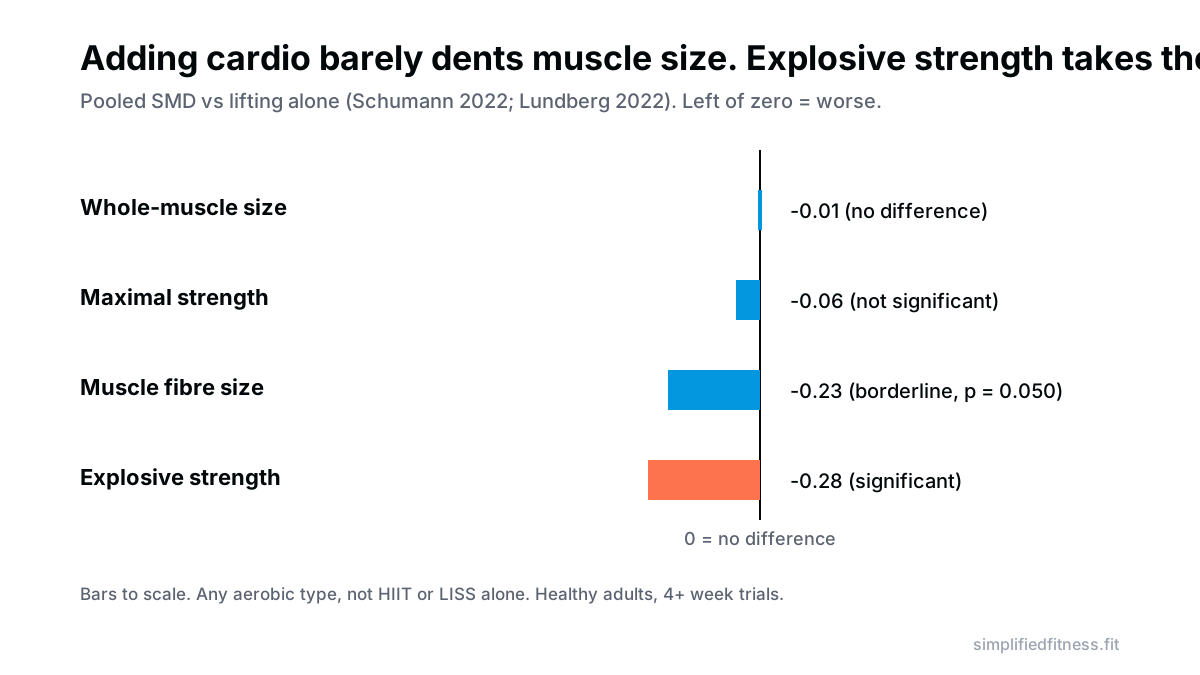
The same group’s fibre-level analysis found a small negative effect on fibre size (SMD -0.23, 95% CI -0.46 to 0.00), stronger for type I fibres when the cardio was running rather than cycling (Lundberg et al., 2022).
Dose matters too. In a 2012 meta-analysis of 21 studies, interference depended on the modality, frequency and duration of the endurance training. Running, but not cycling, was linked to decrements in both hypertrophy and strength, and more frequent and longer endurance work meant worse outcomes (Wilson et al., 2012).
Why do bodybuilders still favour LISS?
It is a recovery argument more than a proven muscle argument, and the idea fits what we know about training fatigue.
- Low leg fatigue. An incline walk or easy spin leaves you feeling fine the next day. Hard intervals, especially running sprints, can leave quads and hamstrings sore and flat.
- Small recovery bill. Your legs are already paying for squats, deadlifts and leg presses. LISS barely adds to that bill, so the next leg session is not compromised.
- Easy to repeat. You can do 20-40 minutes of walking several days a week without needing a day to recover.
- Easy to scale. Add 5 minutes or a little incline when fat loss stalls.
Notice that none of these claims is “LISS preserves more muscle in trials”. The honest summary is that it protects training quality, and training quality is what keeps muscle.
For the incline-walking details (speed, gradient, session length), see our guide to incline treadmill walking for lifters. For cycling versus running, see cycling vs running for lifters.
LISS vs HIIT for fat loss: does the choice matter?
If your goal is to burn fat without losing muscle, the choice matters less than you think.
A 2019 meta-analysis of 47 studies included a comparison of low-volume HIIT (500 MET-minutes a week or less) with moderate-intensity continuous training. It found no difference in total body fat mass, body fat percentage or lean body mass. HIIT did improve cardiorespiratory fitness more (Sultana et al., 2019). The authors concluded that low-volume HIIT is a time-efficient way to build fitness, but not to improve body composition.
A 2025 meta-regression of 23 sprint-interval trials found no overall difference from moderate continuous cardio in fat mass or body fat percentage. It did find that more weekly sprint time was linked to larger fat mass loss, more so in normal-weight people, and the authors suggested SIT may better preserve lean mass, which is a hypothesis rather than a proven result (Liang et al., 2025).
So: HIIT saves time and builds more fitness per minute. Neither clearly wins on fat loss, and your calorie deficit does most of the work. See cardio during a cutting phase for how to balance both.
Incline treadmill vs sprint intervals: a quick comparison
| LISS (incline walk, easy cycle) | HIIT (sprints, hard intervals) | |
|---|---|---|
| Typical session | 20-40 min, conversational pace | 10-20 min, hard efforts with rests |
| Leg fatigue the next day | Low | Moderate to high |
| Effect on whole-muscle size | No meaningful effect found | No meaningful effect found |
| Fibre-level growth | Little to no effect | Slightly lower in one analysis |
| Fitness gain per minute | Lower | Higher (VO2max) |
| Fat loss in pooled trials | Similar | Similar |
| Best for | Frequent sessions, leg days, cutting phases | Time-poor days, away from leg day |
Common mistakes lifters make with cardio
- Treating HIIT as free. It is short, but a hard session can cost you more recovery than a 40-minute walk, so count it as a leg-day-sized stressor.
- Adding cardio and a steep deficit at the same time. When food is low and cardio is high, recovery shrinks on both sides. Change one thing at a time.
- Doing cardio you hate. The best option is the one you will still do in week eight. A boring walk done five times beats a heroic sprint session done twice.
- Ignoring the trend in your lifts. Scale weight tells you about fat loss. Your squat, leg press and hamstring curl numbers tell you whether the cardio is costing you.
Which should you pick? A practical decision flow
Start with how your legs are doing, not with the cardio label.
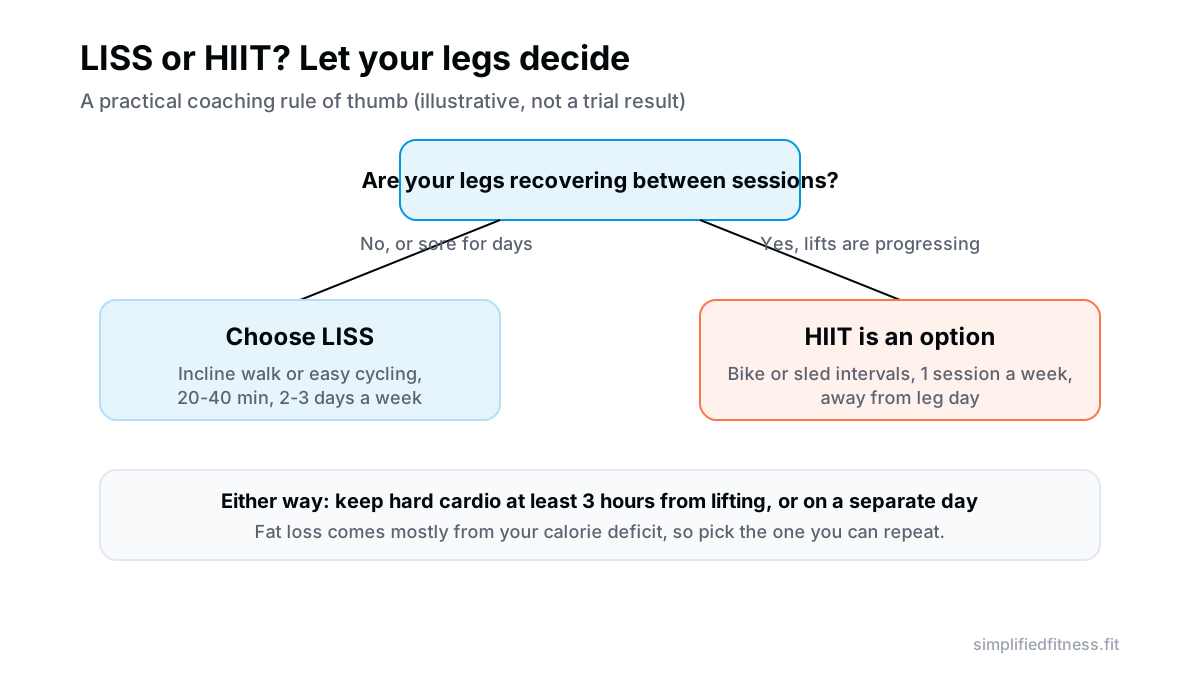
A simple template for a lifter on a lean-out:
- 2-3 LISS sessions of 20-40 minutes. Incline walking at a pace where you could still talk. Use the heart rate zone calculator if you want a number.
- Optional: 1 short HIIT session (for example 6-8 bike sprints of 20-30 seconds) on a day away from legs.
- Track the lifts. If squat or leg press performance drops for two weeks, cut a session or swap the HIIT for LISS.
If cardio feels like it is slowly wearing you down, check your leg session first: our free leg day plan shows a sensible volume to build around.
In hot Indian summers, outdoor sprints add heat stress on top of the effort. An air-conditioned gym bike or a treadmill indoors is often the more recoverable choice, and drink water and take electrolytes (a pinch of salt in water or nimbu pani works) around hard sessions, unless a doctor has told you to limit salt.
When to check with a doctor
HIIT puts a high load on the heart. Stop and get medical advice if you get chest pain, fainting, a racing or irregular heartbeat, or unusual breathlessness. If you have a heart condition, high blood pressure, or have been inactive for a long time, speak with a doctor before starting intervals. LISS is a gentler place to begin.
The bottom line
On muscle size, the evidence says cardio of either kind has little effect when the dose is sensible. On recovery, LISS is the safer bet for leg day. On time, HIIT is efficient. On fat loss, they are similar, so choose the one you will keep doing. The studies are mostly short, in healthy adults, and cannot tell us what happens in a long bodybuilding prep, so use your own lifts as the final check.
Frequently Asked Questions
Is LISS or HIIT better for muscle preservation?
Neither is clearly better in the research, because pooled analyses show added cardio of either type has little effect on whole-muscle size. LISS is easier to recover from, so lifters who train legs hard often prefer it to protect leg-day performance. If your lifts are climbing and your legs feel fine, one short HIIT session a week is reasonable.
Is HIIT bad for muscle growth?
Not in the data we have. A 2018 meta-analysis found concurrent HIIT and lifting produced similar muscle growth to lifting alone, though a 2023 meta-analysis found slightly smaller muscle fibre growth when HIIT was included. Keep intervals short, limited in number, and away from leg day.
Does cardio kill gains?
Usually not. A 2022 meta-analysis of 43 studies found no meaningful effect of added aerobic training on whole-muscle size or maximal strength, though explosive strength was reduced. Large amounts of cardio, poor recovery and a big calorie deficit make it more likely to interfere, so keep volume modest.
Is incline walking or sprint intervals better for fat loss?
Research suggests they end up similar for fat loss. A 2019 meta-analysis found low-volume HIIT and moderate steady cardio gave no difference in fat mass or lean mass, even though the HIIT groups did less total exercise. Pick the one you will do consistently, and let your calorie intake do most of the work.
Which cardio is best for bodybuilders?
Most bodybuilders use incline walking, cycling or an easy cross trainer because they cost little recovery. They add about 2-3 sessions of 20-40 minutes a week and raise it only when fat loss stalls. This is a coaching convention more than a trial-proven rule.
Is running worse than cycling for muscle gain?
Some analyses suggest running interferes more than cycling. A 2012 meta-analysis found decrements in hypertrophy and strength with running but not cycling, and a 2022 analysis found a larger effect on type I fibres with running. A different 2022 analysis found no difference between the two, so treat it as a modest lean toward cycling rather than a rule.
How many days a week of cardio is too much for lifters?
There is no single cutoff, but the 2012 meta-analysis found interference grew with the frequency and duration of endurance work. If your leg lifts stall or you feel flat, cut one session or shorten them. Most lifters do well with 2-3 easy sessions a week.
Should I do cardio before or after weights?
After weights, or on a separate day, is the safer choice for lifters. A 2022 meta-analysis found explosive strength gains were reduced more when cardio and lifting were in the same session than when they were separated by at least 3 hours. If you must do both, lift first.
Can HIIT replace LISS completely?
It can for time, but not for recovery cost. HIIT takes less time and improves cardiorespiratory fitness more than steady cardio in low-volume studies, yet it is harder on the legs and nervous system. Many lifters keep one HIIT session and one or two LISS sessions.
Does HIIT burn more fat than LISS?
Not reliably. Pooled studies find no clear difference in fat mass between sprint interval training and moderate steady cardio, though one meta-regression found more weekly sprint time linked to larger fat mass loss. Total weekly energy balance matters more than the label.
How long should a LISS session last?
Typically 20-40 minutes at a pace where you can hold a conversation. The 2012 meta-analysis linked longer endurance duration to worse hypertrophy outcomes, so more is not automatically better. Start short and add time only if your lifts keep progressing.
Do I need cardio at all if I only care about muscle?
Cardio is not required to build muscle, but it supports heart health and fitness, and may help work capacity. Even sprint-interval-based concurrent training improved VO2max without hurting strength in a 2026 meta-analysis of nine trials. A little goes a long way, so a couple of easy sessions is plenty.
I feel dizzy or have chest pain during HIIT. What should I do?
Stop, and see a doctor before doing more hard intervals. HIIT places a high load on the heart, and chest pain, fainting or unusual breathlessness need medical assessment, not coaching tweaks. If you have a heart condition or have been inactive for a long time, get medical clearance first.
Sources & References
Every claim above is checked against peer-reviewed research (PubMed, U.S. National Library of Medicine) or guidance from established health bodies. How we fact-check.
- Wilson JM, et al. Concurrent training: a meta-analysis examining interference of aerobic and resistance exercises. J Strength Cond Res. 2012. PMID: 22002517
- Sabag A, et al. The compatibility of concurrent high intensity interval training and resistance training for muscular strength and hypertrophy: a systematic review and meta-analysis. J Sports Sci. 2018. PMID: 29658408
- Schumann M, et al. Compatibility of concurrent aerobic and strength training for skeletal muscle size and function: an updated systematic review and meta-analysis. Sports Med. 2022. PMID: 34757594
- Lundberg TR, et al. The effects of concurrent aerobic and strength training on muscle fiber hypertrophy: a systematic review and meta-analysis. Sports Med. 2022. PMID: 35476184
- Monserdà-Vilaró A, et al. Effects of concurrent resistance and endurance training using continuous or intermittent protocols on muscle hypertrophy: systematic review with meta-analysis. J Strength Cond Res. 2023. PMID: 36508686
- Sultana RN, et al. The effect of low-volume high-intensity interval training on body composition and cardiorespiratory fitness: a systematic review and meta-analysis. Sports Med. 2019. PMID: 31401727
- Liang W, et al. Moderators of body composition change in response to sprint interval training versus moderate-intensity continuous training: a systematic review and meta-regression analysis. BMC Public Health. 2025. PMID: 41331926
- Ferraro-Farro D, et al. Does sprint interval training cause interference in concurrent training? A meta-analysis study. Int J Sports Med. 2026. PMID: 41734815

Umair Hazrami · Founder & Head Coach, Simplified Fitness
Umair Hazrami founded Simplified Fitness and the Simplified Lifter channel to cut through fitness noise. With 4+ years of consistent training and 10+ coaching clients, he writes every guide from the peer-reviewed research and links the sources so you can check them. Our editorial standards.
Educational content only, not medical advice. If you have a medical condition, are pregnant, or take medication, talk to a qualified doctor before changing your diet, supplements or training. Full disclaimer.
Keep reading
Strength & Cardio
Aerobic Conditioning and Hypertrophy: How Work Capacity Improves Inter-Set Recovery
Does better cardio help you recover between sets? See what work capacity resistance training research says, where theory outruns data, and what to do.
9 min read
Strength & Cardio
Can Cardio Cause Muscle Loss? The Calorie and Volume Thresholds Behind the Fear
Does cardio cause muscle loss? Not at normal doses. See what the meta-analyses say about deficits, protein and running volume, and how to protect your muscle.
9 min read
Strength & Cardio
Cardio During a Cut: How Much You Need and When to Stop Adding
How much cardio during cutting phase? Learn the food-first rule, a walking base, sample weekly schedules and signs you are doing too much. Every study linked.
7 min read
Strength & Cardio
Cycling vs Running for Lifters: Which Protects Muscle and Squat Strength?
Cycling vs running for lifters: Wilson's meta-analysis found running, not cycling, blunted gains. We compare it with newer reviews and give a bike plan.
8 min read