Cardio During a Cut: How Much You Need and When to Stop Adding
How much cardio during cutting phase? Learn the food-first rule, a walking base, sample weekly schedules and signs you are doing too much. Every study linked.

TL;DR. The short answer
- Most lifters need less cardio on a cut than they think: a daily walking base plus 0 to 3 short sessions of 20-30 minutes is a sensible range, with food intake doing most of the work.
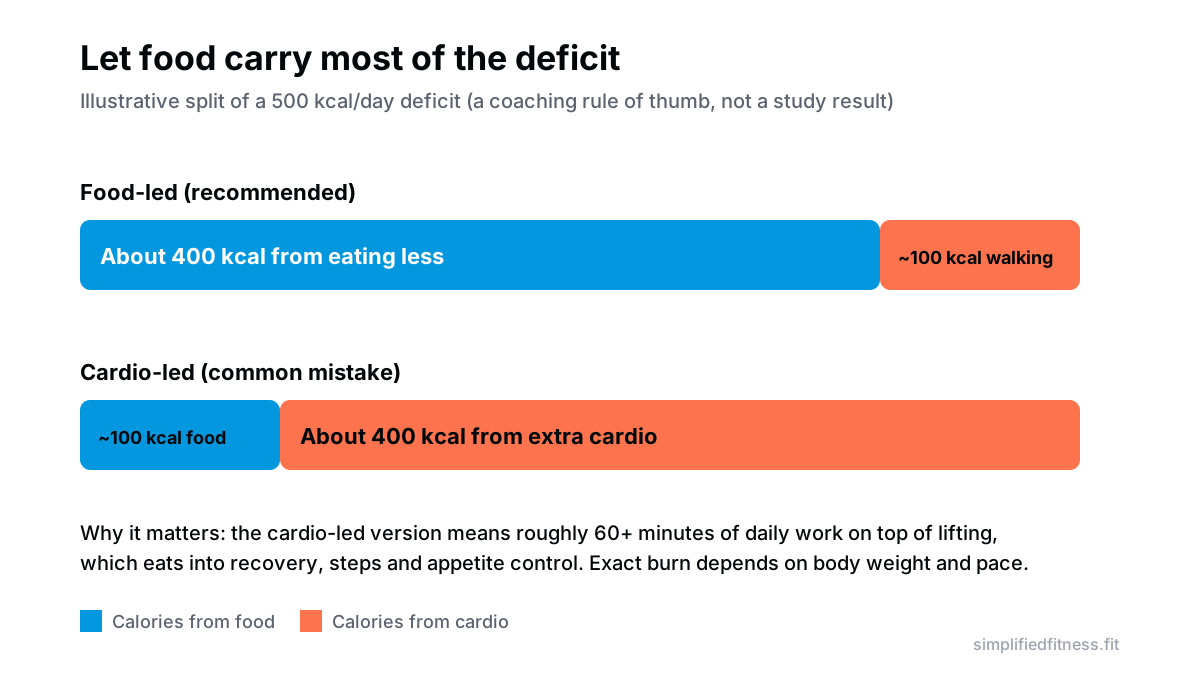
- As a coaching rule of thumb, aim for roughly 80% of the deficit from food and 20% from activity. This ratio is a practical heuristic, not a number from a trial.
- Pushing the deficit past about 500 kcal/day made it harder to keep lean mass in a 2022 meta-analysis of resistance training in an energy deficit, so a huge cardio-driven deficit is a poor trade.
- Your body offsets part of extra exercise, and the offset varies a lot from person to person. Track the scale trend and waist, not calories on a treadmill screen.
- If your lifts are dropping fast, sleep is poor or you feel flat for weeks, cut cardio before you cut food further. Persistent fatigue, dizziness or missed periods are a reason to see a doctor.
Part of our complete guide: Cardio and Concurrent Training: Build Endurance Without Losing Muscle (The Interference Effect)
Table of contents
How much cardio during cutting phase do you actually need? Usually less than the internet says, and this cutting-specific piece of our guide to cardio and the concurrent training interference effect shows why: a daily walking habit plus zero to three short sessions a week, with food doing most of the deficit work. The more you try to burn off on a treadmill, the more you tax the recovery that keeps your muscle.
Here the question is narrower and more practical: where does cardio fit when the goal is fat loss and the lifting has to stay good?
Why does food do most of the work on a cut?
Because it is the lever you control precisely. Skipping a 400 kcal portion of rice and ghee takes seconds. Burning 400 kcal on a cross-trainer takes the better part of an hour, and the machine’s estimate can be well off.
A simple rule of thumb for lifters: aim for roughly 80% of the deficit from food and about 20% from activity. That ratio is a coaching heuristic, not a finding from a trial. What the research does support is the broader logic. A review of contest-prep literature recommends setting calories to produce bodyweight loss of about 0.5-1% per week to maximize muscle retention (Helms et al., 2014). Note that this is set through calorie intake, with training aimed at holding on to muscle.
How big should the deficit be?
Two studies keep the deficit honest.
In a 2011 randomized trial, 24 athletes who all did four resistance sessions a week were assigned to lose weight either slowly (a target of 0.7% of body weight per week) or fast (a target of 1.4% per week; the fast group actually averaged about 1% per week). Fat mass fell by about 31% in the slow group and 21% in the fast group, and lean mass actually rose by about 2.1% with the slower approach while it stayed flat with the faster one (Garthe et al., 2011). These were elite athletes and the groups were small, so treat it as a strong hint, not a law.
A 2022 meta-analysis of resistance training in an energy deficit found that lean mass gains were impaired compared with training without a deficit, while strength gains were comparable. Its meta-regression suggested a deficit of around 500 kcal/day prevented lean mass gains, and the authors conclude that people trying to preserve lean mass should avoid deficits above 500 kcal/day (Murphy and Koehler, 2022).
So a 500 kcal gap is a sensible ceiling to think about, whether it comes from food, cardio or both. If you pile 60 minutes of daily cardio on top of an already aggressive diet, you are not just burning more fat. You are stacking stress.
What does cardio add to a cut, and what does it cost?
Cardio has real benefits: heart health, general fitness, better work capacity between sets, and a modest extra deficit. We cover the health side in our guide to the minimum effective dose of cardio.
The cost is recovery. A 2012 meta-analysis of 21 studies and 422 effect sizes found that interference with strength, size and power depended on the modality, frequency and duration of the endurance work. Running combined with lifting, but not cycling, was linked with significant decrements in both hypertrophy and strength, and longer or more frequent endurance work correlated with worse outcomes (Wilson et al., 2012). The same analysis noted that body fat loss was related to the percentage of maximum heart rate used.
Two caveats. The pooled data come from many different populations, not just trained lifters on a cut. And the interference story is more nuanced than “cardio kills gains”, which we unpack in can cardio cause muscle loss.
When you are already in a deficit, the margin for error shrinks. Sleep, food and fatigue are all tighter, so the same cardio that was harmless in maintenance can start to show up as flat lifts.
Does extra cardio really burn what the machine says?
Often less. This is where the “just do more cardio” plan quietly fails.
A 2018 systematic review of 36 articles (1,561 participants) looked at whether diet and/or exercise reduced non-exercise activity and energy expenditure. Compensation, meaning a drop in that daily background movement, appeared in 26 of 70 intervention arms. It showed up in 63% of diet-only arms, 27% of combined diet and exercise arms and 23% of exercise-only arms. The authors caution that the findings do not firmly support the idea that diets or exercise reliably cut that activity in healthy adults, and that many trials were underpowered (Silva et al., 2018).
In a separate 24-week randomized exercise trial, 48% of participants showed “exercise-related energy compensation”, with total daily expenditure rising about 308 kcal/day less than the energy cost of the exercise prescribed. The researchers found no significant difference in metabolic adaptation in sleeping, 24-hour or resting expenditure between those who compensated and those who did not (Flanagan et al., 2024). In plain words, some people simply end up moving less or spending less elsewhere, and it is not clear this is a slowed metabolism.
A review aimed at athletes adds that energy restriction itself is accompanied by changes in hormones, mitochondrial efficiency and energy expenditure that tend to minimize the deficit and promote regain (Trexler et al., 2014). We go deeper on this in metabolic adaptation and adaptive thermogenesis.
What is a smart way to add cardio on a cut?
Build in layers and only move to the next one when the previous one stops working.
- Fix food first. Track honestly for two weeks. Cooking oil, ghee and tadka are classic leaks, which we cover in hidden calories in Indian cooking.
- Build a walking base. Daily steps cost almost no recovery and add up. Our calories burned calculator gives a rough idea of what a walk is worth for your weight. See also steps versus intense cardio.
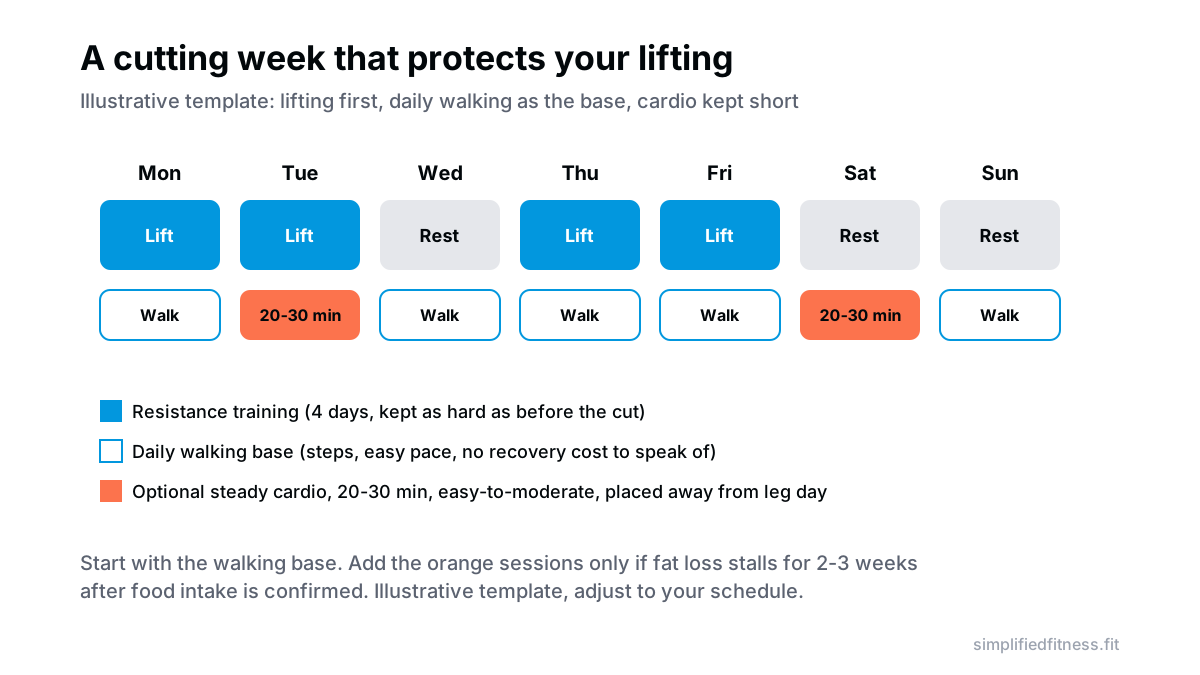
- Add short steady sessions. 20-30 minutes of incline walking or easy cycling, once or twice a week, placed away from your hardest lifting days. Our guide to incline treadmill walking shows how.
- Only then consider more. A third session or a short interval day, and only if fat loss has stalled for 2-3 weeks while your food tracking is solid.
For many lifters, a walk in the cooler morning or evening in an Indian summer is easier to sustain than a treadmill session in a hot gym. Sustainable beats heroic.
Sample cutting cardio schedules
These are illustrative starting points, not prescriptions. Adjust to your height, weight, job and hot-weather tolerance.
| Situation | Daily base | Dedicated cardio | Notes |
|---|---|---|---|
| Starting a cut, lifting 3-4 days | Your usual steps, then add a few thousand | None for the first 2 weeks | Fix food first |
| Fat loss stalls 2-3 weeks, food confirmed | Hold steps steady | 1-2 sessions of 20-30 min easy | Away from leg day |
| Last stretch, lean and tired | Hold steps | 2-3 short sessions, no hard intervals | Watch lifts and sleep |
| Lifts falling, sleep poor | Keep steps | Drop one session | Consider a diet break |
Not sure of your targets? Use our calorie calculator for a starting maintenance estimate, and the heart rate zone calculator if you want easy sessions to stay easy.
What does “too much cardio” look like?
It rarely announces itself. Look for the cluster, not a single sign.
- Your main lifts drop week after week.
- You sleep badly, then wake up unrefreshed.
- Hunger gets louder, not quieter.
- Your mood and motivation flatten.
- Your resting heart rate drifts up (if you track it).
If this happens, trim cardio before you trim food. Protect your lifting intensity and keep volume sensible, which we cover in volume adjustments during a cut. If the deficit is too aggressive, revisit setting an optimal caloric deficit.
When to see a doctor
Cutting should not make you feel unwell. Dizziness, fainting, chest pain, a racing heart at rest, missed periods or an obsessive relationship with food and exercise are not normal costs of getting leaner. Stop adding cardio and talk to a doctor. This article is general education and does not diagnose or replace medical advice.
The practical takeaway
- Set the deficit with food. Keep it modest, in the region of 0.5-1% body weight loss per week.
- Use a daily walking base as your first cardio.
- Add short, steady sessions only when fat loss stalls with accurate tracking.
- Keep lifting hard, keep protein high, and cut cardio before you cut recovery.
The best cut is the one you finish with your strength and your sanity intact.
Frequently Asked Questions
How much cardio should I do while cutting?
Most lifters do well with a daily walking base plus 0 to 3 short cardio sessions of 20-30 minutes per week. Food intake sets the deficit, and cardio only adds a smaller share to it. Start at the low end and add a session only if fat loss stalls for 2-3 weeks.
Is diet or cardio better for fat loss?
Diet is easier to control, because a 500 kcal gap at the table takes minutes while burning the same amount can take an hour. Cardio has real value for heart health and for creating a modest extra deficit. Use food for most of the deficit and cardio to support it.
Can I cut without any cardio?
Yes, fat loss is driven by the energy gap, and many lifters cut with lifting and daily steps only. Cardio is a tool for adding deficit or improving fitness, not a requirement. Keep some regular walking and consider cardio for heart health, which is a separate goal.
Will too much cardio make me lose muscle?
It can if the total deficit and training load outpace your recovery. A 2012 meta-analysis found that the interference with strength and size depended on the modality, frequency and duration of endurance work, with running looking worse than cycling. Keep sessions short, keep protein high and keep your lifting intensity up.
What is the best cardio for cutting?
The best cardio is the one that leaves your legs fresh for lifting and that you will actually repeat. Incline walking and easy cycling are low impact and cost little recovery. Save running and hard intervals for small doses, away from leg day.
How many steps should I walk on a cut?
There is no magic number, but a steady daily step habit is the cheapest way to raise expenditure. Pick a baseline you already hit, then add a few thousand steps and hold it for two weeks. Use a heart rate or calorie tool only as a rough guide, because estimates vary widely.
Should I do cardio before or after weights?
Lift first when strength and muscle retention are the priority, because fatigue from cardio can lower the quality of your sets. Cardio after weights, or on a separate time of day, keeps your heaviest work fresh. Details are in our guide on timing cardio and weights.
Why did I stop losing fat even though I added more cardio?
Your body can offset part of the extra burn by moving less the rest of the day and by trimming expenditure as weight falls. A 2018 systematic review found these offsets in some, but not all, diet and exercise trials. Check your food tracking first, then hold your steps steady before adding more cardio.
How do I know if I am doing too much cardio on a cut?
Warning signs include sinking lifts, poor sleep, constant hunger, low mood and a resting heart rate that creeps up. These point to total stress outrunning recovery. Drop a session, keep steps, and take a diet break or refeed week if it persists.
Does fasted cardio burn more fat on a cut?
It does not change the main driver of fat loss, which is the total energy gap across the week. Some people simply prefer training before breakfast. Choose whatever lets you train hard and recover, and read our fasted vs fed cardio guide for the details.
How fast should I lose weight on a cut?
For lifters, about 0.5-1% of body weight per week is a commonly recommended range for protecting muscle. Slower rates leave more room for training quality, while faster rates tend to cost more lean mass. Weigh daily, average the week and adjust food by small steps.
When should I see a doctor during a cut?
See a doctor if you get dizziness, fainting, chest pain, missed periods, a racing heart at rest or a preoccupation with food and body image that feels hard to control. These are not normal costs of dieting. Do not push through them with more cardio.
Sources & References
Every claim above is checked against peer-reviewed research (PubMed, U.S. National Library of Medicine) or guidance from established health bodies. How we fact-check.
- Trexler ET, et al. Metabolic adaptation to weight loss: implications for the athlete. J Int Soc Sports Nutr. 2014. PMID: 24571926
- Wilson JM, et al. Concurrent training: a meta-analysis examining interference of aerobic and resistance exercises. J Strength Cond Res. 2012. PMID: 22002517
- Helms ER, et al. Evidence-based recommendations for natural bodybuilding contest preparation: nutrition and supplementation. J Int Soc Sports Nutr. 2014. PMID: 24864135
- Garthe I, et al. Effect of two different weight-loss rates on body composition and strength and power-related performance in elite athletes. Int J Sport Nutr Exerc Metab. 2011. PMID: 21558571
- Murphy C, et al. Energy deficiency impairs resistance training gains in lean mass but not strength: a meta-analysis and meta-regression. Scand J Med Sci Sports. 2022. PMID: 34623696
- Silva AM, et al. What is the effect of diet and/or exercise interventions on behavioural compensation in non-exercise physical activity and related energy expenditure of free-living adults? A systematic review. Br J Nutr. 2018. PMID: 29845903
- Flanagan EW, et al. No evidence for metabolic adaptation during exercise-related energy compensation. iScience. 2024. PMID: 38947494

Umair Hazrami · Founder & Head Coach, Simplified Fitness
Umair Hazrami founded Simplified Fitness and the Simplified Lifter channel to cut through fitness noise. With 4+ years of consistent training and 10+ coaching clients, he writes every guide from the peer-reviewed research and links the sources so you can check them. Our editorial standards.
Educational content only, not medical advice. If you have a medical condition, are pregnant, or take medication, talk to a qualified doctor before changing your diet, supplements or training. Full disclaimer.
Keep reading

Strength & Cardio
Aerobic Conditioning and Hypertrophy: How Work Capacity Improves Inter-Set Recovery
Does better cardio help you recover between sets? See what work capacity resistance training research says, where theory outruns data, and what to do.
9 min read

Strength & Cardio
Can Cardio Cause Muscle Loss? The Calorie and Volume Thresholds Behind the Fear
Does cardio cause muscle loss? Not at normal doses. See what the meta-analyses say about deficits, protein and running volume, and how to protect your muscle.
9 min read

Strength & Cardio
Cycling vs Running for Lifters: Which Protects Muscle and Squat Strength?
Cycling vs running for lifters: Wilson's meta-analysis found running, not cycling, blunted gains. We compare it with newer reviews and give a bike plan.
8 min read

Strength & Cardio
Fasted Cardio vs Fed Cardio: Does Skipping Breakfast Burn More Fat?
Fasted cardio vs fed cardio for fat loss: what the trials show on fat burn, muscle loss and cortisol, plus what to eat before a 6am session. Every study linked.
9 min read